Flavor Boulevard

We Asians like to talk food.
Subscribe

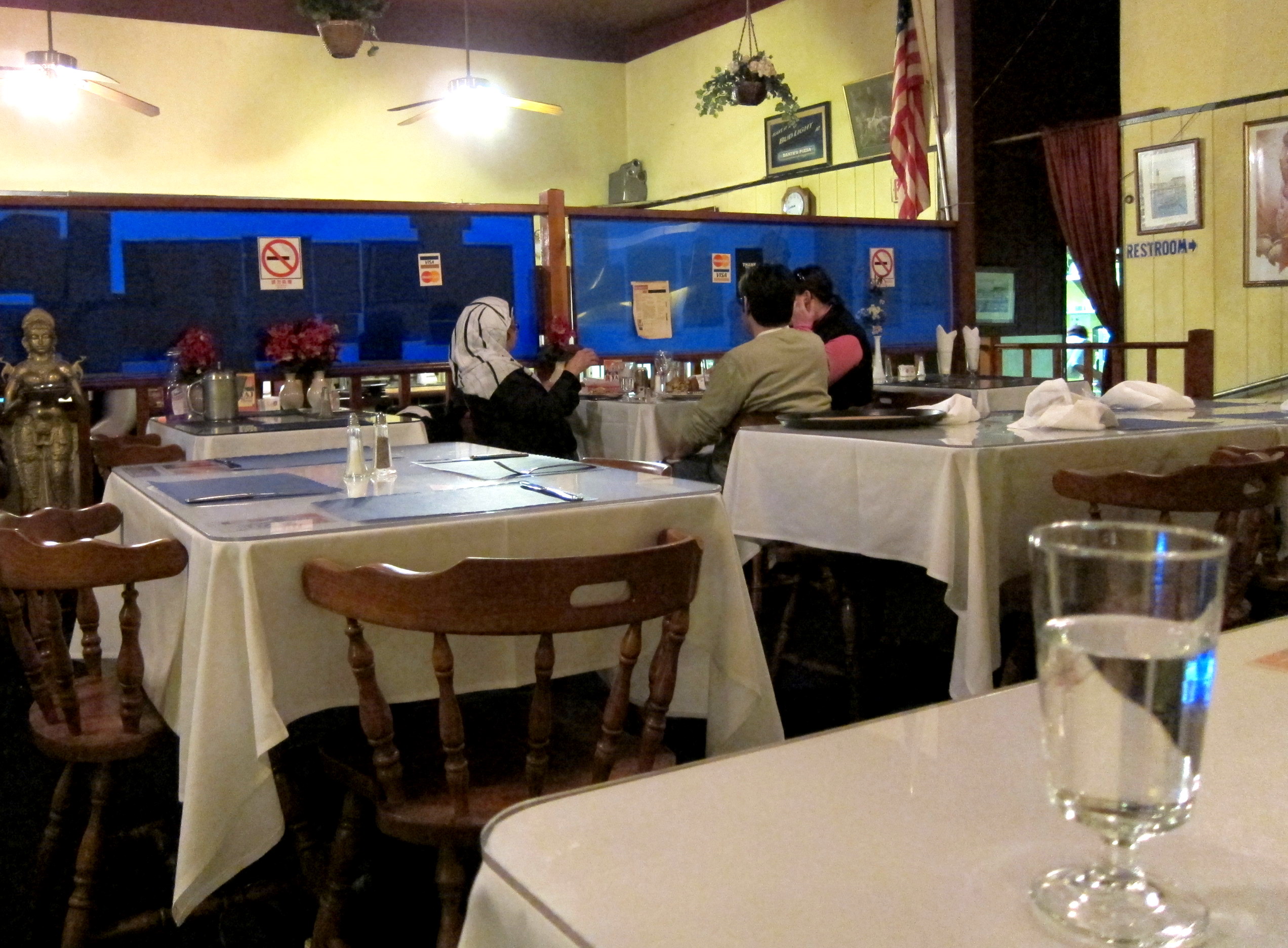
A Green Cafe for vegan cuisine

March 26, 2011 By: Mai Truong Category: California - The Bay Area, Vegan, Vietnamese


The American Vietnamese must not like vegan very much. (And I stress “American” because plenty of places back home specialize in making vegan dishes far tastier than their meat counterparts.) Take Berkeley for example, there’s no Vietnamese vegan diners, but I can think of at least three Chinese ones (Vegi Food, Long Life Vegi House, and Renee’s Place) and a multitude of American’s (like Cafe Gratitude, Herbivore, and Saturn Cafe). Green Cafe in Milpitas is the first Vietnamese vegan restaurant you can find south of Berkeley.


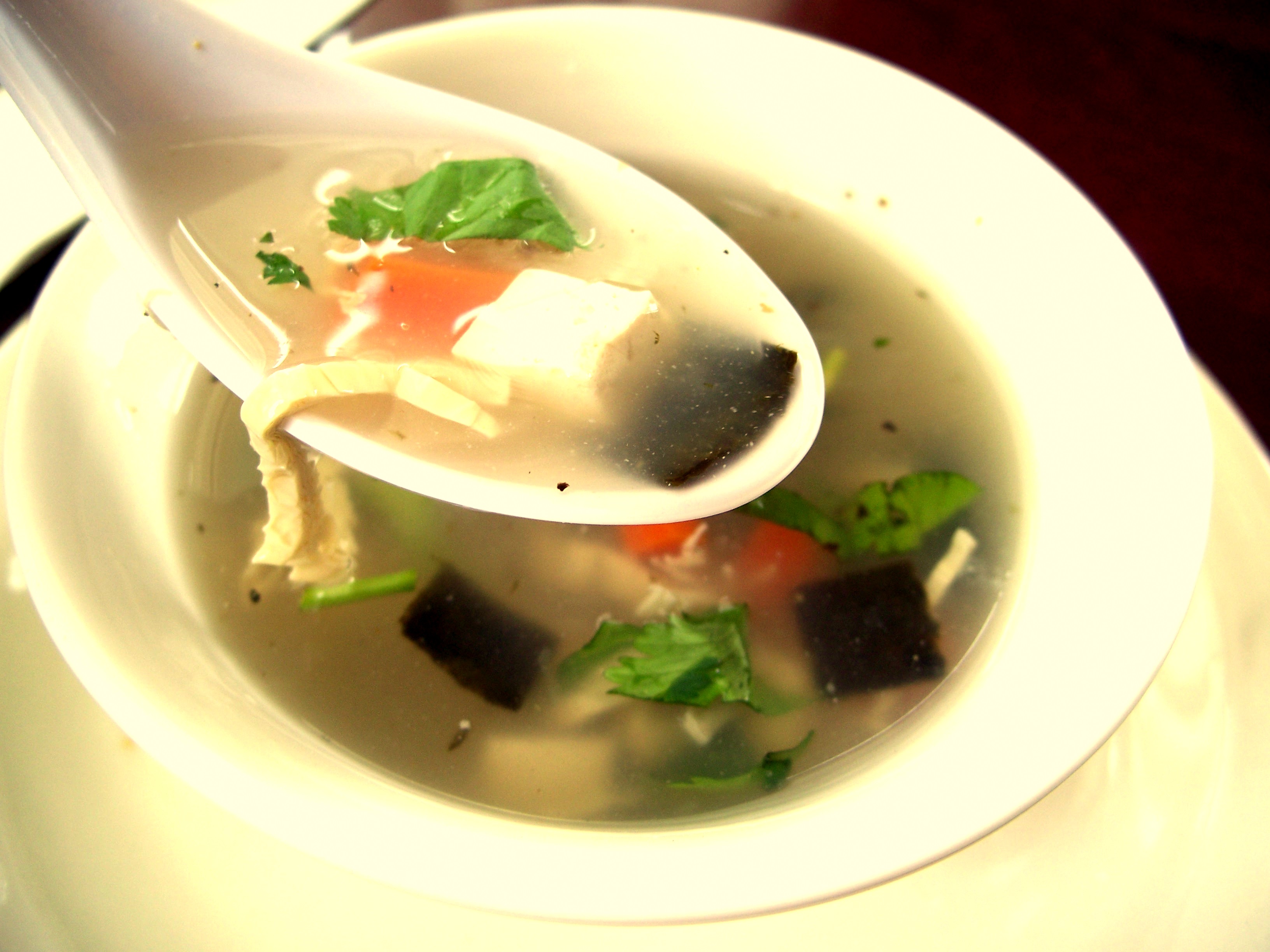
Its good points: there’s an online menu, everything costs under ten bucks, and they give you a free warm-up. The tofu soup has little black squares of dry seaweed and a soothing broth slightly thickened with tapioca starch. The soup isn’t magnificent, but nothing gets the appetite rolling better than a gulp of soup.


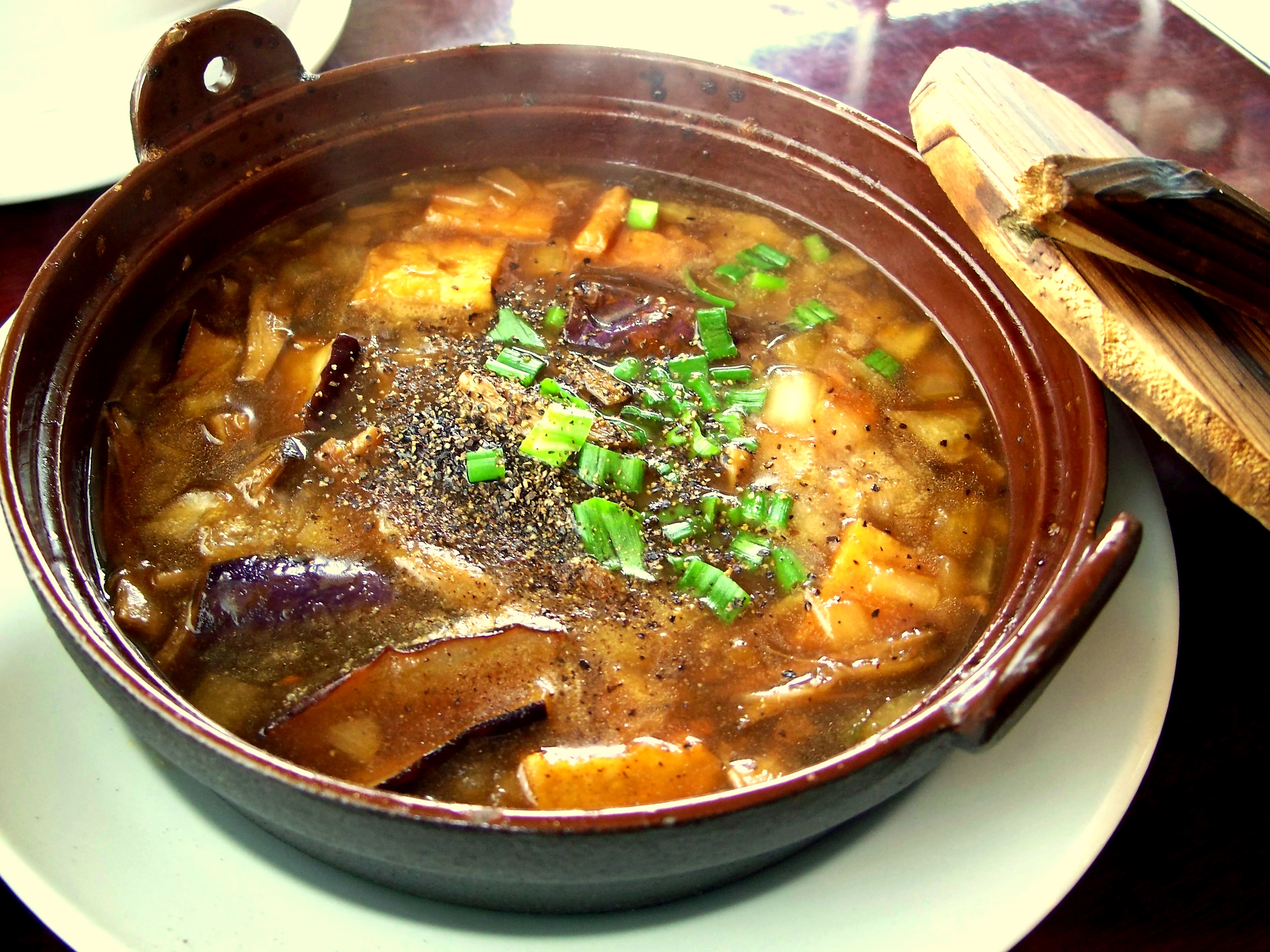
Green Cafe’s fourth good point: no item on the menu has the word “Buddha” attached to its name. Here’s a pet peeve of mine: some people casually name their stuff Buddha this and that whenever their stuff doesn’t have animal. How come I haven’t seen “Jesus steak” or “Krishna delight”? I don’t even see “Washington mix” or any of sort. Just cuz the Buddhists don’t yell at you that it’s offensive to them it doesn’t mean you can commercialize any name as you please. Anyway, Green Cafe doesn’t have any of that on their list, so I eat here in peace. Granted they do have some sequin-sparkling names like “beauty tofu eggplant claypot” or “noble broccoli” (vegan beef and broccoli stir fry). I don’t know if the broccoli is noble, but the eggplant claypot looks as good as it tastes, for eggplant at least. The sauce could use some more salt and sugar and simmering, but the spongy eggplants and mushrooms soak up enough of it to nicely complement white rice.


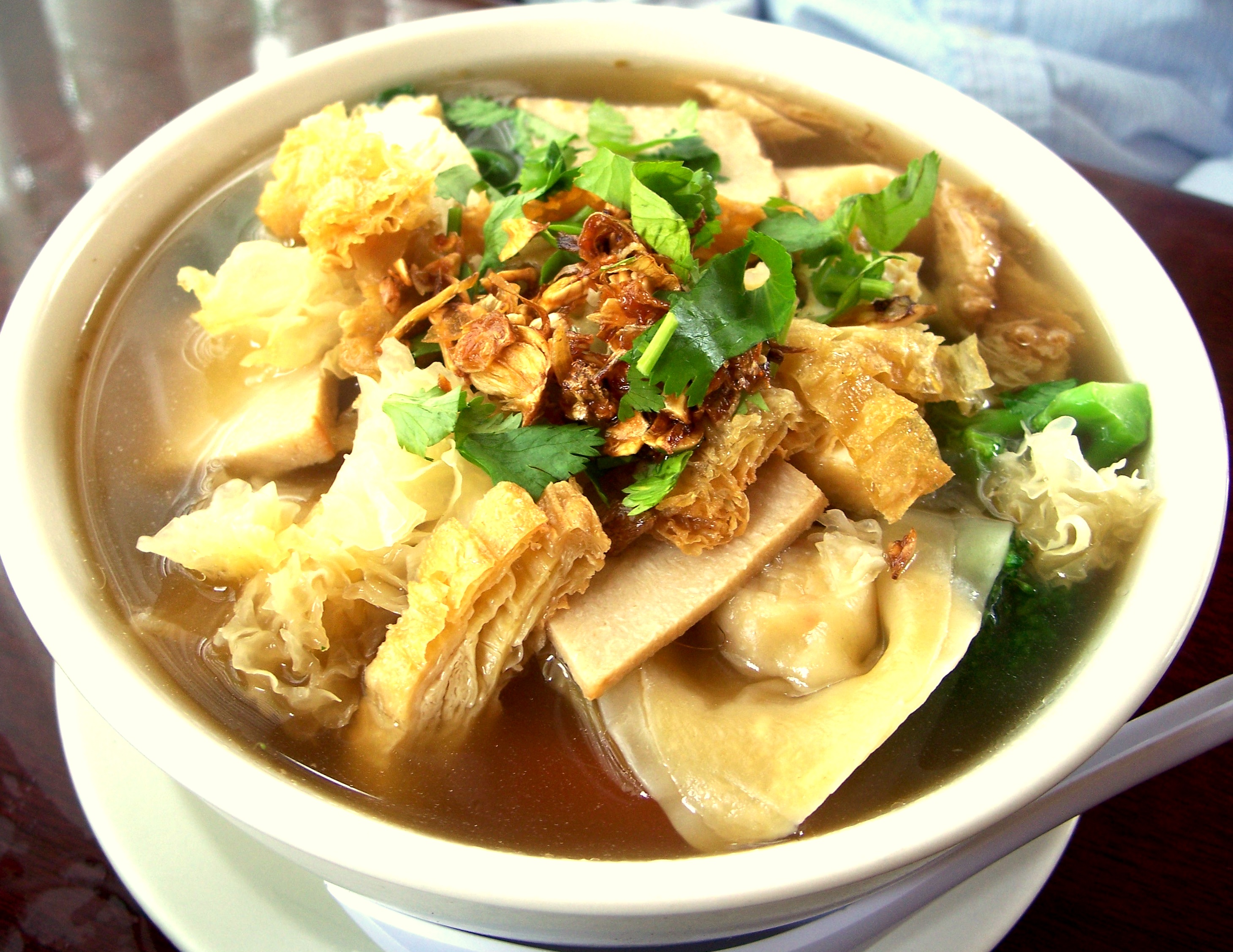
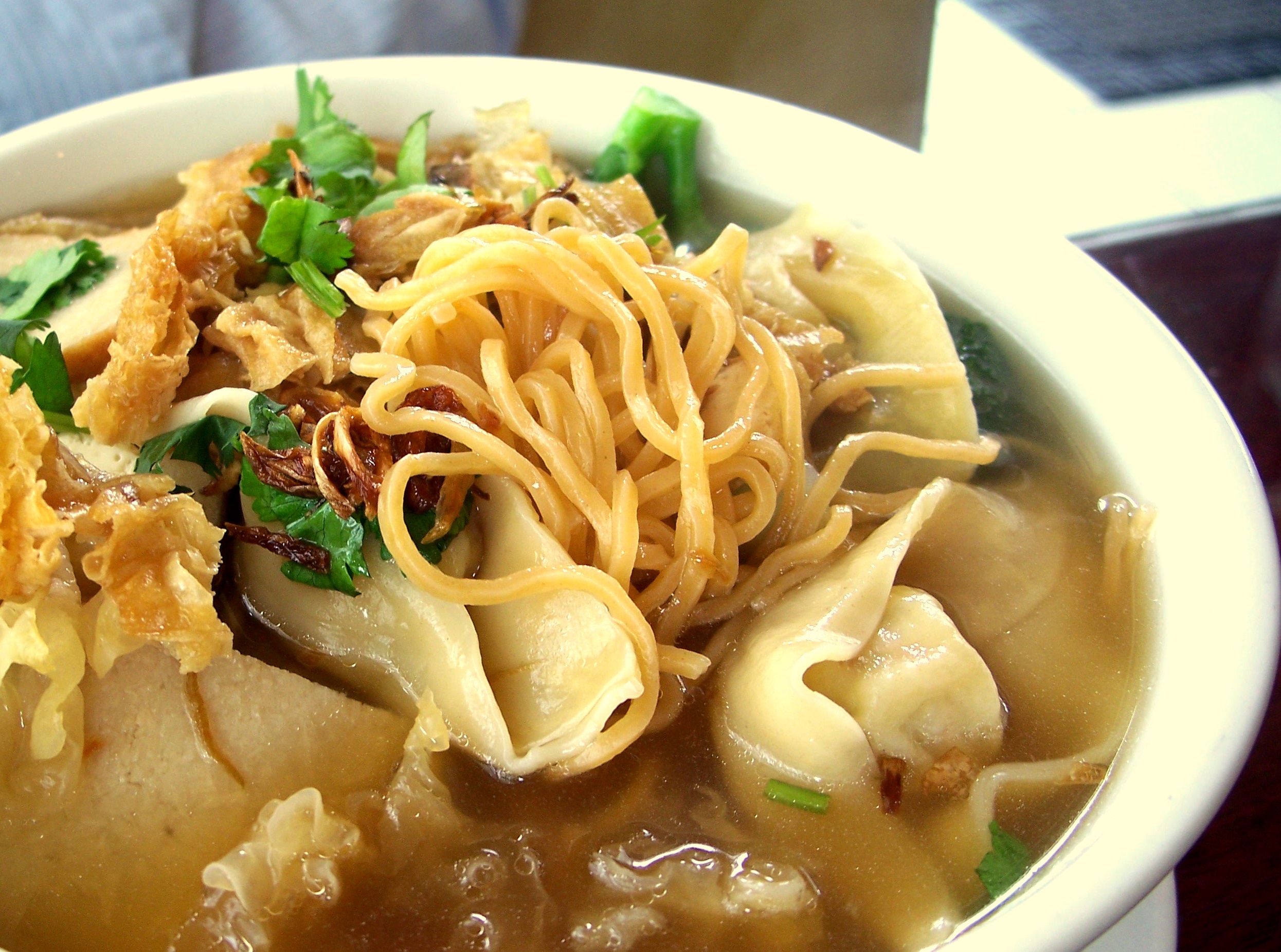
The star of our lunch is the $7.95 wonton noodle soup with soft and flaky fried tofu, snow mushroom, and fried shallot in a sweet broth. If everything on their menu is as good as this soup, Green Cafe would rival Garden Fresh on my list. Or if they have vegan shrimps.

Lunch for two: $19.06

Address: Green Cafe Vegan Cuisine
190 Ranch Drive
Milpitas, CA 95035
(408) 375-8273
http://www.greencafevegan.com/

Tags:

Hương Giang – Savour Huế in Houston

March 23, 2011 By: Mai Truong Category: Central Vietnamese, Houston, noodle soup, sticky rice concoctions, The more interesting


I lost my memory card. If you’re a food blogger too you’d know how devastated I felt: the first advice to a food blogger these days is “good pictures”. Well, the pictures I took at Hương Giang are amazing, they just no longer exist. But, pictures or not, as my professor Lawrence Hall would say in his British tongue, “you can’t stop me,” or in this case, I can’t stop myself from blogging about the restaurant.

Is their food that good? Hương Giang takes a shy, small square in the parking lot at the corner of Bellaire and Boone. If you drive westward on Bellaire Blvd, you’ll see its sign on the left before you reach Hong Kong Market. It’s really a tucked-away place for scoffers, the outlook unimpressive, the sign blue and white like a tired worker shirt. The inside is similar to any average pho joints you’ve seen, wiped clean and plastic cheap. I knew my mom wouldn’t come here if not for blogging’s sake, but in this city it’d be hard to get a menu more Huế than this one.

There are pictures in the menu and printouts taped to the wall to tell you what the specials are. For us it’s a matter of getting what we’ve heard of but not had: gỏi mít tôm thịt, bánh ít ram, cơm hến, and bún suông.

Gỏi mít tôm thịt is jackfruit salad with boiled shrimp and pork, and like other Vietnamese gỏi, it’s served cold with rice cracker (bánh tráng nướng) for shoveling and scooping. The airy blandness of a coal-toasted sesame rice paper elevates the lime juice, the pepper, the cilantro in a gỏi. The kitchen makes a slight mistake by bringing out a plate of gỏi mít hến instead, where the boiled pork and shrimp are replaced by handfuls of tiny basket clams (hến). These freshwater bivalves are connected to Huế like McDonald’s to Americanization. As small as a finger nail, each hến constitutes a second of chewing. As a stir-fried bunch mixed with young jackfruit flesh, the collection feels grainy and humble like a fisherman’s kitchen by the riverside. The color, too, is earthy: blackish-lined ivory hến,  pale brown jackfruit, and a bit of green cilantro.

Cơm hến offers more or less the same atmosphere as the salad, except the rice amplifies the grainy texture in place of the jackfruit’s fleshy blend, no rice cracker presents to break the unanimity, and the hến‘s natural sweetness here isn’t damped by any lime juice. When there isn’t just a few, but at least a hundred of these quiet lives in a bowl of cơm hến, you can’t help but feel the responsibility to treasure each spoonful. It’s the least you can do for the dignity of those tiny freshwater basket clams.

If cơm hến were hamburger, then bánh ít ram would be mac ‘n cheese. It’s not super well known, but anyone who knows Hue food knows this sticky (rice) business. I first learned of bánh ít ram from noodlepie, Ravenous Couple call them fried mochi dumpling (and you really can’t get a better looking picture of bánh ít ram than what the couple styled on their site). Each ping-pong-sized dumpling carries a marvelously inviting look: a plump, shiny round ball on a golden base, cut in half and there snuggle rosy bits of shrimp and char siu pork. Each bite is a step into a river: first soft, then sinking, then hitting the crusty bottom. With or without the mixed fish sauce, savory bánh ít ram, also called bánh ram ít by the natives, is a fair partnership between the steamed bánh ít and the deep fried bánh ram, with each component designed to excite the other. So why is it not as popular as bánh bèo? Because it’s hard to go down the second time. One bánh ít ram is good, two are too many. Ten on a plate, like what we get at Hương Giang, becomes a bloody battlefield.

Thankfully we are a team of three, and we rotates plates to share both the good and the challenging. And thankfully we get bún suông. This noodle soup draws a fine but successful line between being too meaty and being too thin, as it contains both. Ample cuts of chả cá (fish cake, similar to eomuk), chả lụa (silk sausage), and juicy shrimps weave among the angel hair rice vermicelli, all soaked in a slim sweet broth. Bún suông at Hương Giang tastes pure like bún mộc, quite a contrast from the definitions I’ve found online, whose broth is as thick as a deep South accent of the cooks said to invent the noodle soup.

If there are indeed two types of bún suông, the southern style and the Hương Giang style, then I’d choose the latter any day. If the southern style is really the only traditional style, then I’d go to Hương Giang just for their bún suông. You know you can trust a chef who has created something so delicate, so heart-warming, so balanced, and so very Huế.

Address: Hue Huong Giang (near Hong Kong Market)
11113 Bellaire Boulevard
Houston, TX 77072-2607
(832) 328-1308

Money matter:
gỏi mít hến (6.25) + bánh ít ram (6.50) + bún suông (6.50) + cơm hến (8.50)
= $27.25 a big lunch for three

Sweet and spicy Zante’s Indian pizza

March 21, 2011 By: Mai Truong Category: California - The Bay Area, Comfort food


I can eat rice for every meal every day without getting tired of it (with perhaps an occasional craving for noodle soups or a burger). Why? Because rice is a solid starch base upon which you can mount anything and they’d go together just like that. Meats, seafood, vegetables, fruits, other starchy stuff. The closest thing to rice that wheat can do is the pizza. I wouldn’t eat pizza everyday because it always makes me cry for water like a beached whale. But everything goes on pizzas, too. Even curry. Spot on, Zante.


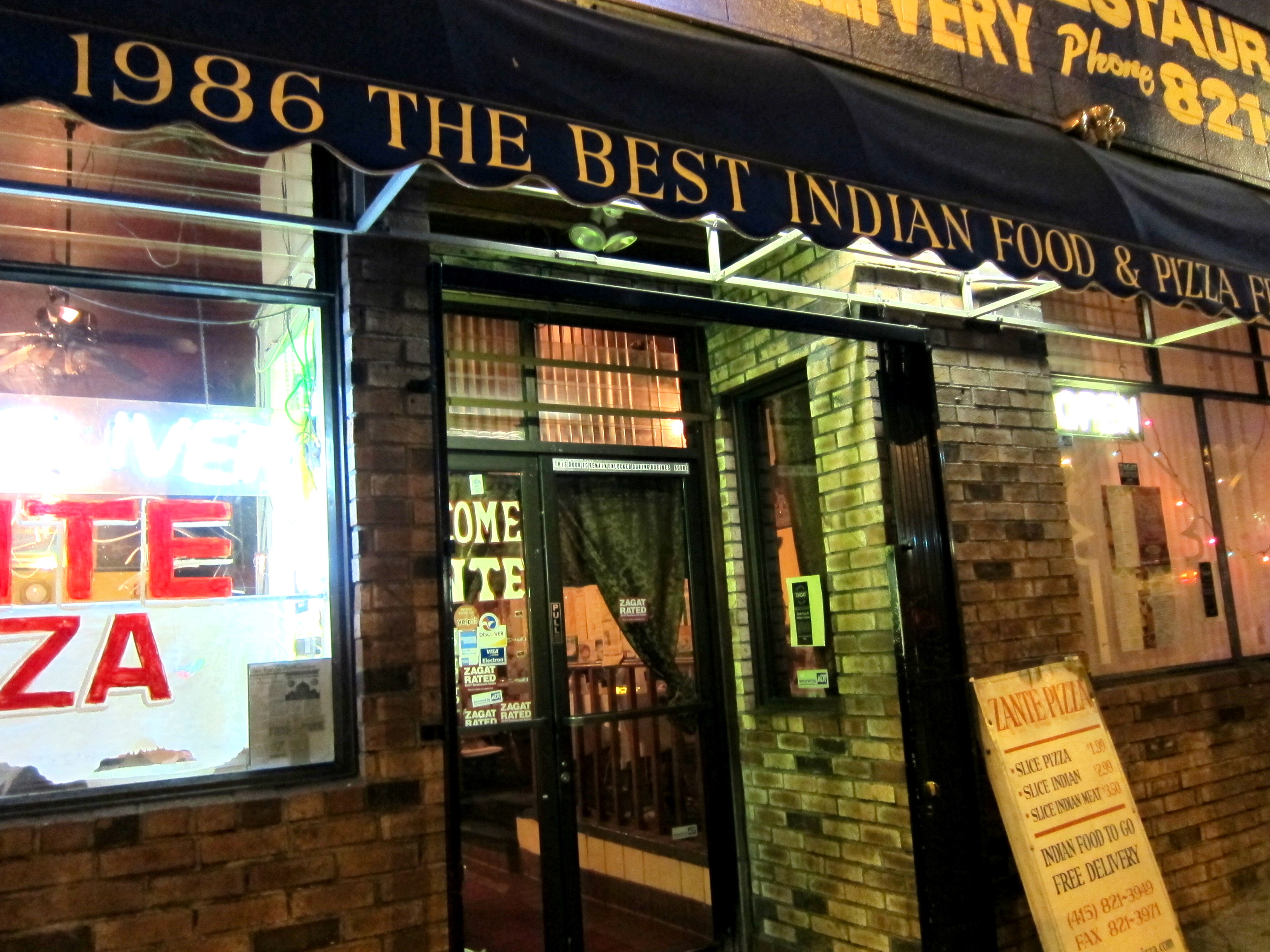
I don’t know how Mudpie knew of this cozy kitchen on Mission Street, but we went there right after I got off the plane from Puerto Vallarta. The combination of “Indian” and “pizza” sounds like comfort on a drizzling January night. Besides, I have a thing for old brick buildings, and the number 86.


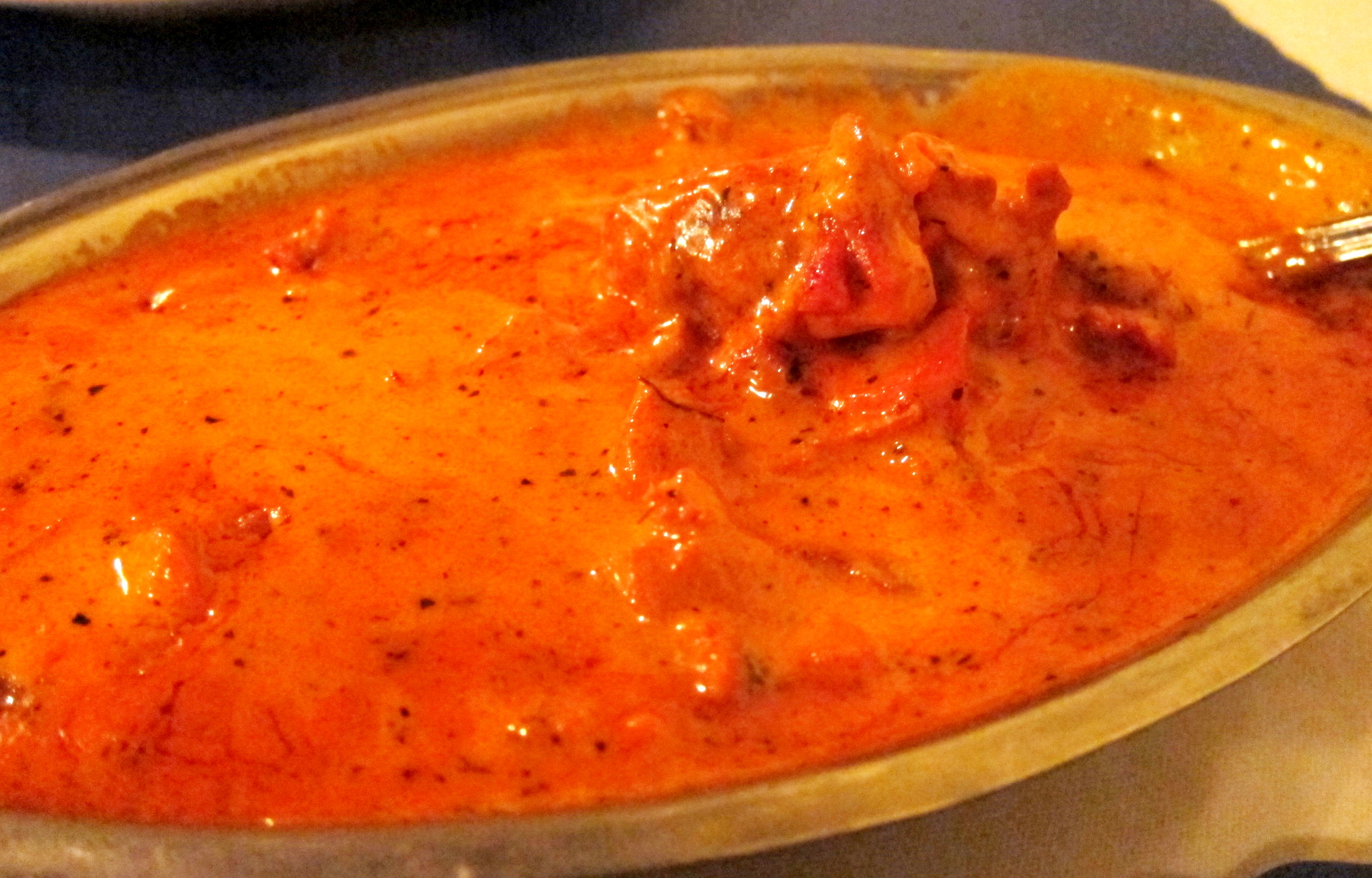
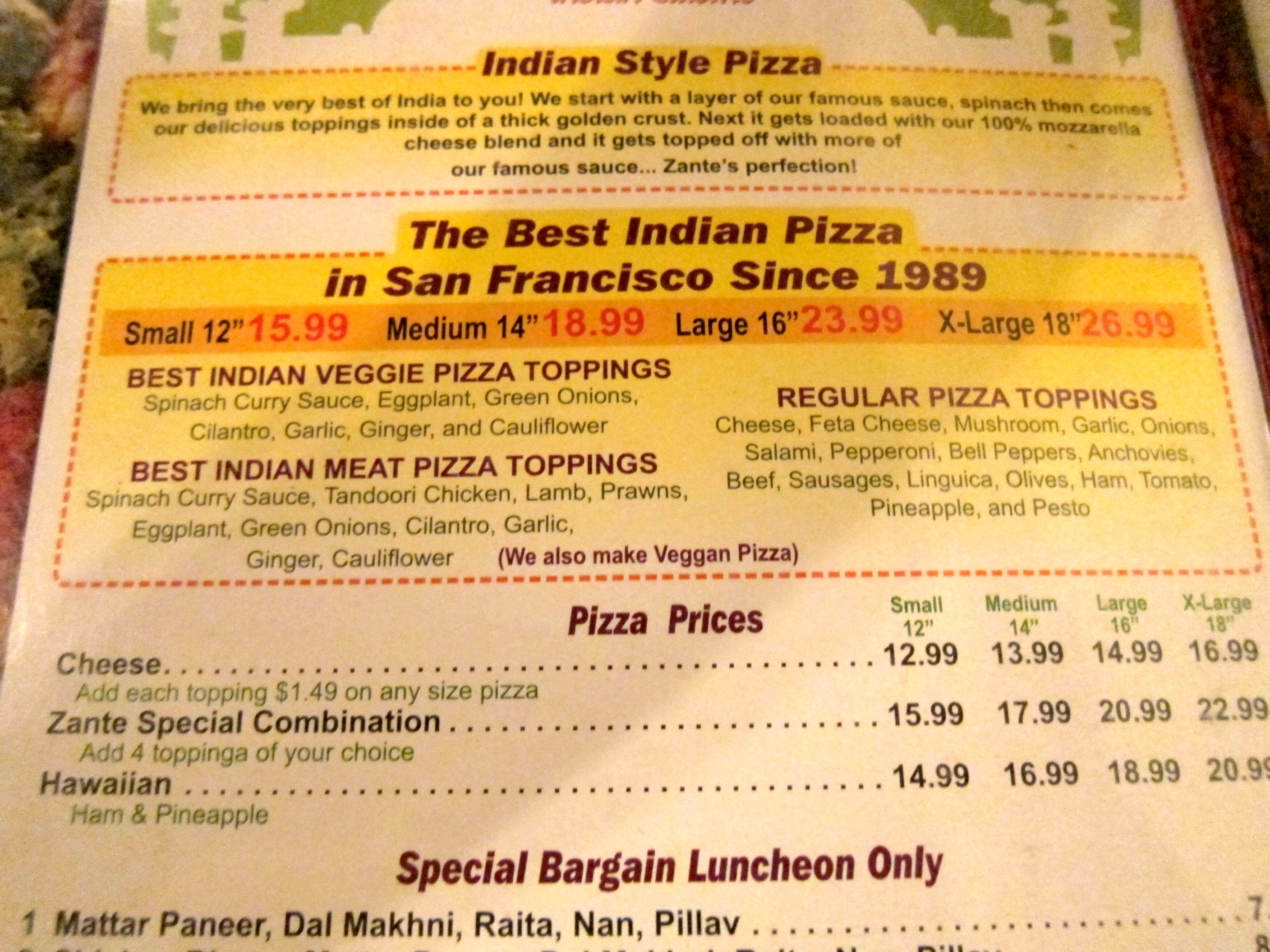
Though the printed menu is much easier to flip and read than the online menu, we still took a while looking for something new and appealing from the maze of flat breads and meaty dishes (and vegetarian dishes, but I won’t go there), mainly because we were looking for non-spicy food. The kabulinan (roti with raisins and nuts) was a sure bet, sweet, chewy, crusty at the edge, and filled with coconut shreds in and out. The chicken makanwala, though good, didn’t deliver much news. I couldn’t sense any difference between this thick orange sauce and the chicken tikka masala‘s thick orange sauce at Biryani House.


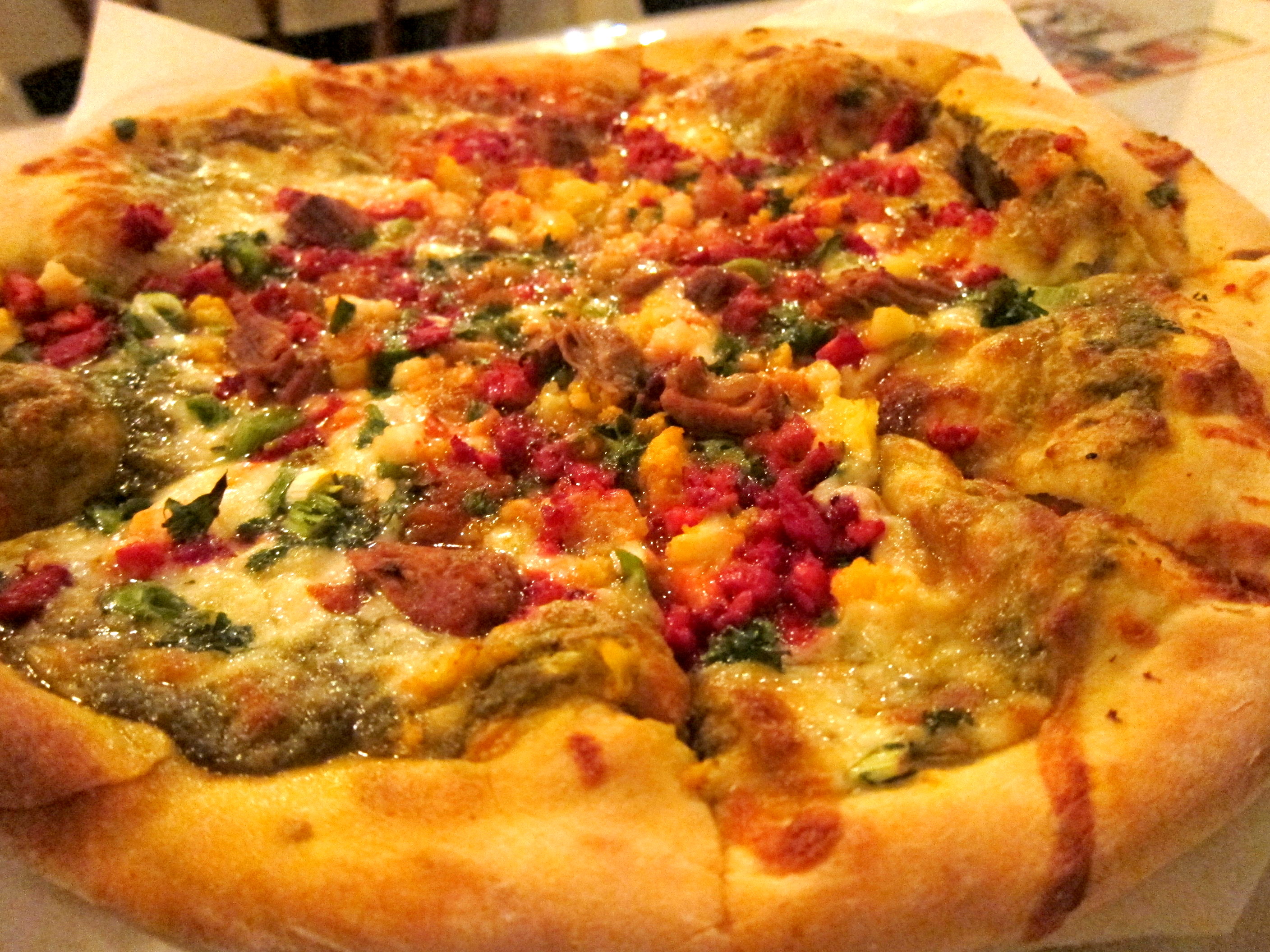
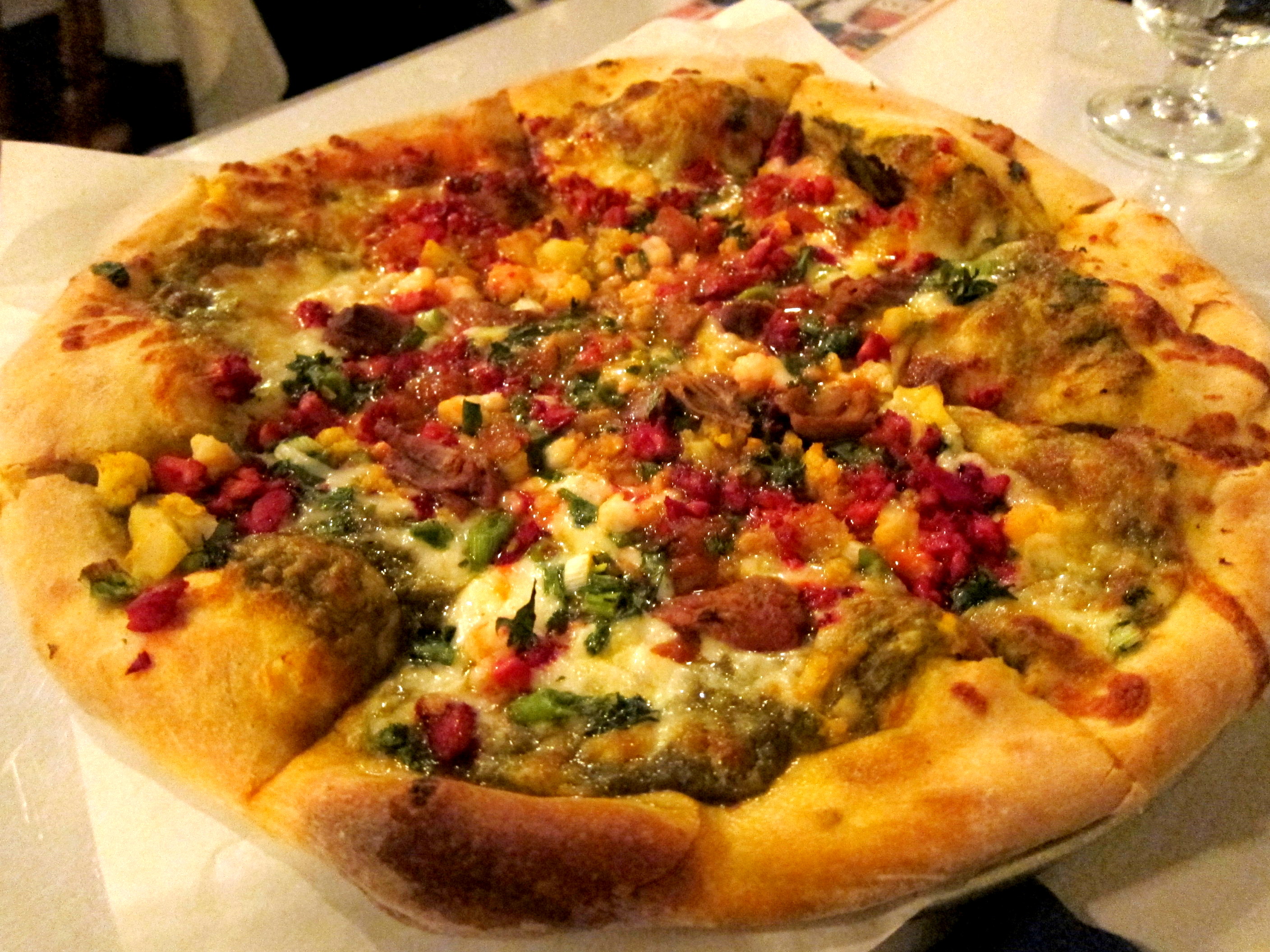
We also got the special pie of course. Tandoori chicken and cilantro make up a mosaic of red and green dots; though the prawns are included in the menu listing, I can’t see any curled up in the pictures here. Well who really sits down and checks every ingredient on a slice anyway. Point is, spinach curry sauce finds its rightful place on a bed of baked dough, and the Indian pizza at Zante is at least as good as any artistic assortment from the Cheese Board that Berkeleyans always chirp about. If you ask me, I think Zante‘s are better, cuz they got meat and no hype.


Address: Zante Pizza
3489 Mission Street
San Francisco, CA 94110-5438
(415) 821-3949

Money matter: $32.55 a dinner for two.

Mom’s cooking #2: Sizzling the Vietnamese steak (bò bíp-tết)

March 19, 2011 By: Mai Truong Category: Comfort food, RECIPES, Vietnamese

Guest post by Mom, translated by me


My little family has three people, and two of them like beef. Ever since we settled in Texas, the land of cheap, good beef, my husband and daughter almost always order something cow related when we go out, even as they love these loving-eyed animals when they’re alive and grazing the fields too. Sometimes I join them in forking red meat, and of those few occasions the American steak does not quite sing to me, but rather they sink a little hard and a bit salty. I guess the blame lies with either the meat quality or the cooking method, and mostly the latter.
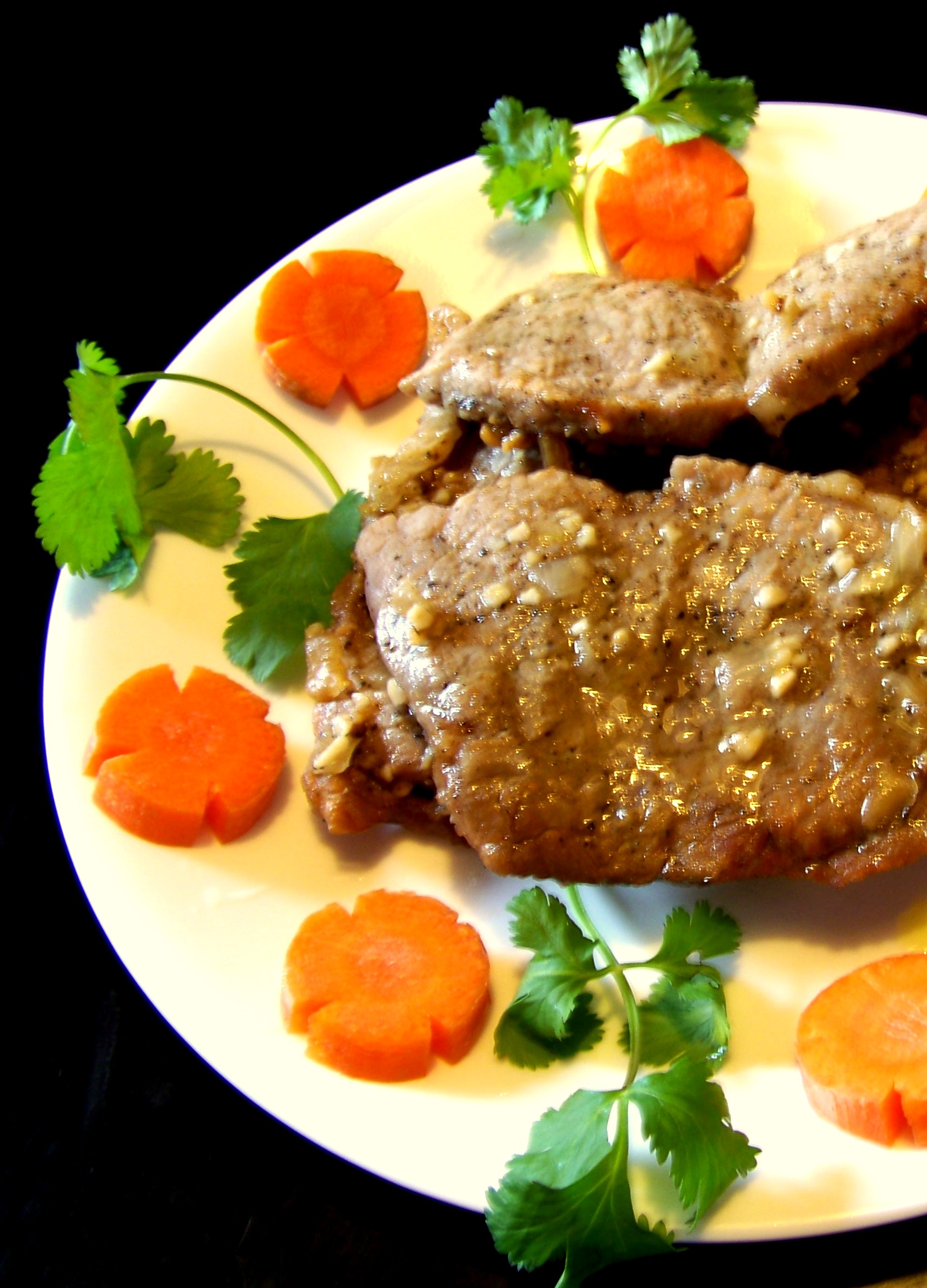
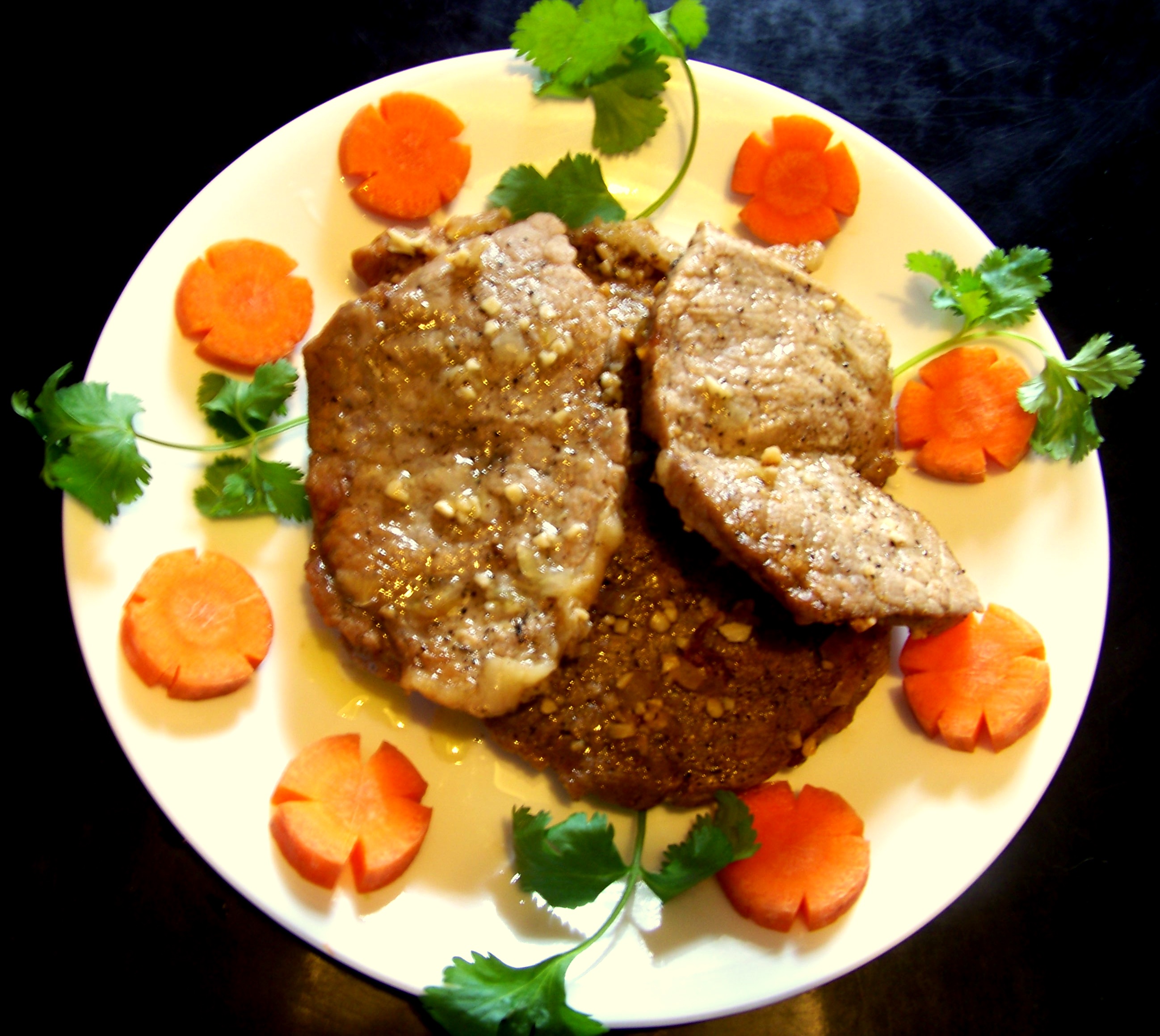
So I buy some steak fillet and try out the way we used to make back in Saigon. I slice ’em thin, marinade and fry, and not trying to toot my own horn here, but my steak is better than them restos’ steaks. 😛 Even Mai’s dad agrees. Its first highlight is the tenderness: it’s so tender I can bite it off with my teeth, who needs the knife and elbow grease to butcher that poor fillet. Its second highlight is the mouthwatering fragrance of garlic, onion, and pepper infused in every strand of muscle. Its last highlight, and also my principle of cooking, is that it doesn’t take long to make.


Vietnamese Steak (bò bíp-tết)

Ingredients:
– 1 lb beef filet
– 1 tbs chopped garlic
– 3 cloves of fresh garlic, smashed to flatten
– 4 purple onions, or half a sweet onion, chopped
– 2 tsp sugar
– 1/2 tsp salt
– 1/2 tsp pepper
– 2 tbs olive oil

Wash the filet, cut into slices of roughly 1 cm (1/3 inch) thick. Marinade the beef with chopped garlic, onion, sugar, salt, and pepper for an hour.
In a skillet, heat up oil on high heat. Throw in the three smashed cloves when the oil is really hot, wait until the garlic turns golden and smell good to add the beef.
Fry the beef slices for about 1 minute, flip over, and fry another 1 minute. Turn off heat and the meat is done.

We eat ’em hot with homemade fries and broccoli. This combination of Texas beef and Vietnamese cooking suits those who don’t have much time (or don’t really like meticulous labor in the kitchen), like me, best.

Candied cà-na (white canarium or Chinese olive)

March 12, 2011 By: Mai Truong Category: California - The Bay Area, Fruits, One shot, Southern Vietnamese, sweet snacks and desserts, The more interesting


It’s not the black stuff they throw on your pizzas or the green thing they toothpick on your sandwich. How many of us city kids have tasted the tartness with a tiny sweet afterpunch of this Mekong delta fruit? It’s addictive like fresh squeezed orange juice on a summer day. Speaking street tongue, it’s nature’s crack in oblong shape.

Eat ’em fresh with chilipepper salt, or candy them with sugar and heat, it’s how kids down South do it with the cà na they shake off from bushes on the riverbanks. And argue if you may, kids know tasty food. The shape is really the only link cà na has with the Western olive (Olea europaea), though it’s at least two times bigger. Does the name “cà na” mean anything?

“Cà” is tomato, and “na” is the northern word for sweetsop, two totally unrelated species to this ovoid fruit. So “cà na” is not a compound noun. I’m no etymologist but here’s my best guess: “cà na” |kah nah| is a shortened vietnamization of the Thai word “kanachai”, from which cultigen taxonomists derive the the scientific name “canarium”, a genus with about 75 species native to the tropics. The cà na we eat and love from those riverbank bushes belongs to the species Canarium nigrum (black canarium) and Canarium album (white canarium), or “trám đen” and “trám trắng” in pure Vietnamese. Another delta variety is Canarium subulatum, pointy at both ends and sappy like green bananas.

Words on the net claim that cà na‘s acidity is good when you have a cold, drink too much, or wants to lower your weight, thus not so recommended for skinny sticks like me. I’ve never popped a fresh one myself, but this is the most (and only) mouth-watering description I could find on the net (translated from the Vietnamese original):

Every year, in roughly August or September, when the Mekong flushes the paddy fields, the cà na trees bear their first fruits. What could be better than rowing a canoe downstream, then tying it to a cà na trunk base by the riverbank to cast your fishing net, and while waiting, dip a bursting green ripen fruit into chilipepper salt to soak your soul with its wild and clean sweetness?


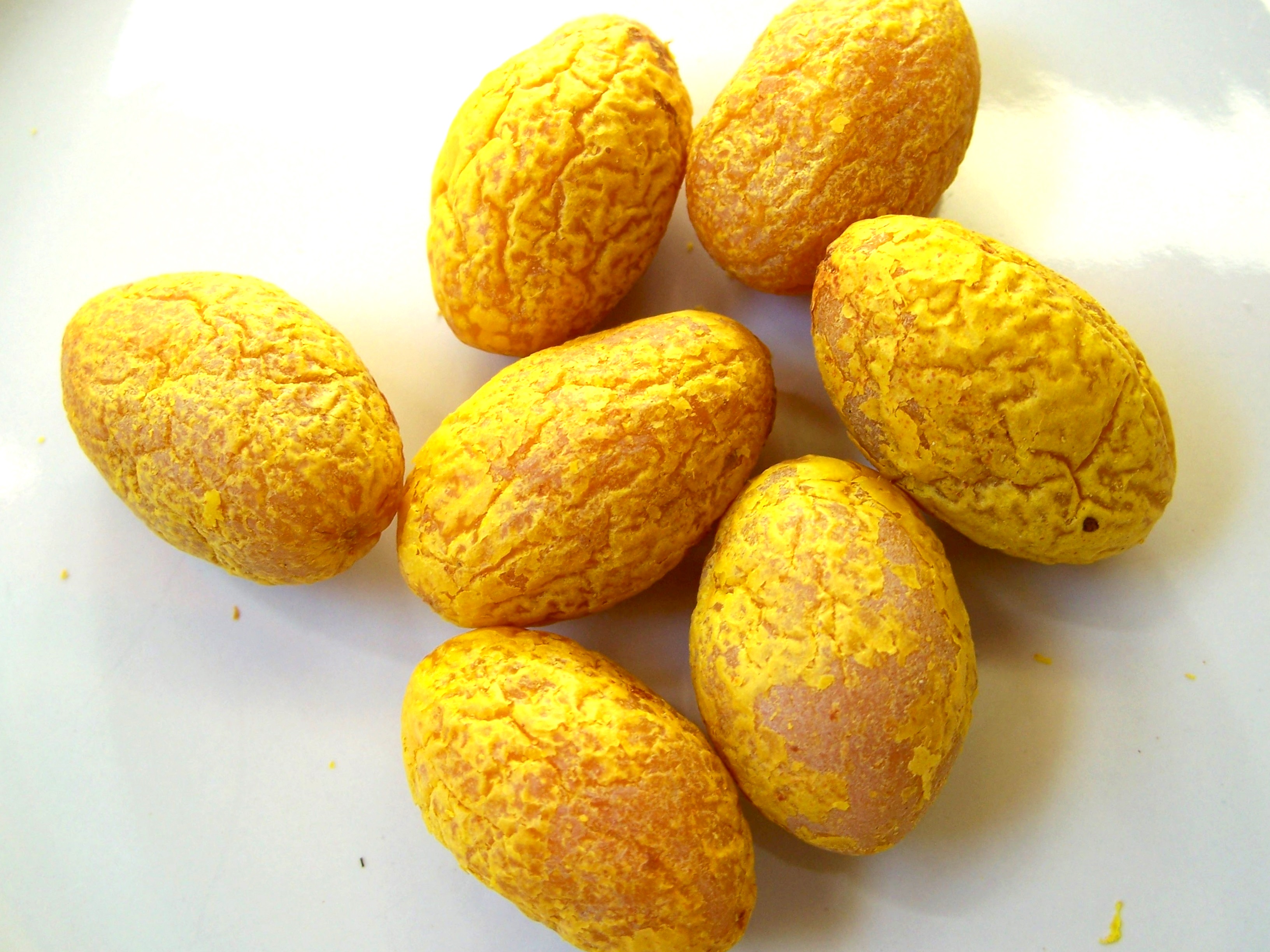
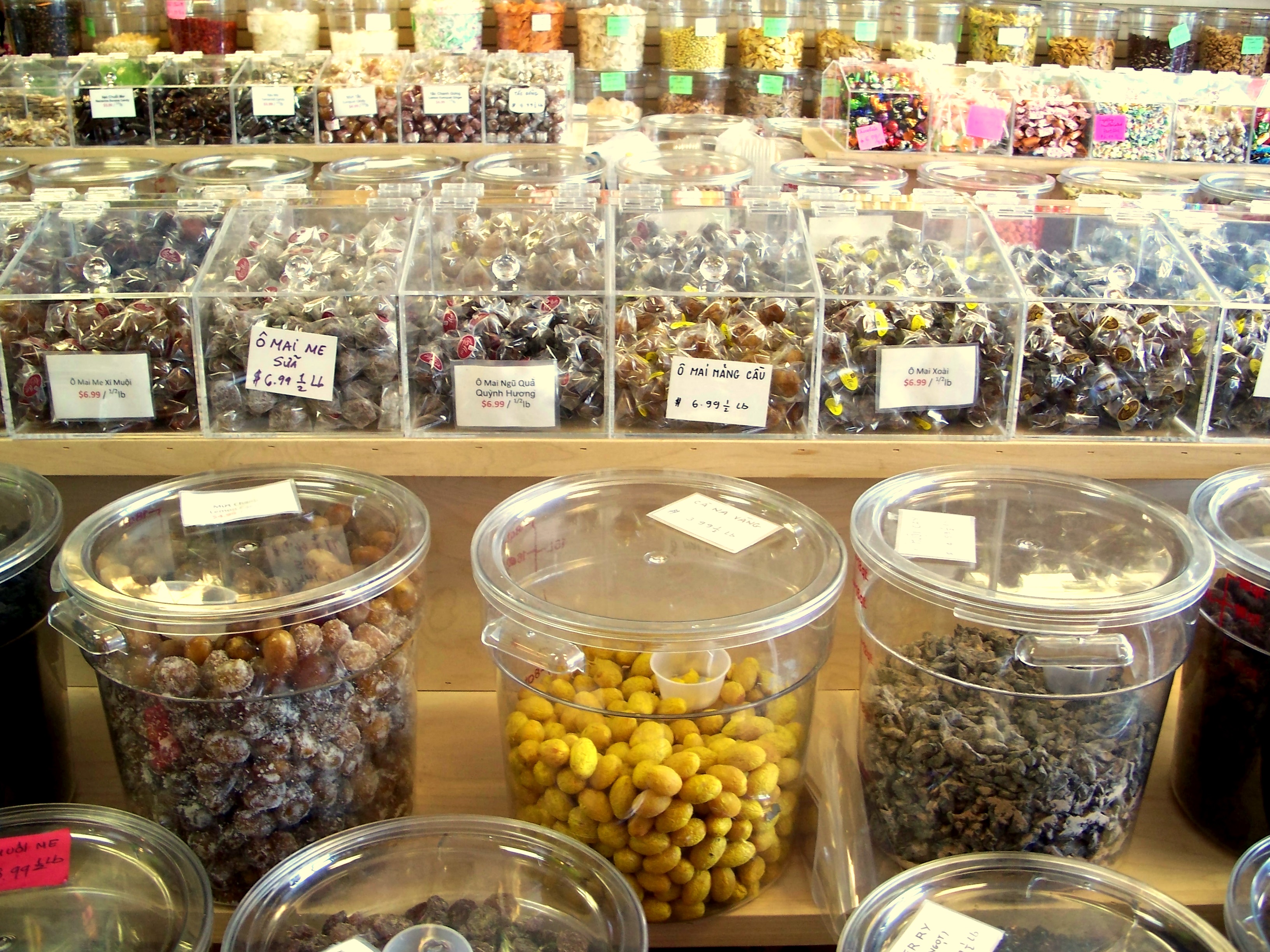
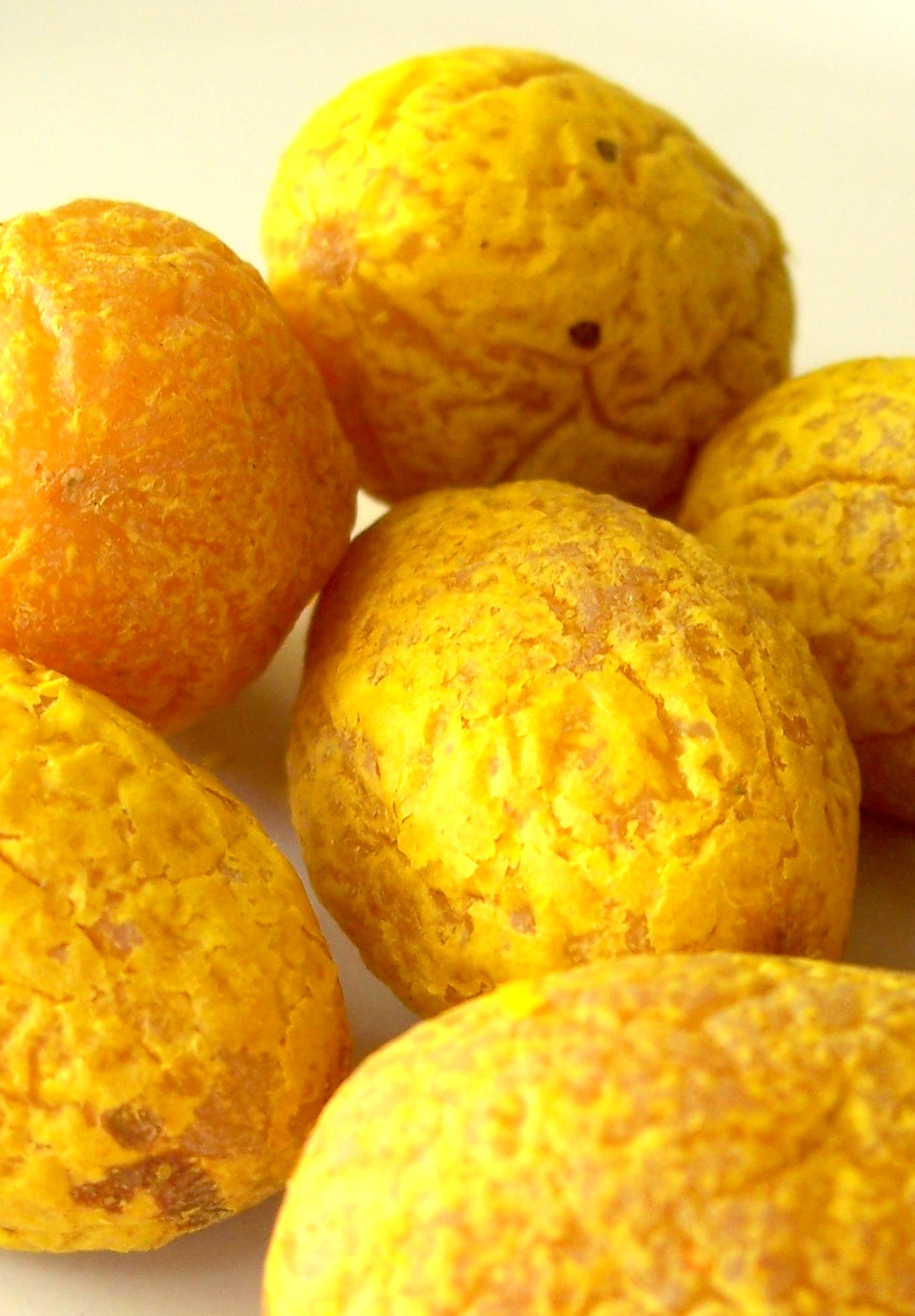
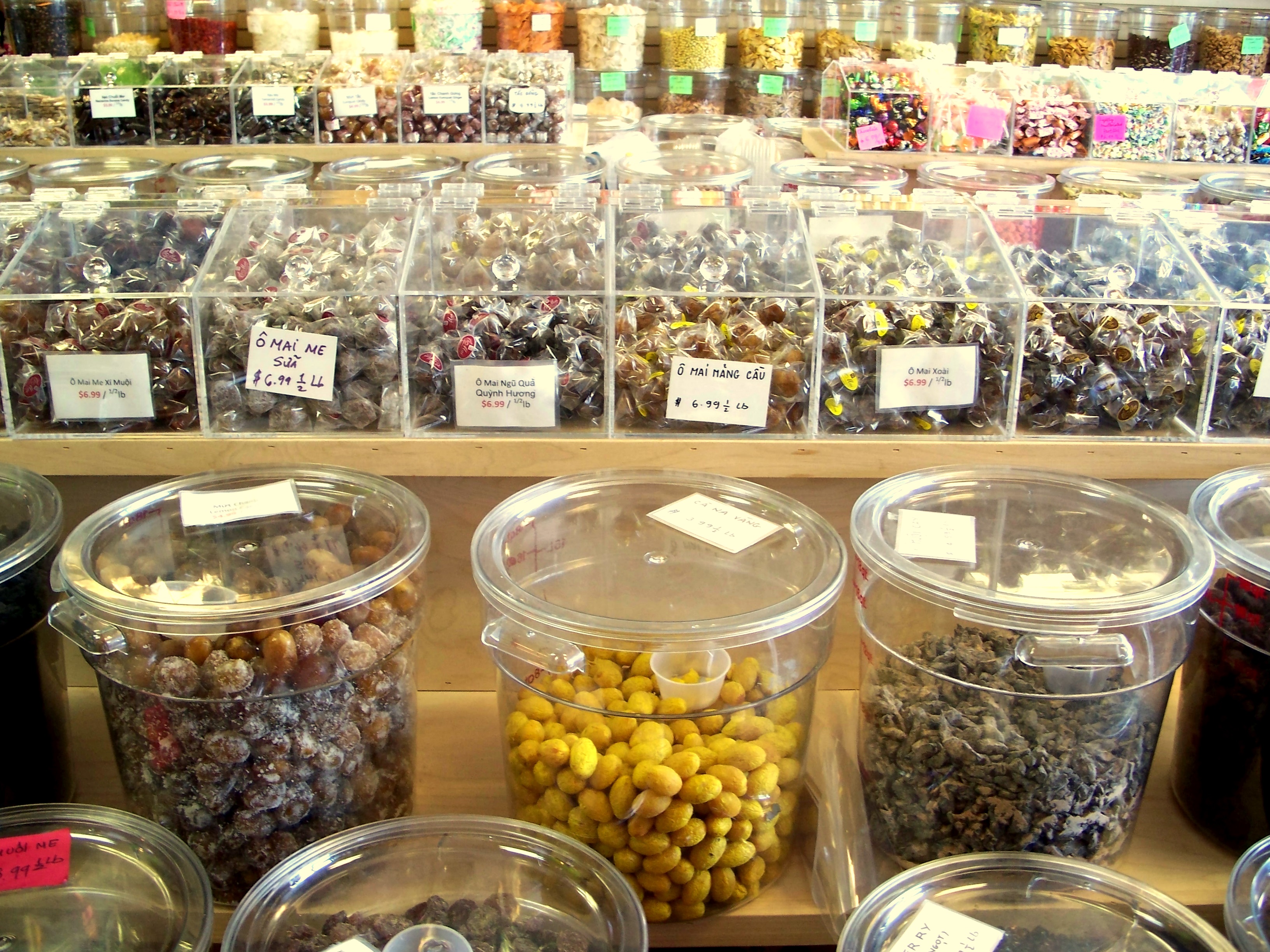
The first cà na‘s I’ve had are bright yellow with cracked skin, as big as a big green grape, resembling petrified dinosaur eggs, sold in glass jar among the ô mai and the salted plums.


The first nibble must be executed with caution. It’s firm and sound, with one big hard seed. No wonder the folks at home call the American football the cà na ball: they look and feel the same, only smaller. The flesh is dense like an old coconut’s meat, sour like lemon leaves, yet sweet like licorice blended with a dash of sea salt. How they’re made is a mystery to me.

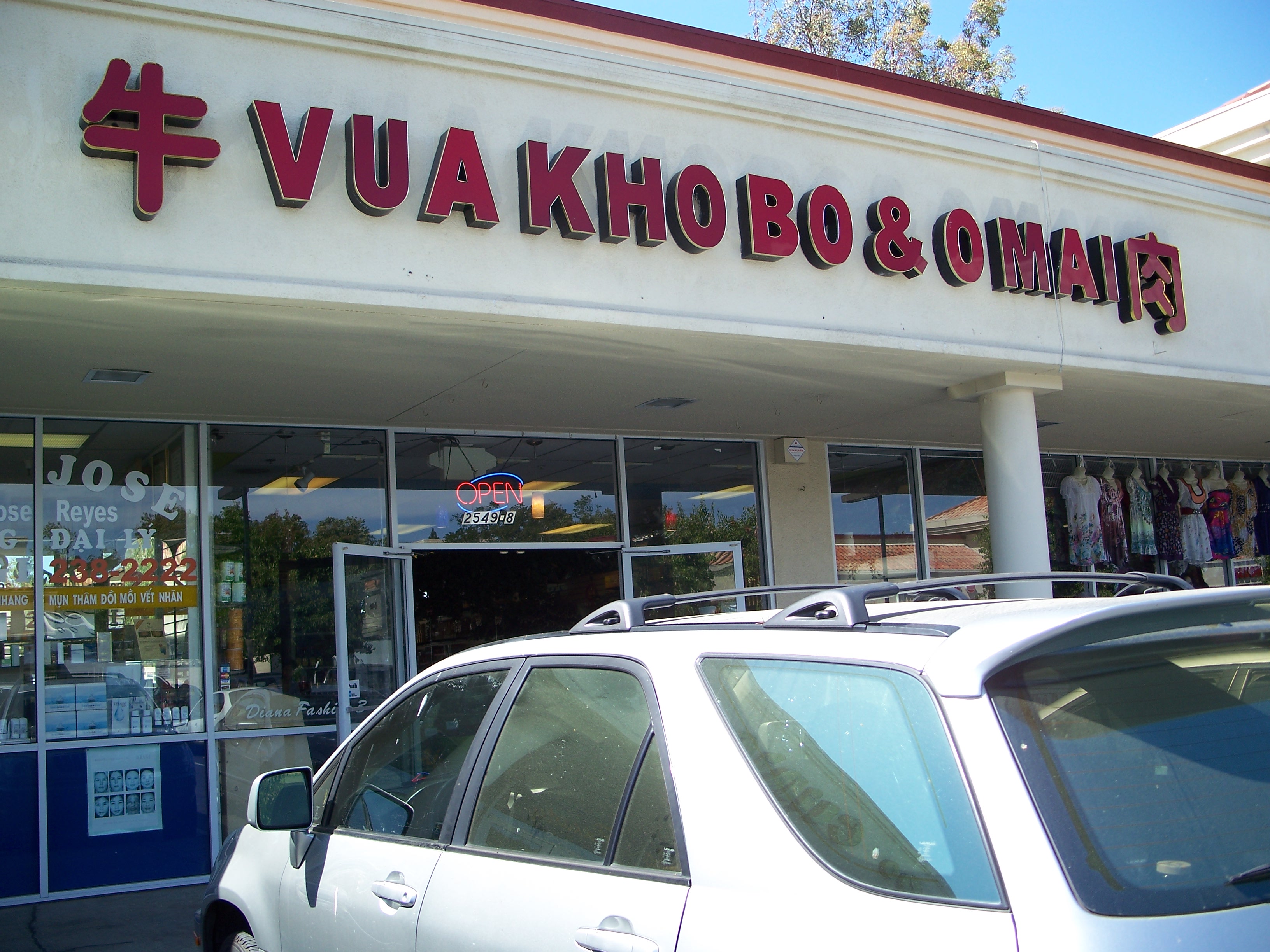
Address: Vua Khô Bò & Ô Mai
2549 S King Rd #A-B
San Jose, CA 95121
(408) 531-8845

Also from here, also fruitilicious:
1. banana tootsie roll
2. ô mai (spiced fruit ball)

Other informative links on the Chinese olives:
a list of different cultivars in China
Autumn olive


This post is submitted to Delicious Vietnam #11, March edition, hosted by The Culinary Chronicles. I’ll head to her blog for more yummy posts on Vietnamese food this month, and many thanks to the Ravenous Couple and Anh for creating this event!

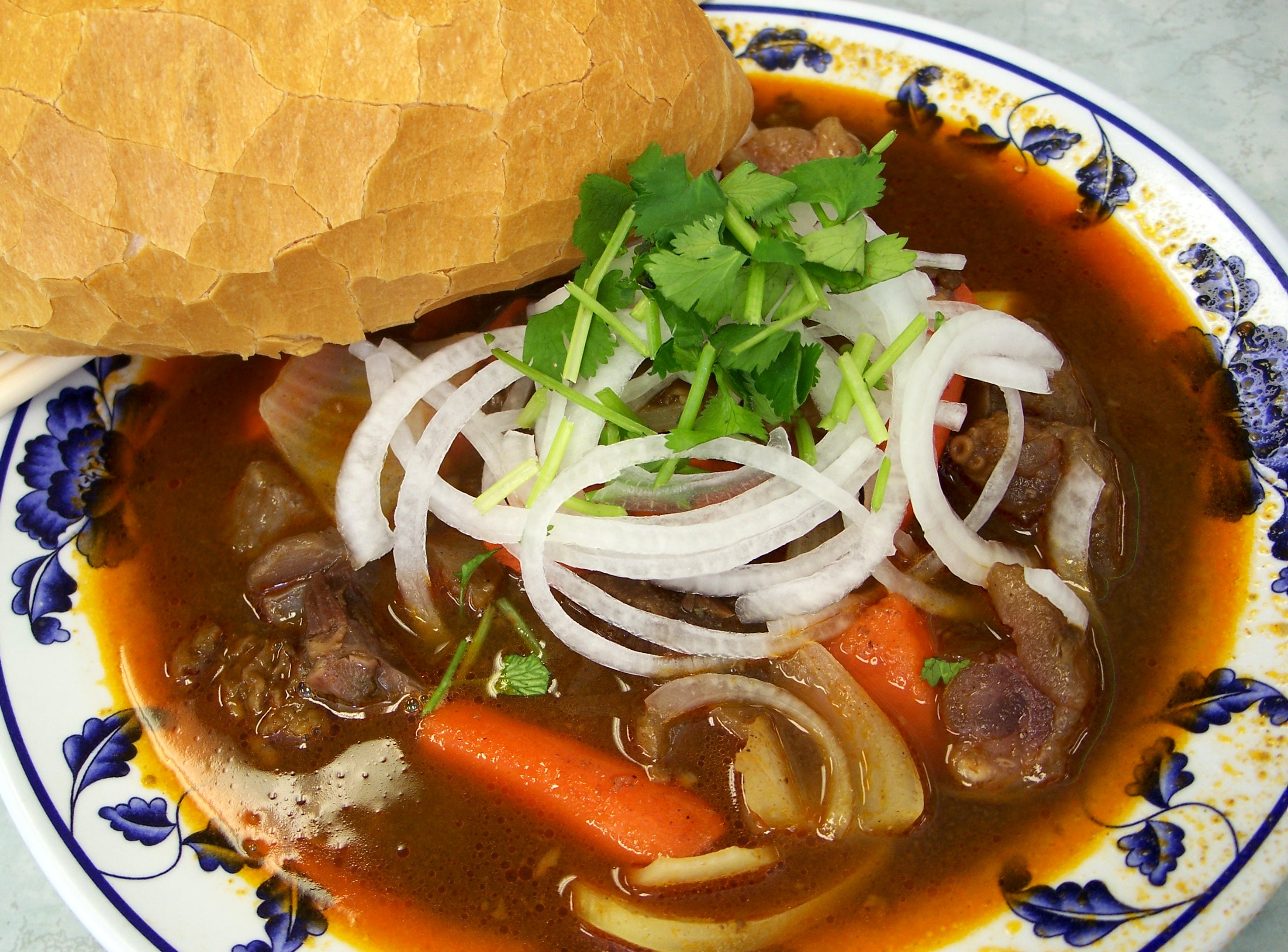
A spot for beef stew (bò kho)

March 09, 2011 By: Mai Truong Category: California - The Bay Area, Comfort food, Southern Vietnamese


When Phở Hòa on Shattuck closed down, a part of me collapsed. No more bò kho? Granted that I can only have a bite or two in one sitting, or Mom would be worried about bò kho giving me a fever, it’s still comforting to know that a bowl of this supertender beef stew is only a few minutes walk away, or simply that it exists at a restaurant. Many a times I have seen Vietnamese restos, especially those in Houston, advertise bò kho on their menu but claim that they’re out of it when you order. So I felt in quite a shock fearing that bò kho has left me alone for good.

Then Mudpie, also a bò kho fan, found Phở Hà. We went and asked to make sure they have it. It’s no Berkeley, Phở Hà is in San Jose, but we’ll take what we can get.


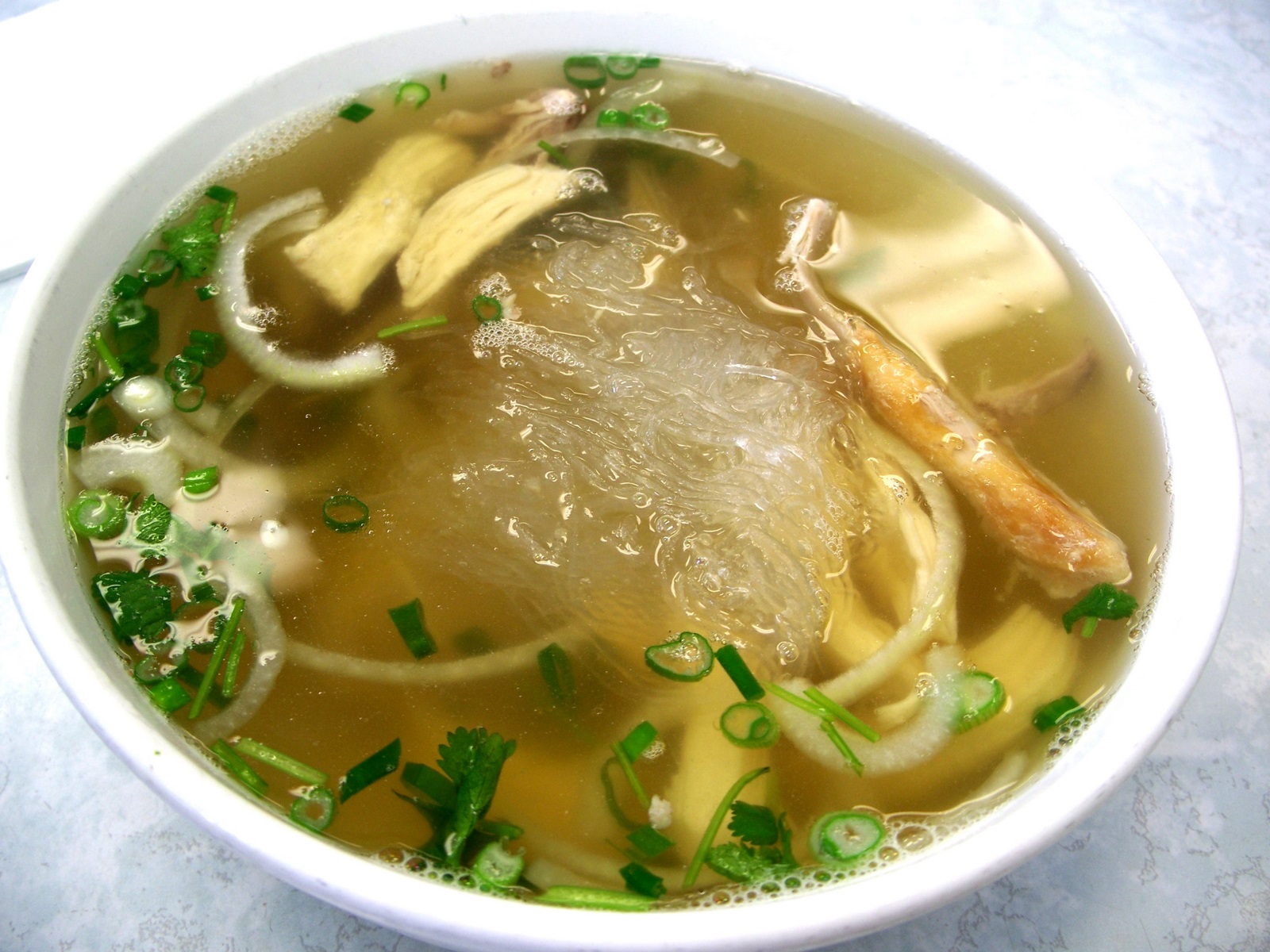
Their plastic bowls and utensils aren’t all that splendid. Their miến gà (cellophane noodle soup with chicken) is decent but their phở áp chảo (pan-fried rice noodle) is too overfilled with thick brown sauce to sing.


Nonetheless, we’ve come here for bò kho after all. And both Dad and Mudpie use up their whole loaf of crusty bread to wipe clean every last bit of that red, spice-ladened beefy juice. I’d say the trip ends well. 🙂

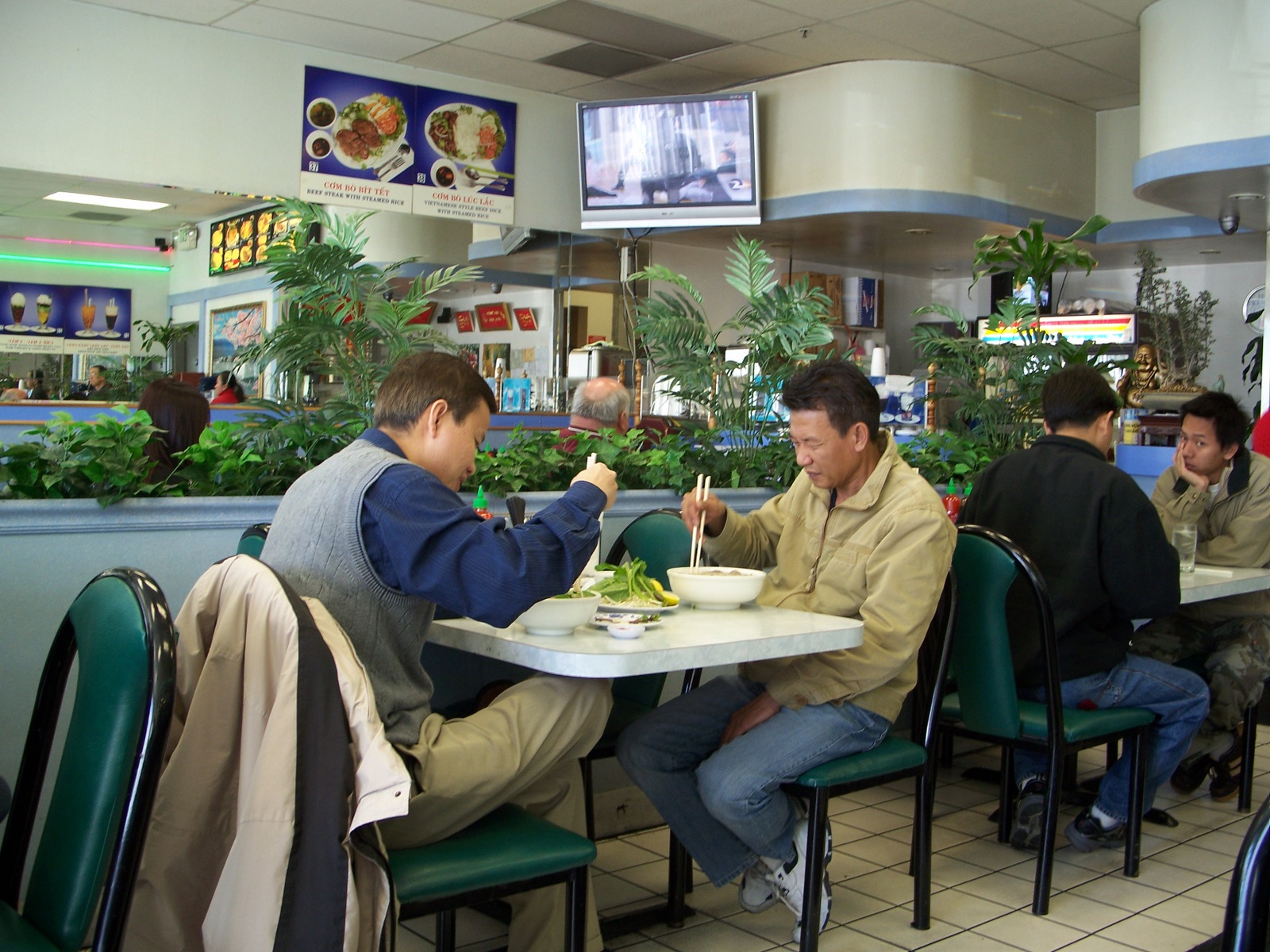
Author's disclaimer: these two men, who are leisurely enjoying the noodle soup, are NOT Dad and Mudpie

Address: Phở Hà (next to the Grand Century Mall)
951 McLaughlin Avenue
San Jose, CA 95122-2612
(408) 280-0381

Sandwich shop goodies 14 – Bánh da lợn (pig skin pie)

March 06, 2011 By: Mai Truong Category: Houston, One shot, sticky rice concoctions, sweet snacks and desserts, Vietnamese


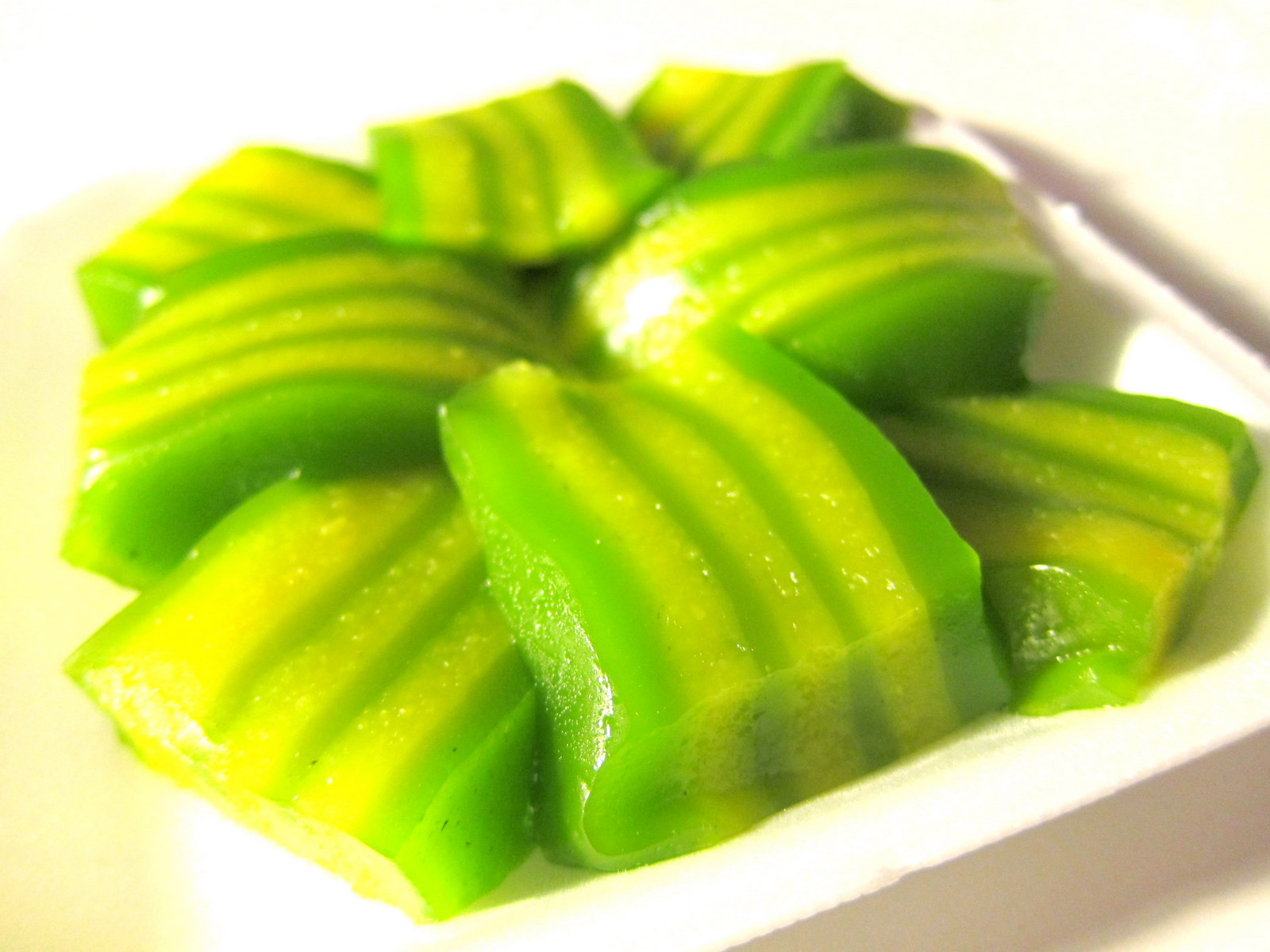
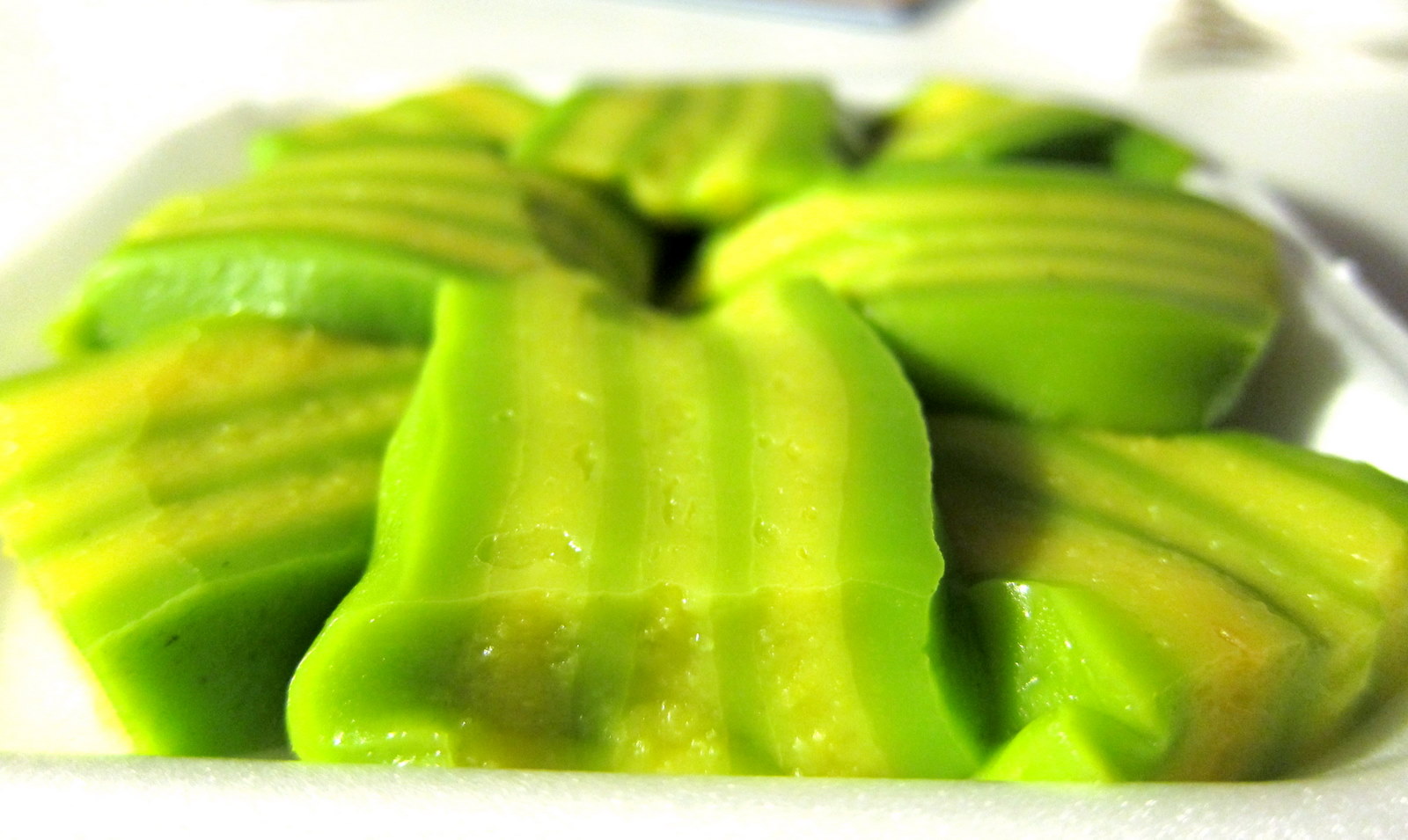
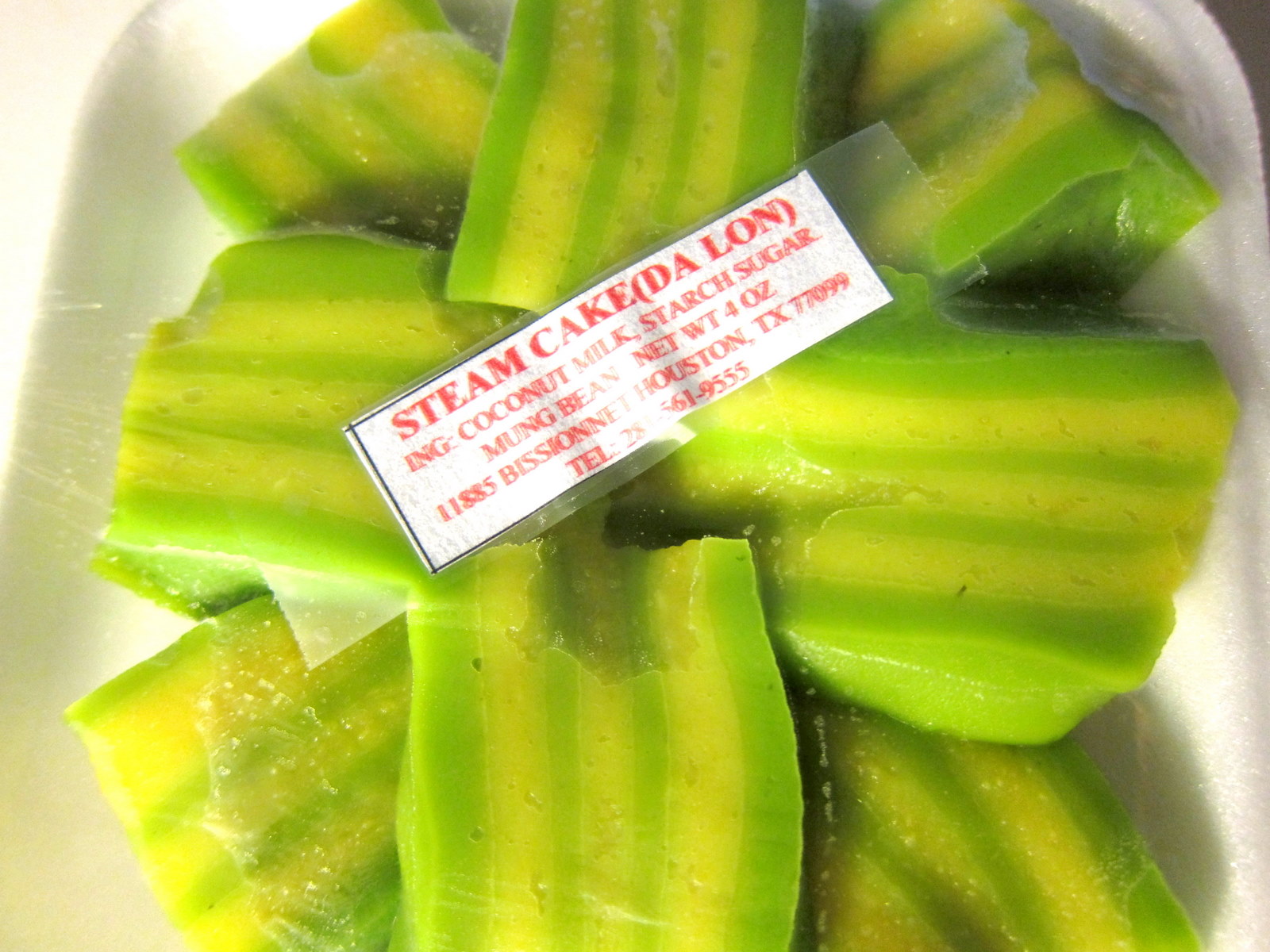
This is no stranger in the Vietnamese food biz: the layered pastry that gets its name from looking like pork belly, except green and yellow. Of course it doesn’t contain any pork skin, it’s sweet, sometimes may even be too sweet. Dad used to buy a whole pie home, as big as a platter and as warm as a father’s hand. From that same bakery somewhere in the market alley, he would buy bánh chuối nướng (bread pudding) too, which I always preferred to the bánh da lợn. But thinking back on those days when we lived near Bà Chiểu Market, it was certainly the best pig skin pie I ever ate.


Many years have passed, and many bánh da lợn have been eaten by me, both in its homeland and across the seas. The best way, I figured, to slaughter these chewy beasts is to peel off the layers one by one, when it’s warm. That wet, smooth skin of tapioca flour, when warm, is fragile. You don’t want to break it while peeling, and you want to drop it whole in your mouth to wrestle with its resilience, all the while inhaling the sweetness of pandan leaves and vanilla fused in its tone.

Simply put, a cold “pig skin” is a dead “pig skin”. A warm mung bean paste layer is also less sweet than a cold one, and thank goodness the bean layers are always one fewer than their tapioca neighbors. The pies Dad bought from that market bakery would have white chewy layers too, and the green ones didn’t look radioactive green like those we get from sandwich shops these days. Ah marketing strategies, just like somewhere in Vietnam someone thought of calling it “bánh chín tầng mây” (cloud nine pie) (because pork skin doesn’t ring any two-cent poetic sound), or when the tapioca layer turns dark purple, because of either magenta plant‘s leaf extract or food coloring, and the bean layer light purple because of taro.


Whatever the case, the original bánh da lợn is still the best. I looked through 51 pages of Google search for its origin, which seems likely lost through generations of home cooking and street food mingling. You see, it was never really a praiseworthy, historically recorded invention in the kitchen. There’s no village or province associated with the best bánh da lợn. It’s probably from the South, even if “lợn” is the Northern word for “pig”. It’s a product from a steamer, it’s cheap, it has texture, kids like it, Dad likes it. That’s all I know.

And by the way, Alpha Bakery & Deli sells some good, thinly sliced, warm numbers for a buck fifty.

Address: Alpha Bakery & Deli (inside Hong Kong City Mall)
11209 Bellaire Blvd # C-02
Houston, TX 77072-2548
(281) 988-5222

Previously on Sandwich Shop Goodies: bánh xu xê (couple cookie)
Next on Sandwich Shop Goodies: bánh quy (turtle mochi)

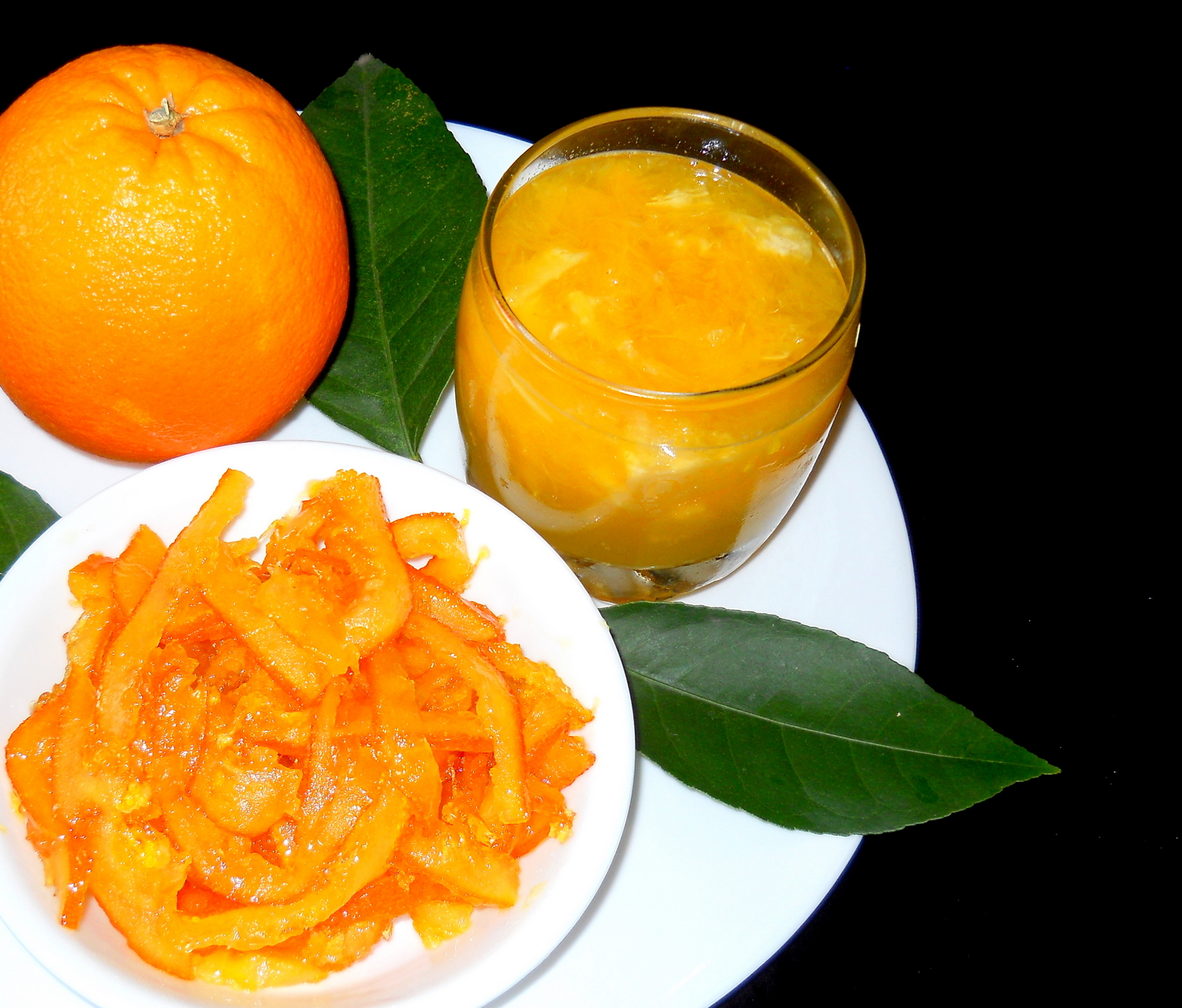
Mom’s Cooking #1: Candied orange peel with pulp

March 03, 2011 By: Mai Truong Category: Fruits, RECIPES, sweet snacks and desserts, Vietnamese

*Guest post in Vietnamese by my Mom, translated by me*


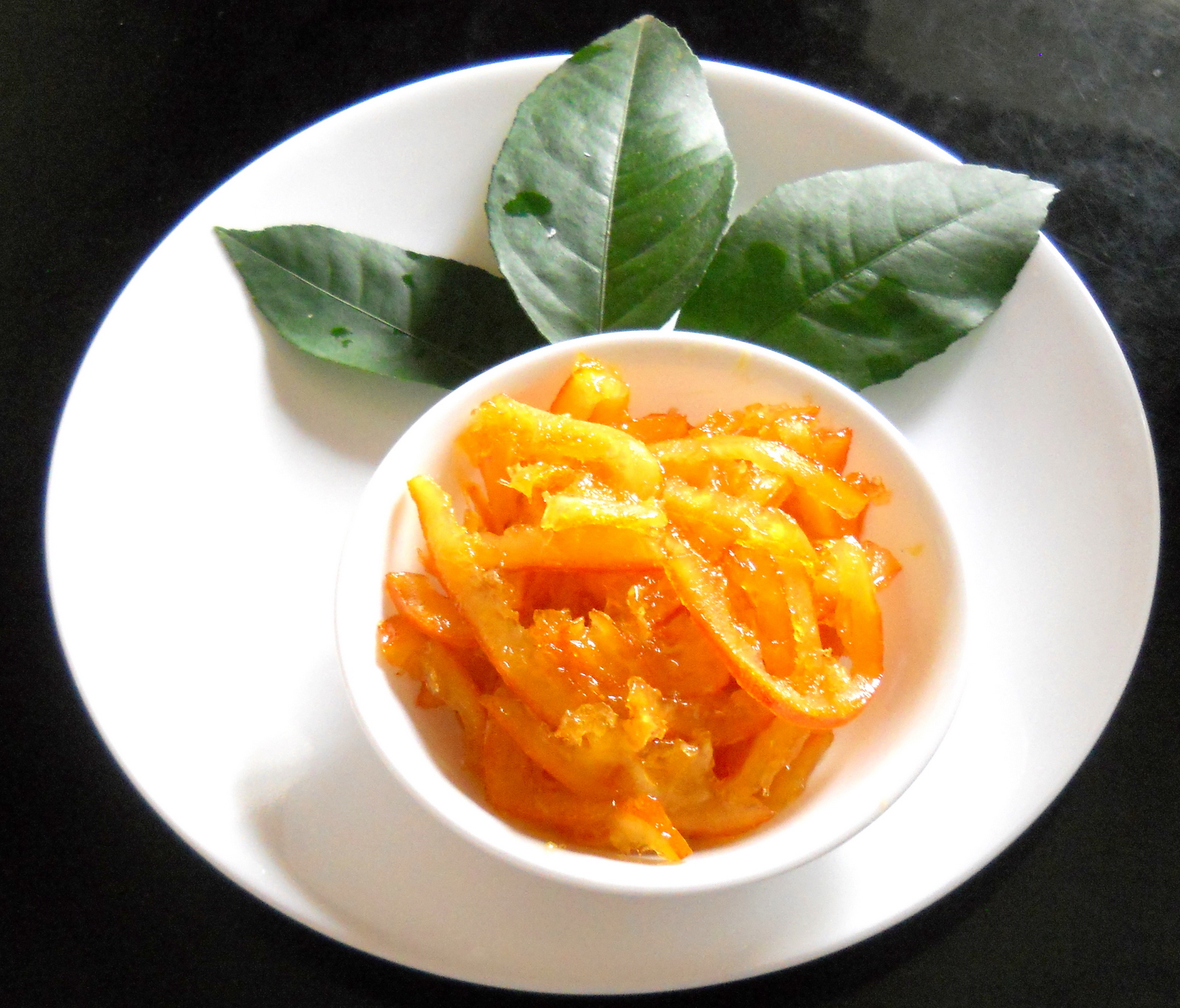
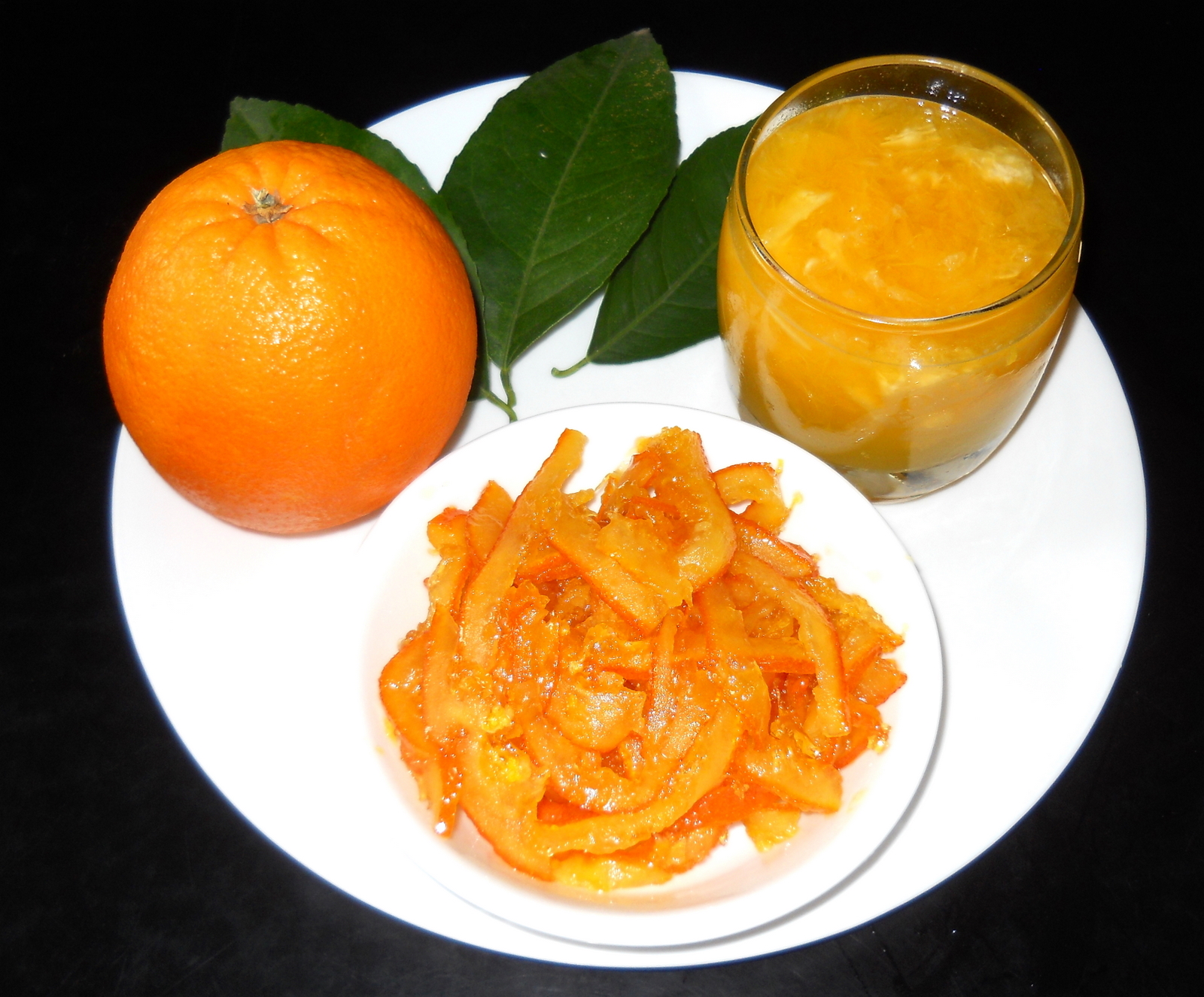
My daughter and her friends always like my fresh squeezed orange juice, so every time she visits home in the summer and winter break, we drive up to the Farm Patch Produce Market in College Station to buy navel oranges. The grocery stores have navel oranges too, of course, but for some reason Farm Patch always have the best. Their rotund shape, their bright color, their rugged skin similar to that of the Vietnamese cam sành, all promise a slender sweetness contained, not to mention the little twin at the apex, darling like a hidden Christmas gift. These oranges are so well worth the two hour drive that I regret throwing them away after juicing, so I thought, why not make “mứt cam“, candied orange peel?


The simple ingredients:
– 2 oranges
– 10 tbs sugar or to taste
– 1 cup water


The simple method:
– Wash and squeeze out juice from the oranges, then slice the peel (with pulp attached) into strips.
– Mix 10 tbs sugar with water and simmer on low heat for roughly 15 minutes. Use a pair of chopstick to test: dip the chopsticks into the boiling sugar liquid, lift up and separate the chopsticks, if a sugar silk strand forms in between then the mixture is ready for the next step.
– Add orange peel strips, continue simmering on low heat for about 30 minutes, stir occasionally to make sure the sugar coat and soak the peel evenly.
– When all liquid evaporates and the peels feel jammy, turn off heat.
– Put candied peel in glass jar, wait until it’s cool to seal and store in refrigerator.


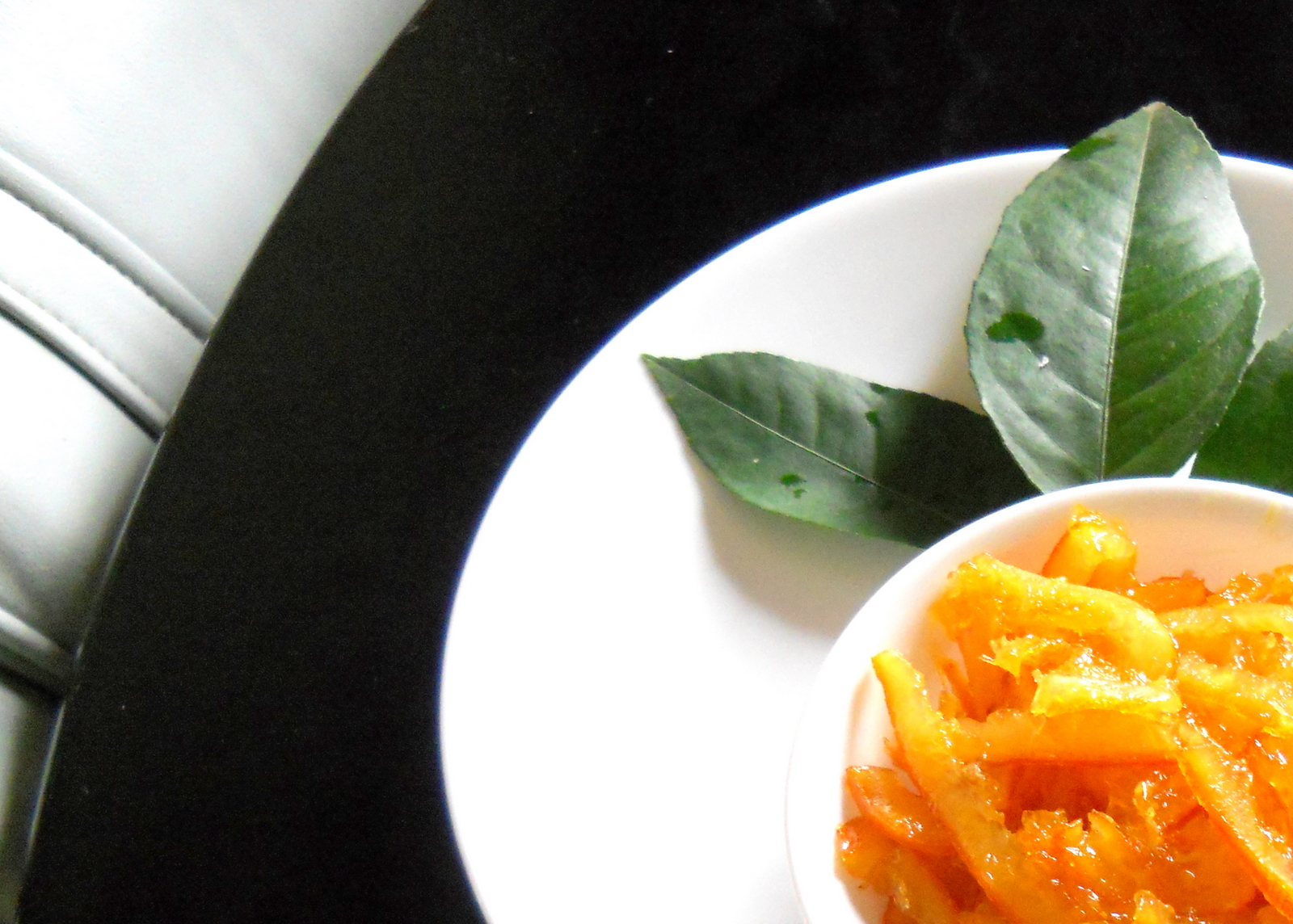
This candied orange can also be eaten with toast like marmalade, its sweetness stark, its texture crunchy, a natural minty sweep from the peel even gives it a healthy sense. They say eating it helps improving sore throats. I think making it helps improving patience. 🙂


This post is submitted to Delicious Vietnam #11, March edition, hosted by The Culinary Chronicles. I’ll head to her blog for more yummy posts on Vietnamese food this month, and many thanks to theRavenous Couple and Anh for creating this event!

Tags:

Korea Garden on Long Point Road

February 28, 2011 By: Mai Truong Category: Comfort food, Houston, Korean


We were looking for a get-together location on New Year’s Eve, when we decided that since both of our families like Korean food, it’d be good to let Ms Baker try it for the first time too. Houston’s West side houses many a place for a good bulgogi, concentrating on the section of Long Point that’s sandwiched between Gessner and Blalock, but we set our mind on Korea Garden. Half of us had been here several times, and we didn’t want any adventure on Ms Baker’s first impression, she’s a conservative. 🙂


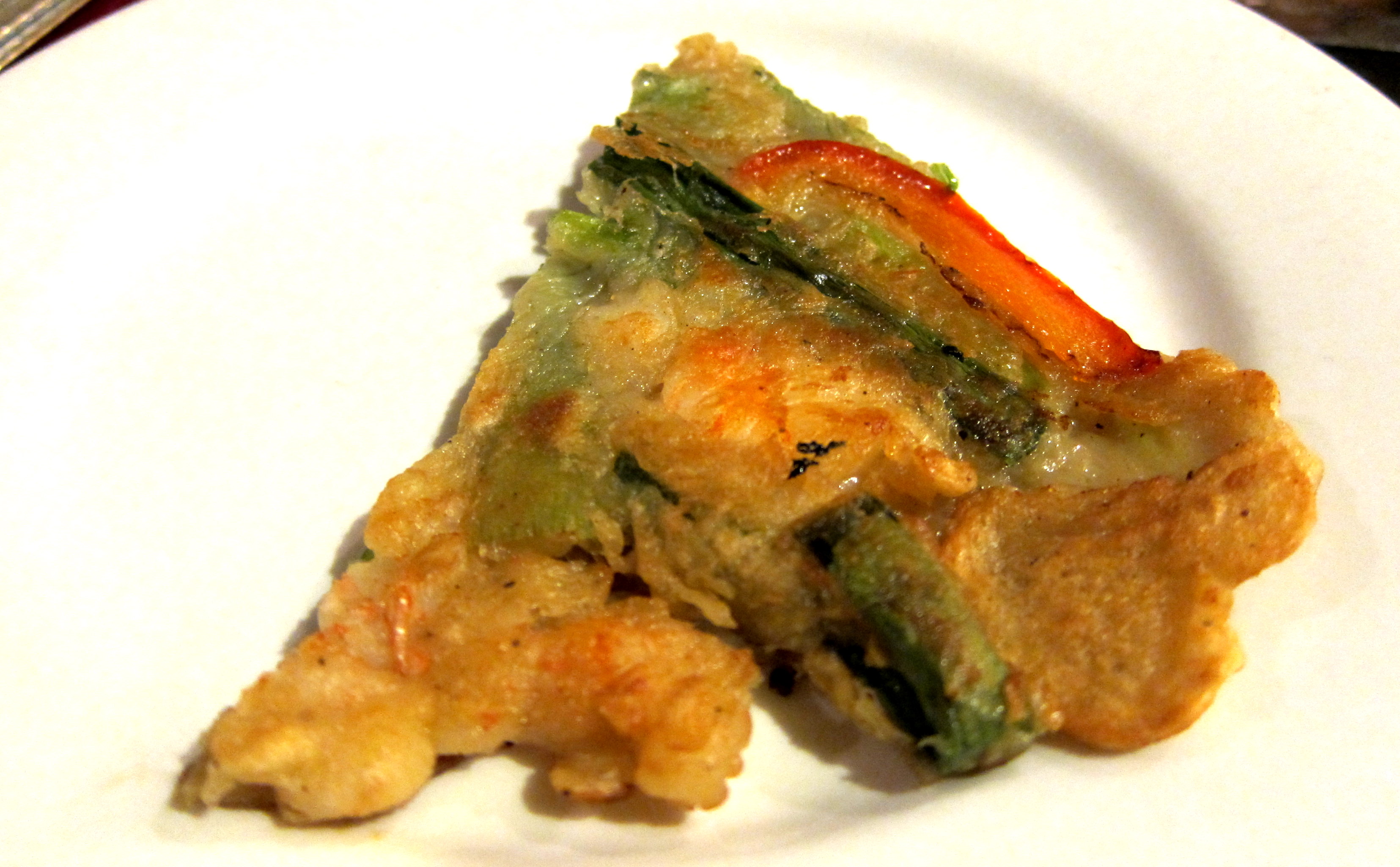
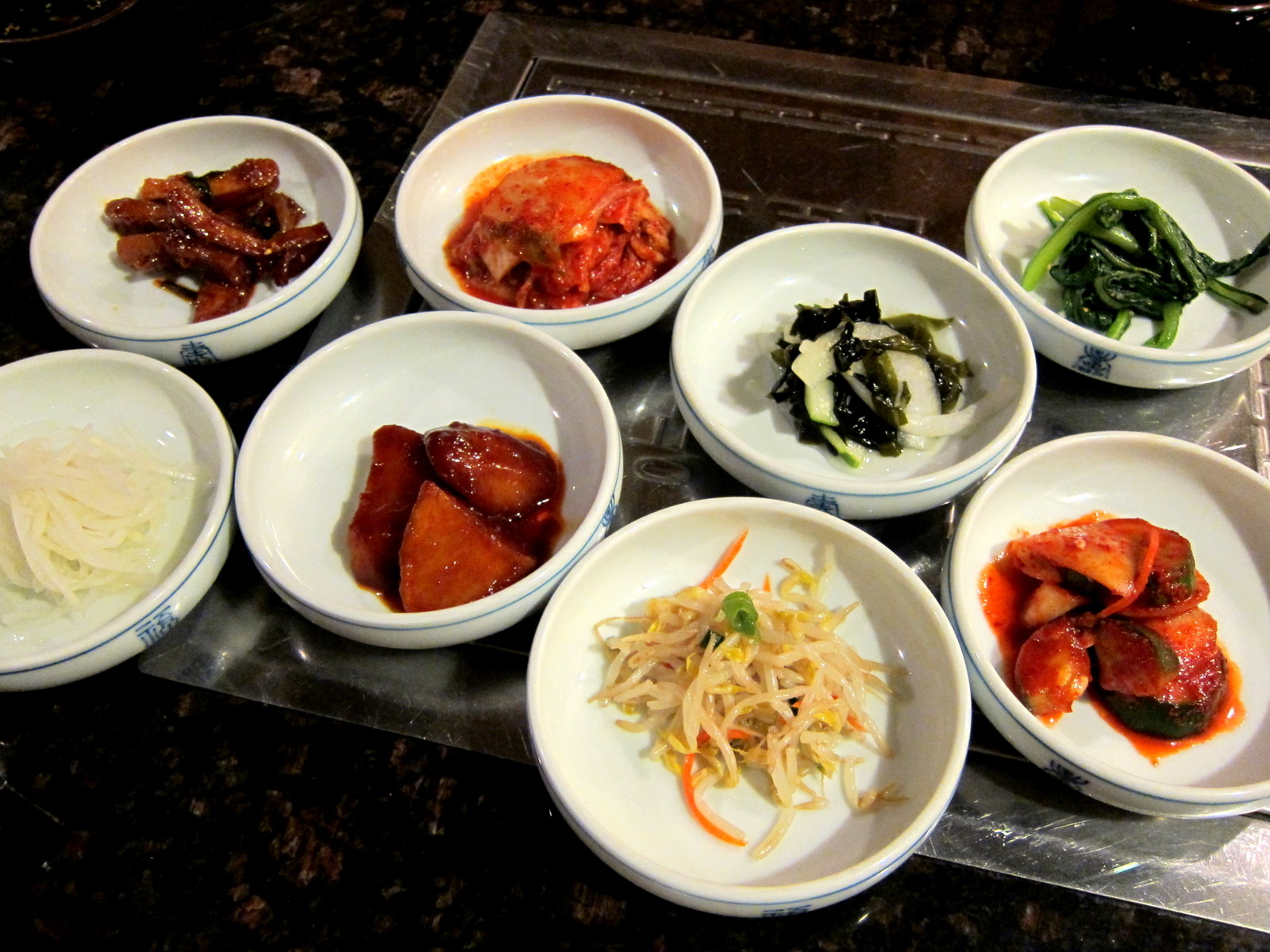
It turned out her very first impression was curiosity: how did they manage to section 7 equal slices of the haemul pajeon (해물 바전)? It was a good jeon, however lay on the soggy side if compared to pancakes at Secret Garden and Casserole House. The banchan selection included some of our favorites: potato, seaweed, and sliced eomuk (어묵), although none appealed to the Americans at the table. The kimchis had quite a bit of chili, though.


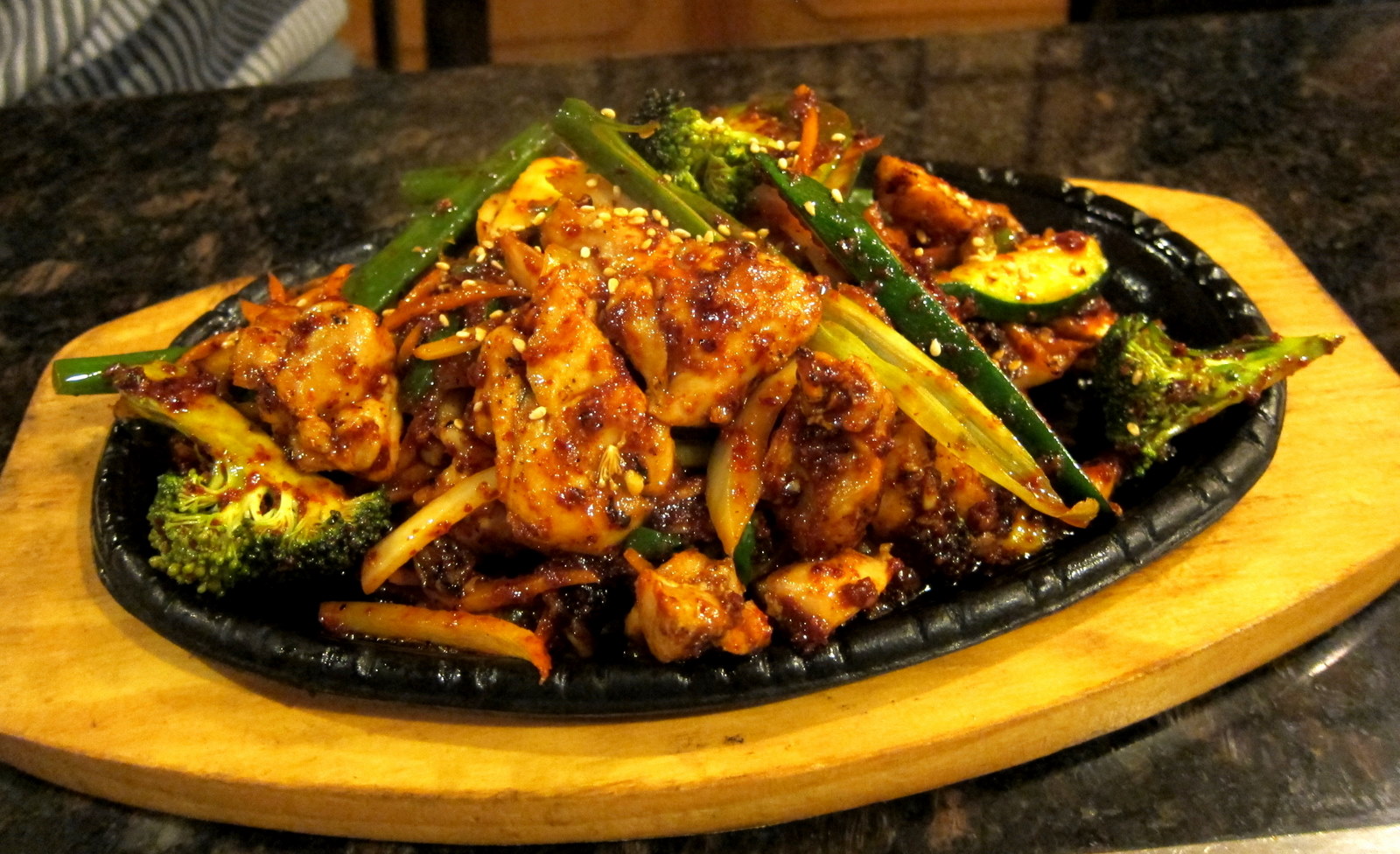
So did the dak bokgeum (닭 볶 음 stir-fried chicken) that my dad fell for. That sneaky heat wouldn’t hit you right away.  Only half way through the heap of bird and veggie did he  turn to my mom and me with a tilted smile and a slight head shake: too spicy.


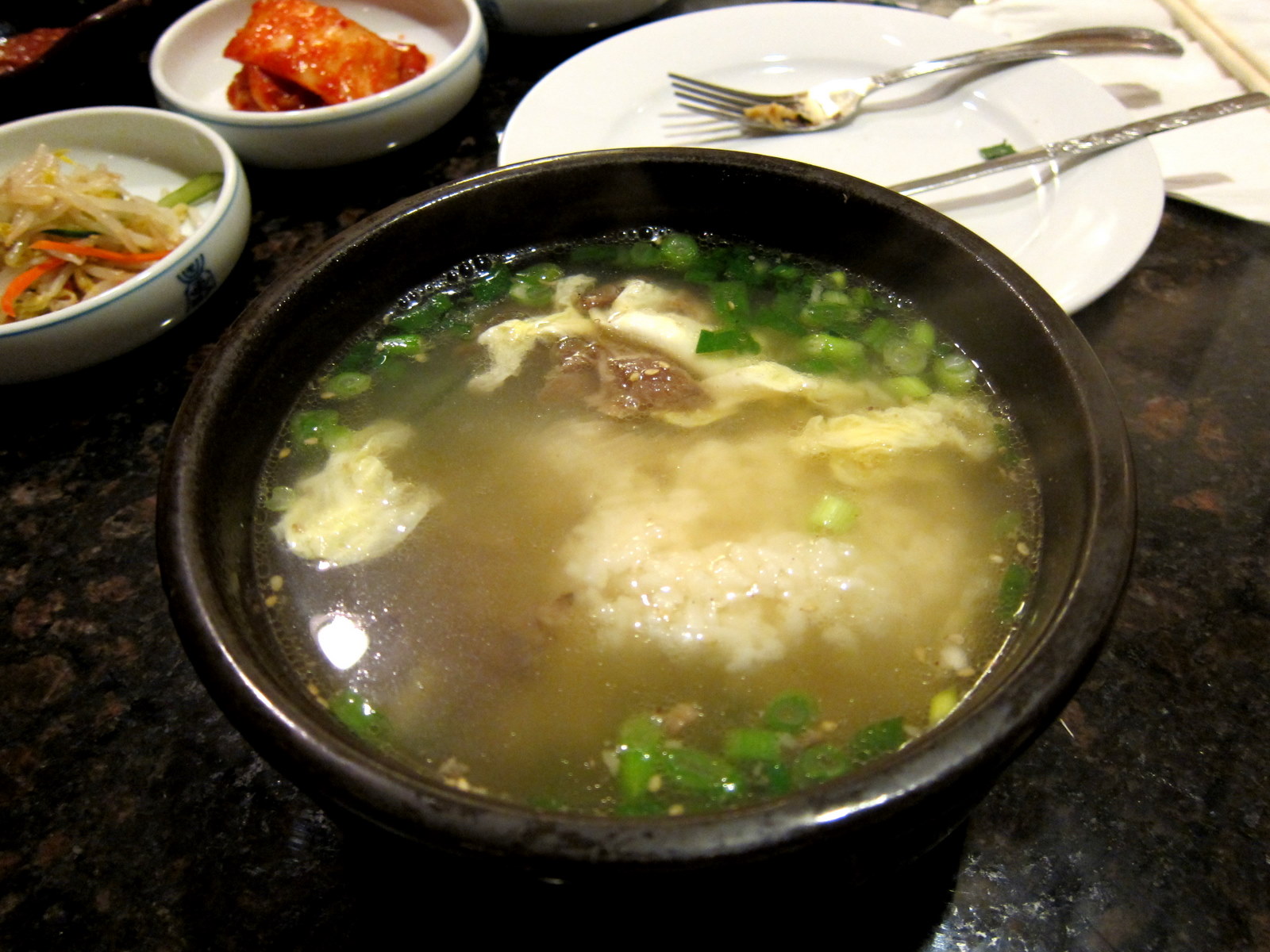
My mom and I knew better than ordering something with a chili pepper sign. So for soups we went. Her a gook bab (국밥 rice and sliced beef in warm beef broth), that was almost too bland.


And me a mandoo gook (만두국 dumpling soup), sweet and delicate but not really a tongue catcher.


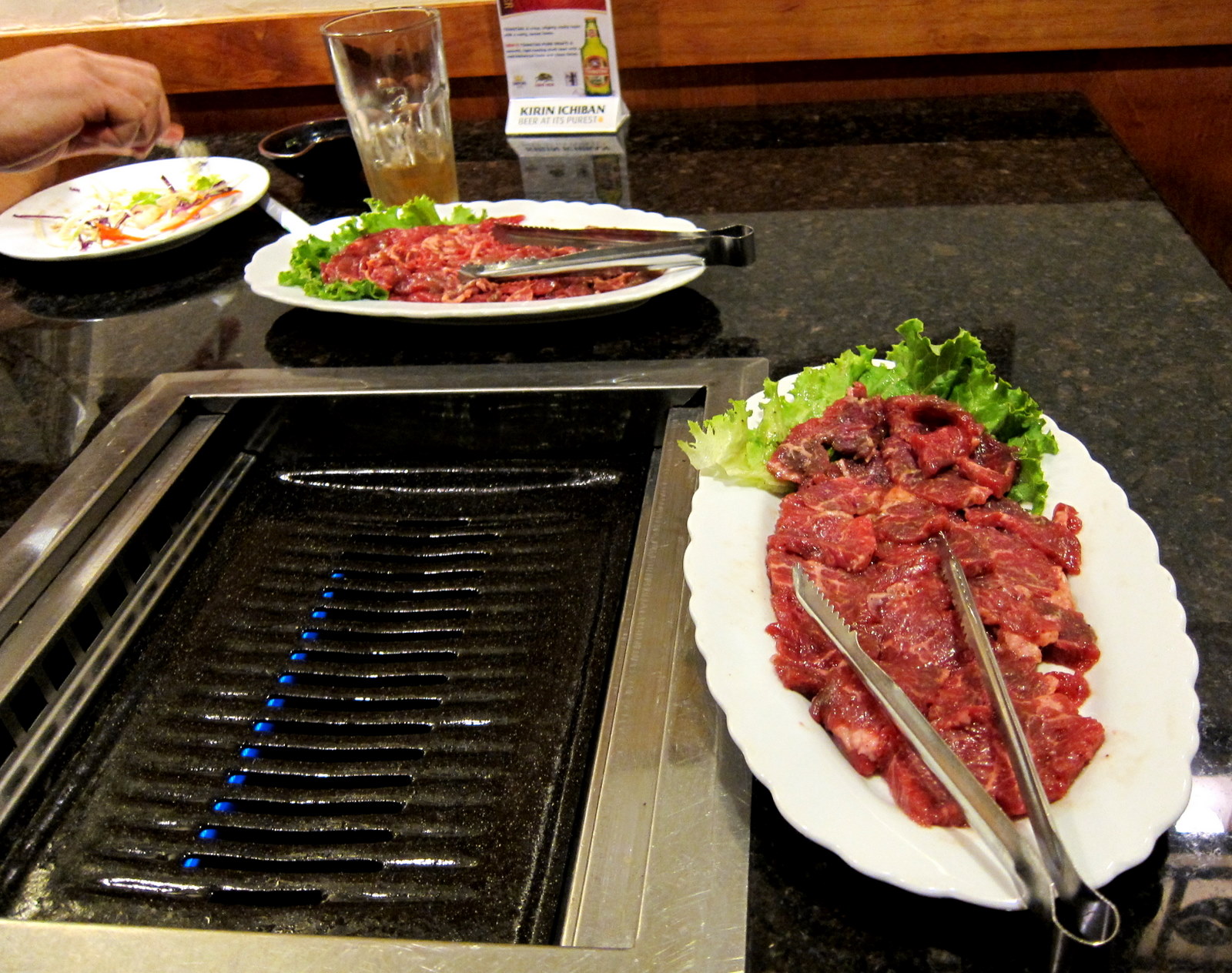
The other side of the table ordered their regular bulgogi (불고기) and bulgalbi (불갈비), something that would never go wrong,


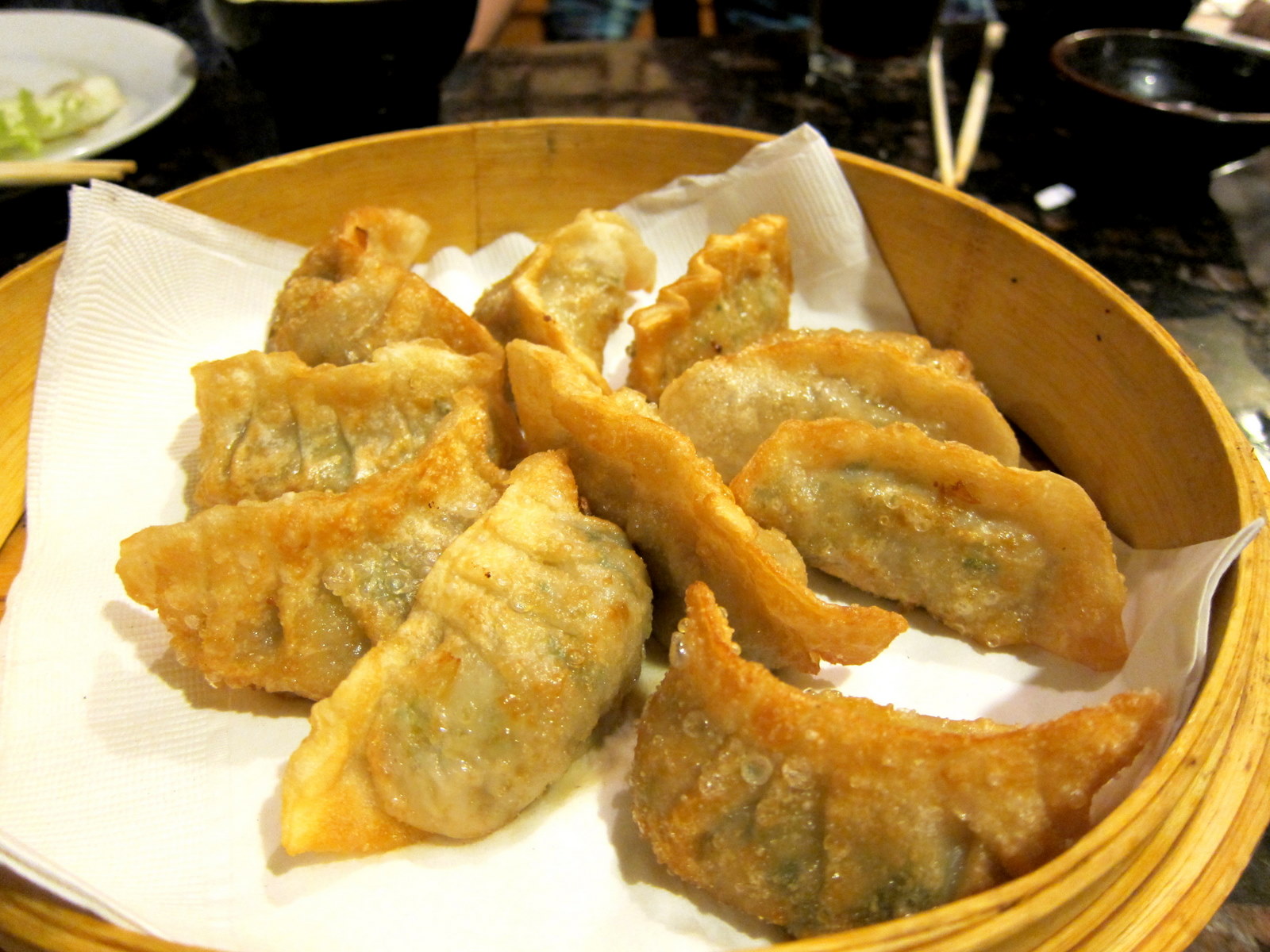
and a side of fried mandoo (만두), which looked irresistibly crunchy.


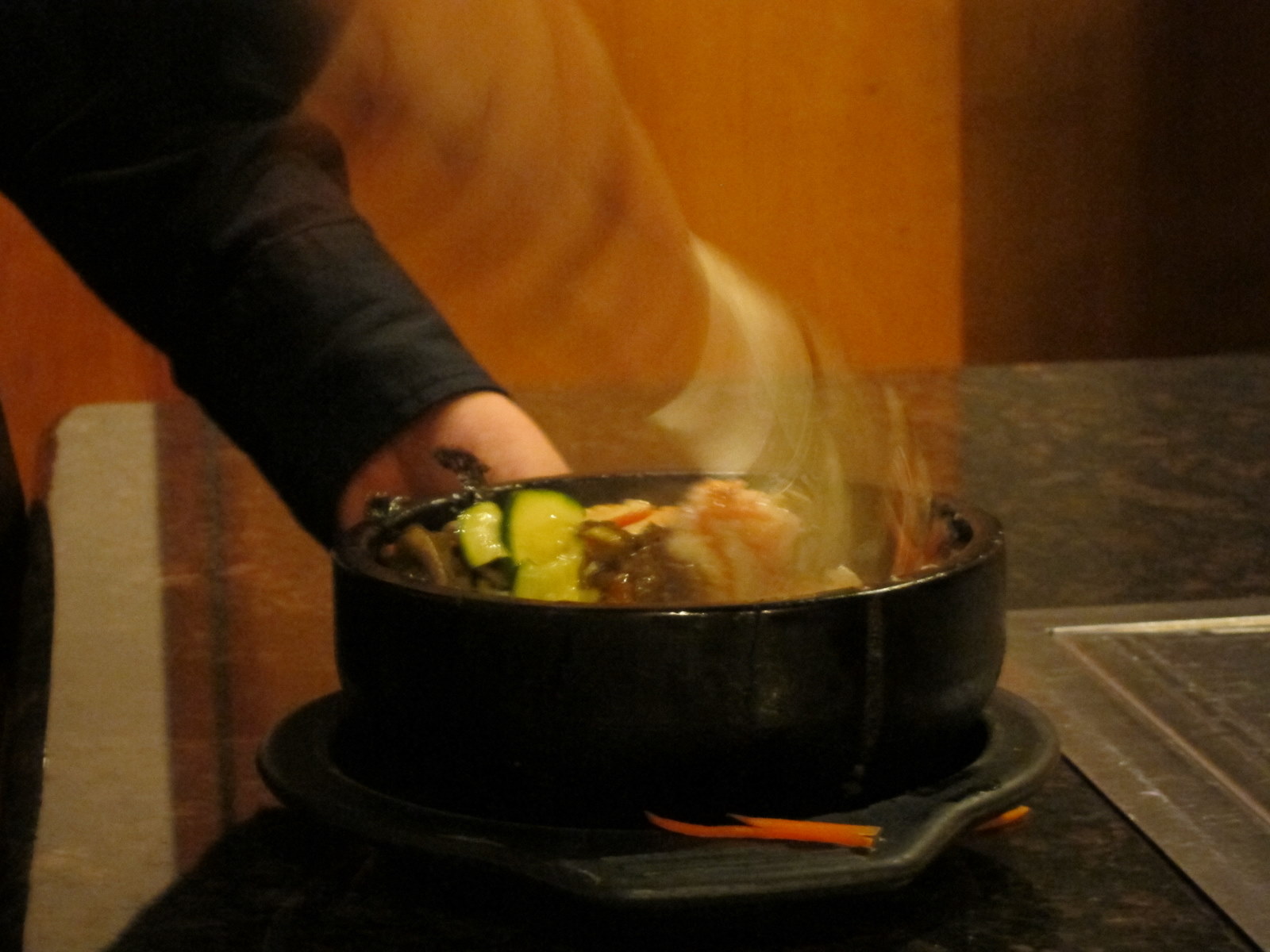
The staff was sweet, like this lady who mixed bibimbap (비빔밥) at amazing speed. Her wrist spun like a cotton candy machine. I don’t know how Ms Baker knew that dolsot bibimbap (돌솥 비뱜밥) is what a first timer should get, of if she knew, but I took it as a good sign that she scooped every last grain of rice.


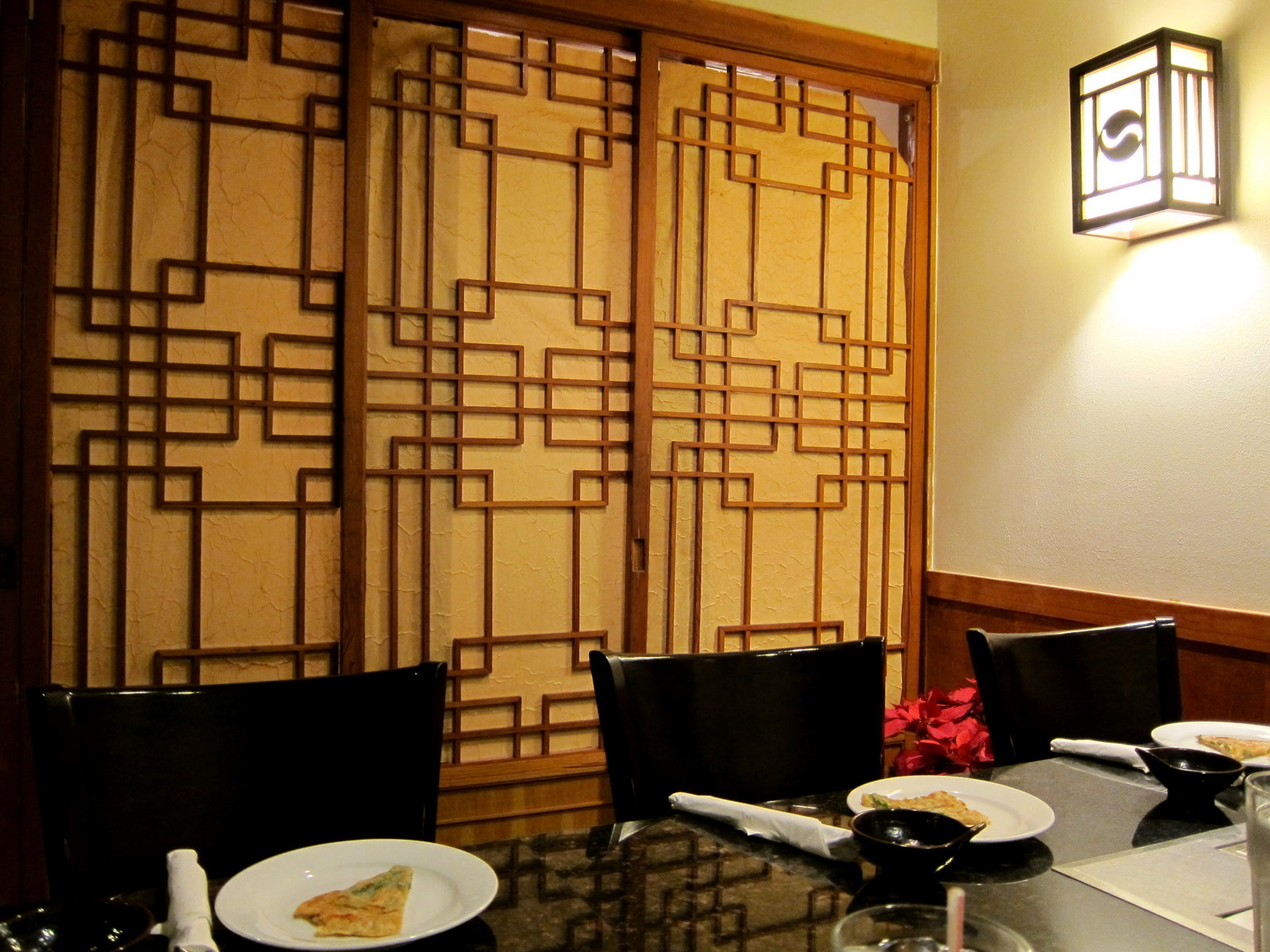
So here we sat in a room sectioned off from the others by shoji screens and chatted from 7:15 to 9:30 about all things from Jerry Brown to TiVo. We must have been the second to last to leave Korea Garden that night. Ms Baker’s first impression of Korean food was heartily filled with laughters. The price was hefty, as most Korean dinners are, but the family bonding between friends is priceless.

Address: Korea Garden Restaurant
9501 Long Point Rd, Ste. Z
Houston, TX 77055
(713) 468-2800
www.koreagardenhouston.com

Dinner for seven: $157.88

Spicy balls of fruit and salt

February 26, 2011 By: Mai Truong Category: California - The Bay Area, Fruits, Review of anything not restaurant, Vegan, Vietnamese


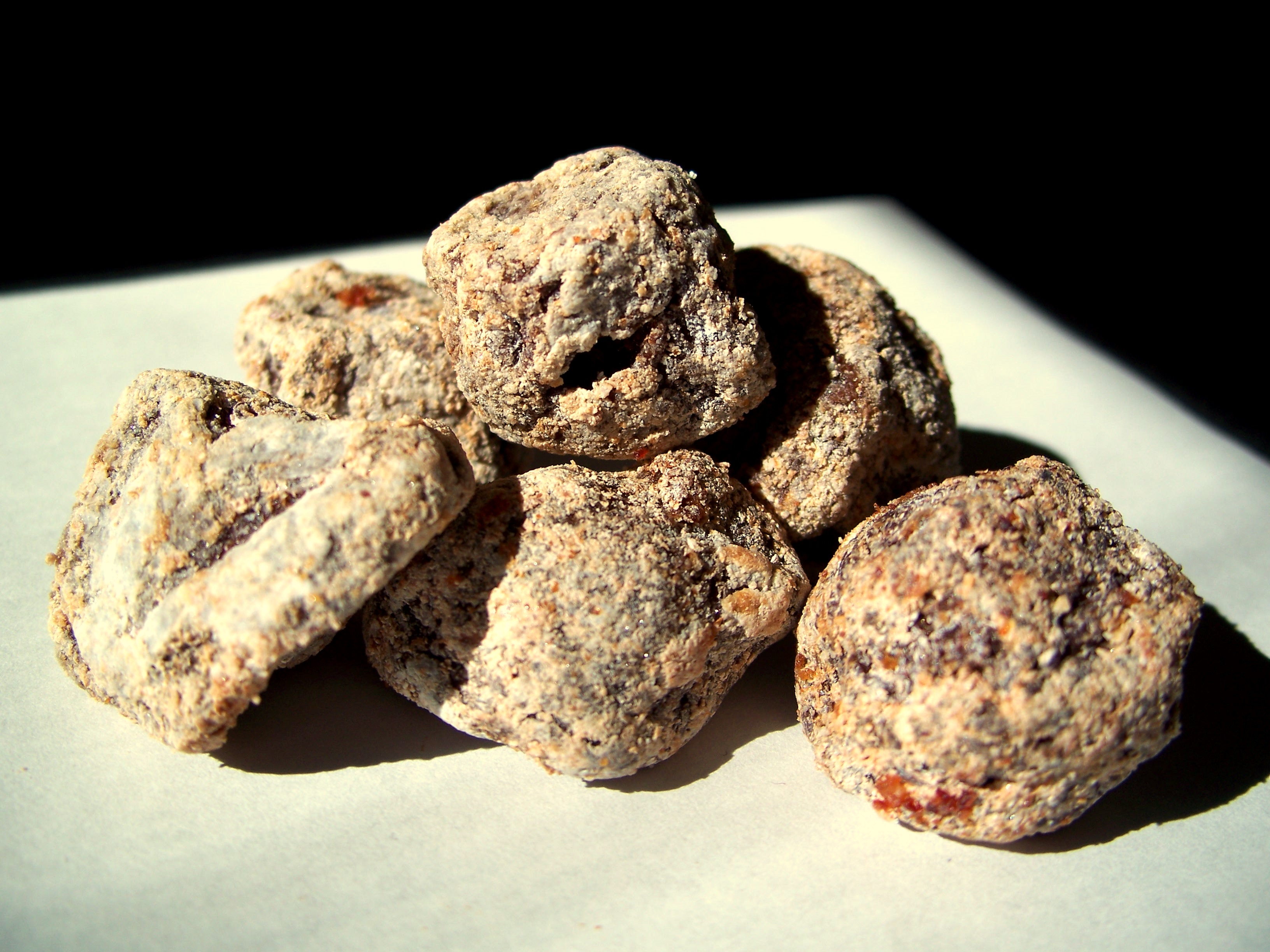
Let’s make it clear: ô mai |oh mai| is not xí muội |xi mui| (huamei), even if Wikipedia says so. The former is a cooked mixture of cut-up fruits, ginger, licorice and spices, the latter is a whole plum dried and salted.


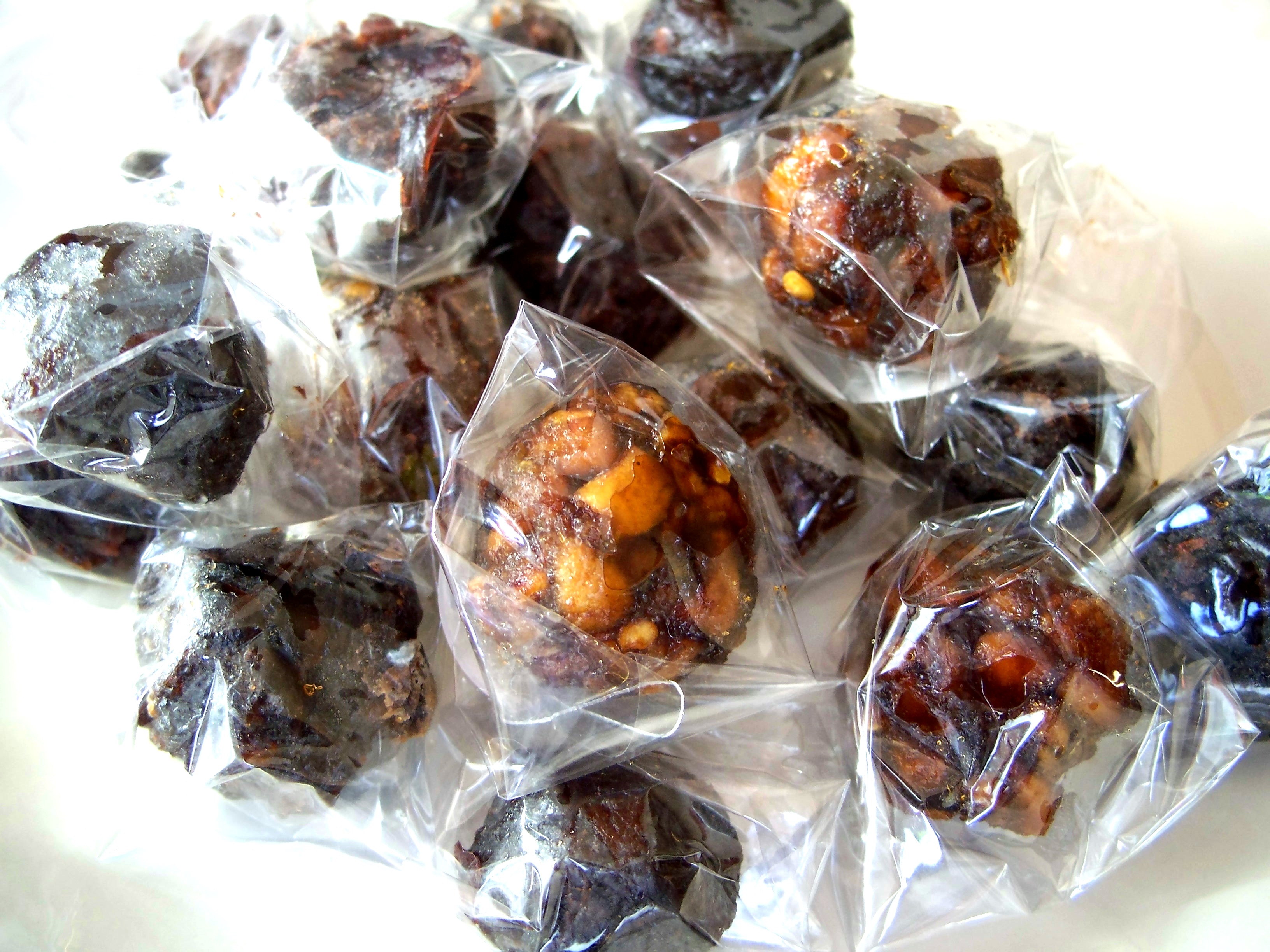
Now that’s settled, I got a bunch of ô mai from Vua Khô Bò & Ô Mai a while ago, all homemade or so the lady told. Guava, rose buds, sấu (no English name, it seems), mango, kumquat, cóc (golden apple), tamarind, and 5-fruit combo, 2 balls each at $6.99 per half pound. Sweet, spicy, chunky, velvety, gingery, tart, salty, it’s all there.

The downside: they all have the same wrapper, so except for the guava one which is extra chunky, I can’t tell which is which if my life depended on it.

And here’s some xí muội. Look more like rocks then edibles, doesn’t it? Americans like ’em not, but I find them lip-smacking good, one tiny nibble at a time.


Address: Vua Khô Bò & Ô Mai
2549 S King Rd #A-B
San Jose, CA 95121
(408) 531-8845

Also from here, also fruitilicious: banana tootsie roll

Tags: