Flavor Boulevard

We Asians like to talk food.
Subscribe

Archive for the ‘Review of anything not restaurant’

An FOB feeling happy after reading Eddie Huang’s Fresh Off the Boat
November 03, 2016 By: Mai Truong Category: Book, Opinions

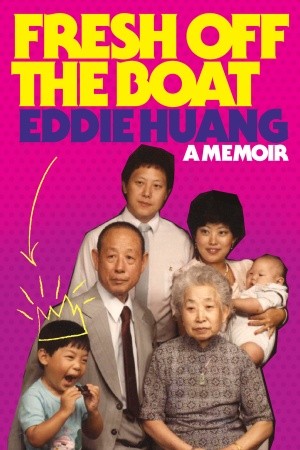
fresh_off_the_boat_-_a_memoir_book_cover
It starts with the food bullying that I feel I can relate to Eddie Huang‘s story. Cleverly, he begins the book with dimsum, so that got my interest, but he talked about dimsum for less than 2 pages. The food bullying though, where his classmates said that his food smelled bad, that he wanted the white kid lunches, that’s where my memories came back. The bully for me wasn’t in school and wasn’t by the kids. Comments, always by adults and mostly white females, that the food my mom made made the house smell bad, or the stuff I eat or drink that they haven’t heard of, much less tried, is “gross”, are this pet peeve of mine that I can’t forgive. Sure, they may not be intended to hurt me or anyone specifically, but they’re never well-meaning. They are too minute to confront the speaker about, so I have no way to tell the speaker that she’s disrespecting my whole culture. They are the papercut stings that you feel every time you wash your hands.

Eddie Huang and I don’t have anything in common, except we both being born to Asian parents. He grew up liking basketball, seeing himself in hip hop lyrics, doing drugs (and selling them), working in restaurant kitchens, getting in fights and juvenile in high school and probation in college. I grew up doing literature, math and science competitions. He lives in the East Coast. I live in Texas and the Bay Area. He is a celebrity. I am one of many of the model minority. Unlike him, I didn’t have classmates bully me for being Asian, because lucky for me, I wasn’t in America until late high school. In Vietnam, at least in those days, when you make good grades, your classmates don’t hate you, the cool kids are not the ones that play football or are in the cheerleader team (there’s no such thing as cheerleading in Vietnamese schools), and there’s no nerd that talks only about science or Star Trek in an annoying, obsessive way that makes a bad name for everyone who actually likes to study and get good grades. So at Humble High, I joined a group of class-loving friends at lunch, we sat by the library, then I went to college wanting to be a Physics professor. In American terms, I’m a big nerd. But I can’t feel one bit related to or represented by Sheldon in the Big Bang Theory. That show is a cheap attempt of boxing all science students and scientists into this inaccurate, overblown stereotype of what a scientist looks and acts like. Not a single real physicist that I know fits into the Sheldon box. However, a few students that I’ve taught, who make themselves fit into that box because they want to be scientists, fit the box like a cat. Shows like BBT make teenagers mold themselves into erroneous molds without ever knowing the correct mold, if there’s even one.

So yes, we shouldn’t fit ourselves into molds, and I’m a bit afraid of trying to fit myself into the Asian mold right here by relating to Edie Huang’s story simply on the ground that we’re Asians.

I feel worried every time there’s an Asian in the news, because most of the time only bad news make it into the news. When my mom saw the news about a drug dealer who happens to be Vietnamese American, she felt ashamed. When news about the Virginia Tech shooting and more recently, the UCLA shooting, came out with just the vague description of the shooter being Asian, I felt ashamed. Then I felt relieved that they weren’t Vietnamese, but still ashamed that they’re Asian. When Asian girls act promiscuously as if they’re trying to prove a point that they’re not the Asian-good-girl type, I feel ashamed. I feel ashamed for every Vietnamese who eats dogs or cats. Just fitting into the model minority image isn’t enough, I feel responsible for every action made by every Asian that doesn’t fit into that image. Why? Because I’m afraid that if we don’t fit into the model minority mold, they’ll make up another mold, a stinky-food-eater K-drama-watcher hip-hop-dancer-wannabe Tinder-hookuper mold, throw us all in, box us up and never let us out. I shouldn’t be ashamed though. Those people with actions that I don’t agree with don’t represent Asians (they don’t intend to represent anyone but themselves), they’re no more Asian than me, and certainly no less American than our presidents.

Yet, why do I feel such familiarity when Eddie Huang said that he felt at home at his friend’s house because he’s Filipino, that the American Thanksgiving dish that he liked the most to bring home to convince his mom of American food was green bean casserole (I think this is a pure coincidence, what culture influence can there be?). I see Kristen’s pen mark underlining every sentence that I feel related to, they must have resonated with her too, and that brings me comfort. Why do I like it when I take off my shoes at the door at Rashmi’s house (not because I enjoy the act of taking off shoes, but because Rashmi’s family is Indian, and we do the same at home)? Why do I like grocery shopping in Oakland Chinatown, just to look at the sauces, dried squid, rambutan, bok choy, sea cucumber, unidentifiable roots, Asian pears in styrofoam nets, when I don’t buy anything? The thing is, I feel comfortable seeing, eating, doing, thinking the stereotypical things that we see, eat, do, and think. Stereotypes are based on truths. Sure, one or two hundred people may deviate from the stereotype in one form or another, but 99% fit the stereotype for that form, and the 1% that deviate may actually fit the stereotype in another form. I’m not studying to be an engineer or a medical doctor, but I’m good at math. My parents don’t work in the restaurant business, but I love food (and still want to run a restaurant at some point). The stereotypes and our experiences with them, good and bad, connect us.

Publishers Weekly say “Huang reconfigures the popular foodie memoir into something worthwhile and very memorable”, and it makes me think they didn’t read past 20 pages of the first chapter. Labeling the book a foodie memoir is wrong. It’s not about food, Huang is not a foodie, and it’s not about him being a foodie. He’s a restauranteur, a popular food personality, a chef, but his memoir is not about his life in any of those jobs. It’s about him growing up in America and becoming successful as an Asian kid who didn’t fit (and didn’t want to fit) into the stereotypical image of Asian kids in America. It wasn’t like he was thinking the whole time, “oh I gotta be different, non-stereotypical”, either. He was just a kid growing up. Fresh Of The Boat is a coming-of-age nonfiction. He tells it as it was, real, unpolished, neither grammatically nor politically correct. He’s good at food, and he’s Asian, but neither is the whole picture. The point of the book is that he, just like everyone else, went through many experiences that a lot of us happen to be able to relate to. (The laughs are on you too, though, Eddie. You tried so hard to figure out what you were and you didn’t want to just take the easy path, conform and be typical, but you actually did everything a typical Asian does: you did your homework, you helped out at your family business, you cared about being a good student, you want your parents to approve of you, you went to law school, and as you pointed out in the book: you succeed by going into the restaurant business. Like you said, “You can take a Chinaman out the paddies, but he will still put MSG in all your food.” The difference is you’ve done other things too.)

You don’t have to be an American-born kid from Taiwanese immigrant parents to relate to the narrative. A lot of people can relate: immigrants, people whose parents used to argue a lot, kids who get bullied in school, smart kids, basketball lovers, hip-hop fans, kids who get into troubles, kids who have to stand up for themselves and their brothers, youngsters who sell drugs, people who work in the restaurant business, people who don’t care for pretentious labels, food, diplomatic talk, etc., college students who don’t see the point of fraternities. Fresh Off The Boat is so awfully relatable, that’s why it’s so good.

That’s not to say you’d be disappointed if you dive into this book looking for some yummy time. The food is the cornstarch in the sauce to bind his book together, as expected from an Asian, we tell stories and discuss business while we share foods. Huang shares his recipe on some meat, and there’s abundant talk of the night market in Taiwan and the shops to hit in New York. The food stuff doesn’t really start until page 190 though, and every sentence rings home: “… that summer in Taipei, I looked around and saw myself everywhere I went. Pieces of me scattered all over the country like I had lived, died, burned, and been spread throughout the country in a past life. Here I was coming home to find myself again in street stalls, KTV rooms, and bowls of beef noodle soup. All the things instilled in me from a young age by my family and home, rehydrated and brought to life like instant noodles. They never left, they just needed attention.” This is how I feel when I am in Chinatown in Oakland, the strip malls near the Lion Supermarket, the food courts in San Jose, and Japan.

It’s not all melancholy either. There are *many* funny comments, here are just a few:

[…] Chinese people don’t believe in psychologists. We just drink more tea when things go bad.

[…] Initially, my recipe was for Chairman Mao’s red cooked skirt steak over rice, but the network asked for something handheld. I didn’t get it and said that rice usually goes in a bowl. I mean, that’s pretty fucking handheld, but they didn’t go for it. So… I did what every culture does when Americans can’t understand something: I put it on bread. From banh mi to baos to arepas to Jamaican beef patties, it takes a little coco bread to make the medicine go down.

[…] Asians don’t use the oven for anything but holding Jordans.

And a few more that represent Huang’s current voice as he’s known for and what Kristen, I, and others who genuinely love food and not the Food Network or I-go-to-culinary-school-and-I’m-here-to-redefine/reconstruct/revolutionize-your-palate hipster version of food want to say but don’t have a voice to say:

There’s a difference between bastardizing an item and giving it the room to breathe, grow, and change with the times. When Chinese people cook Chinese food or Jamaicans cook Jamaican, there’s no question what’s going on. Just make it taste good. When foreigners cook our food, they want to infuse their identity into the dish, they have a need to be part of the story and take it over.

[…] The most infuriating thing is the idea that ethnic food isn’t already good enough because it goddamn is. We were fine before you came to visit and we’ll be fine after. If you like our food, great, but don’t come and tell me you’re gonna clean it up, refine it, or elevate it because it’s not necessary or possible.

White American chefs, if you had just got to “elevate” something, if you stay up at night thinking about what to “refine”, take it out on your food. Burgers, hot dogs, funnel cakes, apple pies, pumpkin pies, steaks, barbecue, baked potatoes, you’ve got tons to work with. If you say that your food is good as it is, which is fair, then what gives you the right to say that our food needs to be refined?

I love America. I really do. It’s my home now. When I’m out of the country, I miss it. I’m infuriated by the Vietnamese way a lot of times, and I like the independent, confident, I-do-what-I-do-and-don’t-you-dare-lecture-me American ways. I’m American, Vietnamese, both, neither, generic Asian, etc., the identities switch around so often, sometimes by choice, most of the time that’s just how things go with the first- and second-generation immigrants. I don’t have one fixed identity, and that’s fine, nobody does. I want to be American sometimes and I’m mad at America sometimes, but most of the time, I love the country, the way you can be yourself here, a lot of the people I met. Maybe I’m making a gross assumption here, but seeing that I agree with 60% of the book (the other 40% I don’t have a clue because it’s about basketball and hip hop), I think Huang the Book Writer does too (maybe not the other personas of Huang’s, but this one does). He gets it. Then he says it loud and clear. That makes me happy. So, American or not, FOB or not, you should get the book, not that the mad famous Eddie Huang could care less about you or I would get make a profit from this post, but chances are you’ll see your thoughts voiced out in there too.
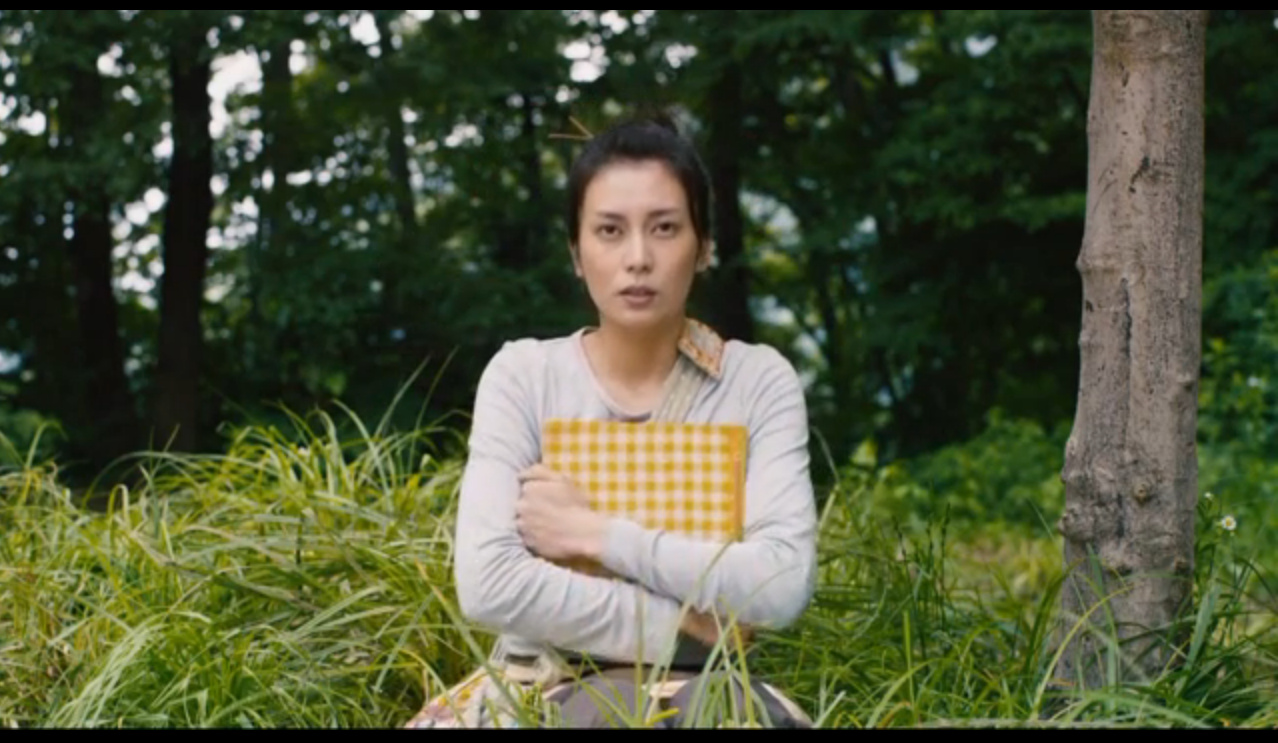
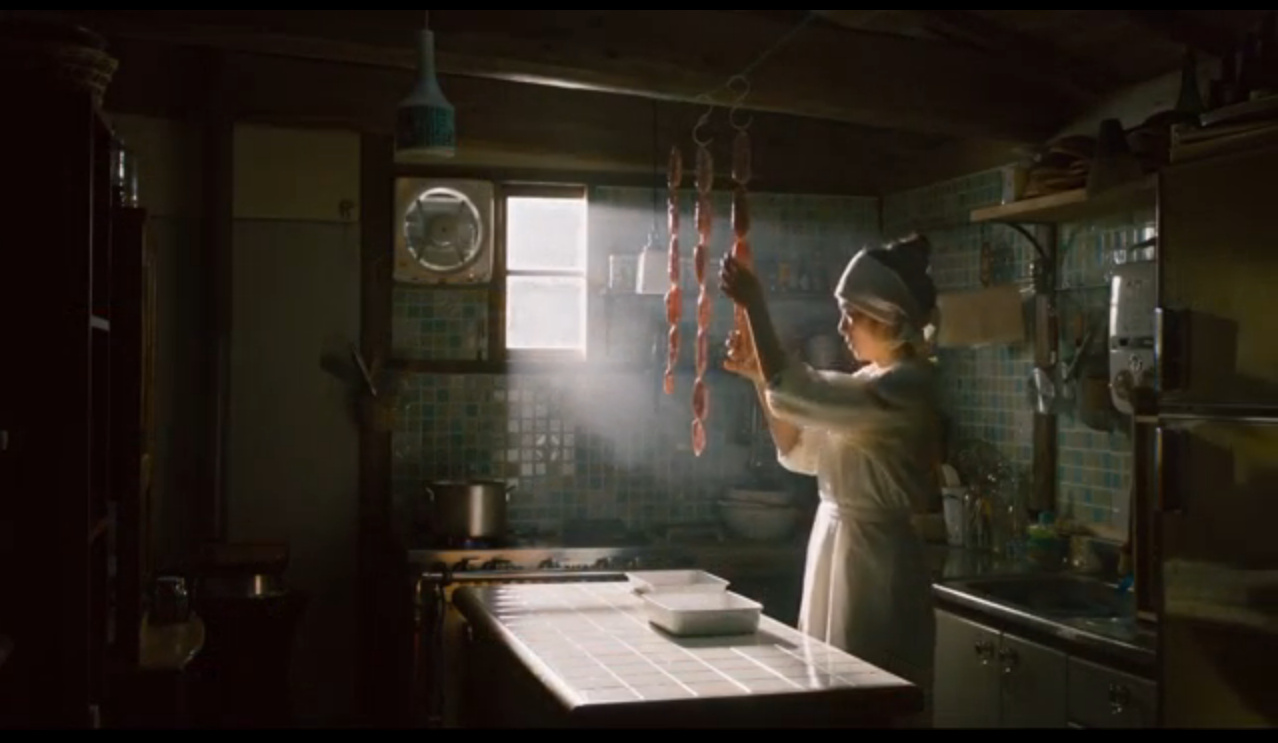
Food and film: Rinco’s Restaurant

May 17, 2015 By: Mai Truong Category: Film/TV, Japanese

rincosdream
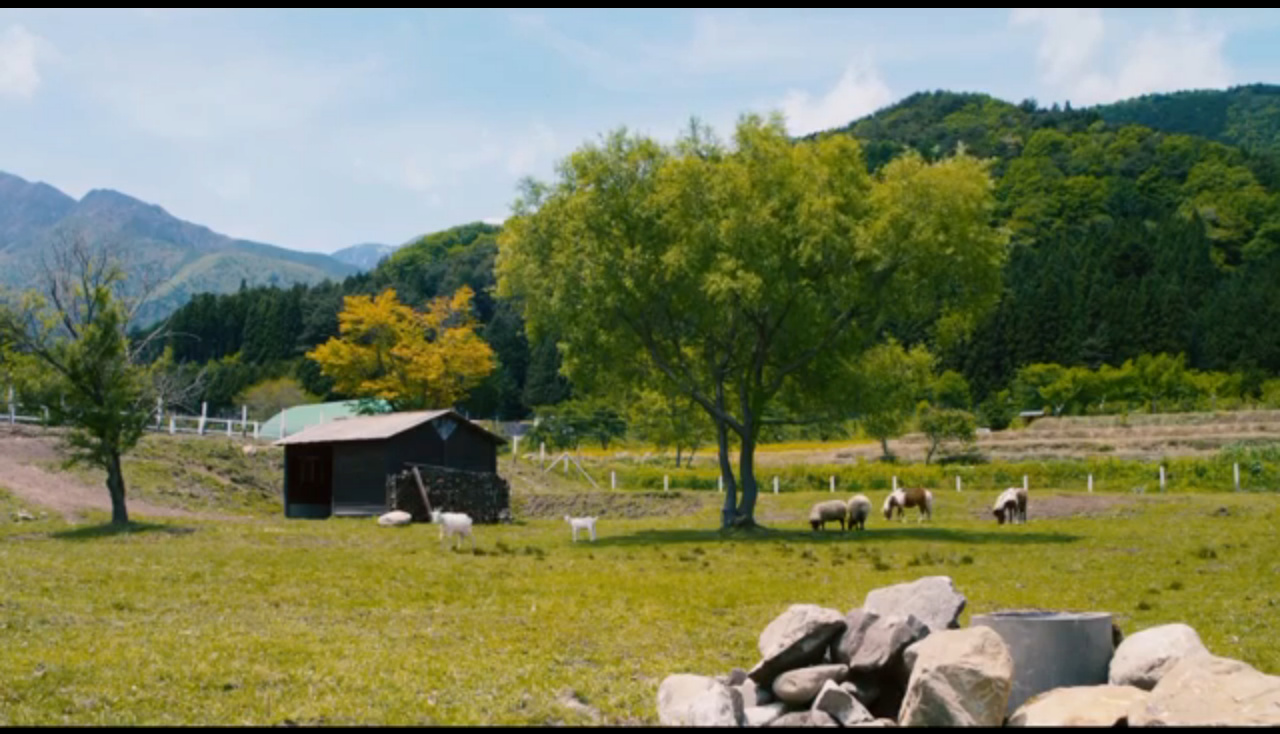
This movie is Slow Food personified. It is about food that’s cooked in a slow way (literally), and the movie itself is at a pace that could not be slower. Since childhood, the protagonist has always dreamed to make a restaurant. With the help of a family friend, she succeeded in converting her mother’s back shed into one, where she only serves one table per day, and the customer leaves it up to her to decide the courses. Her restaurant is named Restaurant Snail.

As always the case with Japanese movies, there are several scenes that can easily be a painting. The cast doesn’t go the cutesy or glamorous way; in fact, they don’t make themselves beautiful, but the beauty comes from the realistic portrayal of people in their normal lives.

rincoinkitchen
The food is quite diverse, it’s not only Japanese food. I was surprised that Rinko can find some of the ingredients that she uses, considering that the setting of her town seems to be rural Japan. I mean, would we be able to find lamb chops and pomegranates in a local grocery store in Smallville, Kansas? Hmm…

farmscenery
The movie has a positive, child-like innocence appearance – lush sceneries, colorful animation, simple dialogues – but what lies beneath is left unsaid. In that sense, Rinco’s Restaurant may easily resonate with the broadest audience: whichever background you have, whichever feeling you’re harboring when you sit down to watch the movie, there’s a piece in the characters’ lives and emotions that you can identify with, because these characters are not fancy superheroes. They’re us. (Except for the cooking part.)

Although there are parts that I can’t agree with towards the end (you’ll know what I mean when you watch the movie), they are consistent with the slow-food theme, where you eat things with appreciation and respect. Somewhere in the trailer, the narrator says this: Eating is living and loving (「食べることは、生きること、そして、愛すること.」), which is universally agreeable. Although I’ve been using “slow food” for lack of a better word and because that’s how we refer to the traditionally cooked, non-factory-produced food in modern days, the theme in this movie very much embodies traditional cooking in general and the Japanese mindset toward food in particular.

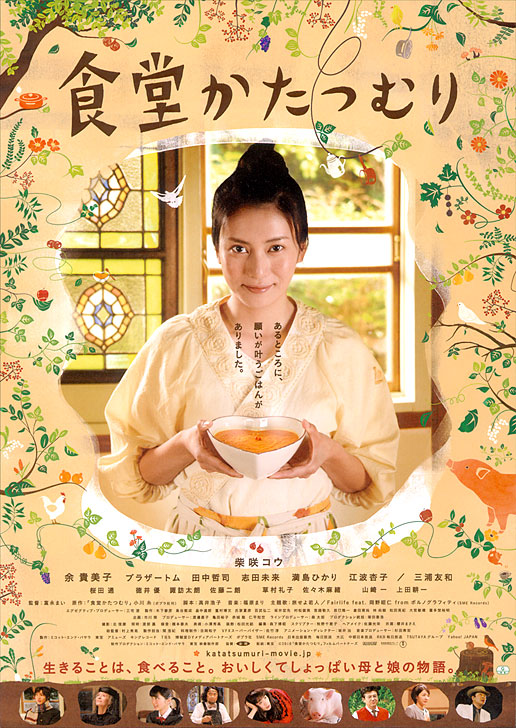
Image taken from asianwiki.com

Image taken from asianwiki.com

The Japanese title is Shokudo Katatsumuri (食堂かたつむり), which literally translates to “Restaurant Snail”, the name of Rinko’s restaurant. The story is based on Ito Ogawa (糸・小川)’s 2008 novel of the same title and directed by Mai Tominaga (マイ・富永). Watch Rinko’s Restaurant here on Viki.

rincofeedserumesu
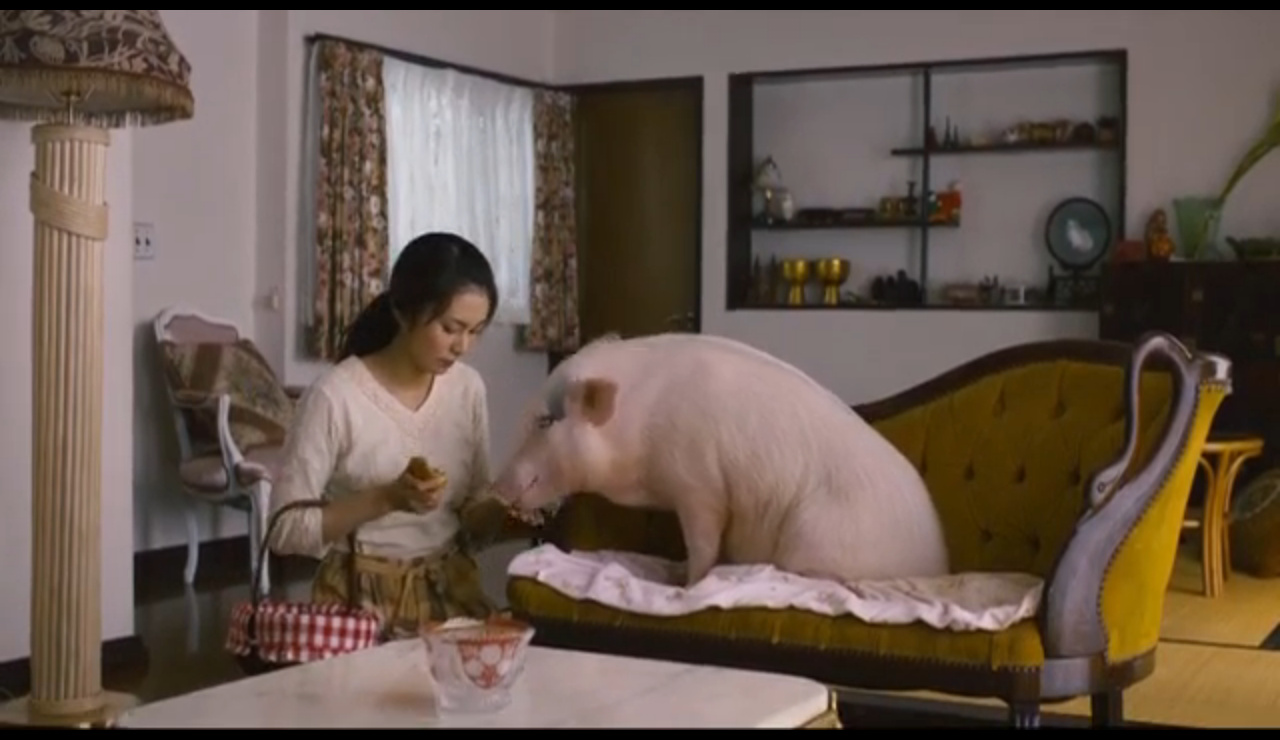
Spoiler: there is a cute piggy, her name is Erumesu. Erumesu is very picky about food. She’s also well kempt and can talk to Rinko telepathically. Rinco’s mom goes to bed hugging Erumesu. Imagine hugging Erumesu! (^_^)

Nishikata Film Review offers a more in-depth assessment of Rinco’s Restaurant with references and mentioning of other Japanese food films.

Pretty Good Number One bucket list

January 12, 2014 By: Mai Truong Category: Book, Japanese, The more interesting

pgno
Go to Tokyo. Visit the Odaiba Takoyaki Museum. Practise using chopsticks correctly and buy a (few) pairs at Kappabashi. Eat shave ice and watch fireworks (and people) on the Sumida river bank in July. Eat pan-fried soup dumplings in a neighborhood dumpling restaurant in Nakano. Eat “hone” (pronounced |hoh-nay|, meaning: deep-fried sea eel backbone). Stop eating eel because they’re in the red on the Seafood Watch list.

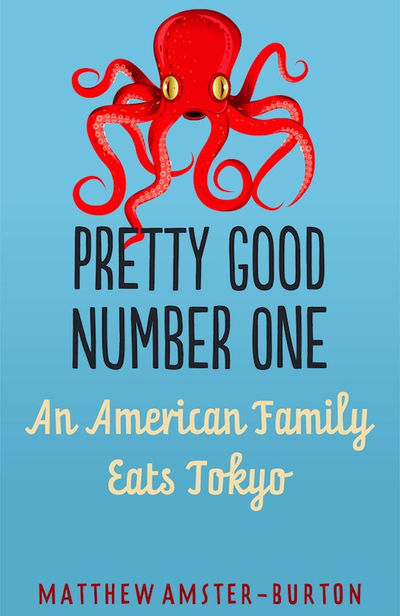
Thanks to Matthew Amster-Burton’s book, I’ve had the first 7 items on my bucket list figured out (it’s a bucket list, not a to-do list because of the stop-eating-eel thing). I can’t wait to do them (except the stop-eating-eel thing). If a few months ago I was complacent with imaginatively traveling through booksPretty Good Number One throws one delicious, chuckle-inducing paragraph after another to my face and say “go to Tokyo, you lazy donkey”. Just about the most expensive place to visit in the world, thanks, Mr. Amster-Burton. 😉

Except for the part where he describes Chinese green tea as having “a hint of smoky barbecue” and how red bean paste is an acquired taste for Westerners (because beans are supposed to show up in savory foods, not sweets – hello, pumpkin pie?), Pretty Good Number One is enjoyable every minute of reading.

The book is short (only 227 pages) in relatively big clear font. It took me a few 10-minute bus rides and one Christmas Eve to finish. It is a good guide for Westerners (and anyone who hasn’t been to Tokyo) and a respectful and honest glimpse into a city in the East. Andrea Nguyen of Viet World Kitchen posted a long wonderful talk with Amster-Burton about the book last year.

Pictures are available on prettygoodnumberone.com, but I’m not looking at them too closely in fear of sleepwalkingly booking a Tokyo-bound flight tomorrow. Amster-Burton’s writing is so witty and the stories about his little “hungry monkey” Iris are cheezburger-cat level of adorable!

Amster-Burton also includes a long list of his recommended readings at the end (some of which he mentions intermittently throughout the book), and I’ve made my first Amazon’s wish list (so many first lists because of Pretty Good Number One!). It is against my traditional Vietnamese culture to outright ask for gifts (man I feel so shameless!), but JUST IN CASE you ever think about supporting Flavor Boulevard… 😉

Judy and Loving Live Treats

December 16, 2013 By: Mai Truong Category: American, California - The Bay Area, Food product, sweet snacks and desserts, Vegan

lovinglivetreats-3flavors
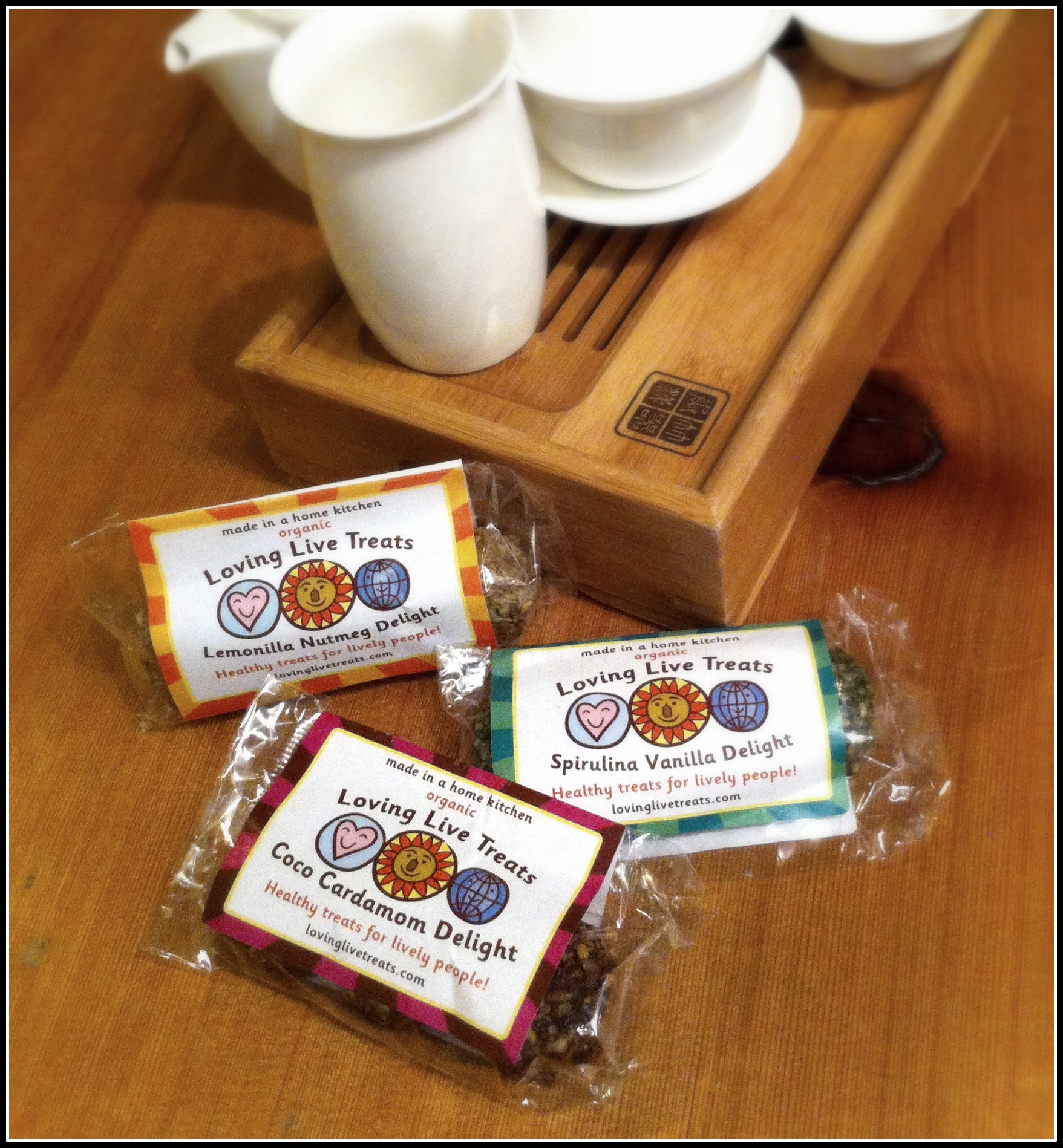
I met Judy in early November. I happened to sit down next to her at Teance, when she was just about to leave and I had just arrived. For some reason, Judy offered me a small, homemade cookie to try. The cookie was interesting, and so is Judy. We exchanged business cards.

With this post, I’m going to risk sounding like a sarong-wearing 62-year-old white-male yoga preacher [there are many of them in Berkeley, sometimes they start talking to you on the street and make everybody uncomfortable], because you know what, some philosophies are beautiful and there’s nothing wrong with appreciating them. With that said, if your patience runs low on the subjects of philosophy, spiritual growth or simply good feelings in general, skip ahead to Part II.

Part I – The Story behind the Treats

After September 11, 2001, Judy Fleischman moved from Oregon to New York, began training as a healthcare chaplain.

“I was on the go a lot,” said Judy. “I needed to bring food with me so that I wouldn’t go broke. In Oregon I got introduced to raw foods, so I started experimenting with making raw healthy snacks to keep me going… Snacks that weren’t just a sugar crash.”

After making batches of these raw, vegan treats with sprouted seeds for herself, she began sharing them with family and friends and began to feel what she called “the gift of giving”.

“Now when I think of the word ‘healthy’, it’s not just the food but the relationship with the people and the ingredients,” Judy said.

Judy’s inspiration stemmed from wagashi – petite, graceful Japanese sweets for tea ceremony that appeal to all five senses, and the philosophy of “mindful eating” in zen training, which she explains as knowing “the difference between a craving and real nourishment”.(*)

In the midst of working as a healthcare chaplain and interacting with stressed people, Judy felt that the treats she made were “wholesome”, and that she “had the urge to share and give to others”, so she started making single packagings to give them out to people at farmers’ markets. As part of the Sensing Wonder group, she was also giving out cups of iced jasmine tea at the Imagine Circle. The more she gave, the more fulfilling she felt.

Loving Live Treats “sprouted from this personal transformation and interaction with the community” to become what Judy hopes to be a mean to sustain her livelihood. Economically, we all need to make a living; spiritually, Judy appreciates and finds it enriching to be able to share what she makes with others – a way of life that she wants to pursue and believes that many others do. That’s why the cookies are wrapped in packages of three – one can surprisingly satiate your hunger (I was amazed myself, considering each is only 0.6 oz [about 17 grams]!), and there are two more to share with friends.

Or share with strangers. Over a month ago, Judy randomly shared it with me, a complete stranger. Somehow, we create new friendships that way, however temporary. Loving Live Treats from start to finish revolves around friendship, whether it was momentarily like the interaction with people at the Imagine Circle, or long-term like with Rodney Alan Greenblat, the artist who designed the label. Perhaps partly because it revolves around friendship, that Judy is happy when she makes them. That happiness shows in the treats, from the playful, childlike label inwards.

lovinglivetreats-packaged
Part II – The Treats

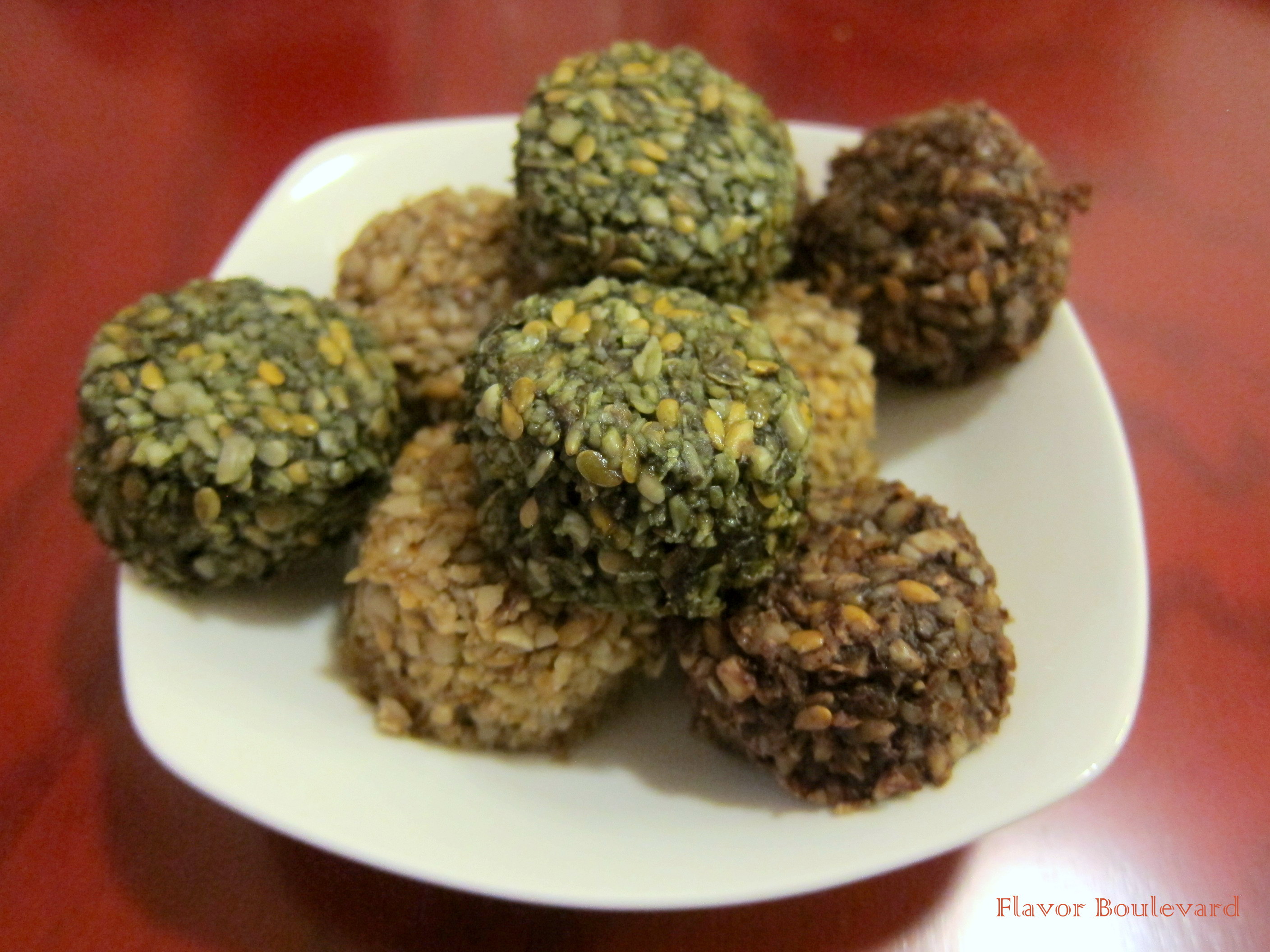
Sprouted sunflower and golden flax seeds, coconut, agave nectar, Himalayan salt, low-temperature dehydrated and compressed into circular cubes (if you know a better word for this shape – not “cylinder”!, please tell me ^_^). There are three different flavors: lemon-vanilla-nutmeg, spirulina-vanilla, and cacao-cardamom. My personal favorites are the Coco Cardamom and the Spirulina (sorry, Nutmeg!), but they’re all precious actually, and the differences are about as pronounced as those between Chinese oolongs and Taiwanese oolongs. That’s the point – nothing too sweet, nothing too strong, just little seeds cozily nudged together. Satisfying on their own and a delicate but reassuring accompaniment to tea.

They’re the opposite of a chocolate chip cookie, which gives you instant satisfaction and an even bigger craving five seconds later. Recently, I watched this Japanese movie “I Wish” by director Hirokazu Koreeda (the Japanese title is Kiseki (奇跡)**), there’s a small detail that I can’t forget: the boys’ grandfather made karukan (a sweet rice-flour sponge cake), at first the older brother thought it wasn’t sweet enough, but Grandfather wouldn’t change his way. Near the end of the movie, the older brother gave a piece to his younger brother. The younger boy also found it “mellow”, i.e., a little bland. Afterwards, when the grandfather asked the older brother what his younger brother thought of the karukan, he smiled and replied “he’s still young”.

When I have an ice cream craving, and I have it ALL the time, admittedly I don’t always reach for an LLT Lemonilla Nutmeg. Like the younger brother in Kiseki, I’m still wet behind the ears when it comes to appreciating the finer things. But when I do reach for an LLT, I get surprised every time – it gratifies in the most pleasant way possible.

–/–

Loving Live Treats by Judy Fleischman: can be ordered for home delivery from GratefulGreens.com, found at the monthly Bay Area Homemade Market, and soon to be served at Teance and Asha Tea House (Berkeley).

–/–

FOODNOTES:

(*) According to the philosophy of mindful eating, there are six types of hunger – eye hunger, mouth hunger, nose hunger, stomach hunger, cellular hunger mind hunger and heart hunger. My guess is to satisfy a craving means you satisfy only one type of hunger, whereas real nourishment satisfies all six.

(**) For now, you can watch Kiseki here. You know how after watching some movie, someone would ask “did you like it?”, and all you can honestly say is “hmmm…”? Well, Kiseki is that kind of movie. It’s not loaded with laughters or gunshots or flying dragons or tear-jerking moments, but let it sit for a few days and the sweetness slowly steeps throughout your veins. Like the grandfather’s mellow karukan.

Blue Trout and Black Truffles – a journey through Europe in 300 pages

November 06, 2013 By: Mai Truong Category: Book

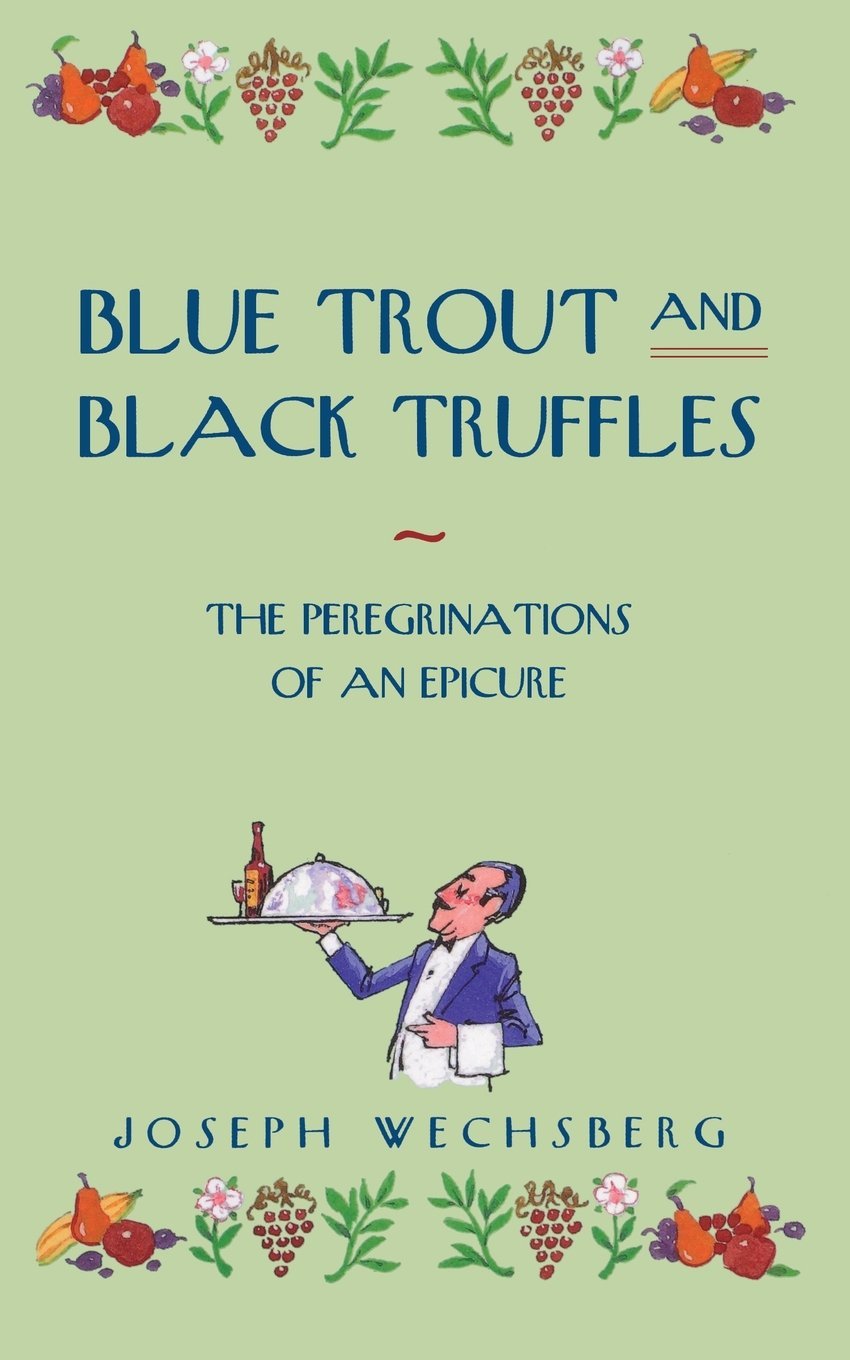
Blue Trout and Black Truffles by J. Wechsberg (Academy Chicago Publishers, Second printing 2001), but the book seems to have been published in German as well (Forelle blau und schwarze Trüffeln (1964)), as Wechsberg also wrote in French, German and Czech (although a majority of his works is in English).

Blue Trout and Black Truffles by J. Wechsberg (Academy Chicago Publishers, Second printing 2001), but the book seems to have been published in German as well (Forelle blau und schwarze Trüffeln (1964)), as Wechsberg also wrote in French, German and Czech (although a majority of his works is in English).

When I was little, and even now, my mom would tell me about the regional specialties of provinces in Vietnam and even other countries. She’s not a traveller, those were places that she has never been to, but she read about them in books and she has the uncanny memory to remember every detail of what she reads and recite it with such enthusiasm and emotion that makes you feel like you’re reading the book yourself. So I never felt the need to travel. (The only thing you can’t really experience from reading is the smell – it’s often the hardest sense to put into words, and any word description is always an understatement of the actual smell.)

Good writers can make you want to travel to the place they describe, taste the food they praise, meet the people they talked to. And then there are the really good writers who pull you into the story. When you read their books, you’re already at that place, eating what they’re eating, listening into their conversation.

When I read “Blue Trout and Black Truffles” by Joseph Wechsberg, I was in Vienna eating Tafelspitz (you have to capitalize the word because it’s German, and did you know that there are 24 different varieties of boiled beef, only one of which is Tafelspitz? [I admire the precision but I’m not convinced of the taste…]), then I was in Prague stuffing down knedlíky (dumplings that contain small cubes of fried bread, dumplings filled with whole plums, cherries, sweet cabbage [?!] or nuts, dumplings made of butter, egg yolk, dry cottage cheese, salted and “almost as light as a soufflé” [!]). I was strolling through the woodlands of Périgord, following a little pig named Mignon in search for black truffles (and almost got convinced that truffle tasted good). Wechsberg, with his gentle, objective humor and a hidden whiff of discerning aloofness, took me from Ostrava before World War I to Budapest in 1946 (when Hungary was still inside the Iron Curtain), then south to Genoa, “where the skies were blue and the people still knew how to laugh” (and made supposedly phenomenal ravioli), then northwest to Paris and Bordeaux and Lyon. I don’t know French and could only silently mumble through the included menus as I read, I’m not even that much into European cuisines, but like an old Roman chapel near L’Oustau de Baumanière in Les Baux-de-Provence, where “even the unbelieving feel the urge to kneel down”, this book makes even the non-drinker feel the urge to hold a champagne flute by the base (and never at the stem!) [I actually can’t picture how that works (-_-‘)].

At 8 am, I finished the last page. I took a shower until 8:45, then went out to lunch with Cheryl at 11. We had soba at Ippuku. I felt like reciting the old Hungarian proverb, “We are poor, but we live well.”

–.–.–.–.–

A few favorite tidbits:

  • “Prague’s women had great charm and vivacity, but they were rarely slim and long-stemmed. Dumplings were the national indoor amusement; to eat twenty or thirty dumplings at one sitting was considered a feat of virility.” (84)
  • “… as they say in Bordeaux, people take on the color of the wine that they ‘work’ and drink. M. Landèche’s face had the reddish color of the grapes of Château Lafite-Rothschild. And M. Henriot’s hue reflected the golden glow of the wines of Château d’Yquem.” (190)
  • “[La Tour d’Argent] was an immediate success and always jammed, but there was always a way of getting a table. A cavalier who had neglected to make his reservation would pull up his horse, walk in, challenge one of the guests to a duel, kill him with sword or lance, and take his place.” (227)
  • Wild goose with plum sauce at La Tour d’Argent was Cardinal Richelieu’s favorite. (228) [To encourage me to eat, my mom would tell me “The Three Musketeers” story (by Alexandre Dumas) while spoon-feeding me. After that story finished, we continued to (and consequentially finished) its two sequel novels, also by Dumas. Ah the good old days…]
  • “You can export all the ingredients, and even the cook, but you cannot seal in a can the shining of the Sun or the blue of the sky and the sea, and pour it into the saucepan.” (127) <– EXACTLY why I would only consider food made by Japanese in Japan truly authentic Japanese food, and likewise with other cuisines.
  • “A Balatoni Fogas to Start with” really resonated with me, perhaps because I’m from Vietnam and know first- (and second-) hand the detrimental effects of communism on Culture [yes, capitalized Culture].
  • “One Moment in Heaven”, “Afternoon at Château d’Yquem” and “Provence without Garlic” are lovely pieces on wine and France [I think… as if I knew anything about wine].

A little bit about the author:

Joseph Wechsberg worked as the European correspondent of The New Yorker from 1949 to 1983. He studied Law and Economics in Prague, Vienna and Paris, then he studied violin at the Wiener Konservatorium, played music in Parisian nightclubs and later on cruise ships to New York and the Far East. His well-travelled experience gave him great advantage in becoming a journalist and a writer. “Blue Trout and Black Truffles” is a collection of essays, some of which originally appeared in The Atlantic, Cosmopolitan, Gourmet, Holiday, and The New Yorker. [I feel incredibly inspired, but that means I need to start traveling and collecting some world(ly) experience soon. (-_-‘)]

Save one meal each month for moon bears

October 23, 2013 By: Mai Truong Category: Opinions, Website

wilfred
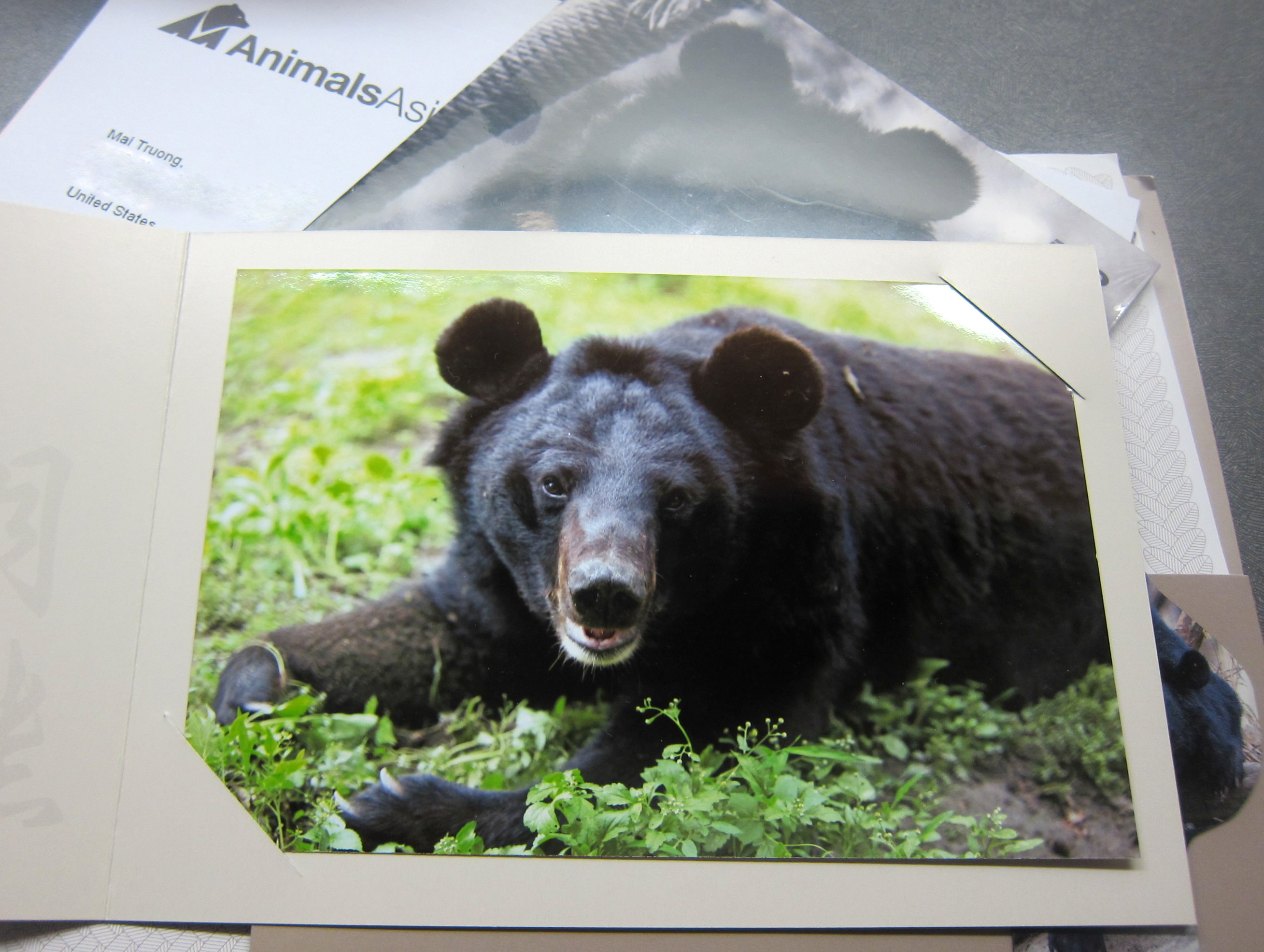
This is Wilfred. He lives in Chengdu, China. He’s an early-middle-age moon bear (not because he’s from the Moon but because like everyone in his species, he has a moon-shape patch of yellow fur on his chest). He likes watermelon and loves to climb. On paper, he’s my sponsored bear.

Wilfred is blind in both eyes, most likely a result of the poor treatment for bile-farmed bears. But at least he’s alive and now cared for in an animal shelter, something that thousands of his species can only dream of while being barred in iron cages, fed only gruel and extracted bile twice a day.

Bile farming   —   In Asia, there’s a belief that bear bile, a digestive juice produced from the liver and stored in the gall bladder, has medicinal effects. This belief originates from China, spreads to the neighboring countries, and results in the shameful practice of bile farming. Wild bears are hunted and kept captive in “bile farms”, where their abdomens are pierced to extract the bile from the gall bladders twice a day. Only rarely is there anesthesia, their abdomens are either stabbed repeatedly until the gall bladder is found, or the wound is kept perpetually open (not allowed to heal), which causes infection and so much pain that they would chew their own paws. The bears stay in cages designed for easy access to their abdomen, and the cages are too small for them to stand up or move around at all. They live for years in such condition until they no longer produce any bile, when they are killed for meat, fur, paws and gall bladders, or until they die from malnutrition and diseases.

Bear bile farming started in North Korea in the 1980s and spread to China, South Korea, Vietnam and most recently Laos (since 2005, when Vietnam banned bile farming). Today, bile trade is legal in China, Laos, Japan and South Korea, and illegal in Vietnam (however, due to loopholes and government negligence, bile farming still exists in Vietnam *sigh*).

Bear rescue   —   Organizations such as Animals Asia set out to negotiate with the governments and the farmers in these countries to rescue the bears and to provide them medical care (many bears need surgery after being rescued because of the years of damage) and food in bear sanctuaries. To date, Animals Asia has rescued a total of 400 bears. However, tens of thousands are still in bile farms, mainly in China. It’s an arduous process to convince the indifferent, money-hoarding governments and the farmers, who, for the benefit of the doubts, are presumably just trying to make a living. It’s also expensive to raise bears the humane way.

I had known about bile farming for many years, but I never looked up any information about it. As time passed, it became something like the thinning of the ozone layer – a problem that I feel so troubled by that I buried in the back of my head and avoided thinking about it altogether. Early August, my mom saw on TV that some organization was rescuing bears from Ha Long Bay (Vietnam), and she told me about it. That organization turned out to be Animals Asia. One of their programs is “sponsoring a bear,” a monthly donation program. You can sponsor a normal bear for $45, or a special care bear (one that is more severely damaged from bile farming, like Wilfred) for $55 a month.

It doesn’t take a whole lot to help   —   Forty five dollars was exactly how much I paid for one dinner at Belli (after my cousin took care of more than half the bill). That dinner wasn’t anything exceptional either, that’s just how much one would expect to spend on a decent meal made of good ingredients around Berkeley. In the past two years, I regularly spent this much or more per dinner, which is quite outrageous when you think about it. Even more outrageous is that rarely did those expensive meals leave me satisfied. So that just leaves a bad taste. But now, with the money I spend on one single meal, Wilfred can have enough food for a month, and I believe he enjoys his food a lot more than I enjoy mine.

Admittedly, it feels weird talking about my spending and donation. It sounds like I’m bragging about my non-existent wealth and puny generosity, and I apologize for that (._.). My intention, though, is to advertise for Animals Asia and hope to convince you to donate for the bears (._.). Animals Asia seems different from other wild life organizations – they don’t bombard us with letters, stationaries and calendars. The donated money at least doesn’t seem to be spent on advertising and “raising awareness”, but goes straight to the animals.

On my end, except for special occasions and work-related meals, you won’t see me stuffing my face at restaurants anymore [says the girl who just stuffed herself with pork shoulder last week!]. Wilfred (and his bear buddies) are holding down the fort for me. I only wish I could take a picture of them chowing.

P.S. Animals Asia’s website is not quite easily navigated at the moment [Update: Animals Asia tweeted me that they’re in the process of changing website], so here are some info links, if you’re interested in donating for the bears *wink wink nudge nudge*

Andy Warhol’s quotes on food

September 25, 2013 By: Mai Truong Category: Book, Opinions

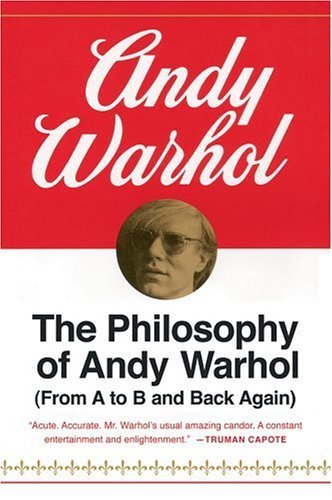
PhilosophyofAndyWarholBookcover
Around spring of 2012, I discovered The Philosophy of Andy Warhol. I’m not a fan of his art works. (I like traditional arts, he’s the most prominent figure in American pop arts, which I actually find weirdly fascinating, though.) His life was the exact opposite of mine. (To start, he’s somebody, I’m nobody.) But I find his view on life strangely resonating and, thus, comforting.

Andy Warhol was also big on food. Very American, very industrial food, but still food. A nice portion of his art works features Campbell’s tomato juice and soups, ice cream, hamburgers and bananas [which I can’t show here because it would entail paying fees ($40 per image) to the Andy Warhol Museum and many legal steps to obtain permission from the Artist Rights Society (I checked). As much as I want to support arts, my humble blog is in no condition for such extravagance. Besides, Google Images does a great job]. Back to food, in the third “Men in Black” movie, when Agent J (Will Smith) goes back in time to stop alien crime stuff, he and Agent K (Tommy Lee Jones) went to a rowdy party looking for Agent W (Bill Hader), whose alias was “Andy Warhol”. While they were discussing alien business, someone called for Andy Warhol, to which Agent W replied “tell her that I’m filming a man eating a hamburger. It’s… uh… transcendent.” That’s my favorite scene in the entire movie.

So here’s 14 food-related quotes from Andy Warhol:

1.

And New York restaurants now have a new thing — they don’t sell their food, they sell their atmosphere. They say, “How dare you say we don’t have good food, when we never said we had good food. We have good atmosphere.” They caught on that what people really care about is changing their atmosphere for a couple of hours. That’s why they can get away with just selling their atmosphere with a minimum of actual food. Pretty soon when food prices go really up, they’ll be selling only atmosphere. If people are really all that hungry, they can bring food with them when they go out to dinner, but otherwise, instead of “going out to dinner” they’ll just be “going out to atmosphere.”

That’s just restaurants everywhere. Not the mom-and-pop shops. Not the actual street vendors. But the classy restaurants.

2.

My favorite restaurant atmosphere has always been the atmosphere of the good, plain, American lunchroom or even the good plain American lunchcounter. The old-style Schrafft’s and the old-style Chock Full O’ Nuts are absolutely the only things in the world that I’m truly nostalgic for. The days were carefree in the 1940s and 1950s when I could go into a Chocks for my cream cheese sandwich with nuts on date-nut bread and not worry about a thing. No matter what changes or how fast, the one thing we all always need is real good food so we can know what the changes are and how fast they’re coming. Progress is very important and exciting in everything except food. When you say you want an orange, you don’t want someone asking you, “An orange what?”

I’m not into progress in food either. I just want traditional food. Good old comfort food.

3.

I really like to eat alone. I want to start a chain of restaurants for other people who are like me called ANDY-MATS—”The Restaurant for the Lonely Person.” You get your food and then you take your tray into a booth and watch television.

Warhol had a fascination for television and diners. He also had a fascination for emptiness, most likely because everything felt empty for him.

4.

But if you do watch your weight, try the Andy Warhol New York City Diet: when I order in a restaurant, I order everything that I don’t want, so I have a lot to play around with while everyone else eats. Then, no matter how chic the restaurant is, I insist that the waiter wrap the entire plate up like a to-go order, and after we leave the restaurant I find a little corner outside in the street to leave the plate in, because there are so many people in New York who live in the streets, with everything they own in shopping bags.
So I lose weight and stay trim, and I think that maybe one of those people will find a Grenouille dinner on the window ledge. But then, you never know, maybe they wouldn’t like what I ordered as much as I didn’t like it, and maybe they’d turn up their noses and look through the garbage for some half-eaten rye bread. You just never know with people. You just never know what they’ll like, what you should do for them.
So that’s the Andy Warhol New York City Diet.

One time I saw someone gave a banana to a homeless guy in Berkeley. The homeless guy took one bite and threw the banana away. Sometimes I give my restaurant leftovers to homeless people, I don’t know if they eat them though. Maybe I should hide in a corner and watch if they eat them.

5.

I know good cooks who’ll spend days finding fresh garlic and fresh basil and fresh tarragon, etc., and then use canned tomatoes for the sauce, saying it doesn’t matter. But I know it does matter.

It does. Warhol lived in the industrial era, I guess he would be pleased now with the revival of farm-to-table foods. Then again, he hardly found happiness in anything, so I don’t know.

6.

I also have to admit that I can’t tolerate eating leftovers. Food is my great extravagance. I really spoil myself, but then I try to compensate by scrupulously saving all of my food leftovers and bringing them into the office or leaving them in the street and recycling them there. My conscience won’t let me throw anything out, even when I don’t want it for myself. As I said, I really spoil myself in the food area, so my leftovers are often grand — my hairdresser’s cat eats pate at least twice a week. The leftovers usually turn out to be meat because I’ll buy a huge piece of meat, cook it up for dinner, and then right before it’s done I’ll break down and have what I wanted for dinner in the first place — bread and jam. I’m only kidding myself when I go through the motions of cooking protein: all I ever really want is sugar. The rest is strictly for appearances, i.e., you can’t take a princess to dinner and order a cookie for starters, no matter how much you crave one. People expect you to eat protein and you do so they won’t talk. (If you decided to be stubborn and ordered the cookie, you’d wind up having to talk about why you want it and your philosophy of eating a cookie for dinner. And that would be too much trouble, so you order lamb and forget about what you really want.)

This is where I’m different, but also the same. Food is indeed my great extravagance, but I like leftovers (if I like what I order in the first place). And the only thing I ever truly want is carb. I would steam some squash blossoms or braise some pork, and after I’m done, I break down and go to the diner downtown and get pancakes. Or I microwave some ramen.

7.

What’s great about this country is that America started the tradition where the richest consumers buy essentially the same things as the poorest. You can be watching TV and see Coca-Cola, and you can know that the President drinks Coke, Liz Taylor drinks Coke, and just think, you can drink Coke, too. A Coke is a Coke and no amount of money can get you a better Coke than the one the bum on the corner is drinking. AM the Cokes are the same and all the Cokes are good. Liz Taylor knows it, the President knows it, the bum knows it, and you know it.
In Europe the royalty and the aristocracy used to eat a lot better than the peasants—they weren’t eating the same things at all. It was either partridge or porridge, and each class stuck to its own food. But when Queen Elizabeth came here and President Eisenhower bought her a hot dog I’m sure he felt confident that she couldn’t have had delivered to Buckingham Palace a better hot dog than that one he bought her for maybe twenty cents at the ballpark. Because there is no better hot dog than a ballpark hot dog. Not for a dollar, not for ten dollars, not for a hundred thousand dollars could she get a better hot dog. She could get one for twenty cents and so could anybody else.

Again, the common diner theme. I quoted this quote before.

8.

When I was a child I never had a fantasy about having a maid, what I had a fantasy about having was candy. As I matured that fantasy translated itself into “make money to have candy,” because as you get older, of course, you get more realistic. Then, after my third nervous breakdown and I still didn’t have that extra candy, my career started to pick up, and I started getting more and more candy, and now I have a roomful of candy all in shopping bags. So, as I’m thinking about it now, my success got me a candy room instead of a maid’s room. As I said, it all depends on what your fantasies as a kid were, whether you’re able to look at a maid or not. Because of what my fantasies were, I’m now a lot more comfortable looking at a Hershey Bar.

9.

It’s strange the way having money isn’t much. You take three people to a restaurant and you pay three hundred dollars. Okay. Then you take those same three people to a corner shop — shoppe — and get everything there. You got just as filled at the corner shoppe as at the grand restaurant — more, actually — and it cost you only fifteen or twenty dollars, and you had basically the same food.

Yet again, the common diner theme.

10.

Of the five senses, smell has the closest thing to the full power of the past. Smell really is transporting. Seeing, hearing, touching, tasting are just not as powerful as smelling if you want your whole being to go back for a second to something. Usually I don’t want to, but by having smells stopped up in bottles, I can be in control and can only smell the smells I want to, when I want to, to get the memories I’m in the mood to have. Just for a second. The good thing about a smell-memory is that the feeling of being transported stops the instant you stop smelling, so there are no aftereffects. It’s a neat way to reminisce.
[…]
When I’m walking around New York I’m always aware of the smells around me: the rubber mats in office buildings; upholstered seats in movie theaters; pizza; Orange Julius; espresso-garlic-oregano; burgers; dry cotton tee-shirts; neighborhood grocery stores; chic grocery stores; the hot dogs and sauerkraut carts; hardware store smell; stationery store smell; souvlaki; the leather and rugs at Dunhill, Mark Cross, Gucci; the Moroccan-tanned leather on the streetracks; new magazines, back-issue magazines; typewriter stores; Chinese import stores (the mildew from the freighter); India import stores; Japanese import stores; record stores; health food stores; soda-fountain drugstores; cut-rate drugstores; barber shops; beauty parlors; delicatessens; lumber yards; the wood chairs and tables in the N.Y. Public Library; the donuts, pretzels, gum, and grape soda in the subways; kitchen appliance departments; photo labs; shoe stores; bicycle stores; the paper and printing inks in Scribner’s, Bren-tano’s, Doubleday’s, Rizzoli, Marboro, Bookmasters, Barnes & Noble; shoe-shine stands; grease-batter; hair pomade; the good cheap candy smell in the front of Woolworth’s and the dry-goods smell in the back; the horses by the Plaza Hotel; bus and truck exhaust; architects’ blueprints; cumin, fenugreek, soy sauce, cinnamon; fried platanos; the train tracks in Grand Central Station; the banana smell of dry cleaners; exhausts from apartment house laundry rooms; East Side bars (creams); West Side bars (sweat); newspaper stands; record stores; fruit stands in all the different seasons — strawberry, watermelon, plum, peach, kiwi, cherry, Concord grape, tangerine, murcot, pineapple, apple — and I love the way the smell of each fruit gets into the rough wood of the crates and into the tissue-paper wrappings.

My mom always says she doesn’t like Berkeley, but Berkeley is growing on me, and I feel like a traitor for letting it grow on me. One big thing about Berkeley is that I can walk here. I used to hate walking because it’s inefficient and especially when it’s sunny. But when I started learning about tea, I started rubbing my fingers on whatever leaf or flower along the road to train my nose. At some point, I didn’t have to rub anymore and could still smell the leaves walking by. I began to like walking then.

11.

I put my napkin over the bowl of cherry pits so I wouldn’t have to look at how many I’d eaten. That’s the hard part of overdosing on cherries—you have all the pits to tell you exactly how many you ate. Not more or less. Exactly. One-seed fruits really bother me for that reason. That’s why I’d always rather eat raisins than prunes. Prune pits are even more imposing than cherry pits.

12.

You take some chocolate . . . and you take two pieces of bread . . . and you put the candy in the middle and you make a sandwich of it. And that would be cake.

13.

My favorite simultaneous action is talking while eating. I think it’s a sign of class[…,] knowing how to talk and eat at the same time. […] It’s very important if you go out to dinner a lot. At dinner you’re expected to eat—because if you don’t it’s an insult to the hostess — and you’re expected to talk — because if you don’t it’s an insult to the other guests. The rich somehow manage to work it out but I just can’t do it. They are never caught with an open mouth full of food but that’s what happens to me. It’s always my turn to talk just when I’ve filled my mouth with mashed potatoes.

Is that why he liked to eat alone? I was telling Kristen how I went to this Korean restaurant in Oakland Chinatown when I had jury duty. I was very tired and just wanted some comfort food. When the owner ladies brought me my samgetang (chicken and ginseng soup), they also started talking to me. A lot. Not only was I by myself, I was also the only customer at that time (it was past lunch time). Between smiling and responding to them, I had no time to eat. I really, really just wanted to eat my soup.

14.

In high-class stores they sell through “display,” in low-class ones they sell through “smell.”

Warhol was talking about clothing stores here. But I think it’s true for food business too.

Food and Film: 4 short animations with food

August 28, 2013 By: Mai Truong Category: Film/TV

Short films are the best, because sometimes I get cravings in the middle of the night and there are no restaurants open (I wish something opened between midnight and 5 am, a rice porridge stall or a noodle soup vendor would be nice).

1. Omelette – by Madeline Sharafian. (Copyright CalArts Films)
Simple and sweet.

2. French Roast – (Oscar Nominated Animated Short 2010)
It’s coffee, not really food, but still…

3. Love Recipe – by Felipe Pizarro S. and Frédéric Bajou
Glamourous and vibrant, also kinda meaningless.

4. Taste of Nostalgia – by Raymond Lau (Aniboom Animation)
I cried.

Bonus: Crayon Dragon – by Toniko Pantoja (CalArts)
Not food, but it’s so bittersweet.

HUB Berkeley Innovation Dinner – food, food for thoughts, and some afterthoughts

August 14, 2013 By: Mai Truong Category: California - The Bay Area, Event, Opinions

Berkeley is known for many things.

The protests, the hippies, the arts, homeless people, the diversity and the acceptance of that diversity (you can literally see every type of people and every type of activity in this city, and anyone who has actually lived here would stop seeing them as different types of people, just as people).

Berkeley also has the best public university in America, and actually the only public university that ranks above the Ivy league schools in many disciplines. (Public universities usually suffer in rankings not because of the students’ quality or the teaching quality, but because of the professor-to-student ratio, which is lower than those of private schools. Why? Ask the government about funding for public schools.) UC Berkeley was the reason I came to Berkeley, and for a while I hardly thought of the city as anything but the school. For a while, the academic life was my only life, and what I had planned for was a straight path into academia (and never out of it). But things change, and on some days, I feel lost. This is when I find that the city of Berkeley is more than the university it contains. That it has people who want to make change, who actually do it, who are willing to teach others how to do it, and some that are all three. Perhaps even more importantly, it hosts the environments where I can meet those people.

The dinner event that HUB Bay Area organized last week is one of those environments. Originally, I was hesitant to go, the official name of the event is “Innovate Berkeley: Sustainable Economic Development – East Bay Social Innovation Dinner”, and its list of participants include CEOs and founders of companies, architects, scientists, people who have not only ideas but the experience of doing something pertaining to the economy, and what do I put in the register box? “Student”. I was hesitant because I didn’t have anything to bring to the table. In the end, I went.

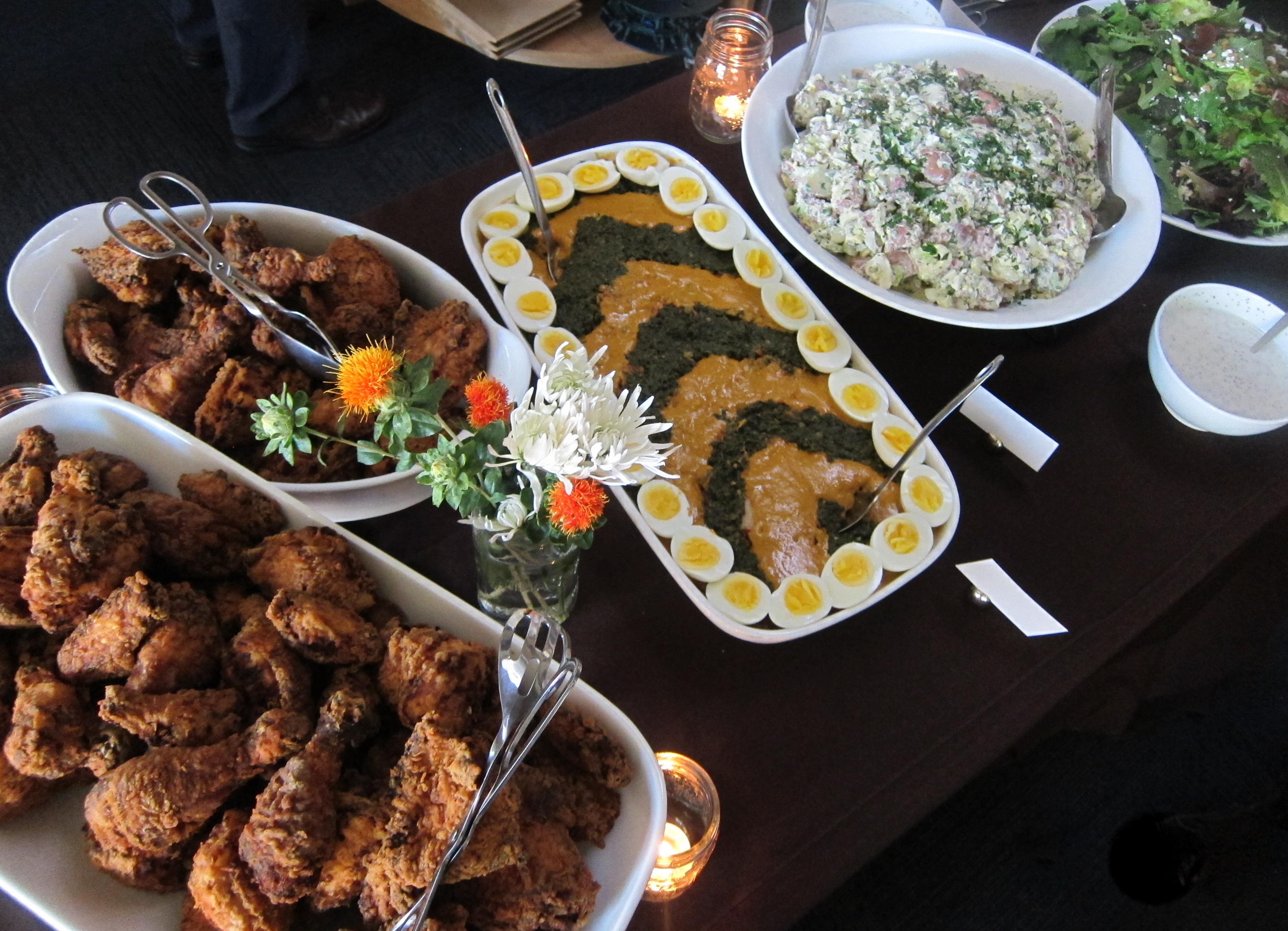
HUB dinner buffet - prepared by chef Hugh Groman and his catering staff.

HUB dinner buffet – prepared by chef Hugh Groman and his catering staff. Baby lettuce salad with plum, goat cheese, pine nuts and sweet poppy seed vinaigrette; potato salad with celery, red onion, sweet pickle and egg; lentil salad with sundried tomatoes, radish, carrots and scallions; and lovely fried chicken (I’ve been craving fried chickens for some time, too…)

The evening began with some beer drinking and mingling. The ice breaker is a casual handshake and “what brings you here?”, followed by “why not, right? there’s free drinks!” with a chuckle. (I don’t drink, so I chuckled along with my glass of water.) Arriving on the earlier side would make it easier to get into groups, and you would get more time to talk to people, so you get to know more people before breaking up into tables for dinner. (Guess who arrived late?) The dinner is accompanied by a presentation. This time, it was an incredibly inspiring and engaging talk by Dr. Mike North about innovations, how they can be born and how they can be useful. After the talk, everyone moved around again, some grabbed desserts, most started or restarted discussions about ideas, careers, business, community developments. Serious topics. By the end of those conversations, business cards were exchanged.

Although I didn’t have anything to bring to the table, it was alright to be on the receiving end, at least this time. I learned from Barbara Hanna about computer vision, from Mike North and Jaki Levy about engineers and entrepreneurs that get together on the weekends to build communication systems for communities in Gambia, or foot brace for children in Nicaragua. Their projects connect professionals of different fields and materialize their ideas together. I listened in on a conversation among a landscape architect, a software architect and an environmental study post-grad, the topics ranged from business management to insurance policies on buildings. There were artists too, not just tech people and businessmen, and there were talks of practical art projects. The age difference was hardly any barrier: the accomplished people in their 60s were generous, and the start-up owners in their 20s and 30s were confident.

Those conversations, the people and the dinner as a whole represent Berkeley as a city, where every idea is welcome, and everyone is open to new ideas. But unlike the usual social events, these people weren’t playing nice. If you’re wrong, they tell you that you’re wrong, and they explain. Isn’t that how innovations come about, and how Berkeley is a hub for innovations?

Over the course of three hours, I felt completely intimidated, but also motivated. My line of work is one of the farthest way you can remove yourself from humanity, both spatially and chronologically. (I study light that came from outer space 30-40 million years ago. For comparison, homo sapiens appeared about 0.5 million years ago. The folks who study dinosaurs at least still stay on earth). You can imagine the impact I make in people’s lives today: it’s non-existent. The knowledge I have about solving human world problems? Also non-existent. How can I fix that? Where do I fit in this innovative crowd? I haven’t figured it out. So I’ll keep thrusting myself into this type of event until I figure it out.

—————————————————————————————————–
I’ve published a less personal version of this post on the Daily Cal, not as an abuse of my editorial power (although it may appear so 😉 ), but because I believe that there are other students who would like to know about this type of event.

Logistics: HUB Berkeley Innovation Dinner is a monthly event organized by HUB Bay Area. The dinner is hosted at HUB Berkeley, 2150 Allston Way, Berkeley, CA 94704. Early Bird tickets cost $31.74 each.

MasterChef U.S. Season 4 Mid-Season Commentary

July 11, 2013 By: Kristen Category: American, Film/TV, Opinions

Masterchef is a reality TV show that currently airs on Fox and is in its 4th season. I’ve watched the show for three seasons now (I missed out on the first season), and have been increasingly bothered by much of the show. While I understand the need to create drama to boost up ratings and that shows about cooking that are not on food-specific channels really aren’t actually about food per se, there are some issues, particularly in this newest season, that have been consistently bothering me about Masterchef. I figured that Mai would also feel the same way, so I asked her to watch this season with me and then see if my angry reactions were justified. We decided to share our many Facebook chat conversations with you guys (slightly edited and condensed). We’ll love to create an ongoing dialogue about this show so feel free to talk back in the comments! Any points that you disagree/agree with us? Who’s your favorite/least favorite contestant? Any judges you love/can’t stand? Join in the Flavor Boulevard conversation!

Mai: Hmm, I’m watching episode 2 of MasterChef now. Doesn’t it feel like the judges choose people based on their inspirational backstory or character a bit more than their food?

Kristen: Yes! I’m really annoyed at the show right now, but I can tell you why once you’ve seen more episodes.

M: I mean, like the lady with the fried chicken and singing [Editor note: Sasha Foxx], she’s fun, but it’s fried chicken! And the yacht stewardess [Jessie Lysiak] made seabass en croute [fish fillet baked in a pastry shell], which is much more complicated than fried chicken and they said it doesn’t have what it takes??!!

K: Yeah…in a previous season Joe [Bastianich] said that rice was poor people food.

M: What????????? That is so racist!!!!!!

K: And yet pasta is perfect in his eyes. Even worst, the winner of last season is Vietnamese, and during the final challenge, they asked her why she made a Vietnamese dish when they aren’t in Vietnam…

M: Yeah! I remember that!

K: And they never questioned the other finalist who made classic French food :-/ Yeah… this show. This show.

M: They said it’s like food-truck level or something.

K: I have so much to write about.

M: Yeah, definitely! I mean, just the fact that the three judges are all white already makes it skewed.

K: There’s some kinds of food that’s “comfort home-style food” and then there’s some food that’s “unrefined and poor” (Western food v. Asian/other ethnic foods). And all the “high-end” foods that they want people to cook definitely put a lot of cooks at a disadvantage from the get-go!

M: Exactly, they need to be consistent! Either you praise high-end techniques and whatnot, or you praise home cooking, but not both!

K: Totally agree!

M: Although it’s a bit hard though, depending on the people’s goal with food, it’s hard to say which one is more skillful.

K: Yeah it makes it hard for viewers because we can’t tell if the food is actually good or bad, we only have to rely on the judges’ word!

M: The show needs to have a clear goal, are we making the next professional chefs, or are we just finding the best home cooks? I guess they should just do away with the technique and background thing and just judge the freaking food! That’s why I much rather watch “The Taste“.

K: Exactly!!! it is a Fox show though… so a lot of the show is all these weird advantages and stuff and encouraging people to backstab each other.

M: Really?????

K: Oooo watch more!!! Lol!

M: Ok, I’m boiling already…

K: Hahahaha yeah the more I watch the show the angrier I get. There’s one thing that’s absolutely pissing me off more than anything but I won’t say anything until you’ve seen more!

M: I feel like I would get way too angry 😀 I wonder when Asian food will be considered high-end, we have thousands of years of culinary history for crying out loud, and what does America have, like hundreds of years?

K: Yeah T_T I’m tired of all the privileging of French/other western techniques that “elevate” Asian food gahhhhhhhhhhhhhhh (or any other ethnic food). It annoys me so much (haha it’s also why Eddie Huang doesn’t like David Chang’s food and claims that his pork buns aren’t authentic in his book 😉 ).

M: But David Chang is at least putting Asian food on the screen, it’s good.

K: Yup! I think without him there wouldn’t be as many Asian chefs out there!! For sure!!! I’ve never had his food either, but I love Lucky Peach heehee…

M: Ok I’m gonna watch episode 3 now.

[TWO DAYS LATER]

M: Ok MasterChef really needs to lay off on the “who do you think will go home today” thing. (I’m on episode 5 now.) I think they’re seriously wanting to send Lynn home. Undercooked pasta is better than pasta with the wrong filling? WTH????!!!!!

K: I think so too! It’s ridiculous! I honestly think it’s because the winner last season was an Asian women (an Asian *disabled* women too wooow!) and there were a TON of Asian people last season. My guess is that they can’t really eliminate Lynn because his food is probably too good but they can limit his screentime so no one would mind if he is eventually eliminated, and in the meantime they’re getting rid of all the other people of color..

M: Actually I’m so happy yesterday that Lynn didn’t get eliminated, that Howard is not a bad guy, I wonder why everybody disliked him.

K: Yeah I don’t know why people start hating each other… I guess they’ve been with each other for a lot of weeks by this point but it always seems really random to me. And I’m still on Episode 9! I’m just glad they finally showed Lynn talking and gave him a talking head!!! Now I know he’s 27 and a systems administrator. 😛

M: Wait… oh no I leaked the ending!!!!!!!!!! I’m so sorry!!!!!!!!!!

K: Oh it’s okay!!! I read it on a blog a few days ago actually by accident! Haha so I spoiled it by accident! T_T

M: I feel so bad for Lynn.

K: Me too! His food always looks soooooooo good but apparently his food always needs seasoning :-/

M: The heck with that, I think they’re just trying to make him look bad to the audience. Because seasoning is the only thing the audience can’t see.

K: EXACTLY! By the way this is a great blog by a former masterchef contestant: http://benstarr.com/blog/. Also, back to Lynn, it’s ironic because all of the other contestants have chosen him first in all of the group challenges (up to episode 9 at least) :-/ That means he must be a good chef, right? Blah they probably just don’t want another Asian to win.

M: Exactly!!!!! I’m so angry I could boil an egg on my head.

K: Me too! Why do we do this to ourselves?? I’m sorry for making you angry by having you watch this show with me haha, but it’s nice to vent with someone!!!

M: I totally understand! Venting is necessary! If we notice it I’m sure a lot of others notice it too, and sooner or later the producer will hear some complaints (I hope!).

K: I know! It’s almost too obvious though… how often is it that a single contestant doesn’t get ANY airtime in a cooking show if they aren’t eliminated right away.

M: And what’s with all the Italian thing? It’s like this contest had turned into either “classic American” or Italian, and making classic filled pasta is good and they should keep to the basic, while everything else must be done with “fineness”? What the heck?!!!

K: YUP YUP YUP YUP I agree 1000000000000000000000000%.

M: Haha my gosh it feels good to vent.

K: Oh gosh I can’t wait until we post this on Flavor Boulevard. I’m sure a lot of people watch this show right??

M: Exactly. I mean, it’s people around the world watching it!

K: Sadly so siiiighhh…

M: I wonder how many generations it will take until Asian food is considered classic in America like Italian food.

K: Yuuup. And Howard is totally right: “You want 15 of the same dishes?” I totally hate Joe and his attitude. He’s the worst most elitist person ever.

M: Yesssssssssss I hate Joe too. Being proud of your ethnic food is great, everybody should be, but that’s not the same as thinking it’s sacrilegious, wait, I mean sacred.

[A FEW DAYS LATER]

M: I’m watching the Glee episode of Masterchef, and Krissi is such an annoying character, why does she hate Jessie so much? It’s like jealousy or something. And sure enough, it’s another person of color leaving the competition.

K: Yes that episode of Masterchef made me really dislike Krissi. I don’t think Bime should have left and I thought it was completely contradictory that she chose to save herself. I was hoping she would have more integrity because of the way she acts… but that really made me lose respect for her. I understand it’s a competition but she shouldn’t have made such a fuss about it last time someone saved themselves and then turned around and did it herself.

M: I read on Ben Starr’s blog how they patch scenes and comments together out of context to make it more dramatic, which doesn’t surprise me, but that’s not an excuse for someone like Krissi to appear mean. If you don’t do or say mean things, or agree to say mean things (if it’s scripted), there’s no way to make you appear like that on TV. Also, to make Bime leave because of a stupid mistake is just unreasonable. [He accidentally used cream of tartar instead of corn starch in his pie filling.] That’s another thing I don’t like about this show, if something is good, they show doubts that it’s a fluke, if something is bad, bam! you go home. Why can’t they judge more consistently based on the performance history of the person instead of one or two moments?

K: Oh god the latest episode of MasterChef [Wedding Catering and Macarons episode]… I can’t even watch… I’m too angry… talk about setting people up for failure. It just feels like Lynn is being set up for elimination for anything besides his food [Chef Ramsay pounced on Lynn for wiping his sweat and then wiping dishes meant to go out to diners. Granted, that’s disgusting and wrong, but not a strong enough reason to send someone home!!!].

Closing Thoughts

Kristen: We’ve seen 12 episodes so far, not counting the first 3 because they’re in the process of selecting the finalists, so 9 episodes. For 4 episodes in a row, all of the people that were sent home were people of color…just one after the other. While people can argue that race has nothing to do with this food show, this pattern of eliminating people of color, of continuously privileging Western foods over ethnic foods, and of the judges singling out certain people (not just Lynn, but I think the judges were extremely rude to Howard as well) leaves me with a bitter taste in my mouth when I watch this show. I want to see diversity reflected in the home cooks and after all, as Mai puts it, they’re home chefs and not restaurant chefs. I’ll still be watching because I never expected an Asian woman to win last season (or to see so much Asian American representation in a major network TV show), but with an ever critical eye! What do the readers think?