Flavor Boulevard

We Asians like to talk food.
Subscribe

Archive for the ‘noodle soup’

one shot: Salmon ramen at The Ramen Shop

September 18, 2013 By: Mai Truong Category: California - The Bay Area, Comfort food, Japanese, noodle soup, One shot

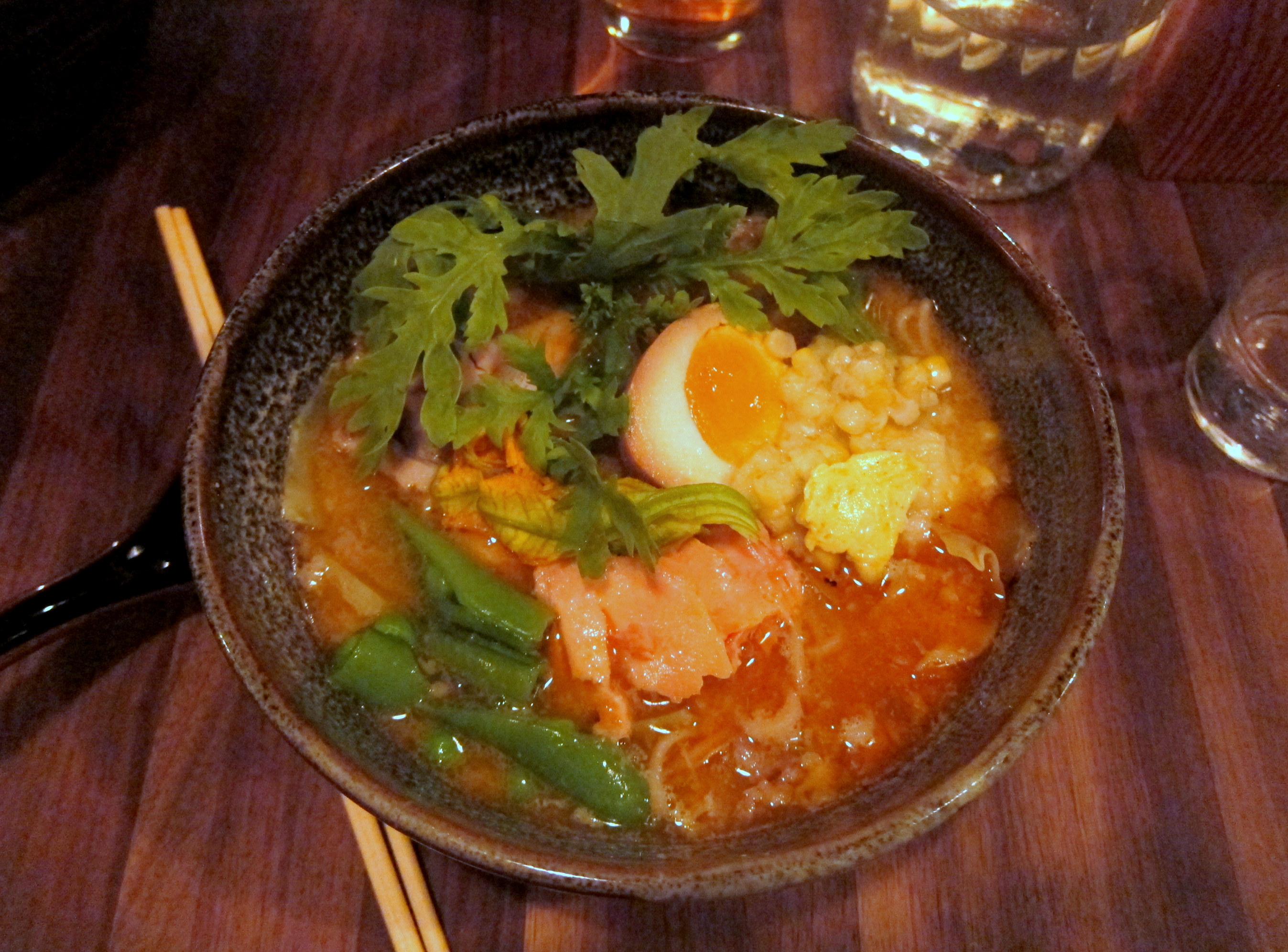
Hokkaido butter corn miso ramen with smoked king salmon, pork belly, soy-marinated egg, snap peas, chrysanthemum greens, and shiitake.

Hokkaido butter corn miso ramen with smoked king salmon, pork belly, soy-marinated egg, snap peas, chrysanthemum greens, and shiitake. ($16)

Okay so, The Ramen Shop is not a place I would go alone. I think eating there alone would be particularly wonderful because ramen is the type of food to be eaten alone, and although the lighting might be too low for reading, it’s hard to read while slurping noodles anyway. BUT, the wait is just too horrible. This place has been hyped up since its opening in January, and it stays hyped. No sensical lone diner should wait an hour for a bowl of ramen.

It’s good ramen, though. I didn’t expect too much, and I was satisfied.

The broth was rich, although not hot enough (maybe I remember more than I should from the movie Tampopo, but they say the ramen broth should be boiling hot when arriving at the table). By American standard though, this is fine. I like that they keep the menu simple: 3 kinds of ramen – shio ramen with manila clams, veggie shoyu ramen with mushroom and salt-cured egg (yeah, ramen ain’t no place for vegan 🙁 ), and miso ramen with salmon. The only complaint: why no simple ramen with just pork belly? I understand that you want to make the $15 price tag seems more reasonable by adding some extra stuff, but the salmon really doesn’t belong.

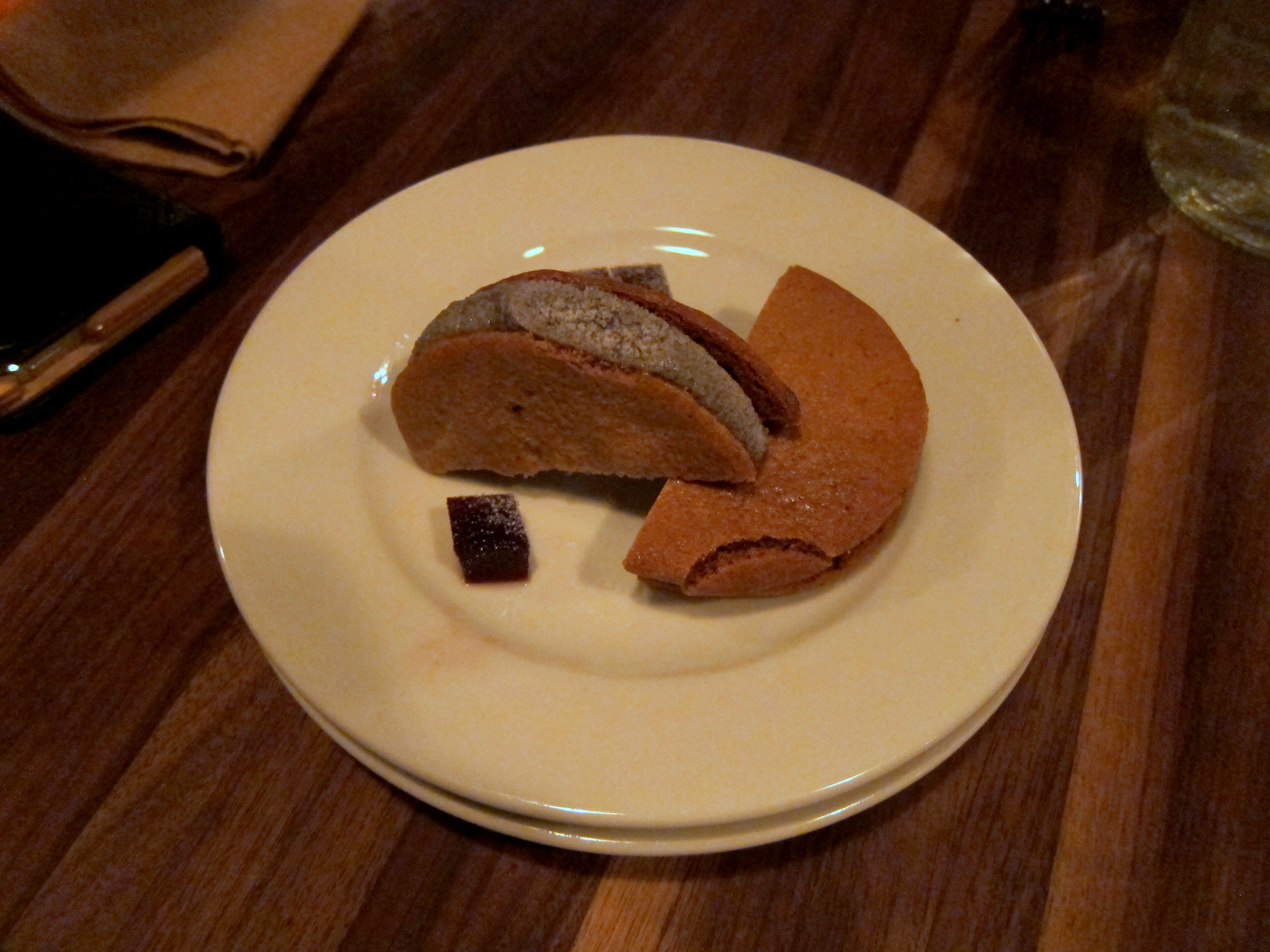
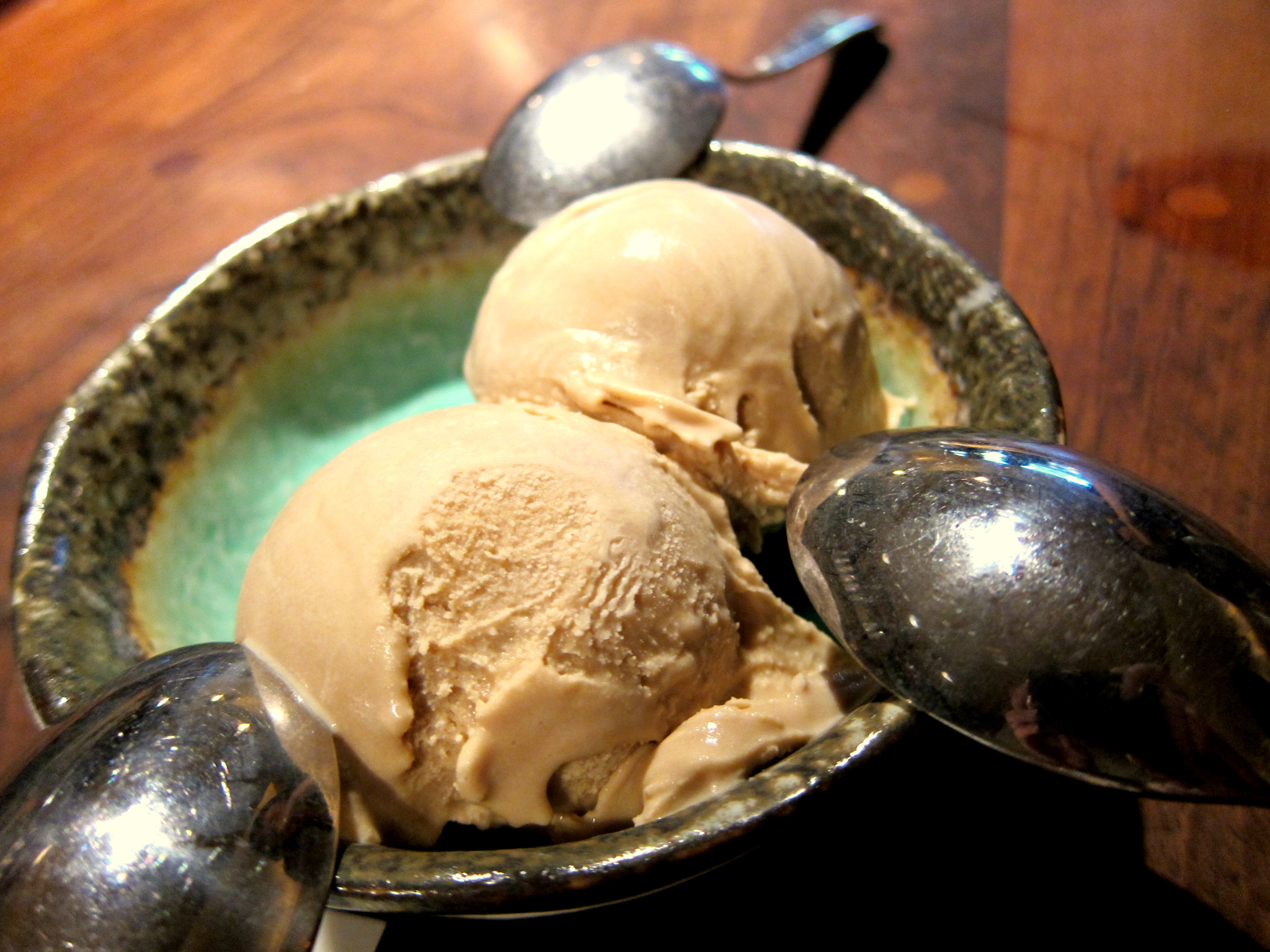
Black sesame ice cream sandwich ($6) - The ice cream part is okay, but I'm not a fan of the sugar cookie.

Black sesame ice cream sandwich ($6) – The ice cream part is okay, but I’m not a fan of the sugar cookie.

The Ramen Shop is at 5812 College Avenue, Oakland, CA 94618 – (510)788-6370.

Tags:

one shot: Bun Rieu at Ba Le Sandwich

June 26, 2013 By: Mai Truong Category: California - The Bay Area, Comfort food, noodle soup, One shot, Southern Vietnamese

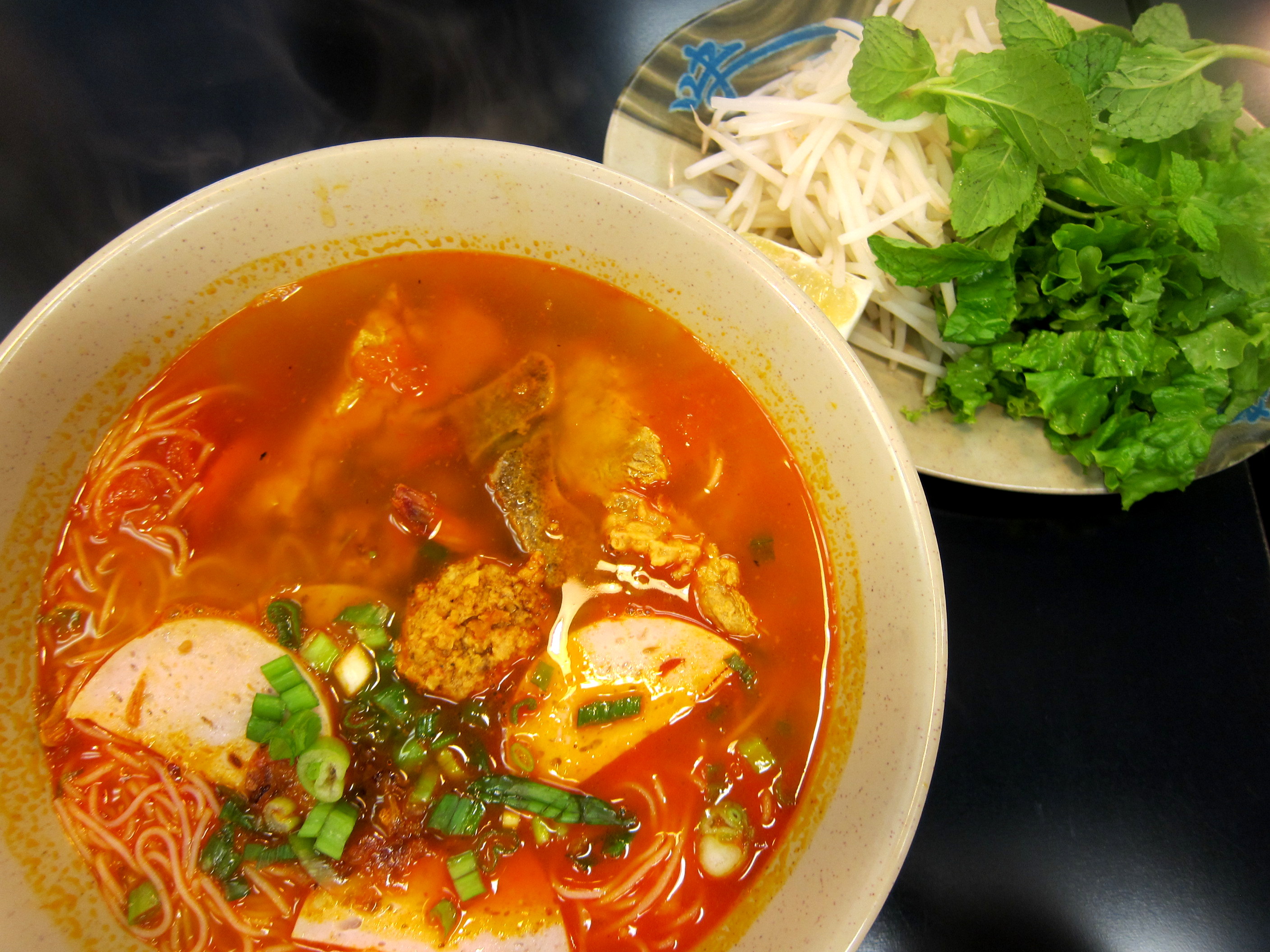
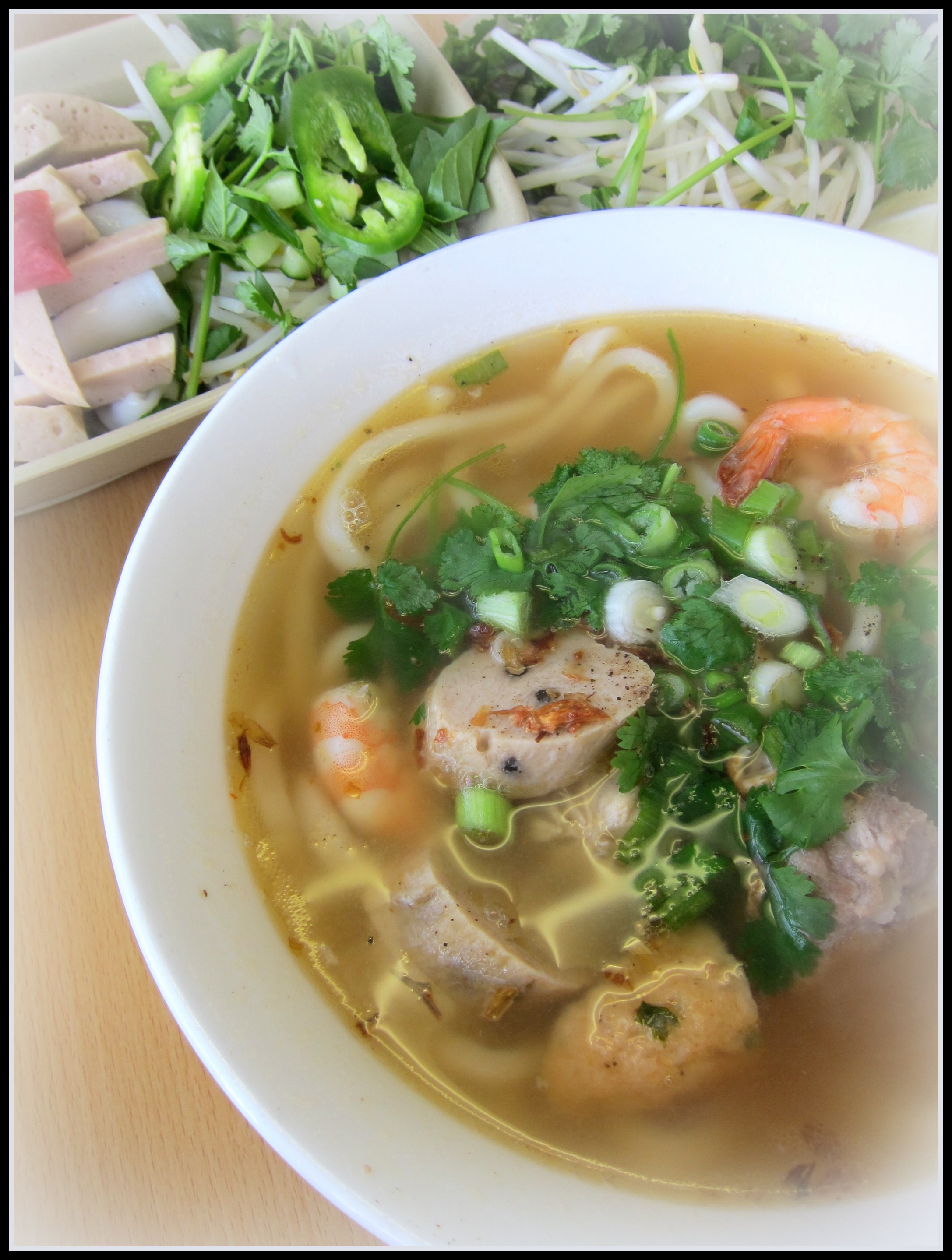
ba-le-sandwich-bun-rieu
Good ol’ tomato and crab noodle soup from Southern Vietnam: bún riêu (pronounced |boon rhee-oo|). The broth looks alarmingly spicy but this soup is actually never spicy. The orange red color comes from tomato and annatto seeds, and if you’re lucky, crab roe (if fresh crabs are used for the soup).

The sweetness of the broth comes from freshwater paddy crabs, where the whole crab (meat and shell) is ground to a paste and strained for the juice. It’s a delicate, distinctive sweetness that can’t be reproduced with dashi no moto, meat bones or mushroom. To deepen the flavor, the cook adds some mắm ruốc, fermented krill paste, to the broth.

Traditionally, bun rieu has crab meat and tofu for the protein part, but bun rieu at Ba Le Sandwich is ladened with cha lua, pork and shrimp.

Traditionally, it’s one of those commoner’s noodle soups that every other street stall sells in Vietnam, nutritious, filling, unrefined, a richness of everyday life and earthy pleasures. Somehow I grew up not thinking much of it and was never impressed by it. In the bustle of North Cali, bun rieu is still nothing more than a commoner’s noodle soup, never elevated to the level of party food, but the more I think about it, the more I find it romantic. In one bowl, I was tasting the unctuous harmony of wetland and freshwater, of simple vegetables and grains and crustaceans that grow up together in one environment and end up together in one pot, or at least that’s how the noodle soup was originally designed. Do things taste best in the company of what they grow up with? I’m inclined to think so.

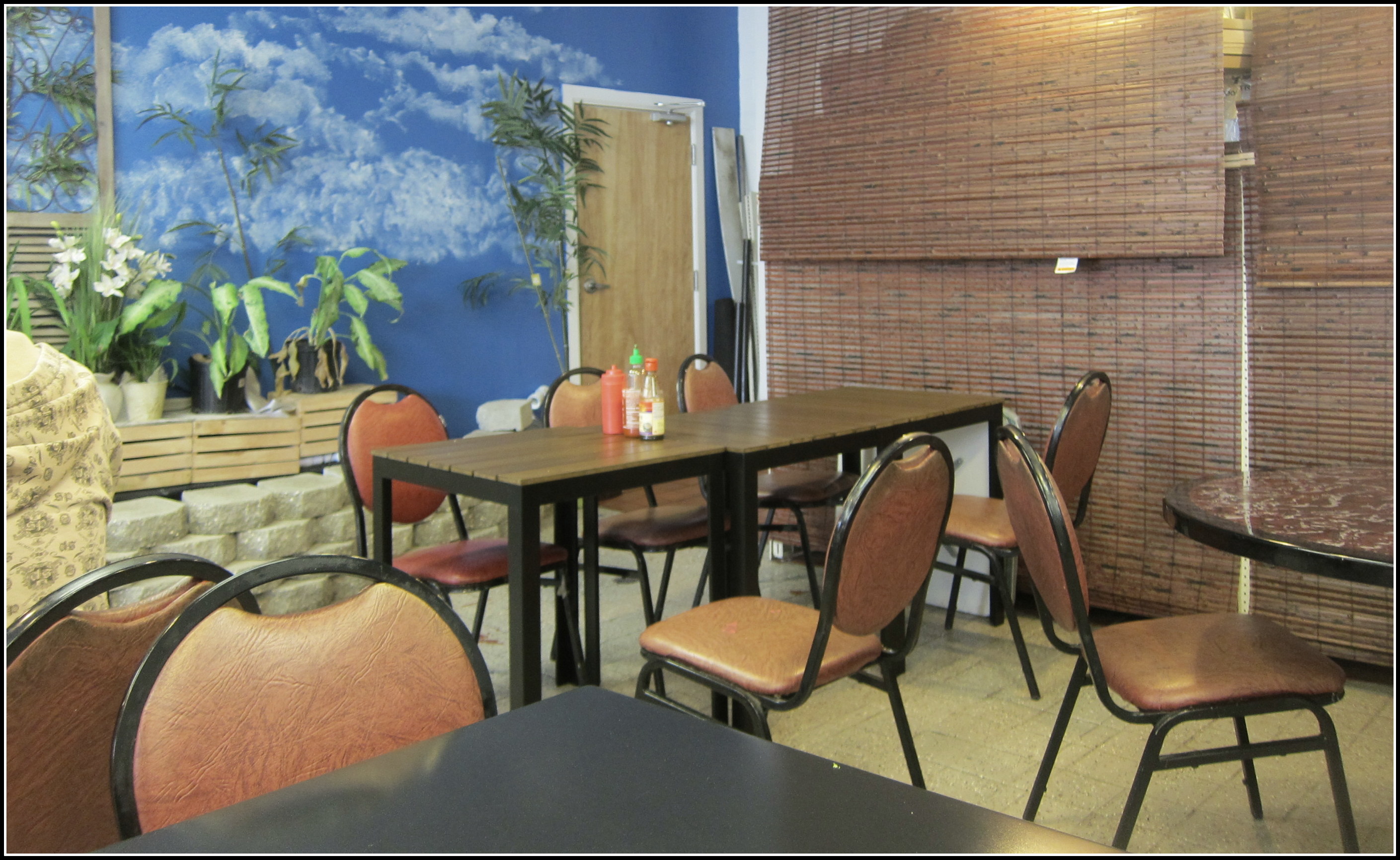
banh-mi-ba-le-interior
Back to a matter-of-fact viewpoint, the inside of Ba Le Sandwich in East Oakland, has been renovated earlier this year into a neat little diner enough to sit 12-14 people, since most customers come for to-go banh mi and on-the-counter goodies such as mungbean milk and sesame beignet. They have hand down the best banh mi in the East Bay north, but everything else tastes good because they know how to season things.

Address: Banh Mi Ba Le (Ba Le Sandwich)
1909 International Blvd
Oakland, CA 94606
(510) 261-9800

One bowl of delta romanticism: $6.50. Another awesome thing about this place: they open at 6:30 am.

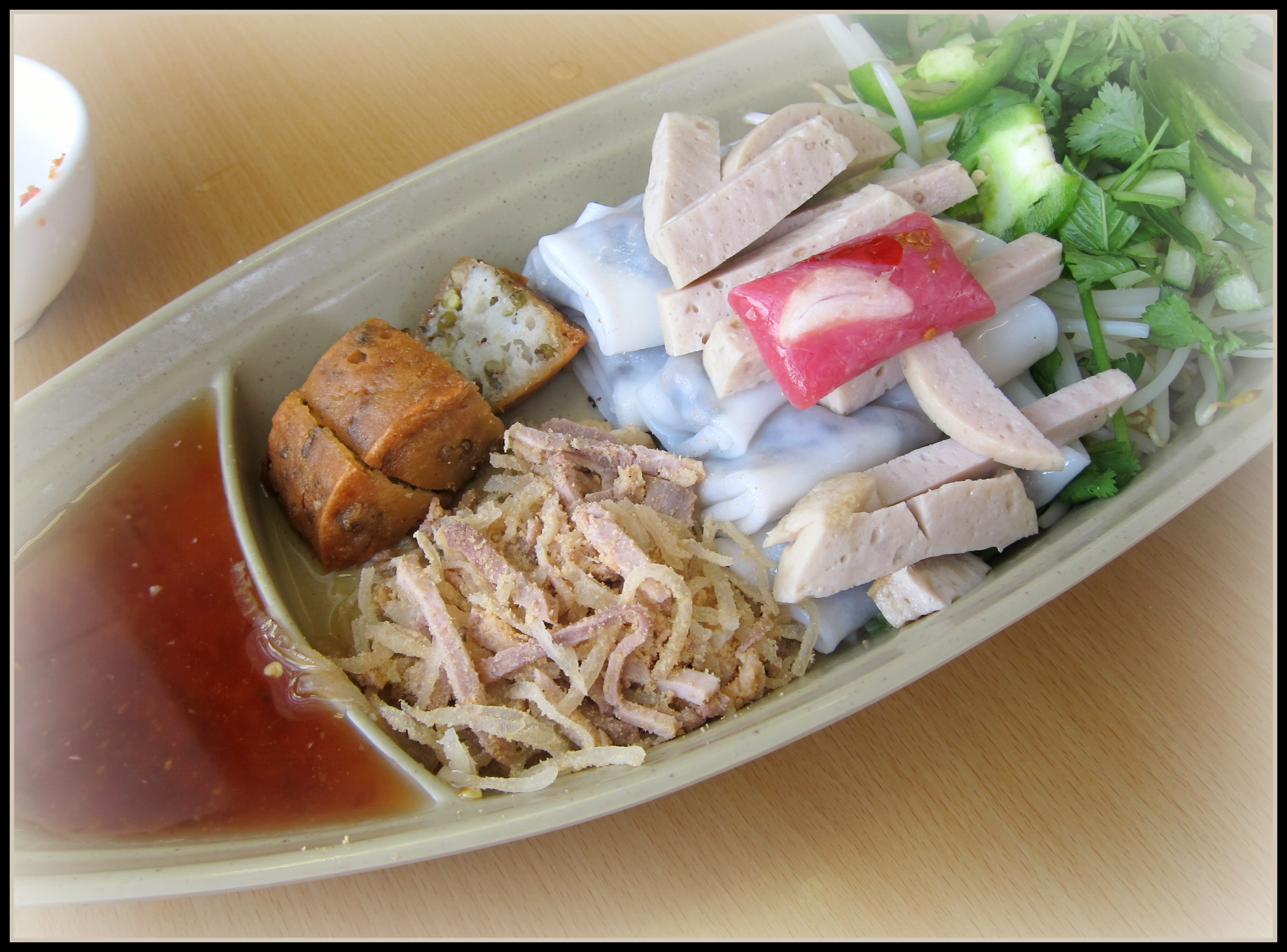
Banh cuon - steamed rice rolls stuffed with pork and mushroom (the white things), and accessories.

Banh cuon – steamed rice rolls stuffed with pork and mushroom (the white things), and accessories.

Banh canh - It's supposed to be tapioca noodle soup with short fat noodle made from tapioca and rice flour, but Ba Le uses Japanese udon instead. The broth is kept original, though.

Banh canh – It’s supposed to be tapioca noodle soup with short fat noodle made from tapioca and rice flour, but Ba Le uses Japanese udon instead. The broth is kept original, though.

Hai Ky Mi Gia – more noodle soups

April 27, 2013 By: Mai Truong Category: California - The Bay Area, Chinese, Comfort food, noodle soup

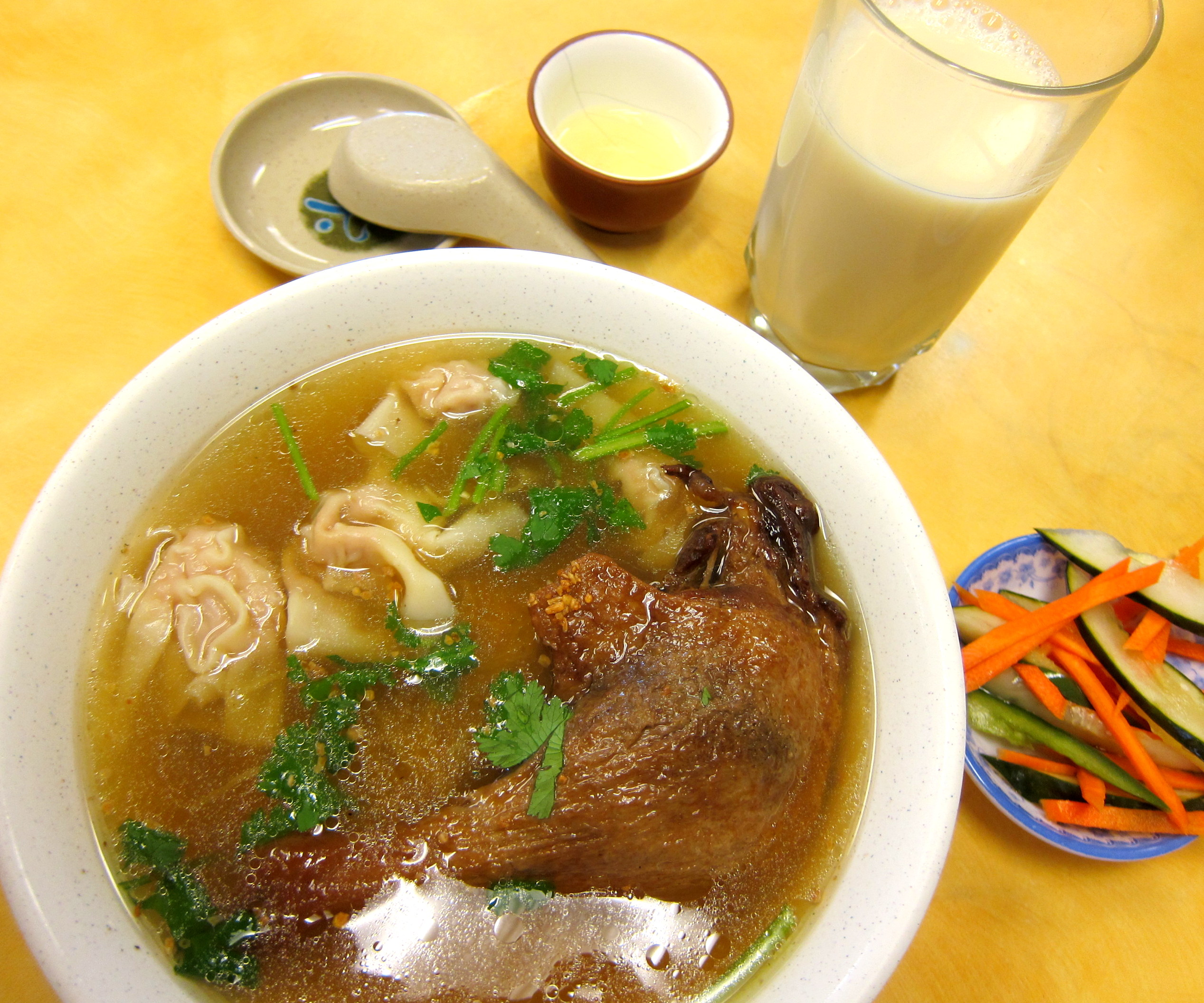
hkmg-duck-leg-noodle-soup-with-wonton

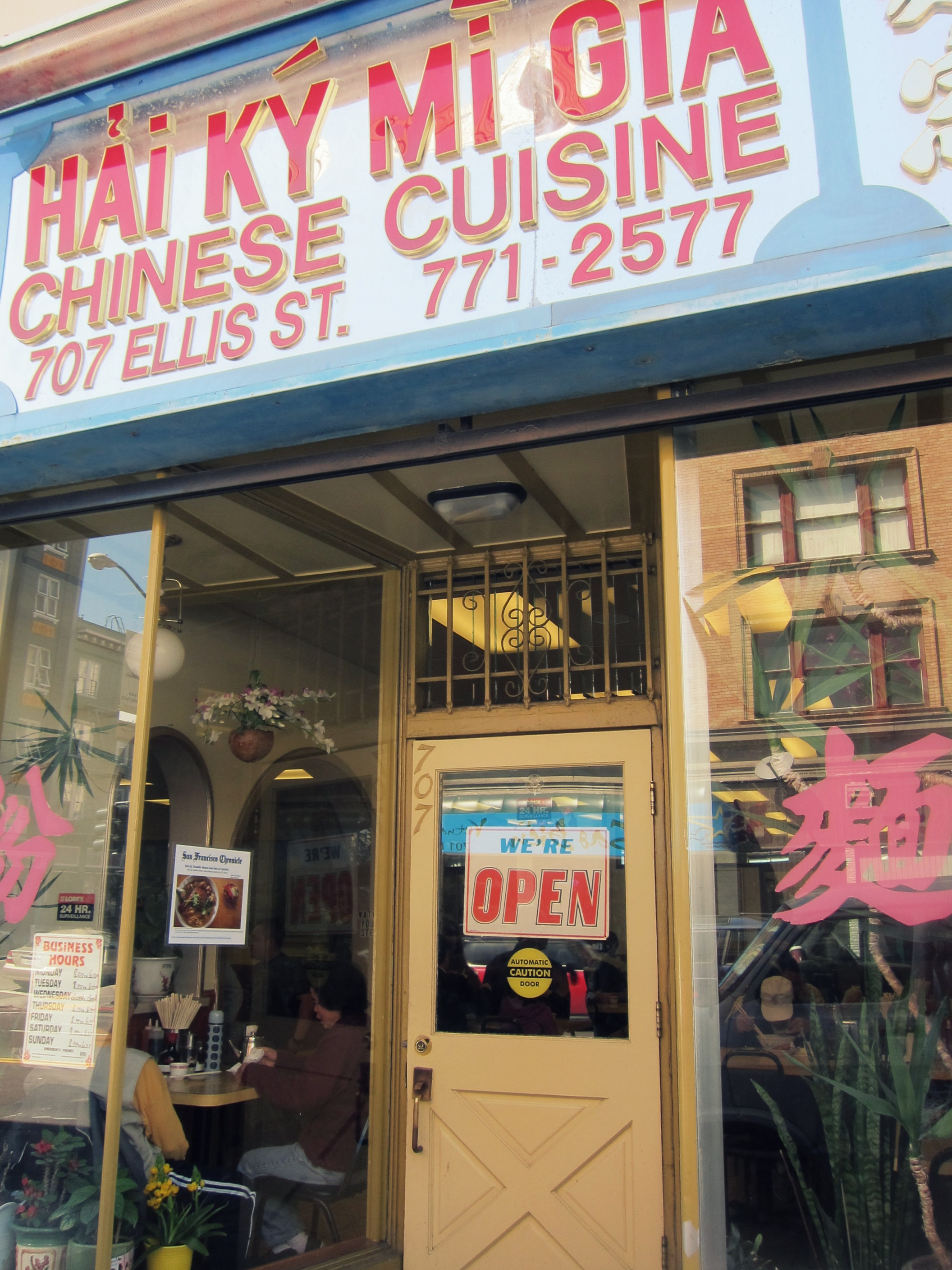
Like many small businesses in the so-called “Little Saigon”s throughout the states, Hai Ky Mi Gia is operated by Chinese immigrants. Originally, Hai Ky Mi Gia is a popular noodle soup joint in District 5, Saigon – the Chinatown of Saigon – before 1975, and it remains popular today. When Saigon fell, the Chinese immigrants in Vietnam left the country with the Vietnamese and became associated with Vietnamese political refugees in foreign lands such as America. These Chinese Vietnamese immigrants continue speaking both languages, opening businesses under the established names(*) in Saigon and catering to the homesick Chinese Vietnamese and Vietnamese alike. Whether this Hai Ky Mi Gia is in any way related to the Hai Ky Mi Gia in District 5 or other Hai Ky Mi Gia’s scattering across the US, its patronage doesn’t seem to care either way. To the Chinese Vietnamese and Vietnamese immigrants, it’s a name they’re familiar with, so they feel at home. To the rest of the patronage… well, I can’t speak from their point of view, but I guess the low price and the popularity raved by Yelp, InsideScoop SF, SF Chronicle, SF Weekly, etc., do have an effect.

Does its food live up to the expectation that these websites have built for it? I’m afraid not, but then again, I would be very surprised if those reviews are ever different from your online zodiac personality description: nothing bad is described.

Do I feel like a jerk for pointing this out? Yes, especially since this place IS popular, my dining companions enjoyed it, the other customers enjoyed it (to some extent, otherwise they wouldn’t come back), and it’s really not the restaurant’s fault that they get hyped up. Noodle soup is comfort food, so it’s meant to be popular. If it’s any consolation, I think of this type of restaurant as the Asian version of McDonalds, or burgers in general.

Because I believe in saving the best for last, I start with what I don’t like.
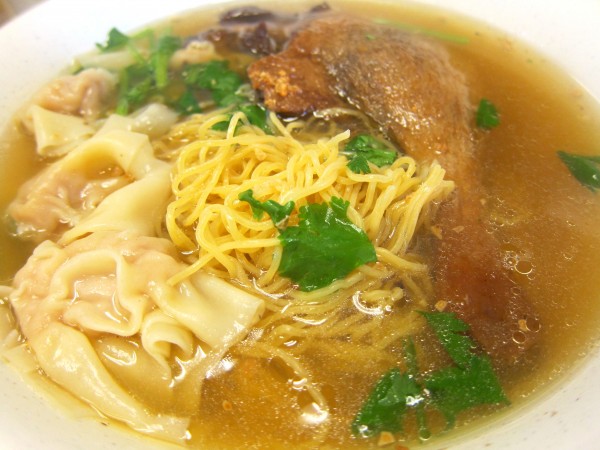
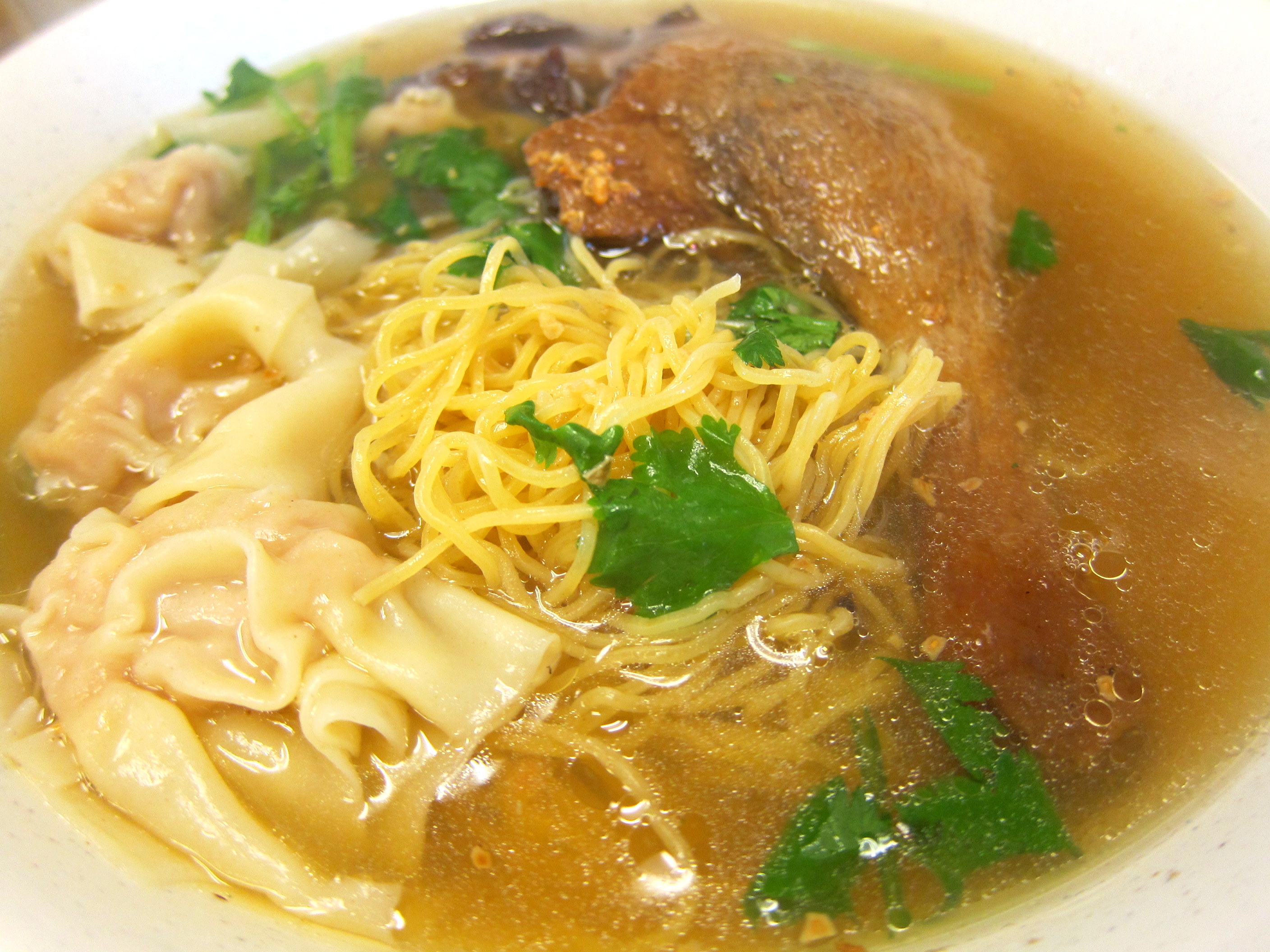
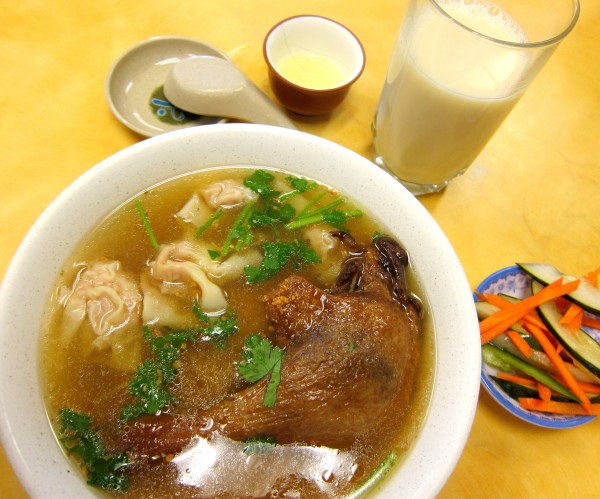
Braised duck leg noodle soup with wonton ($7.59) - #4 on the menu Score: 12/30

Braised duck leg noodle soup with wonton ($7.59) – #4 on the menu
Score: 12/30

Like a McDonald’s burger, the braised duck in Hai Ky Mi Gia’s popular choice “braised duck leg noodle soup” has a distinctive smell. The swampy smell of duck. My mom has told me for as long as I can remember that although ducks bathe often, they have a strong smell, possibly from the preening oil that they spread on their feathers. This smell would go away with enough washing before the duck is cooked. There are several possible reasons that this smell was particularly prominent to me and didn’t seem to bother anyone else:

1. Only my piece of duck happened to be washed less or kept out longer than the other pieces of duck.
2. My olfactory system has become more sensitive as a result of studying tea.
3. Everyone else doctors up their soup with jalapenos, chili paste, soy sauce, hoisin sauce. (The jalapenos at the tables are very green, very fresh, and very strong.) I believe in experiencing the true taste of the soup as the chef makes it.
4. Everyone else is used to this smell because they’re used to eating this noodle soup at this noodle joint.

Whatever the reason, I grade my food based on smell, taste and texture. For this duck leg noodle soup with wonton, 0 for smell, 5/10 for taste, and 7/10 for texture.

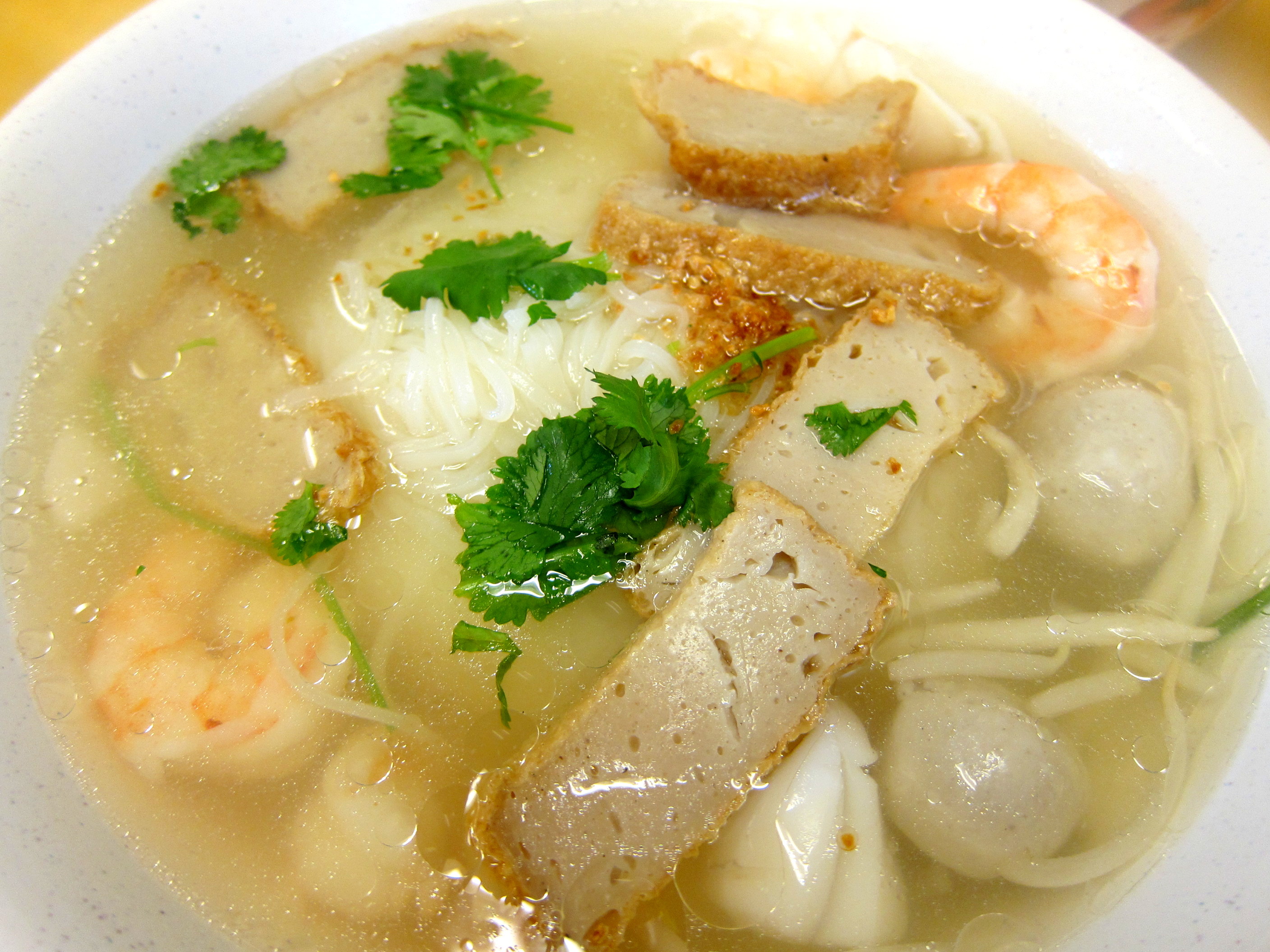
But Hai Ky Mi Gia is not all disappointment. They serve big portions. Their warm homemade soymilk ($2.30) tastes of real soy, rich and soothing (better than store-bought cartons, of course). The seafood noodle soup, which we ordered with thin rice noodle, has a light, mildly sweet broth and enough fish balls, fish cake, squid and shrimp to entertain the diner. The dry noodle with broth on the side makes up for its less-than-deal cousin (the duck noodle soup) mainly because of its well-seasoned, tender charsiu pork.
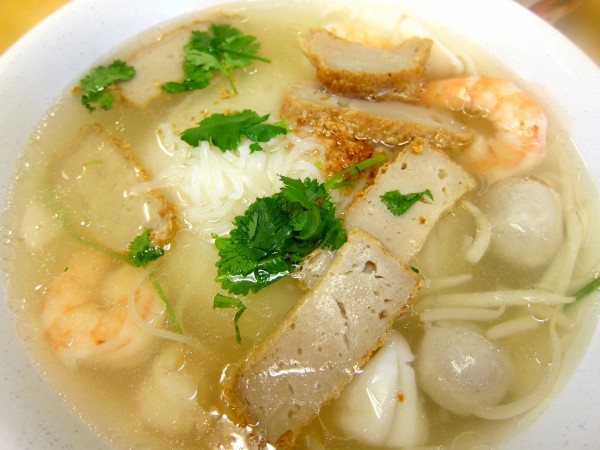
Seafood noodle soup ($7.36) - #13 on the menu Score: 5 for smell + 6 for taste + 7 for texture = 18/30

Seafood noodle soup ($7.36) – #13 on the menu
Score: 5 for smell + 6 for taste + 7 for texture = 18/30
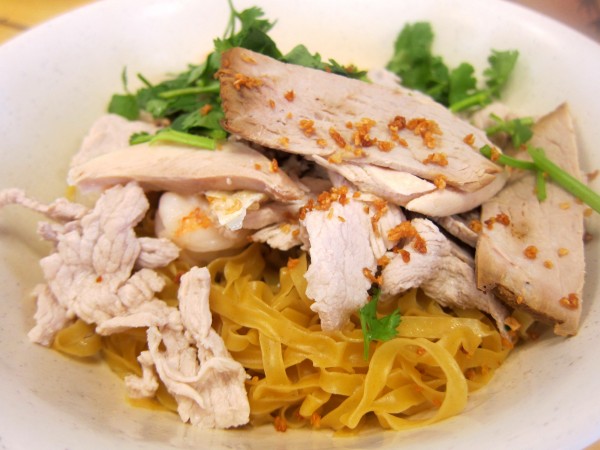
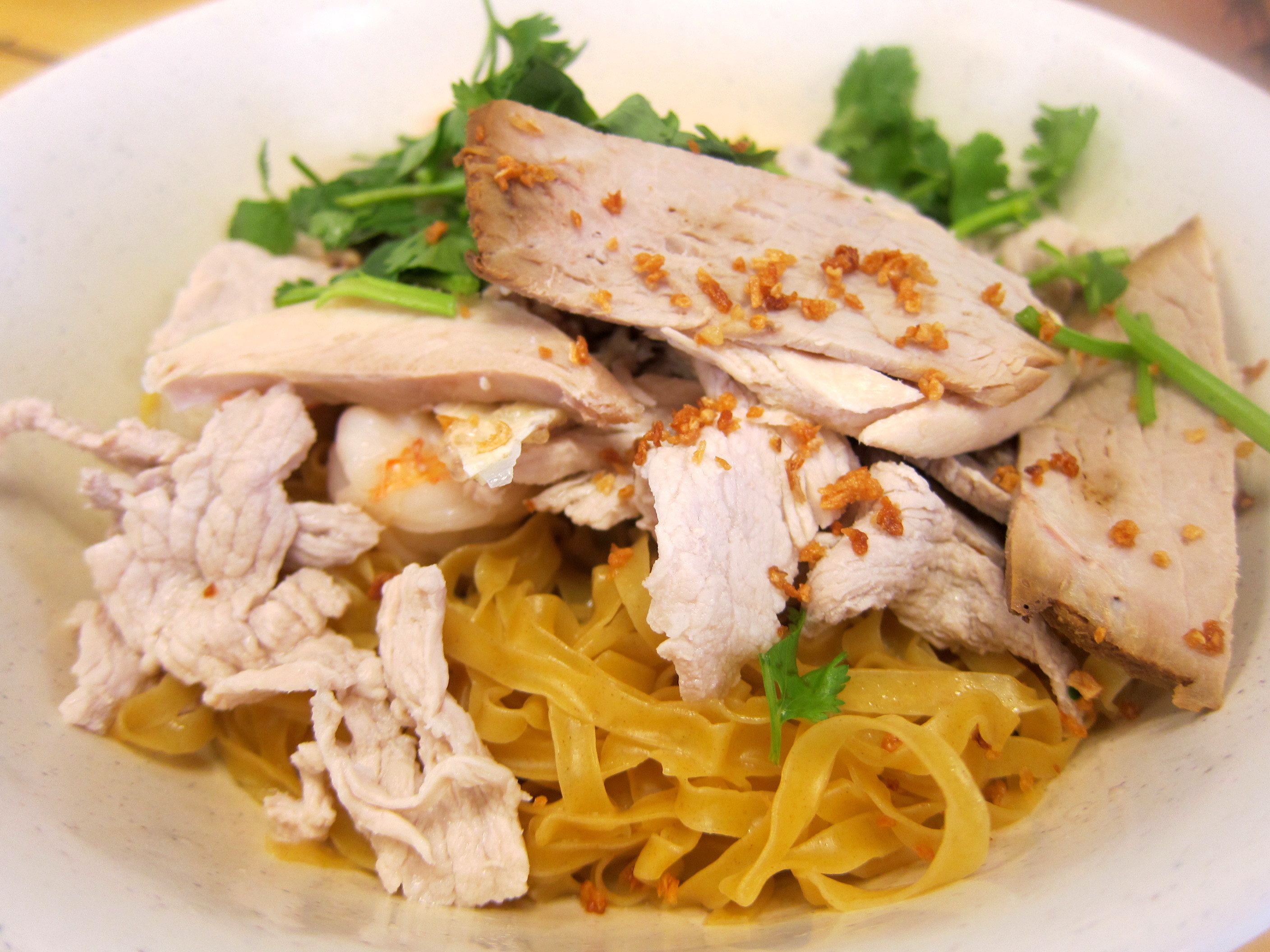
Dry wheat noodle with pork (charsiu pork, ground pork, boiled pork) and broth on the side - Not on the menu but you can order by asking the hostess. Score: 5 for smell + 7 for taste + 7 for texture = 19/30

Dry wheat noodle with pork (charsiu pork, ground pork, boiled pork) and broth on the side – Not on the menu but you can order by asking the hostess.
Score: 5 for smell + 7 for taste + 7 for texture = 19/30
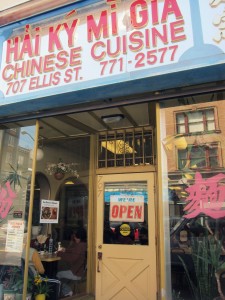
hai-ky-mi-gia-sf

For out-of-town guests, I wouldn’t recommend this place, but the Hua family who opened this Hai Ky Mi Gia did not open it to attract tourists anyway. It’s meant to serve affordable comfort food with no frills, and I found comfort at least in its soymilk, so the restaurant fulfills its purpose.

Address: Hai Ky Mi Gia
707 Ellis Street (in the Tenderloin)
San Francisco, CA 94109
(415) 771-2577
Closed on Wednesdays. Cash only.

(*) If a restaurant/bakery/cafe/any food establishment has “Ky” or “Ki” in its name, it is 100% run by a Chinese immigrant who lived in Vietnam. “Ky” or “Ki” (pronounced |kee|) is the vietnamization of 計 (as in “生計” – |Sheng Kee|, which means “measure”, “plan”, “calculation”, etc).

One bite: Harusame soup at Cha-Ya

March 23, 2013 By: Mai Truong Category: California - The Bay Area, Japanese, noodle soup, One shot, Vegan

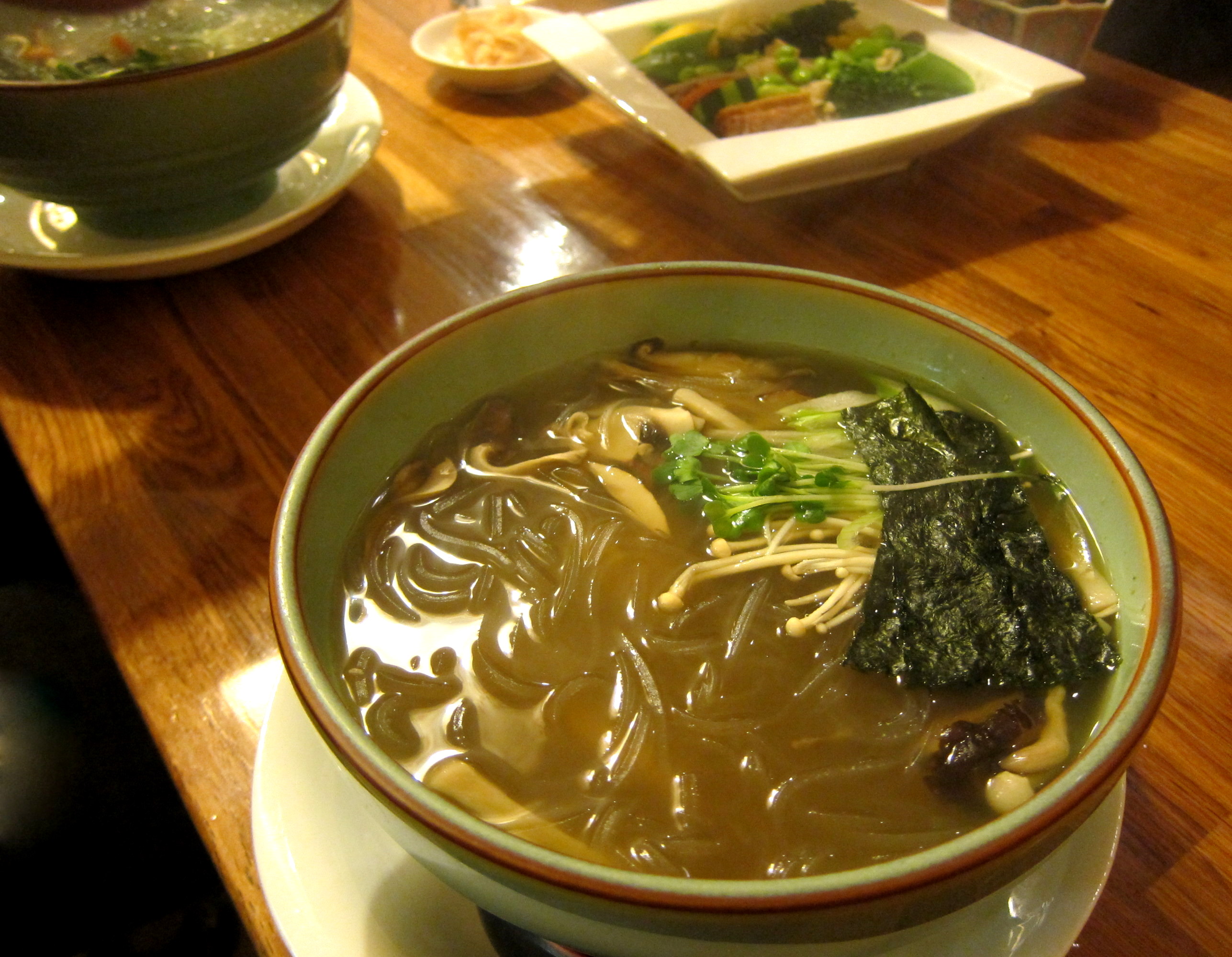
Kinoko harusame ($8.50) - potato starch glass noodle soup with mushroom (shimeji, eryngii, enoki, hiratake (oyster mushroom), portobello mushroom and shiitake.

Kinoko harusame (~$8) – potato starch glass noodle soup with mushroom (shimeji, eryngii, enoki, hiratake (oyster mushroom), portobello mushroom and shiitake.

Japanese glass noodle (harusame 春雨) is different from Vietnamese glass noodle: it’s made from potato starch (instead of mung bean starch or canna starch), it’s much thicker (like a spaghetti, whereas Vietnamese glass noodle is like a capellini), and it has a softer chew.

With that vegan broth sweetened by mushroom, it was comforting.

Until you finish that monster of a bowl, and you feel so full that it’s no longer comfy unless you unbutton a button or two.

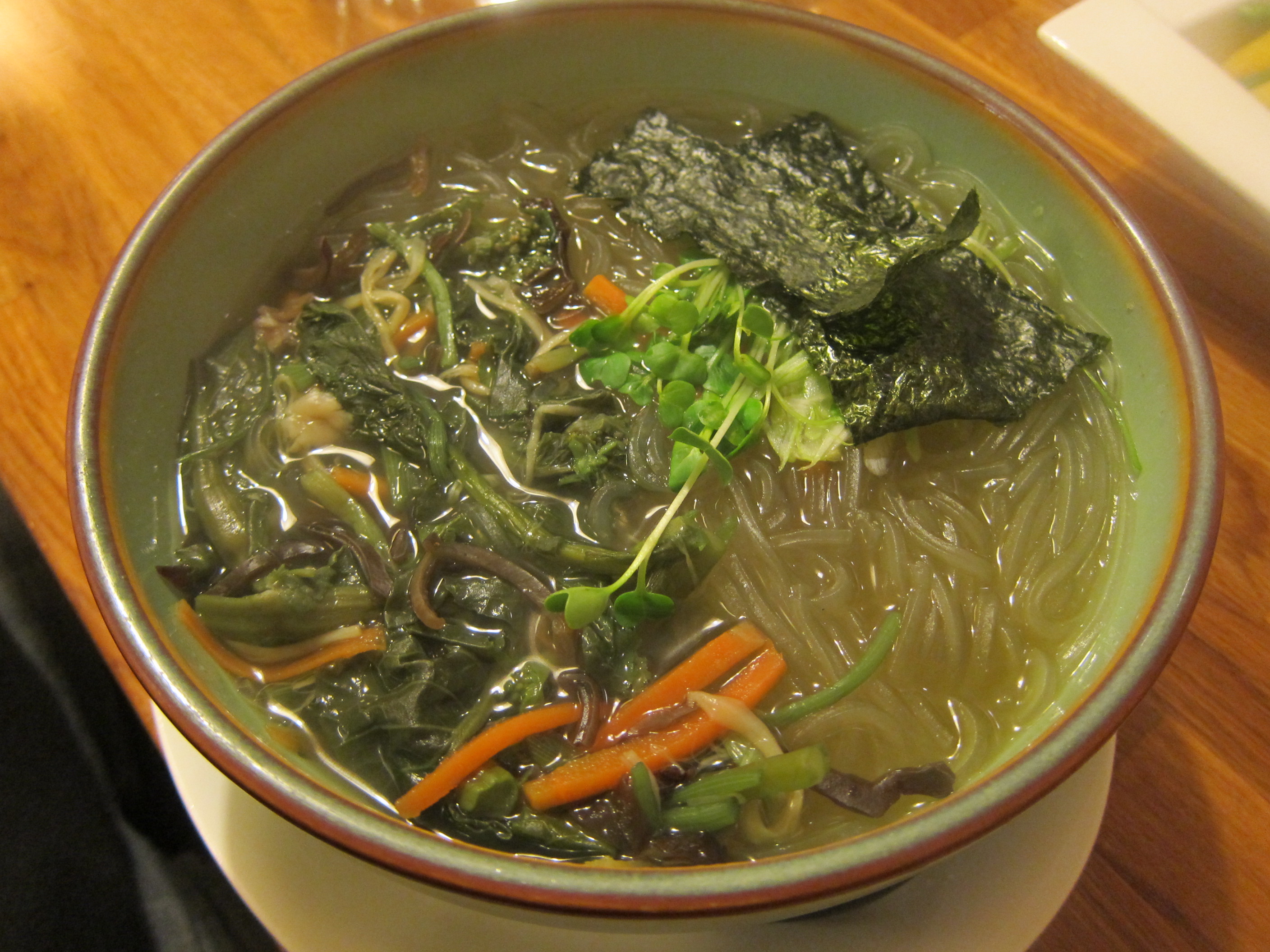
Sansai harusame - potato starch glass noodle soup with bracken, bamboo shoots, carrots, woodear mushroom and some kinds of greens

Sansai harusame (~$8) – potato starch glass noodle soup with bracken, bamboo shoots, carrots and woodear mushroom

I don’t think I’ll ever get hungry thinking about Cha-Ya (does anyone ever get hungry for vegan food?), but I’d never turn it down when someone suggests Cha-Ya either. I get full and feel healthy when I go there. What more can I ask for from this little place?

P.S.: My previous experience at Cha-Ya was a little more elaborate than a bowl of noodle soup, and was just as comforting. 😉

Ten-minute noodle and nectarine

August 01, 2012 By: Mai Truong Category: Korean, noodle soup, RECIPES


It’s summer. Time for cold noodle. Refrigerated, ice-cold noodle. And all it takes is 10 minutes (that includes water-boiling time).
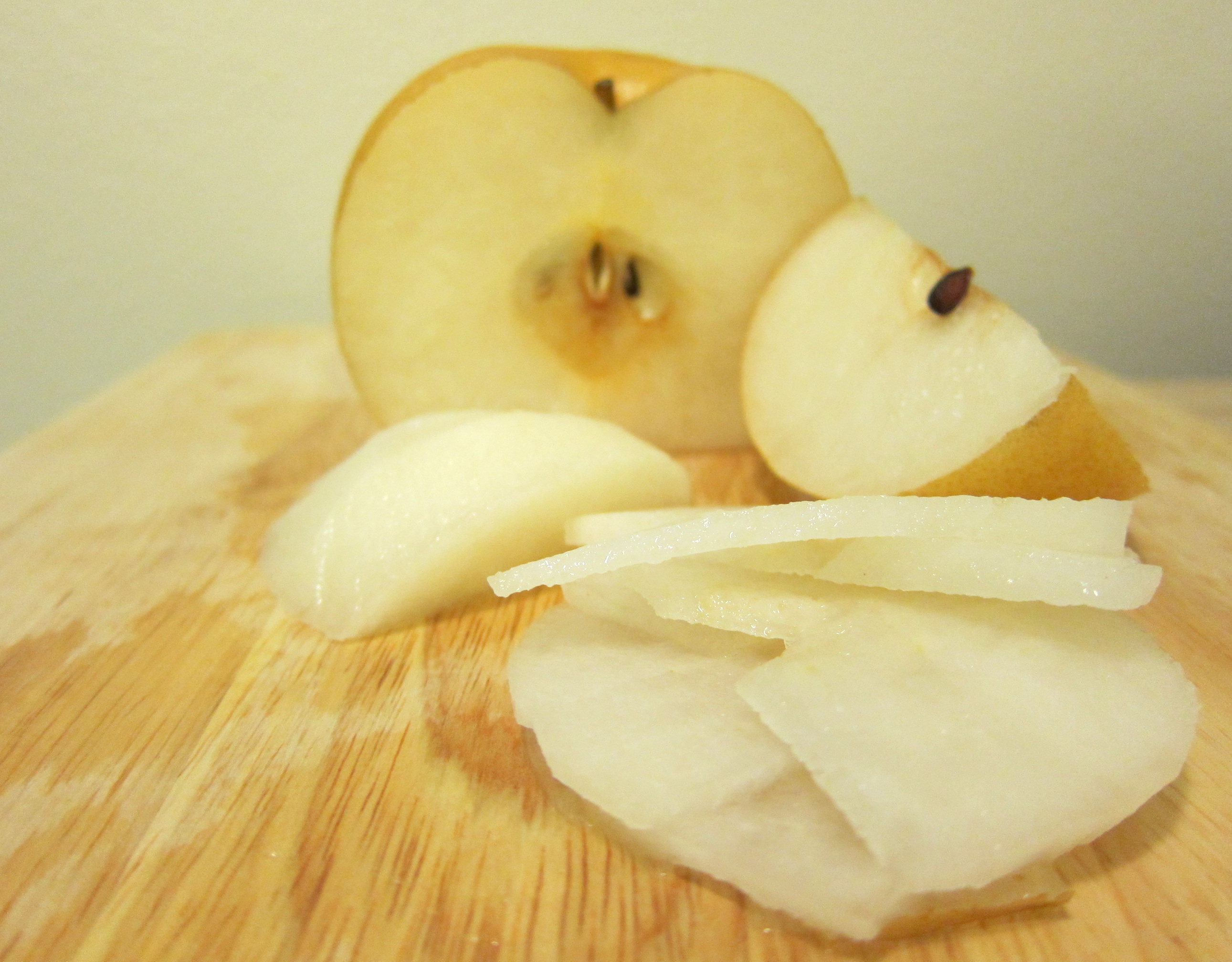
Traditionally, the Koreans sweeten mul naeng myeon (물 냉면, “water cold noodle”) with sliced Asian pear and julienned cucumber. Asian pears are not yet in season (I don’t really know when its season is, but the tiny ones at Berkeley Bowl look too sad to slice), and when I want to cook my naeng myeon, like always, I never have what the recipe calls for, even if it’s just cucumber. So I did what everyone would.
I ignored the recipe.


I used nectarine in place of pear and pickled cucumber (shiba zuke) for fresh cucumber. Works out great. Nectarine is sweeter than pear. 🙂


Almost-instant Korean Cold Noodle with Nectarine (make 1 serving)

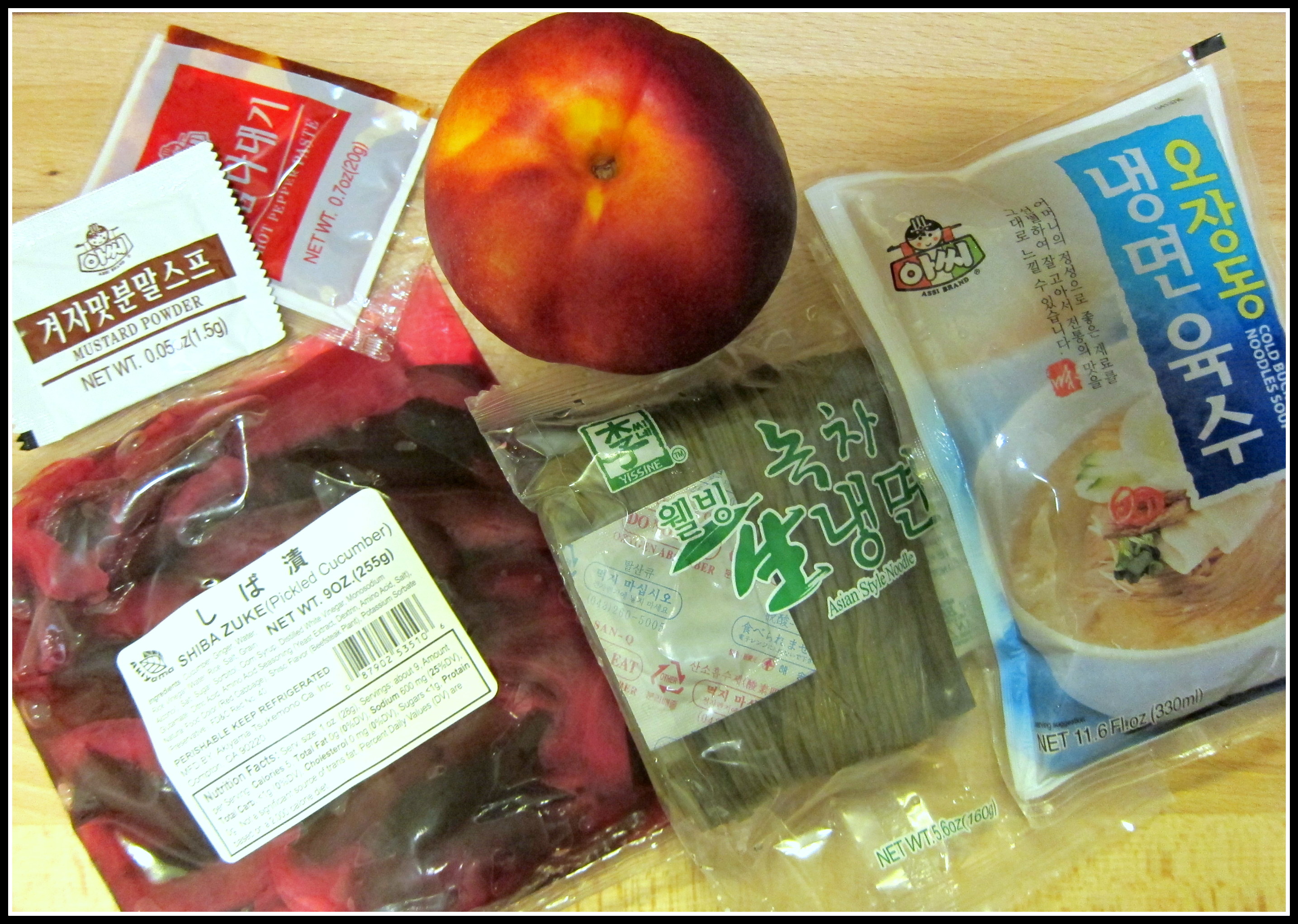
– 1 bag of mul naeng myeon (물 냉면) (can be found at your local Korean market). This thing contains 2 packets of buckwheat noodle, 2 packets of cold broth, 2 packets of mustard seed, 2 packets of pepper paste (in case you just want naeng myeon without mul (water)). Just take 1 of each.
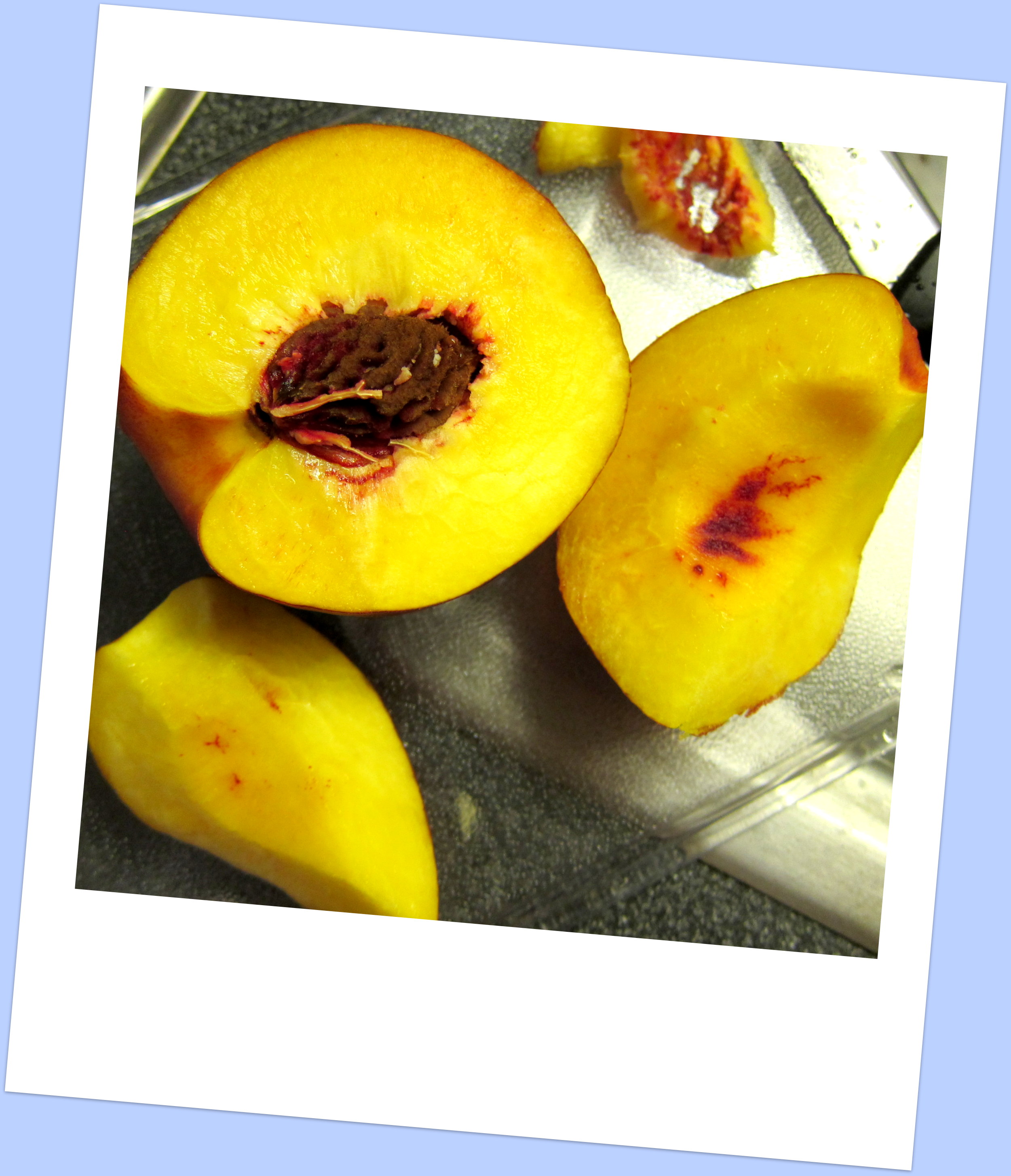
– 1/4 slightly unripe nectarine, sliced
– a few pieces of pickled cucumber (shiba zuke)
– water
– a pot

Boil water. Cook the noodle in 1 minute, then drain under running cold water. Let cool. Slice the nectarine.
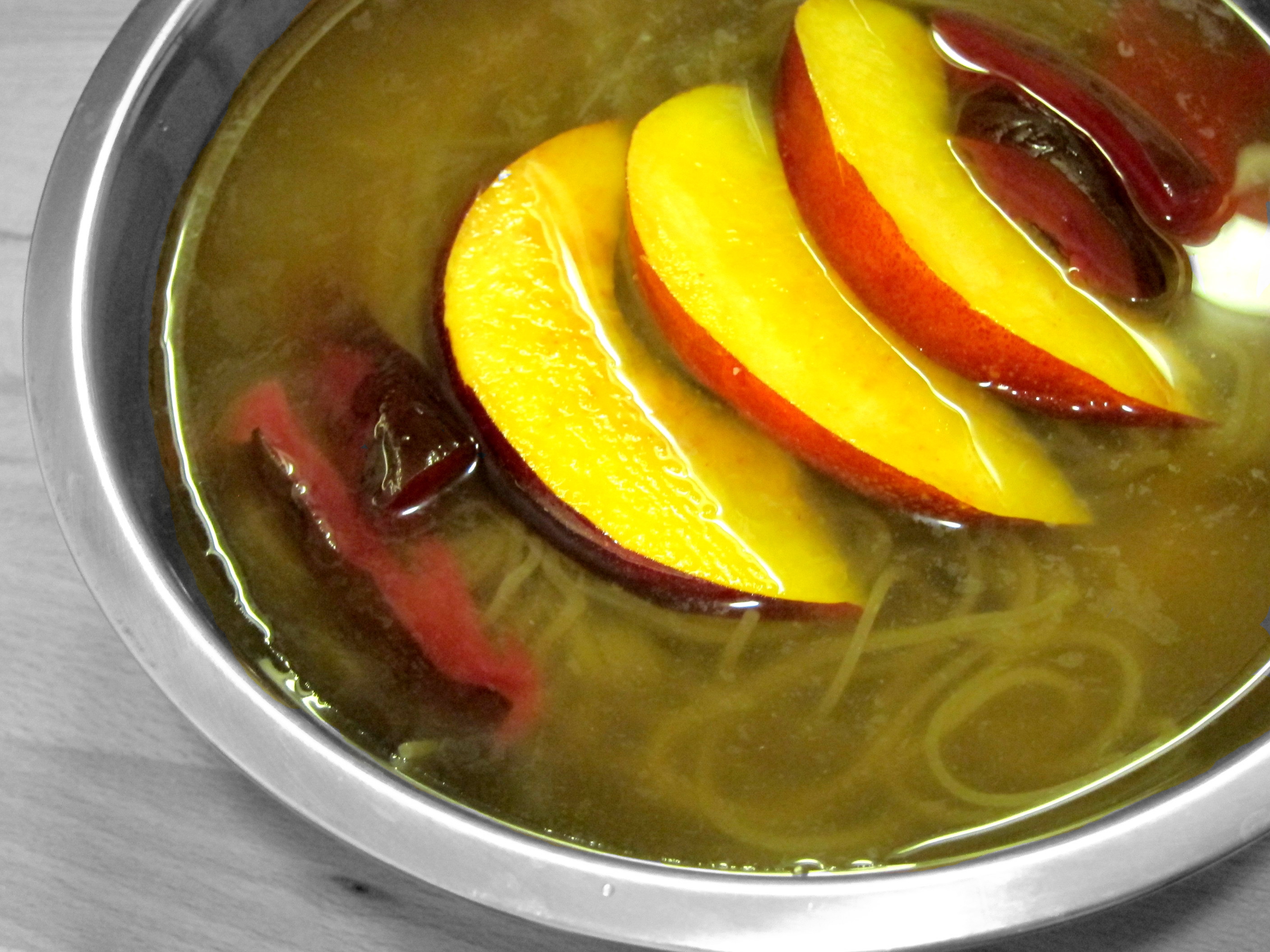
In a bowl, place the noodle, top it with pickled cucumber and nectarine. Pour the chilled broth. Add the mustard seed if you like. Put the bowl back into the fridge to make it colder.
Quench your thirst.

In the Eye of Tea

May 14, 2012 By: Mai Truong Category: California - The Bay Area, Japanese, noodle soup


After a 5-course afternoon tea, the three of us felt our stomachs’ calling. The wind blew chilly moisture from the sea. A hearty dinner of noodle in hot broth would hit the spot, one that was saturated with oolong. Quite appropriately, we walked into O Chamé, meaning “eye of tea”(*) literally and “playful little one” colloquially. It’s Mother’s Day, no reservation, we couldn’t be any luckier that the guy found us three seats at the end of the bar.

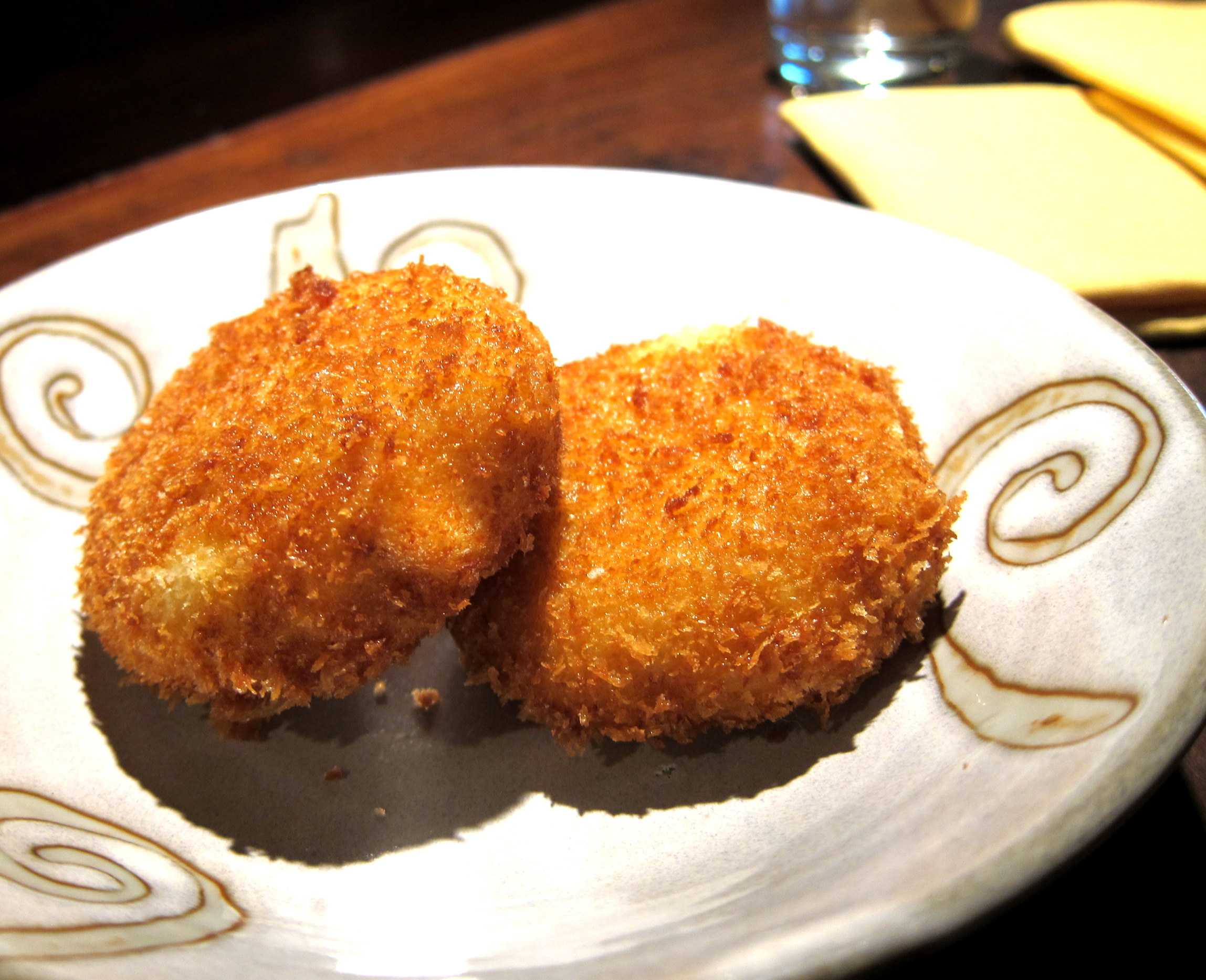
Of course, who would skip the appetizers. And of course, we couldn’t decide on just one appetizer, so we ordered three. The potato and snow crab croquette ($8.50), buttery but mild, tastes ten times better after a dip in the plumier-than-usual-and-not-too-sour tonkatsu sauce. Usually I don’t dip my stuff, but the sauce is a must here.


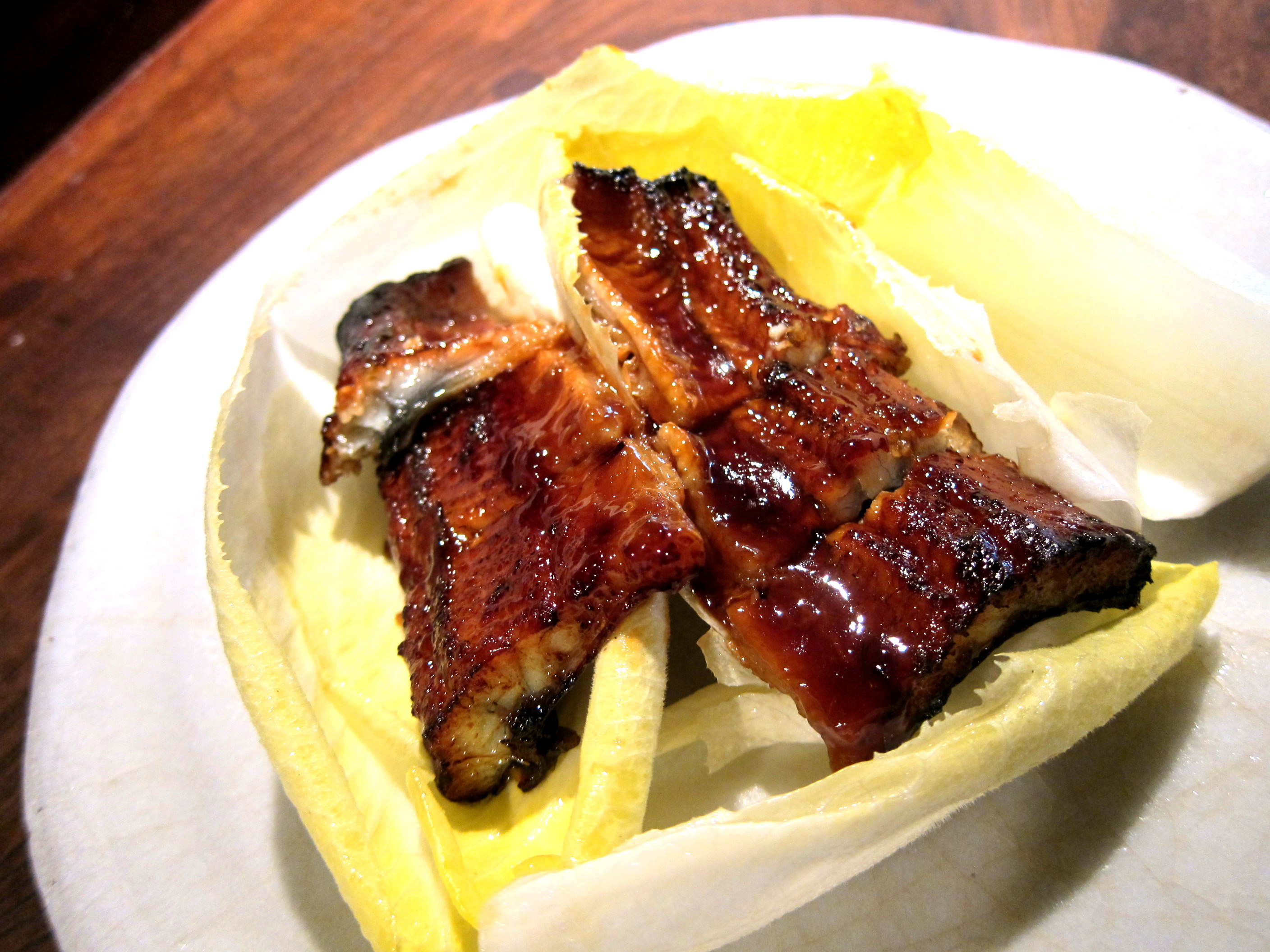
The grilled, caramelized eel ($10.50), Kristen’s choice, is great. Little Mom loves eel, and she would love this. Happy Mother’s Day, Mom! 🙂 A bite into the crisp endive releases a burst of sharp, almost minty air to balance the eel’s fatty sweetness.


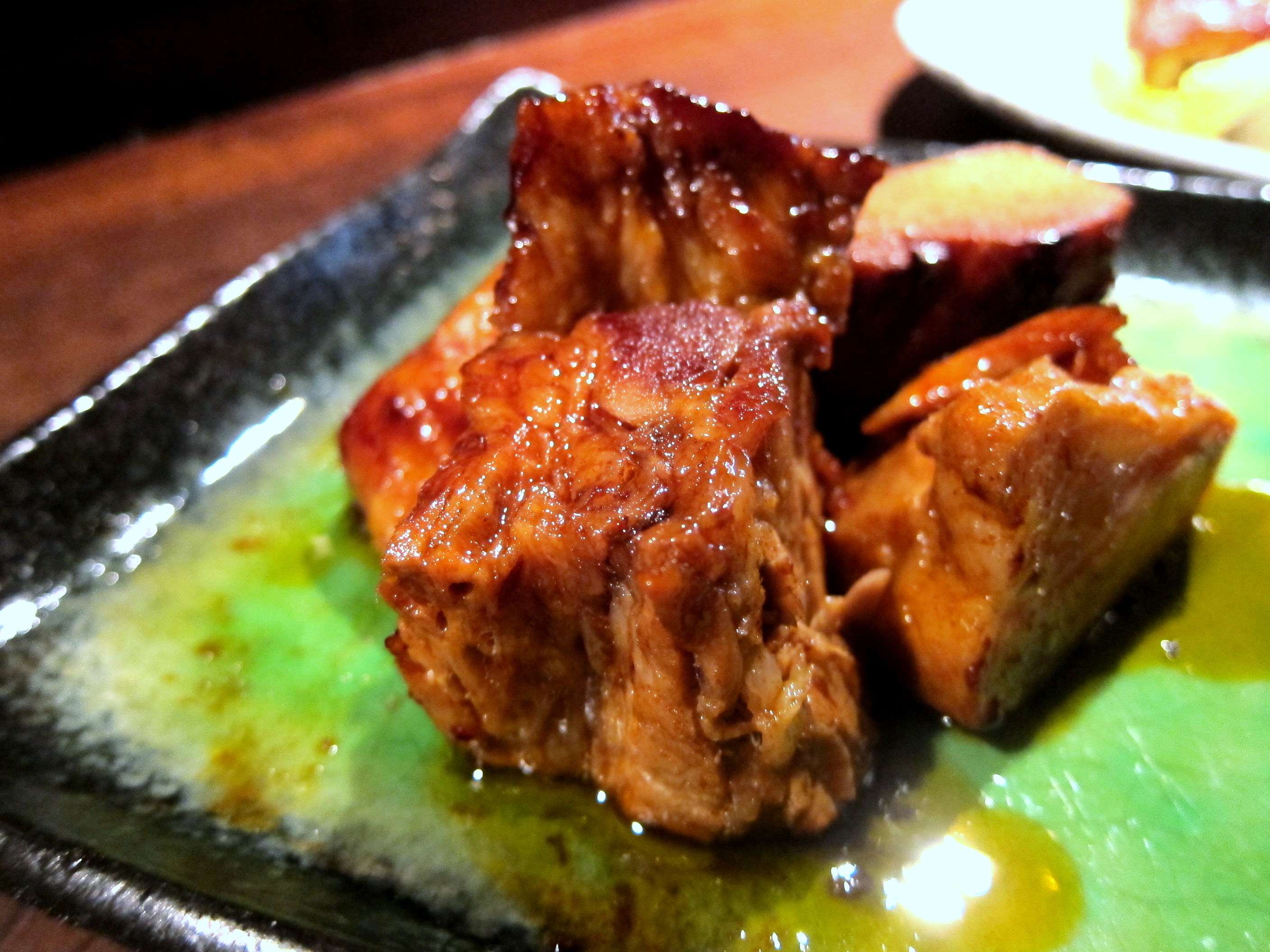
Another fatty, sweet thing is the braised pork ribs with ginger and lemon ($8.50), so sweet I could detect neither ginger nor lemon. The leaner pieces looked soft but not too thrilling. One must go for the pieces with lotsa fat and semi-charred ends, those are gold.


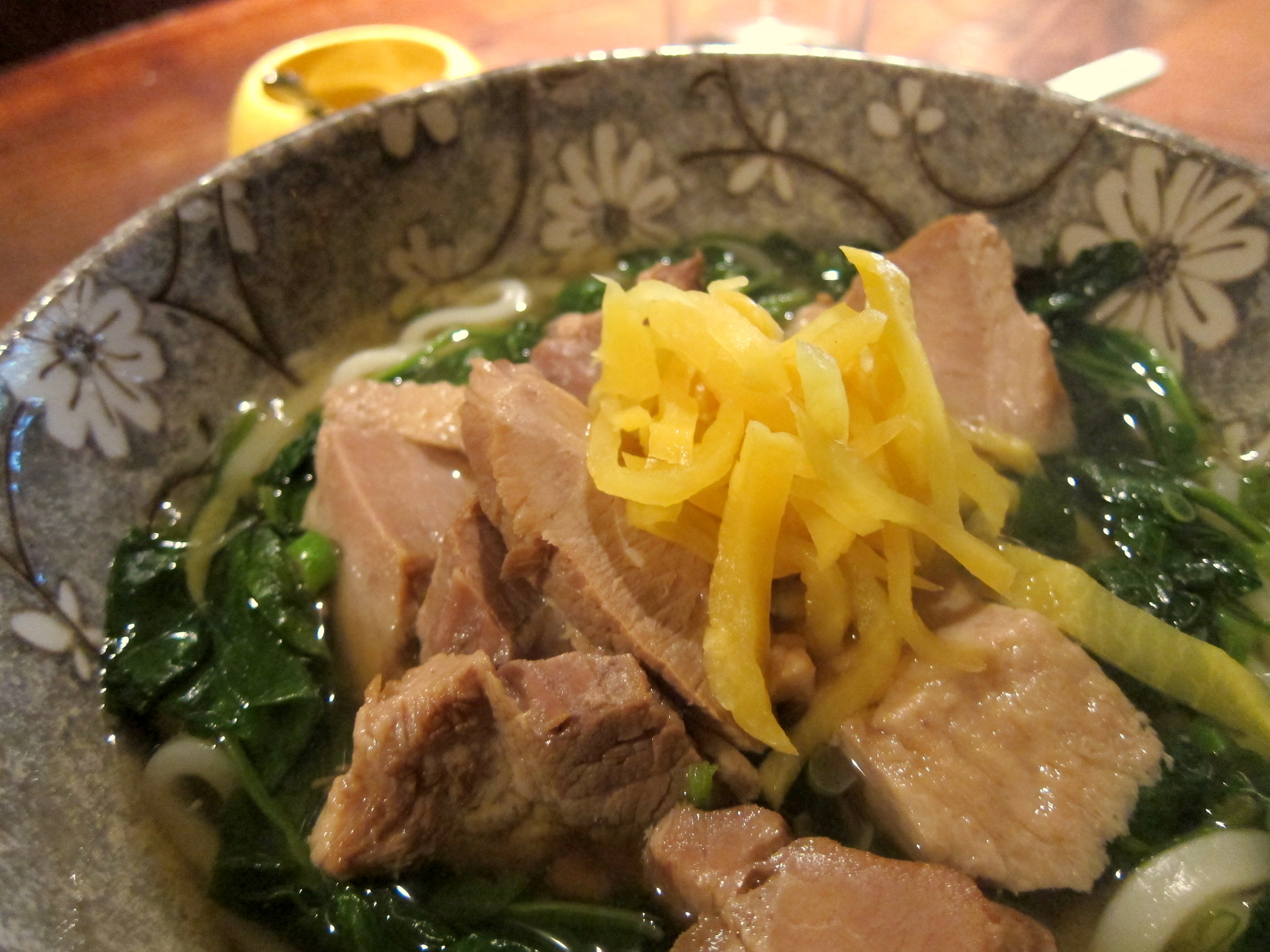
Then came the reason we decided on O Chamé: the noodle soups. The broth is light yet hearty. Actually, I’m still in tea mode so I can only think of the word “full-bodied” to describe it. Tender pork as the base, smooth spinach for texture, and thin strips of takuan (pickled daikon) to freshen it up. Both Tiana and Kristen settled on this pork shoulder udon ($14.50). My normal self would, too.


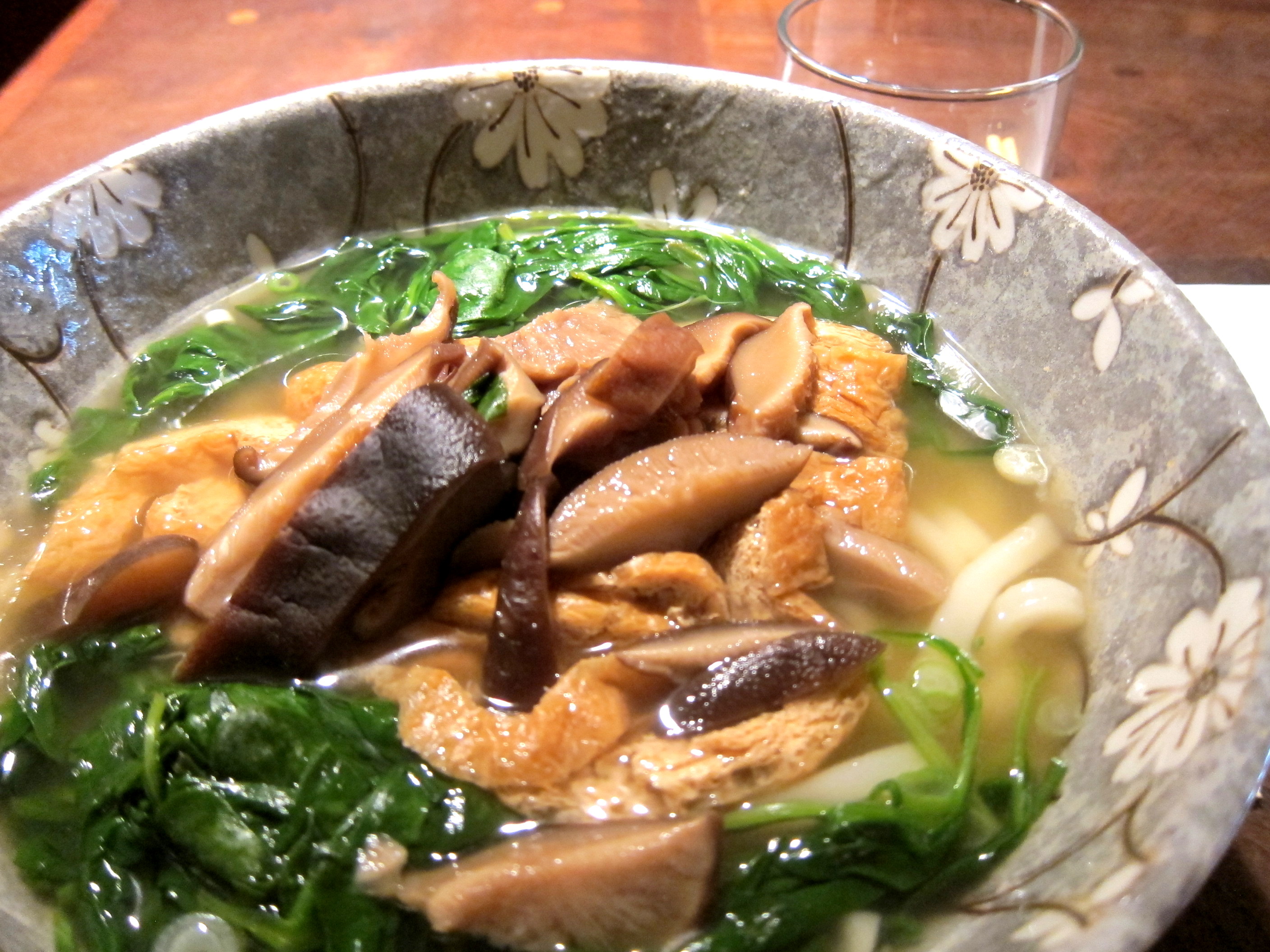
But I chose the tofu udon instead. Lately I’ve decided that I should gauge a restaurant based on their vegetarian/vegan numbers because it’s hard to make vegan stuff taste good (unless it’s a dessert). This shiitake-spinach-aburage (fried tofu skin) udon (13.50) passes the bar, but it would be nice had it been entirely vegan. The broth is a fish stock flavored by the earthy sweetness of mushroom. I prefer the vegan udon at Anzu, whose broth has the more refreshing note of chrysanthemum greens.

Our face bathed in the steam, our stomach getting packed. It was hot. We were dead full half way through the bowl. I did my best picking up all of my spinach and mushroom, but shamefully left half the broth and a third of the noodle. We thought we couldn’t eat anymore, but then we flipped the page and stared at the desserts, then looked among ourselves and grinned: “I don’t think we’re ever too full for ice cream”. 😀 Just one dessert is not gonna hurt. The agony was when we narrowed our choices to four (from nine): sherry custard, poached pear with berries, truffle torte, and what we ended up getting following the waitress’s suggestion: two scoops of caramel balsamic gelato ($5).


The first spoon was, well, interesting. But it grows on you. It has a bite to it. Kinda feisty, or in Kristen’s words, “like yogurt”, which makes sense because both balsamic vinegar and yogurt are products of fermentation, works of microbes, and sour. Definitely worth squeezing in at the last minute.


Address: O Chamé
1830 4th Street
Berkeley, CA 94710
(510) 841-8783

Dinner for three + tax: $81.56

(*) At first I pronounced it |oh-shah-mei|, like a French thing, you know. But seeing its meaning, I guess it must be |oh-jah-mei|, like “cha” (tea) in sencha.

I can’t think of a title for Tofu Village

April 01, 2012 By: Mai Truong Category: Comfort food, Houston, Korean, noodle soup


Lately I think I’ve reached a wall in terms of Korean food. To be precise, the Korean food that I can get my hands on, i.e., in the Bay and in Houston. Every Korean restaurant here, in strikingly similar manner to Vietnamese restaurants, has the same menu as every other Korean restaurant. The menu may contain a hundred things, but it boils down to maybe ten, with tiny variations.


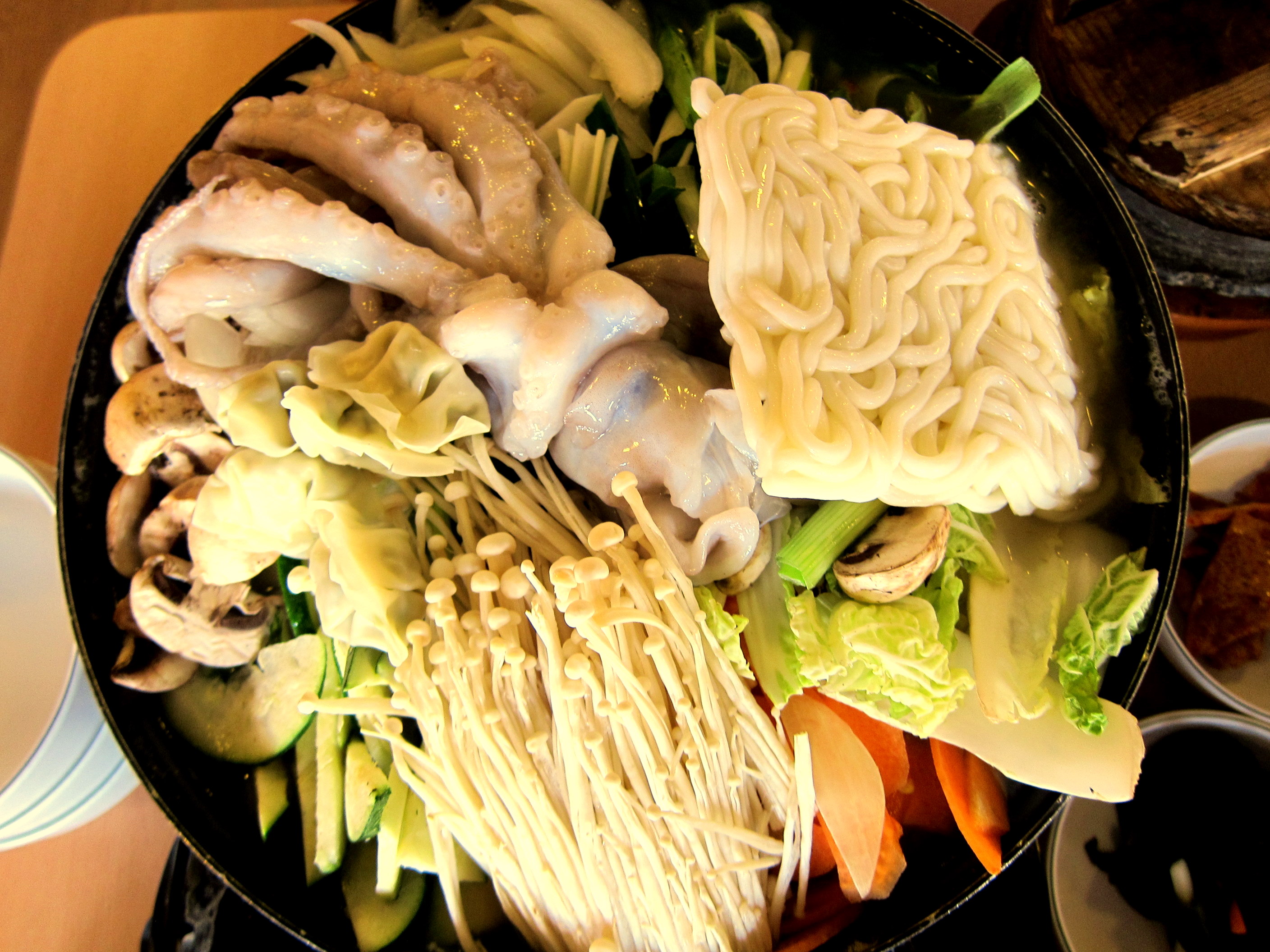
To be blunt, I’m bragging that I can name practically every dish on a Korean menu in the States. The novelty is gone. Little knowledge is left to obtain. But just as I don’t stop going to Vietnamese eateries altogether, I still like to share a big Korean meal with Mom and Dad. A bubbling jeongol, rice and banchan always give the familiarity that a Western meal cannot.


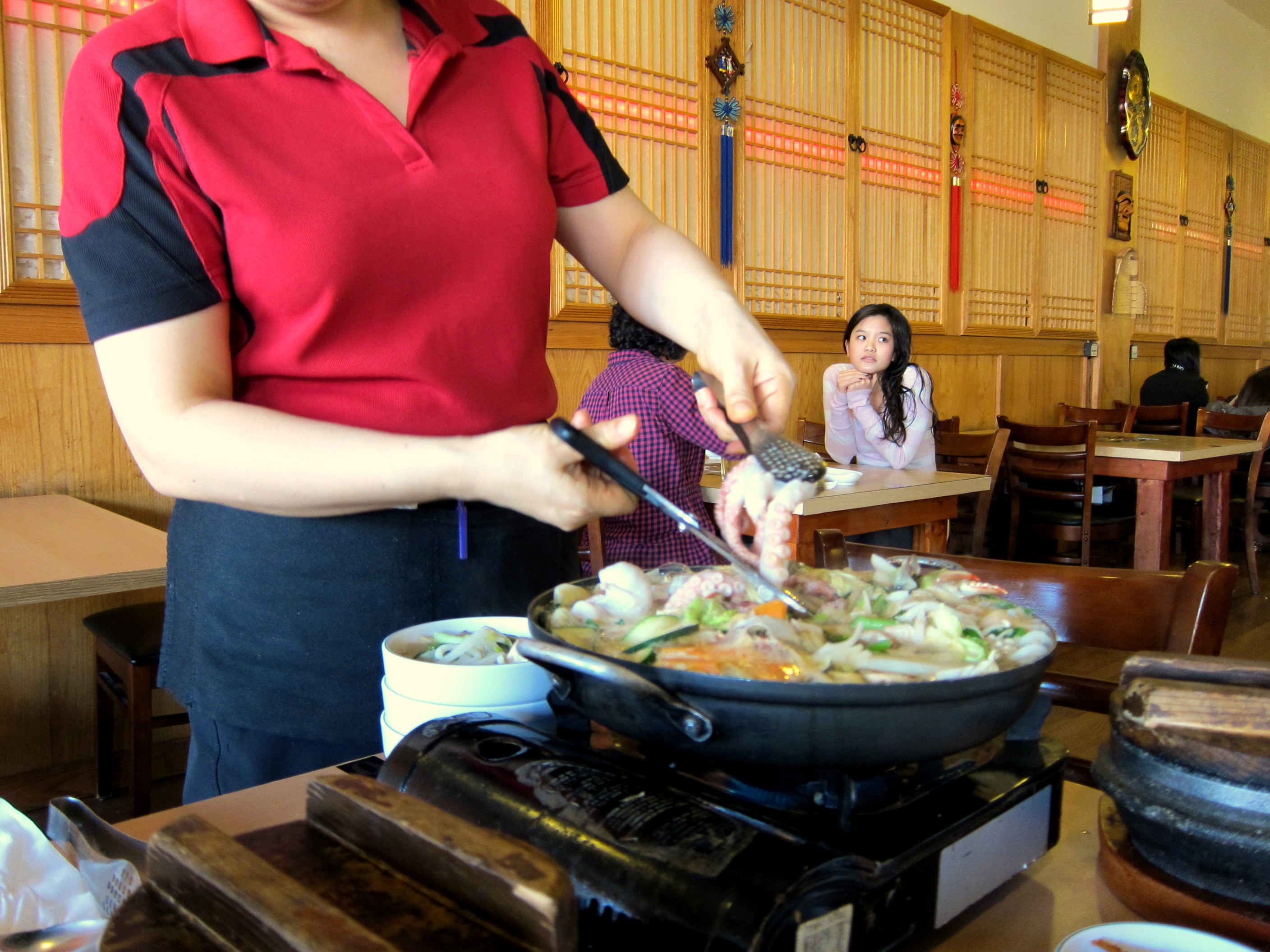
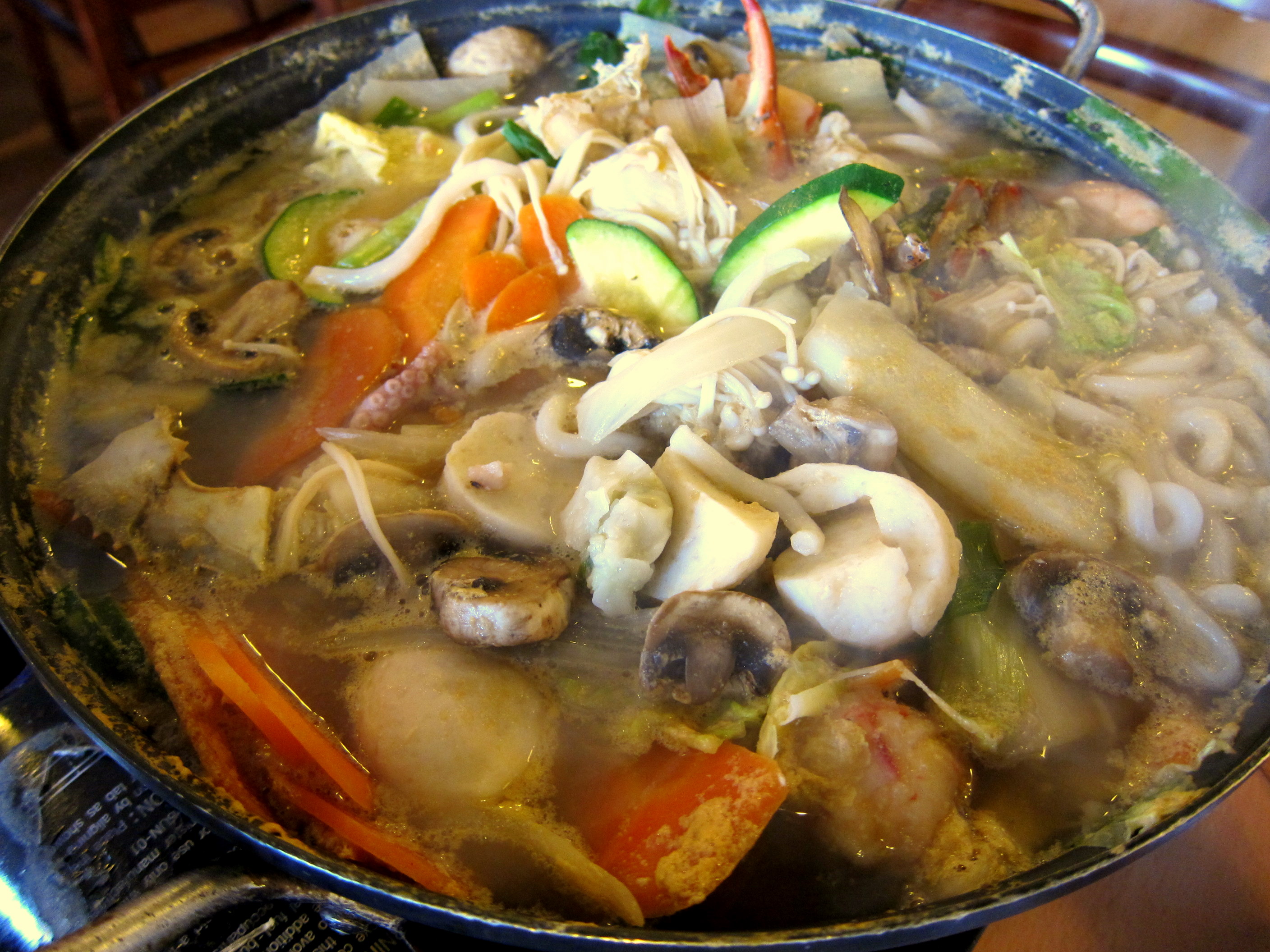
That said, there are a few things that I’m still not used to, such as the scissors. The lady was cutting up the crabs and octopus with big black scissors. I admit their convenience, but I get the weird feeling that she is cutting flowers. Why? I don’t know. Anyway, I didn’t eat the crabs because I don’t care for crabs, but I like the octopus. I think I might prefer octopus to squid. The broth is also just right.


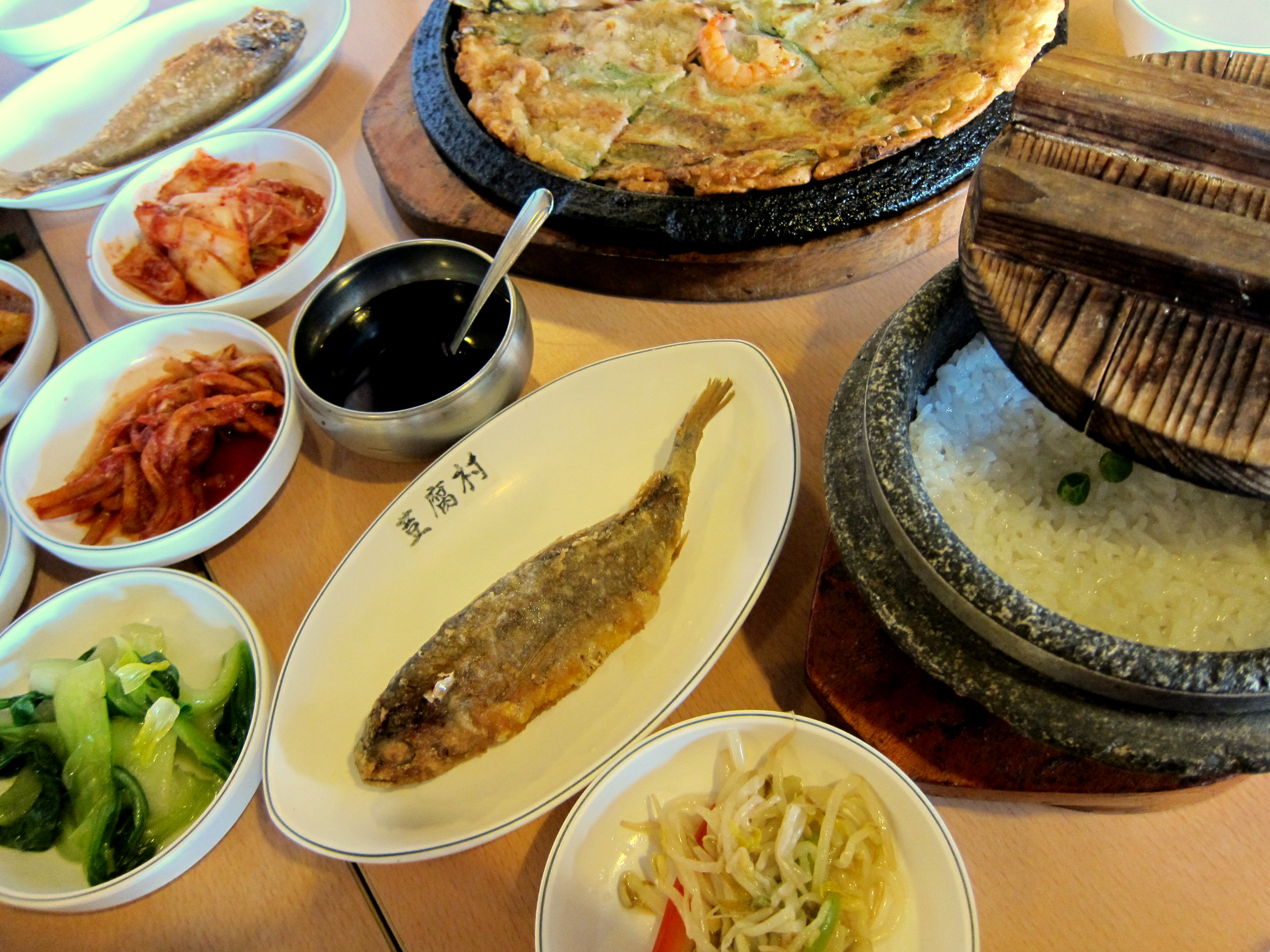
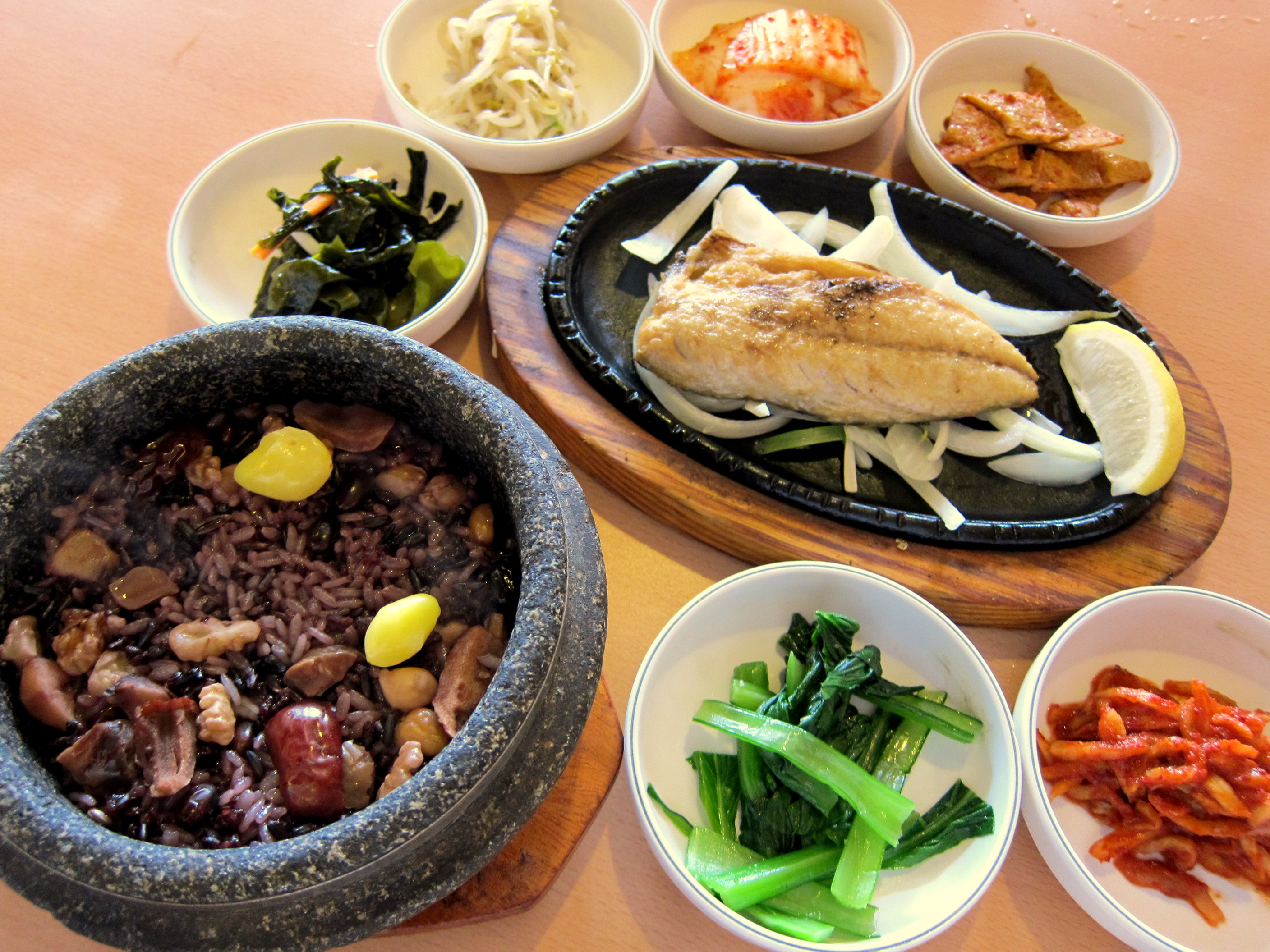
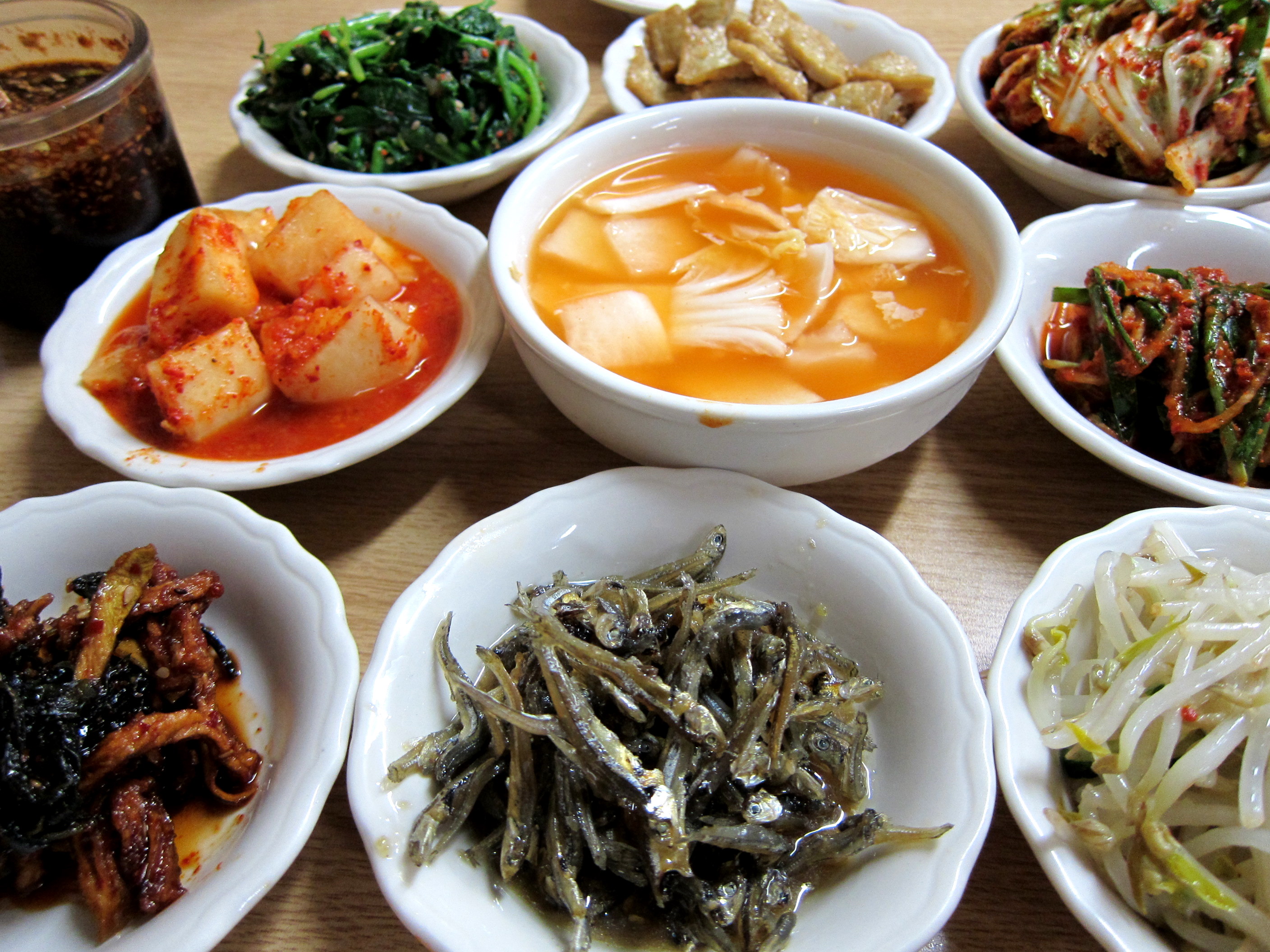
The banchan is standard, but they include two fried fish for every order of jeongol. Little Mom likes fried fish. 🙂


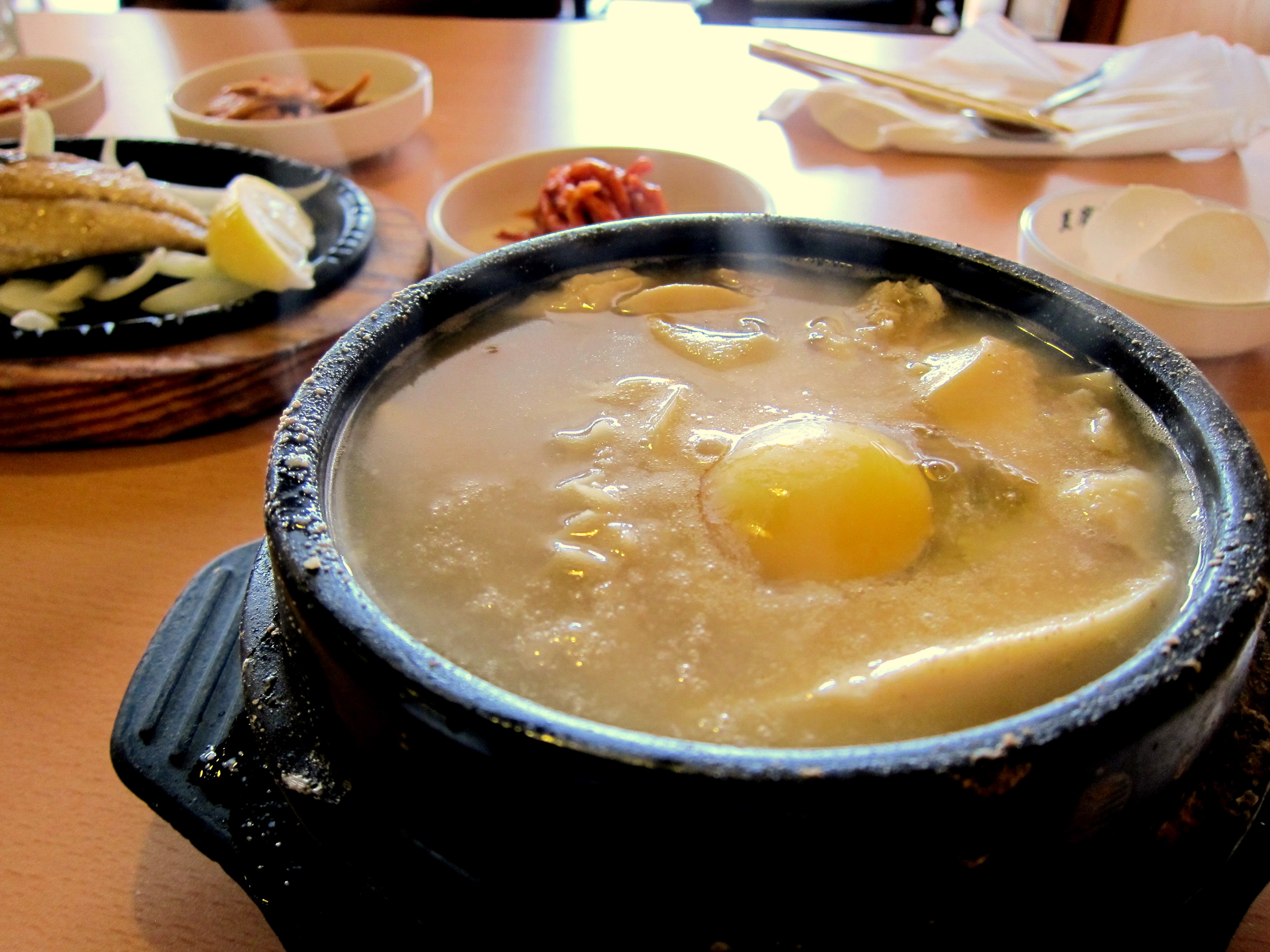
The soondubu with tripe and intestine is also nice: soft tofu in contrast with crunchy tripe and chewy intestine. Well, Tofu Village would not live up to its name if its soondubu wasn’t good.


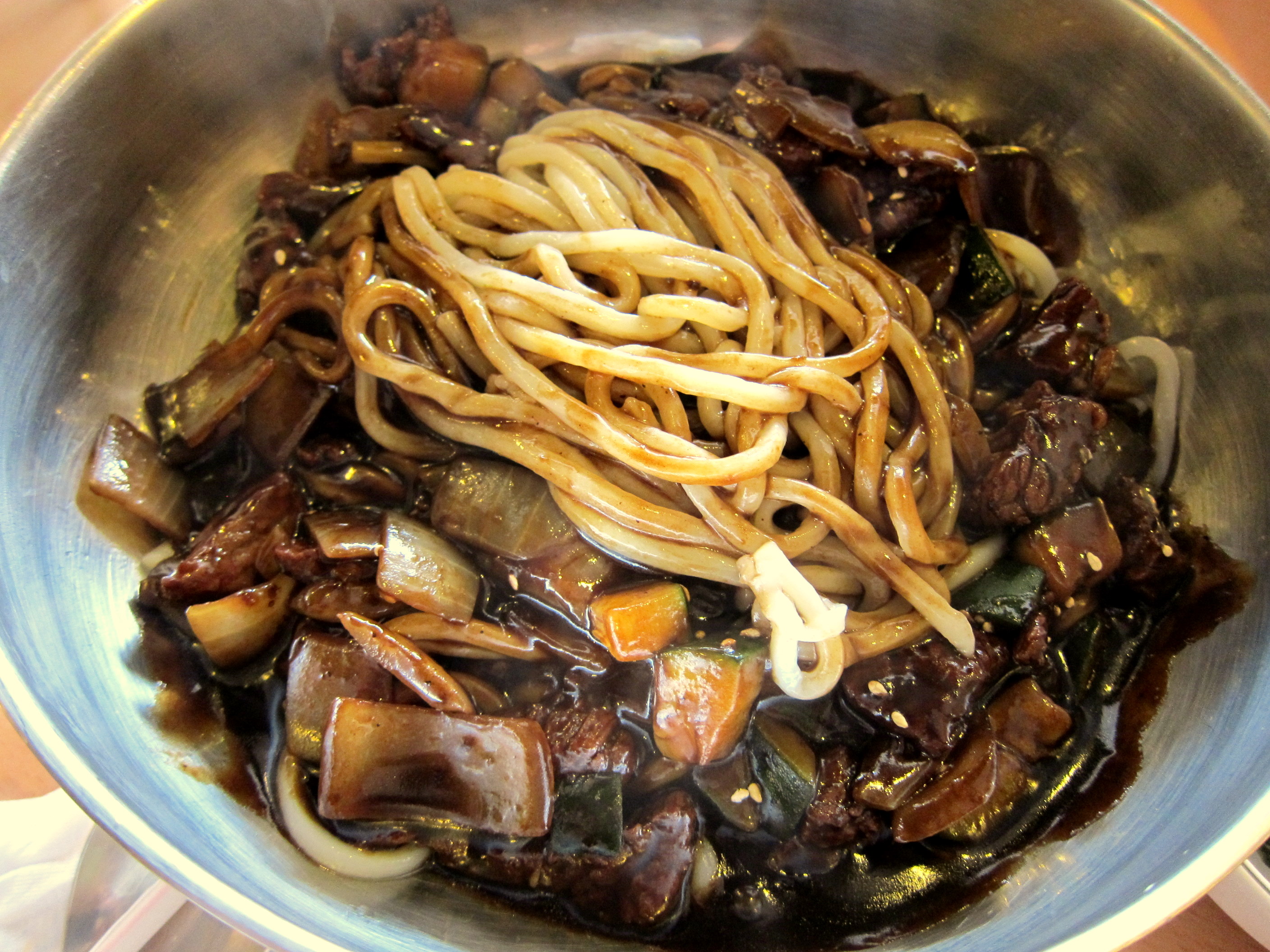
The jajangmyeon is a slight disappointment, compared to the one at Daddy and Daughter‘s in the H-Mart food court. The sauce is not sweet enough. Being served in an inox bowl makes it lose its heat too quickly. The noodles are also too thick.


One thing that I try here without having tried before is the “nutrition rice”, which is blackish purple rice (nếp than) with walnuts, dried jujubes, peanuts, and two yellow nuts whose name I don’t know. I like white rice because like water, white rice keeps your palates clean for the other dishes, but not only is this nut-mixed rice fun to eat, it also deems the mackerel and the kimchi unnecessary.


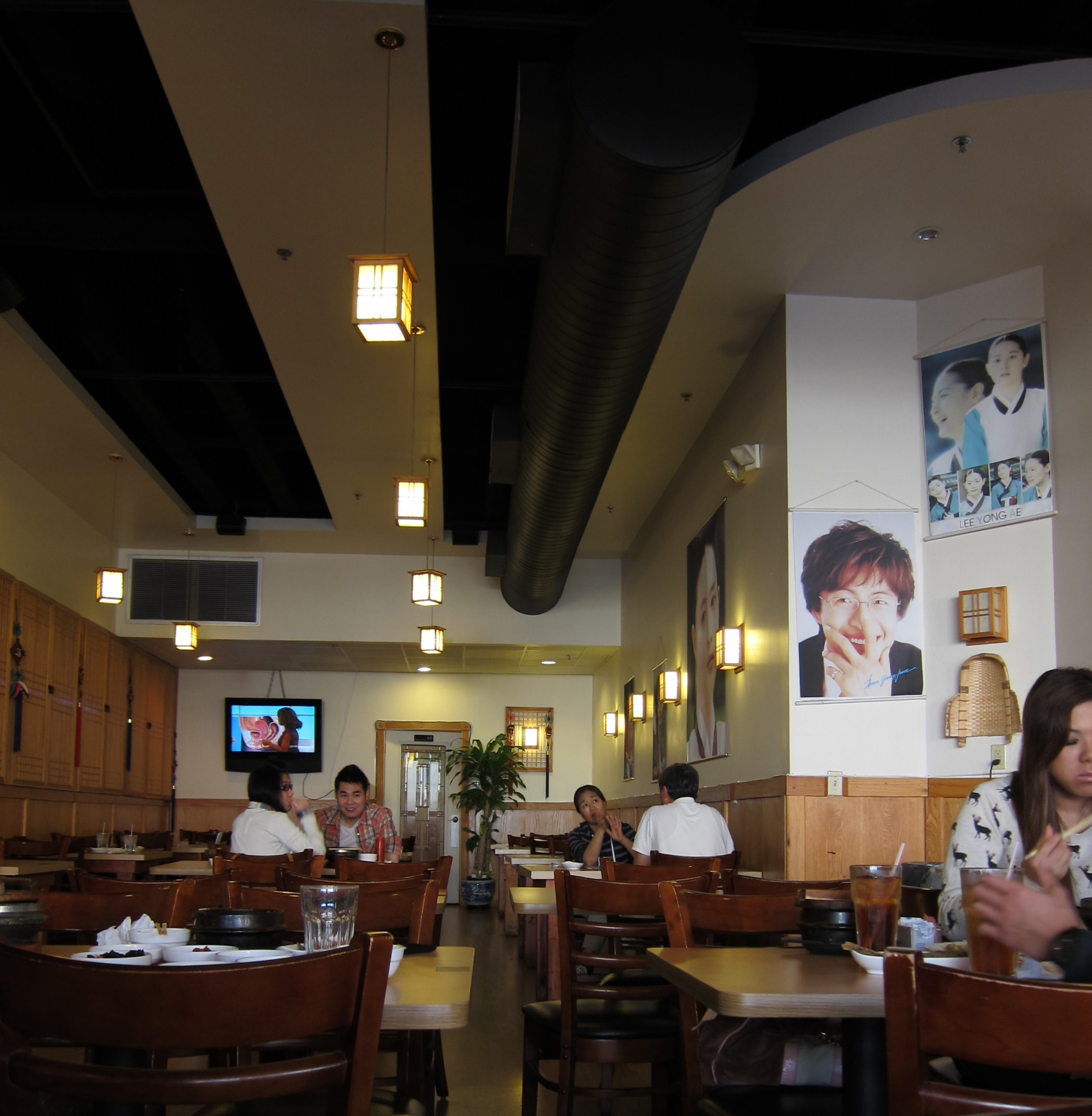
The biggest identifier of Tofu Village must be the celebrity posters on the wall. At least that’s how Aaron and I knew that we were talking about the same Korean restaurant when he mentioned that his group has a new place to frequent. Would I frequent it myself? The name “Tofu Village” does sound a little Americanized, and I can’t say that everything I ordered was stellar, but to be fair, what I ordered were not the common dishes that people order at a Korean restaurant here. Naturally, the chefs would be more comfortable with what they expect the customers to get. So next time I’ll get something more standard, with tofu. 😉

Address: Tofu Village (두부 촌)
9889 Bellaire Blvd #303
Houston, TX 77036

The unpredictable Myung Dong

October 16, 2011 By: Mai Truong Category: Comfort food, Houston, Korean, noodle soup


Unpredictability #1: “Are you opened today?”
Before you set your GPS to Myung Dong in Houston, make sure you call and ask that question in the clearest, simplest way possible. Aaron tried different versions, most were a bit too elaborately polite with a perfect American accent, and only succeeded in confusing the poor old man. I tried it once and got the answer “Yes, open.” We hopped en route.


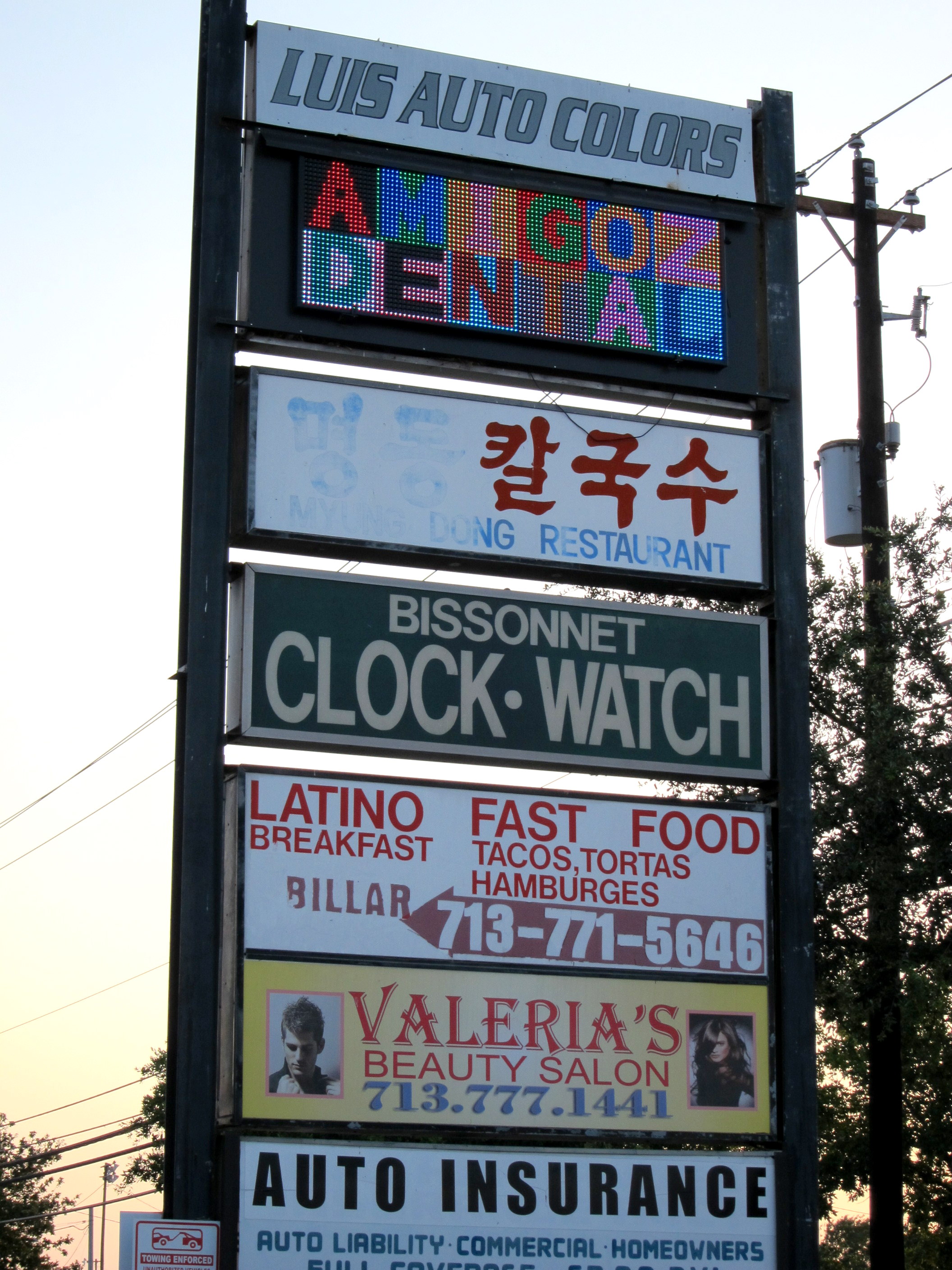
(If you don’t call, there’s a slim chance that your schedule will coincide with the owner couple’s schedule, which depends on the lady’s health, and she’s the only chef. That slim chance didn’t happen for me the first time I set out for Myung Dong.) The limited English conversation is nothing uncommon at Korean and Vietnamese mom-and-pop diners, but I have to mention it because it’s one of those things that make me classify Myung Dong as more “authentic” than the other Korean restaurants in Houston. The second thing is that its name doesn’t contain “Seoul” or “Korean”, they go more local: Myungdong (명동) is a part of Seoul (in Vietnam, its equivalent would be a phường). The third thing is that its name contains its specialty: kalguksu (칼국수). In fact, that’s the only part of the name still visible on the sign, the Myungdong part has faded completely, which explains why we couldn’t find it the first time (aside from the other fact that we couldn’t read Korean at the time)*.

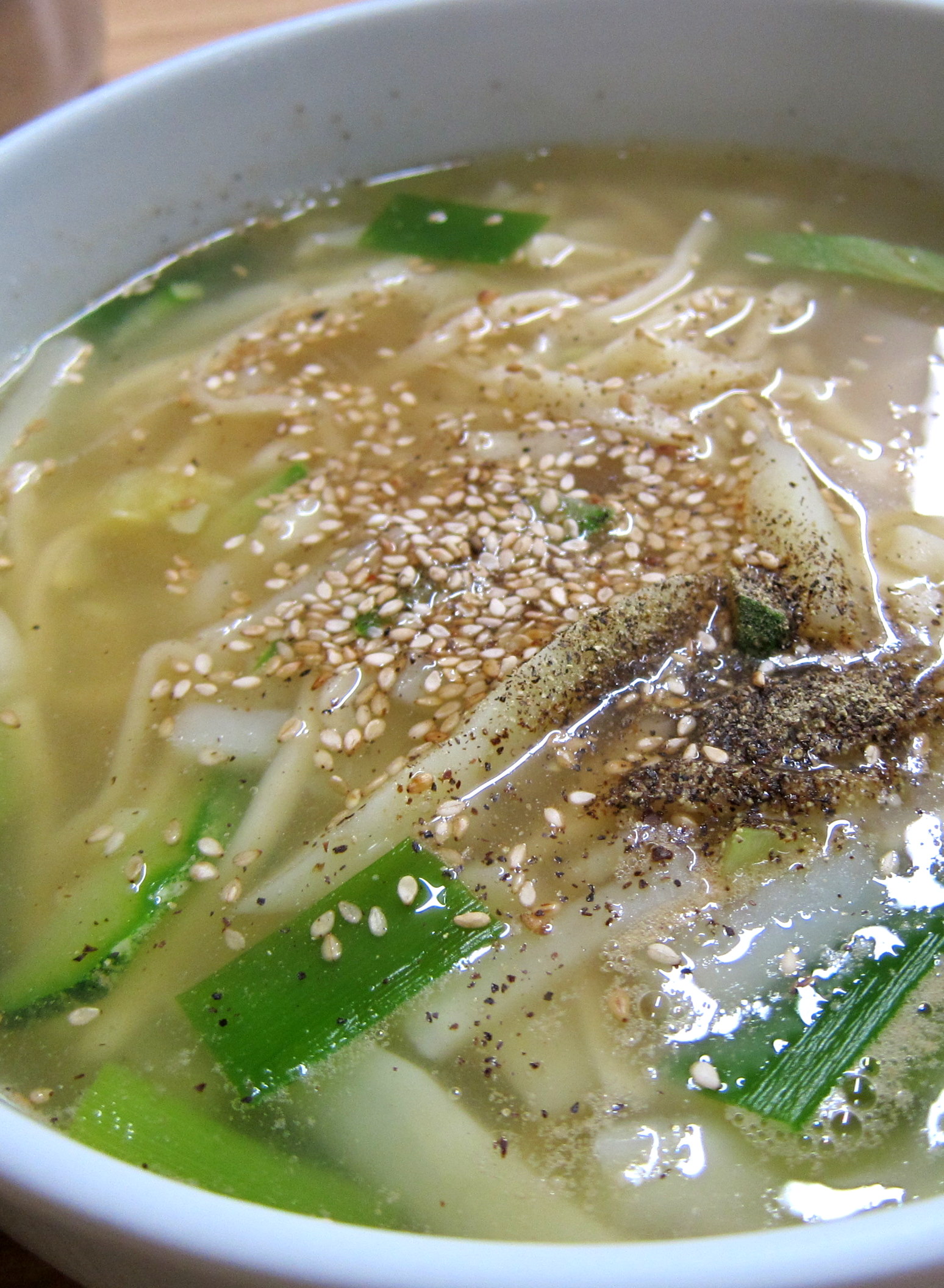
Of course we ordered it. It was the first kalguksu I’ve ever had. It’s a handmade, knife-cut noodle in soup, and this version has only noodle, broth, and vegetables. The broth was sweet and deep, the noodles were wonderfully chewy. But kalguksu is like fireworks, the first two minutes are great, then you ask yourself “just when is it gonna end?”. Now that I’ve had kalguksu, unless I get a two-minute-size bowl, I doubt I will gather enough curiosity for a second kalguksu in my life**.


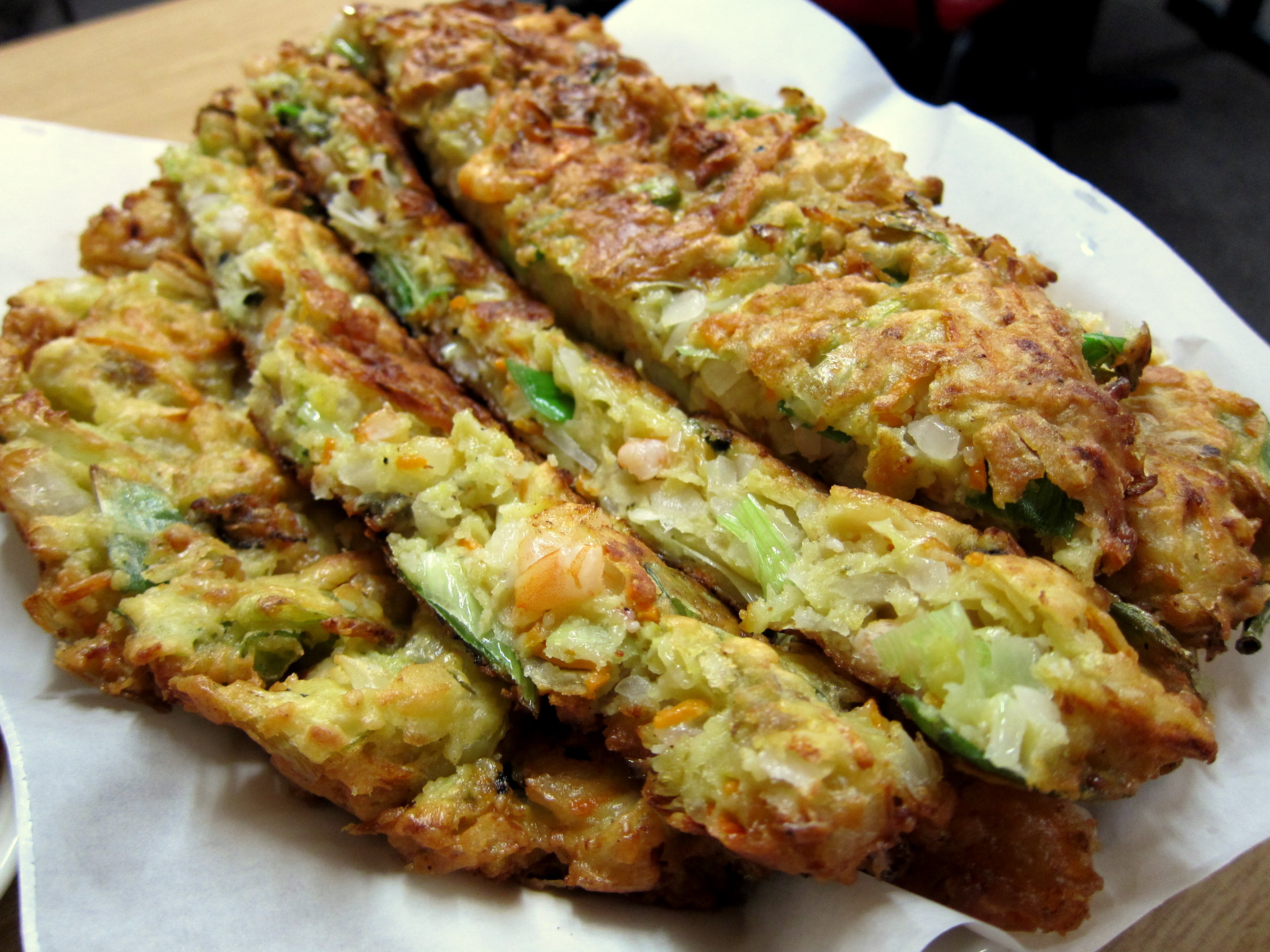
But kalguksu was still a memorable thing. In my Commis post I went off on the memorability of meals, and here I go again. Myungdong has something worth remembering: the portion (Unpredictability #2). Aaron and I each ordered a dish, him the kimchi duaeji bokkeum (김치 돼지 볶음, stir-fried pork with kimchi) and me the kalguksu, and we decided to share a pajeon (it was a really good pajeon too, thick, crispy, airy, and chewy, oh, and not oily). The usual banchans came. We were both starving like baby goats. Then the big stuff came, covering the whole table. A diligent hour later, in Aaron’s words, “it looks like we hadn’t eaten anything at all”. We looked at the old man with hopeful eyes, for boxes. Many boxes. Also in Aaron’s words, “he’s quietly laughing at us: gotcha, foreigners, didn’t know what you were getting into, did you”. He did laugh with us, a very congenial laugh of old men, as he poured the goods into the containers and loaded the containers into a cardboard box. Aaron had enough food for the next week. And Aaron is no timid diner.


Address: Myung Dong Kalguksu
6415 Bissonnet St
Houston, TX 77074
(713) 779-5530

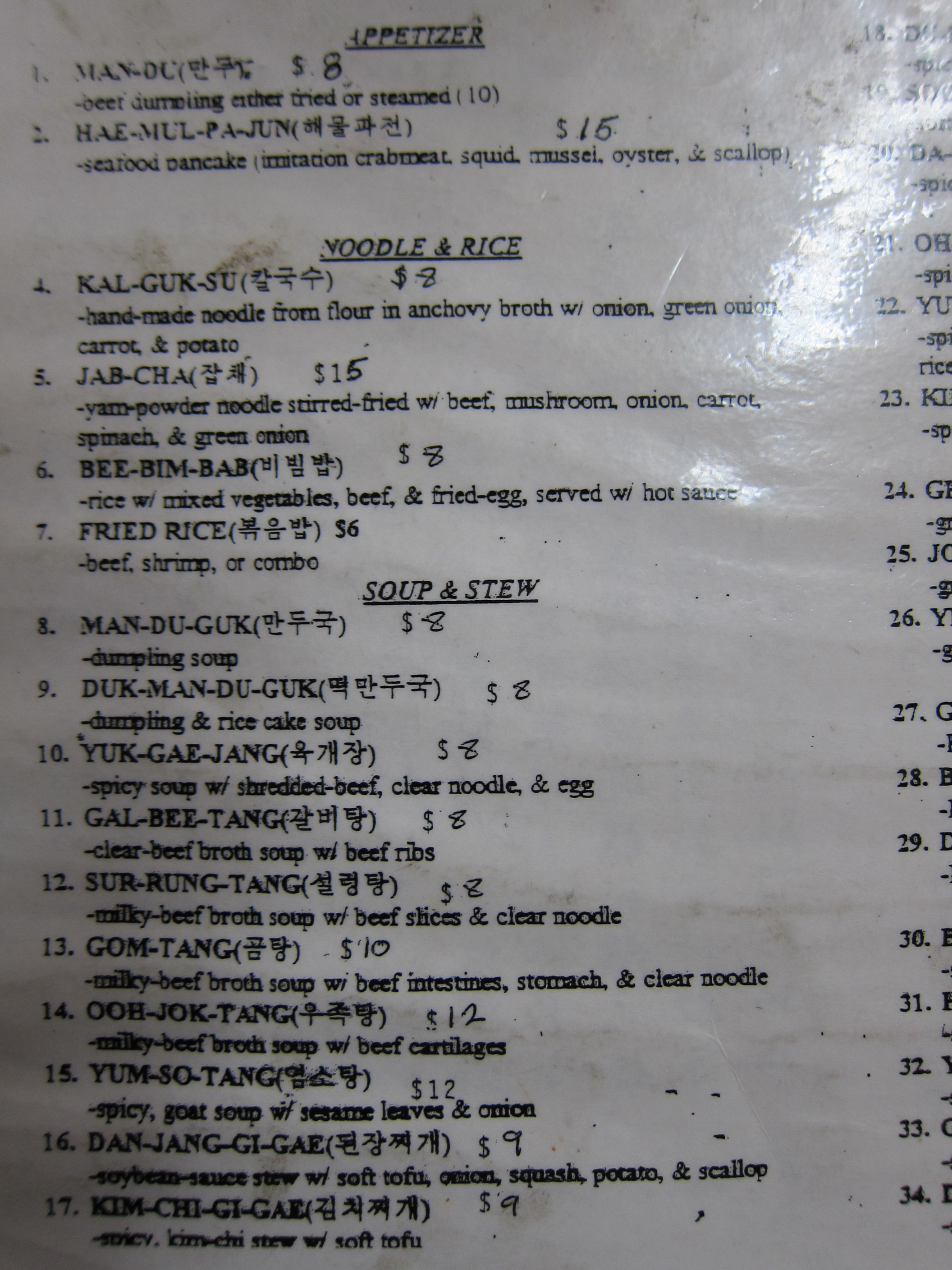
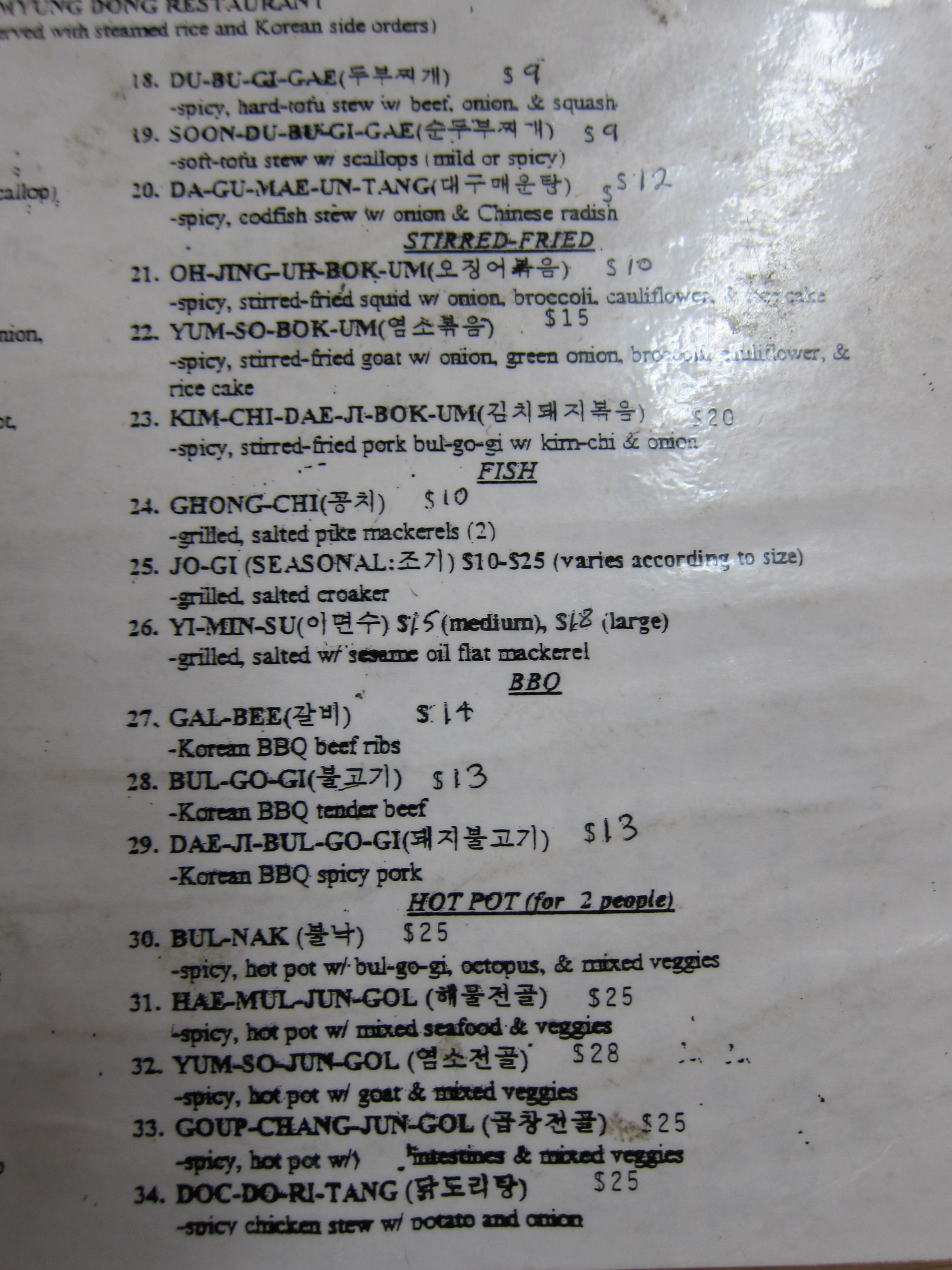
Dinner for so many more than two: $50. See Menu pages 1 and 2.

(*) It’s a neon green one-story house with no door sign. Very noticeable. If in doubt, ask the people in the same parking lot, they’ll confirm “The Chinese restaurant? Yes, that’s it there!”
(**) This is why I didn’t get kalguksu at To Hyang, although it’s one of their recommended’s. In a few ways, such as the homemade kimchis on the table, Myung Dong is similar to To Hyang. When my Korean is better, I’ll ask them if they grow herbs in the back too.

Korean chilled noodle soup with a few Vietnamese twists

September 27, 2011 By: Mai Truong Category: Korean, noodle soup, RECIPES, Vietnamese


Sometimes my craziness surprises myself. I woke up one morning, reflecting that the week’s been warm, and decided to make mul naengmyeon (물 냉면). Weeks earlier, I bought the buckwheat noodles but never had the time to cook, or the mood. Now I still don’t have time to cook, but today is the day. I remember the main ingredients of a true Korean naengmyeon, but just to make sure that I don’t have them, I look at Maangchi’s recipe anyway.

Beef bones? No. Mushroom? No. Dried anchovies? No. Kelp? No. Yeolmu kimchi juice? Hah. In my dreams. I don’t even have cucumber. Am I going to the store? Of course not. The wind might blow away my cooking mood, which is already rare as it is. Besides, I have a blind confidence that what I do have will make a fine bowl. The deaf ain’t scared by gun fires, they (we Vietnamese) say.

Naengmyeon has three fundamental components: the broth, the buckwheat noodle, and the toppings. The broth needs to be clear and slender. To get the sweetness, I substitute beef bones by pig trotters. They have plenty of bones, and unfortunately also plenty of gelatin, but as long as I skim off the fat while the stock boils uncovered, my broth is clear. In place of dried anchovies, I use fish sauce. So far so good.


The tricky part is the yeolmu kimchi juice, or some kind of dongchimi. Naengmyeon, unlike all other noodle soups, can be eaten cold because the tangy, bitter kimchi juice freshens the otherwise fatty stock. More acridity comes from the mustard, but I don’t like mustard so I (coincidentally) miss it from the noodle package. Anyways, no dongchimi in sight, what to do? I just use normal kimchi. Currently I have a jar of cabbage kimchi, but any kimchi would do. The fermented, spicy, and sour flavor is our goal. Churn a handful of kimchi in some cold water, then mix with the cooled broth to taste, it comes out just as well had it been yeolmu kimchi juice.

The noodle: boiled and cooled.


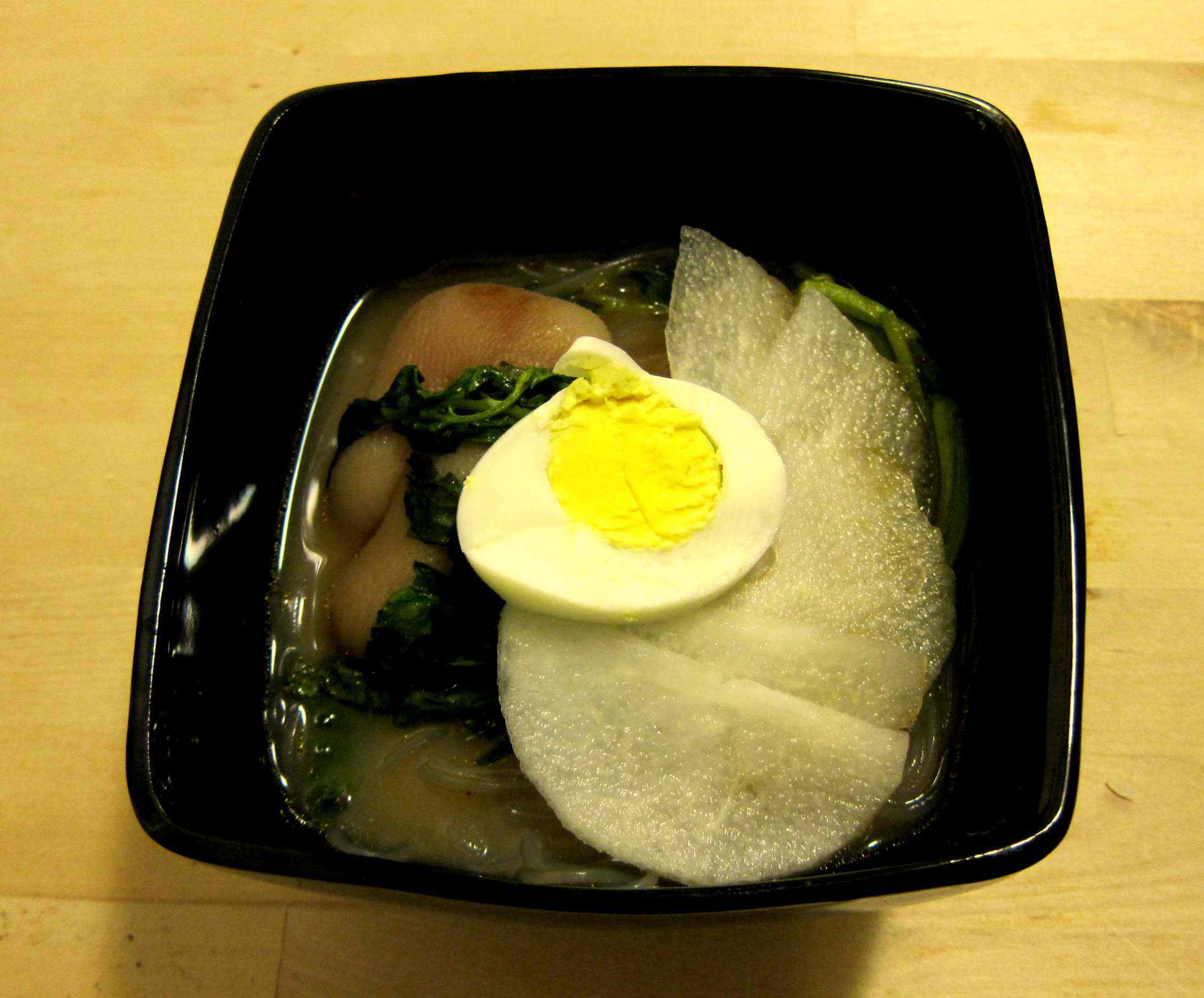
The toppings. Because I’m making the soup version, mul naengmyeon, I don’t need the pepper flakes, pepper paste, ginger, and onion, all of which I don’t have, to make the spicy sauce for the bibim nangmyeon. (You may also wonder what kind of kitchen doesn’t have onions.) Mul naengmyeon toppings are simple: hard boiled egg, cucumber, and Asian pear. The cucumber and the pear, as you might guess, are for crispiness and coolness. I don’t have cucumber so I double the pears. In fact, there’s no such thing as too much pear. It’s sweet, crunchy, and refreshing. It defines naengmyeon.

Another twist I came up with to maximize the freshness: add watercress. Right before serving. Not only does it herbalize and lighten the broth, the porous stems complete the textural spectrum. Just out of curiosity, I also try it hot. Then it’s just jokbal myeon, or miến giò. 😛 In one single bowl is every ingredient that I love: chewy noodle, pig feet, kimchi, and pears. Delicioso.

Mai’s extremely simplified take on mul naengmyeon:
Jokbal Mul NaengmyeonMiến Giò Lạnh
Ingredients: (6 servings)
– 2 lbs pig trotters
– kimchi
– buckwheat noodle (naengmyeon, or miến kiều mạch)
– 1 Asian pear
– 3 hard boiled egg
– watercress (optional)
– 2 tbs Red Boat fish sauce
– Other possibilities: chrysanthemum greens and night scented lily (bạc hà) to clarify the broth.

Preparation:
– The broth: Put washed pig feet in cold water with a pinch of salt. Bring to a boil. Dump out the water, rewash the pig feet in cold water. (This first boil is to get rid of the piggy smell, said Little Mom.) Boil the trotters again, uncovered to keep the stock clear. Skim off the white fat layer frequently. Boil until tender. (This second boil takes about 2 hours.)
—- Add fish sauce near the end. Too much fish sauce would muddle the broth. I use 2 tbs fish sauce and some salt to keep it light. No sugar.
—- Mix a handful of kimchi with cold water, then add to the cooled broth. For less sourness, add the kimchi directly to the broth right before turning off the heat.

– The noodle: boil 3-4 minutes, then rinse under cold water to increase the chewiness and remove the starch.

– The toppings:
—- One or a few slices of hard boiled eggs.
—- A few thin slices of Asian pear. A trick I learn from Maangchi’s recipe: keep the pear slices in cold sugar water to preserve its color and sweetness.
—- A few sprigs of watercress.

Serve cold: refrigerate for 20 minutes or add crushed ice.
Serve hot: like every other noodle soup.


When was the last time I made noodle soup? It was bún bung, exactly one year ago! (Sep 25, 2010 – Sep 25, 2011). Ironically, real bún bung calls for pig feet, and I had to use beef bones. Now real naengmyeon needs beef bones, and I use pig feet.

I think I’ve vietnamized this unique Korean noodle soup enough that it’s qualified as a Vietnamese dish to submit to Delicious Vietnam, a monthly blogging event created by Anh of A Food Lover’s Journey and Hong & Kim from Ravenous Couple. In fact, that’s just what I’ll do. Thank you Bonnibella for hosting the 18th round. 🙂

The Koreans make good pho

August 11, 2011 By: Mai Truong Category: California - The Bay Area, Korean, noodle soup, Vietnamese


Every time I ride the bus on Telegraph, Kang Nam Pho stands out to me like a supernova. (There are these “sorta” cosmologically important exploded stars that have been on my mind for quite some time now, which is an excuse for the sparse blogging of late.) I’ve seen Chinese-owned pho places, but they never have a Chinese name. Pin Toh on Shattuck, which used to be Phở Hòa, has pho cooked by Chinese chefs, but it’s a Thai diner (talk about incognito). In my American pho encounters, Kang Nam Pho is the first instance of a Korean-owned Vietnamese diner with a Korean name. They even put the whole “Phở” with accents on their white-on-red sign, next to “강남 윌남국수” (Kang Nam Wilnam guksu, i.e., Kang Nam Vietnamese Noodle). I like this place already.


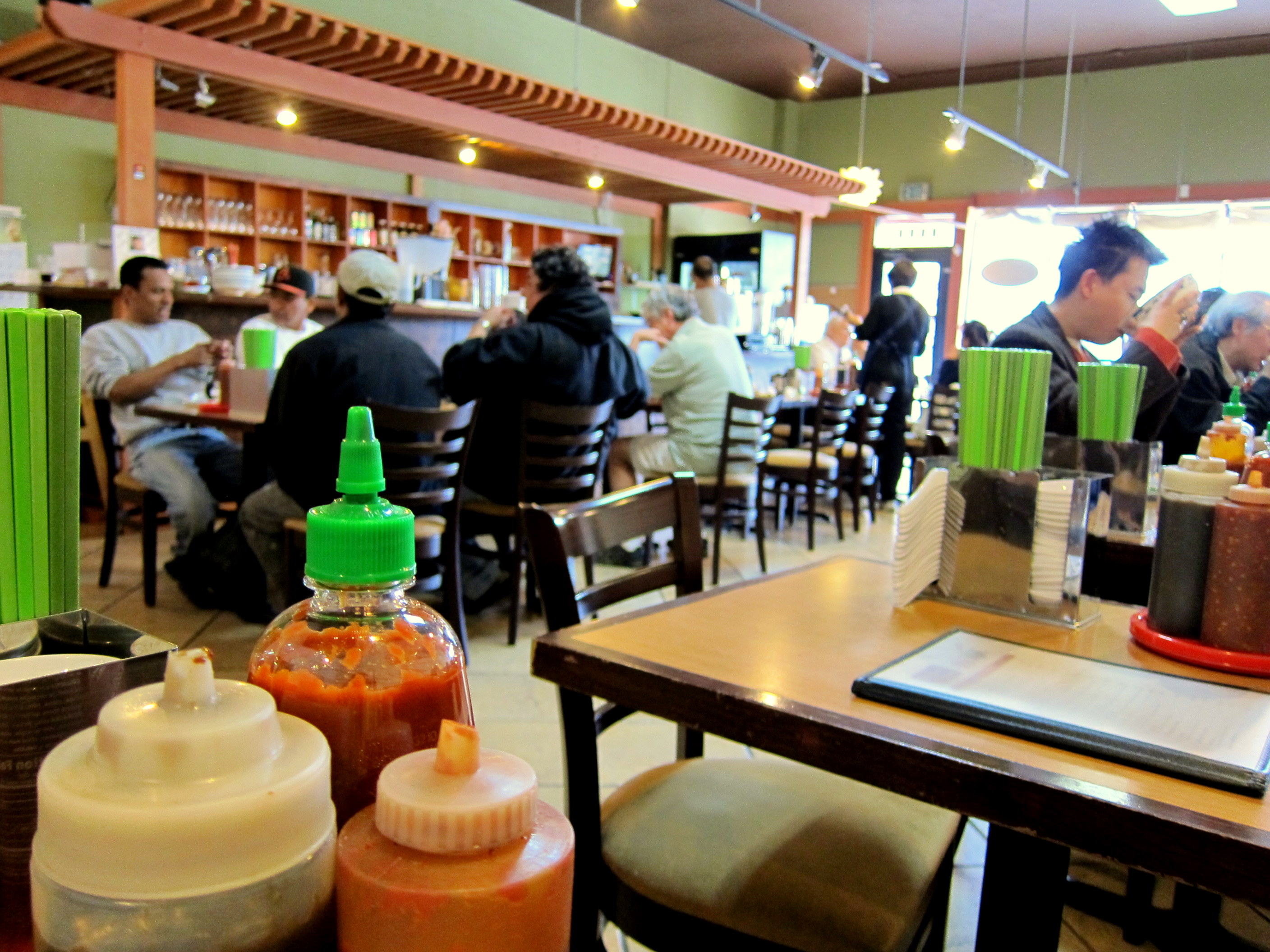
Their menu is also all in Vietnamese, again, with complete accents albeit some misspellings; there is English description under each name and very little Korean. I vaguely remember bibimbap and bulgogi at some bottom corner of a page, but Kang Nam has things that even a common pho joint wouldn’t always have, such as hủ tíu Nam Vang (kuy teav Phnom Penh) and bò kho (noodle with beef stew). The tables are even equipped with green chopsticks, hard-to-eat spoons and sauce bottles. If only the customers didn’t flock every table that day and keep the ladies moving like shuttles in a loom, I would have asked what inspired them to make the place even more Vietnamese than a Vietnamese would, for better and for worse (the spoons…).


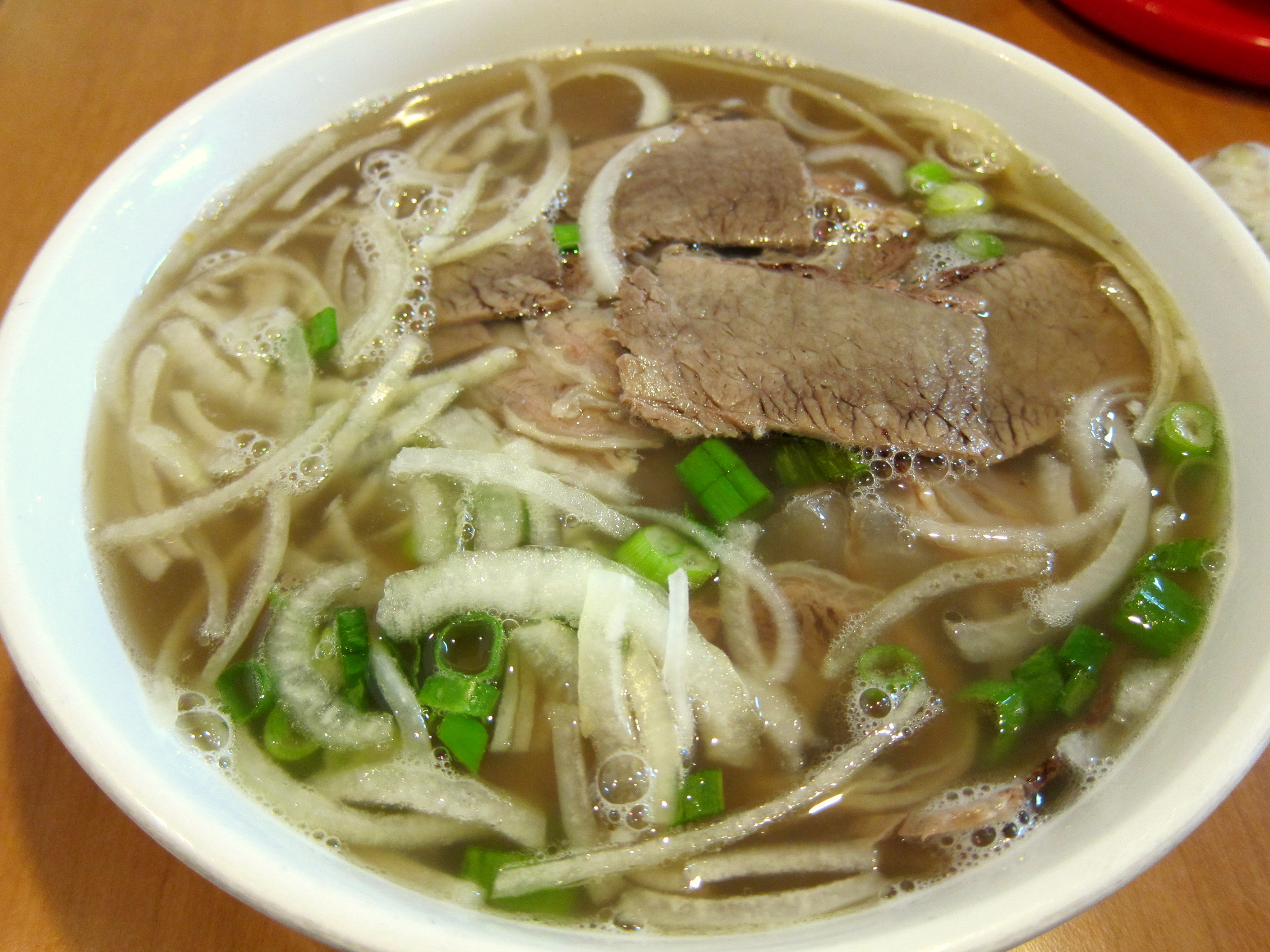
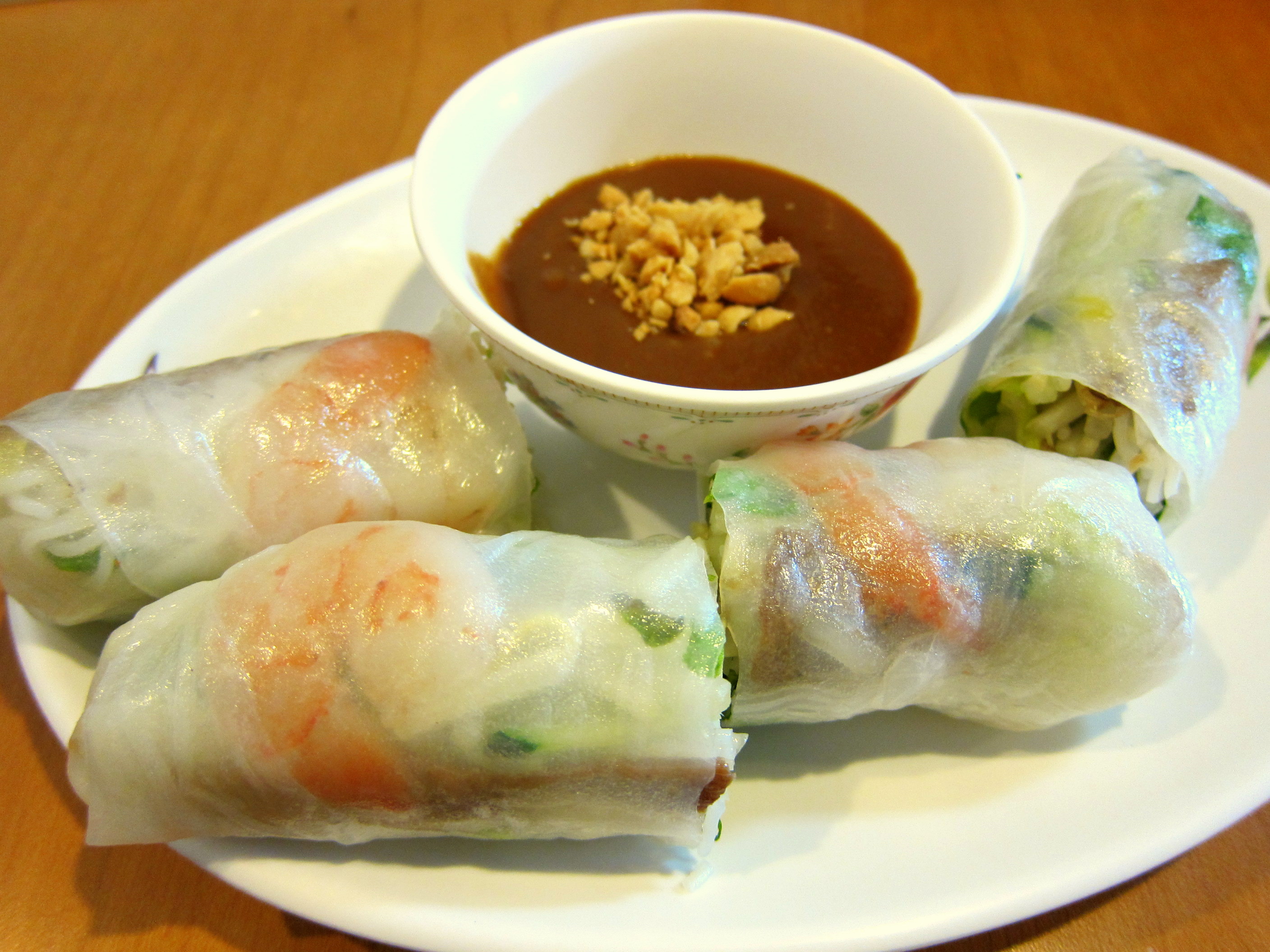
After ordering the inevitables, gỏi cuốn to start and phở chín nạm gầu gân sách (brisket, tendon, tripe) to fill, I followed the usual practice of a lone diner: pull out a book and pretend to read while eavesdropping on my neighbors. However, just barely 3 minutes into opening the book, the summer rolls arrived. Casting aside my literate facade, I started rearranging the roll halves for a good pic when the noodle soup swiftly got placed in the way. They did it fast. That’s how pho should be: you got a pot o’ broth, cooked meat, and blanched noodle ready, an order comes, they all go into a bowl. It shouldn’t take more than one minute. The problem is with me: too little time for a good picture and unable to decide what to eat first. The pho won. The rolls wouldn’t get soggy waiting.

This is one of the best pho I’ve ever had (mom-made pho not included). Deep and subtly sweet broth, chewy noodles, lots of tripe and tendon. A clean aftertaste and a warm broth until the last morsel. Little Mom, a frequent pho craver albeit a picky patron, would like this pho. Why didn’t they struct their business a little closer to campus so that I could come here for lunch? Would they serve blanched beansprout or pickle onion if I ask for it? Next time…

Whenever I ride the bus on Telegraph, I contemplate pulling a stop request for a bowl. Perhaps I’ll go tonight in the name of celebrating Little Mom’s birthday. 😀 We’re Vietnamese, but just to go along with this post’s blending spirit: 생일축하해, 엄마! 🙂


Address: Kang Nam Pho House
4419 Telegraph Ave
Oakland, CA 94609
(510) 985-0900

UPDATE: A 5-second roaming on the ‘net reveals that the Koreans like pho (I’m not surprised, they have plenty of beef based noodle soups) enough to make Korean pho restaurants, and generally Korean pho broths are described as more bland (if disliked) or more clean and fresh (if liked) than Vietnamese pho. For Kang Nam, I side with the latter. Which reinforces the consistency of my pho style. Those who have eaten pho with me often shake their heads at my indifference toward the sauces and the herbs: I don’t put veggies into my pho (not a single leaf), and I don’t adulterate my broth with Sriracha or the black bean sauce. I like my pho pure: beef and noodle. More Korean pho samplings are necessary before I can confirm the difference. When the supernovae start making more sense, the new quest will start. But is this quest possible in the Bay Area?

This post is submitted to Delicious Vietnam #16, August edition, hosted by Chi Anh from Door to My Kitchen.