How can you bring kimchi to lunch at work without the smell of fermented cabbage?
I like the garlic smell of my homemade kimchi, but I’m not sure if I want my office to smell like it. Besides, I’m not a fan of bringing multiple containers to work. I don’t even want people to see me with a fork at my desk, and it’s even worse with an empty but dirty container. The ideal lunch is some kind of finger food, preferably balanced.
One afternoon, I decided to make ssam bab, a kind of roll with napa cabbage kimchi outside and stir-fried rice inside that I first saw in Kimchi Family and never in real life. You can find kimbab (rice roll in kim – seaweed) for very reasonable price in the Asian Ghetto just south of campus, but no Korean restaurants in the Bay dish out ssam bab. The only problem: I cut the napa cabbage leaves in half when I made kimchi, so now the leaves are not big enough to wrap up the rice, and things fall apart. Well, if I can’t make it the Korean way, I’m making it the Vietnamese way.
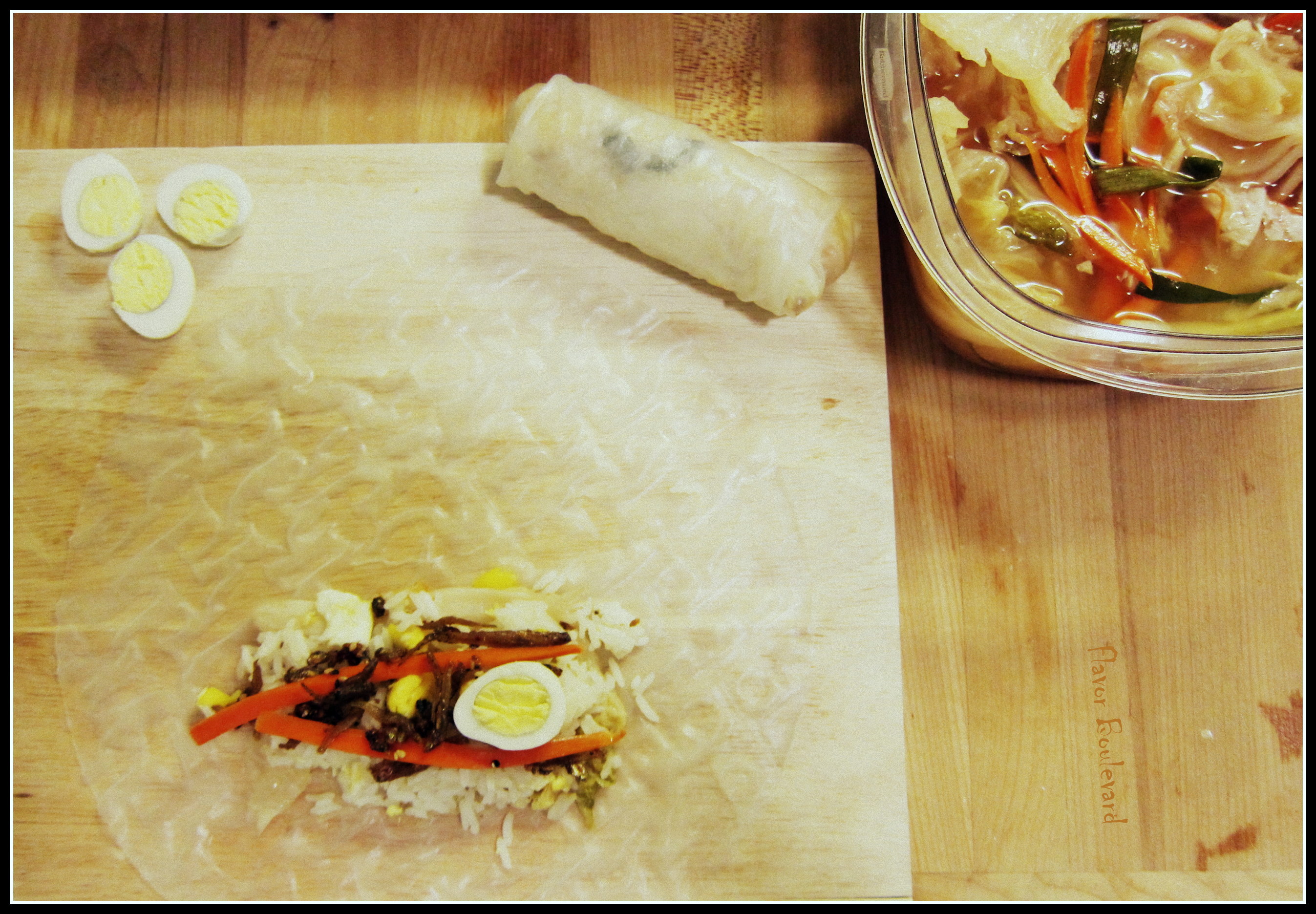
I use rice paper to wrap the ssam bab. The result: a cross between ssam bab and fresh spring roll. The perfect triple-layer balance: rice-kimchi-rice. The rice paper blocks the kimchi smell from diffusing across the room, keeps the roll intact thanks to its elasticity, and makes a clean, grease-less, non-sticky wrapper. The kimchi gives the roll a sour, spicy, garlicky edge so we don’t need a dipping sauce. Texture-wise, a bite takes us from chewy rice paper to juicy but crisp kimchi to the soft rice mixed with crunchy fried anchovy. Three of these rolls fill me up, but I chomp another just because.
Korean ssam bab: sauté pork and kimchi, mix with hot steamed rice, roll in a leaf of pickled napa cabbage, tie the roll with a leaf of cooked green onion.
Rice Paper Kimchi Roll
(make 20 rolls)
– 1 clove garlic, thinly sliced and browned
– 6 eggs, scrambled with garlic, and salt and sugar to taste
– 2 cups rice, cooked
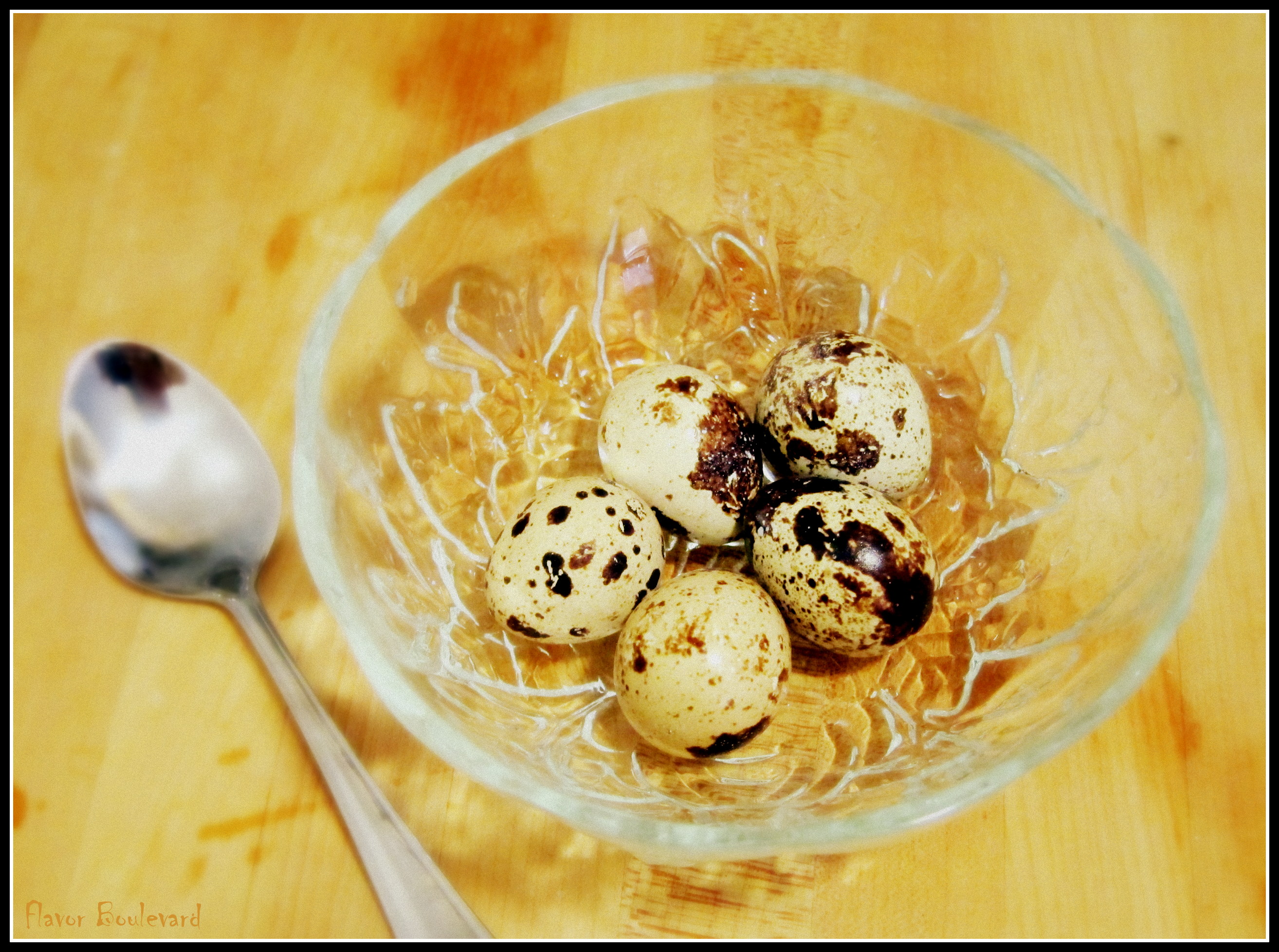
– 10 quail eggs, halved
– 20 sheets rice paper
– 1 cup fried anchovy (myeolchi bokkeum)
– 20 pieces napa cabbage kimchi, the best size is 1.5 inches x 3.5 inches
Mix the scrambled eggs with the cooked rice.
Wet a sheet of rice paper in warm water until it’s soft, spread the rice paper on a plate or a chopping board.
On the rice paper, layer a piece of kimchi, some egg rice (about 1 tablespoon), a few row of fried anchovies, half a quail egg.
Fold the rice paper up along the kimchi piece to cover the filling, then fold the ends over.
Roll. The edge of the rice paper will stick naturally to the roll if the rice paper is moistened enough.
The rolls will stay good in the fridge for 4 days. Cover 3 rolls with a moist paper towel and microwave on high for 1 minute to regain freshness.
July 08, 2012By: Mai Truong Category: Korean, RECIPES
A week we waited. Today had the moment of truth arrived.
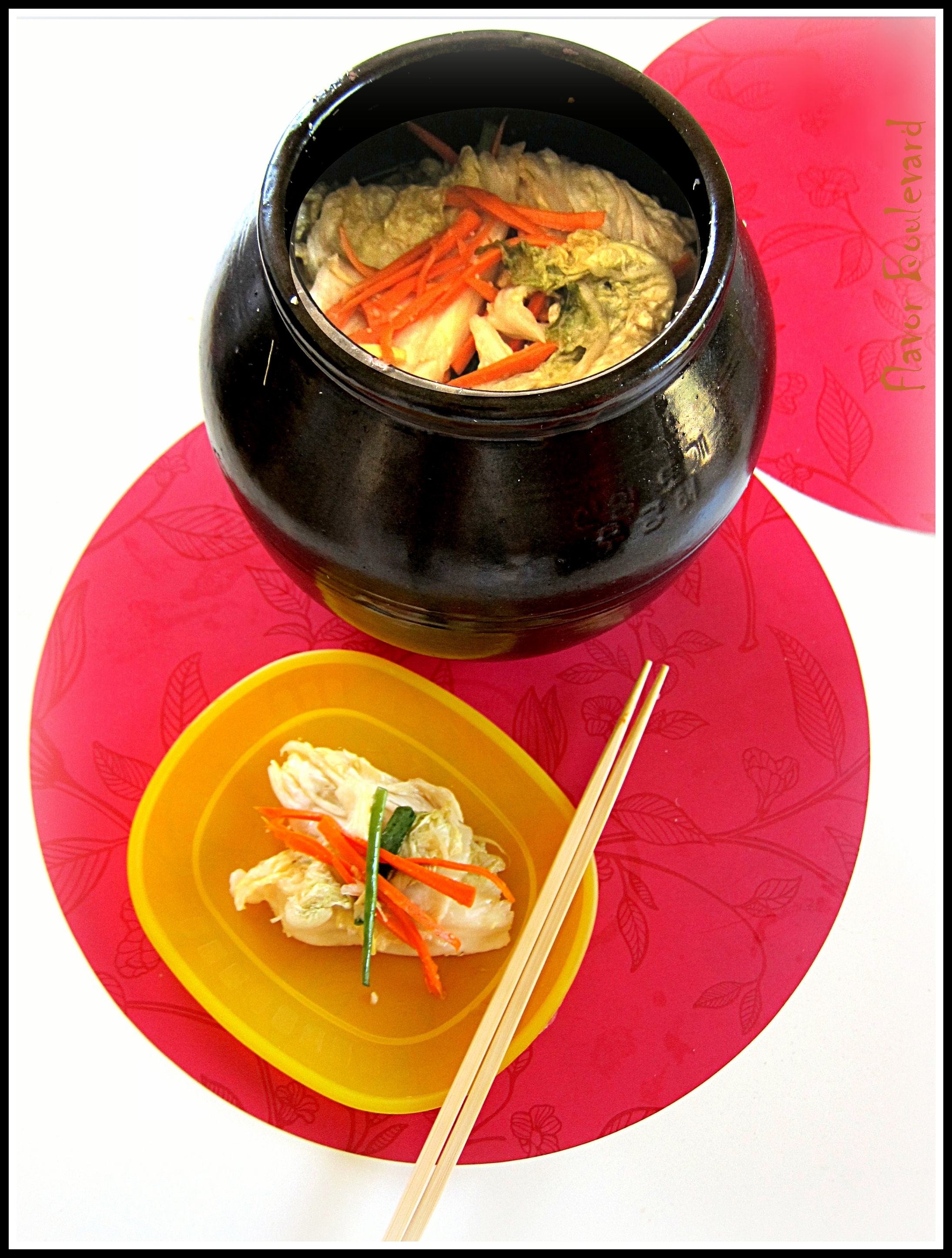
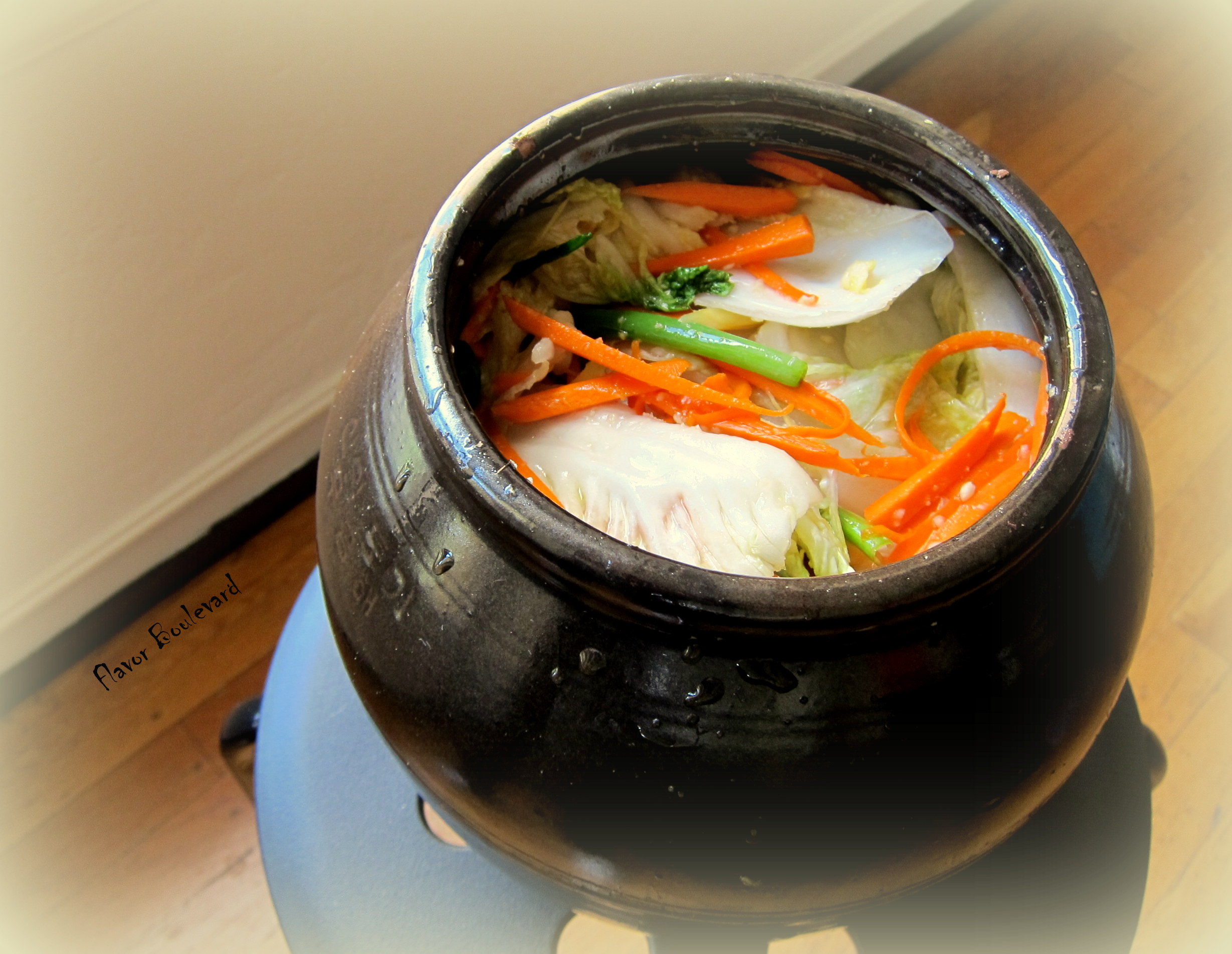
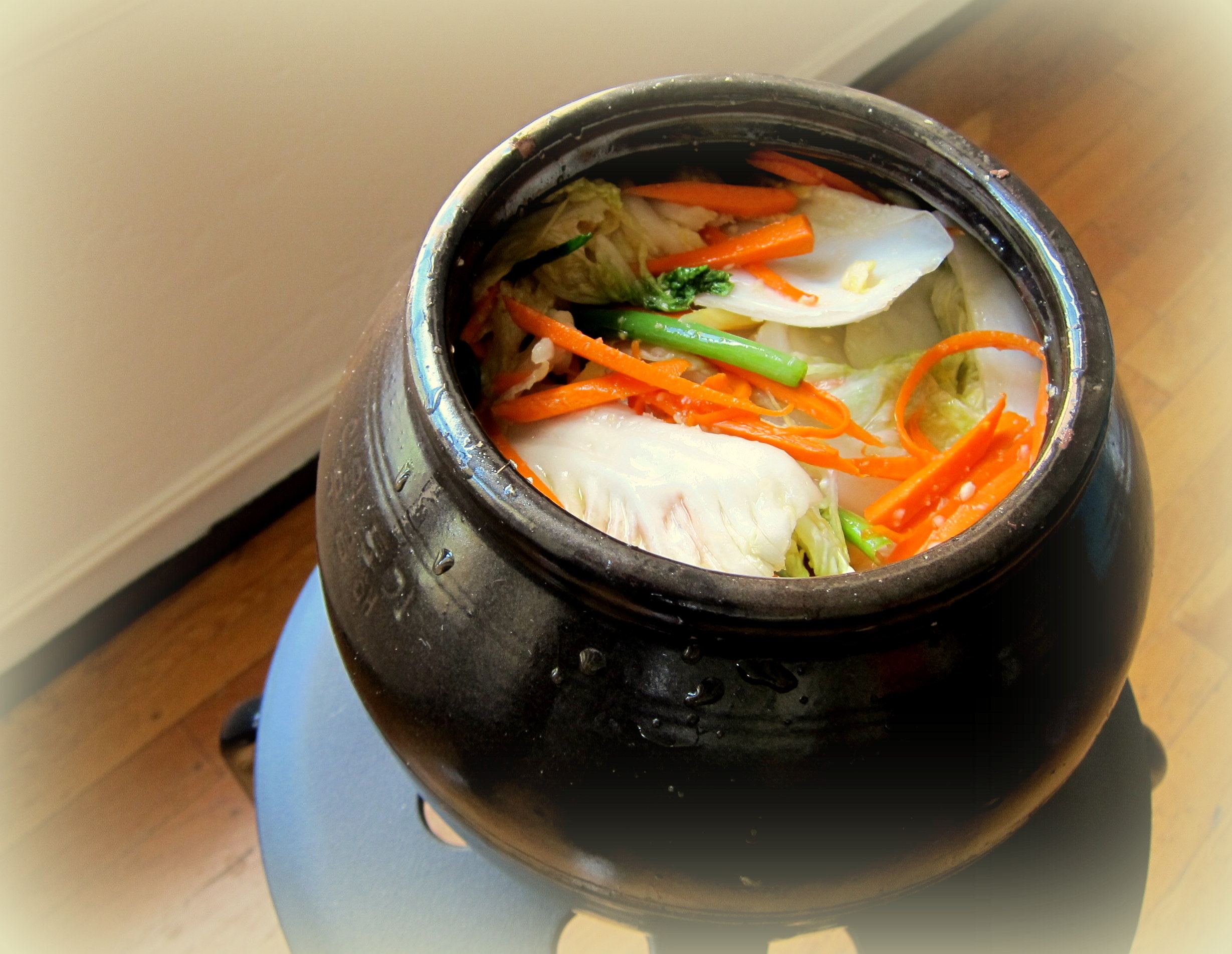
Open the jar we did. Saw some white stuff on the top layer that initially worried us but turned out to be just bits of ground garlic. Off we scraped them anyway, and to check the pickle juice that heavy jar we tilted. Little Mom, who more than anyone I know carrots and bean sprouts and bokchoy pickled has, to me revealed that if the juice is cloudy, the smell “sour in a bad way” and the cabbage disintegrating, into the trash go the kimchi must. But clear is the juice, garlicky and sour in a good way the smell, and crunchy the cabbage. Few moments in life there are when I feel so happy that I get quiet for fear of having mistaken. This is one of those. Followed by a high five and a hug with Kristen.
And yes, being someone who hardly ever cooks then succeeding at making kimchi on first try will make you speak like Yoda. On our side the Force is today.
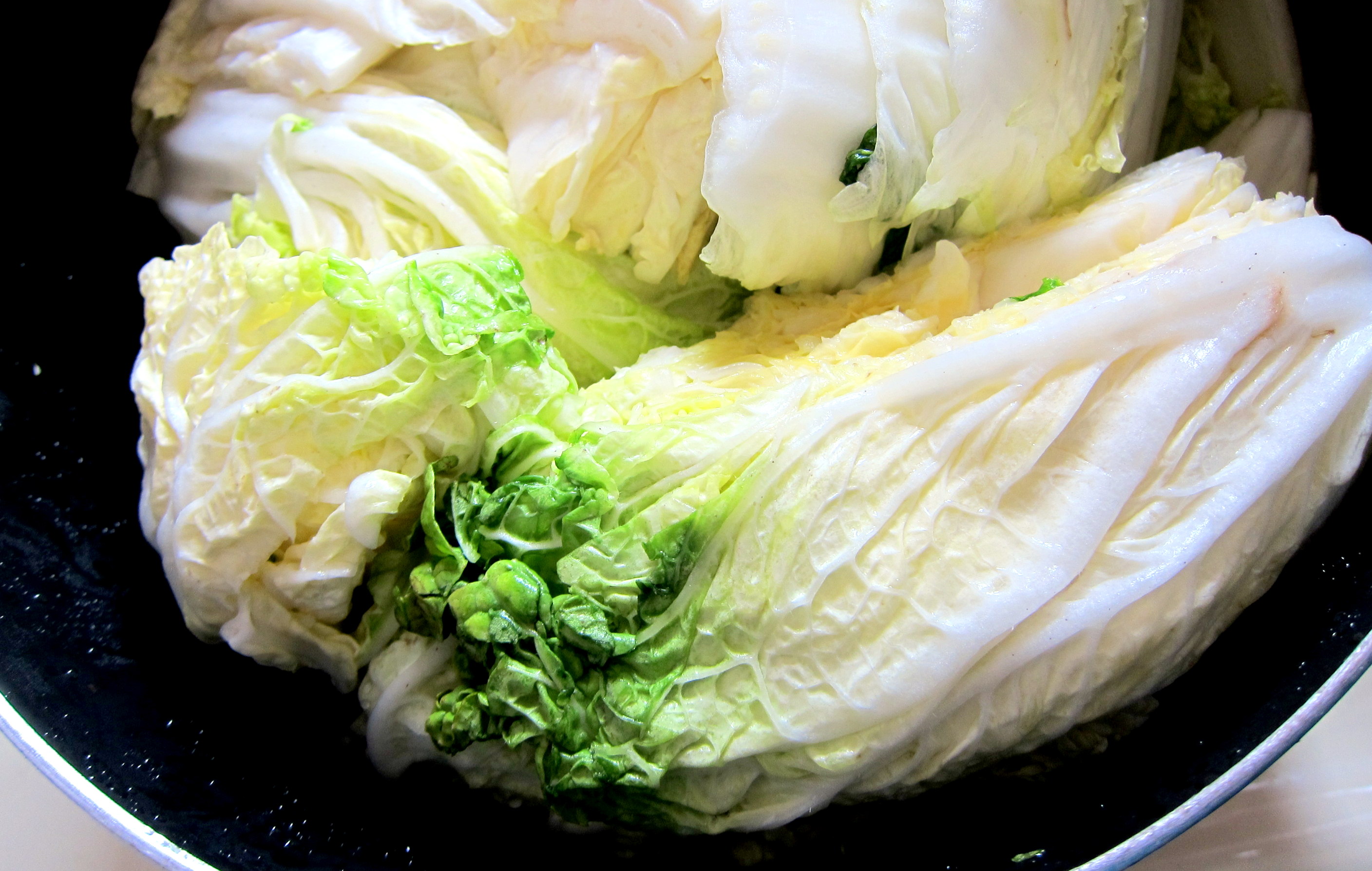
Okay, so we tried to follow Dave Chang’s recipe in Lucky Peach #2, but we bought a head of napa cabbage big enough to hatch a T-Rex, so we scaled things up a tad (although Chang didn’t specify how heavy “a head” of cabbage weighed).
White Napa Cabbage (Baechu) Kimchi (white because it’s not red – no chili massacre)
– 1 head of napa cabbage (our receipt said 1 lb, but I could’ve sworn it really didn’t feel like 1 lb, more like 3)
– 1 bulb of garlic (~15 cloves)
– 2-inch piece peeled ginger (to puree)
– Another 2-inch piece peeled ginger – julienne this one
– 3/2 cups corn syrup
– 4 tbs salt
– 3 tbs sugar
– 1/2 cup soy sauce
– 1/2 cup rice vinegar
– 2 carrots, julienned
– 6 scallions, cut into 2-inch pieces
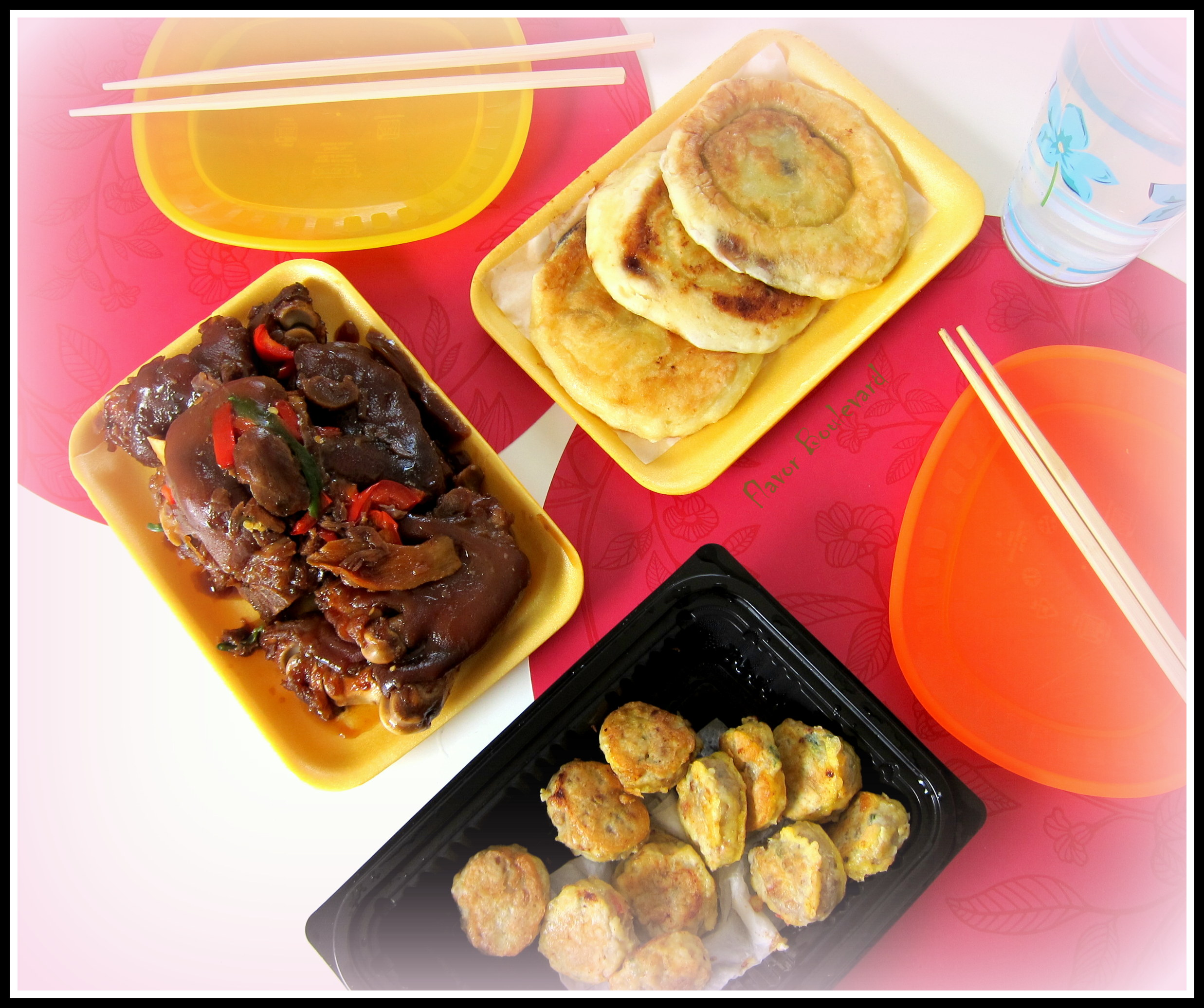
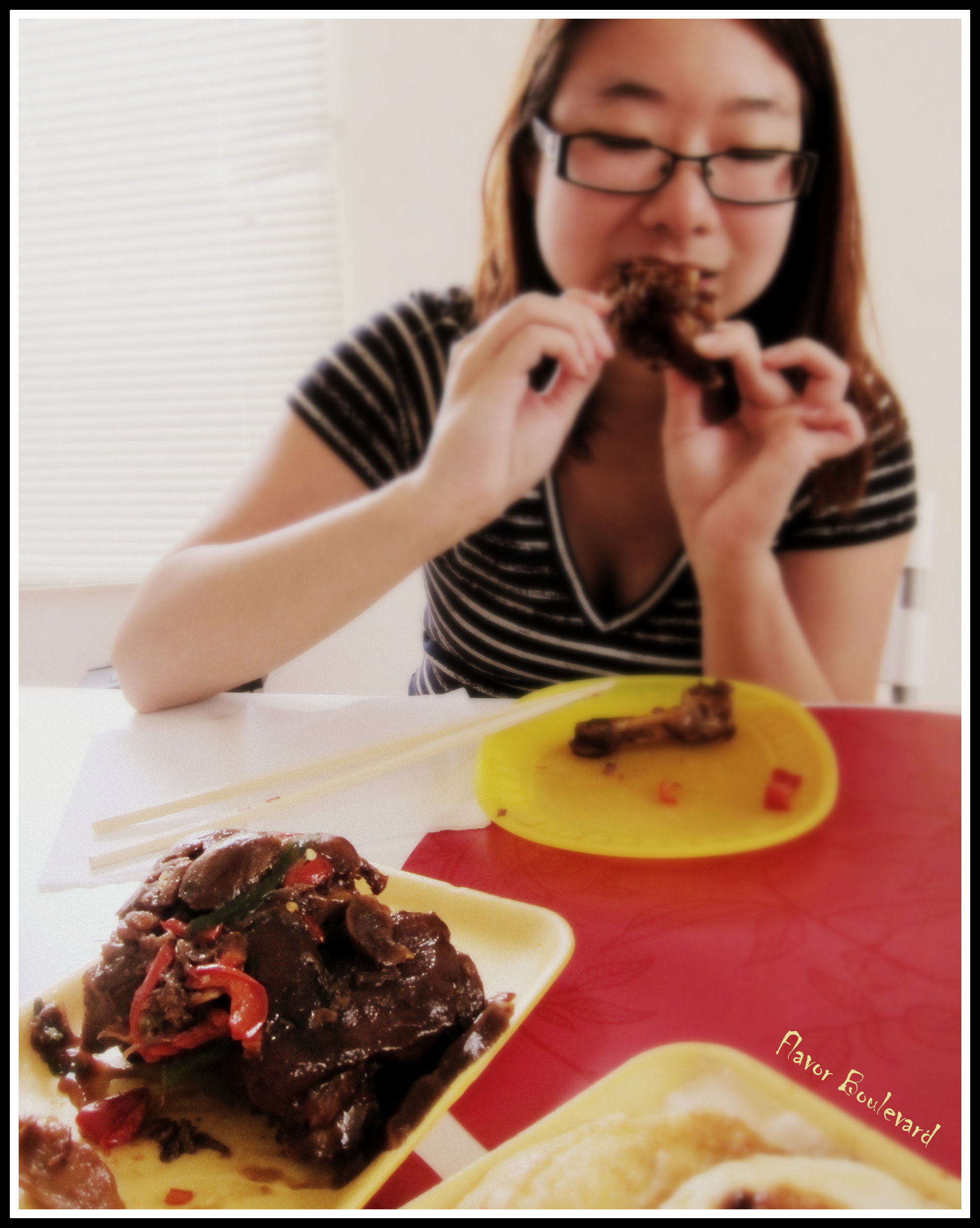
Put me next to a pig foot and I turn into a total nut case. But boy, these chunkies, sweet, salty, chewy, just a little spicy… I cleaned the bones until they were white.
A feeble attempt at including some starch to our lunch: ground beef and pork coins covered in batter and fried.
Dessert: ho tteok (호떡) – chewy sweet pancake with some kind of syrup or melted brown sugar filling, and the best part? They’re not too sweet!
Ready-to-go lunch for two: ~$15
Address: Koreana Plaza
2370 Telegraph Avenue
Oakland, CA 94612
(510) 986-1234
Yesterday is momentous. Here we are, making kimchi. Is that a big deal? Yes. There’s a joke that if you’re gonna get married into a Korean family you’d better learn how to make kimchi. It’s just pickled vegetables, but it has an entire nation behind its back (and a pretty proud one at that), so you can’t mess with it and expect something good to happen. So here we are, jotting down the recipe from Lucky Peach Issue 2, going to Koreana, buying a clay jar to show that we mean business. Glass jars are so… see-through? (And no, there’s no Korean wedding that I know of… for now. Maybe Kristen will shoot me an invitation to her big day next month with Park Hyunbae and now she’s just using the delicious drama Kimchi Family as an excuse, and I’m her Guinea pig. :-D)
But yeah, for now, Kimchi Family is the main reason to our story. It’s a Korean food drama, and it’s delicious. Not only do they show tasty pictures of kimchi glistering and steaming under the sun beam, they make food making seem peaceful! It’s not like Food Network competition stuff where all you see are burly husky men (and unfortunately, women) with glowing red face running like mad in the kitchen with a clock ticking to death, a host rushing out 300 words per minute, knives and flames flaring up everywhere. Nah, Kimchi Family shows two sisters gently mixing and stuffing kimchi into jars, telling stories in their gentle voice and ending their scene always with a gentle smile. Between them and the competition chefs, we think they look cooler. So we bought a clay jar to make kimchi.
DAY 1 Step 1: Wash the clay jar with salt and water, wipe dry. Actually, we didn’t do Step 1 until after we finished Step 6, but anyway.
Step 2: Wash, peel off funny-looking leaves from the napa cabbage. Cut it up and mix the parts with salt and sugar. Let the bundle sleep in the fridge overnight. (How should you cut it up? Dave Chang said in his Lucky Peach recipe to cut into 4 quarters length-wise, then into 2-inch pieces, but his recipe calls for the oh-so-American glass jar. The movies usually show grandmas stuffing chili sauce in between the leaves of the whole cabbage, so romantically we guess we shouldn’t even cut it up, but we chose the mid-ground: 4 quarters length-wise, then halve them, so 8 pieces total.)
DAY 2
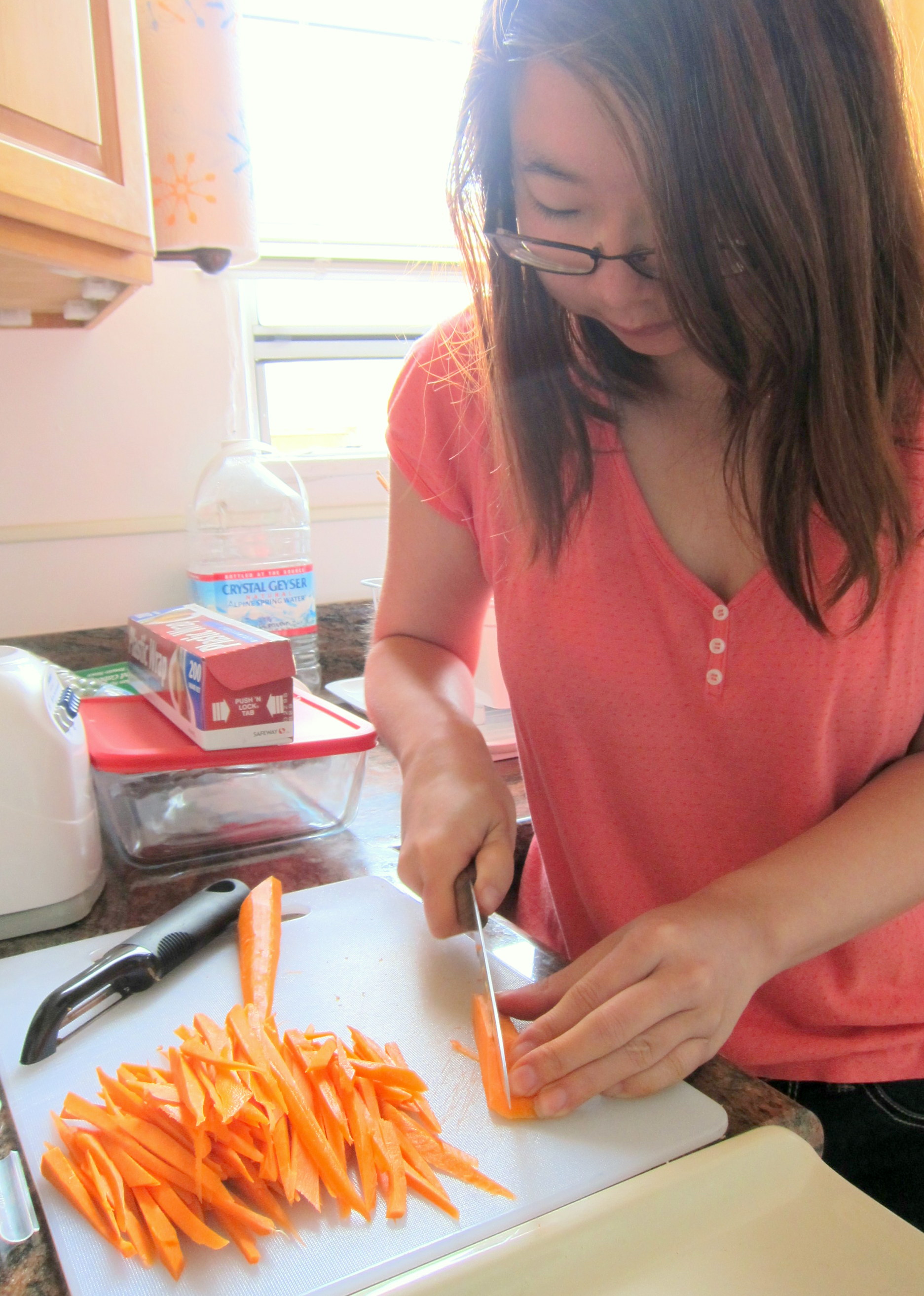
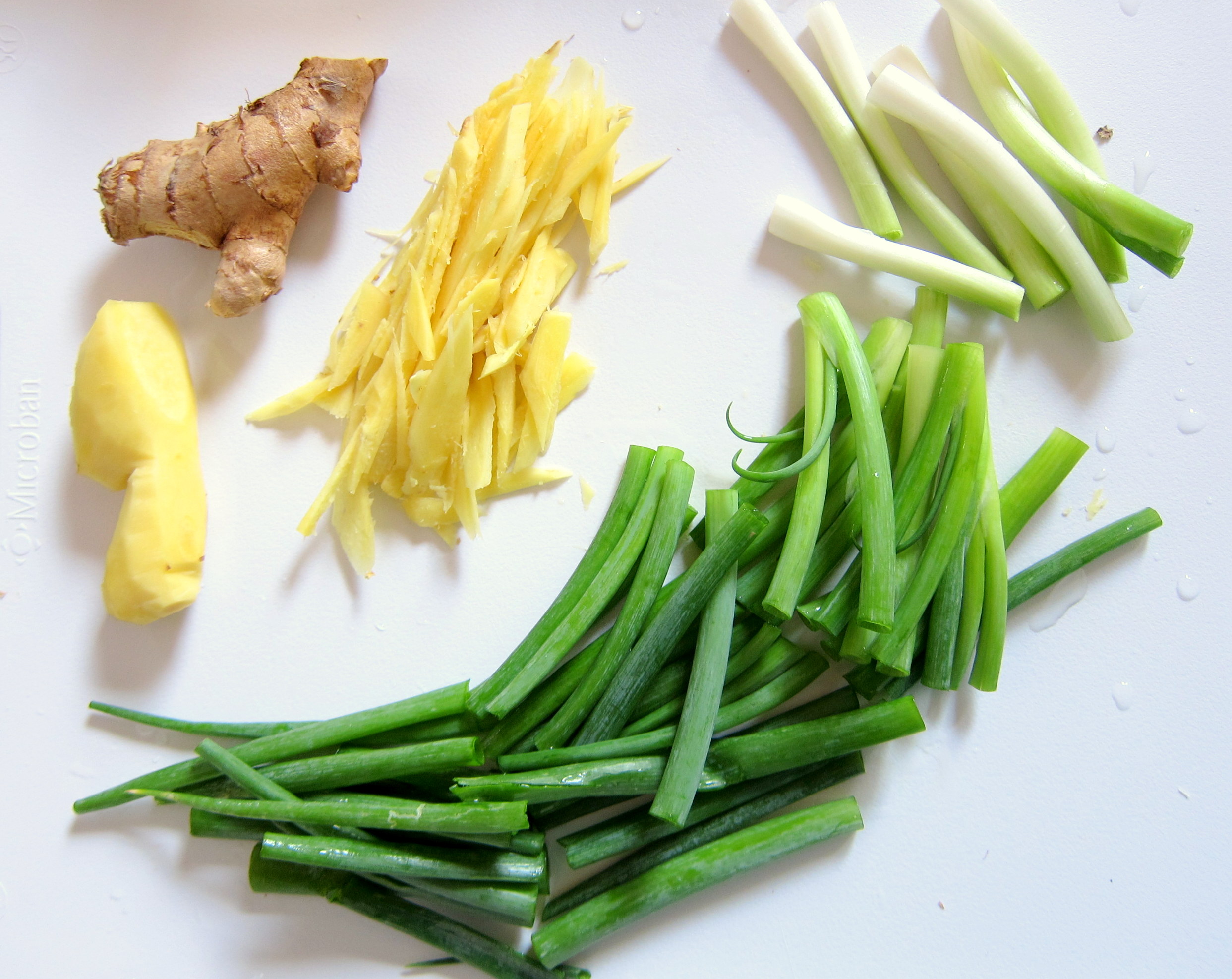
Step 3: Julienne carrots, julienne ginger, cut green onion into 2-inch-long sticks. Step 4: In a juicer, blend together garlic, ginger, and corn syrup. Step 5: Mix garlic-ginger-syrup sauce with soy sauce and vinegar. Step 6: Drain the napa cabbage from its salty water.
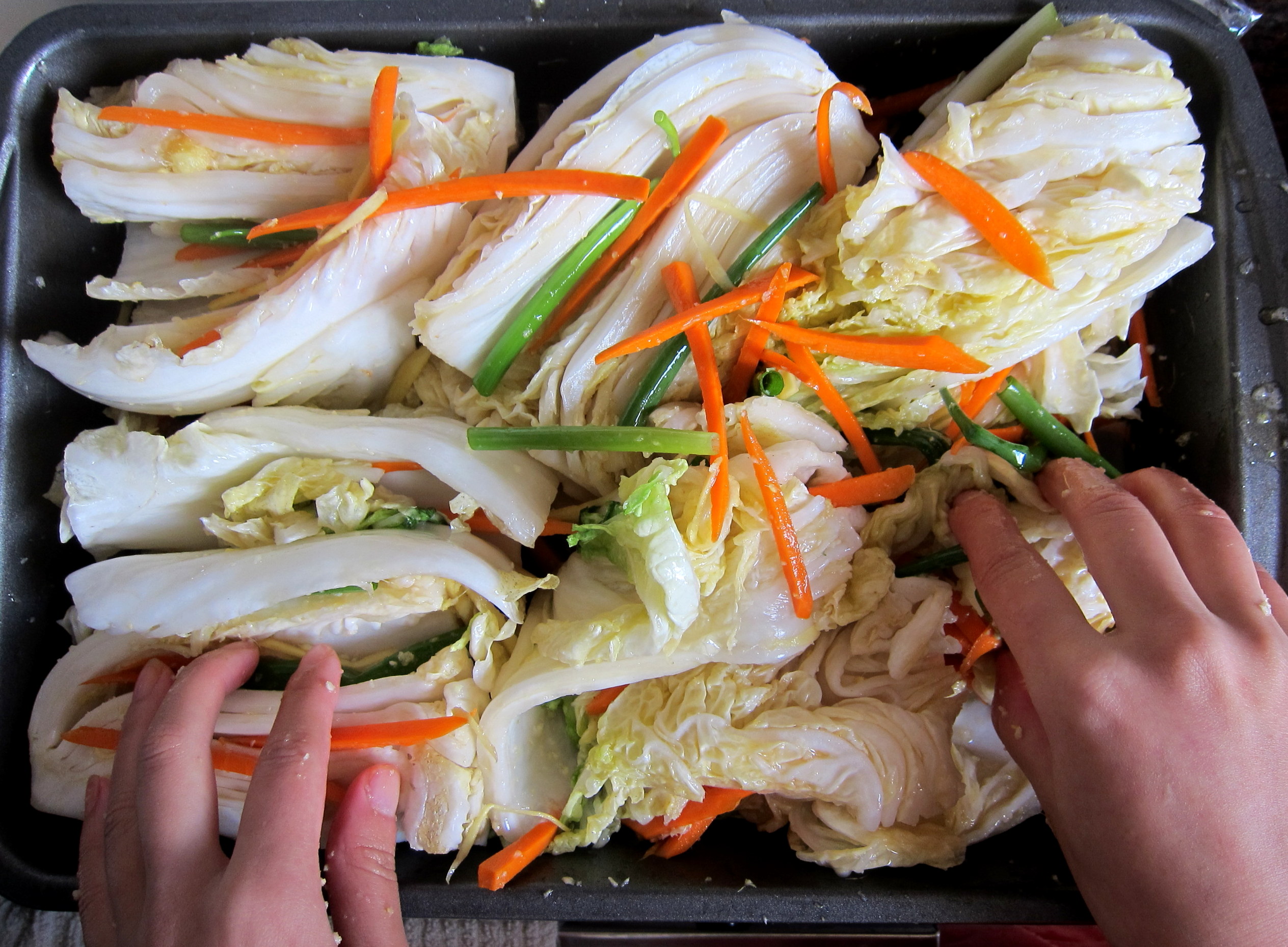
Step 7: Rub the sauce in Step 5 into every crevice of the brined cabbage, mix green onion and carrots for colors.
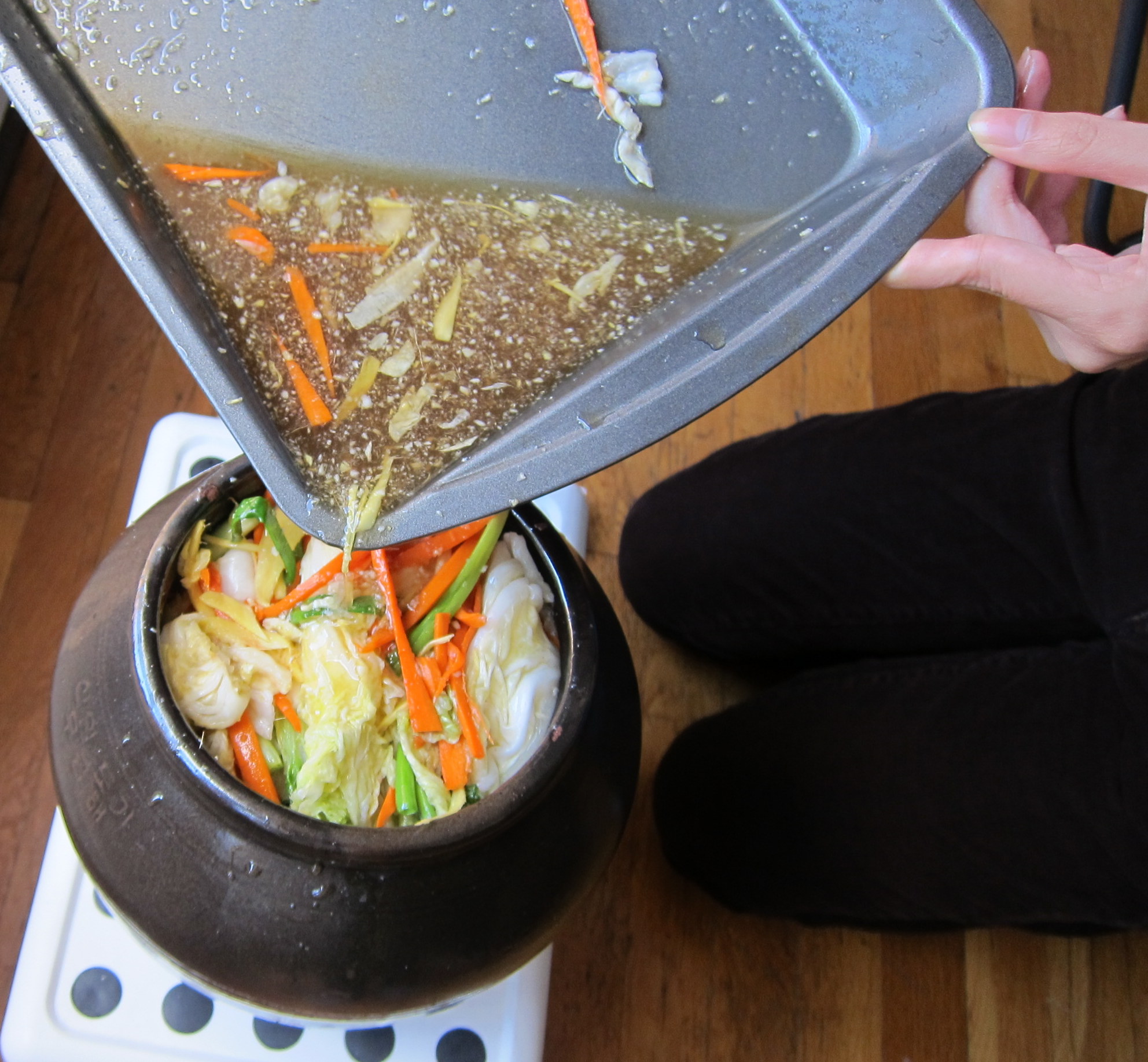
Step 8: Stuff the vegetables into the jar and pour the sauce on top.
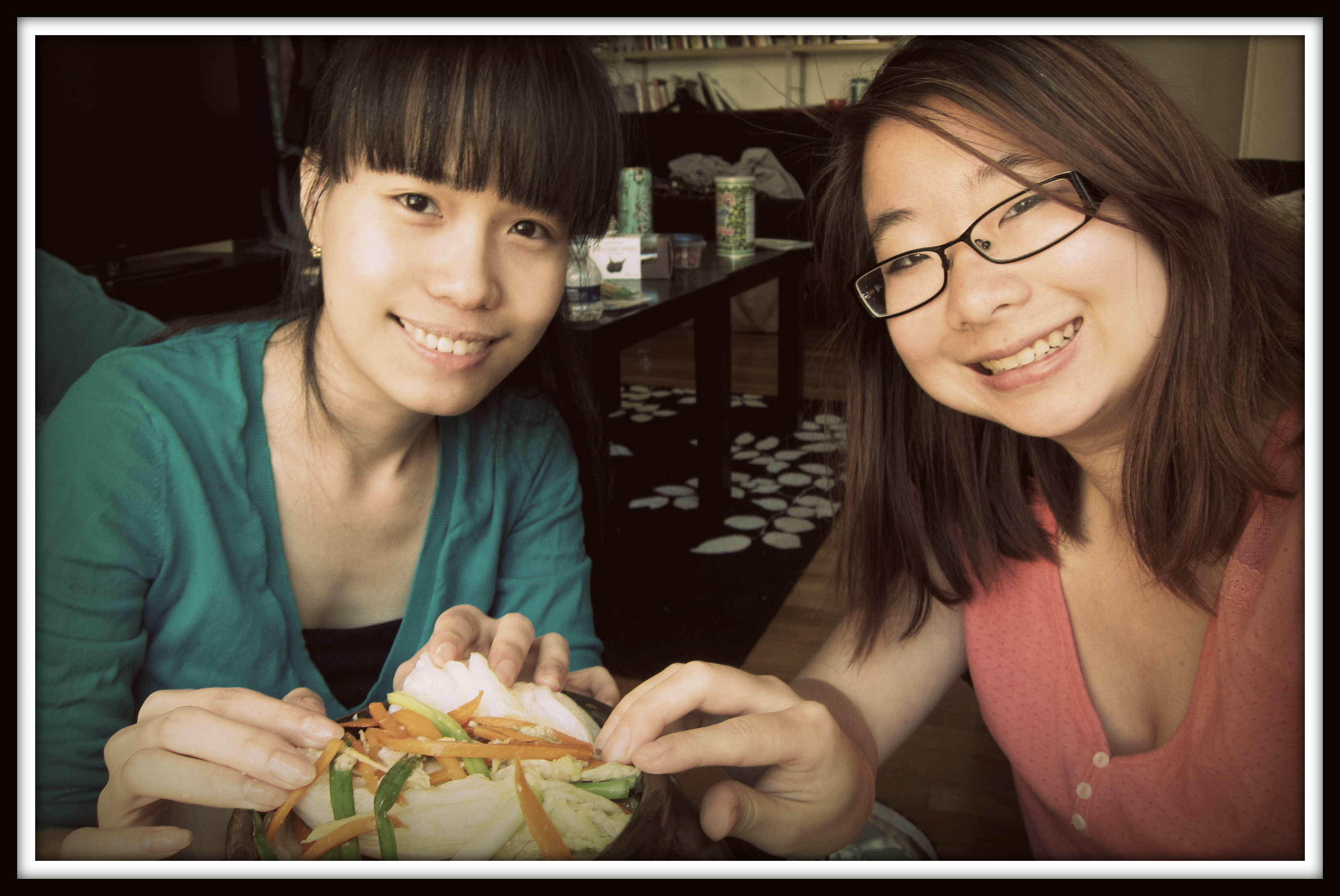
Step 9: Smile and take a picture.
Now let’s wait 7 days and hope that the kimchi will turn out well. If it does, the ingredient list with all precise measurements will be updated. If not, there’ll be some massive cleaning up to do, but you won’t hear about it.
Movies are food for the eye (and ears, and brain, or whatever else you like). I watched Bread of Happiness on the plane ride from Houston back to SFO, and it made me happy that whole day. It also strengthened my resolve to study Japanese. The breads shown in this movie don’t seem particularly complicated, their presentation doesn’t sparkle, but they perfectly suit the gentle atmosphere that flows through the plot: looking at the steam rising as you break a fresh loaf in half, you can smell a sincere love.
Something that I learned from the main guy, a baker, in Bread of Happiness: do you know the literal meaning of “compagnon”?
Also designed to make you feel all warm and fuzzy inside, the Korean drama Kimchi Family hits the spot on days when I feel down (and also when I’m eating my cup noodles). It’s another string of small stories of how food made with heart can touch people’s lives in positive ways. If you don’t watch it for the plot, watch it for the kimchi! So many kinds of kimchi that I haven’t thought of being possible before. You can watch it on Hulu.com.
Tonight I actually cried watching its 8th episode. But at least I was at home. For Bread of Happiness, aish, I had to sink into my seat so that the guy sitting next to me didn’t see my eyes turning all red…
TranslationHave some, have some
Have a cup of this wine
This wine is not wine
This wine is our mother’s tears
This wine is our father’s sweat
Don’t say it’s bitter or sweet
Have a taste with your heart
Don’t be sad
The myeongsasibri rose buds fall
When spring arrives next year
you will bloom once againOur pitiful life
is like a floating rootless weed
Have some, have some
Have a cup of this wine
The paulownia tree
in the bright fall moon
reminds me of my wife
and saddens me
Does my wife think of me?
Or am I alone in this thought?
In the morning’s cold frost,
the wild goose cries and leaves
I hope for news of my wife
The overflowing clouds
are empty of noise
Lately I think I’ve reached a wall in terms of Korean food. To be precise, the Korean food that I can get my hands on, i.e., in the Bay and in Houston. Every Korean restaurant here, in strikingly similar manner to Vietnamese restaurants, has the same menu as every other Korean restaurant. The menu may contain a hundred things, but it boils down to maybe ten, with tiny variations.
To be blunt, I’m bragging that I can name practically every dish on a Korean menu in the States. The novelty is gone. Little knowledge is left to obtain. But just as I don’t stop going to Vietnamese eateries altogether, I still like to share a big Korean meal with Mom and Dad. A bubbling jeongol, rice and banchan always give the familiarity that a Western meal cannot.
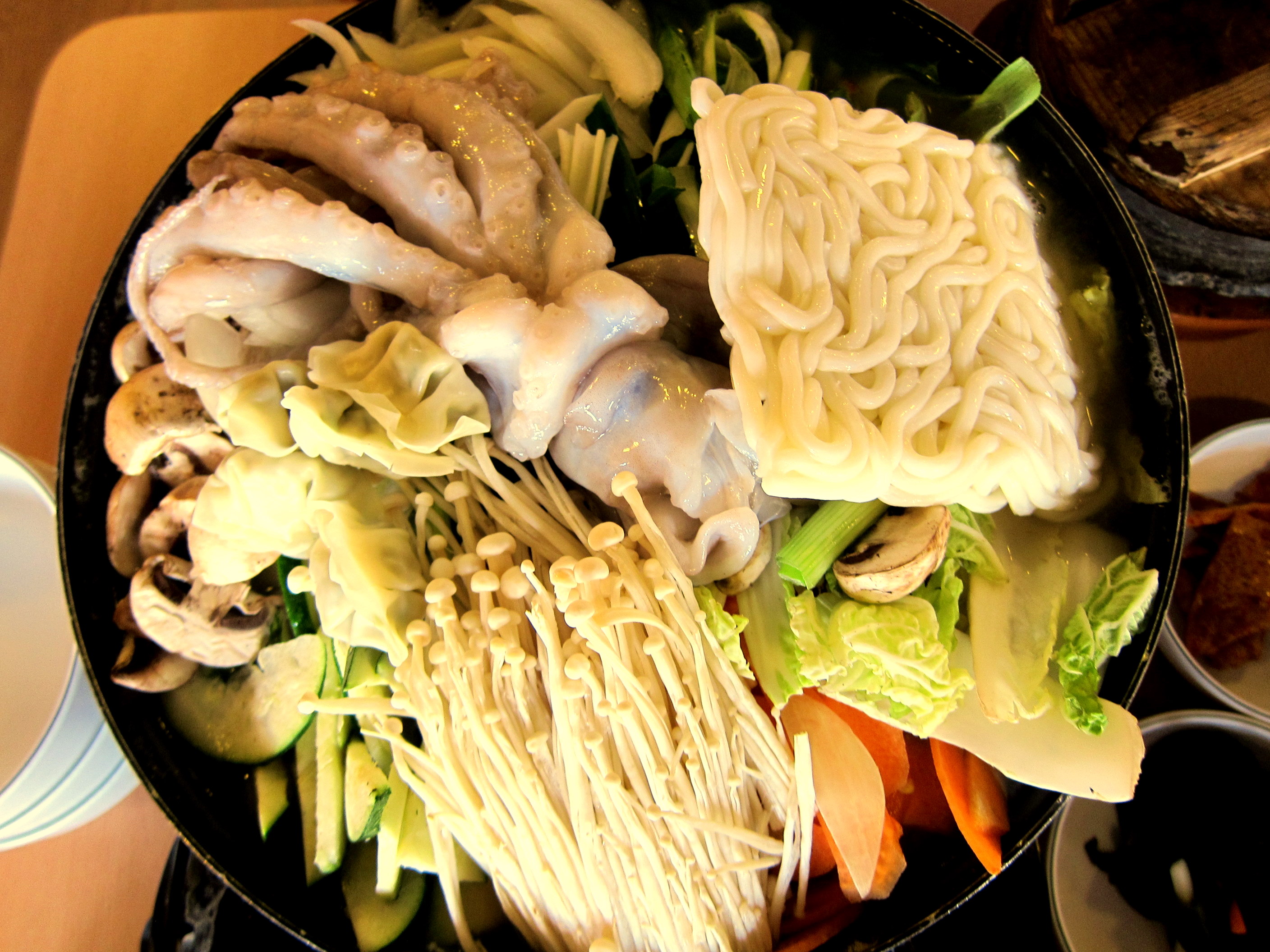
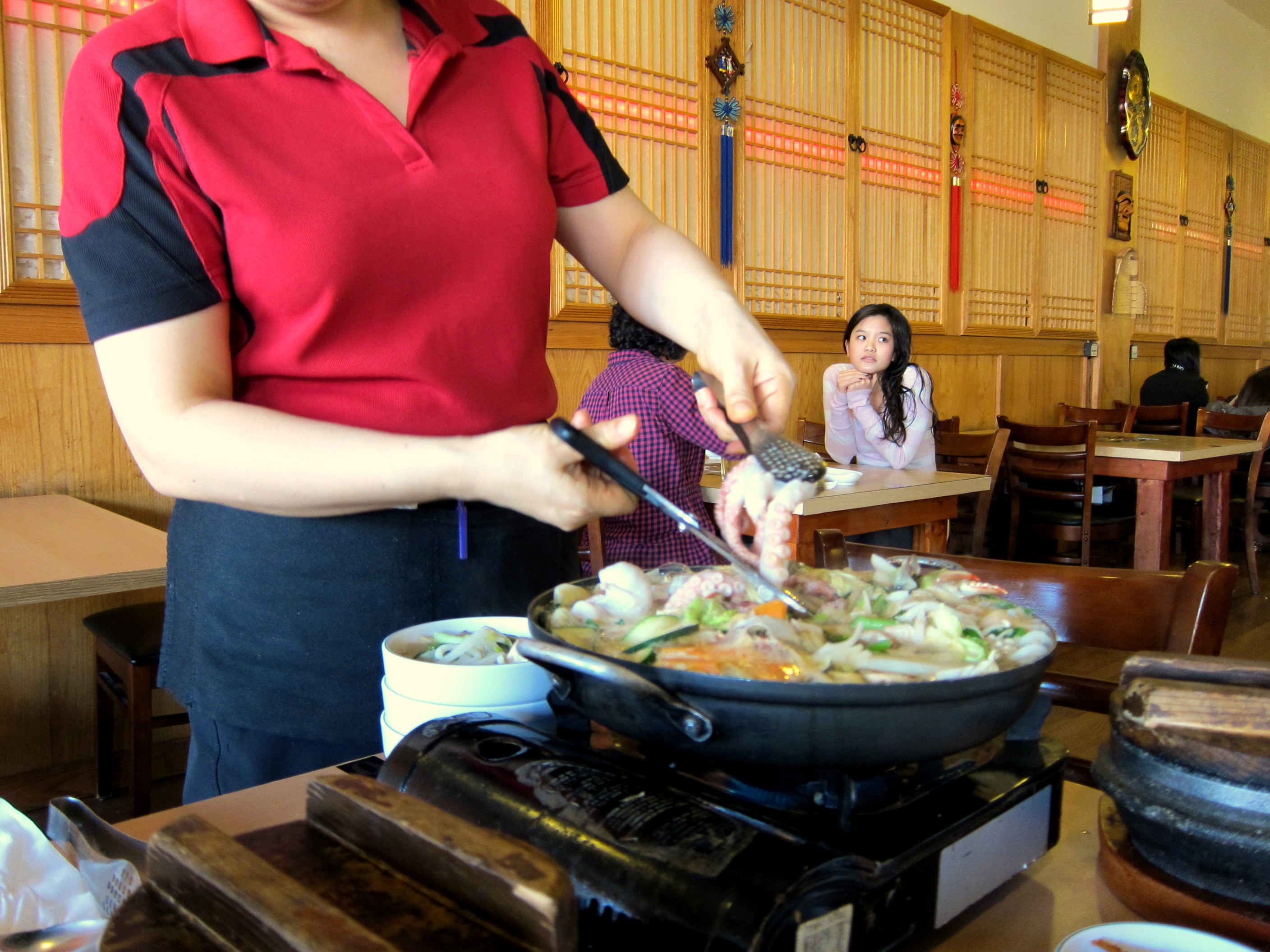
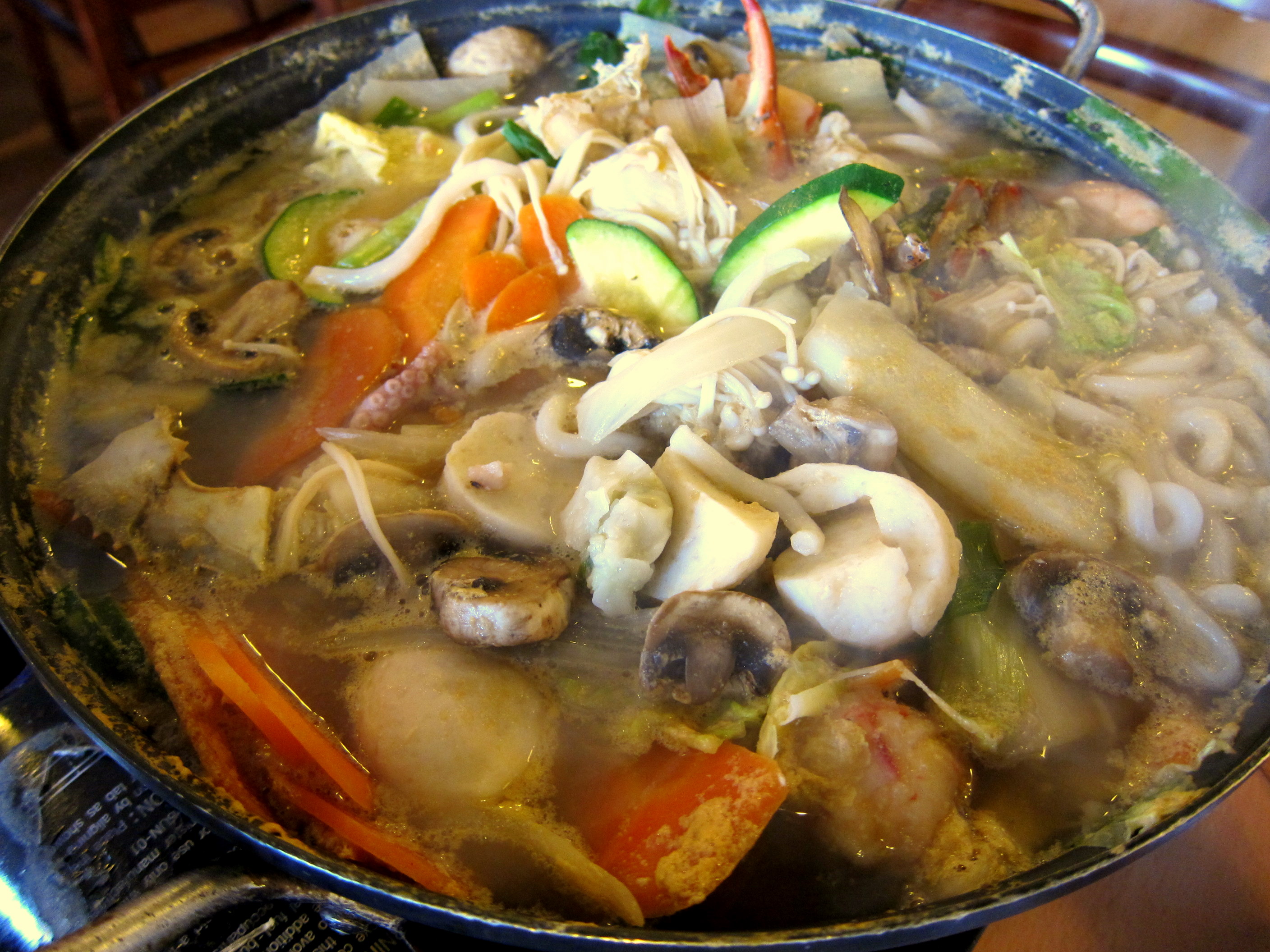
That said, there are a few things that I’m still not used to, such as the scissors. The lady was cutting up the crabs and octopus with big black scissors. I admit their convenience, but I get the weird feeling that she is cutting flowers. Why? I don’t know. Anyway, I didn’t eat the crabs because I don’t care for crabs, but I like the octopus. I think I might prefer octopus to squid. The broth is also just right.
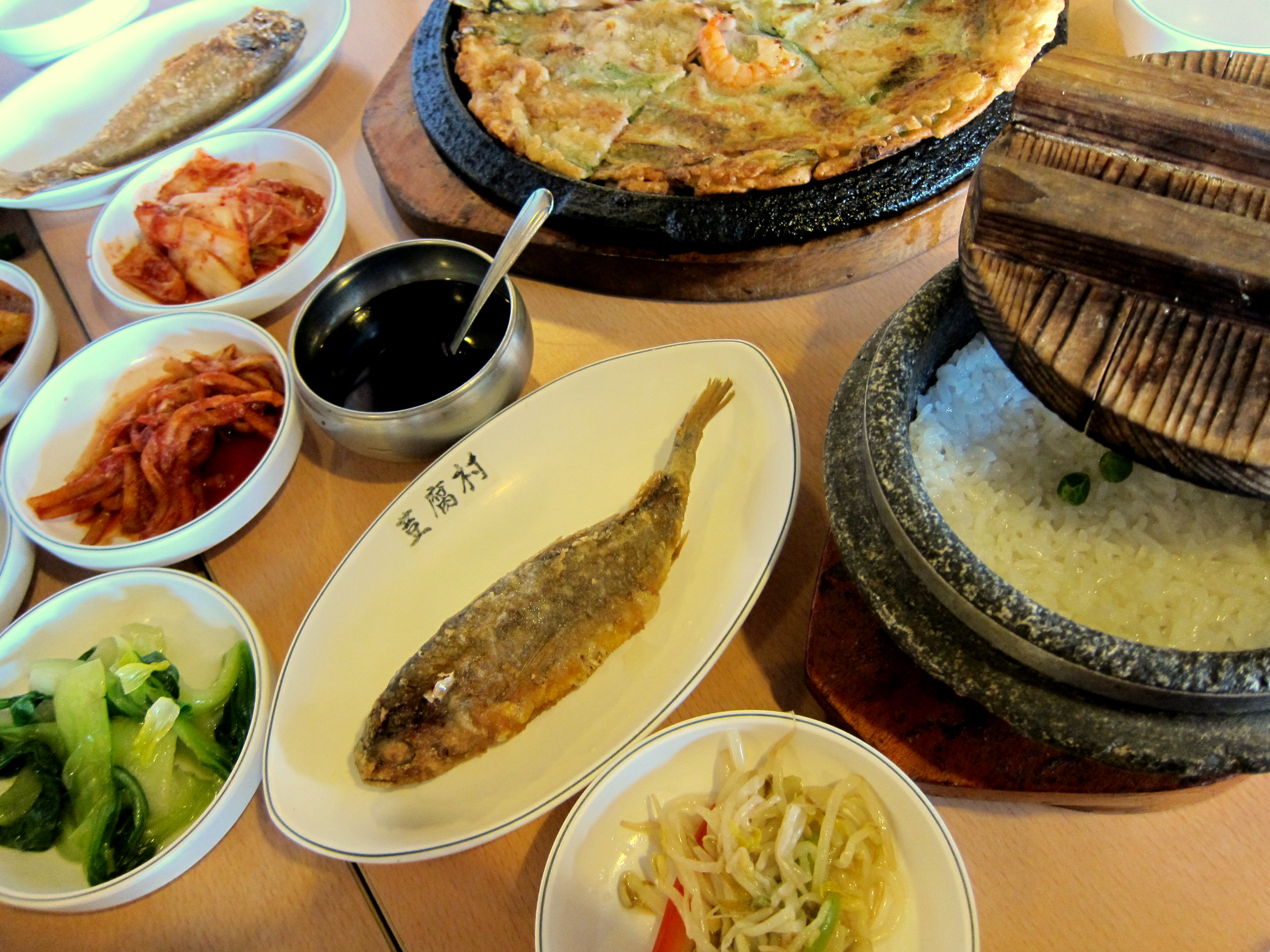
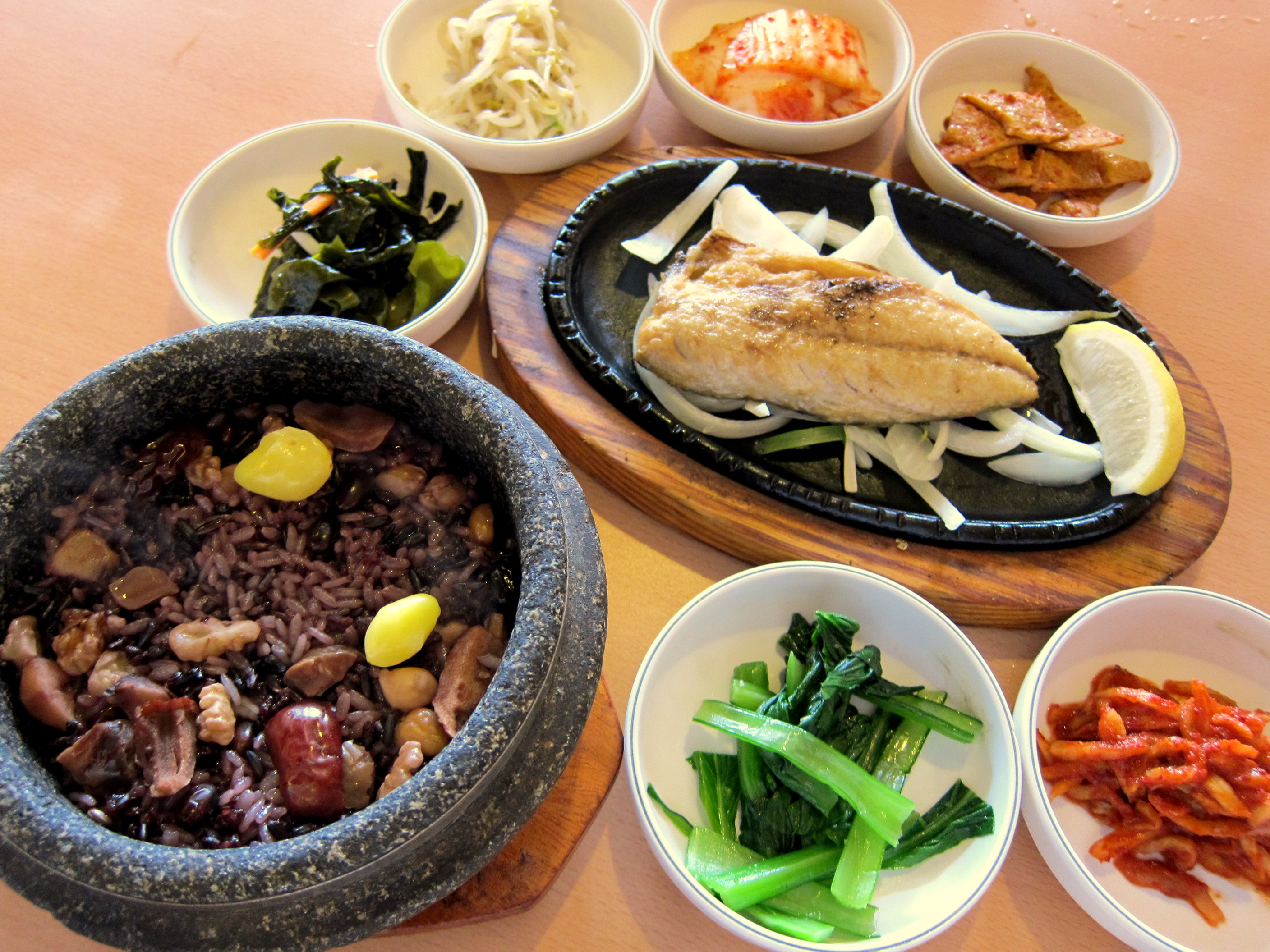
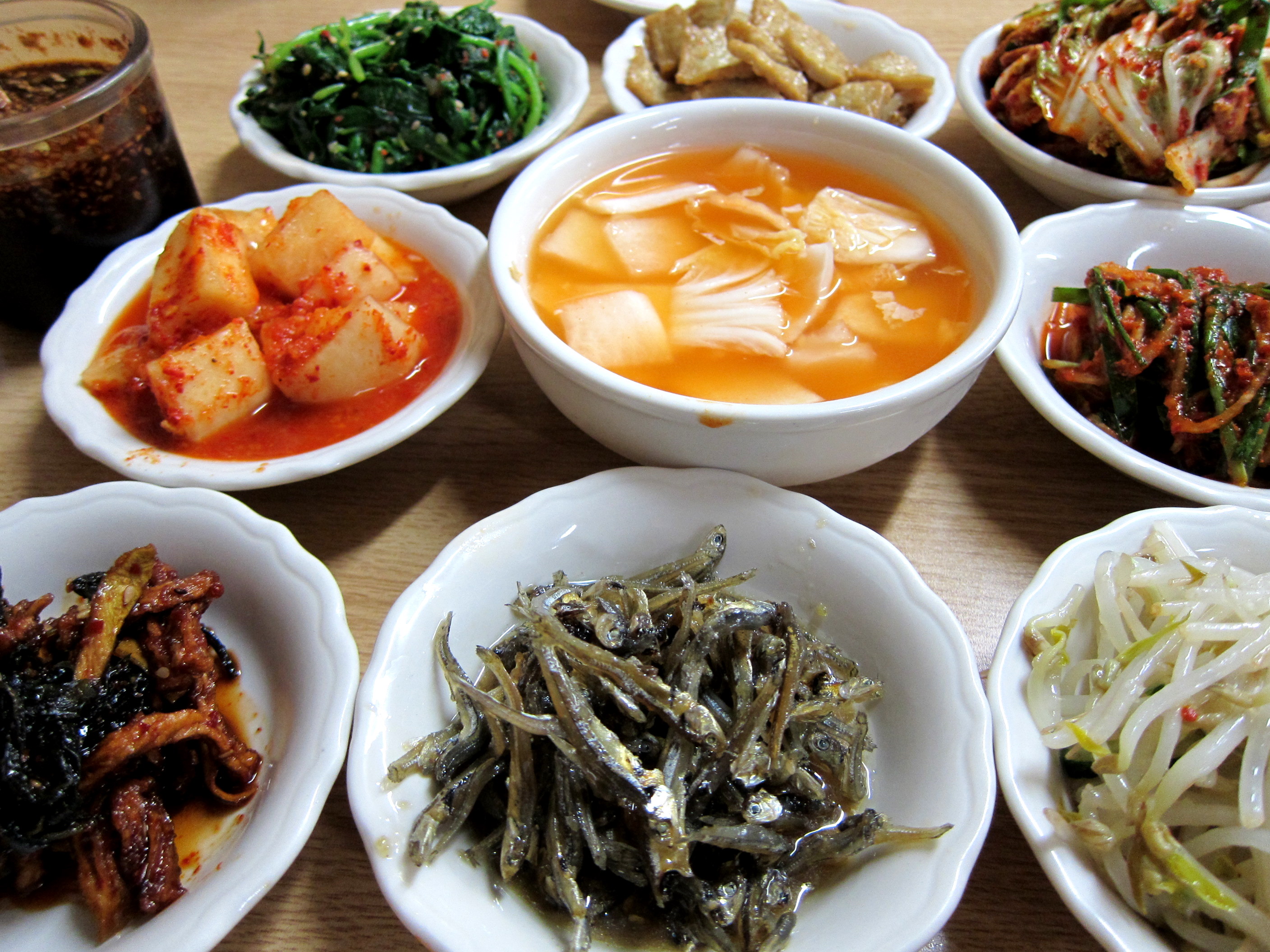
The banchan is standard, but they include two fried fish for every order of jeongol. Little Mom likes fried fish. 🙂
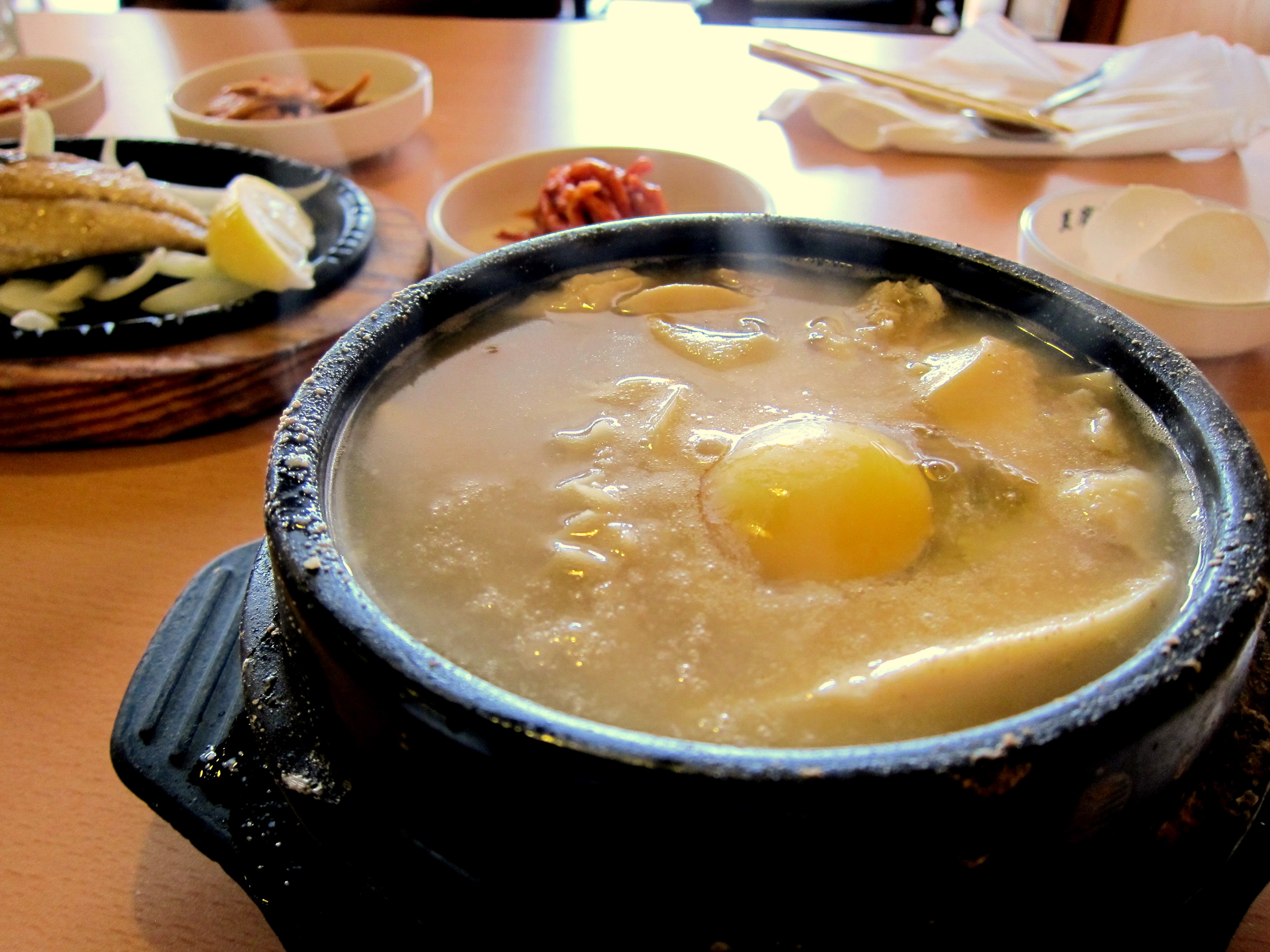
The soondubu with tripe and intestine is also nice: soft tofu in contrast with crunchy tripe and chewy intestine. Well, Tofu Village would not live up to its name if its soondubu wasn’t good.
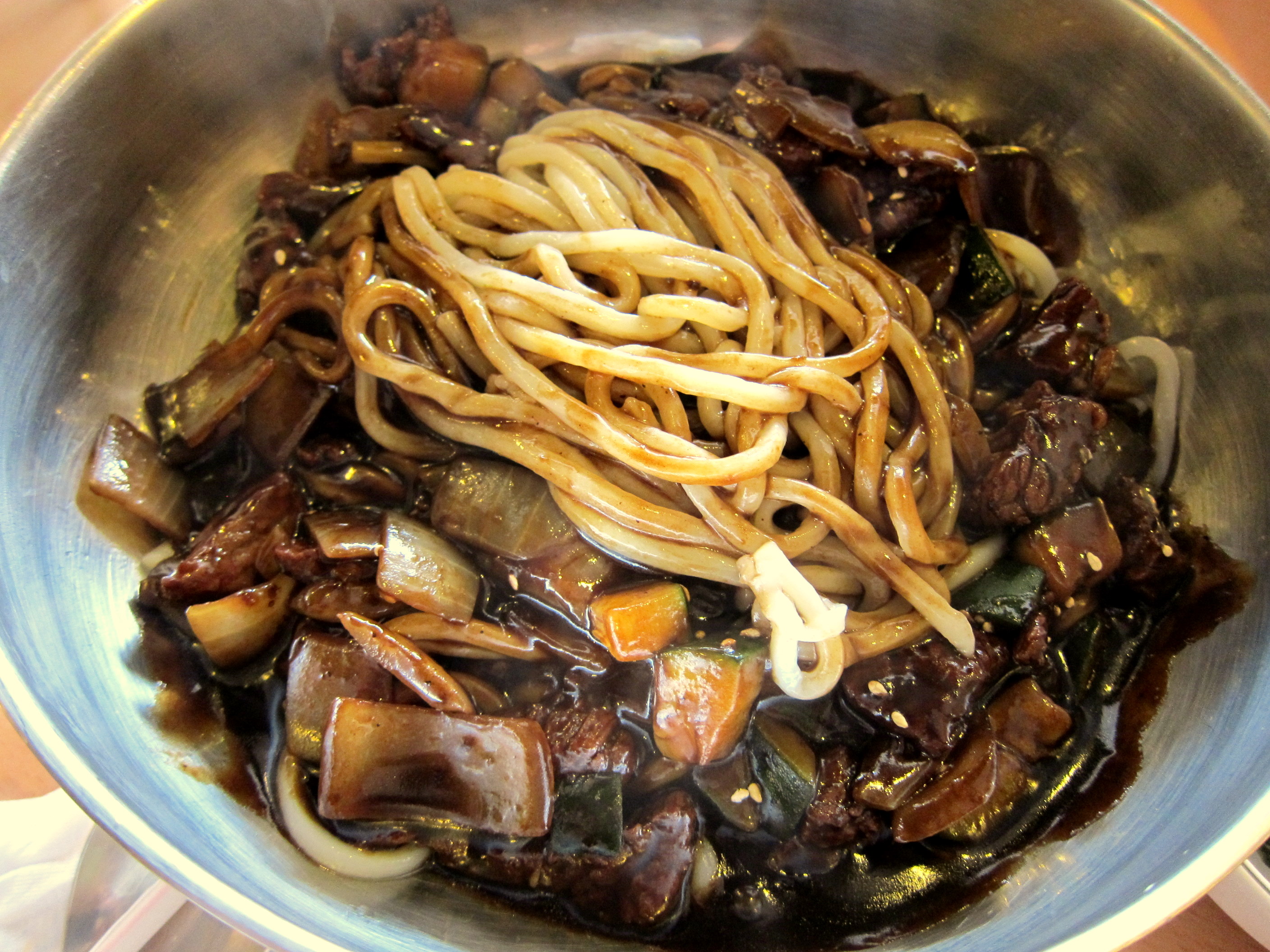
The jajangmyeon is a slight disappointment, compared to the one at Daddy and Daughter‘s in the H-Mart food court. The sauce is not sweet enough. Being served in an inox bowl makes it lose its heat too quickly. The noodles are also too thick.
One thing that I try here without having tried before is the “nutrition rice”, which is blackish purple rice (nếp than) with walnuts, dried jujubes, peanuts, and two yellow nuts whose name I don’t know. I like white rice because like water, white rice keeps your palates clean for the other dishes, but not only is this nut-mixed rice fun to eat, it also deems the mackerel and the kimchi unnecessary.
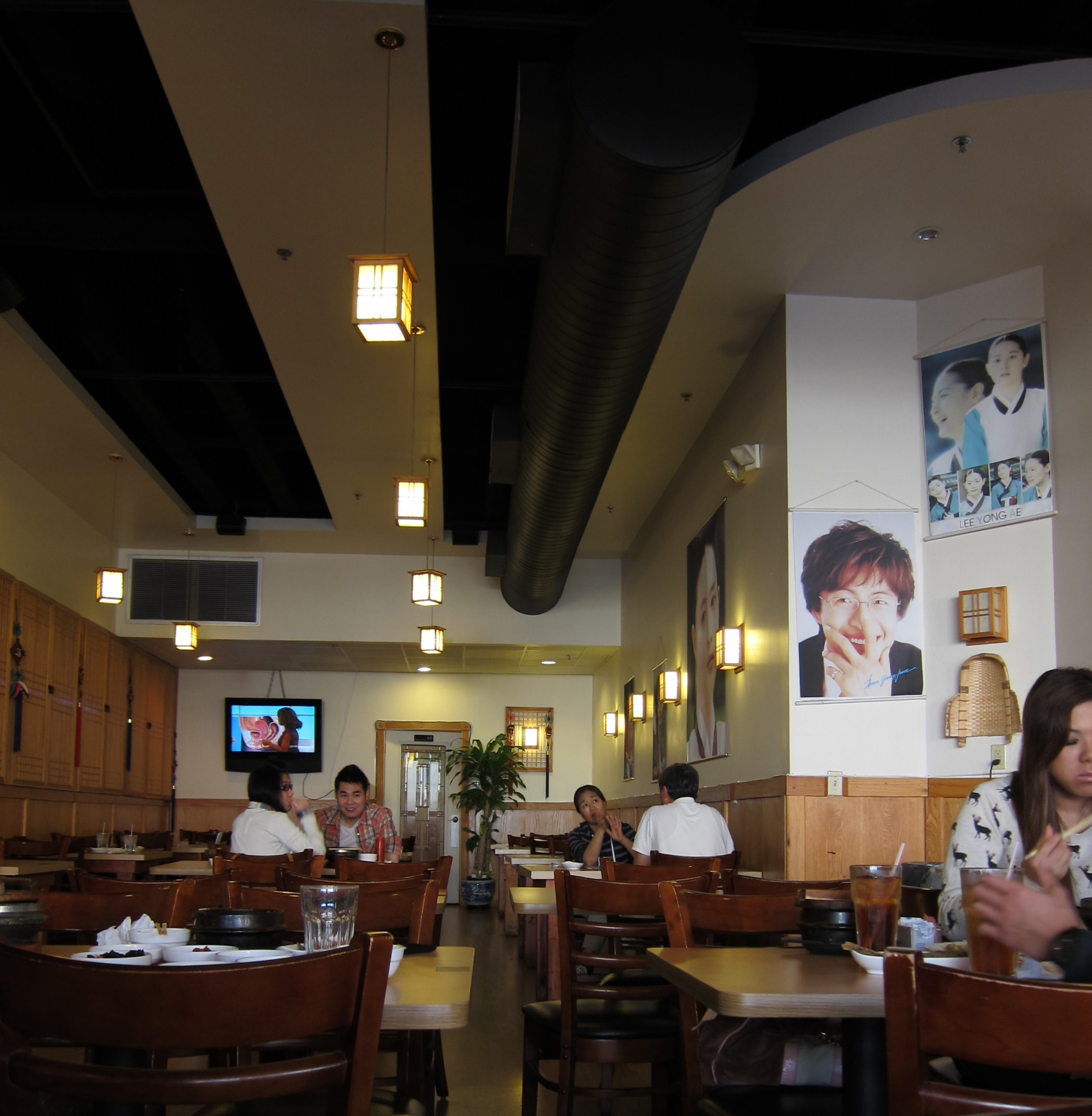
The biggest identifier of Tofu Village must be the celebrity posters on the wall. At least that’s how Aaron and I knew that we were talking about the same Korean restaurant when he mentioned that his group has a new place to frequent. Would I frequent it myself? The name “Tofu Village” does sound a little Americanized, and I can’t say that everything I ordered was stellar, but to be fair, what I ordered were not the common dishes that people order at a Korean restaurant here. Naturally, the chefs would be more comfortable with what they expect the customers to get. So next time I’ll get something more standard, with tofu. 😉
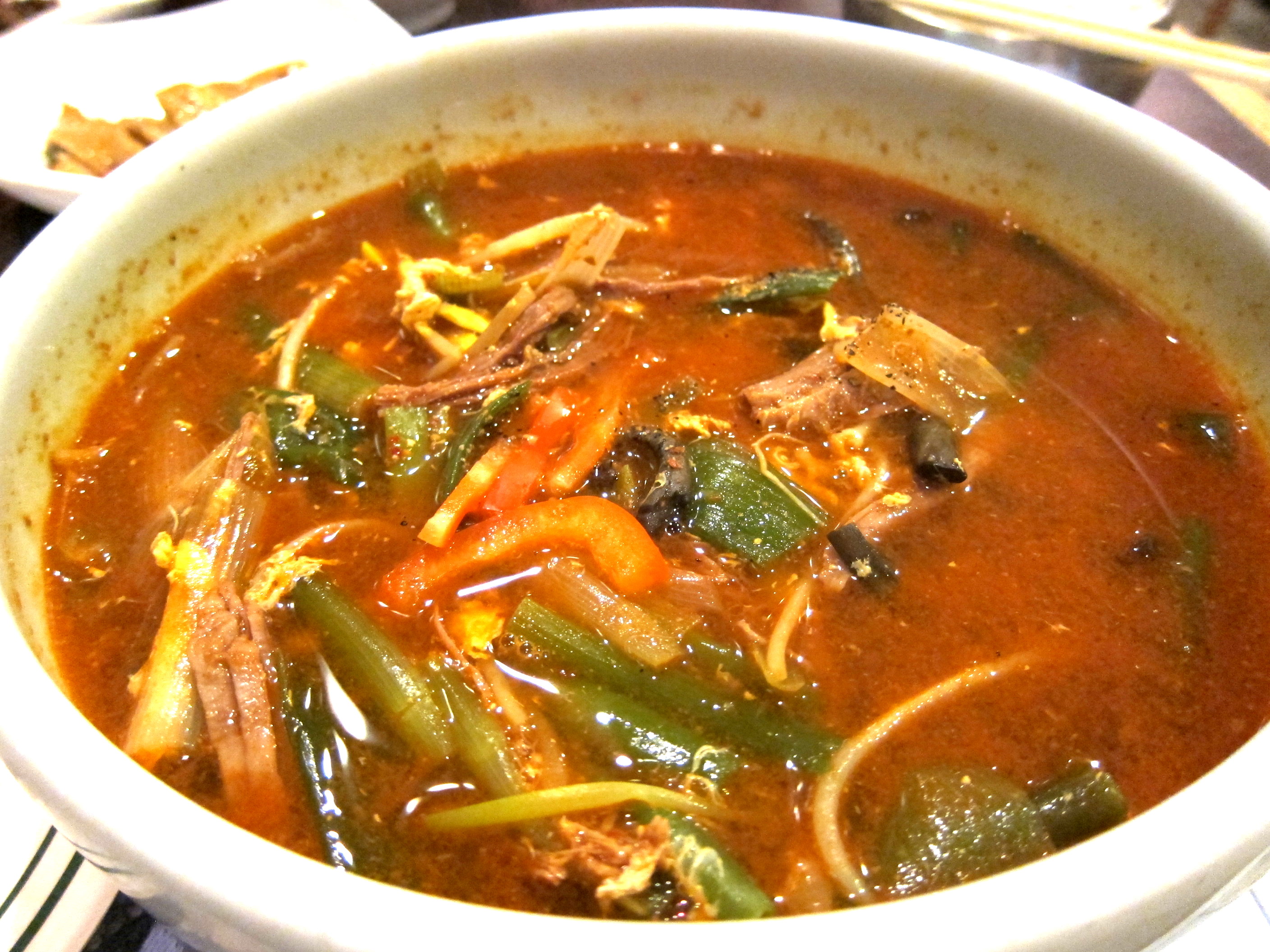
A while ago, I was fairly convinced that of all the different types of spiciness, I can handle the Korean spiciness. Take kimchi for instance, it usually looks scarier than it tastes, and the scorching can be quickly washed away with corn tea. Not an eye was bat when I saw the garnet broth of Il Me Jeong‘s specialty. It’s just loads of shredded beef, sesame leaf, glass noodle, green onions, etc., in a thin soup. Then tears rained down.
No more yuk gae jang (육개장) for Mai. Ever.
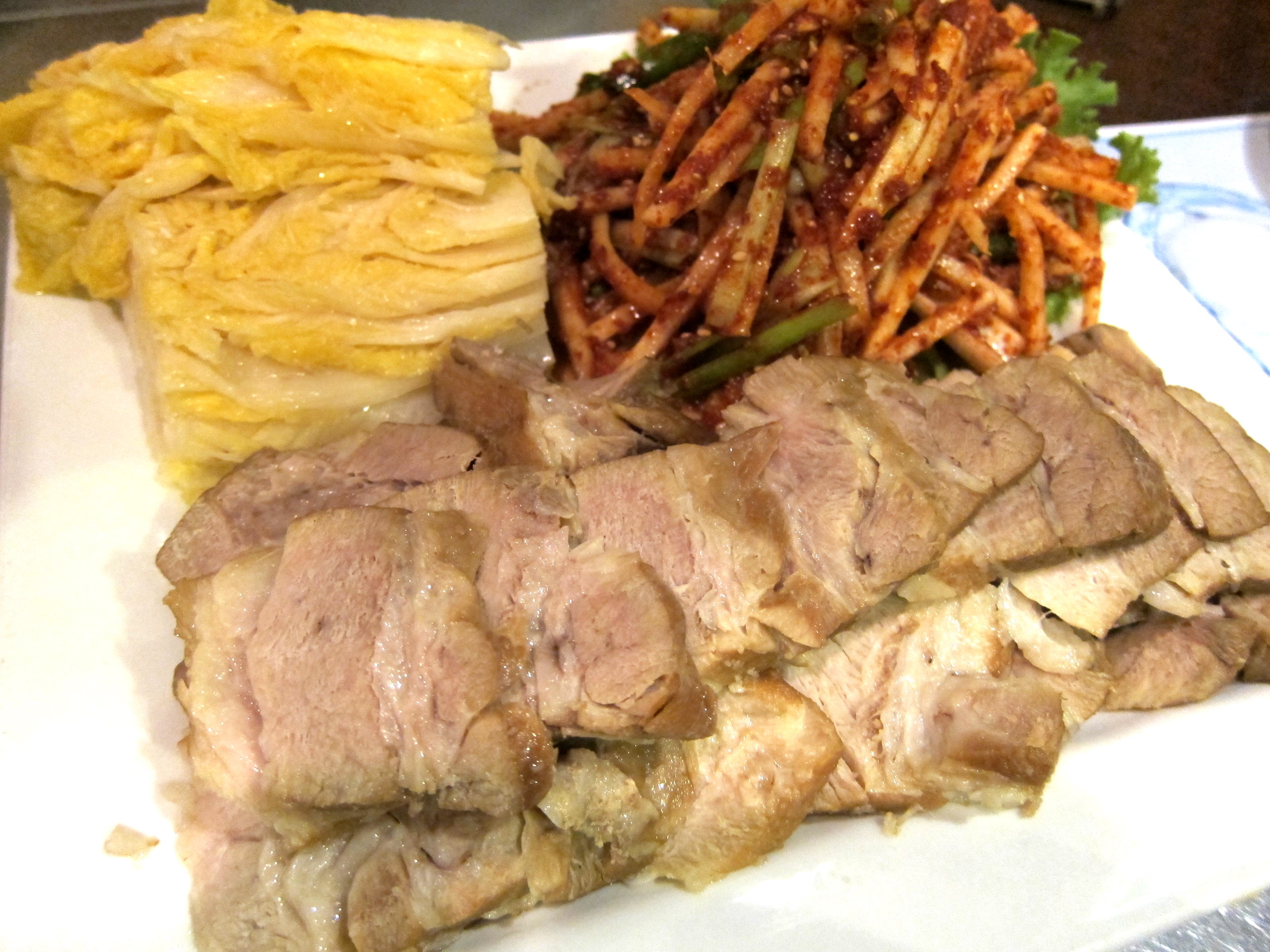
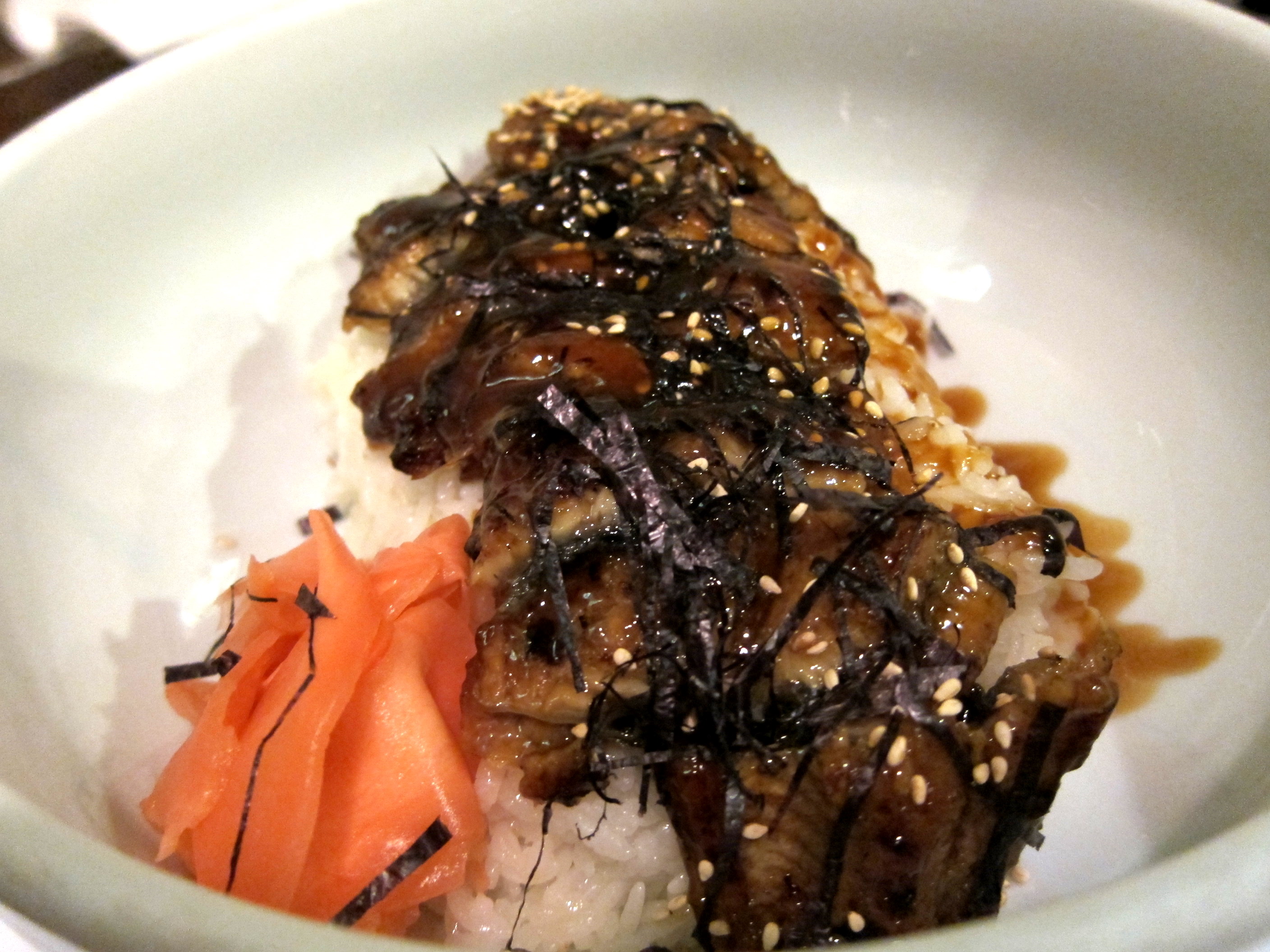
Il Mi Jeong has good unagi don and bossam though. 😉 Go for those instead.
Address: Il Mi Jeong (or Il Mi Jung)
10017 Long Point Road
Houston, TX 77055
(713) 827-8808
Between 4 and 6 PM today was the most interesting 2 hours I’ve had this week, and also the most effortless educational experience I’ve had in a long time. That’s how the Korean tea ceremony is meant to be, as I’ve learned: formal but relaxing, and ceremonious but natural. The rules are rather simple to get acquainted to, the movements make sense, and just watching made my mind feel nothing but calmly pleasant. The kind of pleasant feeling one would get gazing off into space alone, on a grassy hillside, on a cloudy day.
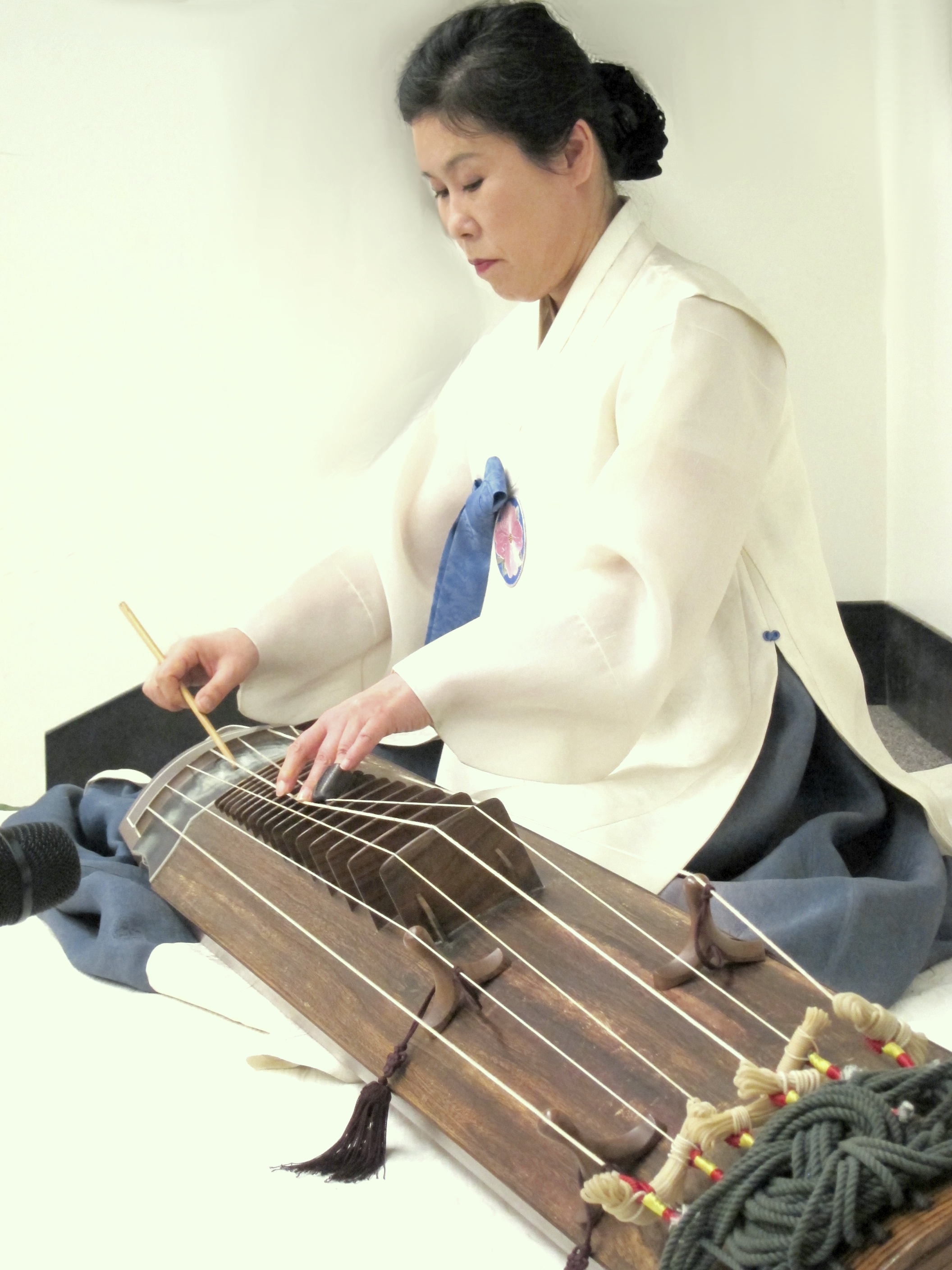
Now for the logistics. Inje University‘s Traditional Korean Tea Society (TKTS) gave a 2-hour presentation at Berkeley today as part of the “Dew of Wisdom” tour, Stanford and California State University got their tea before us. During the first 40 minutes, the students of TKTS demonstrated two types of tea ceremonies, both accompanied by the slow, deep, hardy rhythm of a 6-string zither 거문고 (geomungo).
The first type, 들차회 (deulchahue), is to be enjoyed with friends and relatives outdoor during spring and autumn. The setting is lighthearted, the purpose is to relax and to appreciate nature, the gathering comprises both men and women, and both hands are used during the preparation, serving, and tasting of tea.
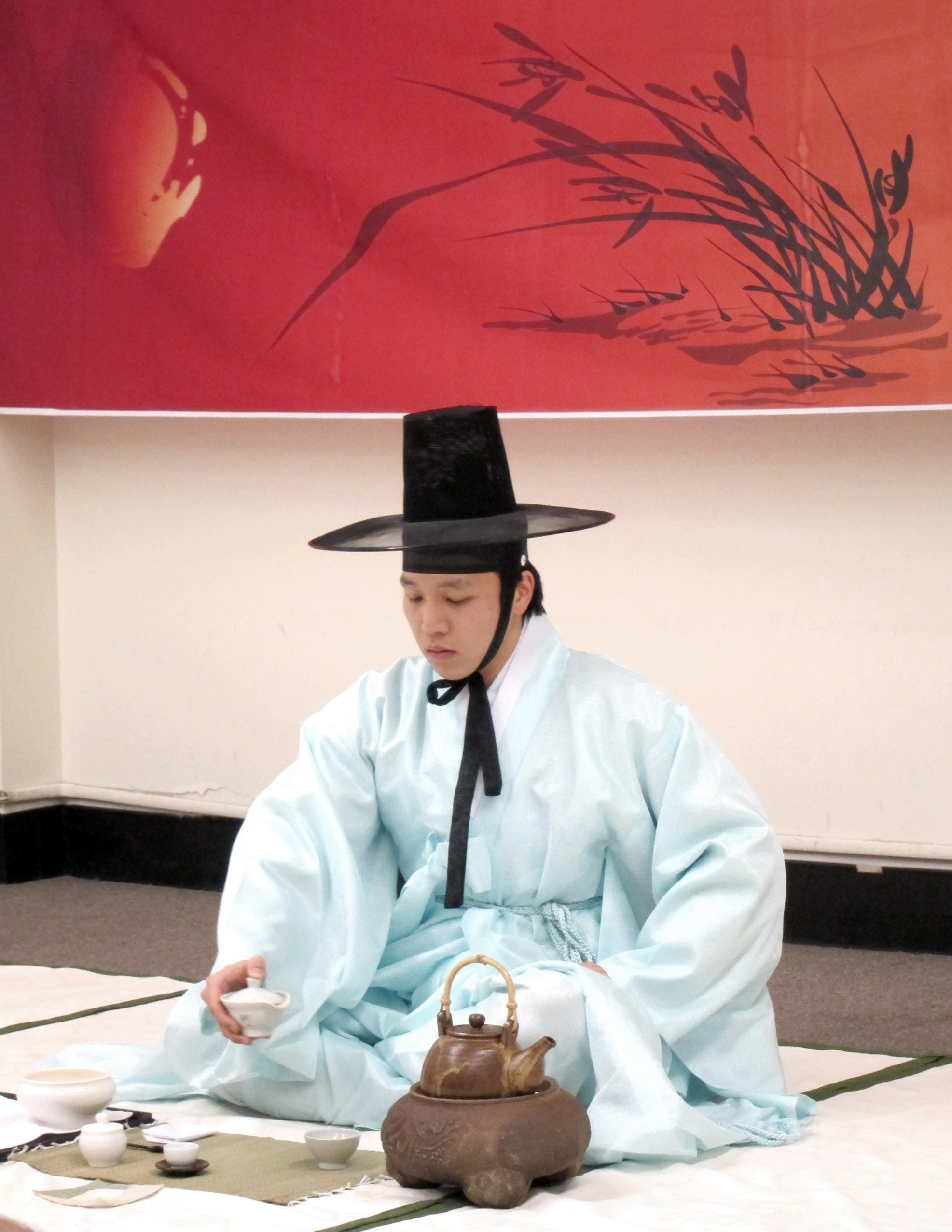
The second type, 선비다례 (seonbi darye), or “Scholar’s tea ceremony”, is practiced by noblemen to clear their mind and heighten their wisdom. The setting is dignified, and the man uses only his right hand to prepare and serve, signifying a more profound status than that in deulchahue. In both cases, the movements are fluid, slow, and steady.
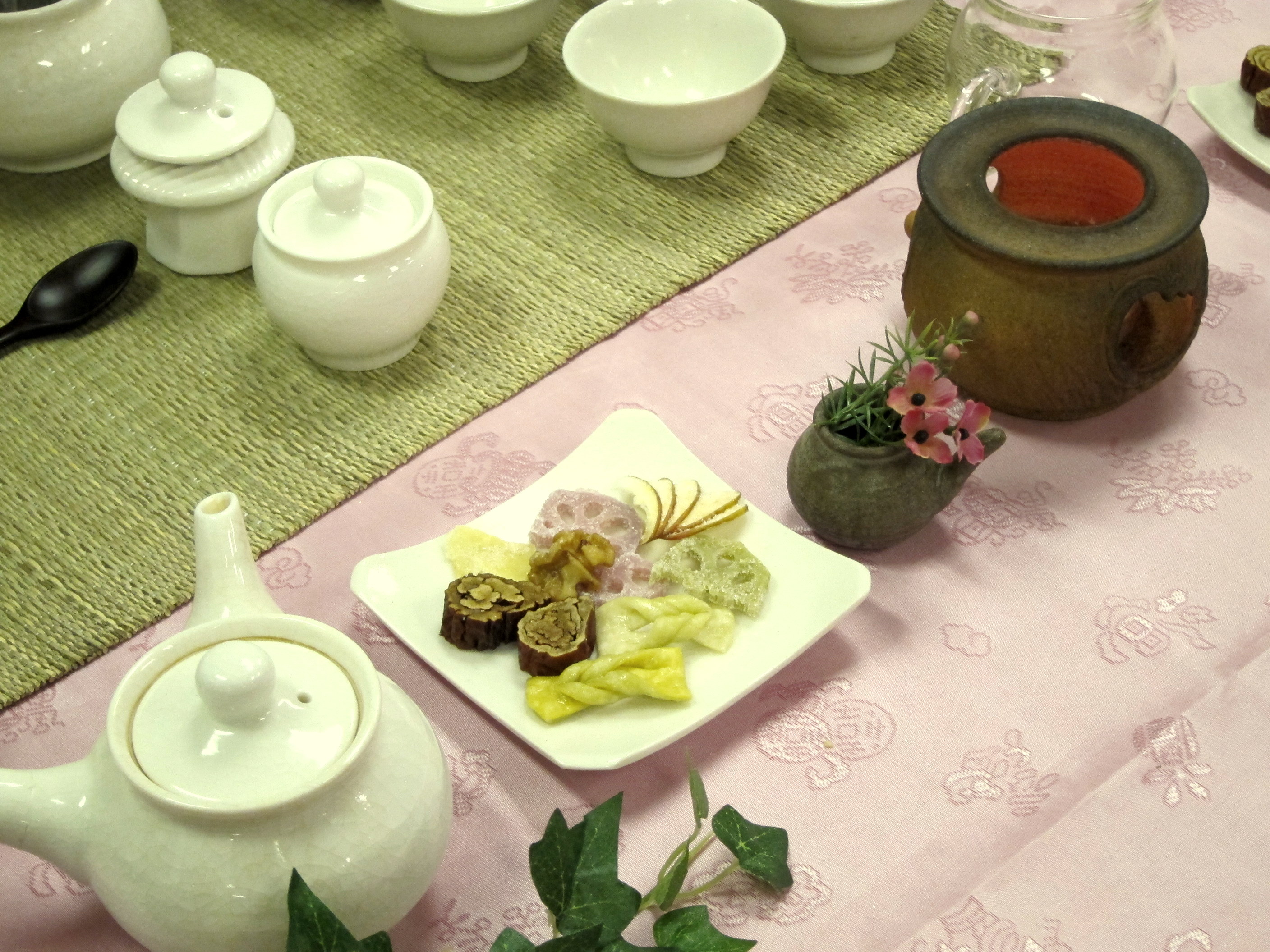
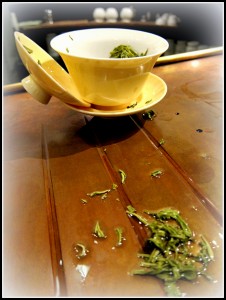
During the next 20 minutes, the guests were invited to taste green tea and yellow tea with a variety of 다식 (dasik), tea snack: candied lotus root, dried apple, dried jujube, and a kind of fried chips that I’d only seen in the drama Sungkyungkwan Scandal (성균관 스캔들). The green tea, unoxidized, looks and tastes clear with a very light herbal hint, like a white tea. The yellow tea, about 50% oxidized, similar to Tieguanyin, has an upfront sweetness and a deep citrine hue. Each batch of tea is brewed for about 2 minutes in 60-70°C water, as boiling water would induce a bitter taste.
After ample tea had been served, the guests came back to their seats for a brief presentation from Prof. Jaesup Pak, President of TKTS, on Korean tea production and ceremonial methods. I scribbled like mad, and here’s what little knowledge I’ve gained:
There are 3 major tea plantation regions in Korea: Boseong, Hadong, and Jeju. Boseong is the largest and most respected tea plantation, producing roughly 40% of Korean tea in 5.3 million square meter of hillside. Hadong, second in line, has produced wild tea for over 1200 years, and from its neighboring town Hwagae originated the Korean green tea culture. The tea here is grown completely natural on rocky 400-500 meter high mountainsides and harvested by hand. In contrast, Jeju‘s tea is grown with chemicals and fertilizers on rich volcanic island soil, plucked and chopped by machines, and heated and dried with steam.
Regardless of regions, tea leaves are plucked young between April and May because fully developed leaves are too coarse to use. Different grades of green tea are categorized based on their youngness. Ujeon (우전), the first grade, comes from the first harvest, which means it is picked by hand before April 20 for a delicate flavor. Sejak (새작), the second grade and the most popular type, is picked early May. Sejak means “Sparrow’s Tongue”, referring to the pointed shape of the young leaves at this stage. And finally, Jungjak (중작), the third grade, is picked mid May. The tea offered to the guests at the colloquium today was Sejak from Hadong.
The production process involves 6 steps: plucking, withering, parching, rolling, separating, and drying. Hand plucking tea is meticulous, even the most skilled women can pick only 2 kg per day. Within 24 hours after plucking, the leaves are left to wither in open air. Then they are tossed and stirred constantly in an iron cauldron over wood (traditionally) or gas fire at 200°C to soften. Rolling comes afterwards to intensify the taste, where the leaves are rubbed and rolled for 3-4 times on straw mats. This process makes the leaves stick together, thus separating must be done to help moisture evaporate from the leaves. Finally, the leaves are spread out and dried naturally on paper on a heated floor for 4-5 hours or overnight.
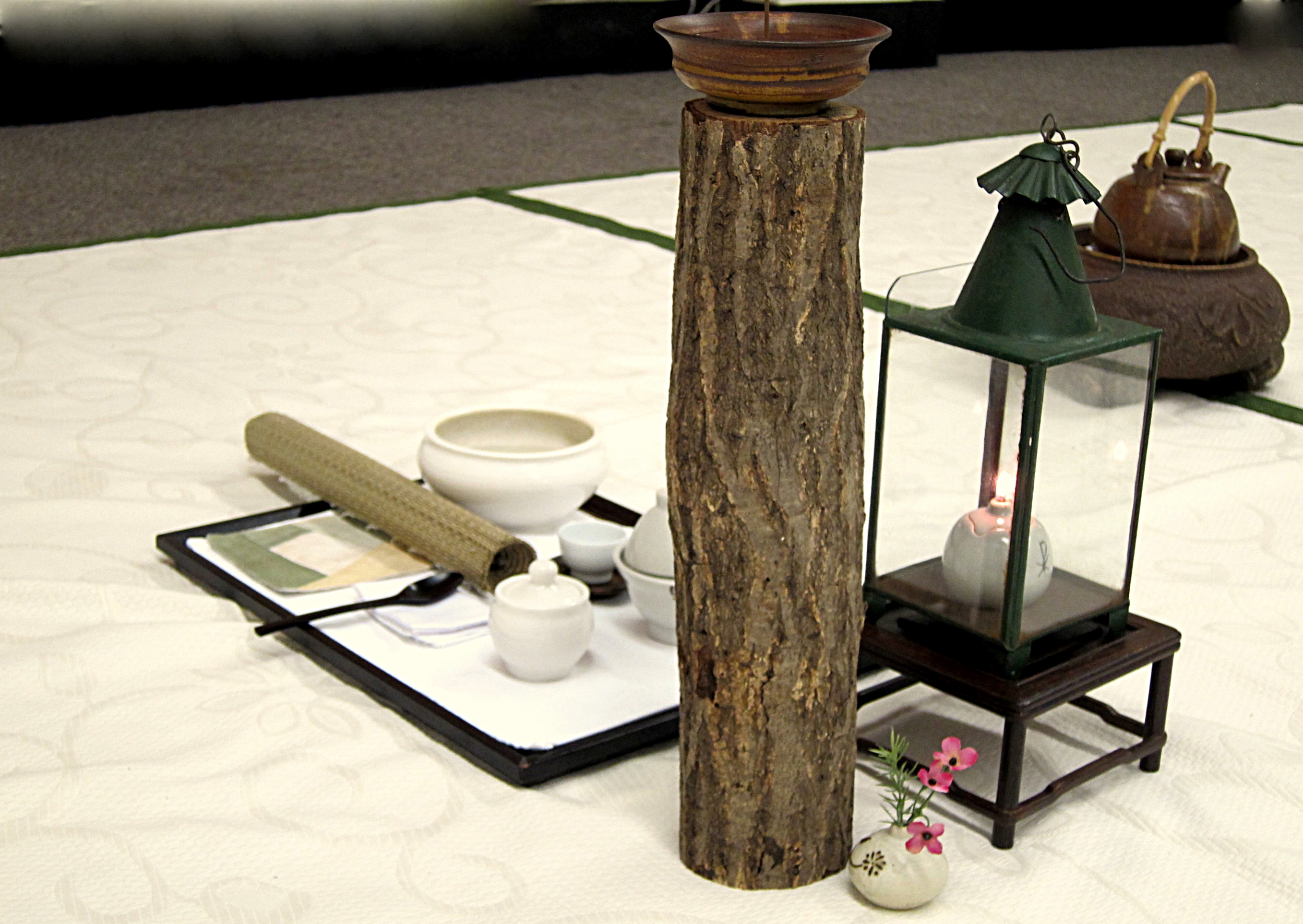
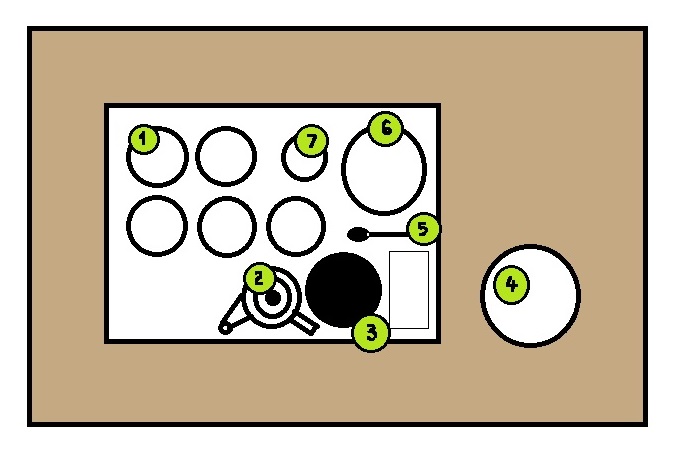
The teaware, or chagi (차기), are typically arranged as shown in the diagram above:
(1) Tea cups: usually 3 or 5 cups per set
(2) Tea pot for brewing. The teapot and kettle should be on the right side and closer to the host.
(3) Tea cup saucer, on which the filled tea cup is placed and received.
(4) Large bowl, into which the water used for warming the pot and cups is discarded.
(5) Tea spoon for taking tea leaves
(6) Smaller bowl for cooling the water and the tea, and for pouring the tea into the cups
(7) Tea caddy, which contains the tea leaves.
The small rectangle represents a napkin for tidiness.
Professor Hyeyoung Shin (Chuncheon National University of Education) performing da-ak (다악, tea music) on a geomungo at the colloquium
The preparation after the arrangement begins with pouring hot water into the cooling bowl and letting it cool for under 2 minutes. Then the teapot, ready with 1-2 spoons of leaves, receives the cooled water; the lid is closed, and the leaves are brewed for a few minutes. While serving, the tea is poured into warmed cups from a high distance to create bubbles in the tea, which are believed to confer good luck. The receiver should hold the cup with the right hand and support it with the left hand, inhale the aroma, take a sip that is about one third of the cup, and drink 3 times from each cup served. I think I did it in more than 3 times… I was savoring the flavor a little too carefully.
At the end, we got to take our cups home as a souvenir. A cute little white tea cup to commemorate a sweet, delicate two-hour lesson. 🙂
Unpredictability #1: “Are you opened today?”
Before you set your GPS to Myung Dong in Houston, make sure you call and ask that question in the clearest, simplest way possible. Aaron tried different versions, most were a bit too elaborately polite with a perfect American accent, and only succeeded in confusing the poor old man. I tried it once and got the answer “Yes, open.” We hopped en route.
(If you don’t call, there’s a slim chance that your schedule will coincide with the owner couple’s schedule, which depends on the lady’s health, and she’s the only chef. That slim chance didn’t happen for me the first time I set out for Myung Dong.) The limited English conversation is nothing uncommon at Korean and Vietnamese mom-and-pop diners, but I have to mention it because it’s one of those things that make me classify Myung Dong as more “authentic” than the other Korean restaurants in Houston. The second thing is that its name doesn’t contain “Seoul” or “Korean”, they go more local: Myungdong (명동) is a part of Seoul (in Vietnam, its equivalent would be a phường). The third thing is that its name contains its specialty: kalguksu (칼국수). In fact, that’s the only part of the name still visible on the sign, the Myungdong part has faded completely, which explains why we couldn’t find it the first time (aside from the other fact that we couldn’t read Korean at the time)*.
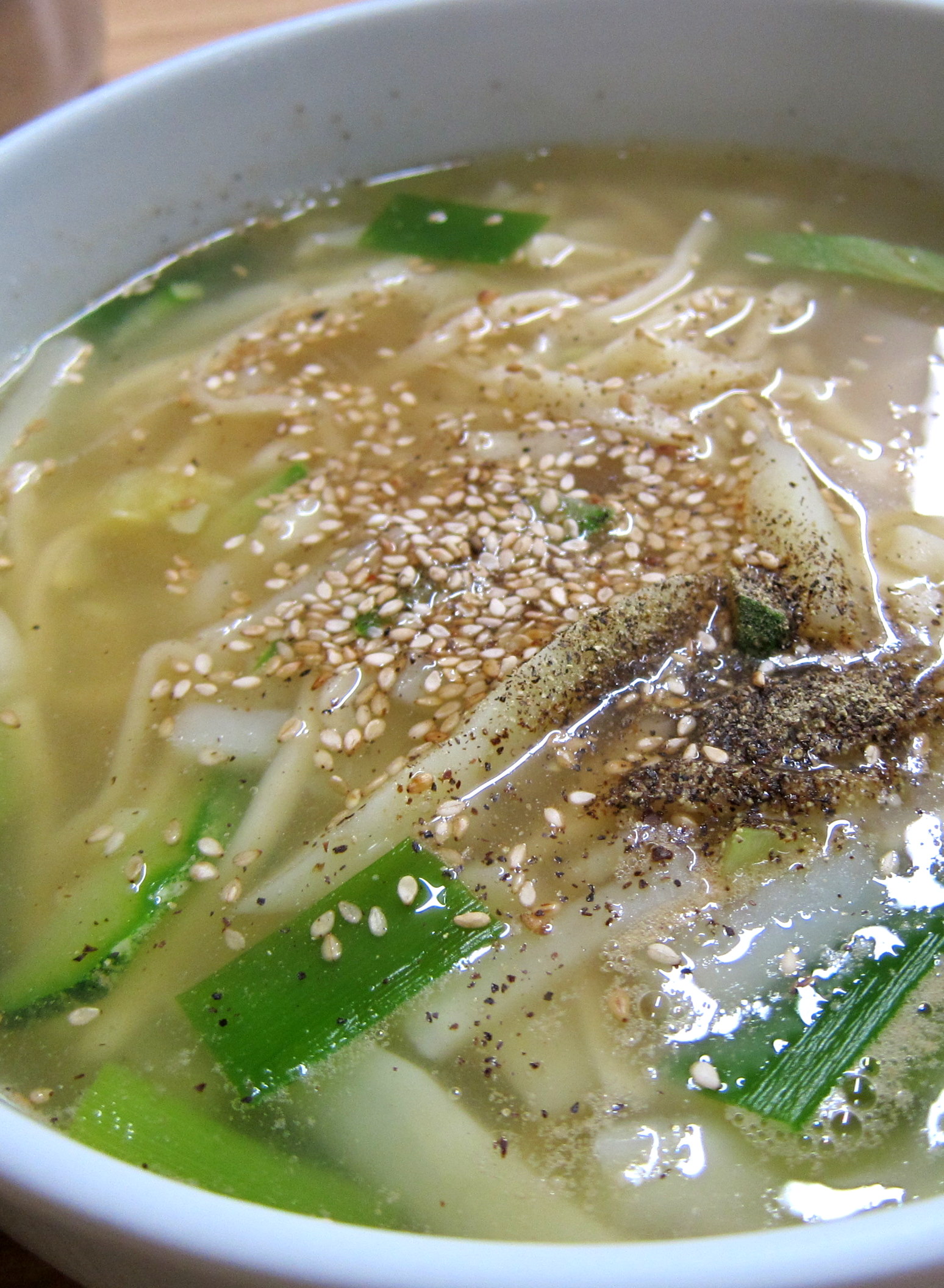
Of course we ordered it. It was the first kalguksu I’ve ever had. It’s a handmade, knife-cut noodle in soup, and this version has only noodle, broth, and vegetables. The broth was sweet and deep, the noodles were wonderfully chewy. But kalguksu is like fireworks, the first two minutes are great, then you ask yourself “just when is it gonna end?”. Now that I’ve had kalguksu, unless I get a two-minute-size bowl, I doubt I will gather enough curiosity for a second kalguksu in my life**.
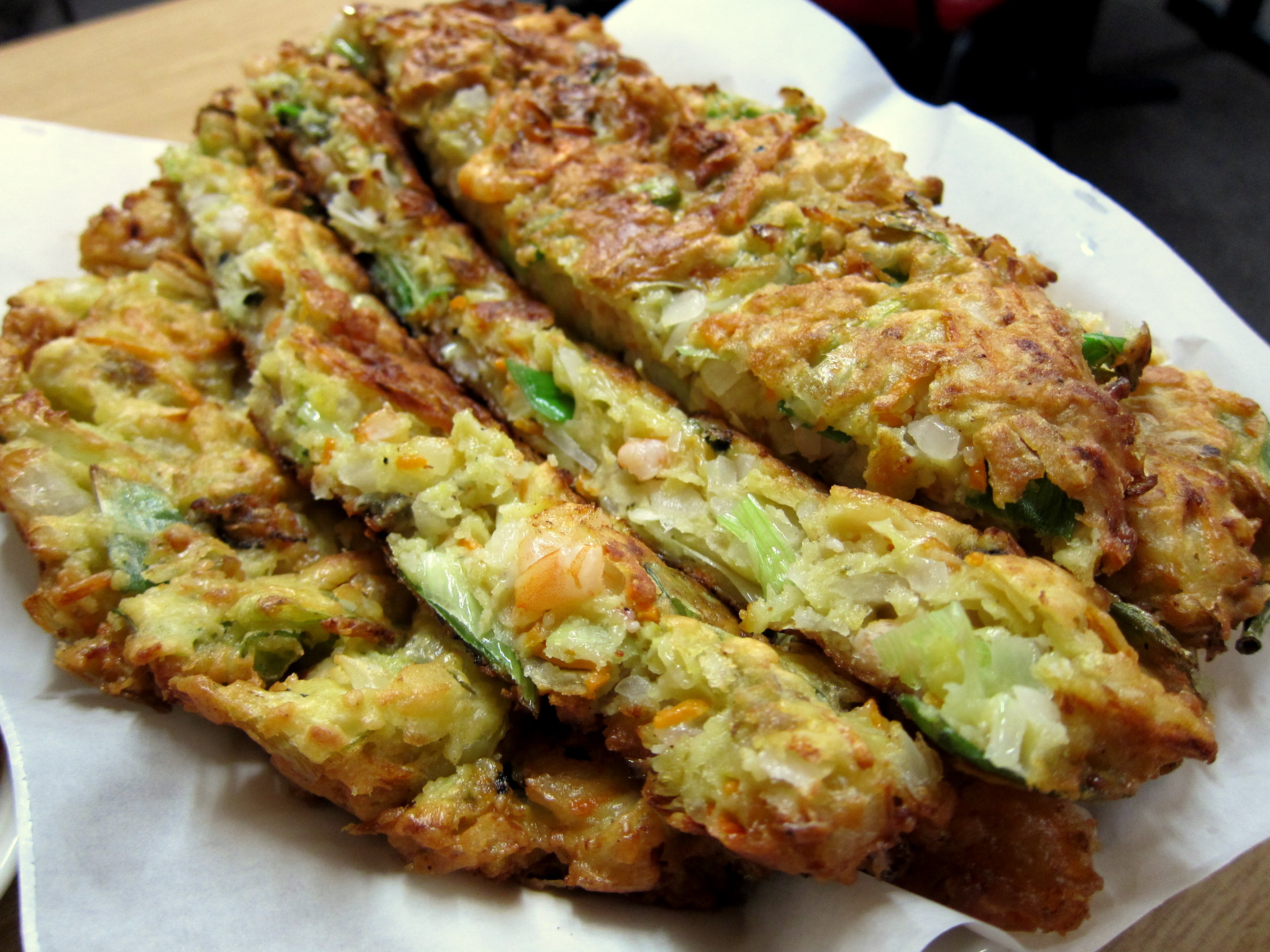
But kalguksu was still a memorable thing. In my Commis post I went off on the memorability of meals, and here I go again. Myungdong has something worth remembering: the portion (Unpredictability #2). Aaron and I each ordered a dish, him the kimchi duaeji bokkeum (김치 돼지 볶음, stir-fried pork with kimchi) and me the kalguksu, and we decided to share a pajeon (it was a really good pajeon too, thick, crispy, airy, and chewy, oh, and not oily). The usual banchans came. We were both starving like baby goats. Then the big stuff came, covering the whole table. A diligent hour later, in Aaron’s words, “it looks like we hadn’t eaten anything at all”. We looked at the old man with hopeful eyes, for boxes. Many boxes. Also in Aaron’s words, “he’s quietly laughing at us: gotcha, foreigners, didn’t know what you were getting into, did you”. He did laugh with us, a very congenial laugh of old men, as he poured the goods into the containers and loaded the containers into a cardboard box. Aaron had enough food for the next week. And Aaron is no timid diner.
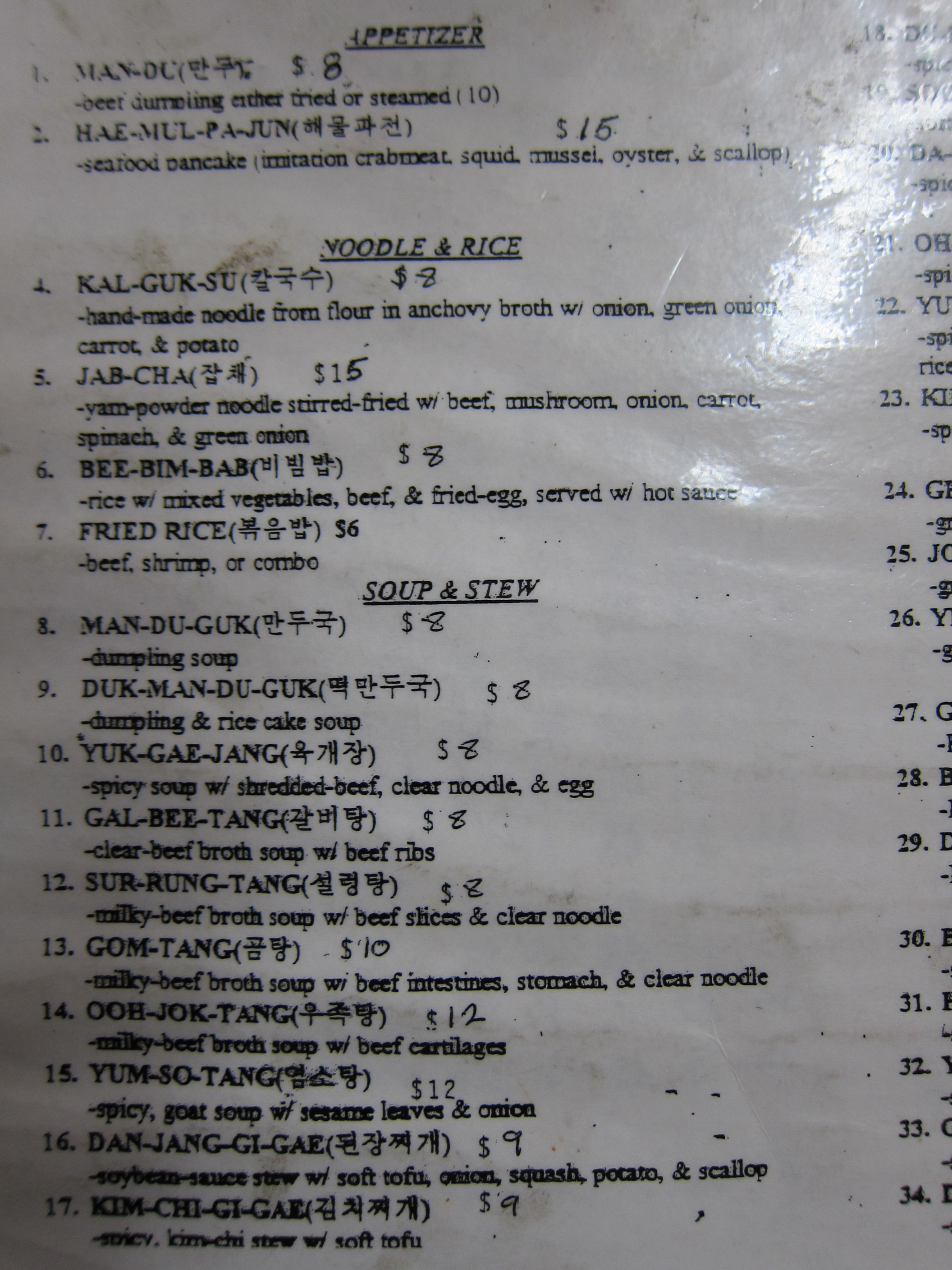
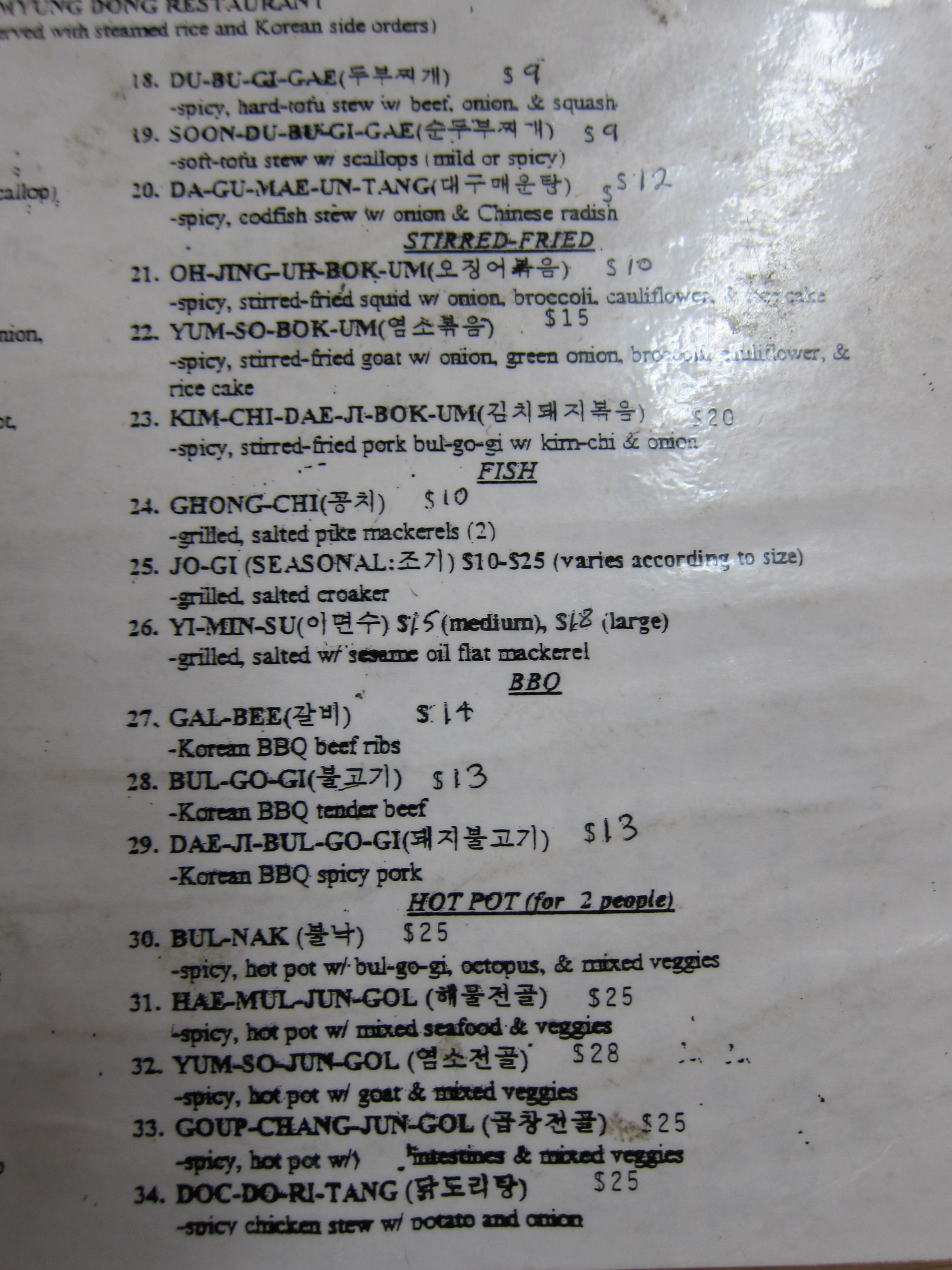
Dinner for so many more than two: $50. See Menu pages 1 and 2.
(*) It’s a neon green one-story house with no door sign. Very noticeable. If in doubt, ask the people in the same parking lot, they’ll confirm “The Chinese restaurant? Yes, that’s it there!”
(**) This is why I didn’t get kalguksu at To Hyang, although it’s one of their recommended’s. In a few ways, such as the homemade kimchis on the table, Myung Dong is similar to To Hyang. When my Korean is better, I’ll ask them if they grow herbs in the back too.
Sometimes my craziness surprises myself. I woke up one morning, reflecting that the week’s been warm, and decided to make mul naengmyeon (물 냉면). Weeks earlier, I bought the buckwheat noodles but never had the time to cook, or the mood. Now I still don’t have time to cook, but today is the day. I remember the main ingredients of a true Korean naengmyeon, but just to make sure that I don’t have them, I look at Maangchi’s recipe anyway.
Beef bones? No. Mushroom? No. Dried anchovies? No. Kelp? No. Yeolmu kimchi juice? Hah. In my dreams. I don’t even have cucumber. Am I going to the store? Of course not. The wind might blow away my cooking mood, which is already rare as it is. Besides, I have a blind confidence that what I do have will make a fine bowl. The deaf ain’t scared by gun fires, they (we Vietnamese) say.
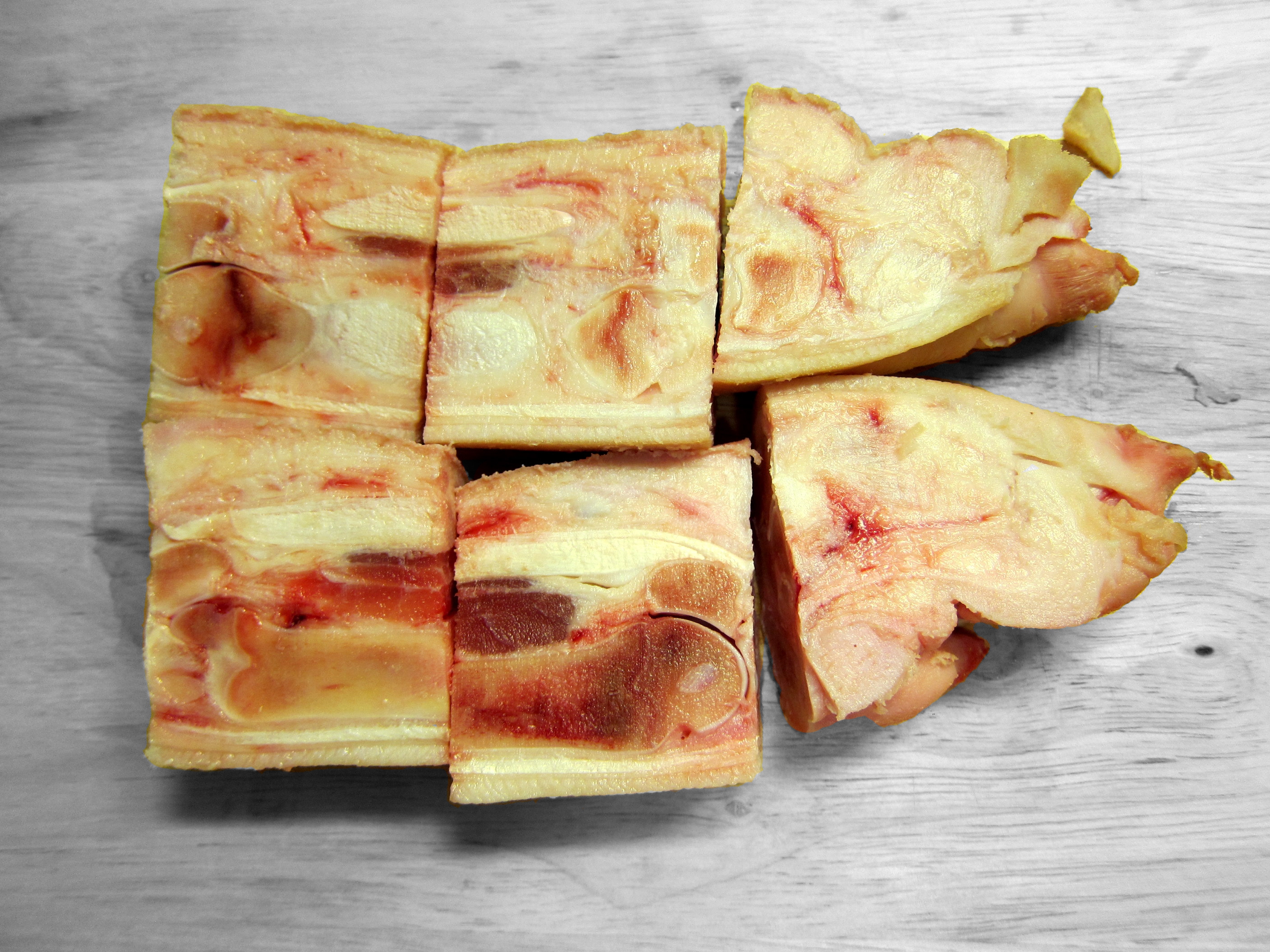
Naengmyeon has three fundamental components: the broth, the buckwheat noodle, and the toppings. The broth needs to be clear and slender. To get the sweetness, I substitute beef bones by pig trotters. They have plenty of bones, and unfortunately also plenty of gelatin, but as long as I skim off the fat while the stock boils uncovered, my broth is clear. In place of dried anchovies, I use fish sauce. So far so good.
The tricky part is the yeolmu kimchi juice, or some kind of dongchimi. Naengmyeon, unlike all other noodle soups, can be eaten cold because the tangy, bitter kimchi juice freshens the otherwise fatty stock. More acridity comes from the mustard, but I don’t like mustard so I (coincidentally) miss it from the noodle package. Anyways, no dongchimi in sight, what to do? I just use normal kimchi. Currently I have a jar of cabbage kimchi, but any kimchi would do. The fermented, spicy, and sour flavor is our goal. Churn a handful of kimchi in some cold water, then mix with the cooled broth to taste, it comes out just as well had it been yeolmu kimchi juice.
The noodle: boiled and cooled.
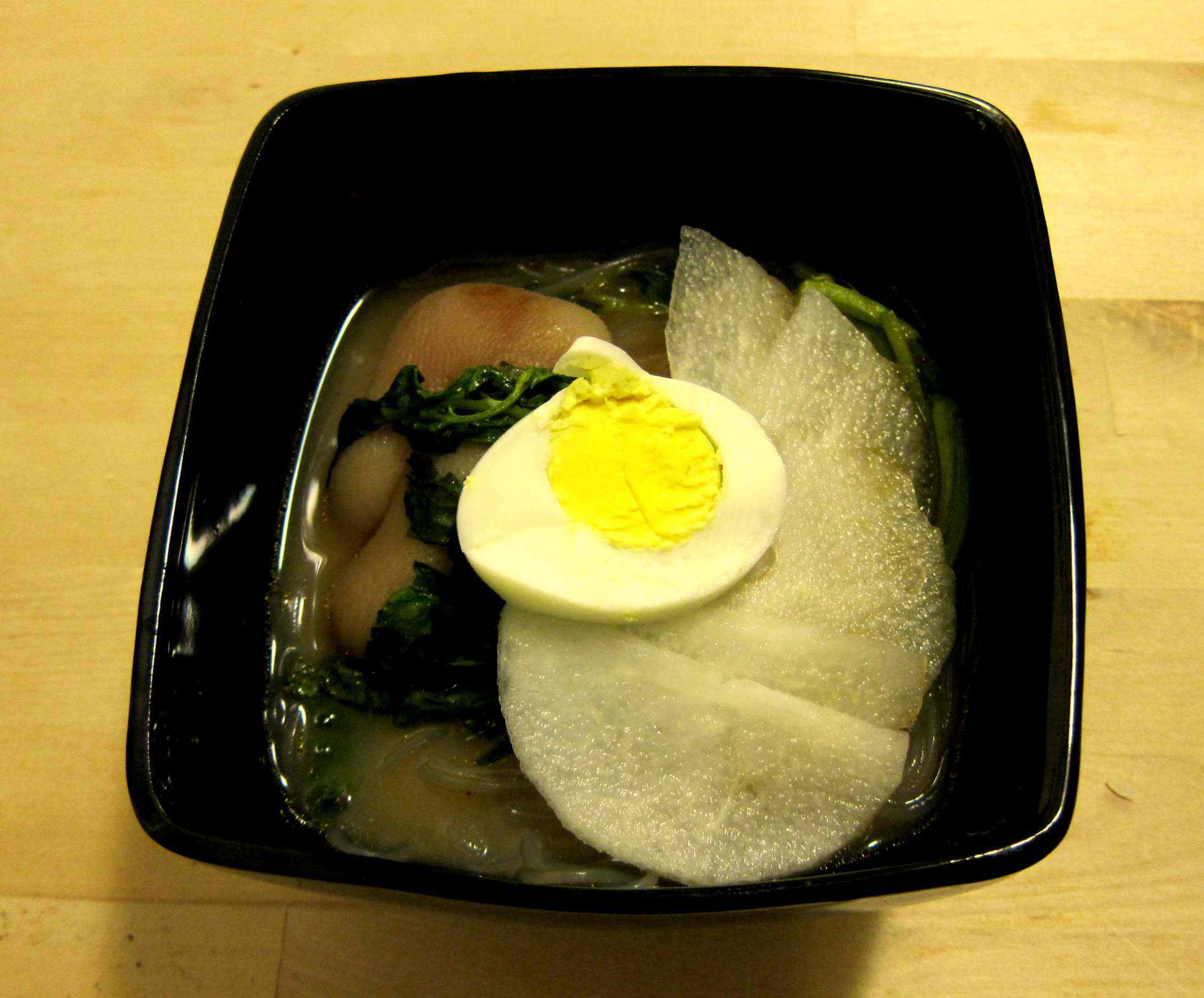
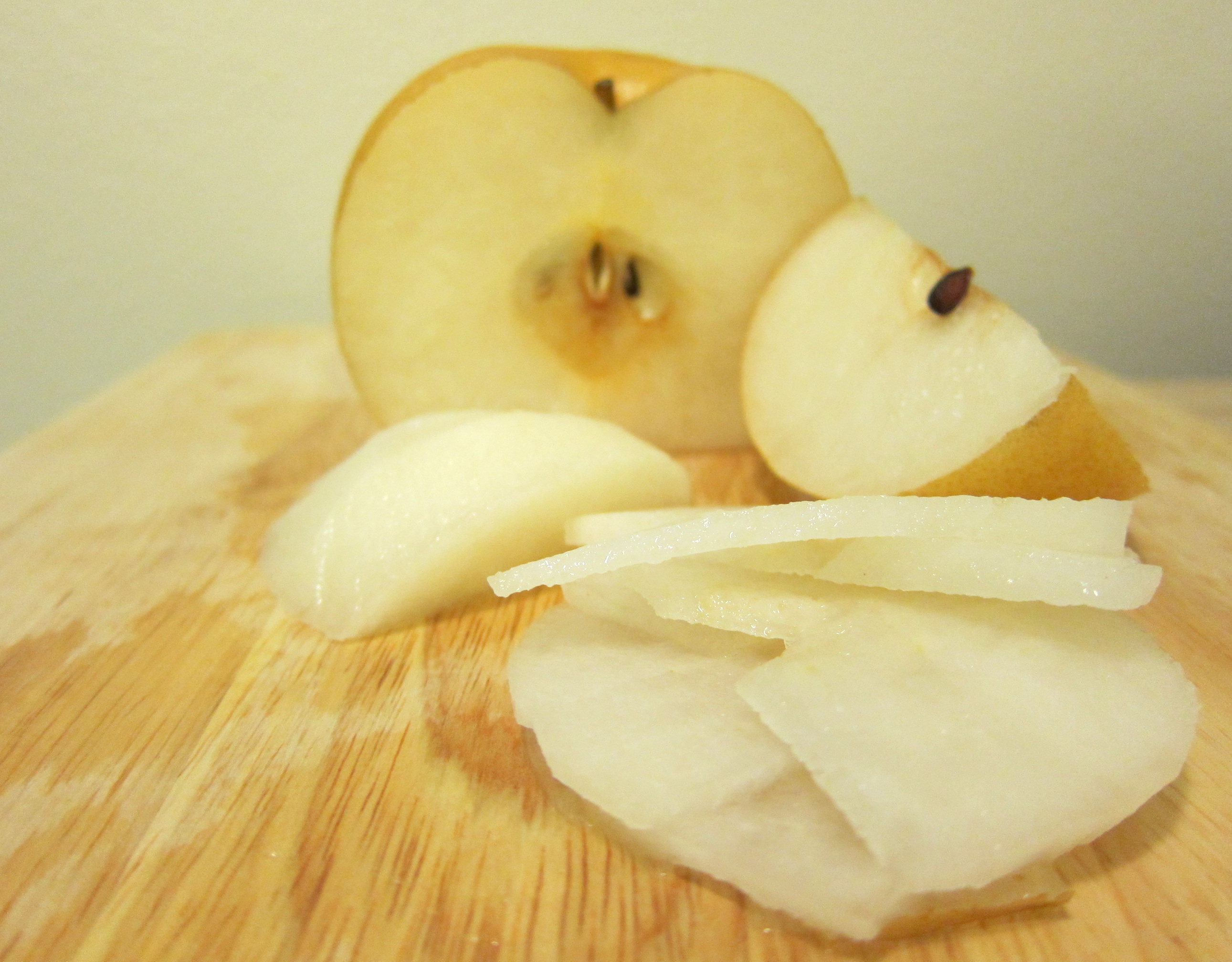
The toppings. Because I’m making the soup version, mul naengmyeon, I don’t need the pepper flakes, pepper paste, ginger, and onion, all of which I don’t have, to make the spicy sauce for the bibim nangmyeon. (You may also wonder what kind of kitchen doesn’t have onions.) Mul naengmyeon toppings are simple: hard boiled egg, cucumber, and Asian pear. The cucumber and the pear, as you might guess, are for crispiness and coolness. I don’t have cucumber so I double the pears. In fact, there’s no such thing as too much pear. It’s sweet, crunchy, and refreshing. It defines naengmyeon.
Another twist I came up with to maximize the freshness: add watercress. Right before serving. Not only does it herbalize and lighten the broth, the porous stems complete the textural spectrum. Just out of curiosity, I also try it hot. Then it’s just jokbal myeon, or miến giò. 😛 In one single bowl is every ingredient that I love: chewy noodle, pig feet, kimchi, and pears. Delicioso.
Mai’s extremely simplified take on mul naengmyeon: Jokbal Mul Naengmyeon – Miến Giò Lạnh Ingredients: (6 servings)
– 2 lbs pig trotters
– kimchi
– buckwheat noodle (naengmyeon, or miến kiều mạch)
– 1 Asian pear
– 3 hard boiled egg
– watercress (optional)
– 2 tbs Red Boat fish sauce
– Other possibilities: chrysanthemum greens and night scented lily (bạc hà) to clarify the broth.
Preparation:
– The broth: Put washed pig feet in cold water with a pinch of salt. Bring to a boil. Dump out the water, rewash the pig feet in cold water. (This first boil is to get rid of the piggy smell, said Little Mom.) Boil the trotters again, uncovered to keep the stock clear. Skim off the white fat layer frequently. Boil until tender. (This second boil takes about 2 hours.)
—- Add fish sauce near the end. Too much fish sauce would muddle the broth. I use 2 tbs fish sauce and some salt to keep it light. No sugar.
—- Mix a handful of kimchi with cold water, then add to the cooled broth. For less sourness, add the kimchi directly to the broth right before turning off the heat.
– The noodle: boil 3-4 minutes, then rinse under cold water to increase the chewiness and remove the starch.
– The toppings:
—- One or a few slices of hard boiled eggs.
—- A few thin slices of Asian pear. A trick I learn from Maangchi’s recipe: keep the pear slices in cold sugar water to preserve its color and sweetness.
—- A few sprigs of watercress.
Serve cold: refrigerate for 20 minutes or add crushed ice. Serve hot: like every other noodle soup.
When was the last time I made noodle soup? It was bún bung, exactly one year ago! (Sep 25, 2010 – Sep 25, 2011). Ironically, real bún bung calls for pig feet, and I had to use beef bones. Now real naengmyeon needs beef bones, and I use pig feet.
I think I’ve vietnamized this unique Korean noodle soup enough that it’s qualified as a Vietnamese dish to submit to Delicious Vietnam, a monthly blogging event created by Anh of A Food Lover’s Journey and Hong & Kim from Ravenous Couple. In fact, that’s just what I’ll do. Thank you Bonnibella for hosting the 18th round. 🙂

 How can you bring kimchi to lunch at work without the smell of fermented cabbage?