Flavor Boulevard

We Asians like to talk food.
Subscribe

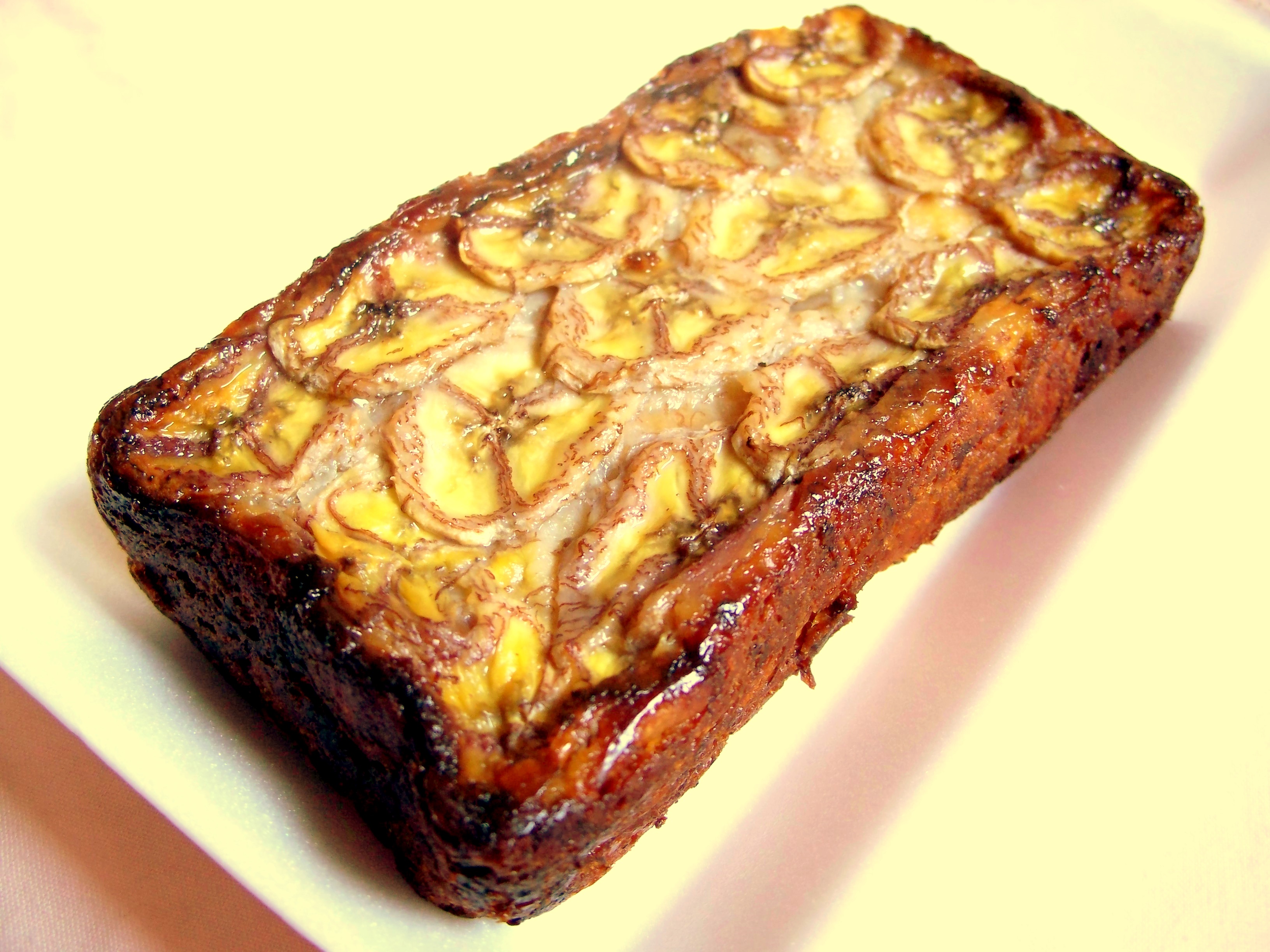
Recipe for bánh chuối nướng (Vietnamese banana bread pudding)
August 25, 2009 By: Mai Truong Category: RECIPES, sweet snacks and desserts, Vietnamese


Compared to other Vietnamese sandwich shop goodies, banana bread pudding is relatively easy to make at home, perhaps because of its strong connection with Western desserts. The ingredients contain bread, milk, rum, and vanilla, but at the end of the day, the tropical note of banana plays the key role.

Ingredients:
– 1 bunch of banana ~ 7-8 fingers, preferably Chuoi Su cultivar (also known as Chuoi Xiem, Pisang Siem, Siusok, Kluai Namwa Daeng)
– 1.5 loaves of old stale bread (the pullman loaf to make sandwiches)
– Rum (1 tbs for every 300g of banana) (optional)
– 2 cups milk
– 2 cups coconut milk
– 2 eggs
– 1 1/4 cups sugar
– 4 tbs melted butter
– 1 tbs vanilla (optional)

Use an 8-inch (20-25 cm) cake pan, at least 2 inches (5 cm) thick so that the bread pudding has enough room to rise. Grease the pan.

Slice bananas (in any direction) and mix lightly with rum. Powder the banana with a little bit of sugar if you want the banana to turn red after baking. If you don’t like rum, just slice the banana.

The bread: you can keep or trim off the bread rind, which would slightly change your bread pudding’s firmness. Either way, dip the bread slices into a mixture of milk, coconut milk, beaten eggs, sugar and vanilla. Squeeze the bread enough to rid it of too much liquid. This is an important step, the cake would be dry if it’s too squeezed, and fall apart if it’s too wet.

Layering:
Method 1: alternate 1 layer of bread (~1.5 cm/half inch thick), 1 layer of banana, another layer of bread, etc. until reaching the rim of the pan. Try to have room for a layer of banana on top. Firmly and evenly press the layers down so that the baked cake won’t be too spongy or crumbly.
Method 2: mix banana with soaked bread, fill up the pan with the mixture and have 1 layer of sliced banana on top. The result will be a finer texture.

Bake at 175C (350F) or until golden. Quick check: stick a small chopstick/toothpick deep into the bread pudding and pull it out, if the chopstick/toothpick is dry, the banh is done. It usually takes 25-30 minutes.

References:
Playing With My Food
Liên (Tú, Đăng’s Mommy)’s blog
vietbao.vn

P for Potatoe, B for Beef

July 16, 2009 By: Mai Truong Category: American, Comfort food, Houston, sandwiches, Texas

Before you say hey dummy foreigner, learn how to spell, no, I did not come up with “potatoe”. Potatoe Patch did. And I think it’s pretty cute.
These days it’s been hard to find wholesome meat within walking distance and spending measure (for a frugal grad student). The best one can afford around Berkeley is little slivers of chicken in a *huge* bundle of pad thai, or minced pork in cheap dim sum. I can’t help but posting about this now to ease the carnivore’s mind.

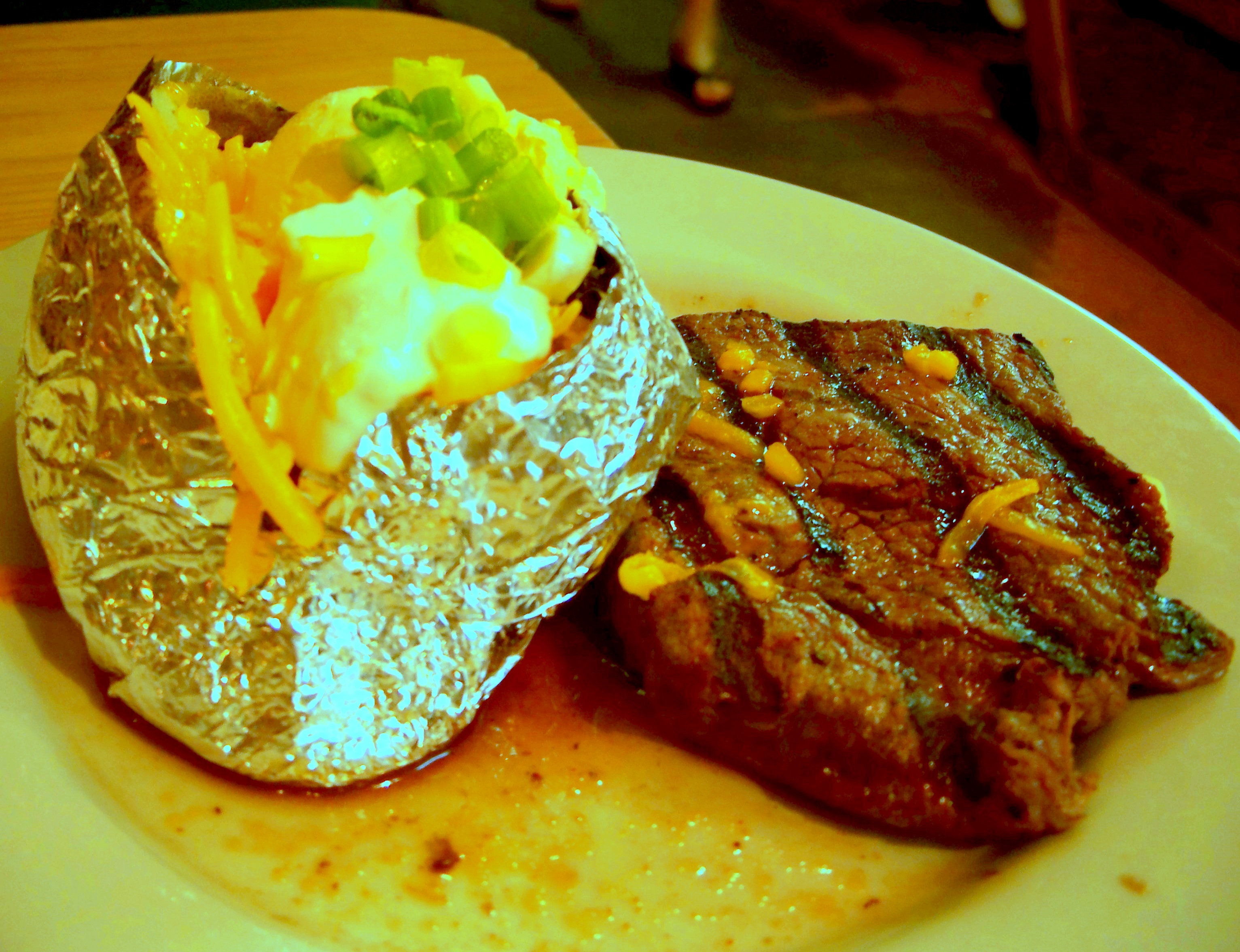
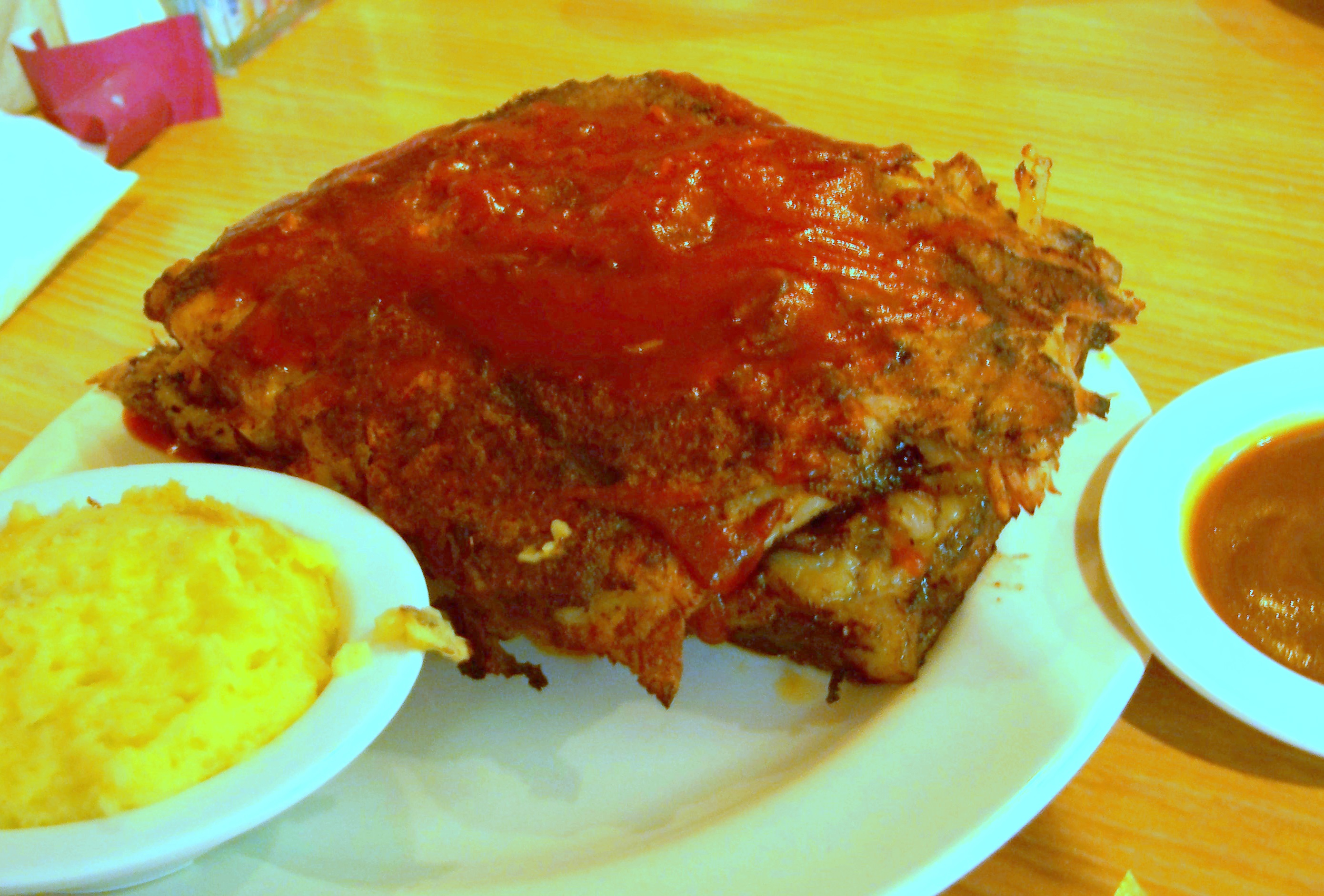
I would flat out say that this is our most-frequently-visited American restaurant. Great food. Good price. Excellent service. A serving here would freak out the health-conscious, nitpicking nimble diner, but who cares. We’re here for the hearty, generous embrace of baked potatoes in melting cheese and sour cream, of thick gravy, of sizzling steak, of tingling barbecue sauce, of a full rack of ribs so tender it falls of the bone.

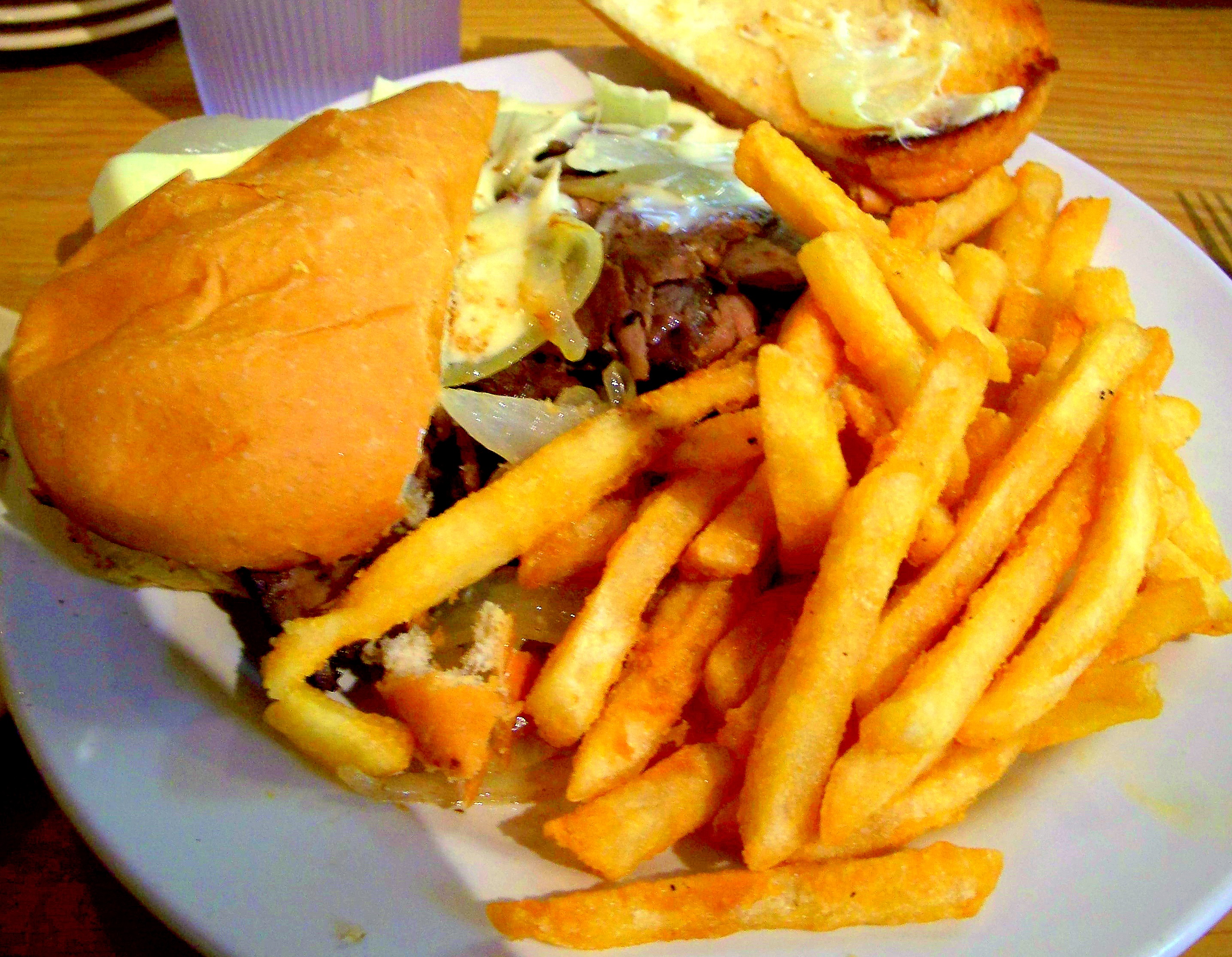
Forget fork and knife. Ribs are sweeter and better with fingers, and so is a philly cheese, that which should be called philly meat not philly cheese. Gooey, mushroomy, beefy. Good fries, too.

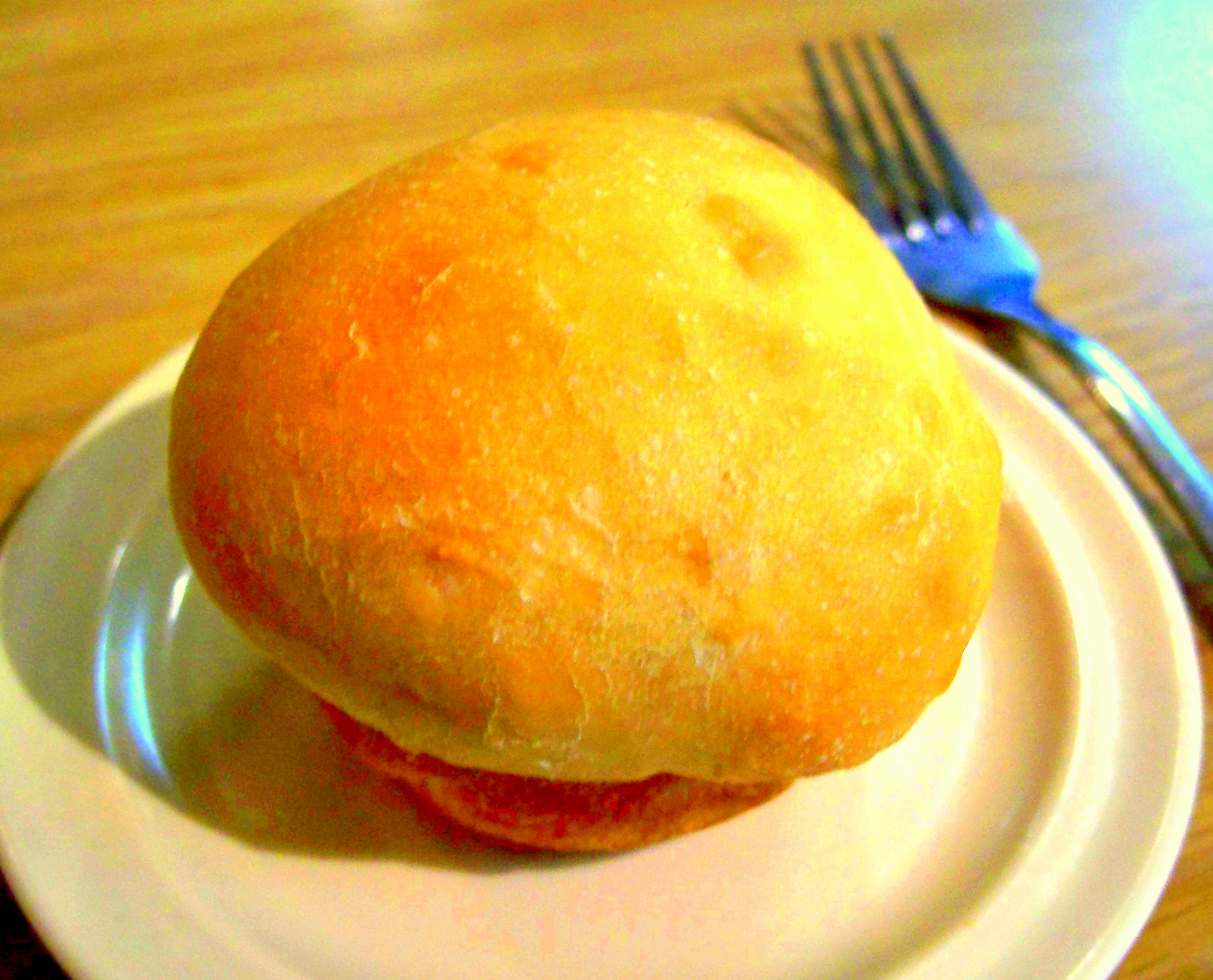
But forget all that. Potatoe Patch is home of throw’d rolls. The best rolls I have ever had. It’s crusty outside, fluffy inside, the dough is so gently sweet. It’s warm. A guy goes around with a tray of freshly baked rolls, you raise you hand, and he throws it to you, sometimes from across the room. And you know it’s a good catch. I would go on TV and do a commercial for this even if they only pay me with unlimited fresh rolls. If it’s not a very busy time for the roll thrower, he’d be happy to throw you as many as you want, make sure you stock up on them. We do every time we come here. Makes perfect breakfast piece for the morrows.

I should be fair and say that they also have great muffins, which usually aren’t throw’d. But nothing, I repeat, nothing, beats the rolls. Even the meat.

Each serving of philly cheese or sirloin steak sets you back by roughly 9 dollars. A full rack of ribs costs 17.95. Total (including tax): $38.59

Address: The Potatoe Patch #1
2504 FM 1960 East
Houston, TX 77073
281-443-3530

Rice noodle day in Banh Hoi Chau Doc, Bellaire

July 06, 2009 By: Mai Truong Category: Houston, noodle soup, Southern Vietnamese, Texas, Vietnamese

Vietnamese places usually don’t appear on the web, why? Because they already paid for ads on Vietnamese newspapers and radio station. Of course the ads are in Vietnamese. There are a little over 30,000 Vietnamese in Houston. It’s amazing how such a small community can sustain its numerous restaurants, with customers primarily themselves. I think I’ve said the word “Vietnamese” enough times for the month. But let me say it one more. Vietnamese must really like to eat out.

So we found a new address in one of the newspapers. We arrived past lunch time, so it felt as if we rented out the whole place. The hostesses seem to be enjoying their leisurely afternoon snack as well, they sat at a nearby table watching TV with us. A flat screen on the wall with documentary films about Vietnam.

Anyway, let’s start with an appetizer.

This is for 3 people to share. Each bánh bèo (water fern bánh) is like a really thin mini rice-pancake, steamed instead of fried, topped with dried shrimp powder, scallions, and guess what, mung bean paste (once again, Mr. Mung Bean won the competition and became Paste of Choice). The final and most important touch is the nước mắm (fish extract sauce). Bánh bèo, like other Central Vietnamese dishes, cannot go without nước mắm. I’m not exactly sure what the coconut milk is doing there. The thinner the pancake is, the harder it is to eat with chopsticks, or any kind of utensils you can think of, because it’s slippery and fragile like jello. But only the thinnest kind is the best kind. Too thick, and all there is is a block of utmost boring rice pudding. So, I’d say these were above average. Onto the main course.

Bánh tầm bì thịt nướng (bánh tầm with shredded pork skin () and grilled pork). I’m confused by the Vietnamese naming system sometimes, there’s not much “bánh”-ness about this cold udon-like noodle. Authentically it should be shorter and fatter. They really gave us a behemoth bowl here, filled with noodle, peanuts, sliced pork skin (), and veggie, but only one skewer of pork! A little blackened. Good pork though. Can crispy-edge grilled pork ever not taste good?

Bánh canh cua (bánh canh with crab). Yet another rice noodle variation, strangely named “bánh”. I think this restaurant uses the same type of noodle for the soup and the grilled pork dish above. The orange color is from gạch cua (something under the crab shell whose English name I know not). The mysterious substance supposedly is stirred in frying pan until gooey and gives the broth a natural sweetness. I’m not big on sea crawlers. My mom likes it.

Bánh hỏi thịt nem nướng (bánh hỏi with grilled pork and grilled nem – a kind of pork sausage). It’s among the more expensive dishes in Saigon and the abroad, but cheap in the provinces where it was first made. The intricate nets of rice vermicelli gives the tongue a fun texture. Chopped scallions swiftly stir-fried with olive oil and a tad salt gives the sleek taste. Generous sum of sliced cucumber, bean sprout, pickled carrots and the backyard herbs counterbalances the carcinogenic charred and brined meat. Nước mắm is also a must. This plate rightfully makes the restaurant’s name.

Bánh hỏi Châu Đốc

Lunch for three: Bánh bèo tôm cháy: 4.95, bánh canh thịt cua: 6.95, bánh hỏi thịt nem nướng: 9.95, bánh tầm bì thịt nướng: 7.95. Total: $29.80.
Address: 10800 Bellaire Blvd, Houston, TX 77072.

If I recall correctly, the menu does have brief English descriptions, and the young waiter seemed more comfortable speaking English than Vietnamese.

Banh mi run

July 05, 2009 By: Mai Truong Category: California - The Bay Area, sandwiches, sticky rice concoctions, Vietnamese

You know how school kids don’t get tired of peanut butter sandwich even if they eat it every day for lunch? Well, every time I catch the BART down to Fremont, it’s hard to pass up the chance to stop by Huong Lan Sandwich in Milpitas for a fresh crusty loaf, or many of those banh mi’s – a week’s supply for lunch.

When in California, be liberal. The store has diversity. Above is packages of bánh bèo (white) and most likely bánh bột lọc (leaf-wrapped). Many kinds of cookies, crackers, shrimp chips, and other snacks unknown to ubercmuc. Below is the real goodies: nice warm bánh bao (steamed pork bun), bánh cốm (the bright green flat thing), bánh giò (leaf-wrapped pyramid), and mini bánh chưng (the squares).

Here’s the square unwrapped and cut in four. The pork is fatty, which is not quite right, but nonetheless it’s well done. So the story goes as follows: in a competition among the princes in ancient Vietnam, the king asked all the princes to find an exceptionally good food. The youngest prince, having no money and little power, couldn’t afford fancy stuff like ginseng and who knows what in the woods, so with the advice of a god in his dream, he took sticky rice, meat, and mung bean to make a bánh, wrapped in lá dong (Phrynium placentarium), and boiled for hours. The bánh is a green square, symbolizing the square Earth, pork – the animal, and mung bean – the plants. So I suppose fatty or lean pork doesn’t really matter to the story. After all, we have some really chubby animal, not just skinny ones. Mung bean seems to be Vietnamese’s favorite legume, just like red bean is to the Japanese. Perhaps because it’s good as a paste (in both sweet and savory bánh), a powder (on xôi), whole beans (in sweet deserts like chè), and as an ice cream flavor.

Don’t let size tricks you. Half of this mini bánh chưng definitely made a filling breakfast, the whole thing would be too filling. And if you’re too full you wouldn’t be able to eat a nice crusty bánh mì for lunch… uhm hmm…

Look at all that pickled carrots and radish. It’s a balanced meal. I usually get bánh mì thịt nướng (grilled pork), but that is proven quality, so this time gà nướng (grilled chicken) is up for test. I should stress that no matter what the filling is, a banh mi can never go wrong. You can put just soy sauce and a banana in it, and it would still be yummy. Something about the crusty, flaky bread that makes everything better. Back to the chicken. Well, it’s not dark meat, and it’d take some serious brining to make white meat flavorful. So let’s put it gently, I’ll be loyal to grilled pork.

Hương Lan must be a chain, or it’s just a name sandwich-makers like. They’re everywhere in this area, but I believe every store has a different touch to it. Here they put peanuts and nước mắm in the grilled pork bánh mì. The more flavors the merrier. Address: 41 Serra Way #108, Milpitas.

Oh, the end of the story is, the youngest prince, proved to be the wisest, was chosen for the crown. 🙂

Lemon Grass of San Jose

July 03, 2009 By: Mai Truong Category: California - The Bay Area, Vietnamese

The nice thing about Berkeley is it’s about an hour away from San Jose, where Little Saigon is with all the good old Vietnamese food. The sad thing is Berkeley is *cluttered*, no space for parking, hence it’s impractical to have a car, hence if you want to go to San Jose, you can either get on and off five buses for a decent cost and risk missing your stops, or get a zipcar and have to bite your nails over how many hours you should spend hunting for food at the expense of the car, or quickly get over 25 years of age and rent a car at the local Enterprise, Hertz, and the like. Or hope that a friend with a car likes you and Vietnamese food enough to make the drive.

Because one Bánh Cuốn Tây Hồ mysteriously didn’t exist where Google Maps say it is, and another was closed, we ventured to Lemon Grass on Story Road for a Vietnamese lunch. It looks nice on the outside, and the inside too. I would go as far as saying this is how I’d like a Vietnamese restaurant to look, a notch above the common phở houses. Yelp’s reviewers don’t seem to approve of it, but arguably for the wrong reason. Yes, the service was slow, but the food was good. When rating a restaurant, food quality comes first. Just look how the lady immersed herself in the sensation of the hot pot.

We ordered bánh cuốn hồ Tây and cơm sườn nướng (rice grilled pork chop). The bánh cuốn turned out to be no bánh cuốn

… just layers of soft rice sheets, eaten with nuoc mam pha, cha lua, and sprinkles of fried shallot. It’s bánh ướt (“wet banh”), no more, no less. If you’re interested in meat, don’t order it. Even though the shrimp tempura is good.

Order cơm sườn nướng instead! So, this could just be my craving for meat in an almost meatless, vegetarian, health conscious city where you can’t find a steak house, but this was the best grilled pork chop I’ve had in years! Sweet, salty, marinated, juicy, charred, aromatic, the flavor seeps throughout the meat. It’s not one of those huge chunk of pork you get at a supposedly upscale diner that only looks good on the outside but tastes like hay on the inside. If I didn’t have to retain some dignity in front of strangers, I’d have picked the bone.

Address: Lemon Grass Vietnamese & French Cuisine
1143 Story Road, San Jose, CA 95122

Update: more food during Second time at Lemon Grass

Cha lua kimbap

June 30, 2009 By: Mai Truong Category: Korean, RECIPES, savory snacks

3 cups of rice, 3/4 lbs cha lua, 1.25 cucumbers, 3 avocados. Made 10 fat rolls of kimbap. We used long grained rice because we didn’t want to bother buying short grains, giving the rice a little more water than what the cooker says, and it’s sticky, but gotta roll quickly or the rice would dry out, perhaps in hindsight short grain would do the job better? Seasoning the rice calls for sugar, salt, and vinegar, but ubercmuc detests the taste of vinegar, hence water substituted. Inadvertently, my rolls deviate from Maangchi’s by a great distance.

Cha lua (also labelled giò lụa) was bought at a local Vietnamese shop in Little Saigon, hot and fresh from the steamer. Don’t buy those frozen things at the Asian supermarkets, who knows how long they’ve been there. I cut up the cha lua and boiled the slices to lessen the nuoc-mam flavor (which is only a wisp to begin with). It is a much better meaty core than crab stick.

We weren’t sure if we got nori or kim, the sheets are green instead of black, salty, and have a noticable taste of the sea. A 27cm x 27cm sushi mat was well sufficient. We have yet to master the art of slicing a roll of rice, stuffing, and seaweed without breaking them apart, but I found that a cling-wrapped, refrigerated roll, microwaved for 2 minutes, then cut with a wet knife, turned out to be much more beautiful than those cut fresh or cold. Microwaved kimbap also tastes as good as new, at least to a foreign mouth.

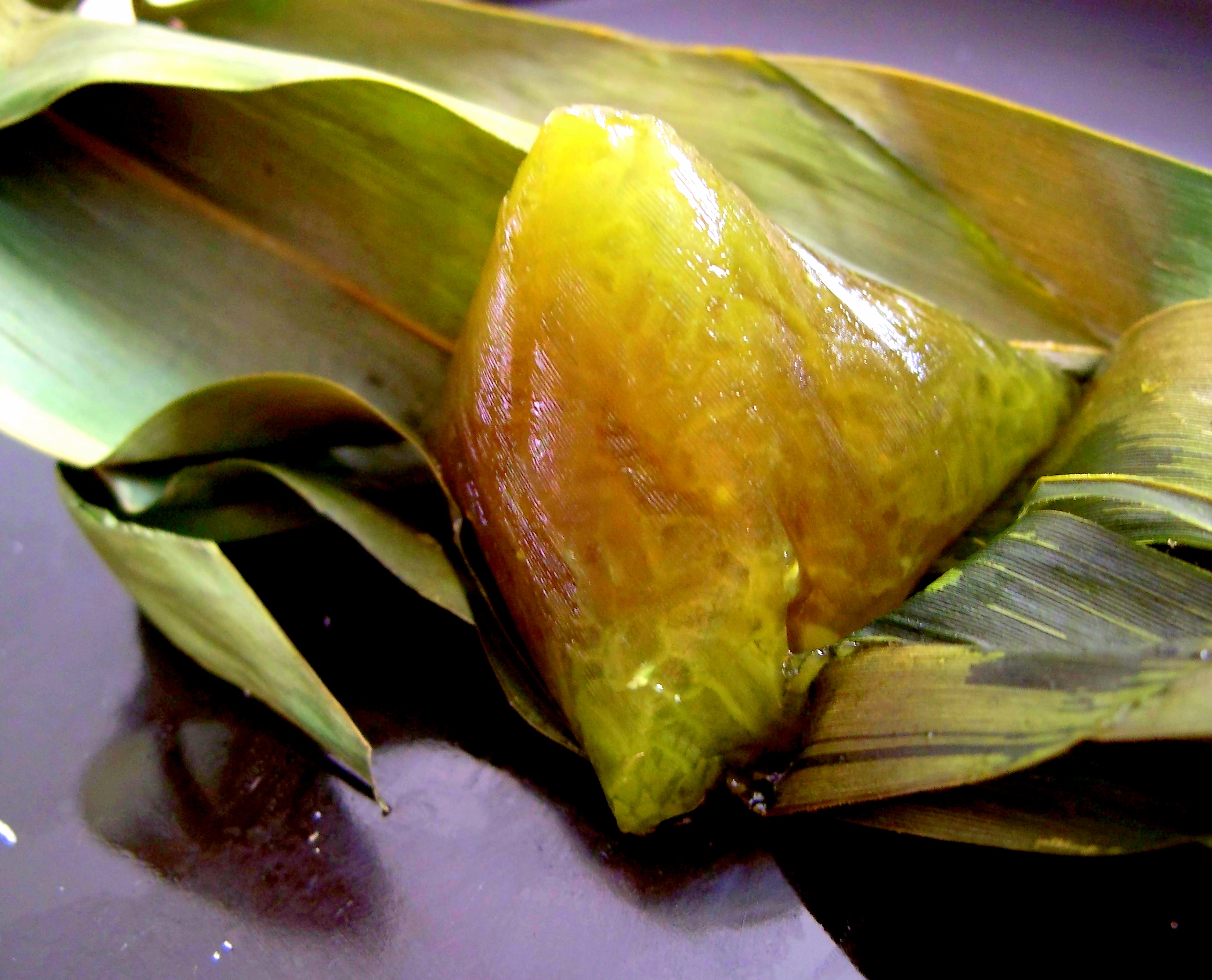
Recipe for Bánh ú tro (Vietnamese-adapted jianshui zong)

June 30, 2009 By: Mai Truong Category: Chinese, RECIPES, sticky rice concoctions, sweet snacks and desserts, Vietnamese

The recipe calls for a lot of prep time (up to a year!), and the products are little triangular pyramids sold for $3.75 a bunch at sandwich shops. But hey, if you can make bánh ú tro, you can enjoy it any time of the year without having to wait until the Fifth of Lunar May.

1. Ash water

Use the fine, soft ash from burnt coal, dissolve in water. The common ratio is 50 grams of ash for every liter of water, but it varies depend on how strong the ash is and how strong you want your banh to be. Let the ash collect at the bottom, leaving a clear solution. Sift the solution to get rid of dirt and coal bits.
You can use lime powder instead of ash. White lime gives bánh ú tro the natural green hues of wrapping leaves, red lime gives them reddish amber hues. The mixing ratio is 20 grams/liter for lime powder.

2. Sticky rice

– Use 1-year-old sticky rice. Such grains are more powdery than new sticky rice. Wash sticky rice with cold water, then soak in ash water overnight or until the grains break easily when you press them between two fingers. Soaking time varies with different ash types and grain types, but beware that grains soaked for too long can make the banh smell like ash.
– After the grains are done soaking, rewash them thoroughly with water and let dry.

3. Sweet filling

Traditional bánh ú tro doesn’t have filling and is eaten with honey or sugar. But bánh ú tro with fillings are arguably tastier than their plain counterparts, and here are a few filling ideas:
Mung bean paste: split and peeled mung beans are washed and cooked until tender, mashed while it’s still hot and mixed with sugar. The bean-sugar ratio varies to your likings.
Red bean paste: soak red beans in water overnight to soften them. Wash, cook until tender, mash. In a skillet, add 1 tbs oil and 200g brown sugar for every 500g red bean, stir on low heat until all sugar dissolves. Let cool.
Grated coconut: boil water and sugar with ratio 1:1 on low heat , stir frequently until all sugar dissolves. Pour the syrup into grated coconut and mix until it becomes a soft sticky ball.

4. Wrapping bánh ú tro

– Use bamboo leaves (about 5-6 cm wide and 30 cm long) or banana leaves cut into similar size. Wash the leaves clean and let dry.
– Bend one end of a leaf into cone shape. Use 2-3 leaves to increase the banh size.
– Put in 2-3 teaspoons of sticky rice for the plain kind. Or 1 tsp sticky rice, followed by 1 tsp filling, then 1 tsp sticky rice on top for the sweet kind.
– Wrap the remainder of the leaf tightly around and over the cone until all faces are covered.
– Tie it up with a nylon string. Then tie every ten banh into a bunch with a long string to easily pull in and out of boiling water.

5. Boiling bánh ú tro

– Cover the bottom of a large pot with banana leaves or bamboo leaves to keep banh from sticking to the metal.
– Arrange banh in the pot. Pour water. Water level should be at least 4 inches above the banh. Make sure banh stay submerged the whole time, you can cover banh with a big sieve and a weight on top to keep banh from floating up.
– Boil banh for 45 minutes to an hour (after the water starts boiling). Add more water if the level gets too low.

Submerge cooked banh in cold water for 10 minutes to aid cooling, then hang them dry. Well made ones can last 2-3 weeks at room temperature.

Recipe translated from source.

Nexus

June 26, 2009 By: Mai Truong Category: California - The Bay Area, University & Cafeteria

After all I happen to stay in school longer than the average person, and if all goes well I will die a member of some academic body, so I figured school cafeterias might as well be another source of food and blabbing inspiration. Previously I blogged about the dining facility at Texas A&M, here comes Nexus at Stanford, where I ate last August. The price of course has changed with the economy, but hopefully the taste remains the same.
Nexus has a few different sections of food, the menu also changes weekly it seems, but the Texan in me often has no difficulty picking out lunch – to the grill I went.

The sign said it all. Burger with blue cheese and sauteed balsamic onion, and the food came out exactly that, with some lettuce, tomato, pickle, and more onion. I really had some doubt about the blue cheese, its presence neither enhanced nor diminish the taste of a good beef patty, its lack of texture didn’t make the burger any more or less juicy. It was a third wheel, unnoticed. The burger was good.

But the more memorable thing I had there was the grilled artichoke. Nexus has a good deal of vegetable choices for salads (with extra cost, though). The grilled artichoke (bottom left of the plate) tastes a bit nutty, unexpectedly munchilicious! Grilled (or baked?) sweet potato follows suit with a sweet little chewiness worth forfeiting all cookies in the world. To my regret I only took a sample of each, since you couldn’t go back for second after you pay. Ah, it’s not Sbisa here, it’s California.

Down the Aisles -1: Endangered species chocolate

June 25, 2009 By: Mai Truong Category: sweet snacks and desserts

Follow up on my previous chocolate review, this time in a much better mood as I’ve settled at the new school. New city, getting further behind in blogging.

Deep forest mint: dark with mint (72%): what do you expect, well… it’s like eating your toothpaste, only more unyielding. It’s not bad, but a little sweetness would be nice. You know how you picture a humid, colorful setting damped with flavors and warmth when you hear “deep forest”? This chocolate doesn’t taste at all tropical. It’s cold, harsh, dry, it flushes your sinus with strength. I prefer mint chocolate ice cream. I shouldn’t score this one.

Wolf: dark with cranberries and almonds: crunchy, crunchy, little bar, almond, chocolate, there you are… no trace of cranberries though. What else is there? Have I lost taste for dark chocolate? Perhaps. It is 70% in any meaning you can think of. Pass.

Sea otter: smooth milk (48%): little sweet treat. My new favorite. 48% seems to be the best medium, not too bitter, not too sugary, not too hard, not too soft. I can eat it all day long. What is it like? Sleeping in on a rainy day – you just keep wanting more. 9/10.

Grizzly bear: dark with raspberries (70%): it’s really not that that much different from the wolf, if you forget about almonds for a moment. Good for passing time. 7/10.

Bat: I didn’t know that bat was among the endangered species. Anyways, the bat tastes like the grizzly bear, 70% is 70% everywhere, regardless of species. Points? 7/10 (surprise!)

For 2.79 I can either get an animal or 3 bars of IKEA chocolate with 30 cents left over, which taste (and sound) delicious. The animal bars will make you feel like you’ve done something good for the world. IKEA choklad will make you feel like you’ve done something good for yourself. Take your pick.

Next on Down the Aisles: Mo’s Bacon Bar and Hibiscus sorbet

Beach and buffet

June 25, 2009 By: Mai Truong Category: Chinese, Texas, Won't go out of my way to revisit


Galveston beach is calm today. In Vung Tau we can see foaming waves hitting the shore from 300 feet away, and the sun-shy ones (like myself) can hide under the shade of sheoaks planted along the beach (*). Galveston is different. A blazon strip of land.

When you go to the sea on a holiday weekend, you get what you expect: (too) plenty of sunshine, sand, lots of people smiling, sweating on the bikes, burning tanning on the beach. When you go to a Chinese restaurant, you expect cheap, commonplace food, casual companies and indeed they are. But never expect too much. We went to China Island, a “restaurant” 10 minutes from the sea, expected decent seafood, and didn’t get it.

A lady stared at little mom, making her feel guilty for taking the last fish fillet. Later we found out the lady didn’t really miss much, the fish wasn’t fresh. The fried shrimps were poorly coated and poorly fried.

Fried rice hastily done, just as plain as white rice can be. Chickens boring and textureless. Crème caramel and watermelon both tasted like water. The fortune cookies were perhaps the best things, since we all got good quotes. What can I say? It costs only $28.65 for three. Our car got a break and some suntan in the parking lot too.

It looks like I’m not the only one unhappy about China Island.

(*) It must have been 10 years since I last went to Vung Tau. Of course lots must have changed.

Tags: