Flavor Boulevard

We Asians like to talk food.
Subscribe

Archive for the ‘Comfort food’

Claypot fish is now upscale
February 11, 2010 By: Mai Truong Category: California - The Bay Area, Comfort food, One shot, Opinions, Southern Vietnamese, Vietnamese

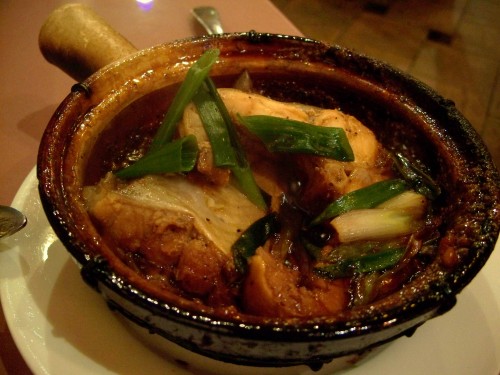
ca_kho_to_claypot_fish
You know how some dishes just instantly come up when you think of certain places? Those are the dishes that always get served when you go on tours to the region they’re associated with, like barbecue in Texas, crawfish in Louisiana, crab in Maryland, clam in the little island Nantucket of Massachusetts. Well, in the deep south Mekong delta of Vietnam, where there are more rivers and canals than Venice, freshwater fish multiply like crazy and the countryside inhabitants make fish dishes like crazy. But for some reason, the name “Mekong Delta” is always linked with “cá kho tộ” (fish simmered in claypot). Why?

The fish (usually catfish) is cut up into thick sections across the body, skin and bone intact (scales off, though), simmered in fish sauce and caramel sauce until it turns beautifully brown inside and out. The mixed sauce is thick and savory, it’s sweet, it’s salty, it can spike up your senses if you add a fillip of chili pepper. Some might argue that fish can taste good by themselves, but this sauce alone would make every mouth water. I’d take the sauce and the sauce-soaked skin anytime over the flesh.

Then again, I had never thought about eating it when I was in Vietnam. Footless animals don’t appeal to me, footless animals with stinky needle bones ready to get stuck in my esophagus appeal to me even less. Footless animals with stinky needle bones were also too abundant, too cheap, and too easy to get when I was there, that boredom won over appreciation of taste. Pick any little food shack for workers on the streets of Saigon, any family-owned eatery by the side of the highway, any book about Southern Vietnamese cuisine, you’re bound to find two things: cá kho tộ and canh chua. It became trite. Little did I know that one day I’d only find it  again in an expensive restaurant in Berkeley.

A few restaurants in Bellaire advertise claypot fish in their menus, but usually say they’re out when you order. It could just be because the dish takes quite some time to make, and scrubbing away those little clay pots with caramelized sauce and fish isn’t really a desirable job. So I was ecstatic when they actually had it at Le Regal (just one good meal after another). The pot came out hot and sizzling, two slabs of fish steaks snuggled in the bubbling golden brown addiction. Fish had never smelled so good. The order does not come with rice, but plain white rice is a must, unless you want to slowly take in nibbles and licks overpacked with flavors.  Be sure to save a bit of rice to clean the pot after all the fish is gone.

Price: about $12-13. (This menu is completely out of date on the price, and does not have all the dishes currently served, but nonetheless it can give you an idea of what they have.)

Address: Le Regal
2126 Center Street, Berkeley, CA 94704
(510) 845-4020

Click here to read Holy Basil‘s recipe of ca kho to.

Want a late-19th-century Parisian afternoon? Go to La Boheme

February 03, 2010 By: Mai Truong Category: California - The Bay Area, Comfort food, French, sandwiches, sweet snacks and desserts

La_Boheme_interiorWhen Mother is a good cook, too often she’s also a dainty diner. Her standard of a good outie consists of a spotless floor, a high ceiling, white table cloth, classy customers, and fine china. So when it comes to taking Mother out for dinner, I have to be extra careful. French is always a safe choice. A French restaurant in the City of Trees is even better, as the rows of Eucalyptus loftily overlooked us driving through, bringing her back to memories of Saigon’s Duy Tan Street. The good mood was set. We arrived at La Boheme in the midst of a sun-bathed afternoon Farmers’ Market, white tents made the variegated crowd all the more picturesque. A step into the open-doored restaurant and the ambience transformed into cool air, quietude, and refined elegance.

Seeing that it was past noon, we skipped the appetizers. The benefit of having company is the ease of trying out different categories in a menu: from land to sea to bakery, from duck confit stew to pan-roasted salmon to sandwich la Bohème.
It would be almost contrived to go about describing the taste. The look says it all. Tenderness shows on the lustrous russet hue of the duck skin, succulence is embedded in the creamy tone of “ground apple” purée, garden’s and oven’s crisps join harmonically in vibrant colors. Perhaps the only setback was the acrid zest of dijon mustard on the sandwich, a taste I have yet to acquaint.

Like a palette with no fixed sets of color patches, this pâtisserie does not have a fixed dessert menu all year round. The business goes by daily creations, but the mousse and the mille-feuille are as irresistible to the chefs as they are enticing to the diners: the window counter cannot lack their beauty, nor can the palates refuse their luscious embrace. Just this once I actually let go of the wicked craving for chocolate and chose the fruity mousse, every morsel of which I adored. Indeed, nothing can beat the citric acid’s touch of delight.


Was it the drowsy sunbeams that made this cafe more removed from its neighboring reality and closer to some distant realm one can only find in books and old movies? Two ladies in their late 60s and wide brim hats softly sipped the afternoon away at a nearby table. Their presence furnished the luncheonette with a whiff of Chez la Père Lathuille – minus Manet’s humorous romantic air, of course, and plus a few walls.

La Bohème Café & Pâtisserie

1425 Burlingame Avenue
Burlingame, CA 94101
650-347-3331

Lunch (and dessert) for Four: $81.94

Food and plates

December 27, 2009 By: Mai Truong Category: American, Comfort food, sandwiches, Texas

ZsFillingStation_Woodville_TXTwo hours north east of Kingwood is this town Woodville. So peaceful is the thirty-some-mile long hilly road from Livingston to it, a thin ribbon through the verdency. Every year mom and dad find it rewarding to make the drive to eat chicken and dumpling at a local restaurant there, when the wind turns cold and the sky is covered in mesmerizing gray. But this year the pilgrimage took a different turn. We missed the chicken dumpling by half an hour, and starvation is not easily appeased with only a tranquil landscape. We drove further to downtown Woodville, found Jack in the Box and Z’s Fillin Station. It was God’s will? We pulled into Z’s Fillin Station.
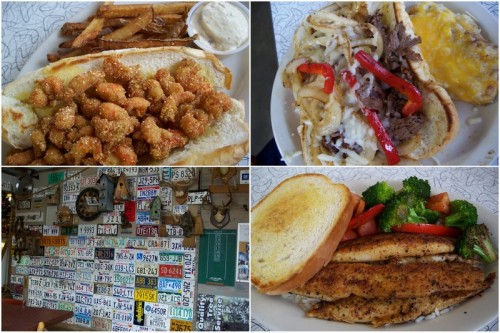
Long menu. The hostess waited patiently for our order, but exhaustion showed on her face. She was also the cook. The host, big and friendly like any countryman of Texas, eagerly checked on us and was happy when we cleaned our plates. A few men in cowboy boots swaggered in, nodded hi to us. This part of Texas is rural and secluded, but it’s nice precisely because of that. People here are home-folk like the land they’ve settled on. The food, too, is bawdy.

Zs Filling Station - Woodville
Philly cheese steak, crawfish poboy, and grilled catfish all came in good portions. A hearty meal with good grease and good salt, with black pepper and bell pepper, with half-boiled broccoli fighting an uphill battle against cheese and butter. But at the end, although the food was absolutely life-saving on that day and quite delectable in its earthy nature, it wasn’t the memory-trigger for me about this “filling station”. What did it were the painted wooden bird houses, the doorbell connected to an iron weight by a rope and a pulley, the collection of car plates from all over the States – some dated back to the time Texas needed only three letters to identify a vehicle. It’s the pure romance in the rust. This place preserves a part of time for those who will not change no matter how the world transforms.

Address: Z’s Fillin Station
307 N Magnolia
Woodville, TX 75979
409-283-5300

Price: Lunch for 3 – 36.64

And here it is, I finally got a chance to blog about the chicken and dumpling joint that we missed.

Tags:

Hot Pot City

December 22, 2009 By: Mai Truong Category: Comfort food, Houston, Texas, Vietnamese

Drop the ingredients into the boiling stock, let ’em bob up and down while you watch and chat, tak’em out and whack’em on top of a wad of noodle, pour a ladle of broth, and inhale the sweet steam… So what constitutes a good hot pot? Well, the stock is of course the key, then it’s common practice to have some meat, seafood, vegetables (some kind of leafy greens and mushroom), some noodle for the starch base. But there is no set rule. Whatever you want in your mouth, you can put into the hot pot. We opted for the half-and-half stock: Vietnamese lau and Japanese shabu. The two are quite similar, but the Vietnamese lau has tomato and is slightly more seasoned. Both stocks contain green onion and sweet onion, the taste is neutral, neither too salty nor too sweet, just downright savory. In increasing order, you can add more tomatoes, pineapple, or tamarind to make it sour, and any kind of chili pepper until your eyes water.

Canadian style thin egg noodle went well with everything. As for the add-ons, we also picked the moderate route, with beef rib eye, beef meat ball (hidden behind the Napa cabbage), broccoli and spinach, fish ball and tiger prawn, a garlic sesame oil sauce (suggested by the waitress but did little to enhance the flavor). Opinions split about the fish balls: Mother and Mudpie like their soft, almost gummy texture, while the rest of the crew voted for the firm and definitive beef balls, which I believe contain ground bits of tendon.

We forwent beansprouts and mushrooms to make room for the yau ja kwai (or dau chao quay, Chinese deep fried bread sticks, usually accompanying soups and porridge). Its misleading name in the menu, “Chinese donuts”, gave the impression of sugar glaze, perhaps even rainbow sprinkles and chocolate? Asian cooks are inventive, but we are not that Picassoesque. No, they are just simple crispy oily sticks of dough to jazz up yet another texture in the variety. Their fluffiness soaks up the broth, delivers it to your mouth packaged and speedy. I remember dau chao quay in Saigon are a tad more salty and less flaky than those served here. The owner of this restaurant is Chinese, so perhaps he prefers it the original way.

Address: Hot Pot City
8300 W. Sam Houston Pwy
Sugarland, TX 77478
832-328-3888

Price:
1 Half-n-Half soup base for 6: 8.95
3 Noodle: 3 x 3.50
+ beef rib eye slice, beef meat ball, fish ball, tiger prawn, napa cabbage, spinach, broccoli, dau chao quay, garlic sesame oil sauce
= total +tax: 57.72

The bill is softer (~$35) if you order the pre-selected combinations and let the kitchen surprise you with what goes into your bowls. Either way, hot pot might just be the easiest solution for a small gathering, as everyone can pick their favorite ingredients, cook and enjoy at the table in their own way without the worries about preparation and post-party cleanup. It can be problematic if a member has some hard feelings against soups or anything cooked in liquids. They would then have to enjoy the posh fractal designs on the walls and Lady Gaga’s rhythmic gnarling in the background, since the menu here offers nothing but hot pot.

Tags: ,

Little big hits

December 22, 2009 By: Mai Truong Category: American, Comfort food, Houston, sandwiches, savory snacks, Texas

It was 7 PM in Houston. Cold winds crept up the rustling trees. We were in the mood for kolaches. No kolache store was opened. (I would be surprised if I could even find some right after noon, it’s usually sold out by 9 AM at any local Shipley Donuts.) Desperate as we were for something small and meaty, we pulled into this backyard parking lot on a dark little street of Montrose. The name is cute, but… “Go Horns”?!*

A few years ago I would have shy away from any place resembling a shady, fuming pub with TV screens blasting out a football game, hoards of muscles with beer in one hand, cigarette in the other, and a gigantic burger streaming cheese and lard in front of the mouth. That’s what Little Big’s looks like from the outside. But the patio was empty. And so were our tummies.

Inside, it was a tamed ambience with three or four rows of long tables and high stools. It has a TV, and football was on, but no attentive enthusiasts screaming at the screen or banging mugs on the table. There was little room between the door and the counter to stand looking at the overhead menu, but luckily we had an expert of the area with us to quickly order and moved out of the way. Everyone walking in here seemed to know exactly what they were hungry for. Not that there are much to choose from on the card.

This joint doesn’t have mayonnaise out for a squeeze. I was in great despair, considering the array of mustards on display. Although the special house sauce was white and good, I thought I felt a tidbit of jalapeno or something equally mordant; besides, it lacked the creamy consistency of mayo. My worries quickly diminished, though. It was instant love at first sight between me and the sliders – baby burgers that can fit snuggly in your cupped palm and come in herds of three. Each herd will set you back by 5.79, an addition of cheese constitutes another 69 cents. Who needs the busy shebang of tomato, lettuce, and those of vegetable origin that keep falling out embarrassingly every time you take a bite? The beef patty admits a layer of rich, juicy grilled onion, and the fried chicken breast was comfortable with a slice or two of pickles. (As Katie put it, Chick-fil-A knows their stuff.) But that was it. A slider epitomizes the way to eat a burger: if you want one, don’t let guilt cover it up with skimpy fresh bits of greens. There is no such thing as a tasty healthy burger, beside one that is only savoured by the eyes.

*Texas A&M was the only school I applied to, so I consider myself a pure bred Aggie.

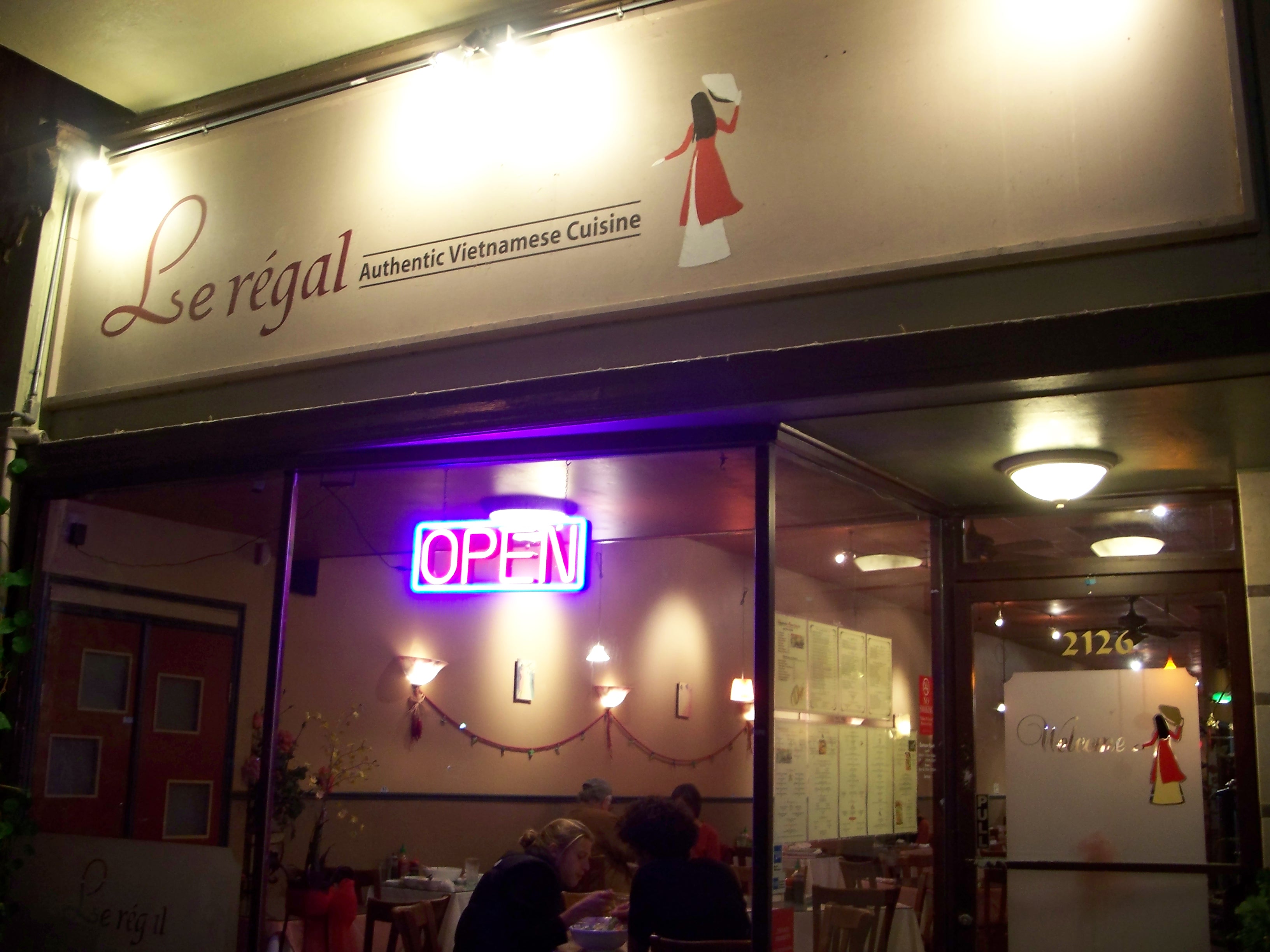
Le Regal – Old food, new taste

December 15, 2009 By: Mai Truong Category: California - The Bay Area, Comfort food, Vietnamese


When asked about Vietnamese food, Americans usually think of phở busily churned out in small noodle houses crowded with plastic chairs and formica tables. Naturally, since most immigrants gather in their community, the variety of traditional food can only circulate in specific areas. A small fraction of the people have settled in a predominantly American neighborhood long enough and are acquainted with the system enough to set up a business, but they often target the young customers with adventurous taste. Meanwhile, most young customers can only afford low price, hence phở and other easily-made noodle dishes make their way to the top.

Careful circumspection would show that pasta alla carbonara requires no more effort than bún thịt nướng, so is it just a matter of gaudy names, flashy advertisement, and aging familiarity that brought one into fancy menus but not the other?

By no means do I want to sound like a snob, but every now and then I get cravings for a nice dinner in a restaurant aptly labeled “restaurant”. Ladles of this melting cheese and mounts of that grated cheese just no longer light the candle. A retouch of Far Eastern eloquence was much needed to make the aesthetic night.


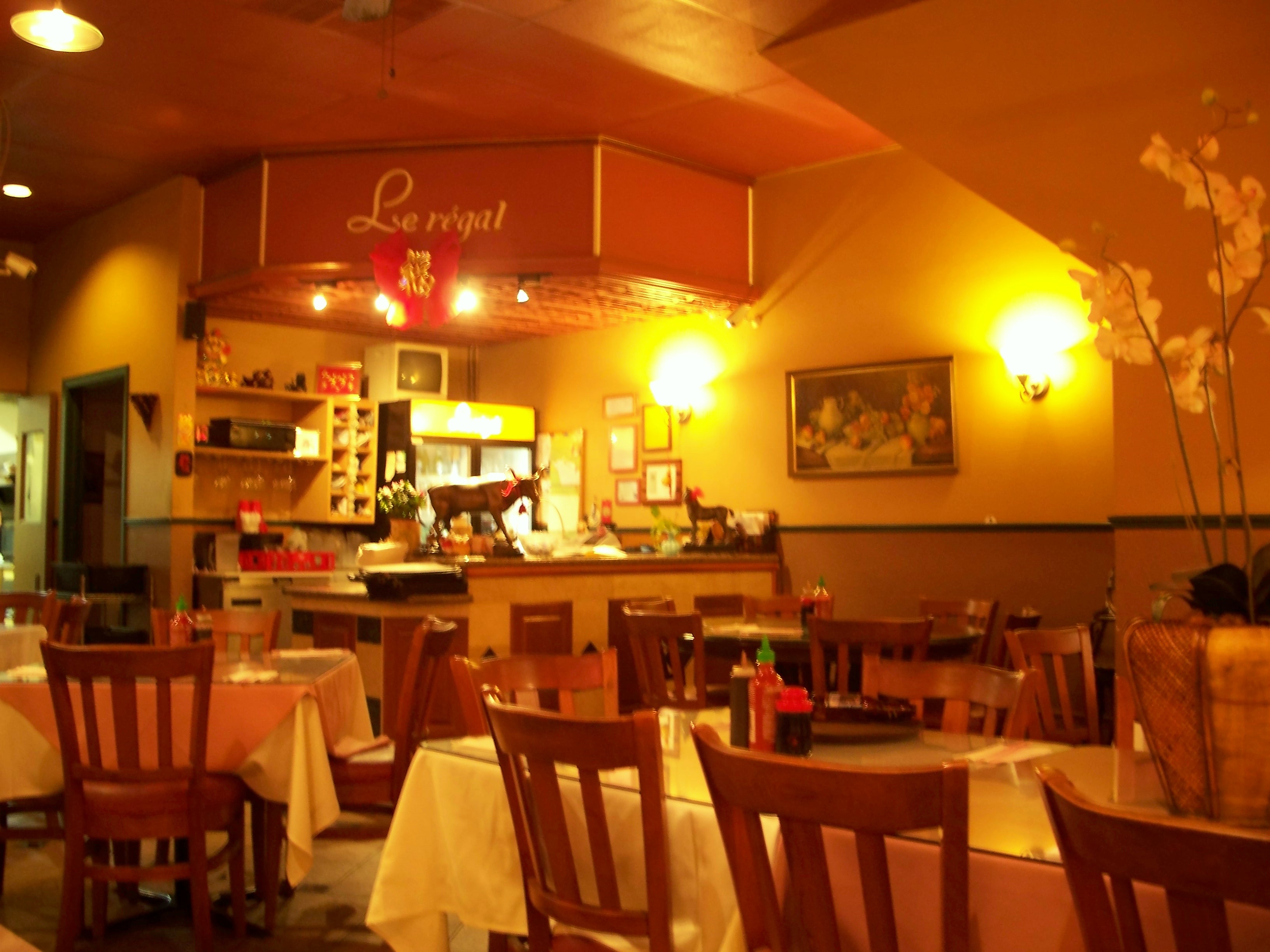
The price is a little steep, but here are clothed tables, warm lights, an all-English menu, little to no disturbances from foreign chattering in the kitchen and among customers. A middle-aged woman, busy like a humming bird, scampered from kitchen to tables with plates in one hand, orders and bills in the other. For a restaurant with a fair size like Le Regal, one-person play seems a little overwhelming. But it works, our food was served within the time it took for us to make a few glances at the decor and exchange some daily news.


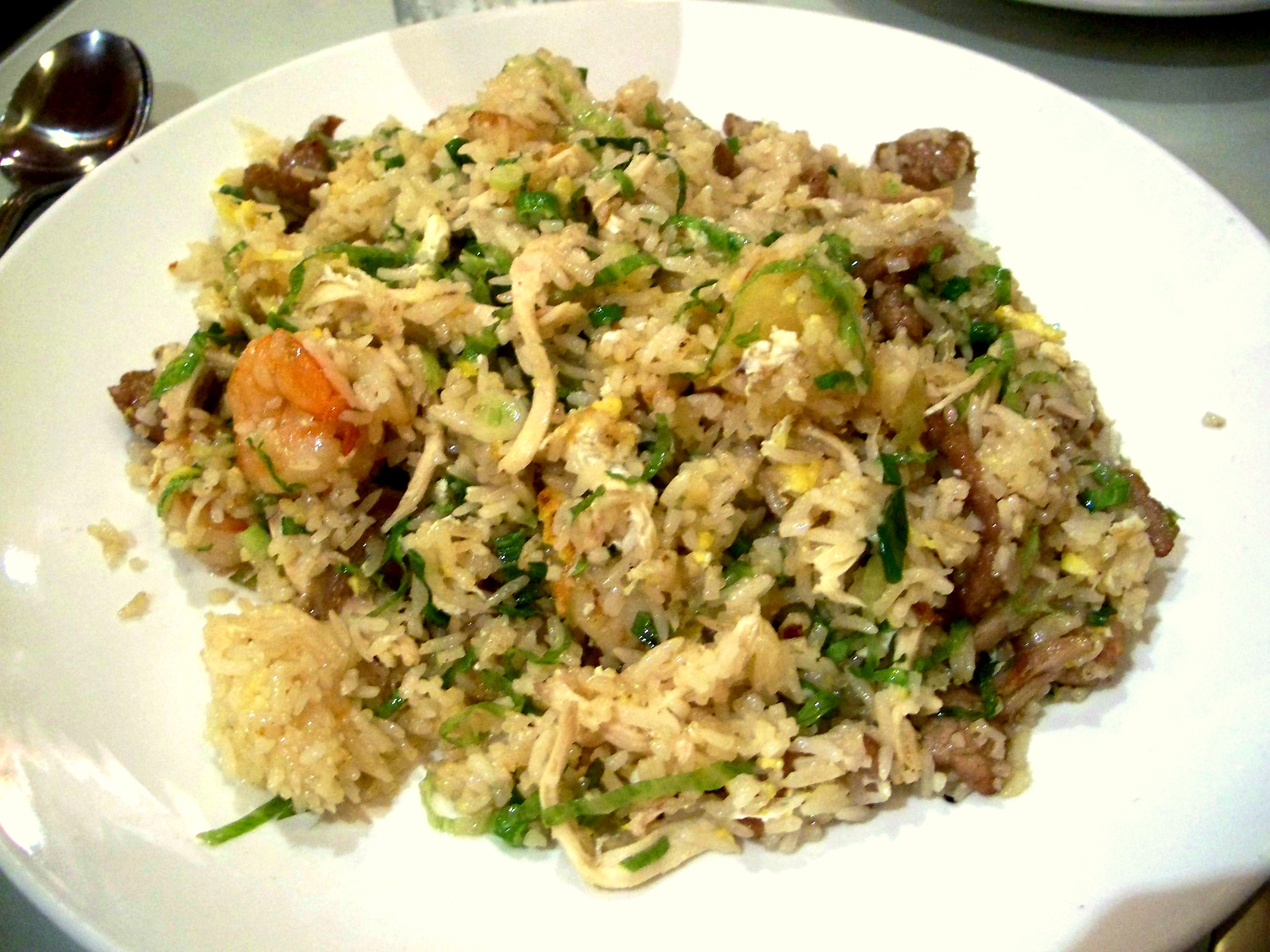
Fried rice is an easy dish, if you throw in some meat, some egg, some legumes, some salt and soy sauce, it can be called well done. Its volatility allows the cook to break free from shackles of recipes, and the eaters to relax from judging its missing-this or extra-that. There’s no fixed list of ingredients, no fixed standard other than appealing to the mouth, hence no objective criterion to rank a plate of fried rice among others. But if we were to nitpick, creativity would pump this one fried rice on top of all other Asian concoctions I’ve had, simply because of the addition of pineapple. There were only a few wedges in that mount, but pineapple is not one to be bullied by other ingredients, its tamed acidity seeps through every grain of rice, sweeter and more thorough than a squeeze of lemon. It helps lowering the guilt of consuming chicken, shrimp, scallops, pork, fried egg and zillions of molecules of saturated fat in frying oil. The rice also made tasty leftover for the next day.


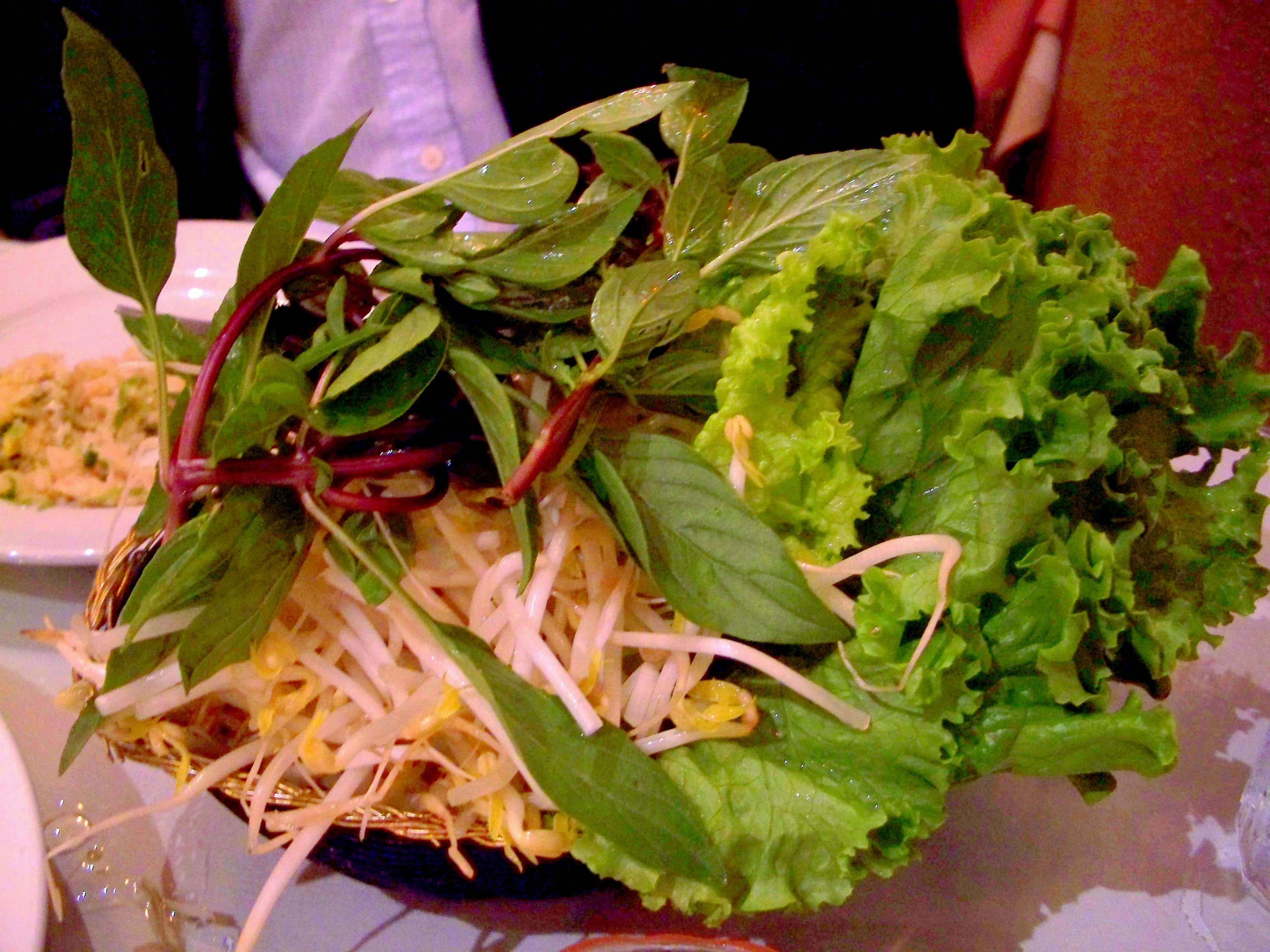
As much as the cook was generous with the protein and the starch, they also gave us enough veggies for ten. At other Vietnamese restaurants, a small plate of sprouts topped with some basil is the usual allowance. Here came a basket of mounting garden goodies. I hadn’t seen any bunch of greens this big for years, especially since we weren’t asking for phở. Not sure what to do, we made lettuce wraps with bean sprout, a couple of leaves of basil and mint, and grilled beef from the other dish we ordered. Dipped in nuoc mam, the wraps were rad.


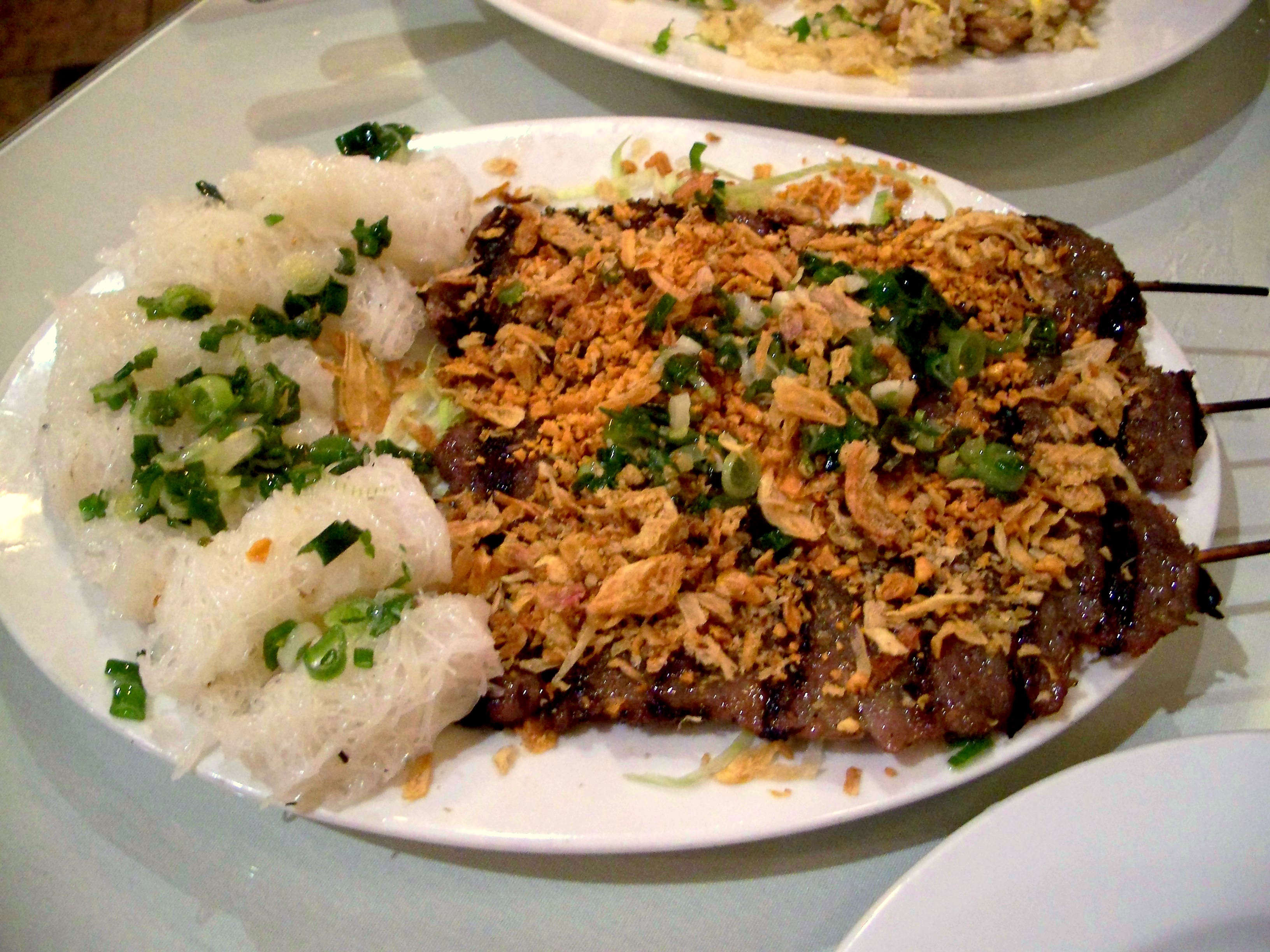
I’ve blogged about bánh hỏi thịt nướng before, so instead of blabbing about the lacy texture, I’d just say that this was delicious. Now clearly it’s a bit disproportionate, nowhere in Vietnam would you find so much meat accompanying so little banh hoi, the rice vermicelli must be the base. But the food pyramid seems to be upside down in America, where meat is vital in keeping you thin and at all cost one must say no to starch. The cook also went bizerk with deep fried shallots and crush peanuts, but those are easily brushed off if you’re not into contaminating grilled beef with relatives of vegetables.

Together with Tomatina, Alborz, some Mexican eatery, and Top Dog, Le Régal makes Center Street a road of international cuisine, of course an addition of kangaroo ragout and kitfo would be nice.

Bill before tip: $26.23 – dinner for two and leftover lunch for one.

Address:
Le Regal
2126 Center Street (between Oxford & Shattuck)
Berkeley, CA 94704

Multi-name Thai Cuisine

September 13, 2009 By: Mai Truong Category: California - The Bay Area, Comfort food

It’s a little hard to tell what the name of this place really is. Yelp says “Da Nang Krungthep Thai Cuisine”. Their little receipt says “Muang Thai Restaurant”. Chowhound disagrees. I’ll go with the name they have on the yellow sign in front. But one thing I do know is it’s busy, even on a drizzly Berkeley Sunday afternoon, and all for a good reason: its good taste.

The good taste extends beyond the food. As Mudpie put it, the interior is “well spaced”. Tables aren’t too closed together to make us talking uncomfortably for fear that the next table could hear. Nice real (not fake) flowers, mini bamboos on the room divider, wooden stools near the window for lone diners.

The middle-aged host brought us our orders with a genuine smile and a friendly warning: it’s spicy, so add this chili sauce only if you like really spicy food. We sure took his advice. The kao pad namh (fried rice with sausage and kai-lan), despite its innocent look and without the sauce, burns.

It’s good though. It’s the kind of tongue-torching well-toned with sweetness. It’s comforting on a rainy day. But what’s even more comforting for the mouth is the tender touch of Ka Moo a la carte. The stewed pork leg.

I bet the plate of meat came from 3-4 pork legs. The less refined name would be “pig feet,” which usually raises an eyebrow or two, or worse, ignites “ew” and “gross” out of Americans. Fine by me, food is like painting, not everyone sees the value until someone puts a very high price on it. And I want my bank account to enjoy the pig feet too, so let’s keep it unpopular. The meat is stewed until it’s so tender you don’t need to chew. The flavors resemble beef slices in pho, juicy, mild, and palatable. They serve it with white rice here, but I think bread would make a tasty companion too.

Lunch for two and leftover: $19.65 before tip. Take a look at the menu here.

A note to self: the exterior (lack of) decorations might be a facade, and shady neighborhoods can turn out to be the best place to find good food. Although, it’s something my mom, who considers look and cleanliness are a crucial part of the taste, would never agree with.

Da Nang Krungthep Vietnamese-Thai cuisine
905 San Pablo Ave.
Albany, CA 94706
(510) 524-6837

Danang Krungthep Muang Thai Cuisine in San Francisco on Fooddigger

P for Potatoe, B for Beef

July 16, 2009 By: Mai Truong Category: American, Comfort food, Houston, sandwiches, Texas

Before you say hey dummy foreigner, learn how to spell, no, I did not come up with “potatoe”. Potatoe Patch did. And I think it’s pretty cute.
These days it’s been hard to find wholesome meat within walking distance and spending measure (for a frugal grad student). The best one can afford around Berkeley is little slivers of chicken in a *huge* bundle of pad thai, or minced pork in cheap dim sum. I can’t help but posting about this now to ease the carnivore’s mind.

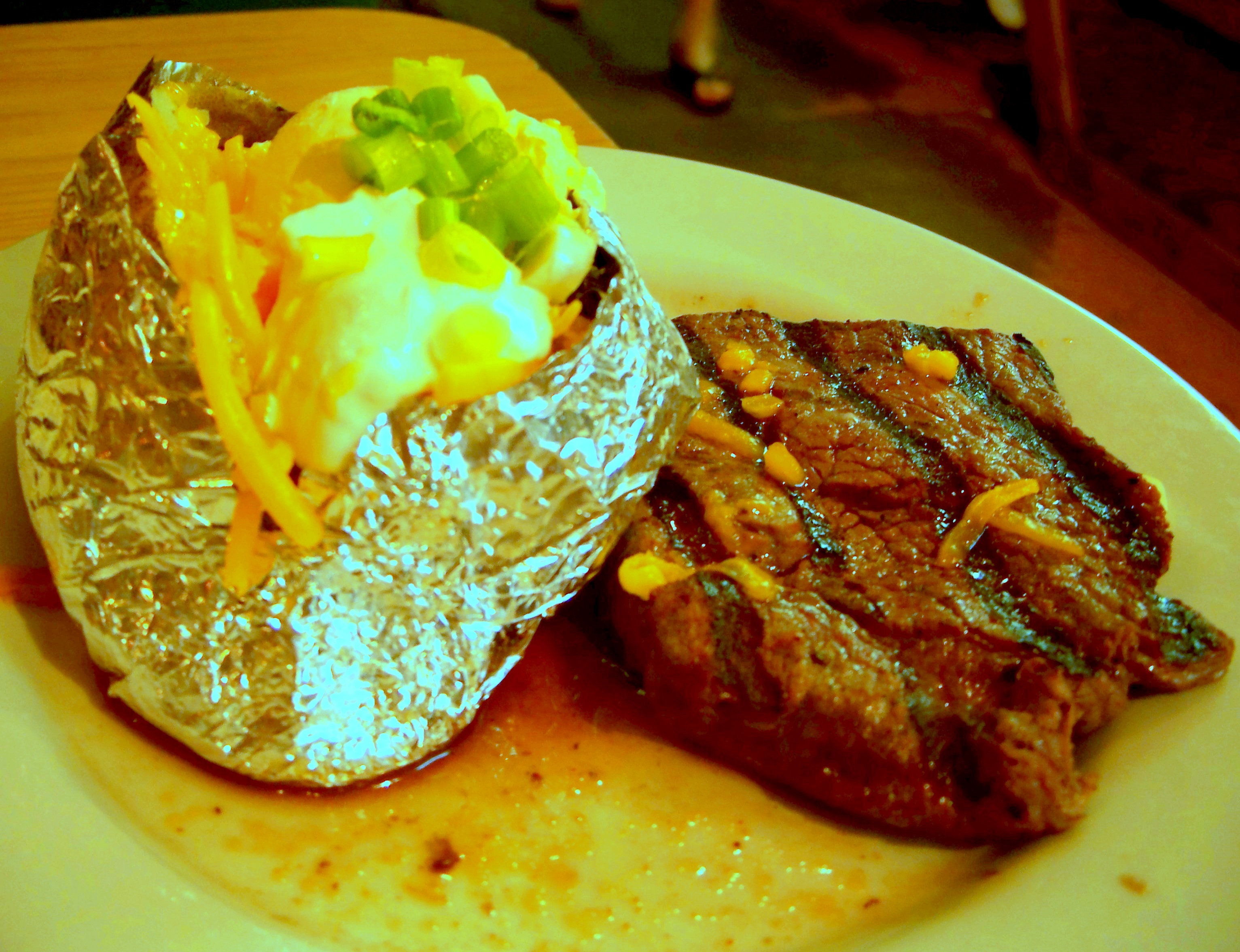
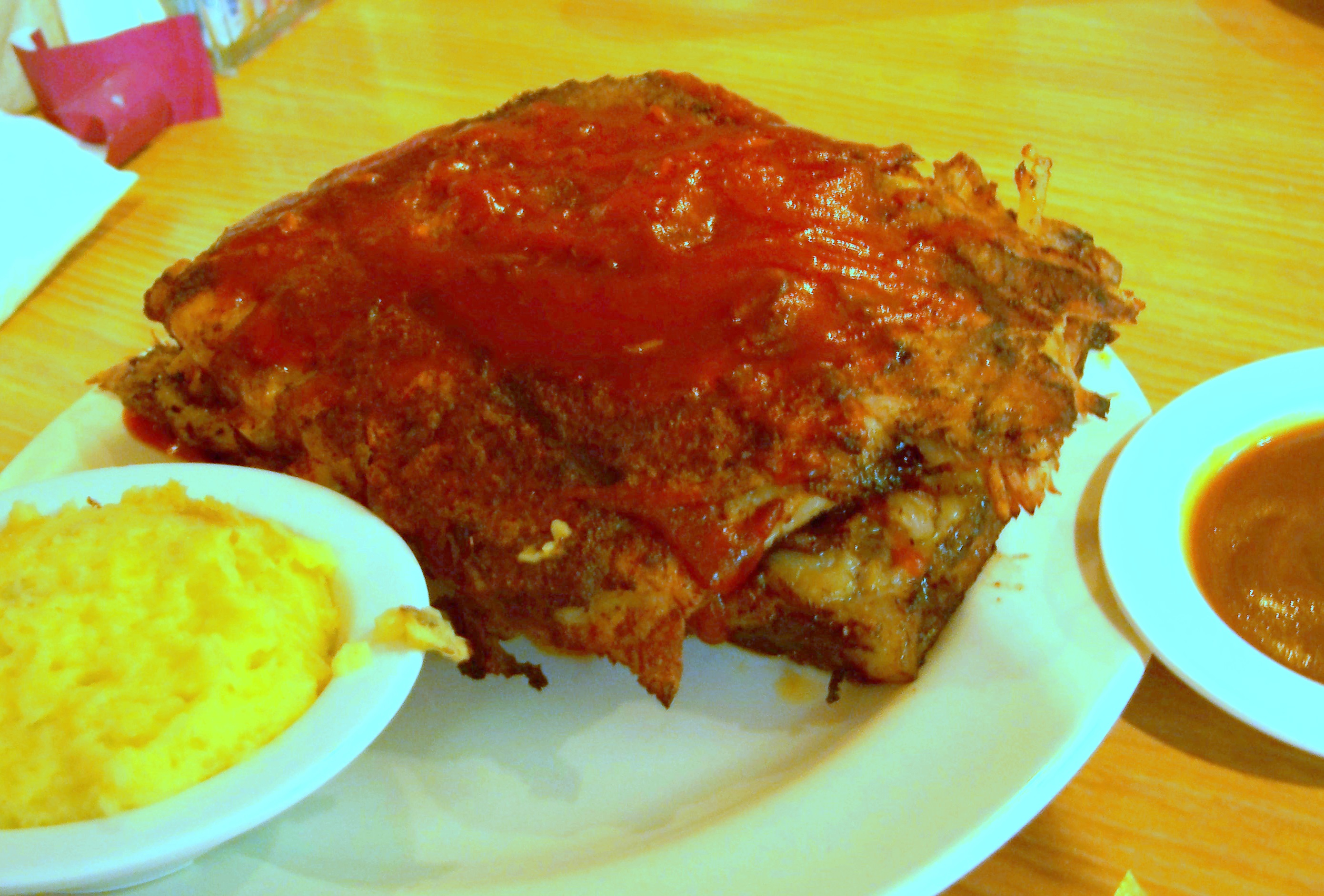
I would flat out say that this is our most-frequently-visited American restaurant. Great food. Good price. Excellent service. A serving here would freak out the health-conscious, nitpicking nimble diner, but who cares. We’re here for the hearty, generous embrace of baked potatoes in melting cheese and sour cream, of thick gravy, of sizzling steak, of tingling barbecue sauce, of a full rack of ribs so tender it falls of the bone.

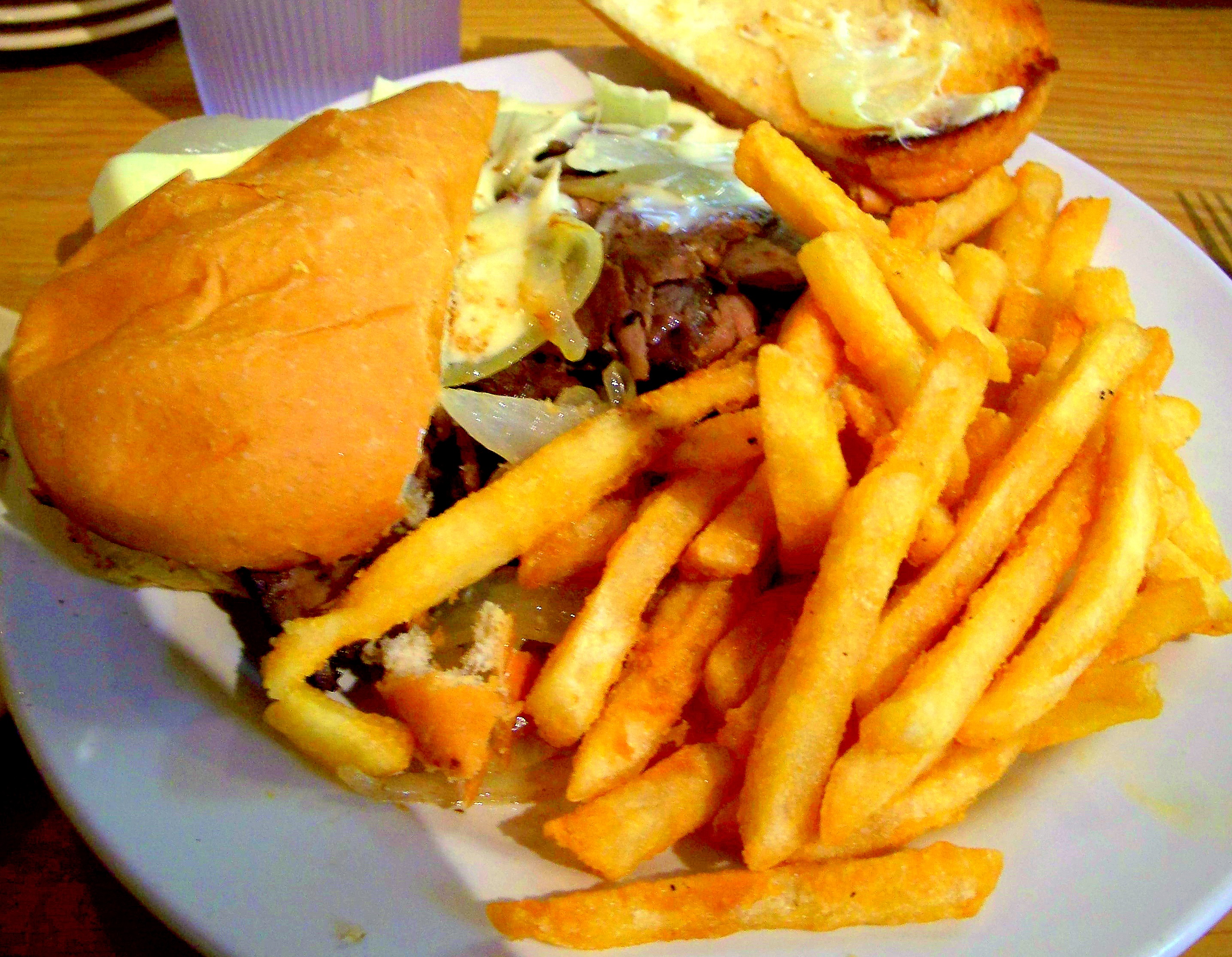
Forget fork and knife. Ribs are sweeter and better with fingers, and so is a philly cheese, that which should be called philly meat not philly cheese. Gooey, mushroomy, beefy. Good fries, too.

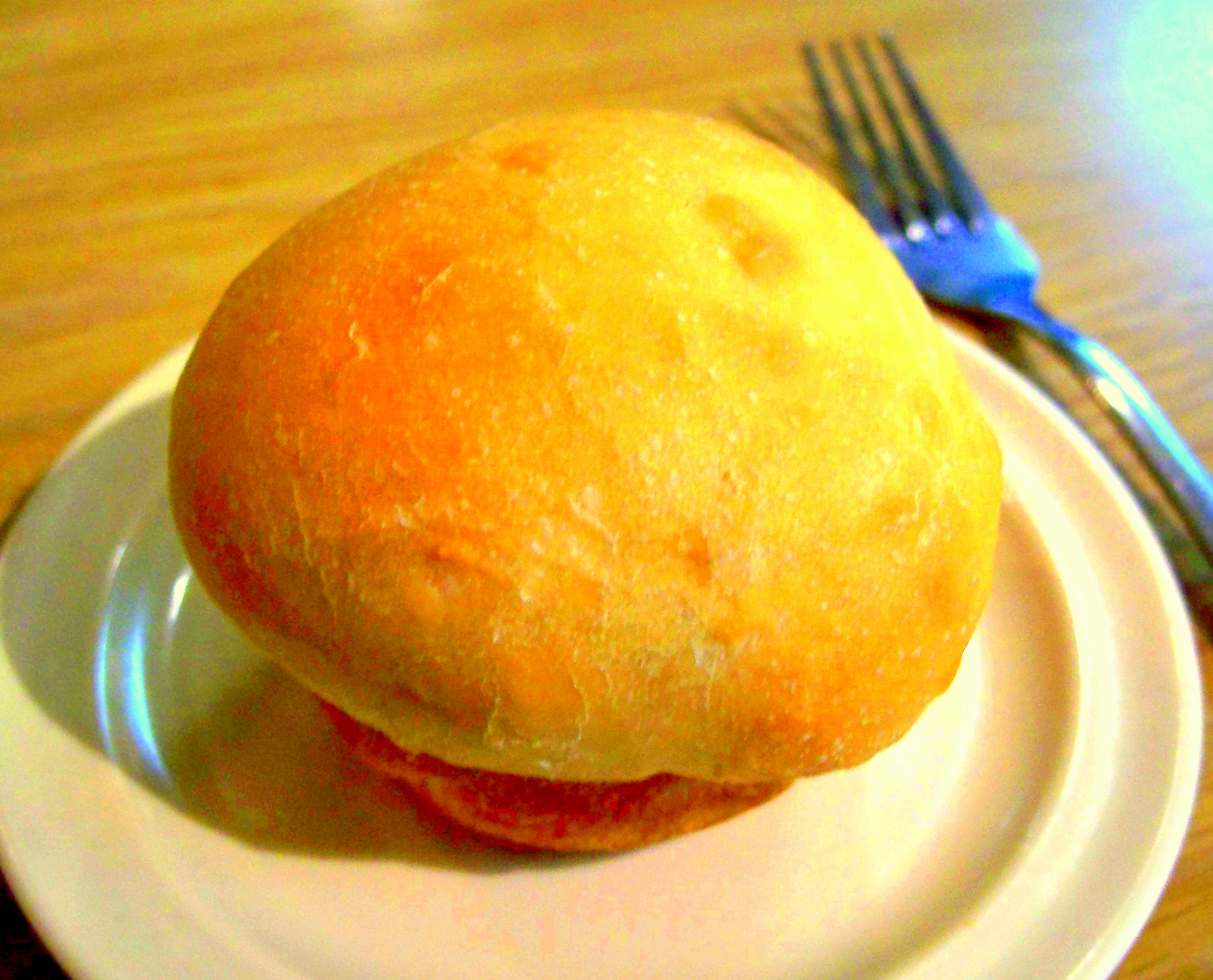
But forget all that. Potatoe Patch is home of throw’d rolls. The best rolls I have ever had. It’s crusty outside, fluffy inside, the dough is so gently sweet. It’s warm. A guy goes around with a tray of freshly baked rolls, you raise you hand, and he throws it to you, sometimes from across the room. And you know it’s a good catch. I would go on TV and do a commercial for this even if they only pay me with unlimited fresh rolls. If it’s not a very busy time for the roll thrower, he’d be happy to throw you as many as you want, make sure you stock up on them. We do every time we come here. Makes perfect breakfast piece for the morrows.

I should be fair and say that they also have great muffins, which usually aren’t throw’d. But nothing, I repeat, nothing, beats the rolls. Even the meat.

Each serving of philly cheese or sirloin steak sets you back by roughly 9 dollars. A full rack of ribs costs 17.95. Total (including tax): $38.59

Address: The Potatoe Patch #1
2504 FM 1960 East
Houston, TX 77073
281-443-3530

Linh Son Pagoda’s banh for the Lunar New Year

January 25, 2009 By: Mai Truong Category: Comfort food, Houston, sticky rice concoctions, Texas, Vietnamese


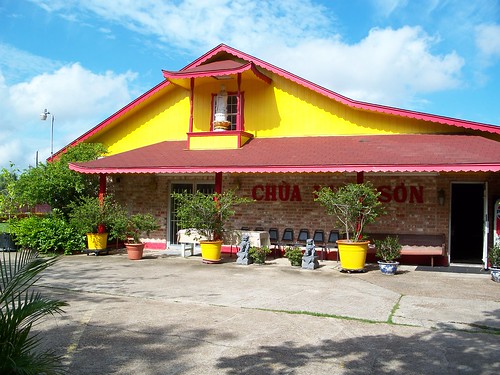
Linh Son pagoda, Houston, click on the image to see more pictures of the pagoda.

Linh Son pagoda, Houston. Click on the image to see more pictures of the pagoda.
Although not all Vietnamese living oversea can take a day off to go to the pagodas on the first day of Tet, many manage to keep the tradition. Of course there is no strict requirement that one has to be looking at and praying to the Buddha at a certain day, for a certain amount of time, or with a certain prayer. Tet is not a religious based tradition. But many Buddhist and even non-Buddhists like to go to the pagodas on the first day of Tet to have a peaceful start of the new year, to feel spiritually lightened (hopefully enlightened as well) and pure on the important day. Many also choose to eat no animal product on this day, as it’s the new spring and every creature deserves to be happy and live in peace. Nonetheless, vegan restaurants are somewhat scarce in the conservative town, places with banh chung banh tet for sale don’t generally make the vegan version, and to deprive a Vietnamese of banh chung banh tet on a Tet’s day is somewhat cruel. So the pagodas take on the precious task.


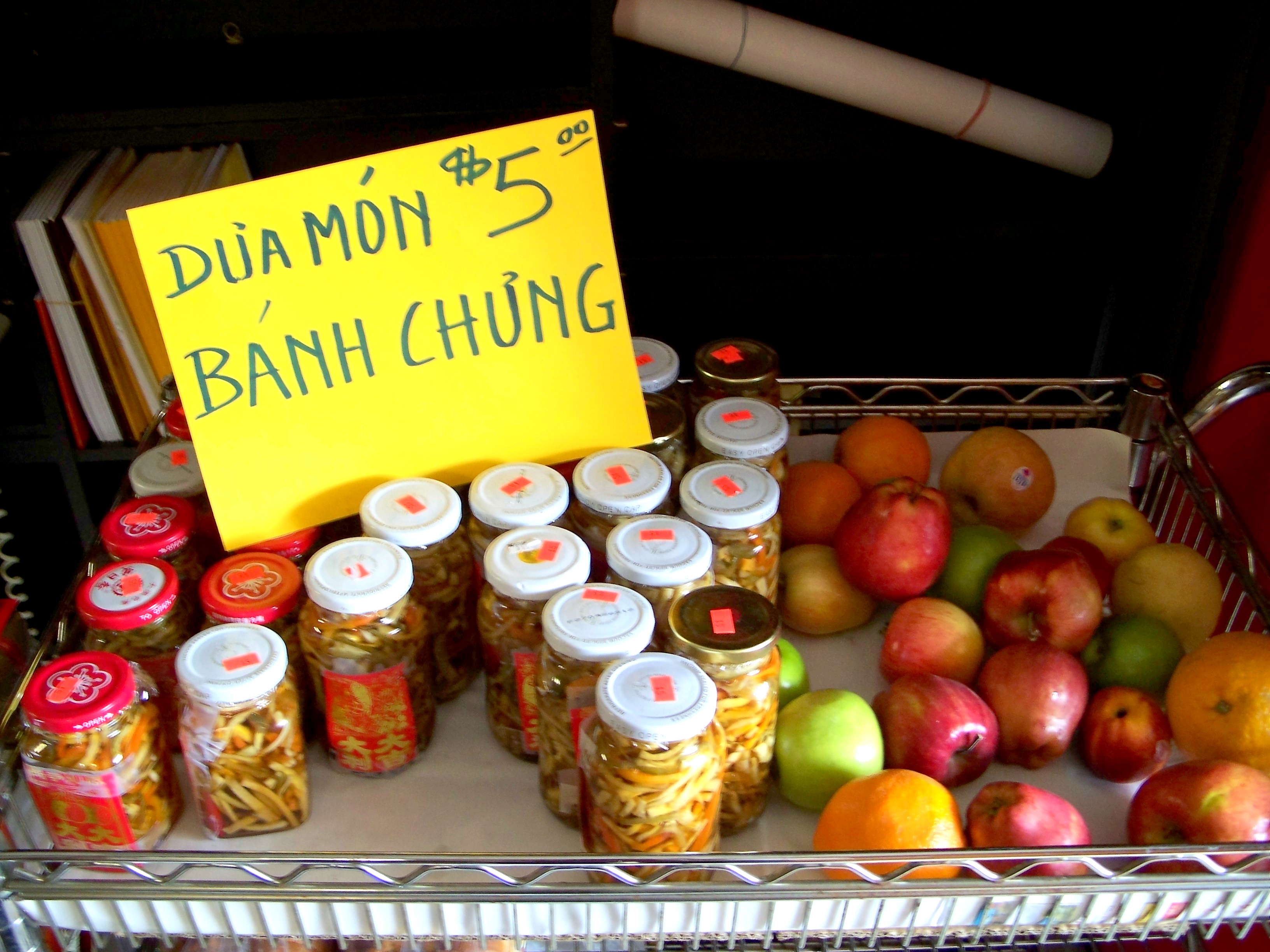
Dua mon is pickled vegetables, here packaged in jars, and apparently on sale for $5? I believe I haven’t had dua mon. I’m not big on veggies in vinegar-sugar-salt mix, the only exception to me is pickled bean sprout (dua gia). But perhaps because every house during Tet is so overabundant with meat and glutinous rice, the dua being a bit tart, a bit sweet, crunchy, and light is a nice change in both taste and texture. In fact, with its economic nature and longevity, a big jar of dua on its own makes Tet in poor households.


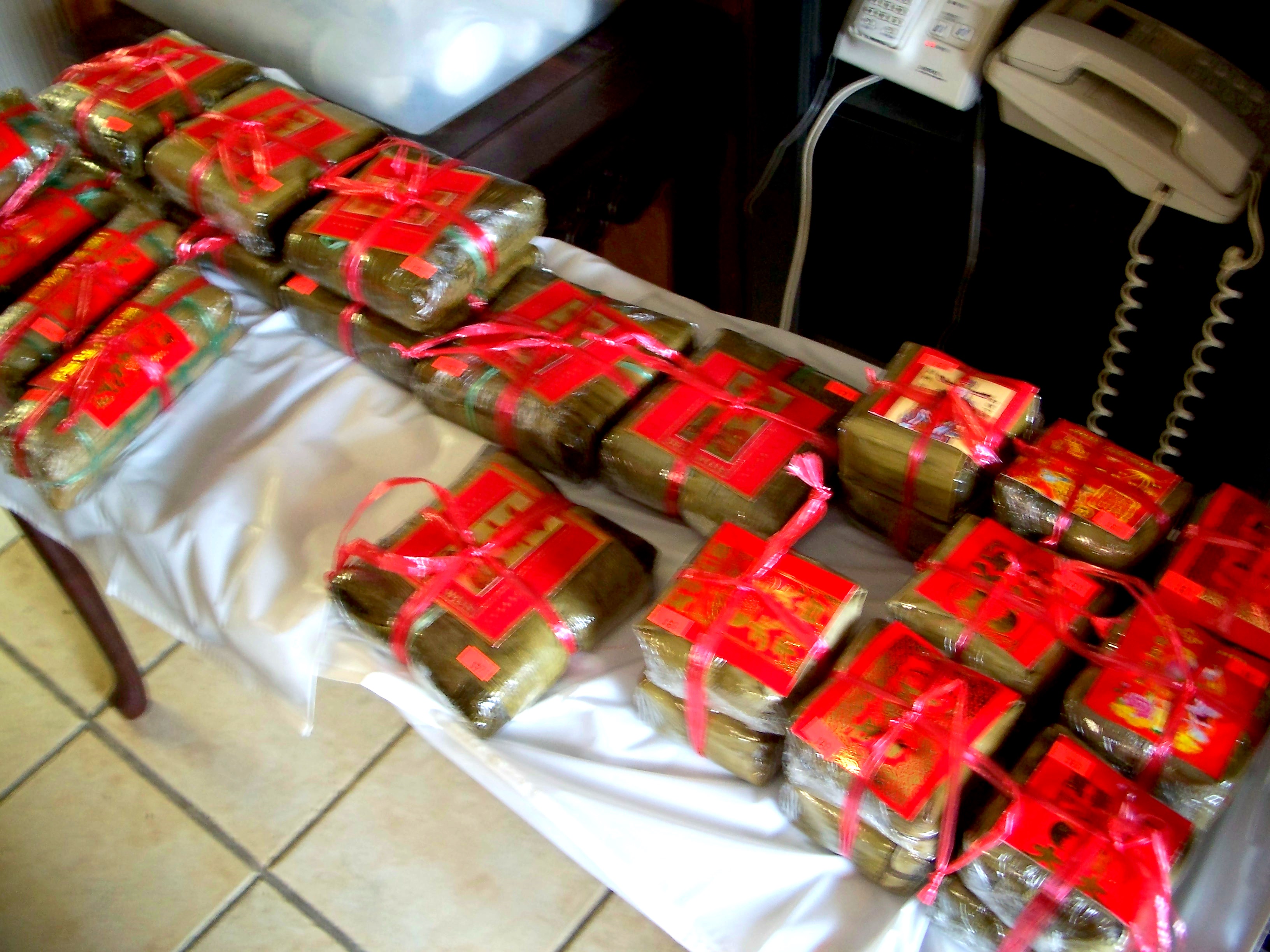
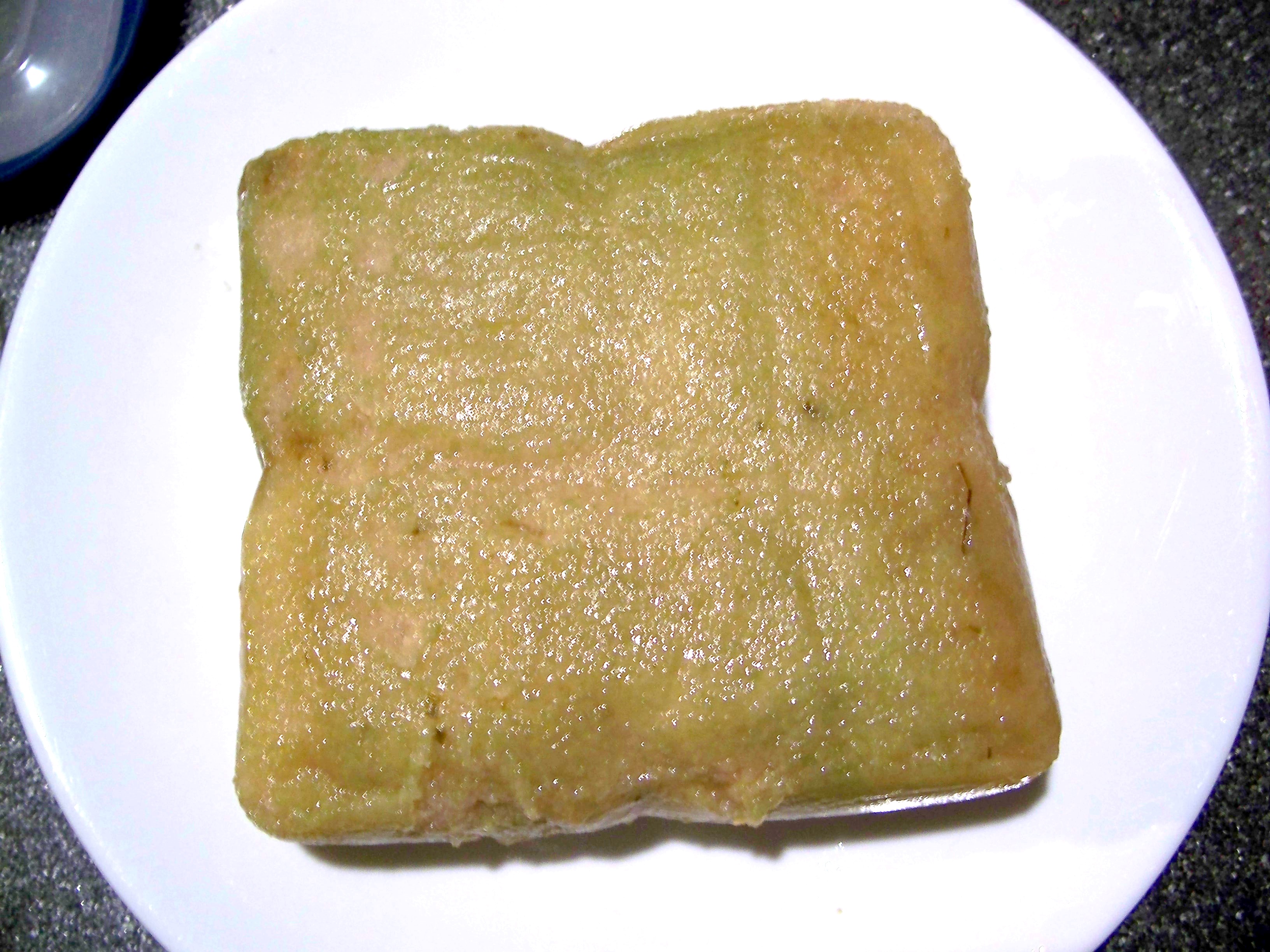
Back to the star of Tet food. The square ones are banh chung, the cylindrical ones are banh tet. Banh chung is wrapped in dong leaves, banh tet is wrapped in banana leaves (theoretically). Banh chung declothed:


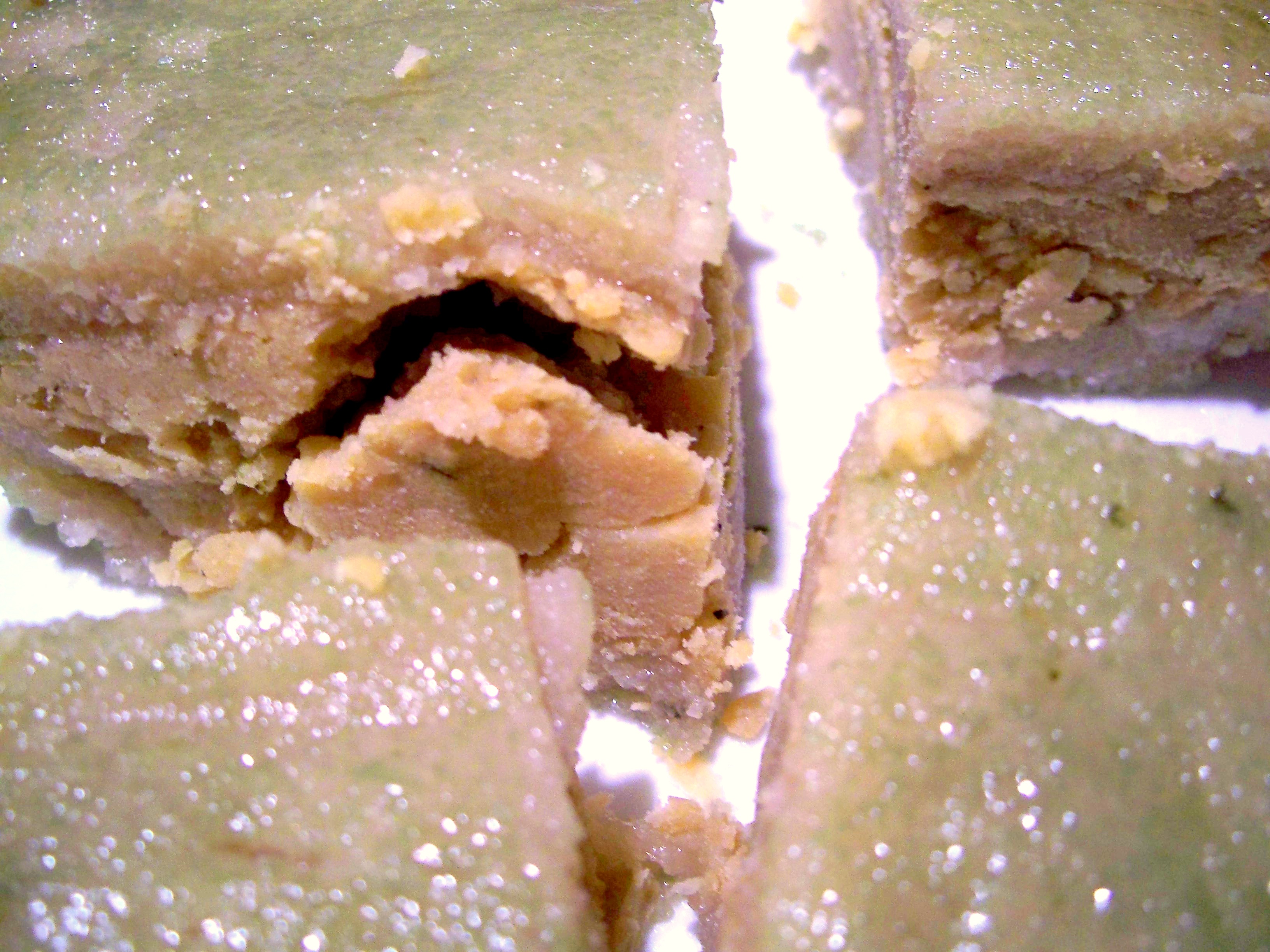
and quartered:


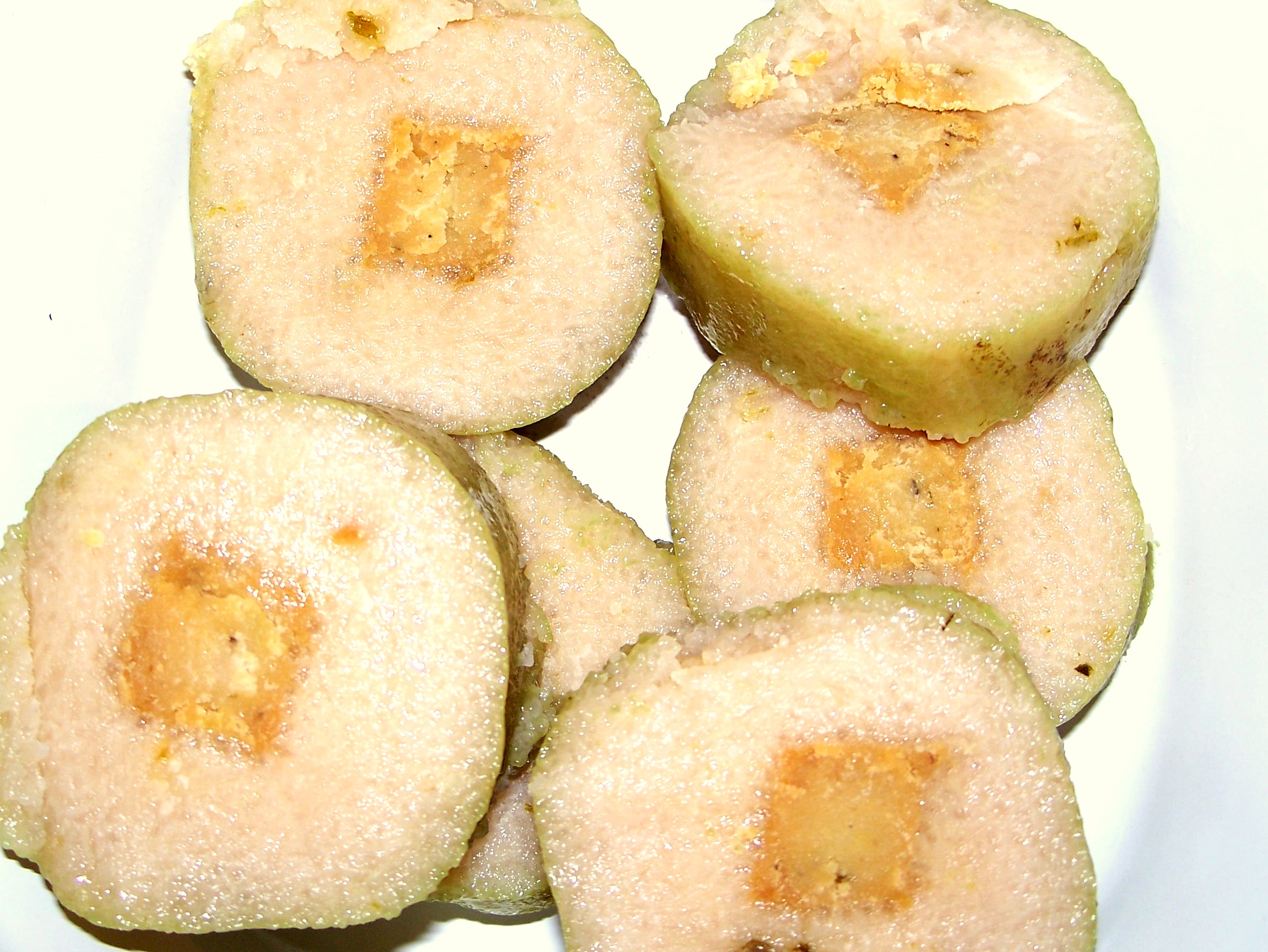
Mother got to the banh tet before I did, with a knife. I was 5 minutes too late to grab the camera. So here, in all gruesomeness, six “khoanh” of banh tet:


If you’re wondering, yes, their basic structure, except for the shape, is the same. Thick coat of glutinous rice outside, simple mung bean paste inside, since these are vegan banh made and sold at the pagoda. The meaty version of banh chung has lean pork amidst the bean paste, and that of banh tet has fatty pork. The outermost rim of glutinous rice is somewhat greenish yellow, naturally dyed by the leaves wrapping them and the long cooking process, in which they are submerged in water for hours. Banh chung was born in the North of Vietnam over 2000 years before Jesus was born, and especially made for Tet and Tet only. It even has a myth to explain its symbolism. Banh tet was its little brother, made for easy cooking and carrying, more popular in the South, available in one form or another all year long. The rice layer is soft and gummy, the bean paste middle is a little salted and sweetened. It’s vegan, but it doesn’t lack flavor. It’s really really heavy though. One khoanh of banh tet for breakfast and I was full from 10AM until 7PM! I would have been starved otherwise, classes all day, and school cafeterias don’t serve vegan food. That means if you like to keep yourself reasonably full, with 6 bucks you are full for 3-6 days of banh tet, and 4-8 days of banh chung. Pretty good huh?

Multitaste soup – canh chua ca at Kim Son

January 10, 2009 By: Mai Truong Category: Comfort food, Houston, Southern Vietnamese, Texas, Vietnamese


They never blink. They never wag their tails. They never mutter a sound. I can never tell what they are thinking or feeling when I look at them. I like them deep-fried, or pan-charred with salt, lemongrass, and pepper, but that’s mostly because of the seasoning mix they’re fried with. By themselves, they are cold-blooded creatures with a distinctive smell, tiny bones resembling oversized needles, very little fat, and worst of all, flaky meat. They’re quite abundant in Vietnam, both alive and cooked. I even like the dipping sauce made out of them. I just don’t like them. Something about their meat freaks me out, or perhaps it’s the childhood memory of having a bone of them stuck in my throat that damages my feeling for those footless fellas. I would have never done it, but my mom, craving for some motherland’s taste, ordered canh chua cá (fish sour-soup) when we went to Kim Son the other day. How could she… fish and soup? Well, it turned out to be the best dish on the table.

Canh is soup. Usually the vegetables in canh are leafy greens, and because canh came about before the French and potatoes arrived in Vietnam, there is no canh with potato. There are, however, canh with taro corm, cassava, sweet potato, and other kinds of starchy roots. A special kind of canh most suitable for summer weather is canh chua (sour), because the mix taste of sour, pepper-spicy and sweet is just cool. The sourness comes from tamarind (fruit and young leaves), starfruit, pineapple, tomato, or lá dang, a kind of sour leaf. Is there sour soup in Western cuisines?

Usually I am indifferent to canh chua at my best mood, because usually canh chua is inseparable from our footless flaky friend. The combination canh chua and fish is adored across the delta, in various menus, and has followed the southern Vietnamese immigrants overseas. It is so southern and so countryside that almost certainly the delta farmers would invite you a bowl of canh chua when you visit them during lunch time. There is also canh chua with shrimp and pineapple, and somewhere in her memory, my mom knows that there is canh chua with chicken, however rare. Fatty meat (pork, duck, beef, etc.) is not allowed. The broth must be clear. The fish must be from fresh water: catfish, snakeheads, climbing gouramis, “pangasius krempfi” (ca bong lau),… Canh chua can’t be cooked with seawater fish because they’re too fishy to be overpowered by the sour benefactors. Ok, what else is there for background check… a bowl of canh chua often has many kinds of vegetables beside the citric star of the act, these add-ons include bean sprout, the stems of night-scented lily (I learn so many new names blogging!), okra,… Native villagers use almost every edible plants they can find in gardens and ponds, so there is hardly any fixed recipe for canh chua. That’s the beauty of it, food is not supposed to be fixed.

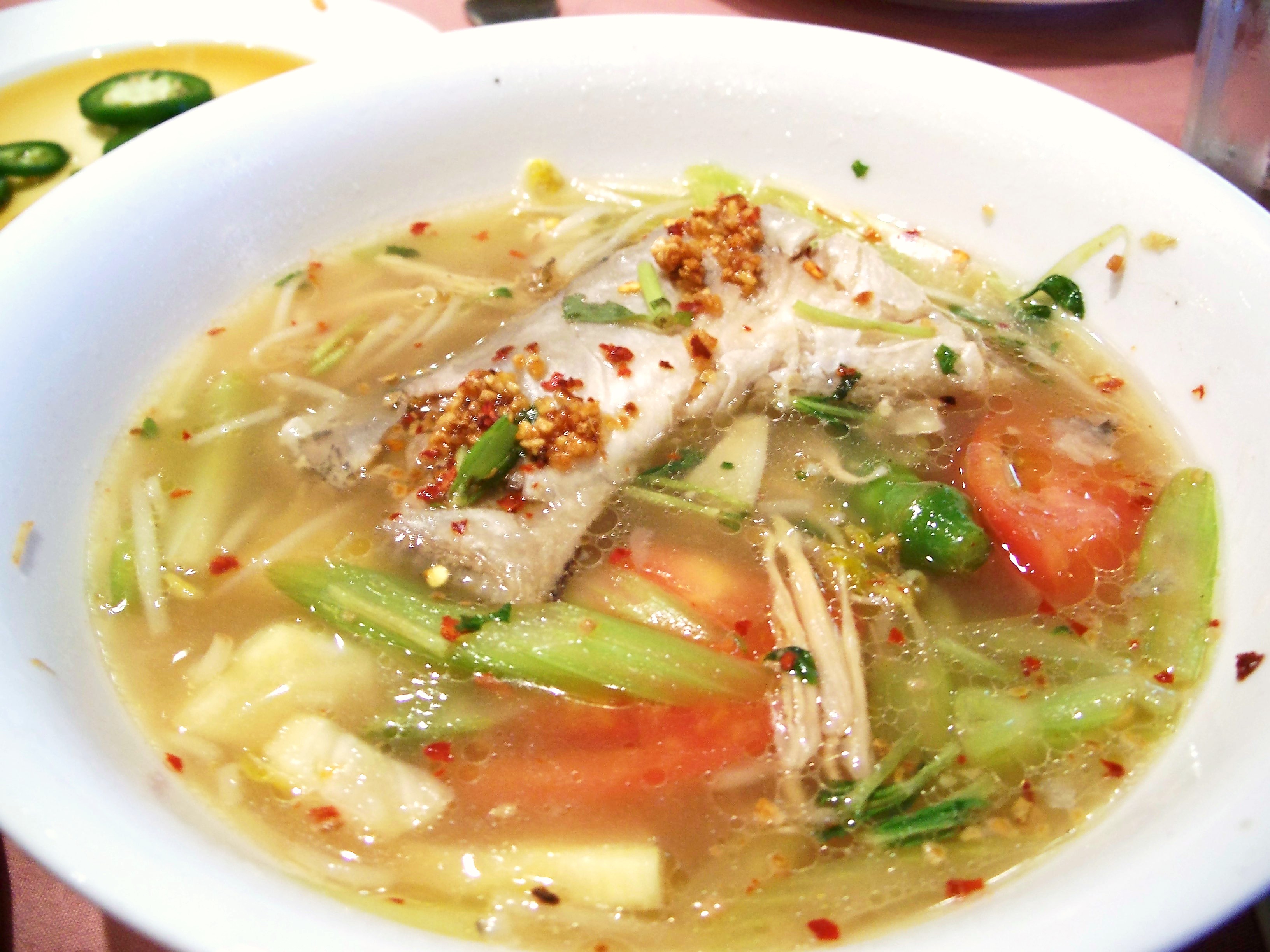
The bowl of canh chua we had at Kim Son has every criterion of tasty canh chua, from the sweet-n-sour clear broth to the finishing touch of hot pepper paste. Pangasius krempfi is no longer fishy, just a tender, juicy piece of white flesh (sorry, I just can’t bring myself to saying any fish is good). If you look at the top corner of the picture, there it is, nuoc mam nguyen chat (pure fish sauce) in all splendor, no additional seasoning, a dapple or two into your canh chua to trigger the salty-crave taste buds. Frankly I am quite disappointed at the sight of jalapeno in that nuoc mam. Authentically it must be red pepper, cayenne, thai, etc. Jalapeno is Mexican, canh chua is Vietnamese, and this is not the time for cultural exchange.

What do I like the most in canh chua? The night-scented lily stems. In Vietnamese people call it a dangerously misleading name, “mint”. Minty? Not really. It’s crunchy, finely porous, similar to lotus stem, it stores the broth so well that each bite pours in your mouth a stream of warm, peppery, sweet and sour. Sensational!