Flavor Boulevard

We Asians like to talk food.
Subscribe

Archive for the ‘Southern Vietnamese’

One Hot Pot & Grill: countryside taste for city price

June 10, 2015 By: Mai Truong Category: Houston, noodle soup, Southern Vietnamese

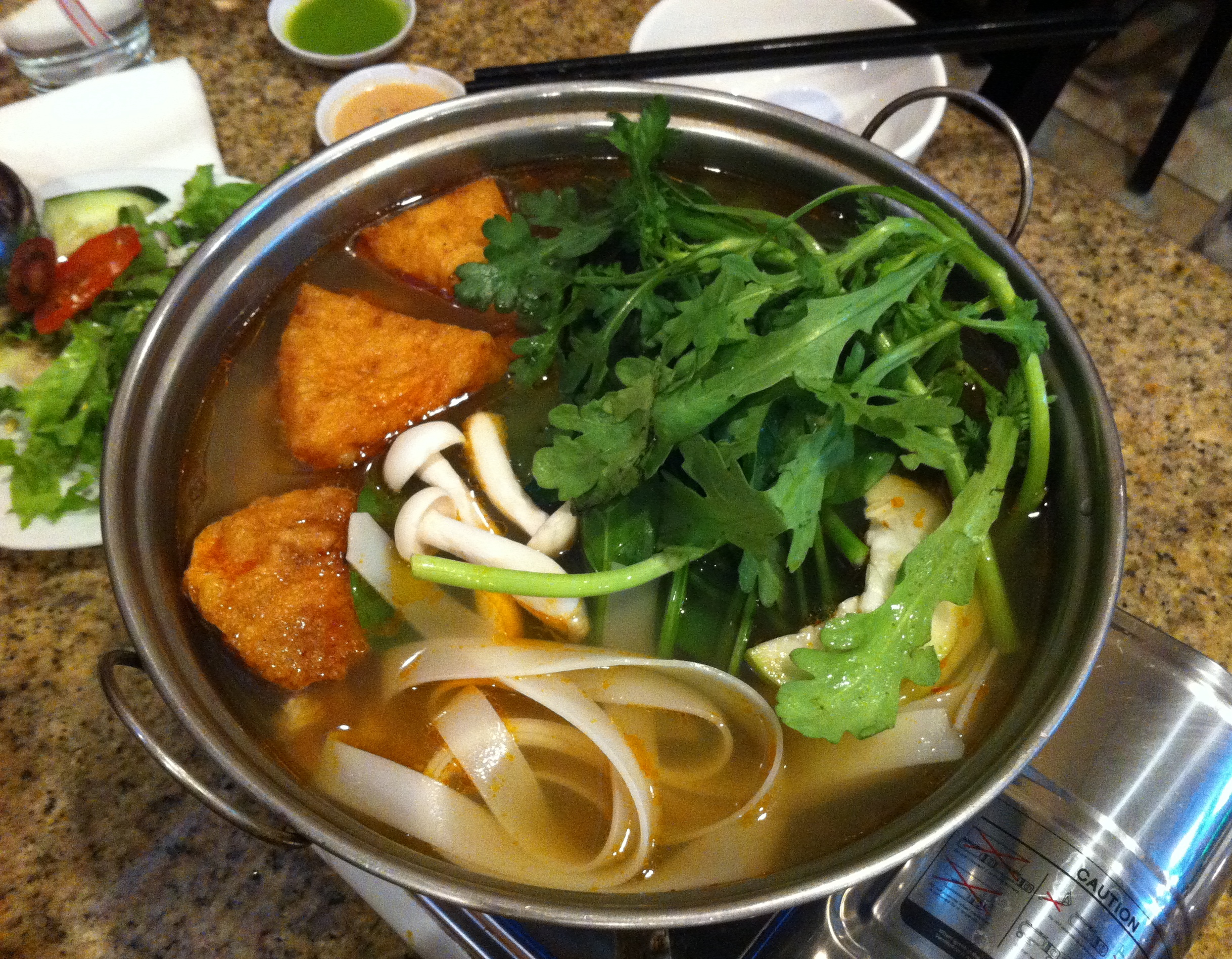
lau-rieu-cua-dong
These days I keep craving noodle soups. There’s just no end to it. Plus, it rained this morning. If I were in Houston, I would go downtown to get this: a crab noodle hotpot (lẩu riêu cua đồng).

The crabs are tiny freshwater paddy crabs, pounded into a paste and strained to make the broth. Throw in some crab meat and fried tofu, some light seasoning, and you get a bubbling soup to dunk your noodles and vegetables. The size of the hotpot in this shop is enough for two, you have to pay a few dollars extra for some chrysanthemum greens (cải cúc or tần ô) and some thin rice vermicelli (they absorb the broth better than the flat kind), but the package doesn’t taste complete without them.

What does this hotpot taste like? Imagine yourself in a remote area on a mildly hot day (not blazing though), sitting on a low chair under the shade, looking out to some green rice paddy in Can Tho, a canal in Giethoorn, or some other kind of open field with flowing water. You’re hungry but not famished, it’s hot enough that you just want something light and sweet but not ice cream. Something that goes down with no effort on your end (and requires little effort on your stomach later too). That’s what this hotpot tastes like.

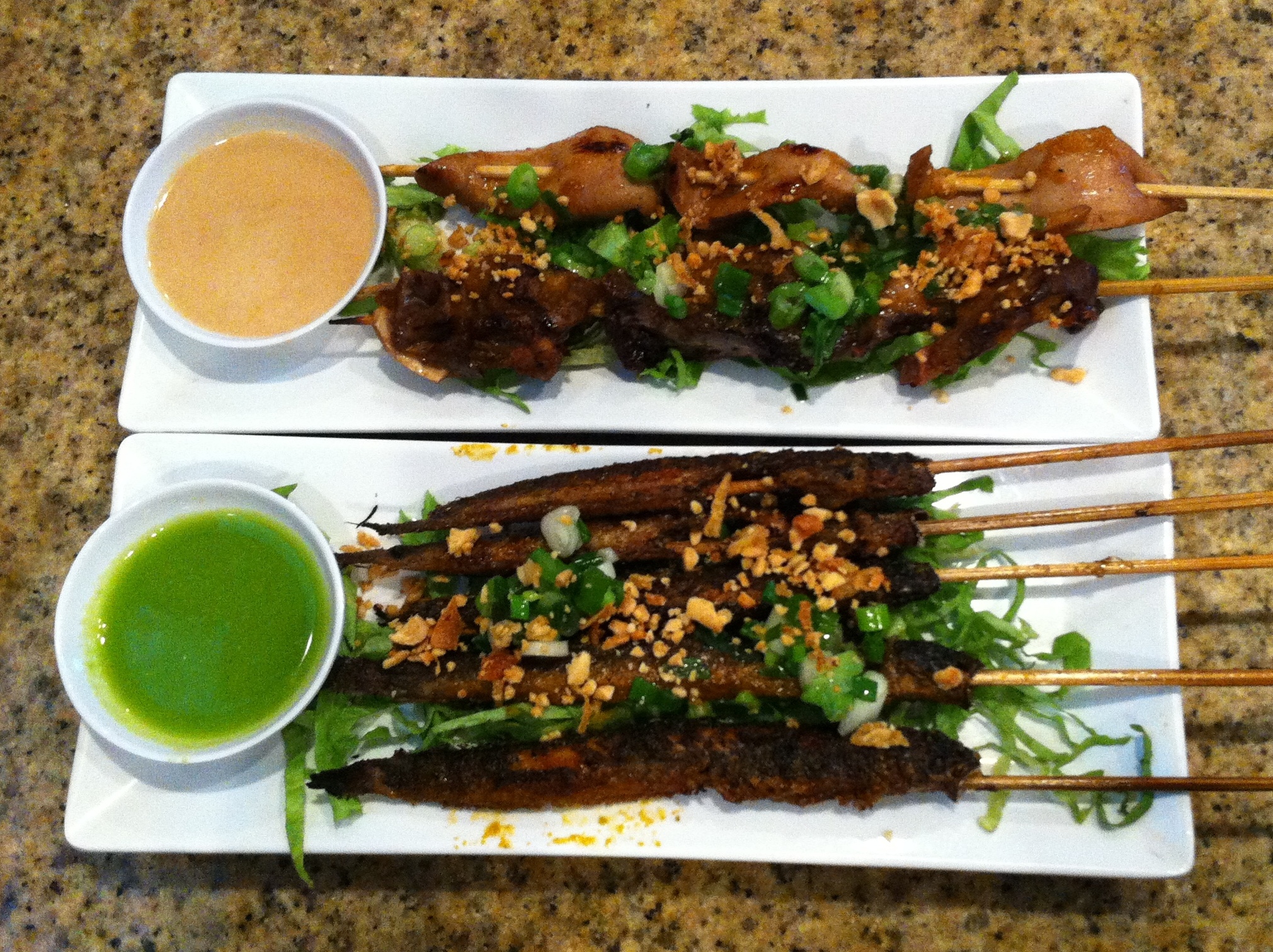
ohpg-grilled-skewers
To spice things up a little, there are skewers. Organ meats and grilled fish. A brief trip to the countryside for $35.67. Slightly overpriced compared to other Houston restaurants, but worth it.

Now where can I get something like this in the Oakland-Berkeley area though…

Address: One Hot Pot and Grill
12148 Bellaire Blvd, Suite 111
Houston, TX 77072
(281) 564-4063
Light dinner for 3: 1 crab hotpot ($15.99) + 1 saffron grilled goby fish (cá kèo, $4.99) + 1 lemongrass grilled pig heart and kidney ($4.99) + 1 chrysanthemum greens ($3.99) + 1 rice vermicelli ($2.99) + tax = $35.67
The service is also nice.

Noodle soup: Banh canh Que Anh & Que Em

April 23, 2014 By: Mai Truong Category: Central Vietnamese, Comfort food, Houston, noodle soup, Southern Vietnamese

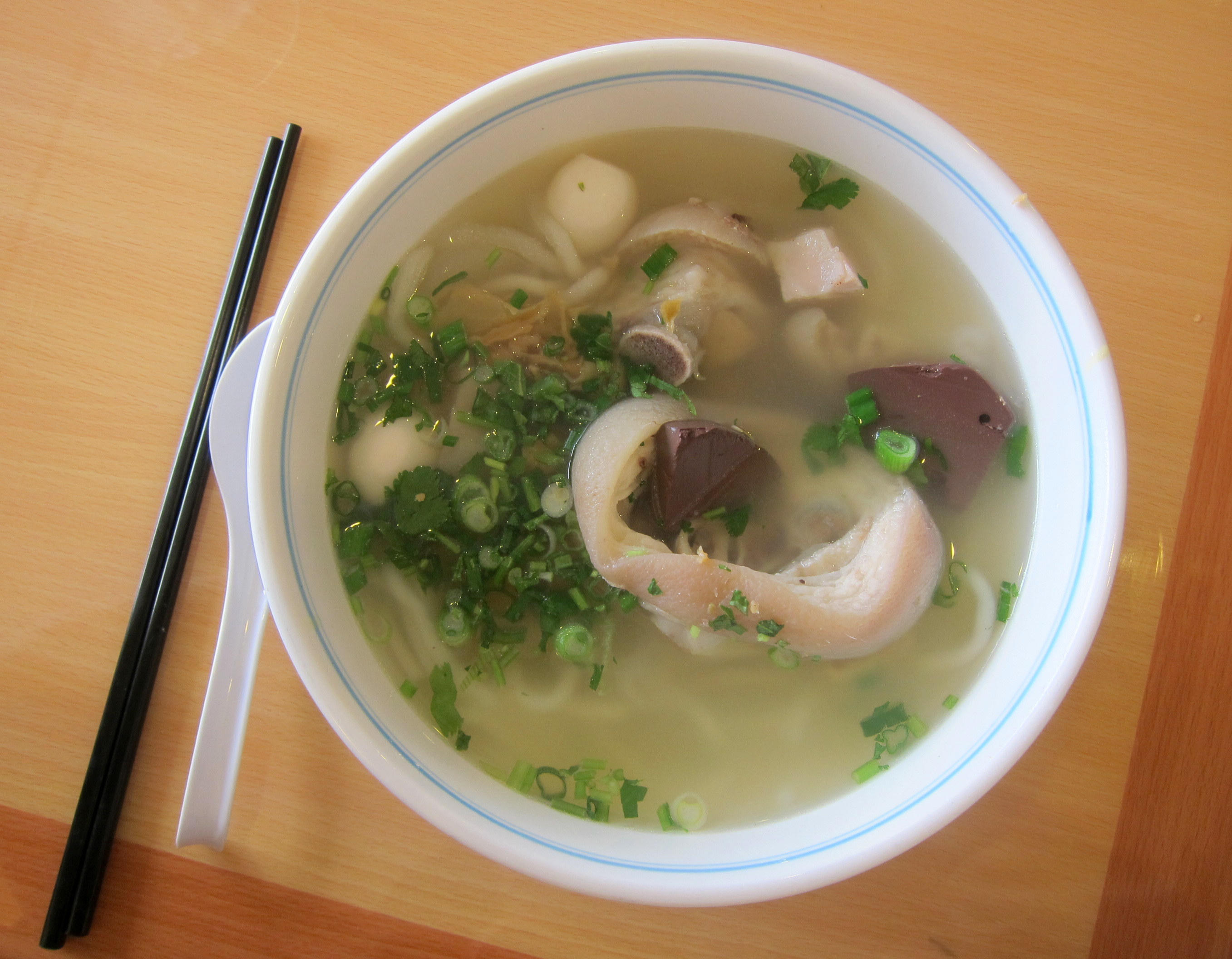
qae-banh-canh-tra-vinh
Quite possibly the cheesiest name of a store I’ve ever seen: Bánh Canh Quê Anh & Quê Em – “bánh canh [from] your hometown and my hometown” (it doesn’t sound cheesy translated into English, but trust me, it’s like Twilight’s Edward Cullen in noodle soup form). Which is actually fitting, since banh canh is commoner’s grub, not a bourgeois lunch. You won’t find a classy madame dressing up just to go out for banh canh. The poor thing will never be elevated to the level of pho. I love it.

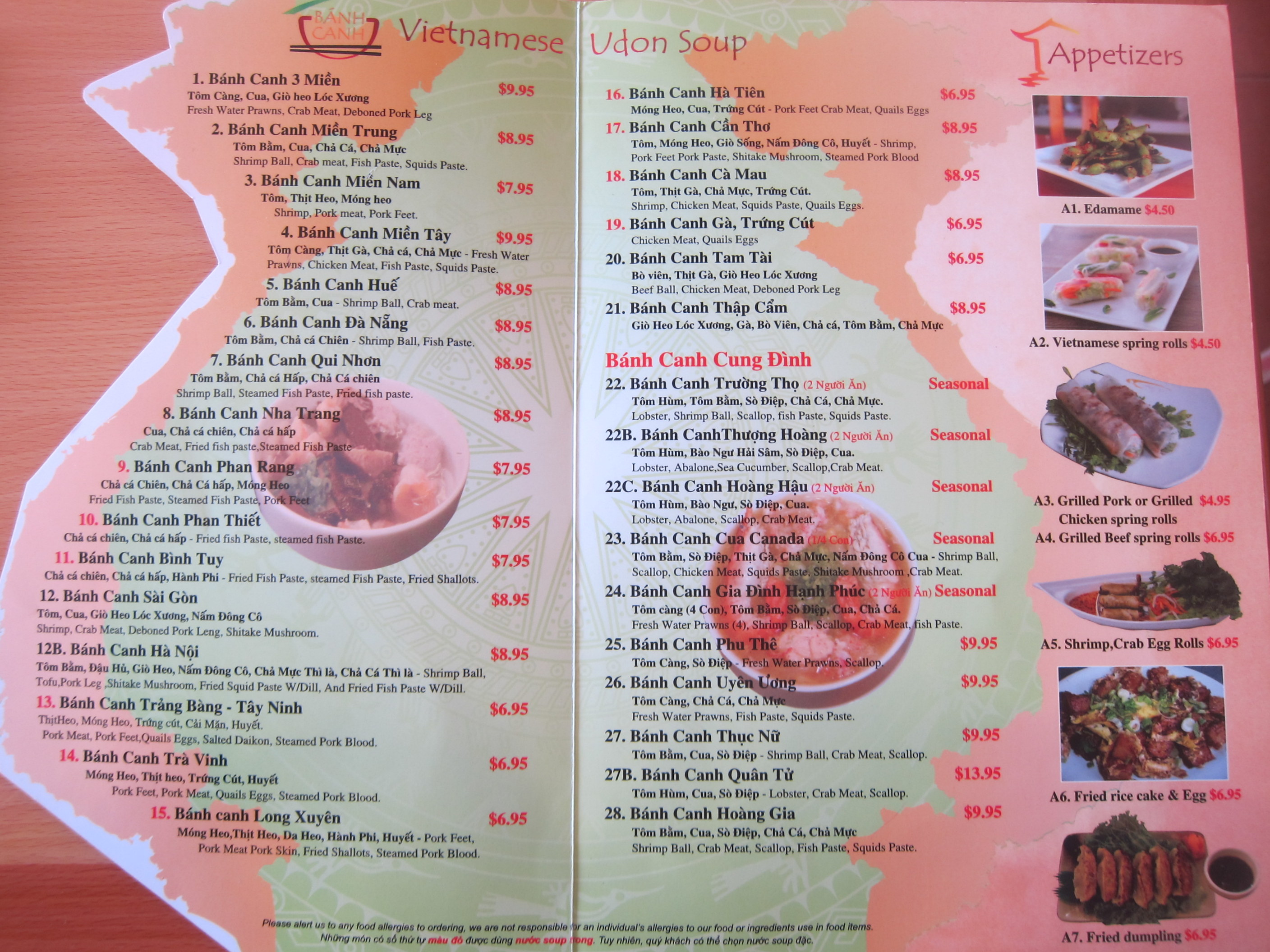
I grew up eating it before I was born (literally). Backstory can be told in person, but despite eating so many bowls, I never knew that there was so many types of banh canh. Que Anh & Que Em offered 30 types (see menu at the bottom), 14 of which are no more traditional than the Spider Roll, but the other 16 are attached to geographical regions in Vietnam, and thus, in this case, more meritable.

Banh canh is a thick, chewy, slippery rice noodle (with tapioca starch). It’s similar enough to udon in appearance and texture (as the shop aptly translates it to “Vietnamese udon”), but also entirely different (udon is made from wheat).

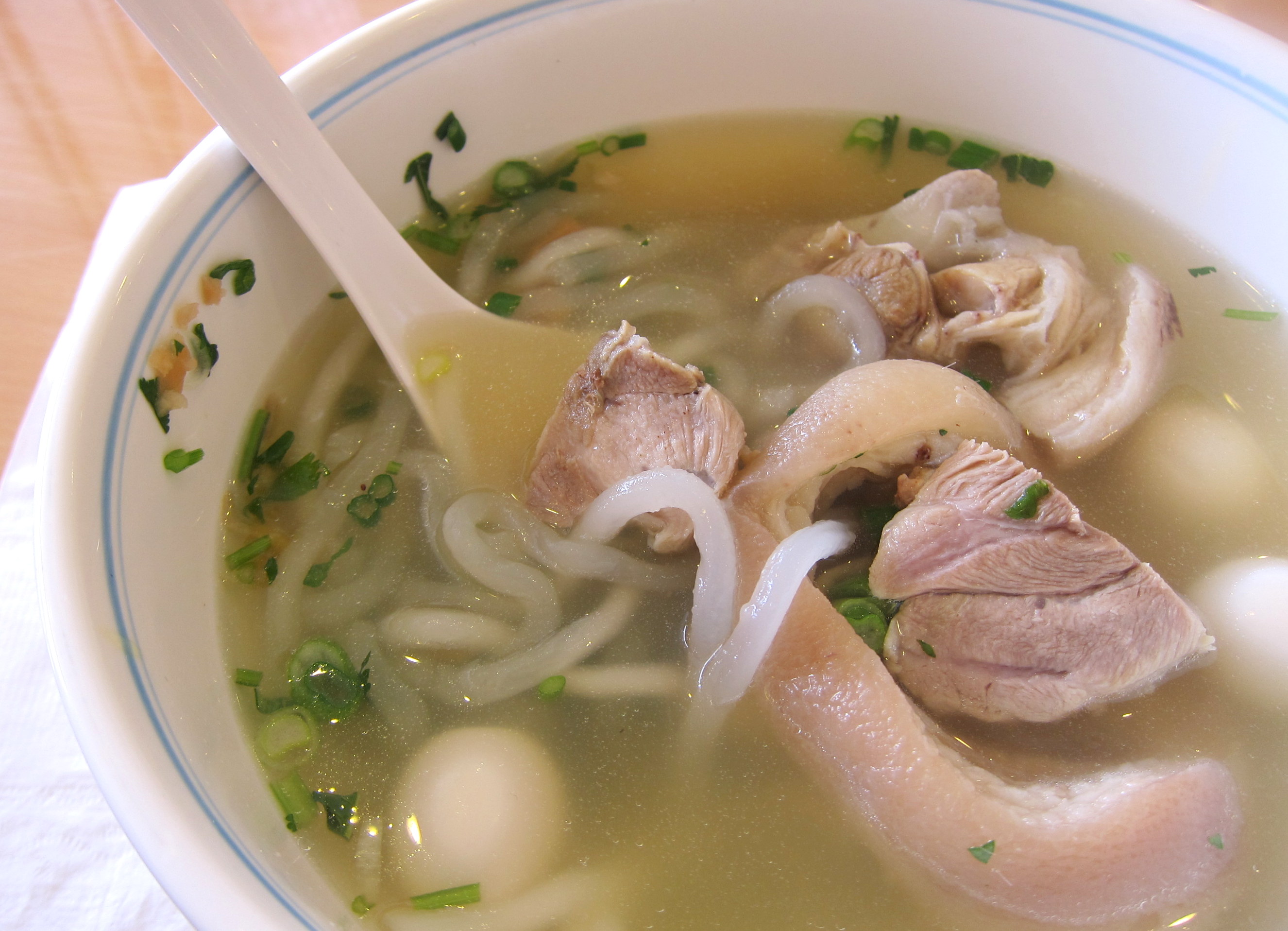
qae-banhcanh-closeup
Close-up of my order: banh canh Tra Vinh – pork, pig trotter, quail eggs, pig blood in a clear, light broth. The classic when people think of banh canh. I can do without pig blood, which I transferred to Dad’s bowl, and the quail eggs (fresh quail eggs are great, but these taste like the canned version). In fact, the noodle and the broth alone are sufficient.

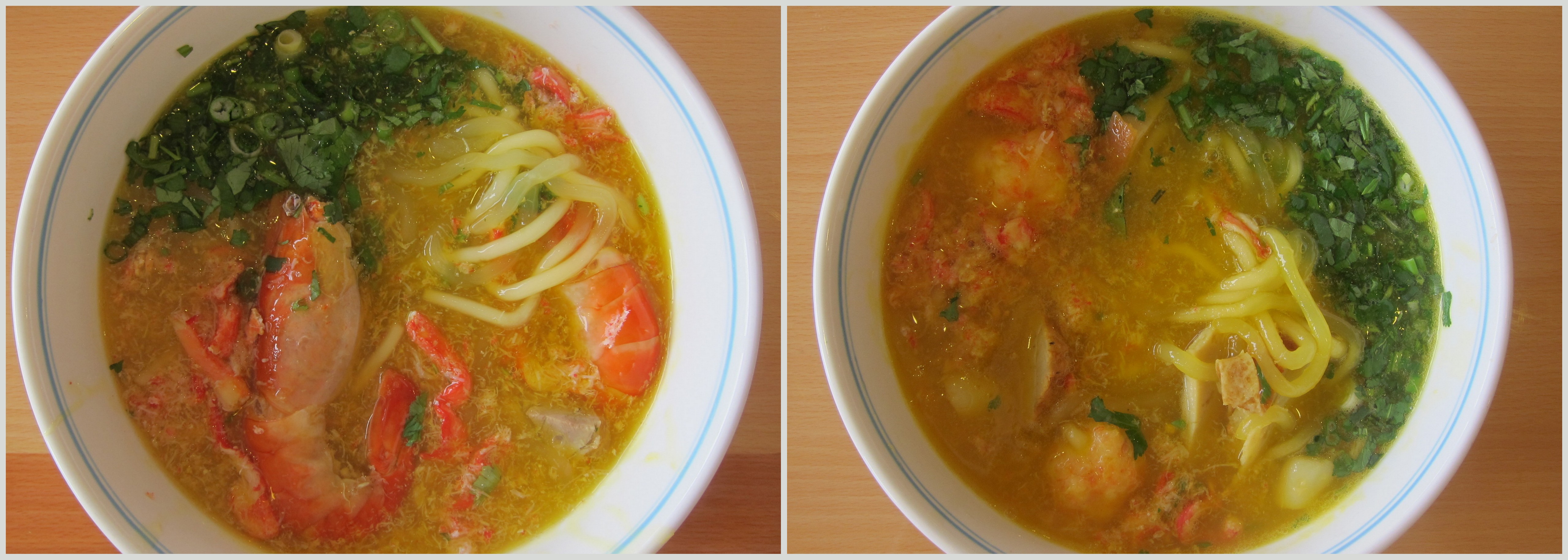
qae-bc3mien-bchoanggia
From left: Dad’s and Mom’s orders: banh canh 3 mien (“banh canh of all three regions”) and banh canh hoang gia (“royal banh canh”). Both names are only meant to illicit interest, the same way “Pho Dac Biet” is really not all that special. The broth of both bowls is thickened, yellow (with turmeric?) and taste richly of seafood, as both are loaded with crab meat and shrimps.

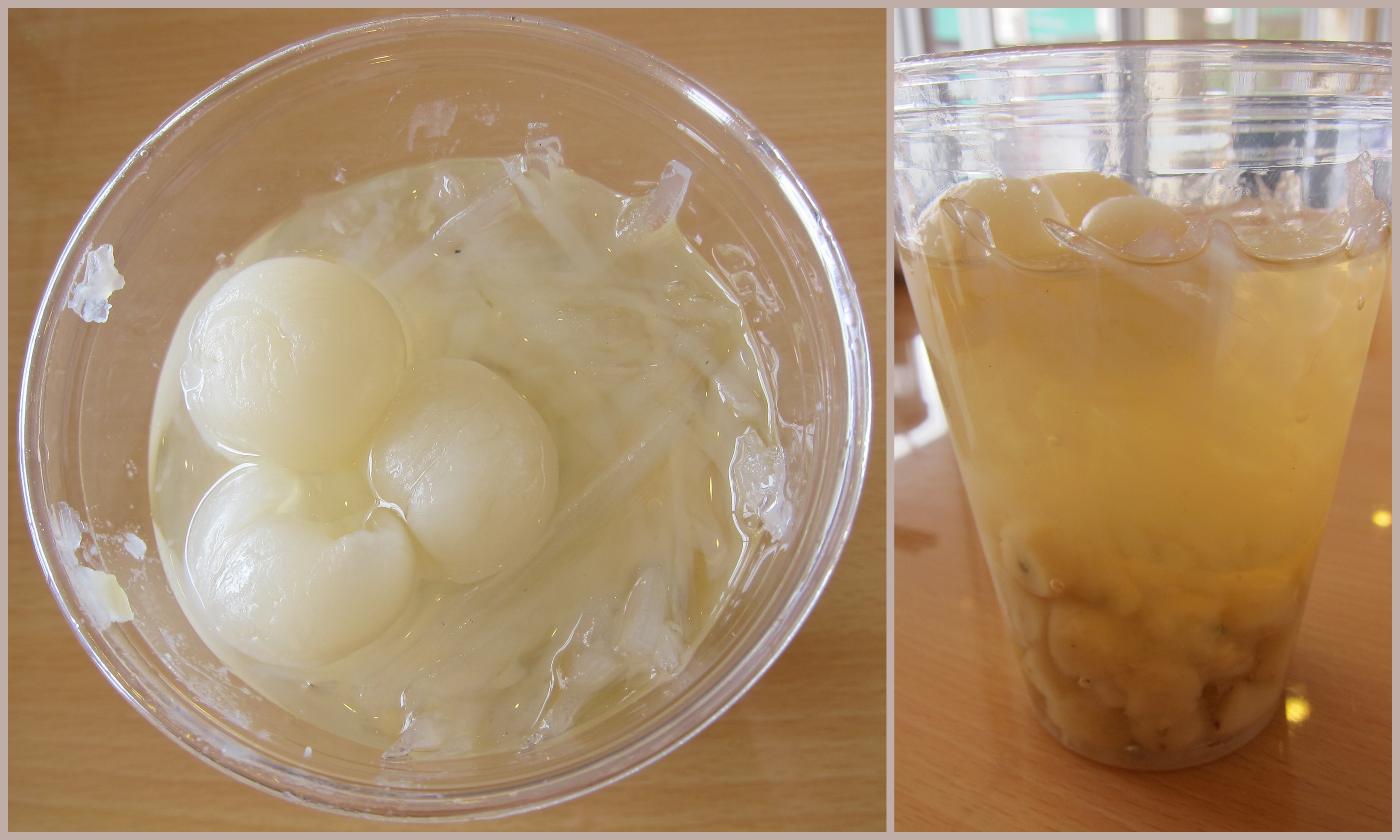
qae-che-longnhanhatsen
Desserts, of course. che long nhan hat sen – longan and lotus seed che… (I got the same thing at Danh’s Garden too, it’s gently sweet, fruity, and hard to get tired of.)

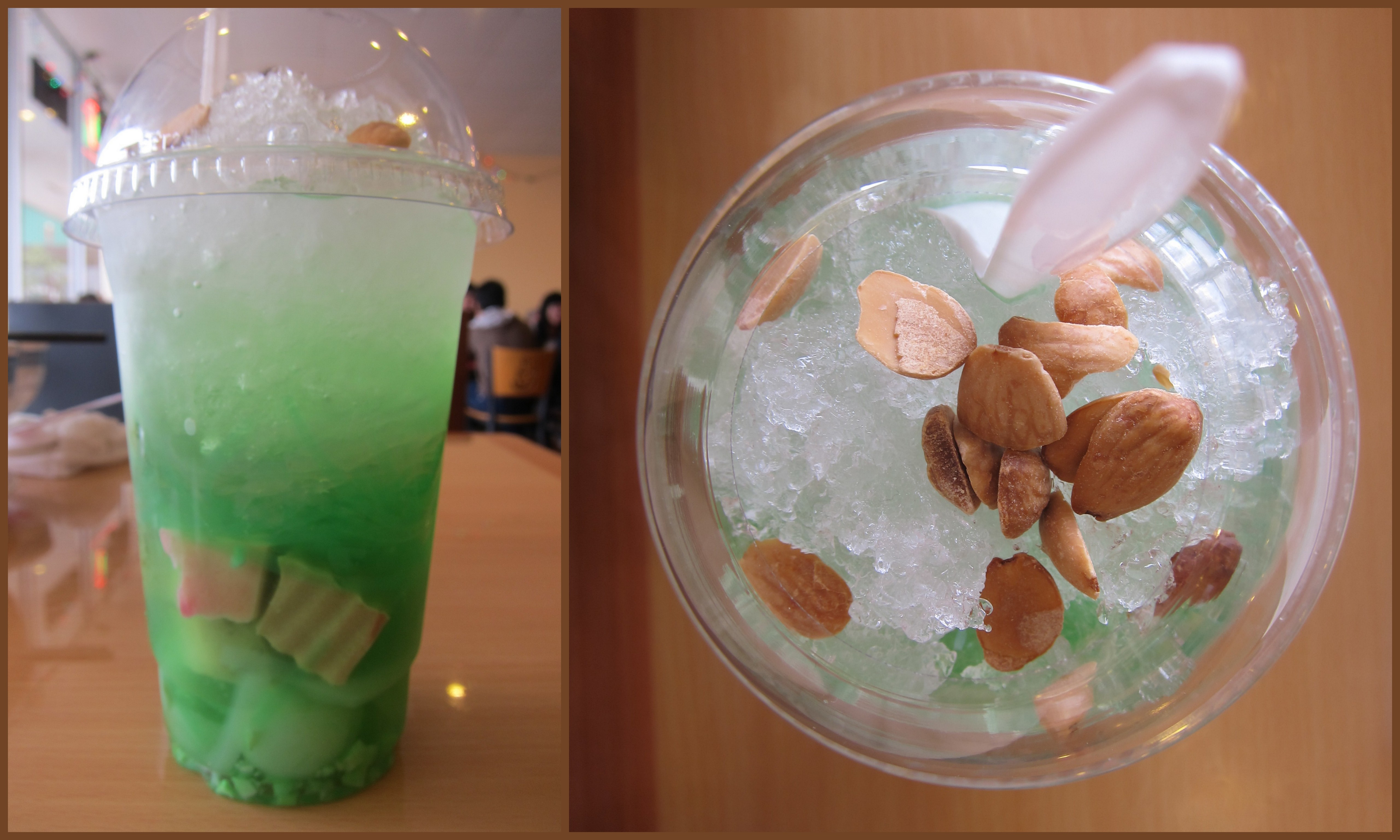
qae-chekhucbach
… and che khuc bach – lychee, some chewy tapioca thing, some chewy milky jello thing, and some nuts. A popular che in Vietnam these days.  Here’s a video to make che khuc bach, which the author loosely calls “almond panna cotta lychee dessert”.

qae-menu
I miss Vietnamese food. It’s been only three days since I left for the mountain on another observing run. Every time I’m in the mountain I’m reminded of what a privileged life I have. I miss being a stone’s throw away from darling nigiri, banh mi, mordin, etc. There’s no Asian restaurant in Big Pine, the nearest congregation of human from the observatory. Then again, it’s already a huge privilege to stay at CARMA, with a private bedroom and bathroom, eating juicy fresh apples and having nutritious meals hot and ready twice a day…

Address: Banh Canh Que Anh & Que Em
11210 Bellaire Blvd, Ste 133
Houston, TX 77072
(281) 416-5316

one shot: homemade hu tiu

January 08, 2014 By: Mai Truong Category: Comfort food, noodle soup, One shot, RECIPES, Southern Vietnamese

hu-tiu-bot-loc
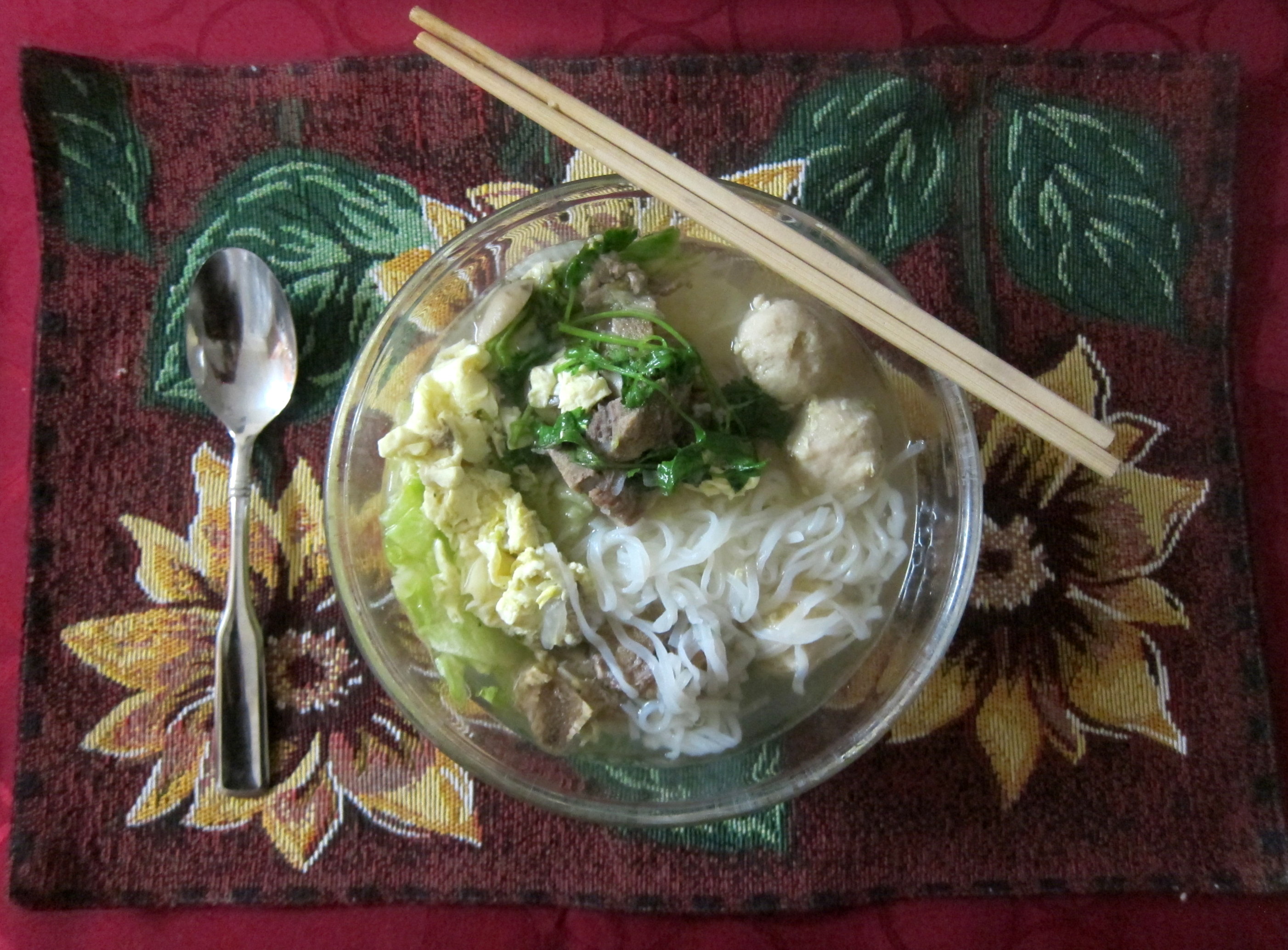
From Mom: hủ tíu bột lọc.

Hu tiu is a common type of rice noodle in Southern Vietnam, often served in noodle-soup form, the noodle soup dish is of course also called “hu tiu“. The usual hu tiu noodle is characterized by its thin shape and chewy texture. Vietnamese love chewy noodles just as much if not more than any other country, so people began using various methods to make hu tiu (*) chewier (the soaking time before grinding, the grinding, washing the rice flour, the mixing ratio with water and other types of starch, the thickness to spread the mixture into a film, the temperature and time to steam it). Bánh bột lọc(**), a type of savory snack, is made with tapioca starch (cassava flour), so I guess hủ tíu bột lọc also contains tapioca starch.

I spent an hour googling but expectedly found little and contradicting information about hu tiu bot loc – nobody in the business would reveal their secret. What I found online is hu tiu bot loc originated from Cần Thơ, and what I found in my bowl are fat (and flat) strings, whose color is clearer and texture is chewier than both the normal (and thin) hu tiu and hu tiu dai (“chewy hu tiu”).

Mom’s hu tiu bot loc: (good luck getting a more detailed recipe than this one from Vietnamese moms!)
– boil dry hu tiu (sold at stores), immediately wash in cold water to preserve chewiness and prevent them from sticking together, set aside
– simmer pork bones to make broth, add salt to taste
– eventually, add pork, beef balls and eggs
– finally, add hu tiu and cilantro

Foodnote:
(*) – That link is written in Vietnamese but the pictures are instructive enough to get an idea of the hu-tiu making process.
(**) – What does “bột lọc” mean? Literally, “bột” is flour, and “lọc” is to distill, so “bột lọc” means “clear flour”.

one shot: Bun Rieu at Ba Le Sandwich

June 26, 2013 By: Mai Truong Category: California - The Bay Area, Comfort food, noodle soup, One shot, Southern Vietnamese

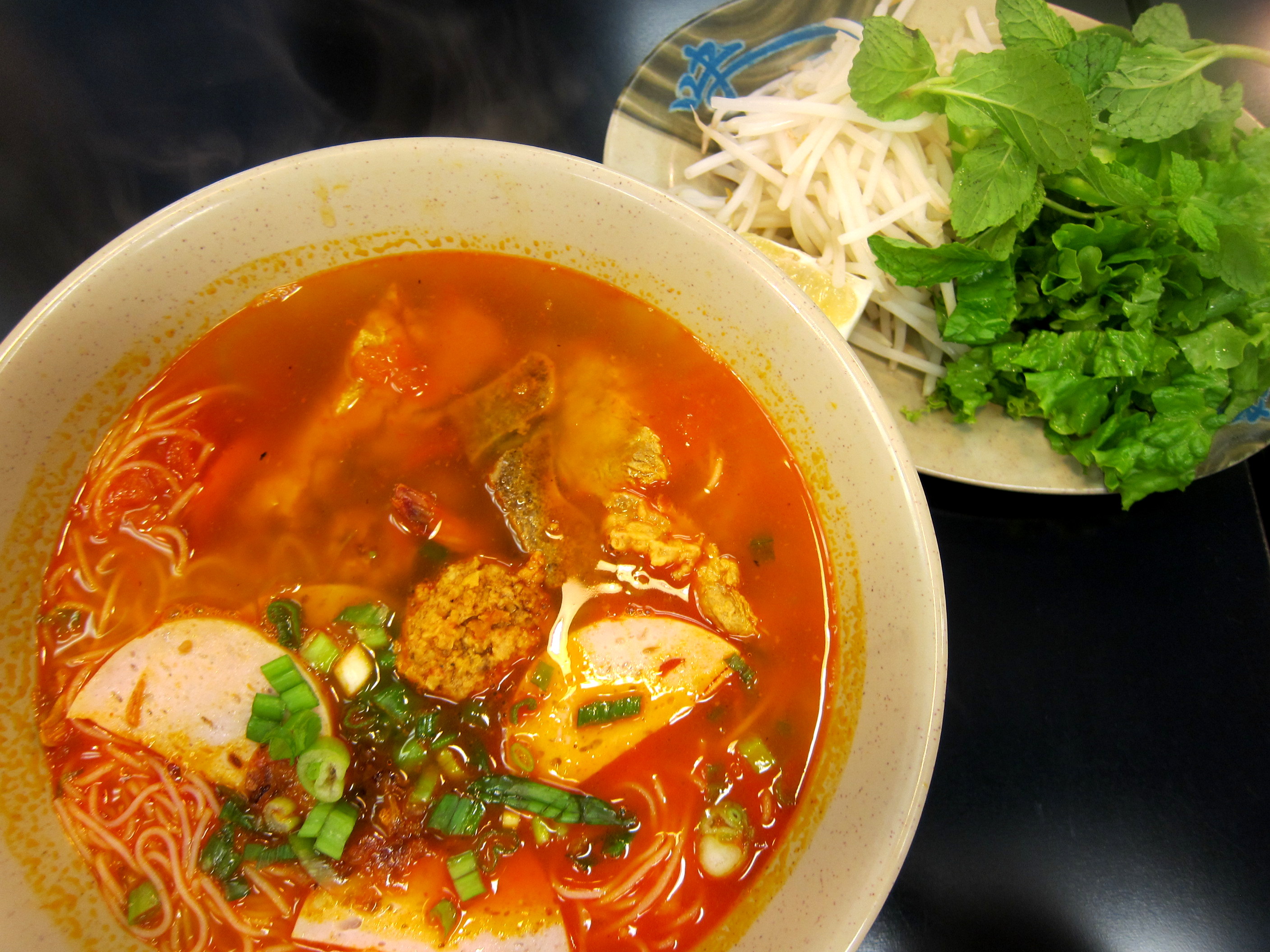
ba-le-sandwich-bun-rieu
Good ol’ tomato and crab noodle soup from Southern Vietnam: bún riêu (pronounced |boon rhee-oo|). The broth looks alarmingly spicy but this soup is actually never spicy. The orange red color comes from tomato and annatto seeds, and if you’re lucky, crab roe (if fresh crabs are used for the soup).

The sweetness of the broth comes from freshwater paddy crabs, where the whole crab (meat and shell) is ground to a paste and strained for the juice. It’s a delicate, distinctive sweetness that can’t be reproduced with dashi no moto, meat bones or mushroom. To deepen the flavor, the cook adds some mắm ruốc, fermented krill paste, to the broth.

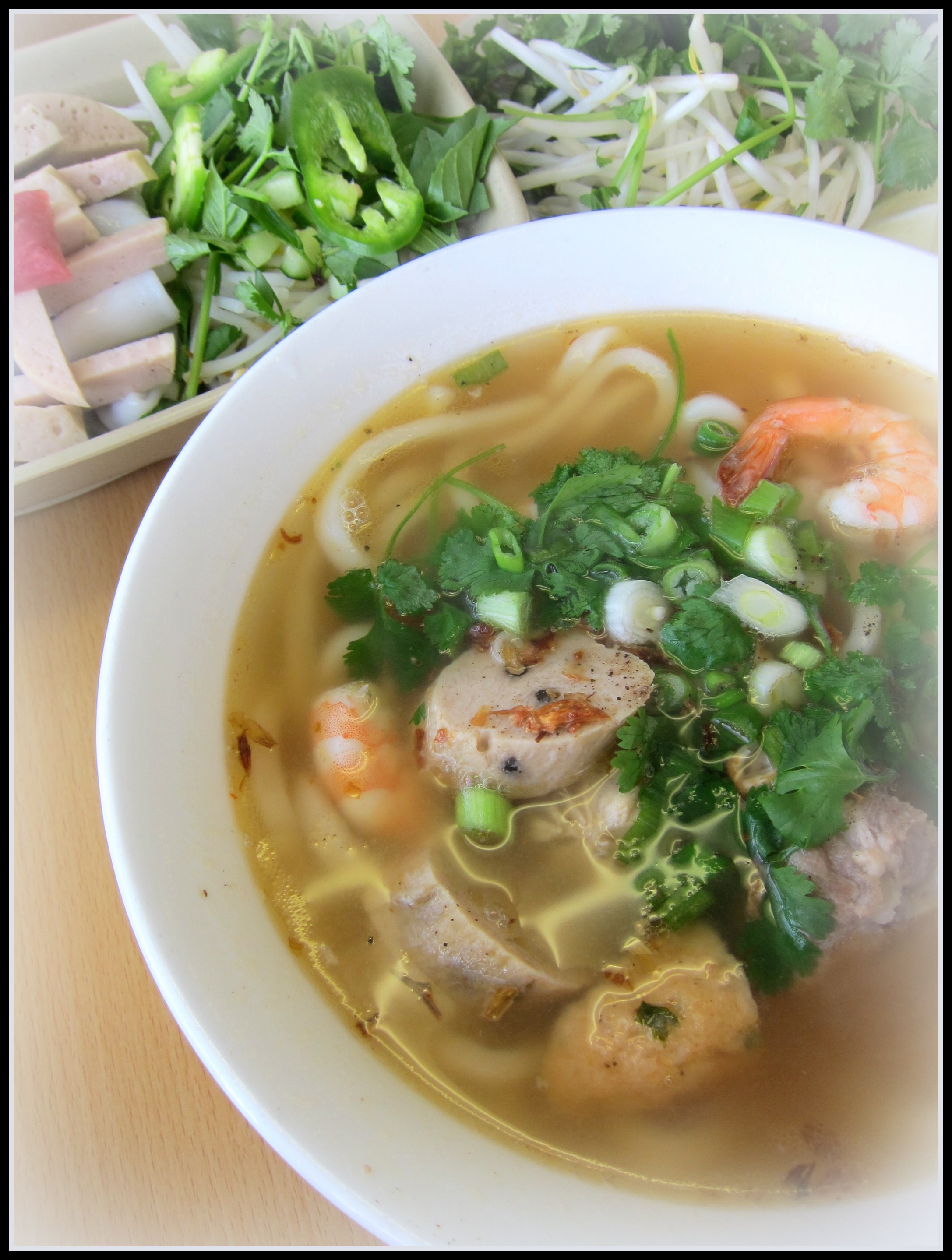
Traditionally, bun rieu has crab meat and tofu for the protein part, but bun rieu at Ba Le Sandwich is ladened with cha lua, pork and shrimp.

Traditionally, it’s one of those commoner’s noodle soups that every other street stall sells in Vietnam, nutritious, filling, unrefined, a richness of everyday life and earthy pleasures. Somehow I grew up not thinking much of it and was never impressed by it. In the bustle of North Cali, bun rieu is still nothing more than a commoner’s noodle soup, never elevated to the level of party food, but the more I think about it, the more I find it romantic. In one bowl, I was tasting the unctuous harmony of wetland and freshwater, of simple vegetables and grains and crustaceans that grow up together in one environment and end up together in one pot, or at least that’s how the noodle soup was originally designed. Do things taste best in the company of what they grow up with? I’m inclined to think so.

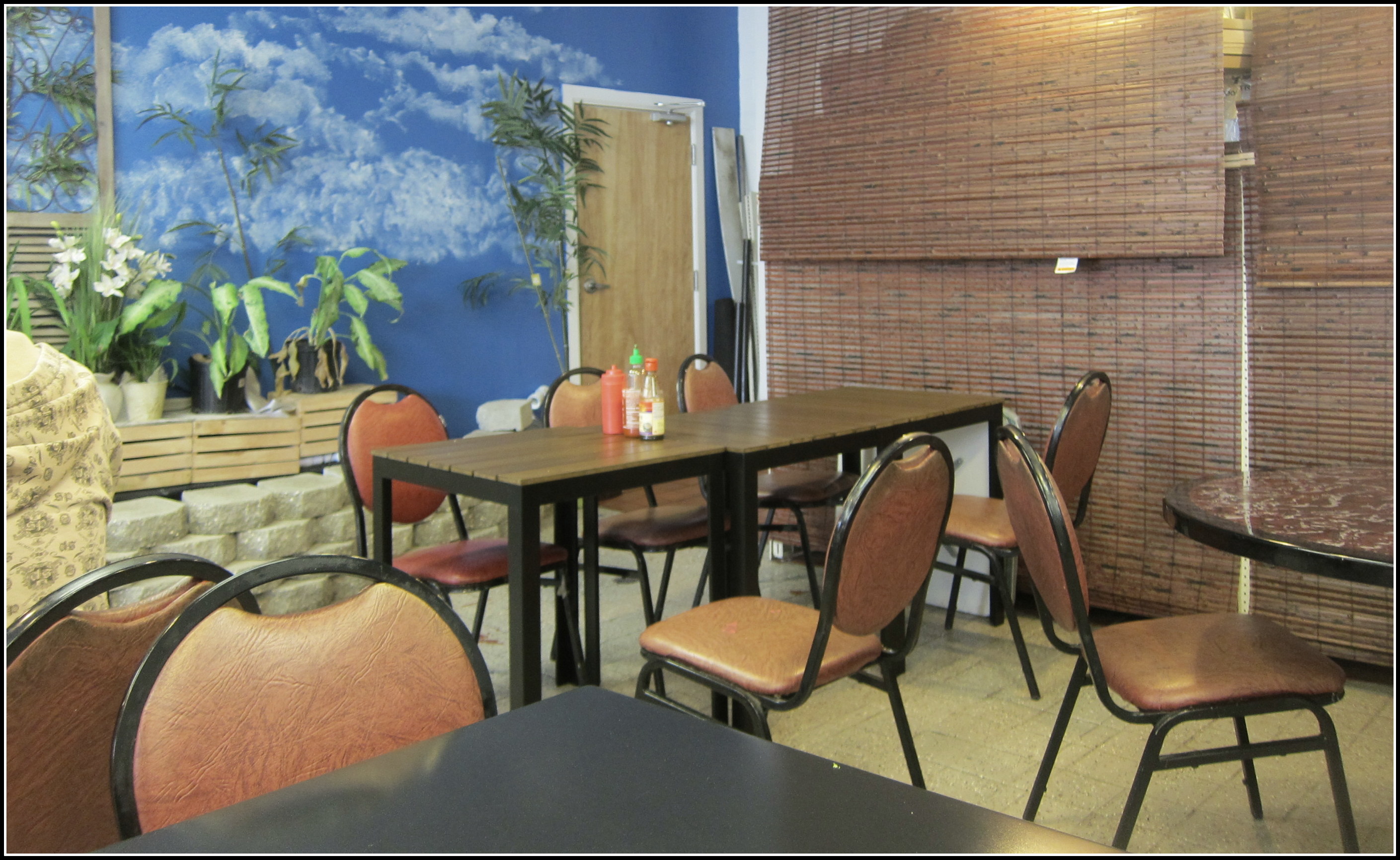
banh-mi-ba-le-interior
Back to a matter-of-fact viewpoint, the inside of Ba Le Sandwich in East Oakland, has been renovated earlier this year into a neat little diner enough to sit 12-14 people, since most customers come for to-go banh mi and on-the-counter goodies such as mungbean milk and sesame beignet. They have hand down the best banh mi in the East Bay north, but everything else tastes good because they know how to season things.

Address: Banh Mi Ba Le (Ba Le Sandwich)
1909 International Blvd
Oakland, CA 94606
(510) 261-9800

One bowl of delta romanticism: $6.50. Another awesome thing about this place: they open at 6:30 am.

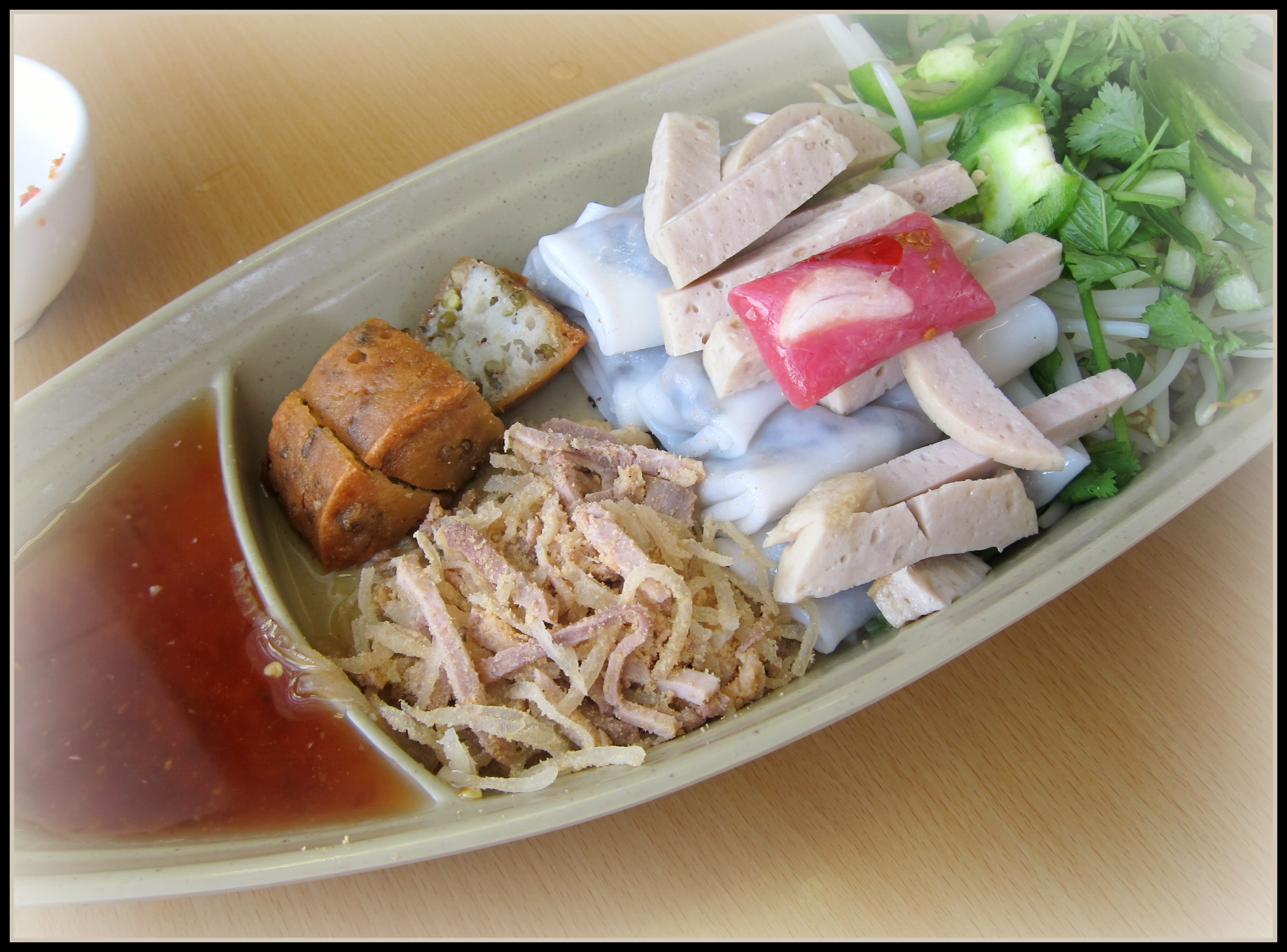
Banh cuon - steamed rice rolls stuffed with pork and mushroom (the white things), and accessories.

Banh cuon – steamed rice rolls stuffed with pork and mushroom (the white things), and accessories.

Banh canh - It's supposed to be tapioca noodle soup with short fat noodle made from tapioca and rice flour, but Ba Le uses Japanese udon instead. The broth is kept original, though.

Banh canh – It’s supposed to be tapioca noodle soup with short fat noodle made from tapioca and rice flour, but Ba Le uses Japanese udon instead. The broth is kept original, though.

Tuesday mind-wandering: food blogging is weight watching?

January 08, 2013 By: Mai Truong Category: Chinese, Opinions, Review of anything not restaurant, Southern Vietnamese

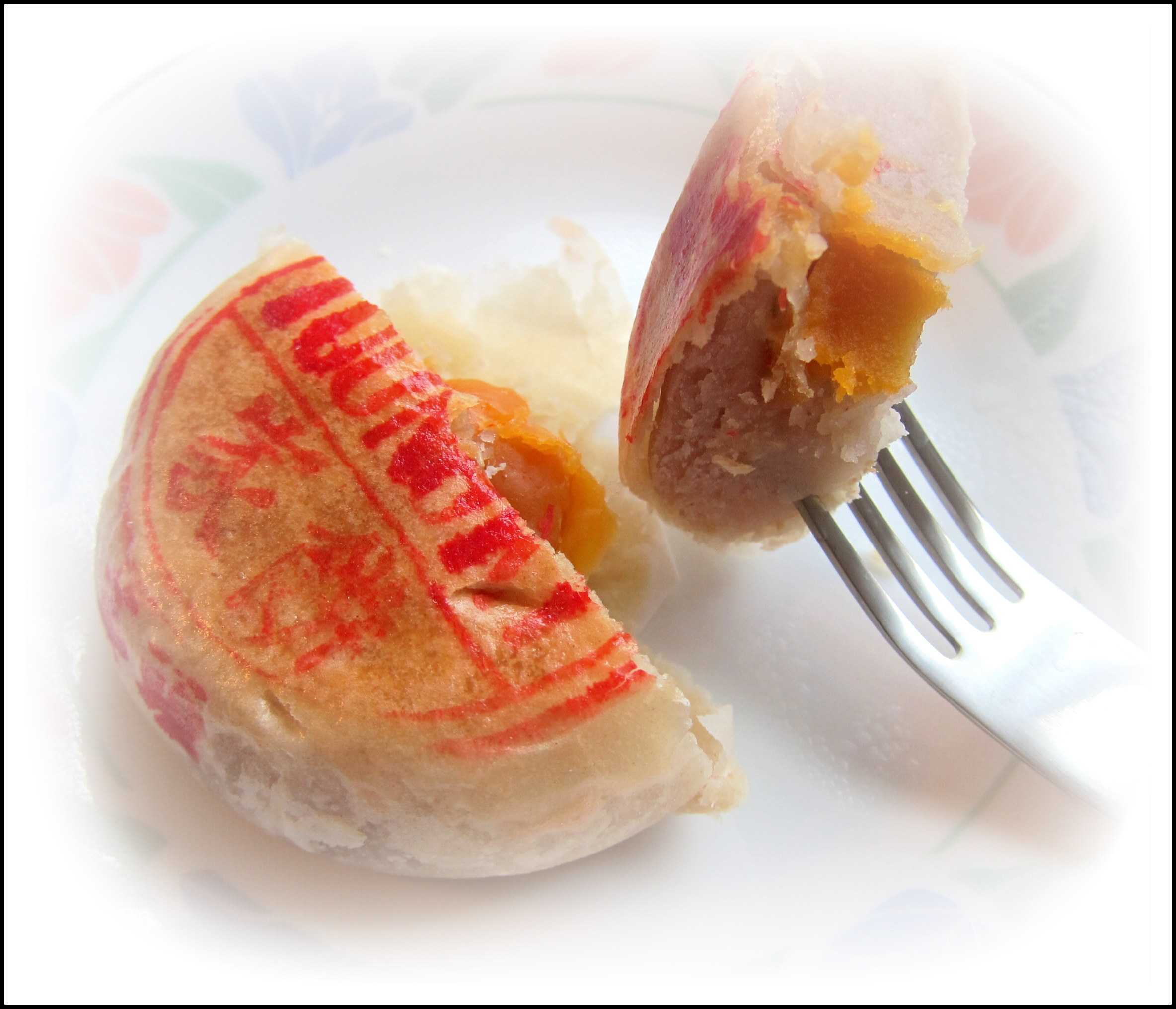
Bánh bía from Tường Ký Fast Food. Filling: taro paste with salted egg yolk, would have been perfect without bits of candied winter melon.  $13 per box of 4.

Bánh bía from Tường Ký Fast Food. Filling: taro paste with salted egg yolk, would have been perfect without bits of candied winter melon. $13 per box of 4.

I’m having writer’s block. Don’t know if that’s true (I once met an Ivy League law school professor who said, as diplomatically as she could, that scientists can’t write), but that’s how my friend put it when I told him that I’ve been sitting around all day producing nothing worth mentioning and munching Vietnamese snacks. As incredibly lazy as that sounds, I think of myself as savoring the cultural assets of my people. (Somehow that sounds even worse…) There’s this Taiwanese movie, Eat Drink Man Woman, I found it a little indelicate and got weirded out (the food looks great though!), but one line from the second sister in the movie stuck in my head: “Dad said that for a person who lives up to 80, he would have consumed 80 tons of food. People who enjoy food and people who eat without savoring it don’t experience the same level of happiness.”

I used to think for sure that what he meant was the people who enjoy food experience more happiness than people who eat without savoring it. But today I thought again.

I’m eating this bánh bía from Tường Ký Fast Food. I can’t help but notice the tiny tiny bits of candied winter melon (mứt bí) in my bánh bía, and I know I like my bánh bía with only taro paste and salted egg yolk, so I’m a bit turned off. When I don’t update Flavor Blvd, I’m happy with teriyaki pork chops from the Chinese family downstairs for weeks. More examples of “ignorance is bliss”: I can’t tell the difference between HDTV and normal TV, so I enjoy any TV with colors. I don’t know shrimps about music, so my friends may think that the drum work of some musician I like is a total fluke, but I still like it all the same. Then again, knowing teas makes me appreciate high-quality teas on a whole different level, and I can still enjoy tea bags with the right company. So I don’t know. The two types of people may not experience the same level of happiness, but that doesn’t mean one level is higher than the other.

Physically speaking, the two types of people probably don’t obtain the same level of energy either. Savoring food means analyzing food. Before I really buckled down and recorded everything I ate, I just ate. Now I think about ingredients. What did they put in there? How did they make it? What could be changed? Why do I prefer my mom’s bánh bao (and Vietnamese bánh bao in general) to jibaozi, family relation aside?

So, food savoring is a brain workout(*), unlikely on the same level as debugging my code, but I think now I have a reply to my mom’s question: “Why can everyone gain weight but you? Eat more!” 😀

Address: Tường Ký Fast Food
8200 Wilcrest Dr., Suite 14
Houston, TX 77072
(281) 988-4888

(*) I typed “how much energy does thinking require” into Google, and the answers seem inconclusive at best, but at least computer work burns 41 calories in 30 minutes for a 125-lb person, and blogging requires computer. Surely more thinking wouldn’t make you gain weight. 😉

Tags: ,

Mung bean porridge

May 24, 2012 By: Mai Truong Category: Comfort food, RECIPES, Southern Vietnamese, Vegan


Rice porridge was my enemy.

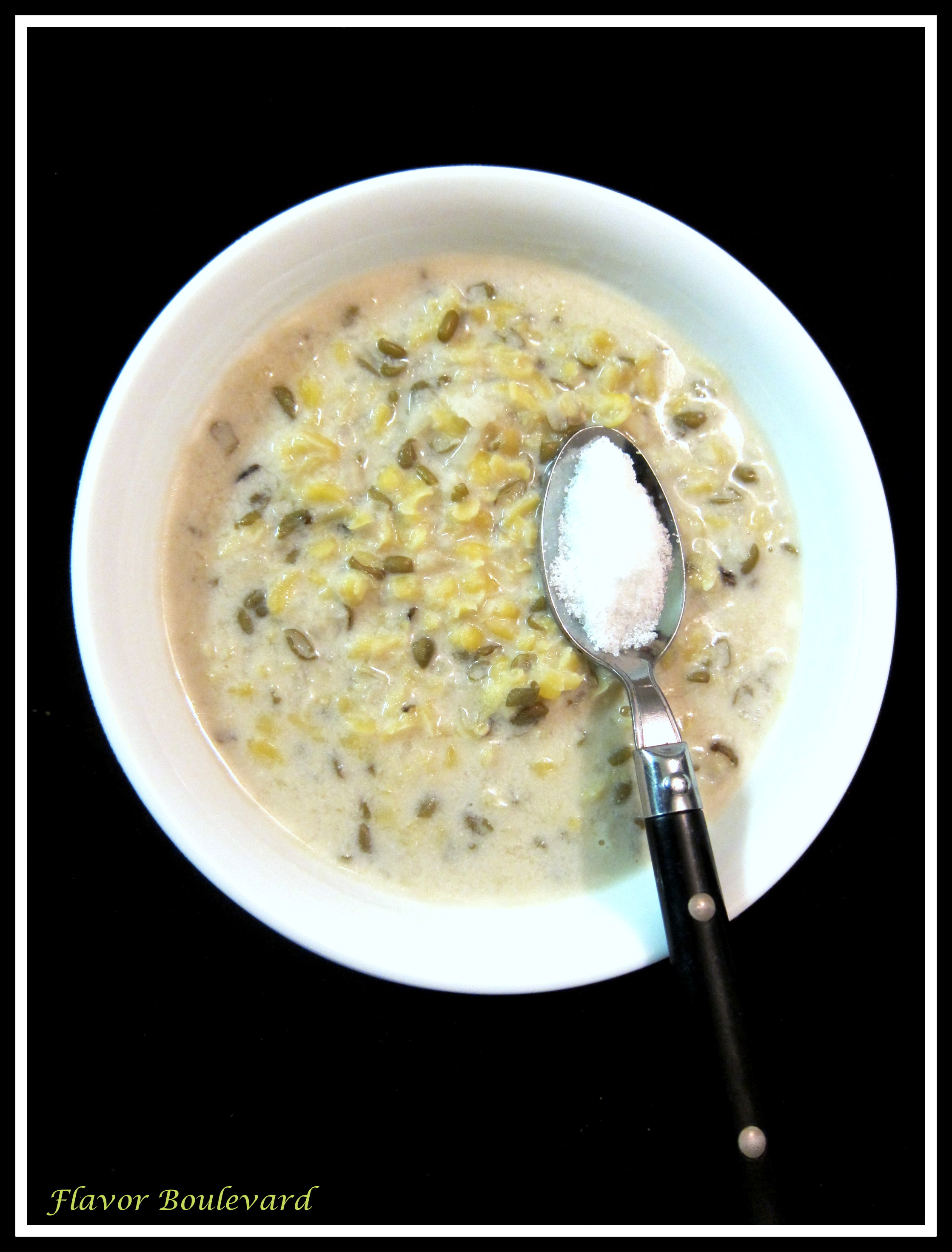
In elementary years, I got a fever about once every month. Aside from feeling tired and having weird dreams when the fever got high, I didn’t really mind that, but my mom did. She was so worried she wouldn’t sleep for days, not until my temperature went back to normal. And she made sure that I ate my rice porridge. She made rice porridge with ground pork and rice porridge with fish, she added vegetable, she seasoned it perfectly, and I still hated every spoon of it. I hated the texture of rice porridge: mushy and textureless. I hated both thick porridge and watery porridge(*). Every porridge meal was a battle between Mom and me, and I always lost, which deepened my aversion to porridge even more. But there were happy days when I actually liked my fever porridge and didn’t need my mom to prod: it was mung bean porridge on those days.

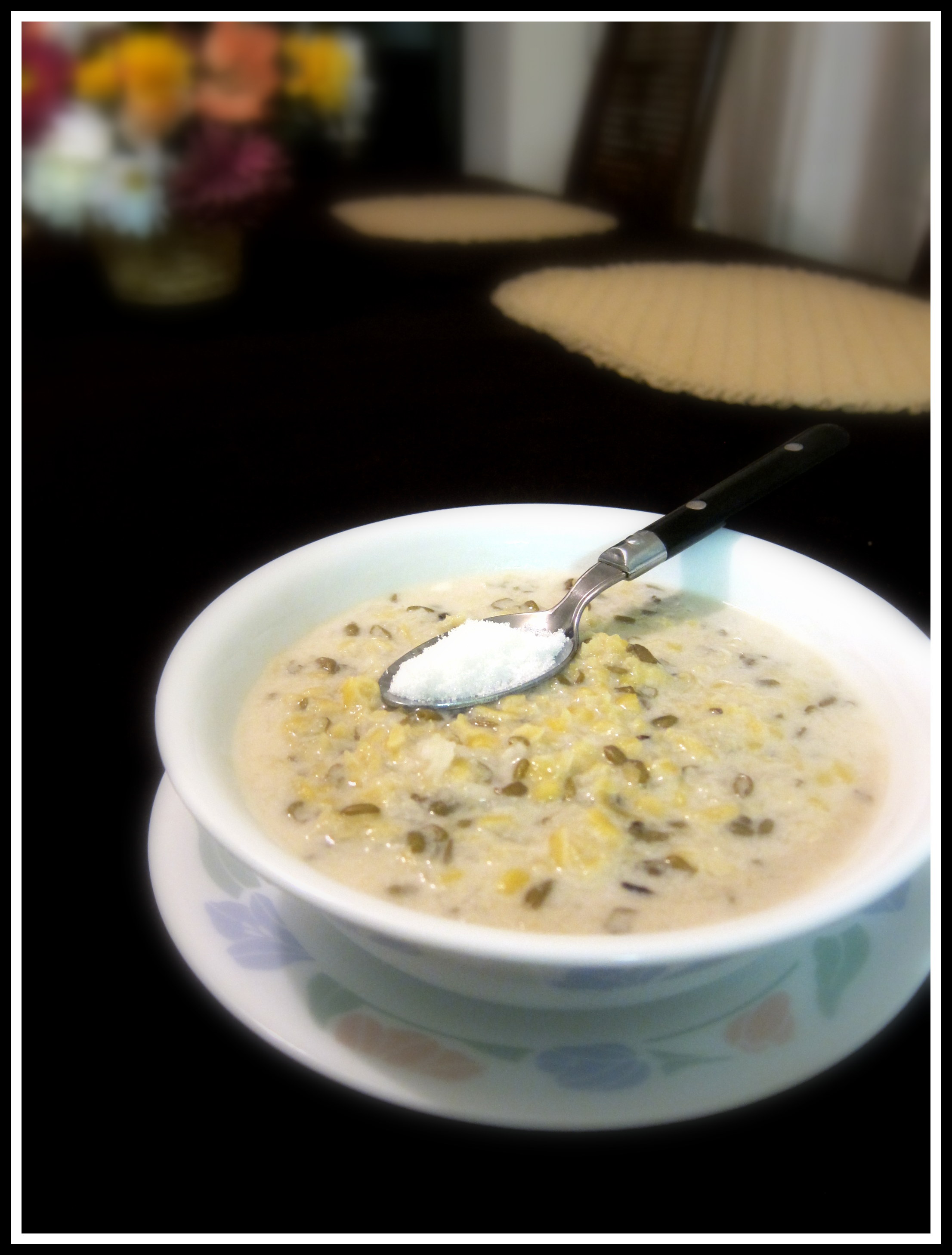
Actually, there’s rice in mung bean porridge, too, but the mung bean skin makes the porridge all nuttier and better. Then it’s a sweet porridge (just rice, mung bean and sugar, no meat), so that’s doubly better. Health-wise, mung bean is a cooling food(*), which would help alleviating the fever and digesting. Little Mom says that the Central Vietnamese eat mung bean porridge with cá kho tiêu (small caramelized pepper braised fish) instead of sugar, I can see that being tasty, and I can imagine substituting the fish with myulchi bokkum (멸치 볶음, dried fried anchovies) for availability. But I’ve found another way to heighten the mung bean porridge experience while keeping it vegan:

I dip toasted rice cracker into the porridge. We had leftover rice crackers from a lunch of rice cracker and pork rolls. There I was sitting, slurping and chewing my porridge, and staring at the stack of crackers, and it just came. Now you get crunchy, airy, nutty, sweet, sesame-y, toasty, liquidy, all in one bite. 😉

(*) These days I can tolerate watery porridge, but I still avoid the thick kind.
(**) I wrote a brief section on the cooling vs. heating effect of food in the post Benefits of Tea.


The Recipe: Childhood Love Mung Bean Porridge (8 servings)

— 250 g mung bean (halved but not shelled)
— 1/2 cup rice
— 1.2 l (42 fl oz) water (less water for thicker porridge)
— 1 can coconut milk
— sugar (as much as you want)
— toasted sesame rice cracker (as much as you want)
Soak the mung bean overnight to soften it. In a pot, cook rice, mung bean and water until the grains turn mushy. Add coconut milk and bring it to a boil. Serve warm with toasted rice crackers.

Chewy dried banana

May 16, 2012 By: Mai Truong Category: Fruits, One shot, Southern Vietnamese, sweet snacks and desserts, Vegan


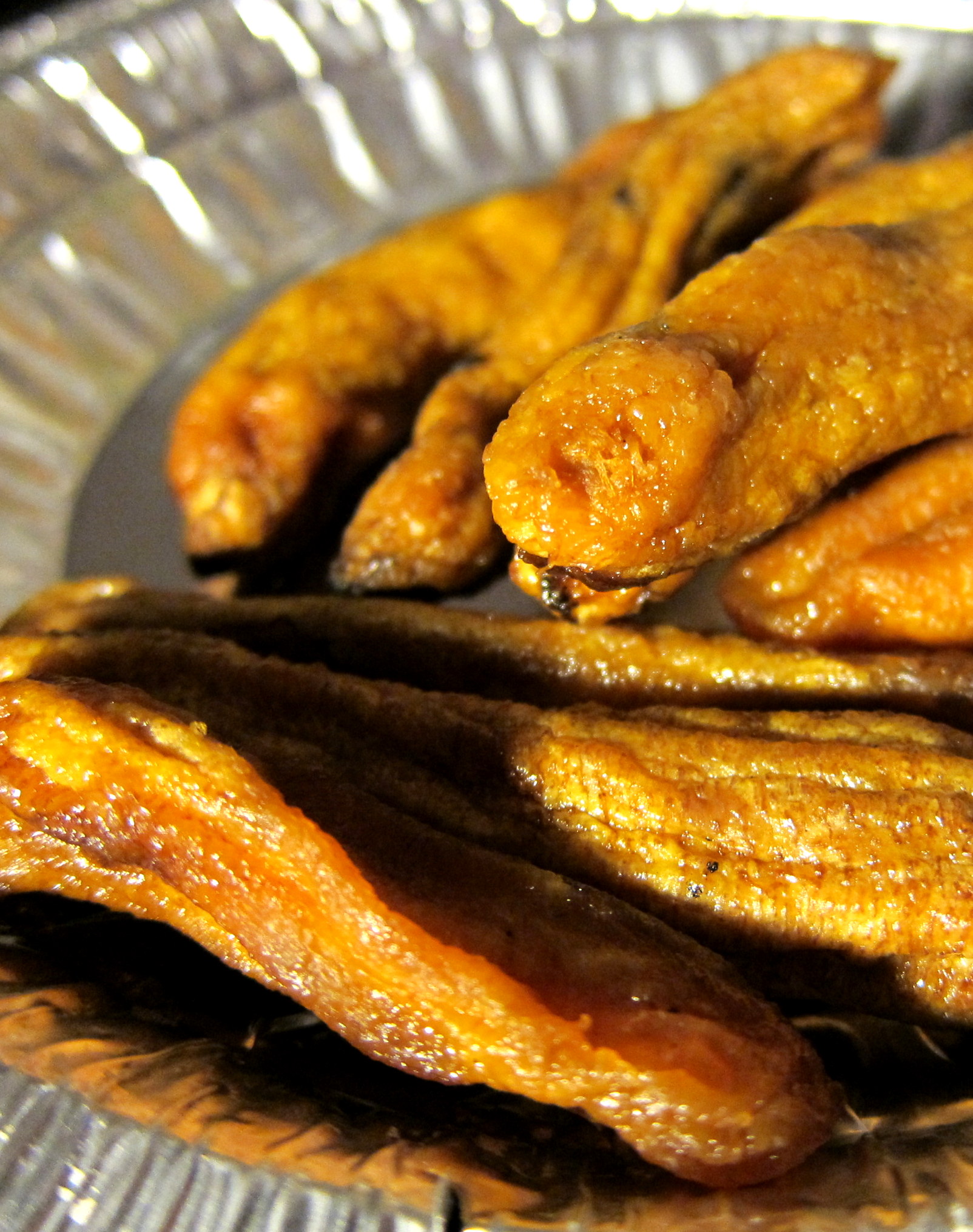
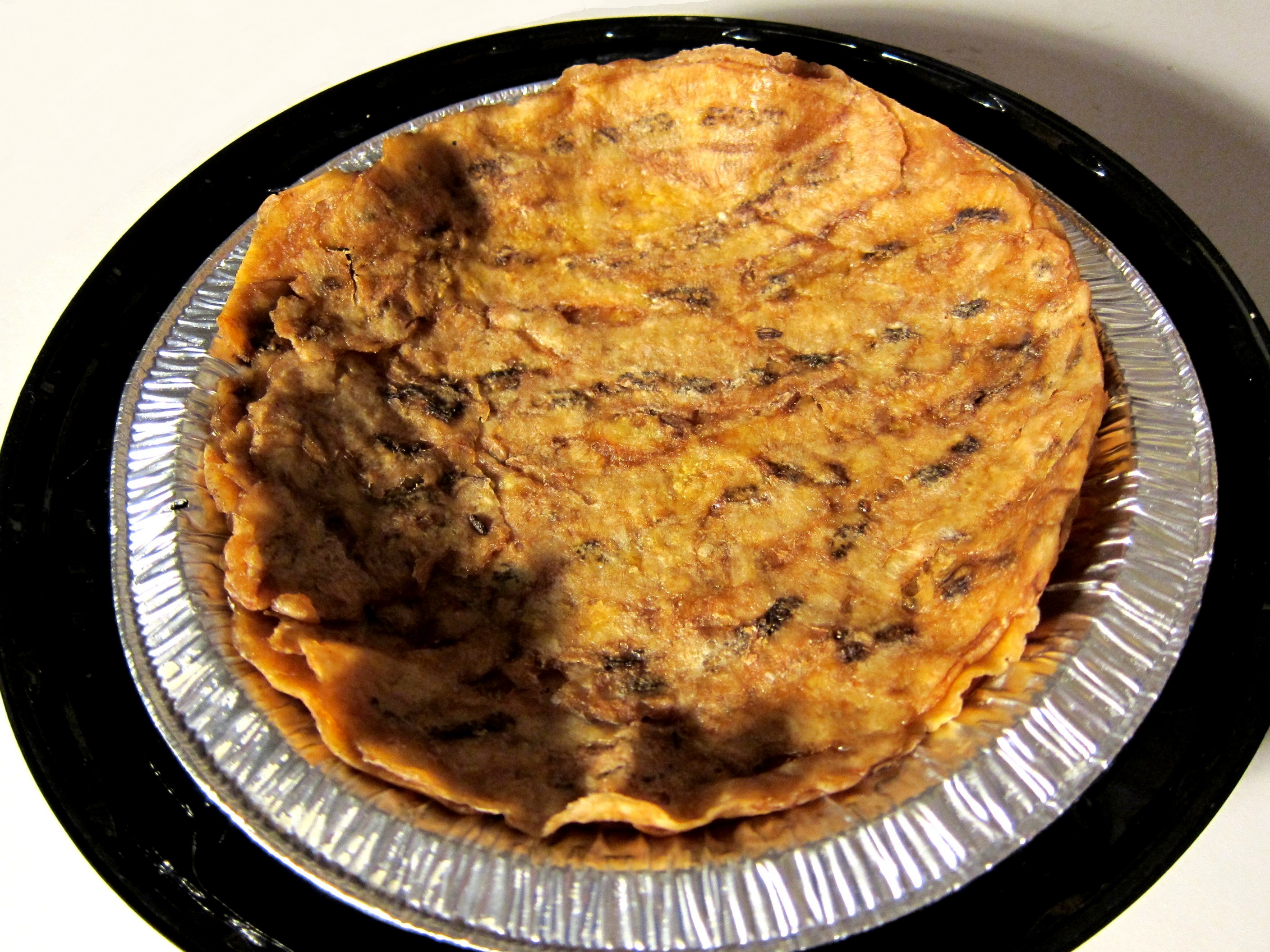
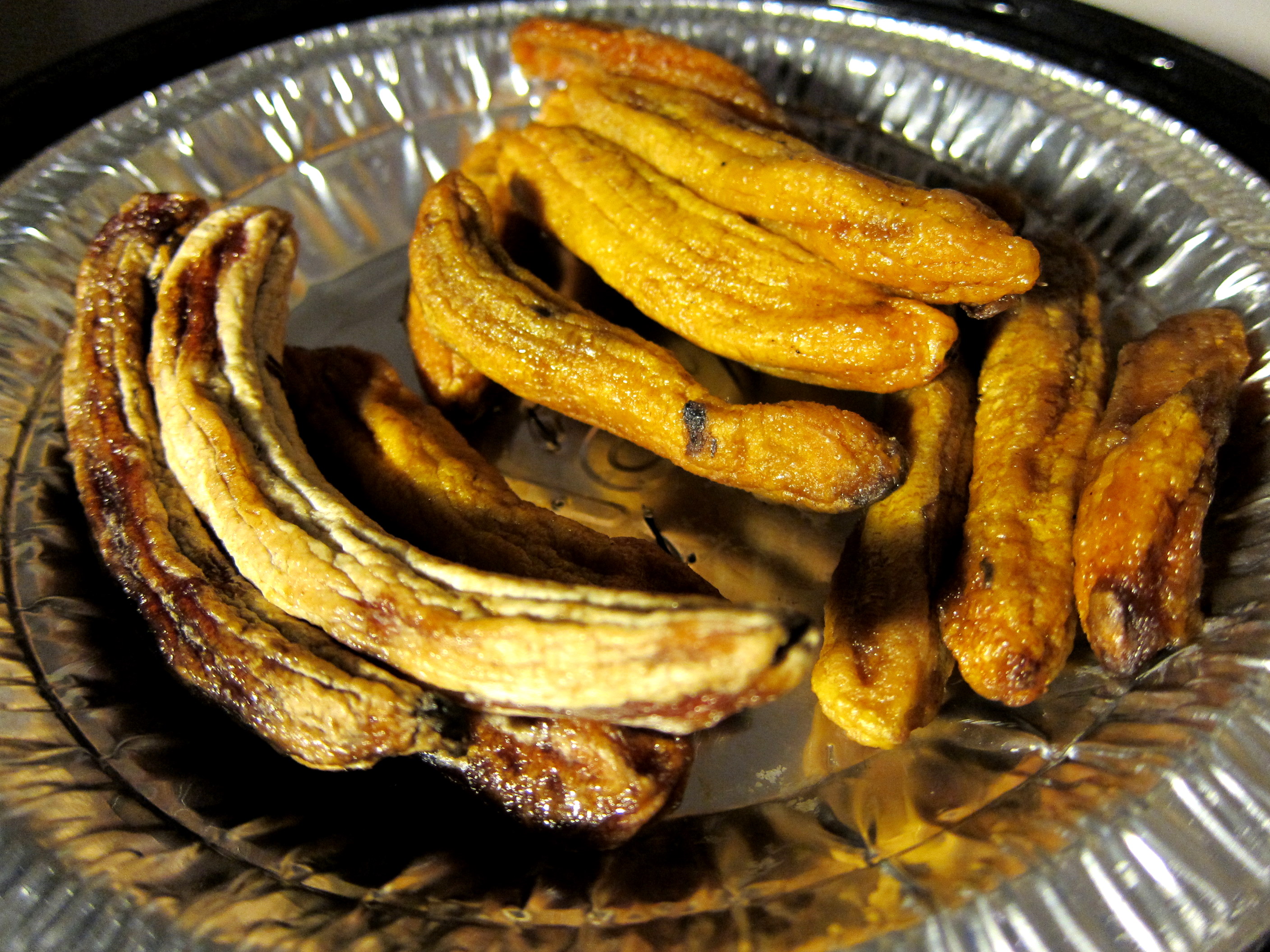
They aren’t banana chips. Those are crunchy, not very sweet, and make you thirsty. These are chewy and packed with honey sweetness. They’re as addicting as soft-baked chocolate chip cookies and as healthy as dried blueberries. At least I like to think so when I nibble twenty of them in one go.


Chewy dried bananas come in many shapes and sizes. Some were pressed into flat sheets (3-5 bananas to make a sheet), laid on bamboo panels and dried under the sun. Cà Mau is known for this kind of chuối khô, the main ingredient of the other 101 banana snack things in the South, e.g., banana candies.


Other bananas are dried whole, and they turn into finger-long wrinkly banana fingers. Eurasia Delight sells two kinds: the normal chuối khô – more caramel looking, shinier, sweeter, shorter and chewier, the “organic” chuối khô – whiter, dryer, longer, not as good.

Flat or whole, I see a pot load of potential for these dried bananas in both the savories and the desserts. [To be continued]

Tags:

Sandwich Shop Goodies 19 – Bánh tiêu (Chinese sesame beignet)

April 03, 2012 By: Mai Truong Category: California - The Bay Area, Chinese, One shot, savory snacks, Southern Vietnamese


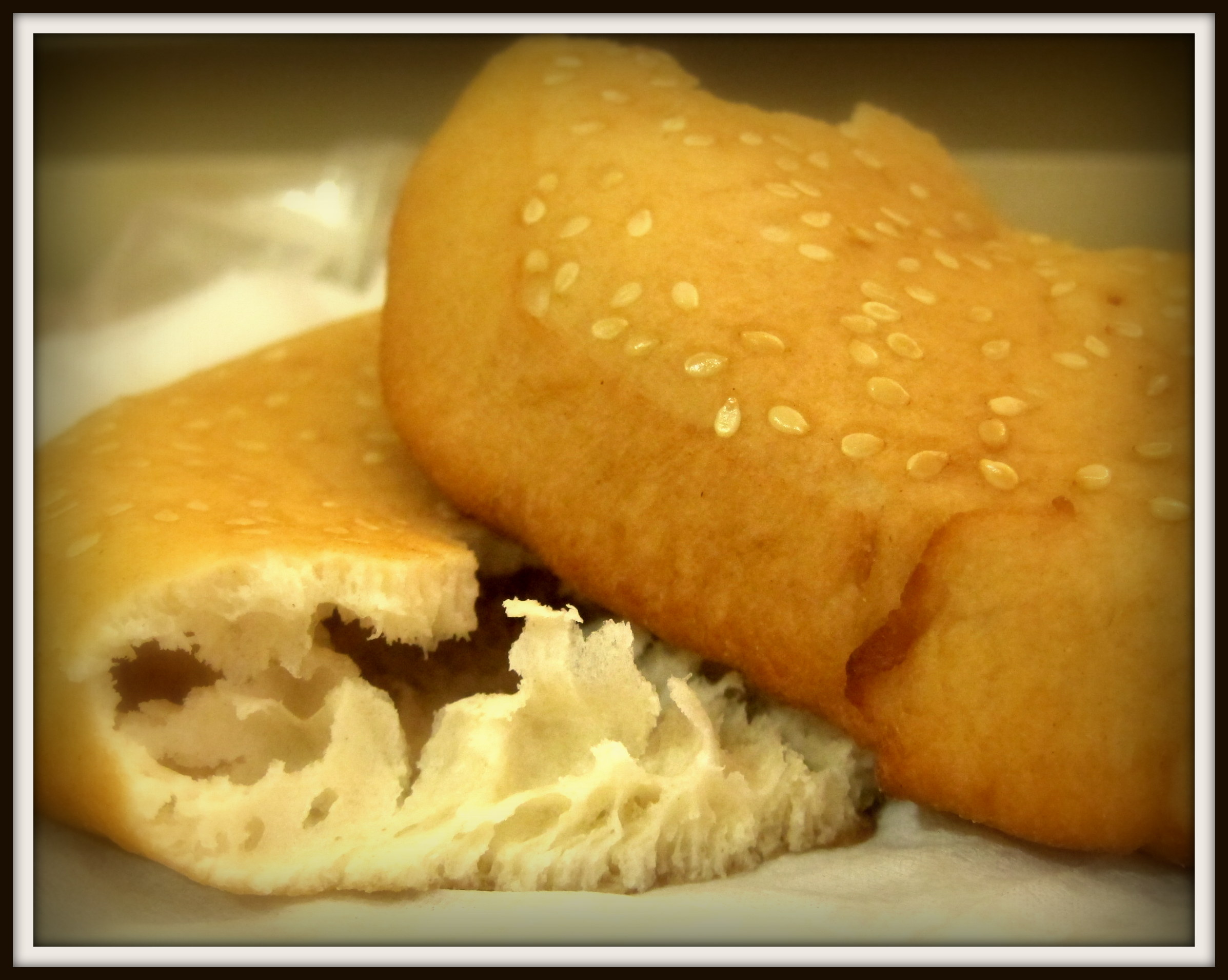
Little Mom and I… we just have different tastes. She likes seafood. She prefers crunchy to soft. She doesn’t like sticky rice (!) She thinks the mini sponge muffins (bánh bò bông, the Vietnamese kind) are sourer than the white chewy honeycombs (bánh bò, the Chinese kind). I beg to differ. The mini sponges can be eaten alone; the honeycombs are almost always stuffed inside a hollow fried doughnut that is more savory than sweet: their sourness needs to be suppressed by the natural saltiness of oil and the airy crunch of fried batter. That doughnut, brought to us by the Chinese and called by us “bánh tiêu“, saves the honeycombs.

The honeycombs could go hang out with the dodo for all I care, but this Saigonese would always appreciate a well-fried bánh tiêu. At any time of the day, one would be able to spot a street cart with the signature double-shelf glass box next to a vat of dark yellow oil. The oil gets darkened from frying too many doughnuts too many times. Sure, it isn’t healthy. But should you really care about health when you eat fried dough?

“Fried dough has appeared in different forms – round, square, triangular, twisted – under many different names. The Dutch settlers had olykoeks (oily cakes); the French in Louisiana had beignets; the Spanish from Mexico made puchas de canela; and the Pennsylvania Germans made fastnachts around Lent.” (Jill MacNeice, “Doughnuts“, in the Roadside Food collection) Now I may add that the Vietnamese in California and Texas have bánh tiêu. One quality of bánh tiêu to make it superior over the other fried doughs: it isn’t coated in powder sugar. Studded with white sesame on one side, it tastes subtly salty of dough, fat, and roasted grain.

An excerpt about Vietnamese vendors making dầu cháo quẩy and bánh tiêu:

Vốc một nhúm bột khô rải đều trên bề mặt miếng gỗ đã trơn bóng – cốt để bột nhồi không bị dính – tiếp tục ngắt một cục bột đã ủ cho lên men, nhẹ nhàng vuốt dọc rồi dùng cây lăn cán qua, miếng bột đã được kéo ra thành một dây bột dài mỏng đều. Người bán lại tiếp tục dùng một thanh tre cật mỏng, xắn bột thành từng miếng đều nhau. Xếp chồng hai miếng bột lên rồi dùng một chiếc đũa ấn mạnh ở giữa, thế là đã được miếng bột “chuẩn” để làm bánh quẩy. Còn bánh tiêu thì phải qua công đoạn vốc một nắm mè vất ra giữa miếng gỗ để mè tự rải đều, sau đó mới dùng bột đã ủ đã nhồi cán thành miếng tròn dẹp, một mặt dính mè, một mặt không.
[…]
Bánh quẩy và bánh tiêu thường bán chung, có lẽ chủ yếu là vì hai loại bột làm bánh này không khác nhau là mấy. Cũng bột mì nhồi với bột khai là chính. Nhưng với bánh quẩy, người ta cho thêm chút muối, chỉ một chút thôi đủ để bánh không lạt lẽo, nhưng vẫn còn giữ được độ ngọt nguyên thủy của bột mì.
Còn với bánh tiêu, người ta lại cho thêm ít đường, cũng rất ít, đủ để làm dậy hơn vị ngọt của bột. Vị ngọt của bánh tiêu vì thế rất nhẹ, không như những loại bánh ngọt khác. Với bánh tiêu, người mua cũng không đòi hỏi phải giòn đến như bánh quẩy. Cái hấp dẫn ở bánh tiêu lại là ở những hạt mè thơm ngậy. Những hạt mè trắng li ti sau khi chiên trở nên căng mẩy, quyện với mùi thơm của bột mì chiên giòn trở nên hấp dẫn kỳ lạ. Nếu như bánh quẩy thường được cho vào dùng chung với cháo, với phở thì bánh tiêu thường được dùng kèm với bánh bò. Xẻ đôi chiếc bánh tiêu, kẹp vào giữa miếng bánh bò nữa là được một loại hương vị khác hẳn. Cái mềm xốp của bánh bò khiến bánh tiêu – vốn hơi khô – trở nên dễ ăn hơn, đỡ ngán hơn. Các loại nhân ăn kèm bánh tiêu cũng khá phong phú, tùy sở thích mỗi người. Có người mách nhau kẹp xôi vào giữa, ăn cũng rất ngon, lại có thể thay quà sáng. Có người lại thích nhân “cadé”, là loại nhân làm bằng trứng gà có vị béo ngầy ngậy, rất hợp với bánh tiêu.

Translated and abridged:

[The vendor] scoops up some flour and sprinkles them on the shining flat wooden board, to keep the dough from sticking, then he pinches off a ball of fermented dough, gently pulls it and runs the rolling pin once over to stretch the ball into a thin strip. Then he grabs a sharp bamboo stick, swiftly cuts the strip into smaller, even strips. Putting two strips on top of each other, pressing a chopstick down in the middle, and he gets a “standard” piece of bánh quẩy ready to fry. For bánh tiêu, he would need to sprinkle a pinch of sesame seeds on the board, then flatten the dough into disks, one side studded with seeds, the other side having none.
[…]
Bánh quẩy and bánh tiêu are often sold together because they have similar dough. Mainly, flour and baking soda. For bánh quẩy, they add some salt to make it savory, but not too much that it would diminish the flour’s natural sweetness. But for bánh tiêu, they would add a pinch of sugar to boost that sweetness. Bánh tiêu doesn’t have to be as crunchy as bánh quẩy either. Its goodness lies in the sesames’ fragrant nuttiness. As bánh quẩy is often eaten with rice porridge or noodle soup, bánh tiêu goes with bánh bò. Slit the bánh tiêu open, stuff in a piece of the soft white honeycomb bánh bò, and you get a whole new snack. Some people substitute bánh bò with sweet sticky rice or with egg custard, that really fattens it up.

In Saigon, Vietnam: 1000 VND each.
At Bánh Mì Ba Lẹ, Oakland: 1 USD each. (1 USD ~ 20000 VND)

Address: Bánh Mì Ba Lẹ (East Oakland)
1909 International Blvd
Oakland, CA 94606
(510) 261-9800

Previously on Sandwich Shop Goodiessteamed taro cake (bánh khoai môn hấp)
Next on Sandwich Shop Goodies: Xôi khúc (cudweed sticky rice)

Year in, year out, savoring the savoriest of pork

December 31, 2011 By: Mai Truong Category: Comfort food, One shot, Southern Vietnamese


If you had to choose, what is the most Vietnamese dish? If you are a Vietnamese expat, what would make your mouth water the most just thinking about? What is the food, the smell, the taste that when you see or hear some stranger is savoring, you’d immediately think, “hey, he must be my fellow countryman”?

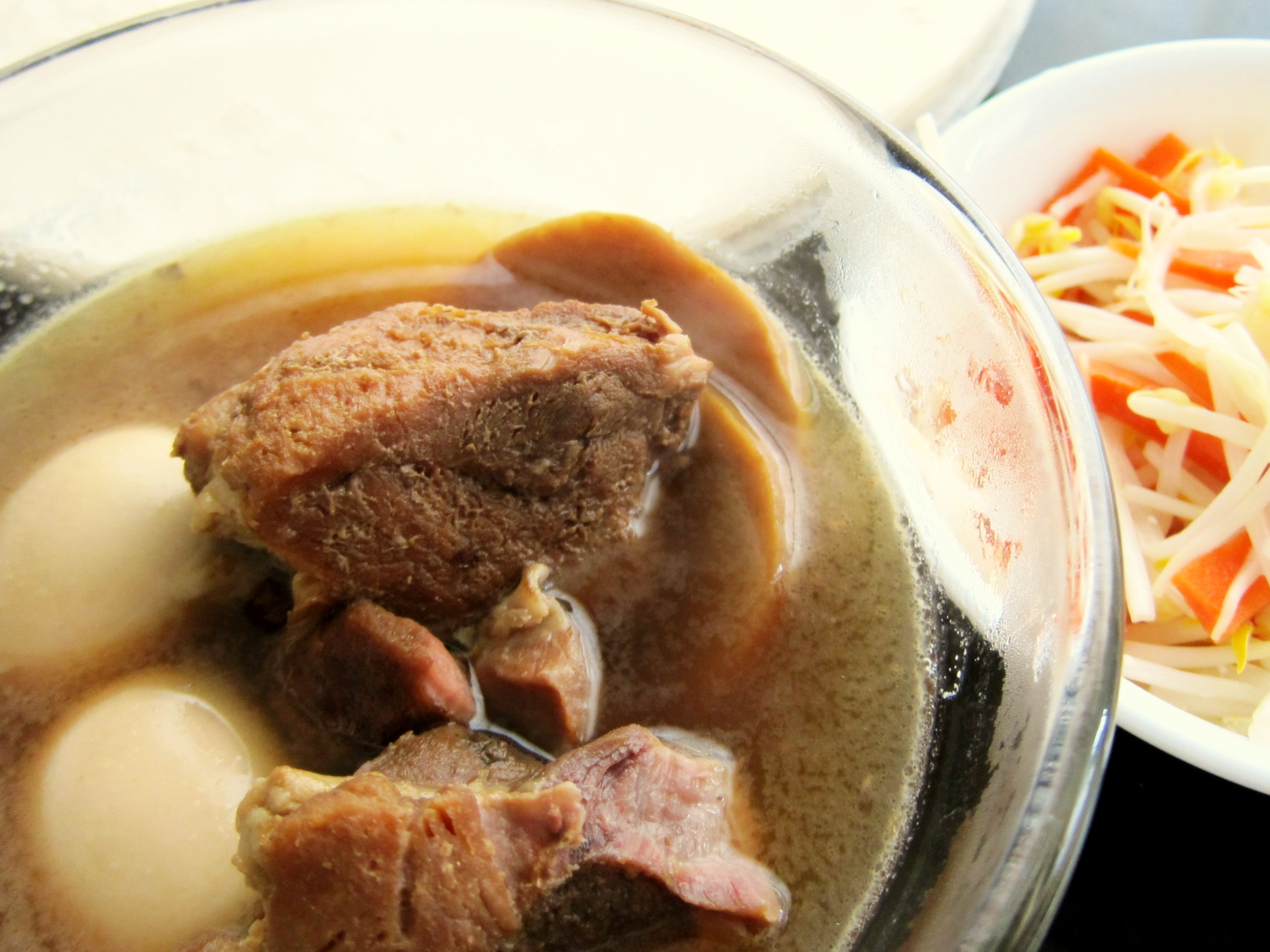
One of my friends lives in Freiburg, Germany. There is one Vietnamese restaurant 1 km away from the University, der Reis-Garten, and it is the only Vietnamese restaurant in a 40-km radius (the next one is across the border: Le Bol d’Or in Wintzenheim, France). For over 6 years living away from home, he survived on pasta and tomato sauce, students don’t have time. One day, external circumstances have finally driven him to decide that he no longer needs to suppress his cravings out of consideration towards his Germanic housemates. He bought a bottle of fish sauce. The next day he made thịt kho. That makes it official: he’s Vietnamese, and he hasn’t forgotten it.


“Success?” “Did you add coconut juice?” “Do you have eggs in the pot?” “Do you have chả lụa too?” The questions come showering on Facebook. We cheered him on with the same salivating imagination no matter which region of Vietnam we are from and where we are living: the fatty chunks of pork so tender that a plastic chopstick can cut through, the amber sauce, with which the hard boiled eggs are imbrued from yolk to white. The fatty, sweet, and salty pork must be freshened up with the crunchy, sour, cold dưa giá (pickled beansprout). The pure fish sauce makes an intoxicating savory smell that permeates the whole house, seeps through the window into the courtyard to the next door neighbor, induces a Vietnamese to lick his lips thinking of his mother’s meals and perhaps, a Westerner to cringe. But why should a cringe matter? The pure fish sauce deepens the savoriness of the meat sauce, making it the best thing to pour over a steamy bowl of white rice. My friend said all he need is this amber meat sauce and dưa giá to down a few bowlfuls. Of course, I agree.

The first weekend I got home, Little Mom sat me down in front of thịt kho, dưa giá, rice, and rice paper. All kinds of rice papers come from all over Asia, but those are for calligraphy and painting. Edible rice paper comes from Vietnam and Vietnam only. A pet peeve of mine is getting served those “spring rolls” made with wonton wrappers in American Vietnamese eateries, like a lumpia. A Vietnamese spring roll must be rolled with the translucent, veil-thin, made-of-rice-flour rice paper. Rolling it with any other kind of wrapper is an unpatriotic insult to Vietnamese cuisine. Anyway, my mom sat me down in front of her succulent slow braised pork, pickled beansprout, rice, and rice paper. Then she said go for it, and boy did I go. I made little wraps of pork and sprouts to dip into the sauce. I poured the sauce over rice. I dipped plain rice paper into the sauce. I made some more wraps and filled another rice bowl. It’s almost barbaric. The comfort of an old country taste is multiplied by the comfort of home. The eyes and tongue are no longer the principle critics, but all five senses are involved: the smell of the sauce, the sound of the sprouts collapsing between bites, the delicate touch much needed in rolling the rice paper. Each bite I took embodied the ordinary, simple, honest Southern cooking and the skillfully honed tradition of hundreds of years: thịt kho is a must-have in our Tet feast, like the turkey at Thanksgiving, the songpyeon on Chuseok, or the ozoni for Shogatsu. Well, it’s not Lunar New Year now, but it is a New Year. Maybe I’ve grown old, but I find that nothing beats celebrating the holidays at your family’s dinner table with family comfort food. 🙂

As I’m writing this post, the fireworks are going off right outside the windows, talk about food setting off fireworks ;-). Happy 2012! And may Vietnam be delicious always! 🙂

Red Boat fish sauce – Good enough to sprout crazy ideas

August 04, 2011 By: Mai Truong Category: Food product, Southern Vietnamese


“It’s sweet, and it shines like honey,” my mom recalls. She was in fifth grade, her teacher, whose family also owns a fish sauce plant, gave each student in the class a sample of the condiment in a mini plastic pouch. When my mom took it home, it took her mom no time to see that this was the Ninth Symphony of fish sauce. It didn’t take the Vietnamese grandmothers in the Bay Area very long either, Rob Bergstrom said, and I quote, to “limp out of the store carrying a full case” of Red Boat’s.

I met Rob because of a half-a-month-late comment that I left on Ravenous Couple’s glowing review. Rob is a man who goes around grocery stores and the world to taste fish sauce straight out of the bottle by the spoonfuls (I don’t recommend doing it at home if you’re under 18). And Rob was moved by my mom’s fifth grade experience, which, he said, is similar to a few sparse stories among the older Vietnamese about an excellent-quality fish sauce that some have once tasted in their lifetime and never again. Especially not in the States, where a “Nước Mắm Phú Quốc” bottle, in big font Vietnamese, reads “Product of Thailand” in the small prints.

For those who know fish sauce, skip the rest of this paragraph. For those who don’t know fish sauce, yes I agree, “fish sauce” does not sound candle-light-and-roses to the ear. It’s a lose translation of “nước mắm“, whose literal translation isn’t any more poetic either (I’d translate it if you ask). The sauce itself is actually subjected to many chuckles and jokes among Vietnamese. But it’s the backbone of Vietnamese seasonings. It’s used to marinate meat, to caramelize claypot dishes, to flavor-ize broths, to make dipping sauce for a myriad of wraps and rolls. Fish sauce to Vietnamese food is like soy sauce and sesame oil to Korean food, curry to Indian food, and BBQ sauce to Texas barbecued brisket. (Savory Vietnamese food, unless made by my mom, needs fish sauce to taste good.) What is the sauce made of? Fish and salt. In a barrel lie layers of fish and layers of salt for months, by osmosis and high salt concentration on the outside, the juice inside the fish is sucked out, the flesh collapses and degrades, the mixture ferments (don’t cringe, wine is fermented stuff too, and old country ham grows mold on the crust). At the end of several months, you open the spout at the bottom, and out comes an amber liquid. That’s the first press of fish sauce. Then water and salt are added to the now mostly, if not all, disintegrated fish, more fermentation takes place, out comes the second press. Then the third, and might as well the fourth. By this time, it’s practically salt water.

The bottles in the markets, even in Vietnam, do not contain pure fish sauce (fish and salt) but also water, fructose, and “hydrolyzed wheat protein”, a more sophisticated name of MSG. The producers have to add those things to boost the taste because the base sauce is not the (first) concentrated extract that comes out of the spout, but what comes after. You might think that there would be a big lucrative market for premium sauce such as this in Vietnam, but sadly, much of it is used by large companies for blending with other additives to produce large volumes of second grade sauce, which is often mislabeled as first quality. Because of this, authentic first pressing Phu Quoc fish sauce is very hard to come by, even in Saigon.

So Cường Phạm brought his family’s first press to the States. Obviously a good move. An even better move is when he shook hand with Rob Bergstrom, who helped him expanding the American market, and last I heard, the New Zealand market too. You gotta hear Rob talk to see how he much adores it. Here’s a few things I learned about Red Boat from him (that Ravenous Couple haven’t covered already):

M: What is the ratio between anchovy and salt in Red Boat fish sauce?
— Rob: The ratio depends on the leanness of any given catch of anchovy, but roughly somewhere between and 4:1 and 2.5:1 fish to salt (by weight).

M: What about the barrel construction?
— Rob: Red Boat uses hand made wood barrels, in the unique traditional Phu Quoc style, instead of concrete or clay ones. The barrels are kept indoors but some sunlight is let in and fresh coastal air is circulated through the building. The wood imparts a unique character on the sauce.

M: How long is the fermentation process?
— Rob: It usually takes 12-16 months to make the sauce, the longer fermentation yields greater protein concentrations and associated richness and depth.

M: What is the market spread of Red Boat now? Where can I find it around Berkeley?
— Rob: Red Boat has been very well received by Asian cooks and chefs. Often when Vietnamese folks try it they remember it as the flavor of the best fish sauce from home and will pick up a whole case. It has also become a “secret” ingredient used by chefs at many high end restaurants and it can currently be found at some of the best specialty food shops on the West Coast. Geographically, we get shipping orders from all over the country and hope to be in Asian and specialty markets nationwide by the end of the year. The enthusiastic reception by people using this in all types of cuisines has been fantastic.
(UPDATE: I met Rob 3 weeks later, when Berkeley’s Monterey Market and The Pasta Shop, among others, are now under the Red Boat spell.)

M: Is it sold in Vietnam?
— Rob: Not currently, but the sample tastings in Vietnam have been extremely well received so it is something that we are considering.

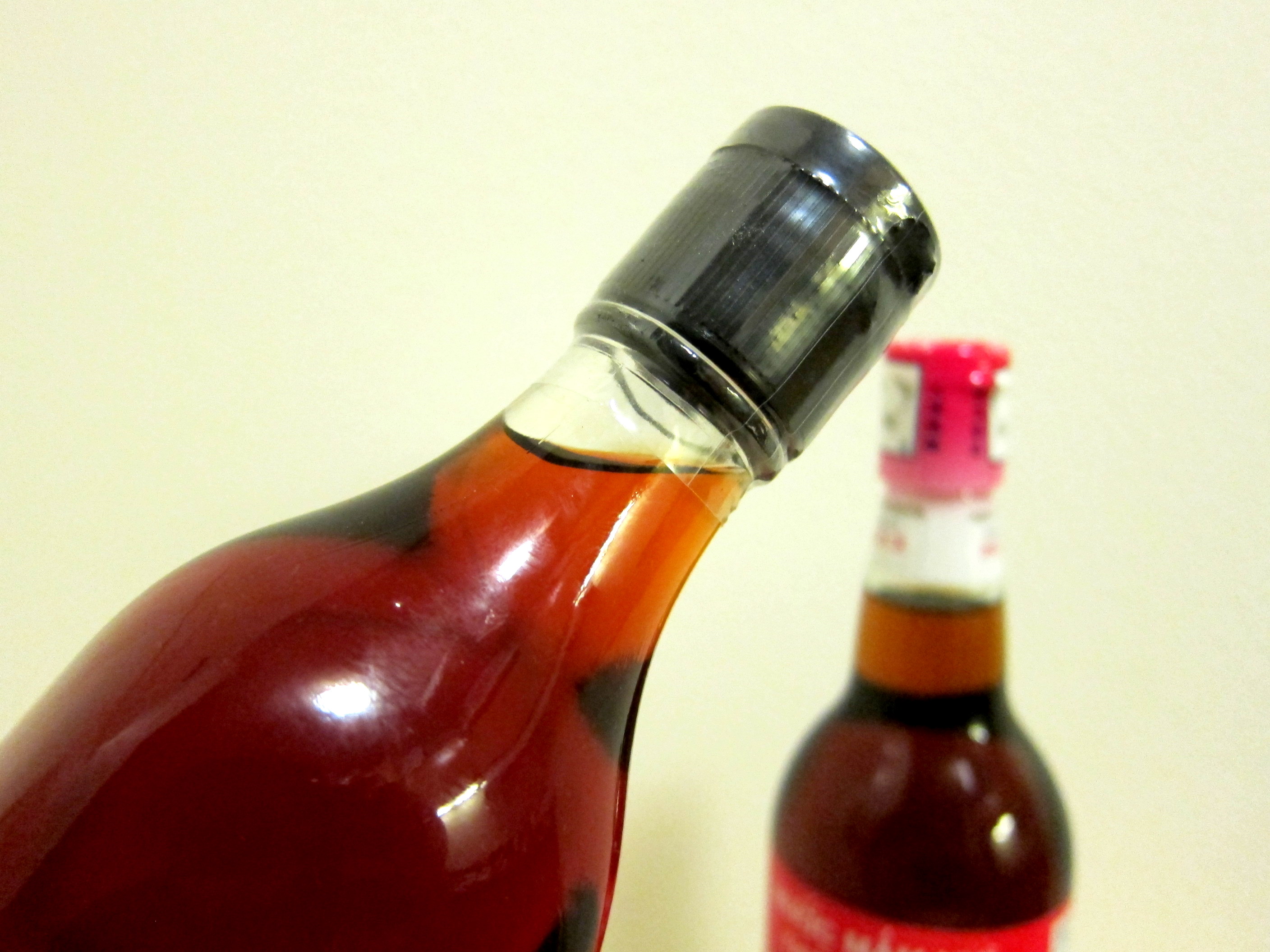
My interest was piqued. The glass bottle is stylishly shaped, the label has a clean design. Is this really the wonder liquid that my mom still remembers for years after tasting it once?

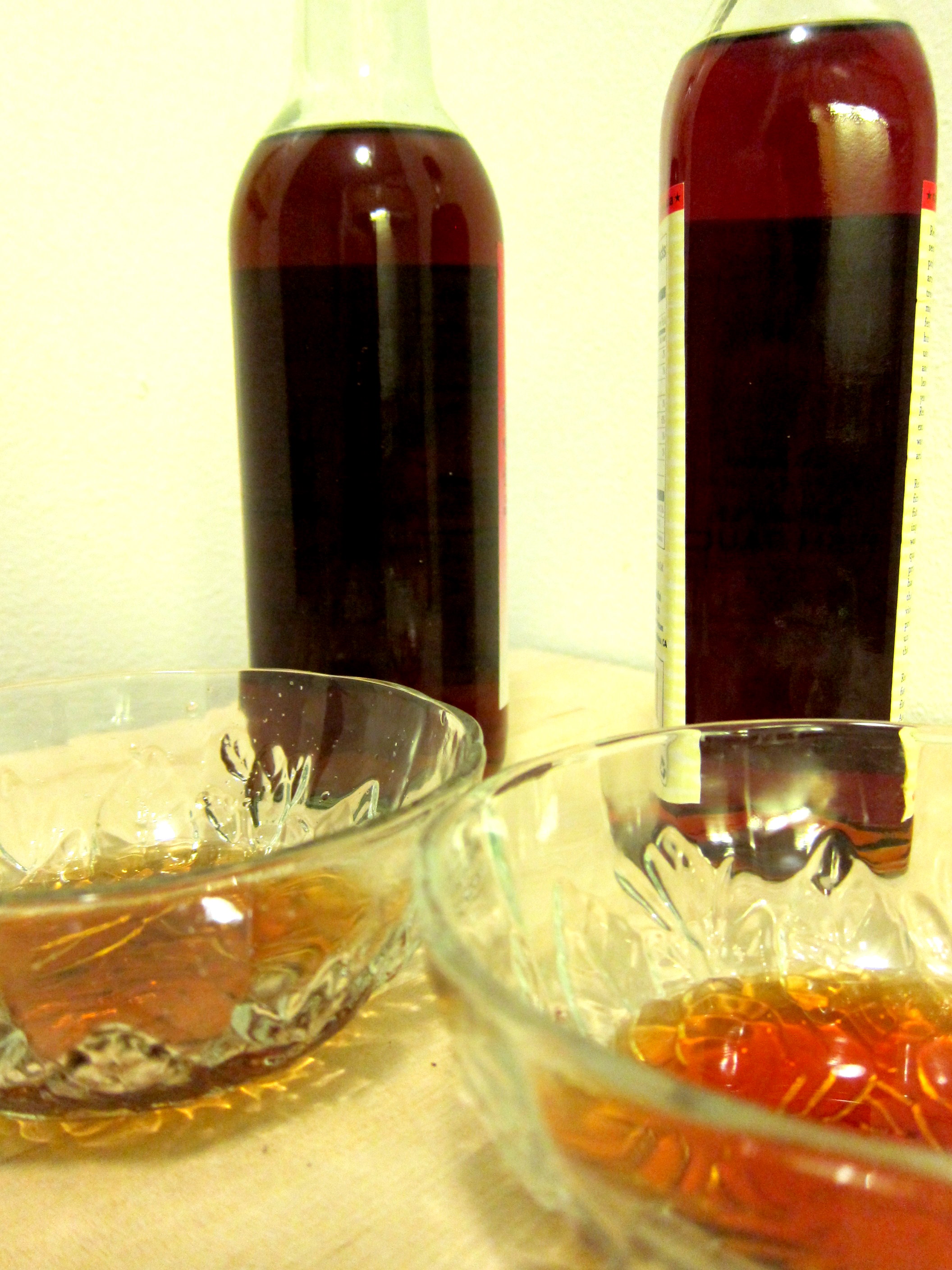
My pantry has a bottle of “Shrimp & Crab Brand – Premium Quality Fish Sauce” (Product of Thailand) that I bought some time ago on a whim. Now it comes in handy. First, a visual check.
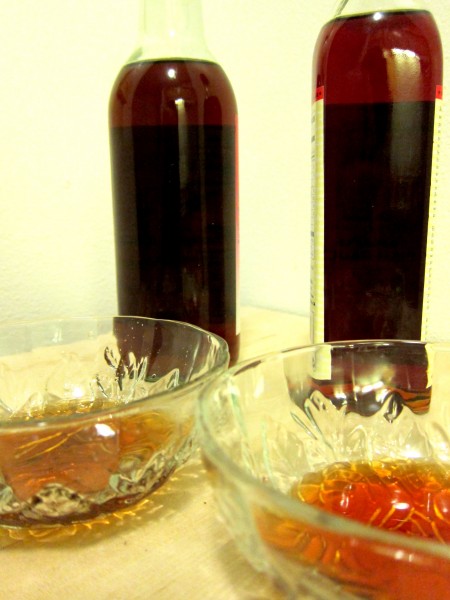

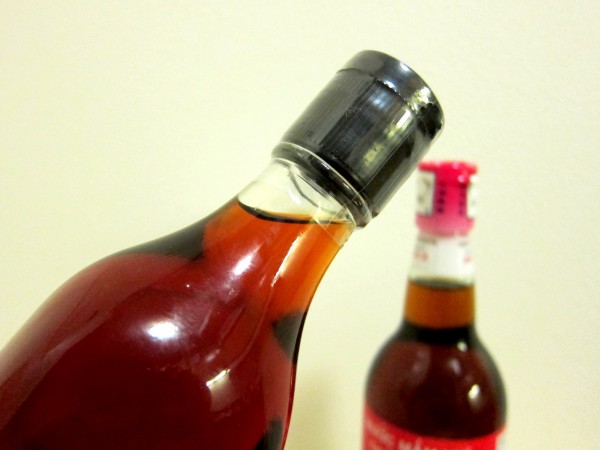
Red Boat: light brown with a red glow; S&C: dark brown with a dead yellow hue. I usually like yellow, but red wins this time.

– Viscosity check: S&C joyously streams out of the bottle like first graders out of school, while RB takes its time forming droplets at the hole. The discrepancy is slight but noticeable, especially if you check with a spoon.

– Smell check: RB is more solid but more pleasant than S&C.

– Taste check: [this is proof of my dedication to blogging. A lot of Vietnamese, my grandfather for example, put fish sauce (out of the bottle) on rice like people put butter on bread. I can’t. But this time, I taste a teaspoon of S&C, drink some water, and taste another teaspoon of RB. Then I repeat.] S&C: tastes like salt water with a stinging residual, RB: the immense saltiness dissipates after a few seconds, giving way to a faint but lasting sweetness at the back of the throat. This fish sauce is actually pleasant in its pure form!
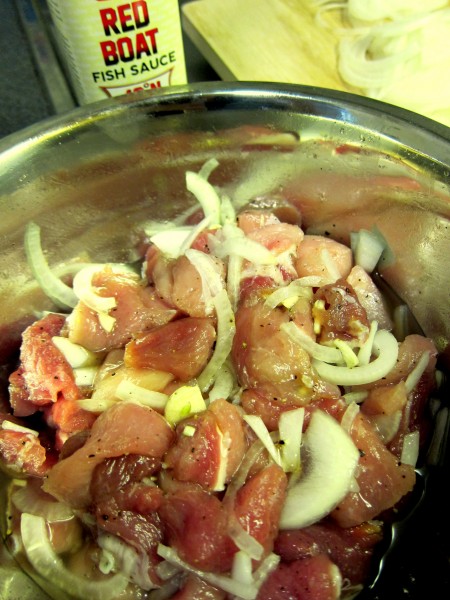

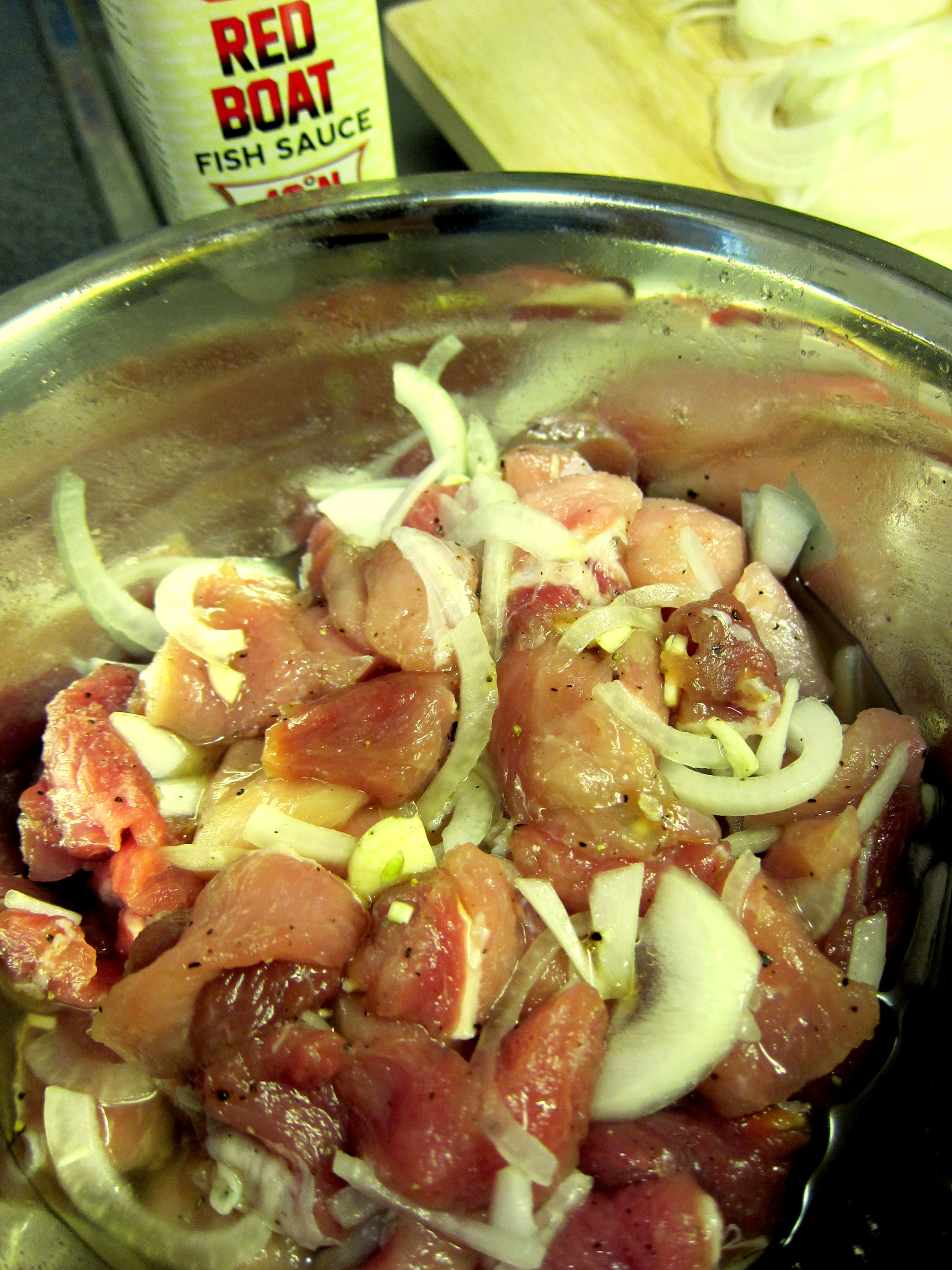
I marinate my pork with it. Bob has used it in every one of his inventions with meat. Rob has tried it in a Bloody Mary. All of them are great. Bob jokes about incorporating it into ice cream, which can be quite reasonable if it’s to balance out a caramel-laden scoop. How about a simple lemonade with Red Boat instead of the common salted lemon drink (chanh muối)? How about Red Boat in sugarcane juice? Red Boat cupcakes? Red Boat mousse? Red Boat truffle? Red Boat key lime meringue? Okay I’ll stop.

DISCLAIMER: Beside one free bottle of Red Boat, I made no profit in exchange for this review. This review was written completely out of my own interest for the product.