Flavor Boulevard

We Asians like to talk food.
Subscribe

Archive for the ‘Snacks’

Sandwich Shop Goodies 1 – Banh gai (thorn leaf bun)

June 09, 2010 By: Mai Truong Category: California - The Bay Area, Northern Vietnamese, One shot, sticky rice concoctions, sweet snacks and desserts, Vegan, Vietnamese


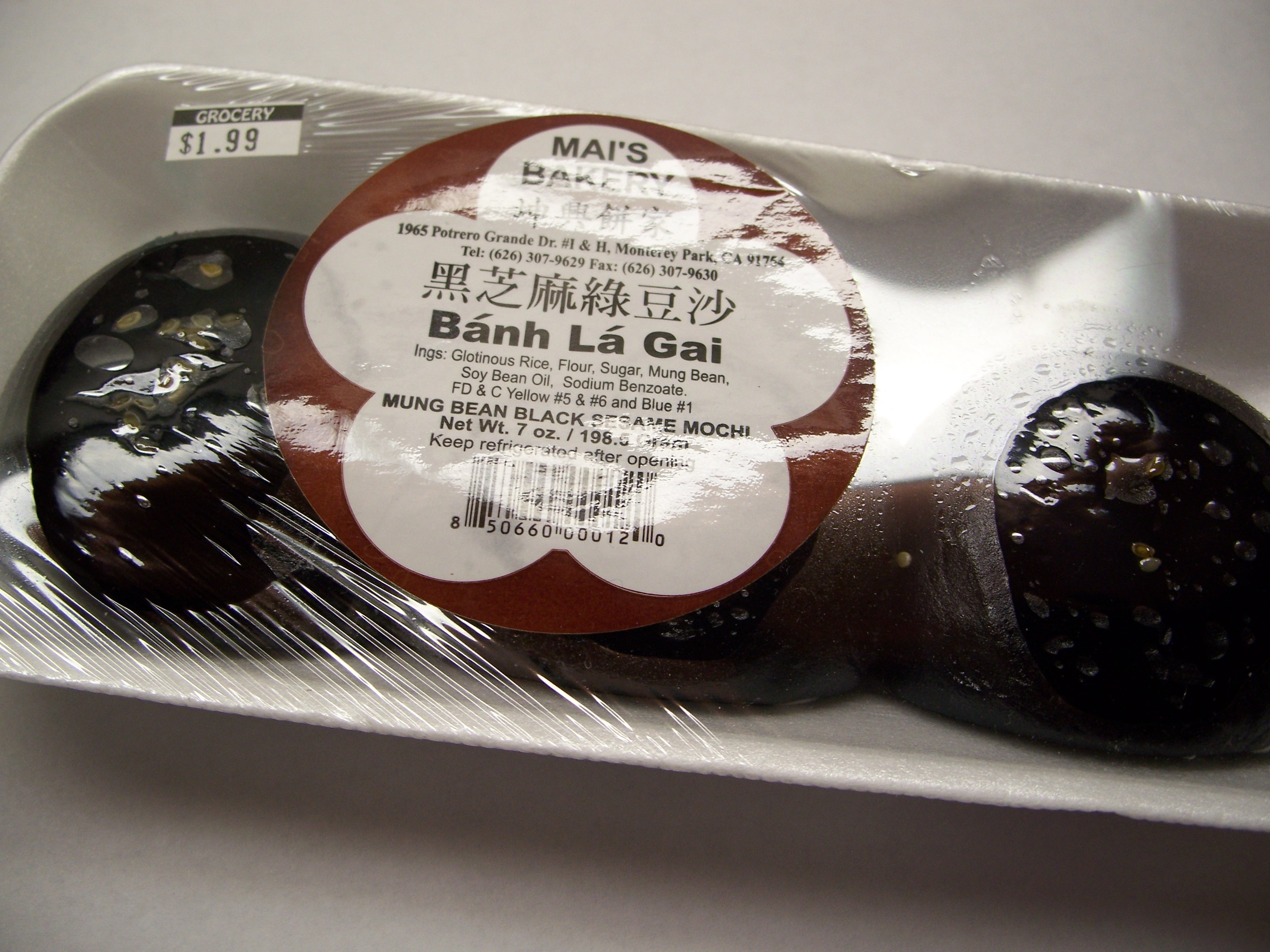
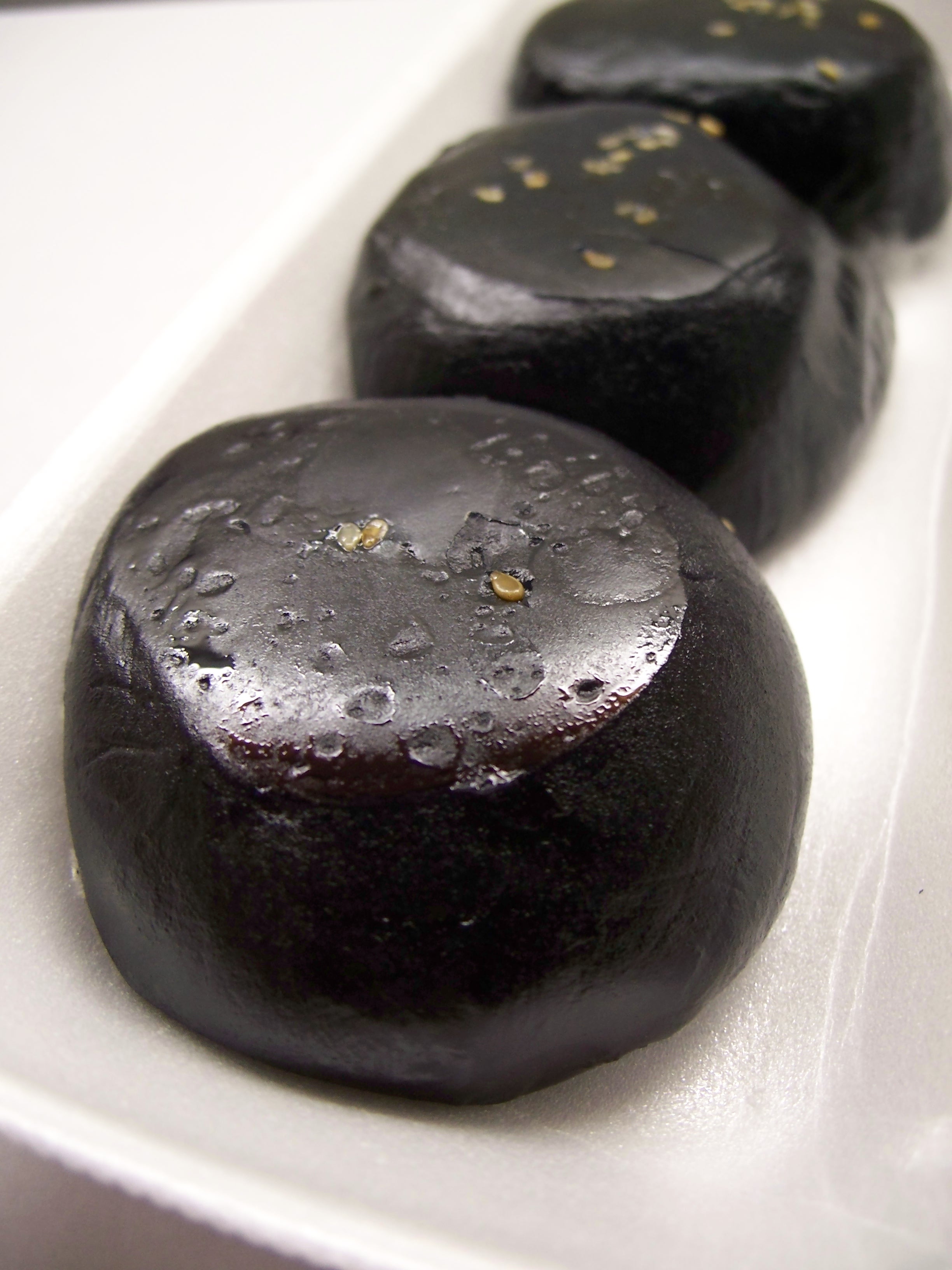
Sitting still, it looks like a rock. It is sweet with a hint of lard. It is chewy with a weak crunch, similar to a lasagna’s crust. The smooth, thick black skin shines like lacquered wood, but possesses an almost clear and cool embrace of jello. Though closely related to the superglutinous and mud-heavy banh it, banh gai takes it light.

The same everenduring stuff of Vietnamese villagers’ creations are thrown together, wrapped and steamed in banana leaves: sticky rice flour, water, mung bean paste, sugar. If you make it in cone shape and let the sugar brown the flour naturally, you get banh it. Go the extra mile of picking, chopping, sun-drying, boiling, and grinding the ramie leaves to a black powder that you would mix with your sticky rice flour in a 1:10 ratio, then after the fire settles you get banh gai.


Actually, you get the skin of banh gai. The thorny ramie leaves with silver underside give the black buns their color and trademark names, “thorn leaf banh it” (bánh ít lá gai), “thorn leaf banh” (bánh lá gai), or, most economically, “thorn banh” (bánh gai). But as proof of their everversatile imagination with ingredients, the villagers of North Vietnam mix the mung bean paste with shredded coconut, lotus seed, ground peanut, winter melon (bí đao) for crunchiness, and translucent cubes of pig fat or vegetable oil for a mild saltiness.


The thorn leaf buns sold in package of three for $1.99 at CD Bakery & Deli don’t have fat cubes, peanuts, and pieces of winter melon. They are wrapped with plastic instead of banana leaves. They are labeled “mung bean black sesame mochi”. They contain yellow and blue (?) food colorings. But I like their slightly sweet, slightly crunchy, slightly cool black skin.

After a week at room temperature, they get white mold. Perhaps, it is to match the white sesame seeds on top.

Address: CD Bakery & Deli (in the Lion Market plaza)
1816 Tully Road, #198
San Jose, CA 95122
(408) 238-1484
Open 7 days 8am – 8pm

Something else from CD Bakery: sugarcane juice

Next on Sandwich Shop Goodies: bánh bía (Vietnamese-adapted Suzhou mooncake)

Satsuki Bazaar on Channing Way

May 25, 2010 By: Mai Truong Category: California - The Bay Area, Festivals, Japanese, Opinions, savory snacks, sticky rice concoctions, sweet snacks and desserts


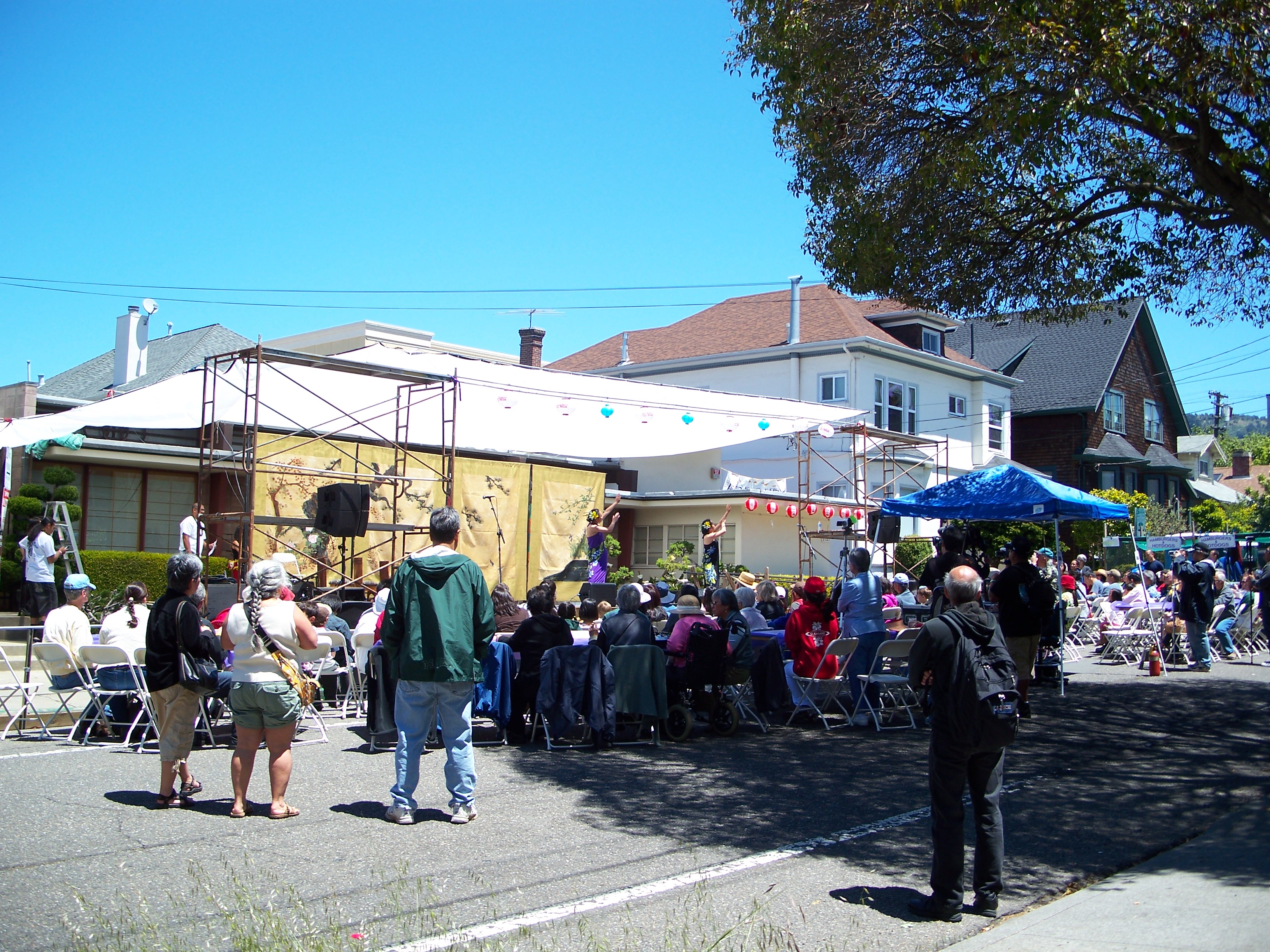
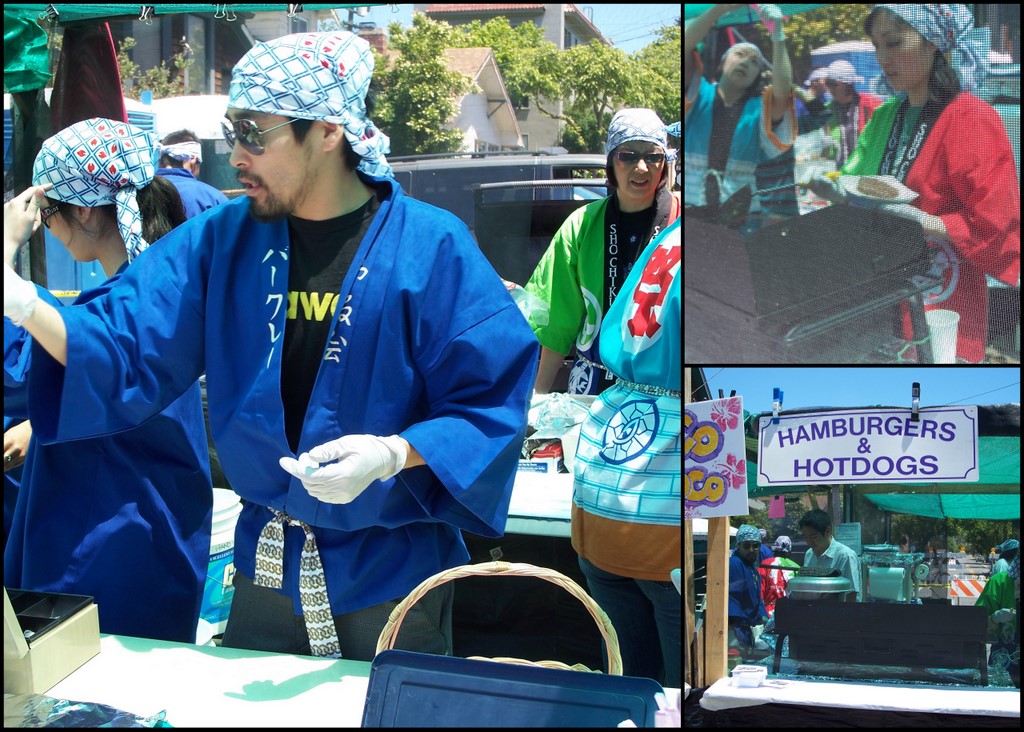
One blue-sky Sunday in May. A section of Channing Way, between Shattuck and Fulton, was blocked. Two girls draped in summery garments danced to joyous Hawaiian tunes on a sunlit wooden stage, surrounded by a small crowd of both familiar spectators and curious passing pedestrians. The seductive smell of grill beef got caught in the wind here and there.


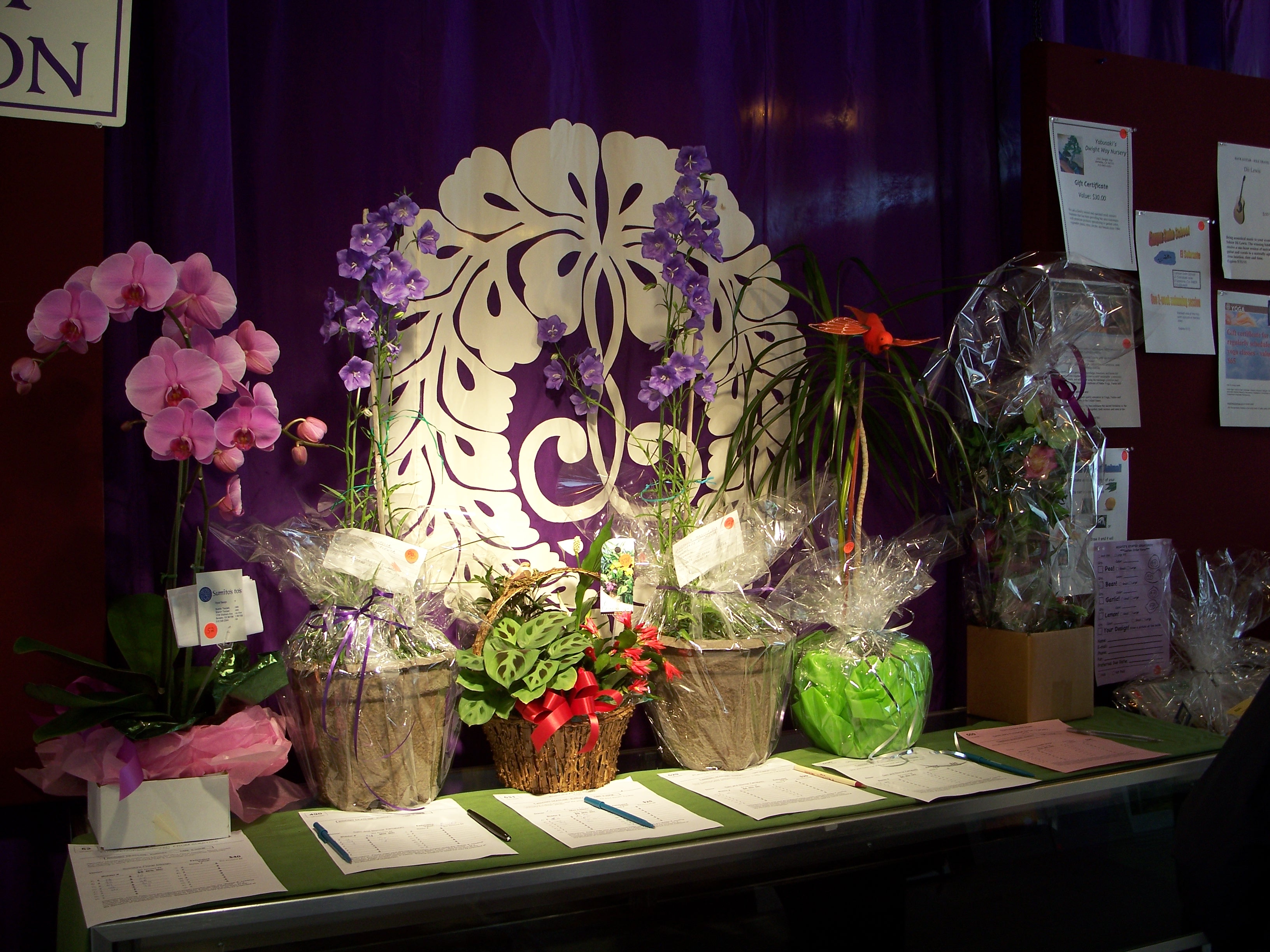
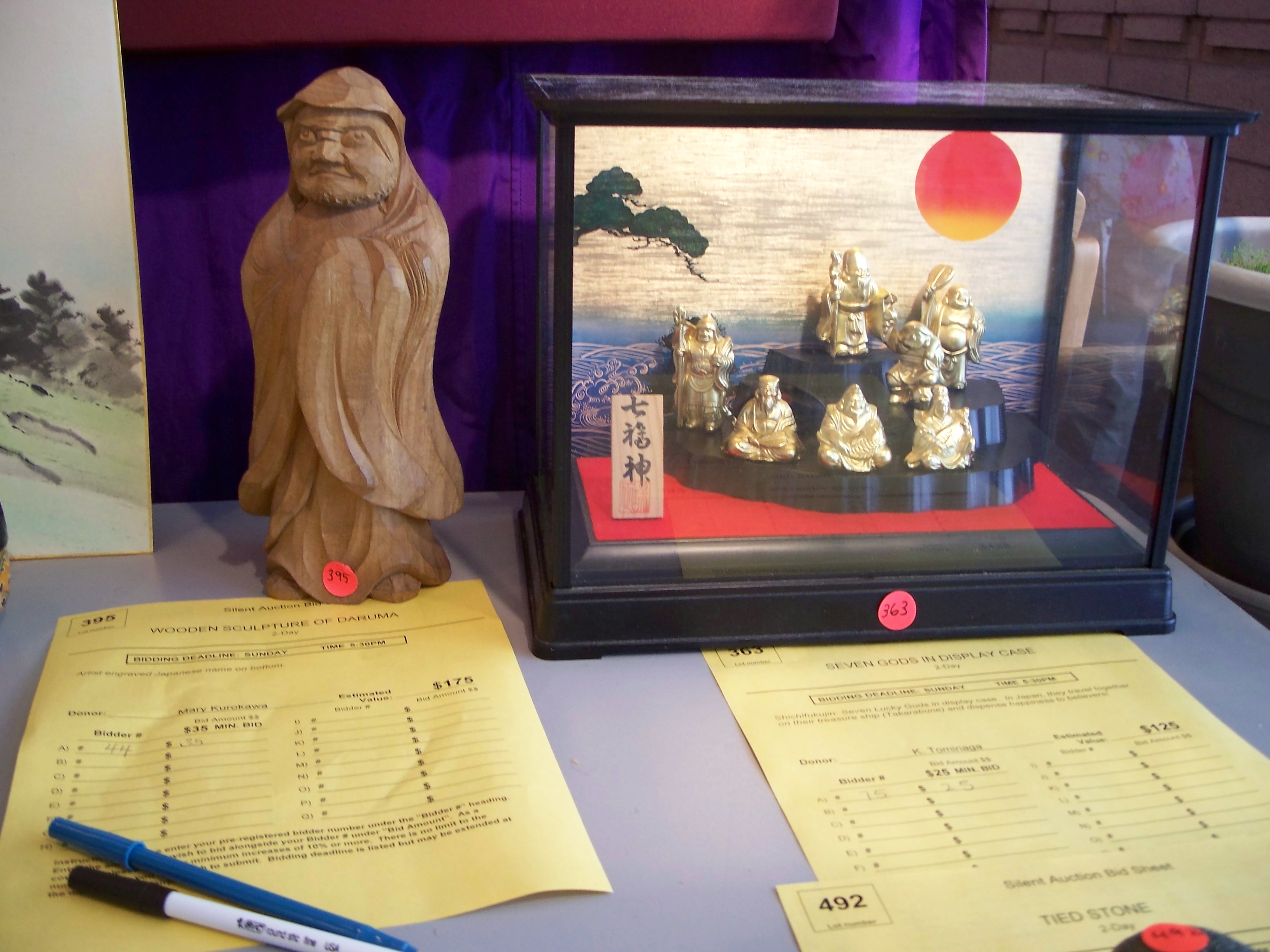
So it was the street front of the 61st annual Satsuki Bazaar and Arts Festival at the Berkeley Jodo Shinshu Buddhist Temple on Channing Way. Inside the temple, a multitude of items displayed for silent auction held visitors’ footsteps, starting with orchids, matted photos and paintings, gift cards to sushi bars and diving lessons…


…to porcelain sets, stuffed toys, a wooden sculpture of Daruma, and Shichi Fukujin in a glass box.


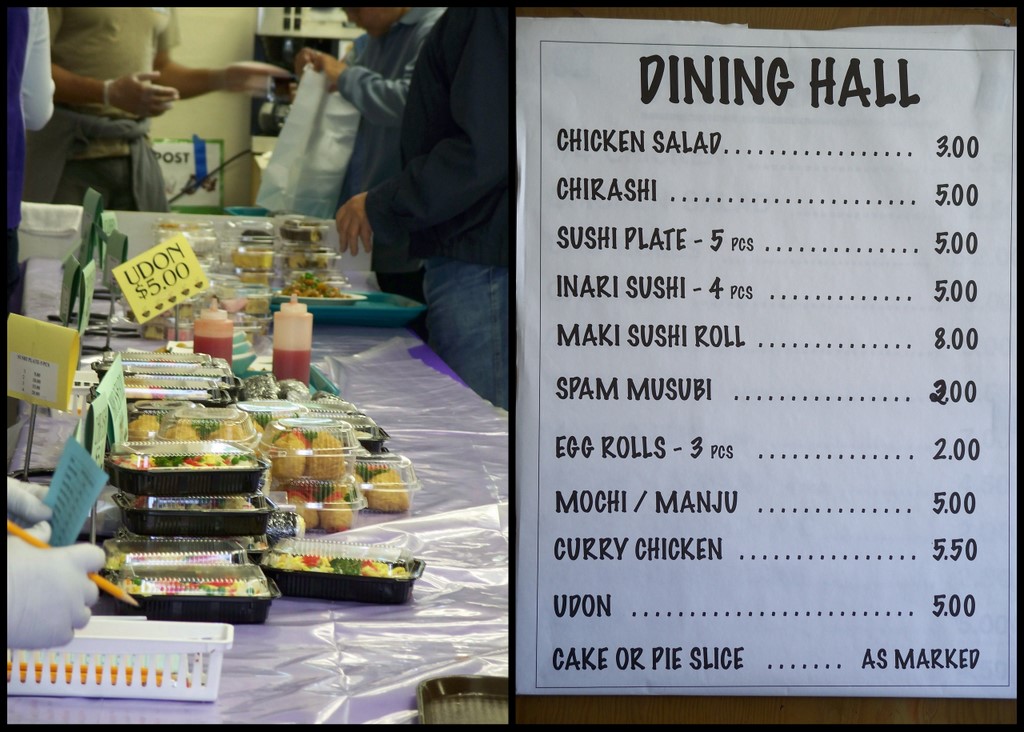
But few things can attract everybody like food. The “dining hall” was packed to the door like a beehive overflowed with nectar.


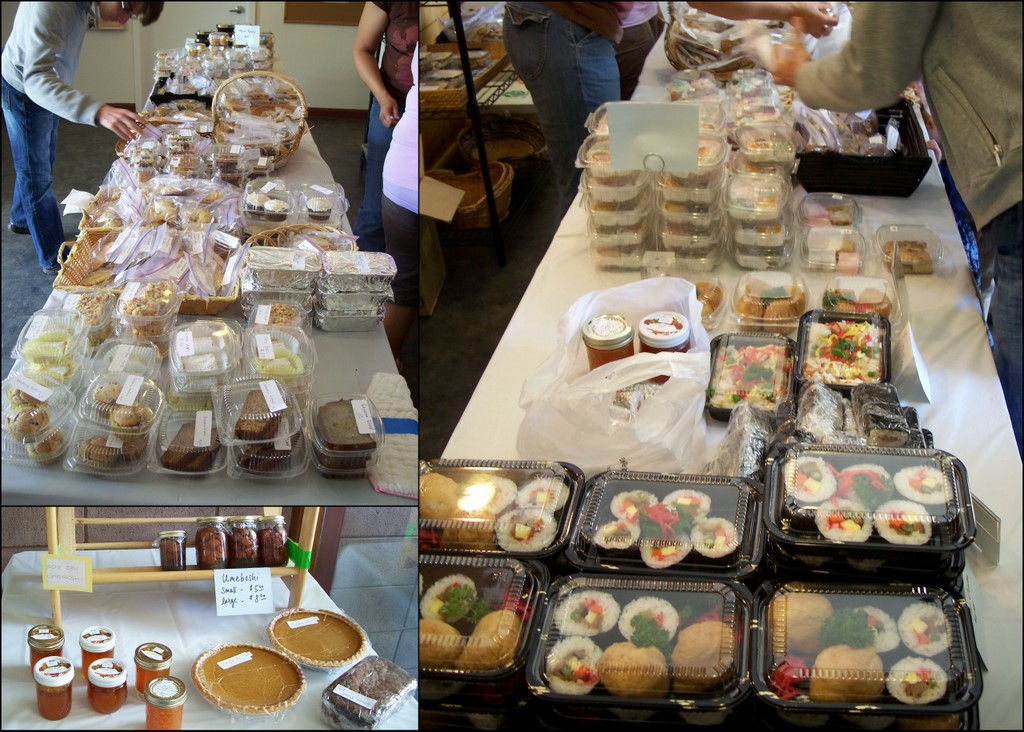
Every few minutes there were tiny old ladies weaving among the crowd with big trays of musubi and sweets from the dining hall to the “bakery”, a front desk covered with homemade edible goods, baked, rolled, fried, pickled, and jarred.


We just couldn’t help it. The umeboshi (pickled plum) was going fast at $5 per small jar and $8 per big one. Mudpie hungrily grabbed onto two jelly jars, kumquat ($4) and persimmon-pineapple-apricot ($5), which have the exact same color. Then we started loading pastries into our bag…


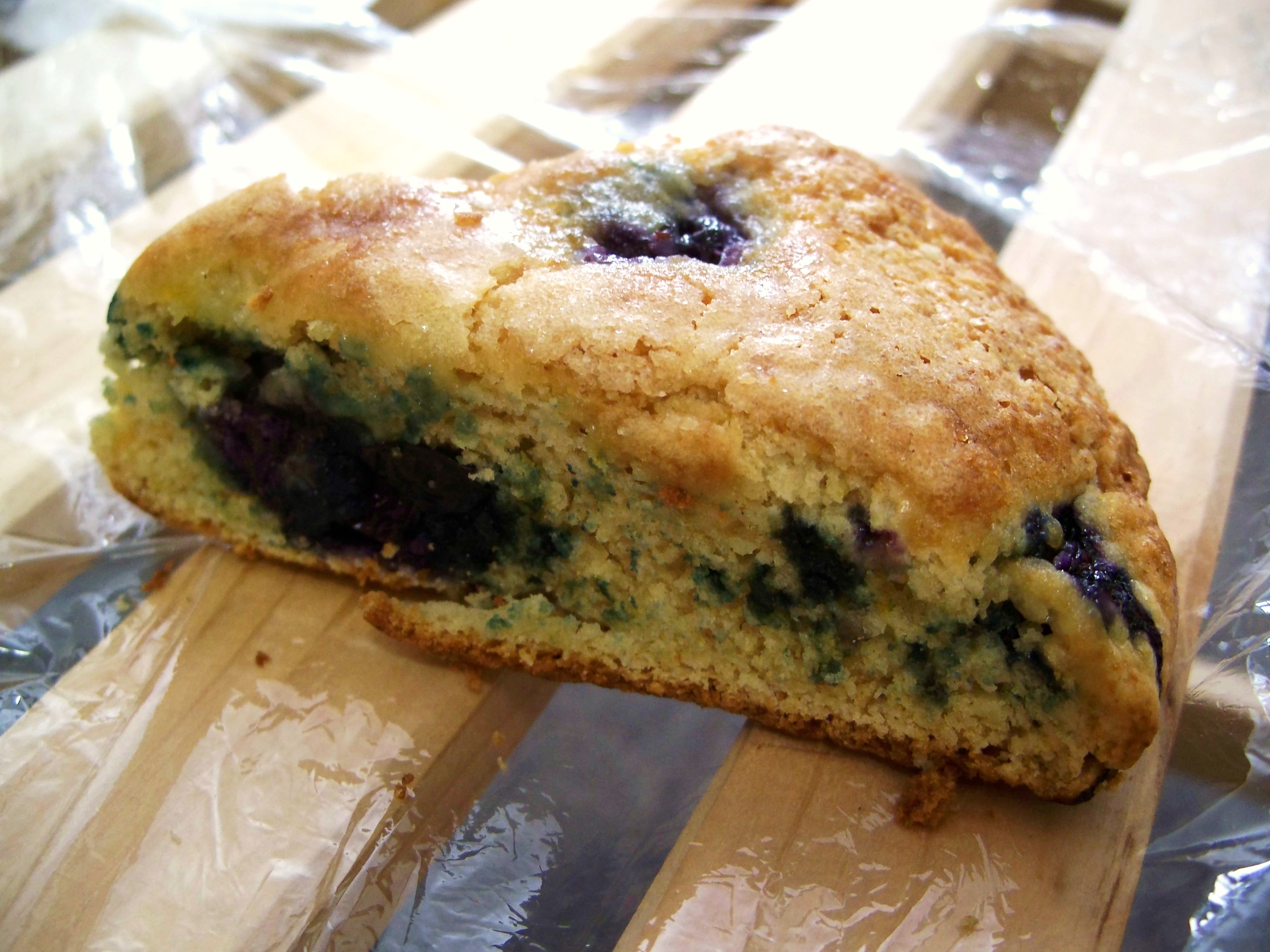
First came the blueberry scone, which tasted like wet sand, but we paid only one buck for it, can’t complain.


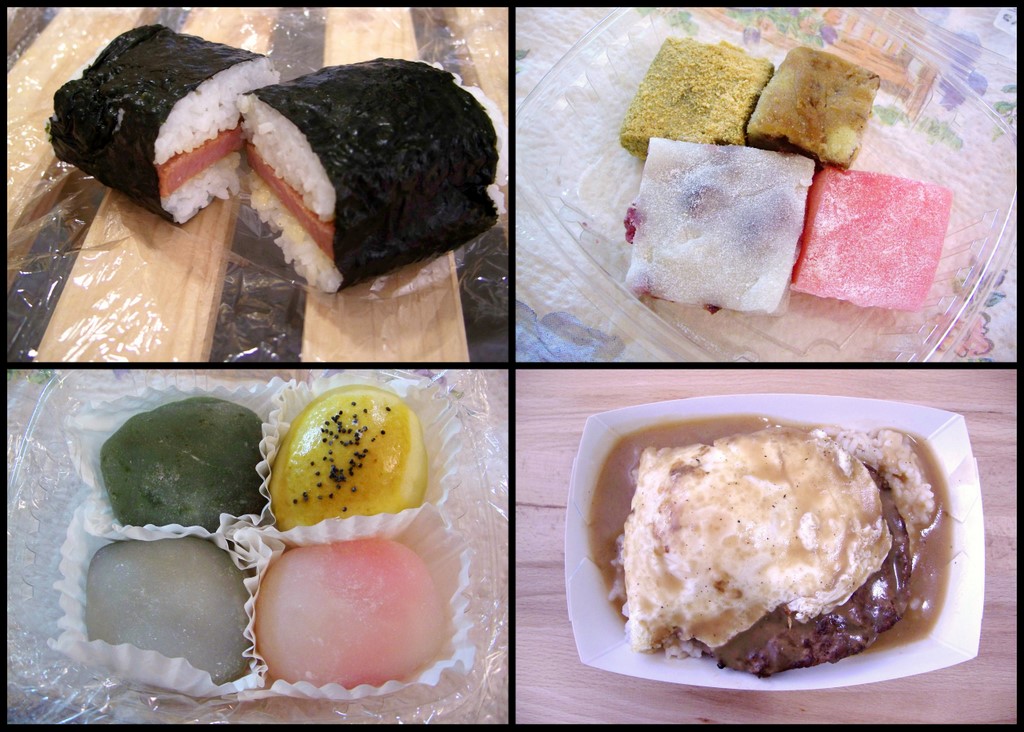
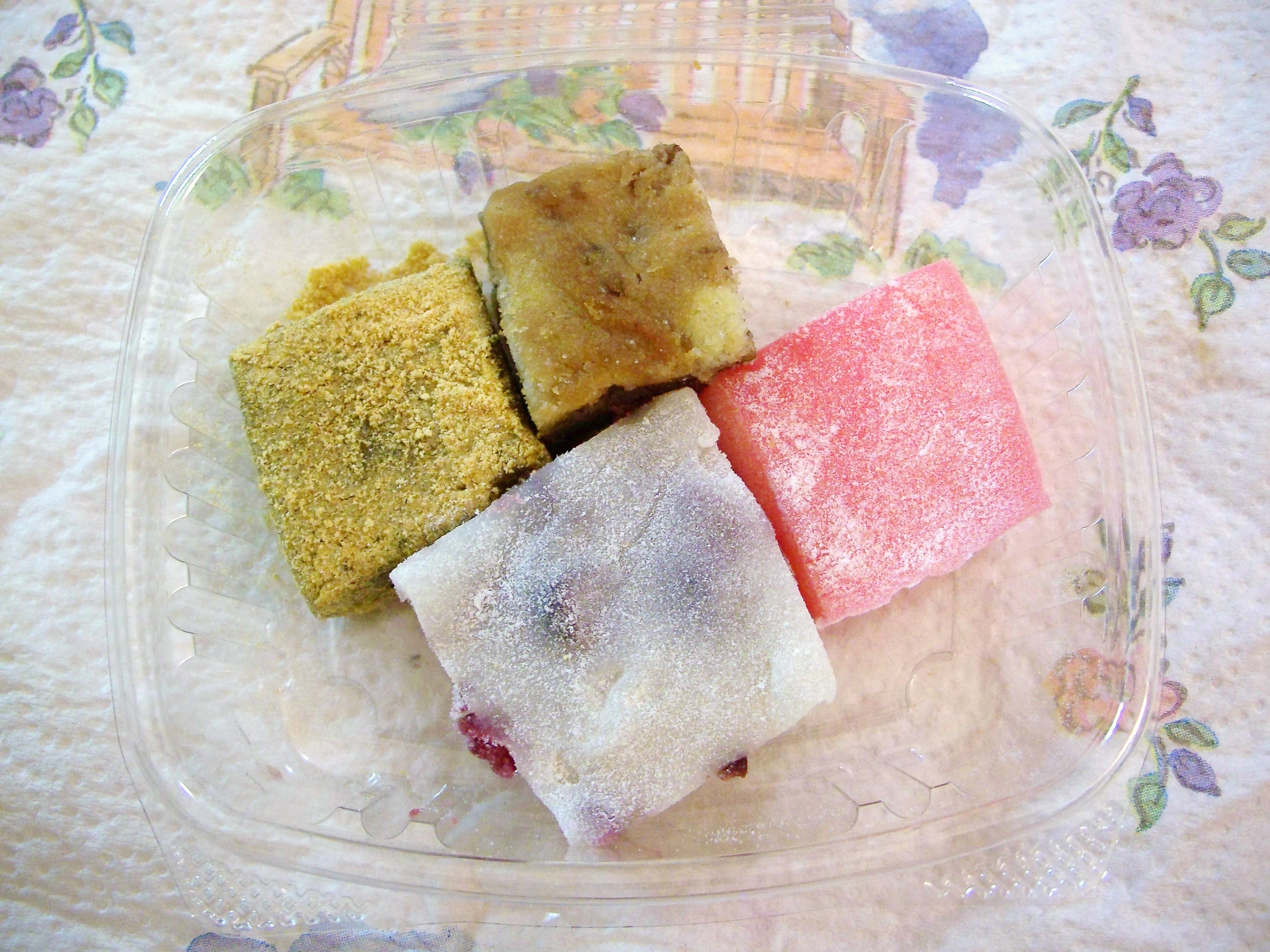
Then there were little squares of mochi (and a lonely piece of brown banana cake). Each square cost a buck too (and they are about 20 times smaller than the scone), but none was as good as the mochi cubes in front of Cafe Hana. Pretty scrumptious lonely piece of brown banana cake though.


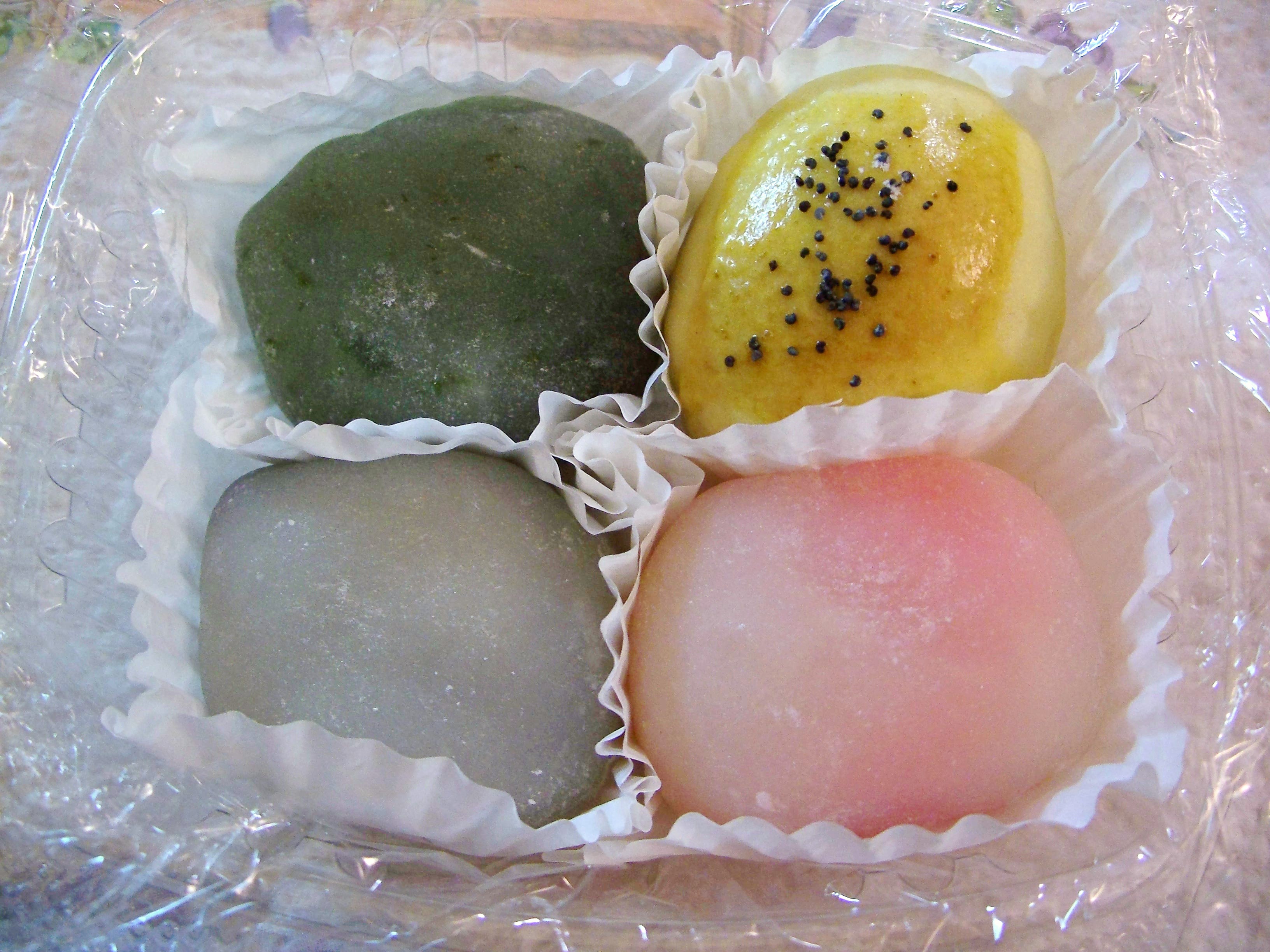
Now these are the real disappointment. The manju, mochi balls with red bean paste, looked so much better than they tasted. Is the yellow egg-shaped pastry dotted with poppy seed and filled with sweetened taro paste also a manju? Guess how much they were. $1.25 each. Sugar excess.


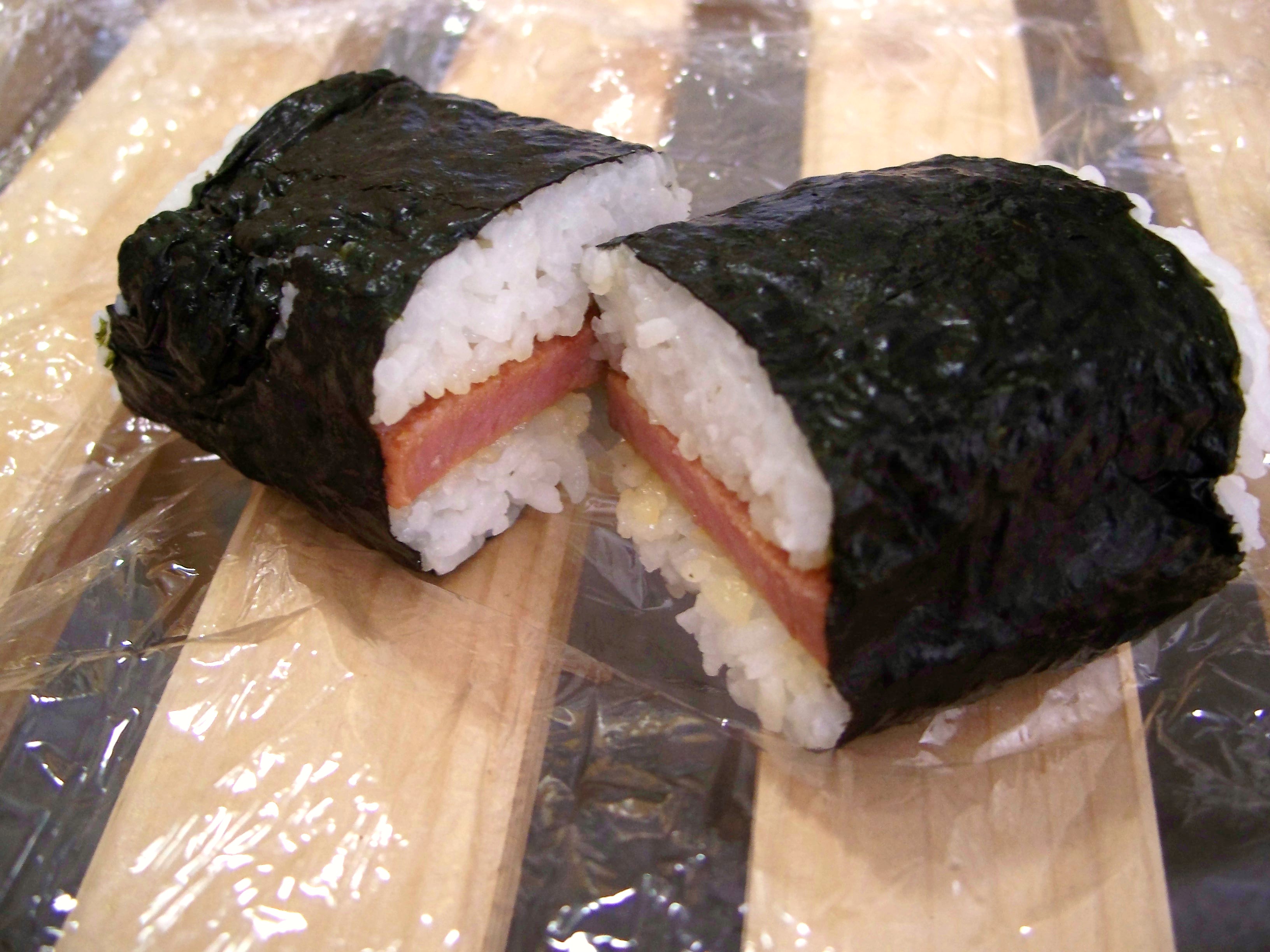
Fortunately the savory side is a greener pasture. The 2-dollar spam musubi hit the spot just right (processed meat always tastes so good after you reprocess it with sugar and soy sauce). The nori was mild, thick, and moist.


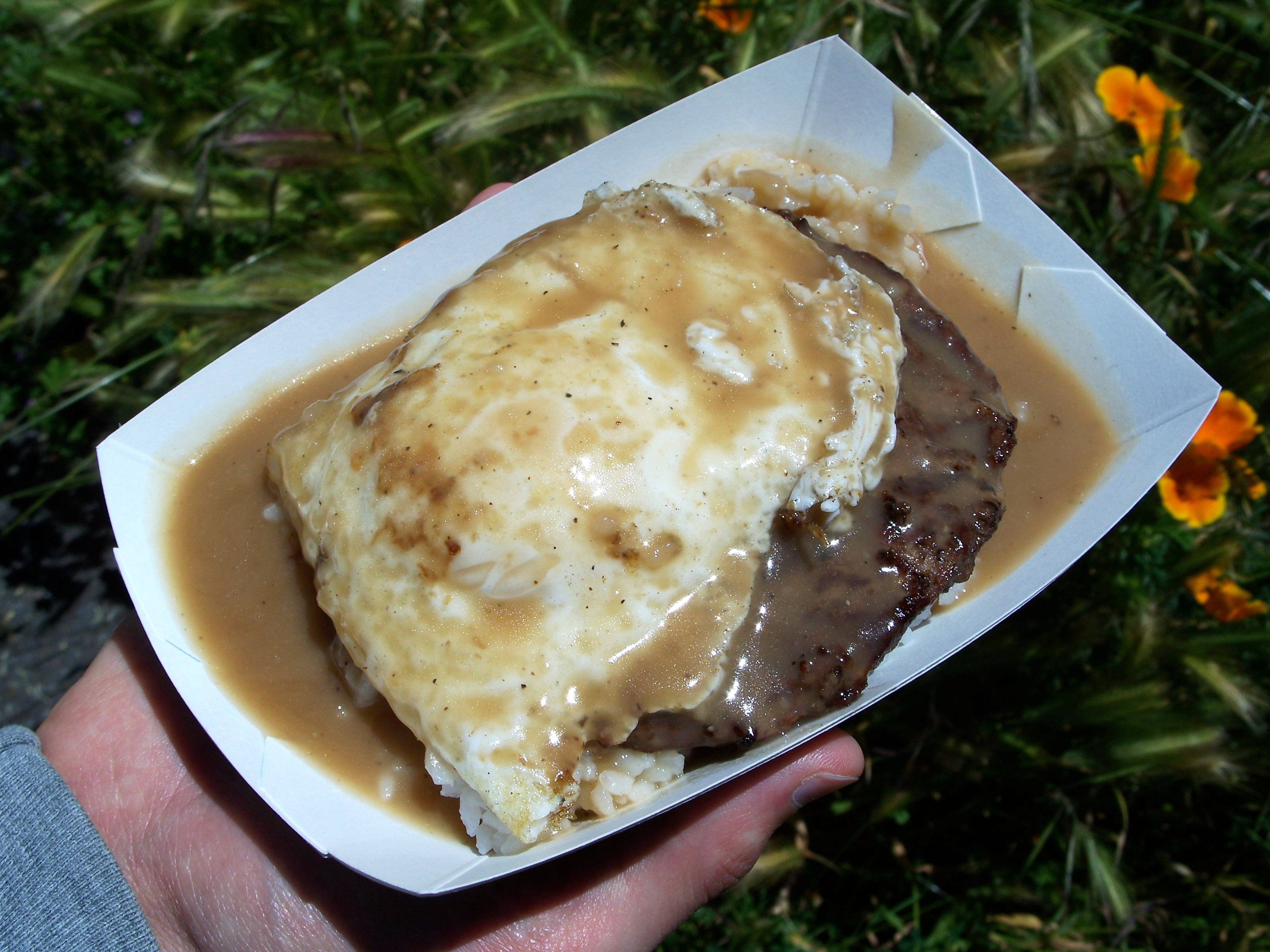
We top things off with a lustrous loco moco, a burger patty squatted on a bed of extremely moist short-grained rice, covered with a runny egg and a ladle of beef gravy. After one spoonful, Mudpie couldn’t stop thinking about it for the rest of the afternoon. The whole thing was like a peppery, creamy, rich butter boat. All for $5, and honestly it would be just as spoon-licking without the grilled meat.


And so I learned something new. At Vietnamese Buddhist pagodas, you can find only vegan food regardless of festive occasions or normal days. Here at a Jodo Shinshu Buddhist temple, there is plenty of meat, crackling and sizzling on one blue-sky Sunday in May.

61st Annual Satsuki Bazaar and Arts Festival, May 22-23, 2009
Berkeley Buddhist Temple
2121 Channing Way
Berkeley, CA 94704
(510) 841-1356

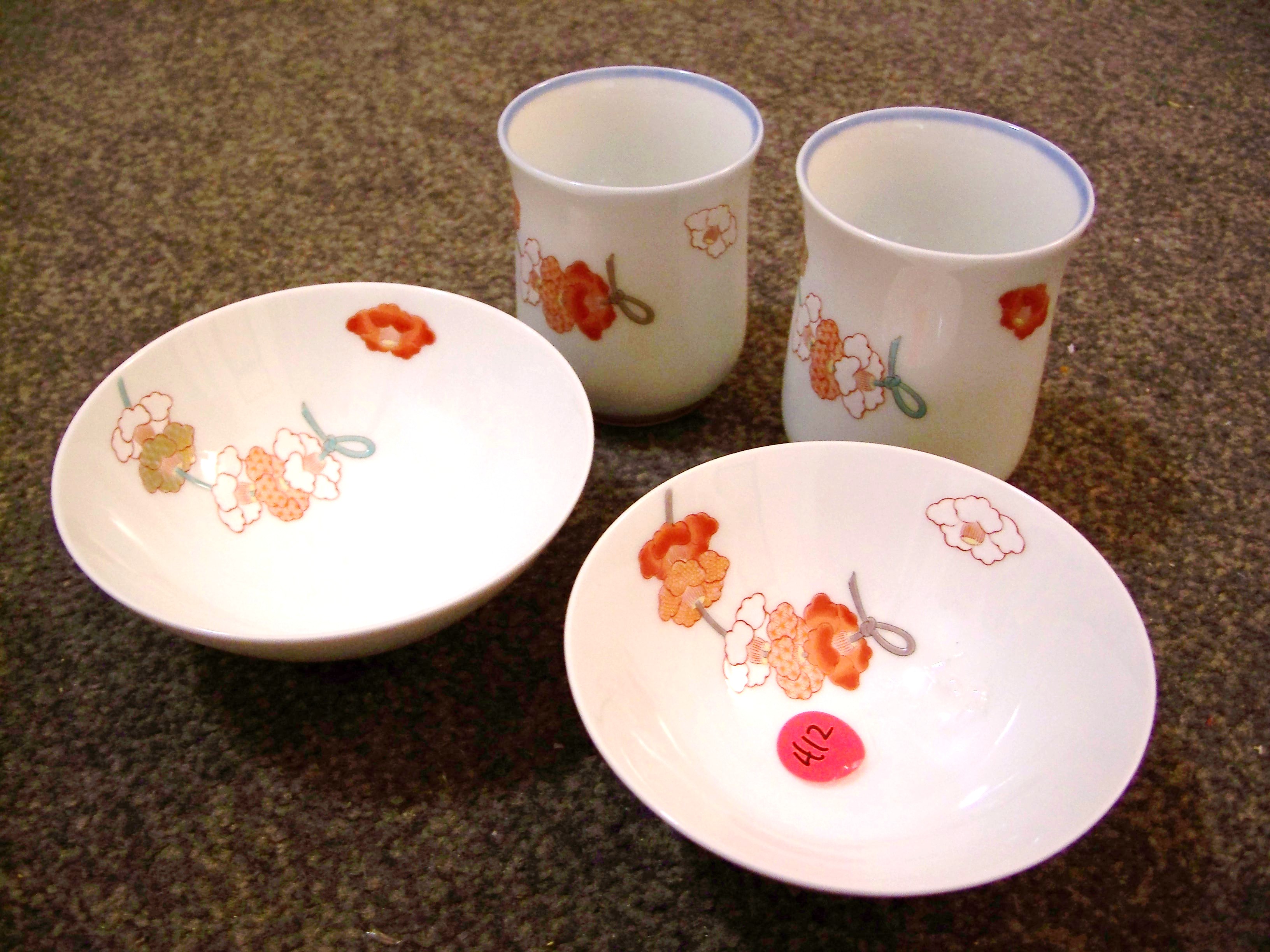
Update: I WON something in the silent auction: an adorable set of tea cups and tea bowls, notice the matching pairs with one tea cup slightly taller than the other. The visit was a success!

When the blossoms bloom

April 15, 2010 By: Mai Truong Category: California - The Bay Area, Festivals, Japanese, Opinions, savory snacks, sticky rice concoctions, sweet snacks and desserts


One Saturday we shove our homework into a corner and make a dash for San Francisco before another spring storm takes over the bay. Parking is as easy as hiking with a twisted ankle, but all that matters is we find a spot, then stroll a mile to the food bazaar on Webster street, Japan Town, arriving just a little bit before noon. Up from the steep sidewalk we see rows of white tents and white chairs, smoke rolling above the grills covered with beef and pork riblets, a line getting long on one side of the conglomeration. It is still early in the first morning of the Cherry Blossom Festival.
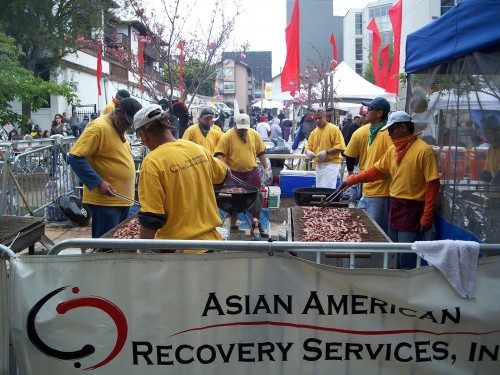

The carnivore instinct leads me right to the grill. It’s never too early to eat meat. The first booth whips out rice bowls with either ribs or unagi, braised eel cut into palm long chunks. We don’t feel like filling up with a rice bowl just yet, so we walk further down the row eying signs, then back track to the Nihonmachi Little Friends’ booth for three skewers of grilled beef at a mere five bucks.
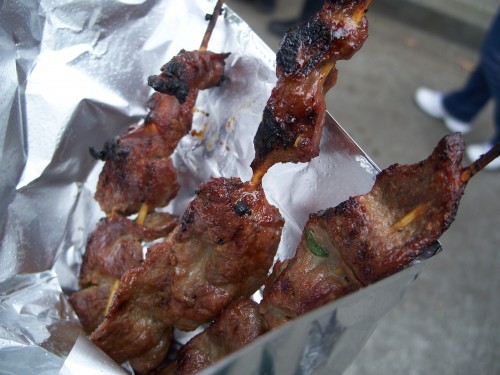

Crispy-charred-edge marinated beef, though erring a little on the chewy side, delight my feet after that hike from our parking spot. The downright old school meatiness would have well enhanced the kiddie dollar snack omusubi, wedges of plain white rice mixed with nori bits, which Mudpie buys way after we finished the skewers. Waste not want not, the musubi will find its place in my lunch this week, after I wrap it up in nori sheets and maybe with a slice of fried spam. My idea sprouts from seeing at least three booths selling spam musubi and dozens of family walking around with golden brown sauce at the corner of their mouths. I, however, fall victim to the facile yakisoba, soft stir fry noodle with crunchy cabbage dressed only with soy sauce and seaweed sprinkles. The noodle tastes flatter than it looks, and certainly flatter than the wad of six dollar bills we pay for it, but it is a good pacifier for the empty stomach.

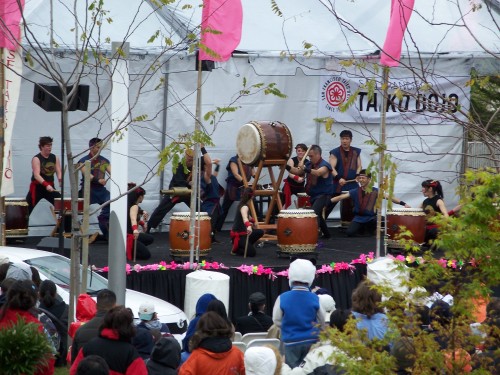
One block east of the food tents, the San Francisco Taiko Dojo artists are pounding their drums on stage. Their vigorous sincerity pumps rhythmic waves of festive air into the onwatchers’ lungs. To the hundreds of Japanese gathering there, I wonder if the drums have the same effect as the firecrackers we set off on Lunar New Year’s Eve, a simple string of sound that brings both excitement and quietude. The drums do halt my hungry thoughts for a moment, until I see some kids weaving about the crowd holding teriyaki burgers and shaved ice.

We’re back to Webster. The teriburger line wraps around one end of the food square, and Mudpie refuses to take one for the team. The fried fish ball line is no better, but I want to find out what the frenzy is all about, whether Mudpie does or not.
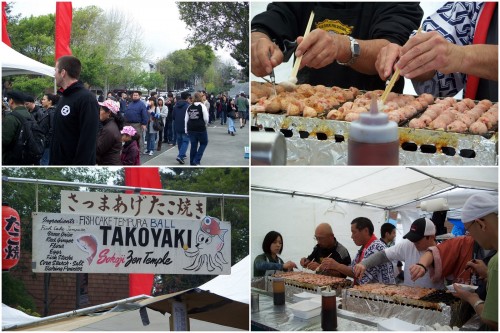
Just as we get in line, a lady asks us if we know the fish balls are any good. We don’t. So during the twenty-five minute wait the lady and Mudpie go over what is up with the LHC in Geneva, current status of the string theory job market, Berkeley Bowl, the beautiful harmony between Eastern religions and sciences, Francis Collins, and which patisserie is the best in San Fran. Meanwhile I can’t take my eyes off her unagi rice bowl, the eel skin shines gloriously in its rich brown sauce. Slowly but solidly we get to the tent where all the pouring, flipping, and toothpicking take place. The cast iron molds are just as busy as the deft hands hovering over them.
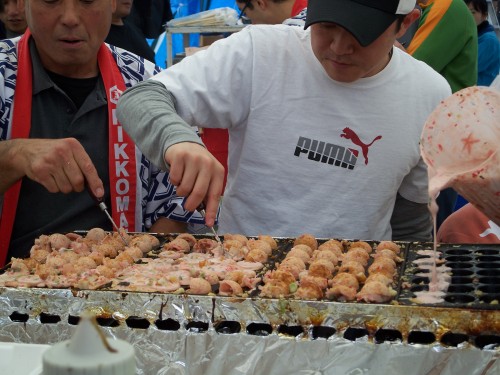
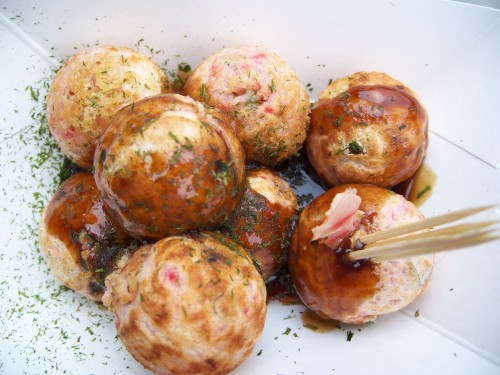
Although the man jokingly says it’s a secret recipe from Japan while he collects orders, this fish ball booth is the only booth with a crystal clear ingredient list on the banner. Although it is called takoyaki (“fried octopus”), it’s a simple ball of batter, fish stock, egg, and seasonings. (Still, it resembles an octopus head, intentionally or not.) Although it looks perfectly solid, it has an air pocket inside, resulting from the flipping of the hemisphere while the batter is still runny. Although it is fried, it is soft. Although the long line suggests that it is amazingly worth the wait, it is not. The seaweed sprinkles, red ginger and green onion do little more than cosmetics, the okonomiyaki sauce is rather too tart. Its goodness lies solely in the warmth to battle those crisp wind blows. In hindsight we probably should have stood in the teriburger line.

As the tongue craves for some sweets, we walk around to the grilled beef and yakisoba side, this time to stand in line for a red bean pancake, imagawa yaki.
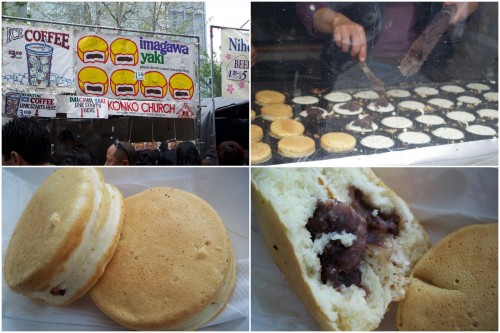
imagawa-yaki (pancake with red bean paste)
The fluffy dough is just like any pancake our mothers make for breakfast on special days. The making process, like those fish balls, is fun to watch. They pour the batter into rows of circular iron molds, wait a few minutes for the batter to semi-solidify, then comes this semi-circular trough, looking  like a cracked-open bone filled with marrow, from which they spoon some red bean paste onto half of the cooking pancakes. The other half are flipped over to make the pancake tops. The batter turns solid, the division between two halves is sealed, three bucks are handed over for exchange of two blowing hot cakes. Mudpie loves the bean stuff. So much that he insists on looking for more inside the Kintetsu mall. I feel more inclined to sitting down, and those benches near the Kinokuniya bookstore and Izumiya have never sounded better. So into the mall we go.

But boy am I a fool. On days like this benches are a luxury, and it’s just rude to fight over a seat with the petite ladies in colorful kimonos and huge wooden zōri, or families with babies. The mall is packed. The human flow is like a school of salmon. My tiny stature serves me well in whizzing through elbows and shoulders, but I would have missed the best catch of the day had Mudpie not spotted the nameless but busy tables in front of Cafe Hana.
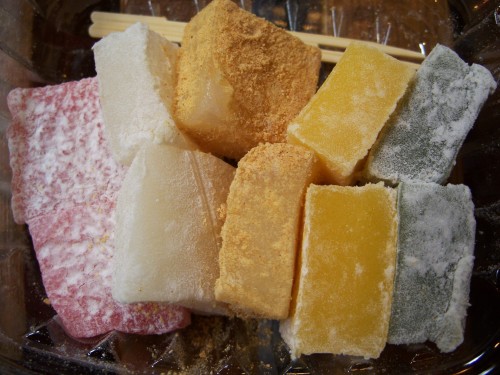

Ten bite sized cubes of cold mochi, five different flavors. From right to left: 1. yomogi (mugwort) – tastes as grassy as its alternate name kusa mochi – “grass mochi”, 2. mango – tastes more like jackfruit or longan, 3. kinako – actually this is warabimochi (jelly-like sweet made of bracken starch instead of sticky rice), covered in soybean flour (kinako) which tastes like peanut butter, 4. lychee – the second tastiest, and 5. strawberry – the tastiest. Chewy, refreshing, gently sweet like a rose petal, I would eat these all day. The best part: it is assembled upon request. The confectionery magistrates, who may be part of Cafe Hana’s team, cut and roll these slabs of sweets in powder and into the plastic boxes, each containing only one flavor. But if you kindly ask, they’ll throw together a mixed box for you at the same price. Top it off with a three dollar scoop of lychee ice cream, as we do, and you’ll feel ten or fifteen years younger. You know, those days of hustling about the school cafeteria, eating cheap treats, feeling fresh and complete. If there’s anything I don’t regret buying at this fair, it’s the lychee ice cream and the mochi at those tables in front of Cafe Hana.

If there’s anything Mudpie doesn’t regret buying at this fair, I think it’s the daifuku, also from those tables in front of Cafe Hana. That red bean addiction is strong.
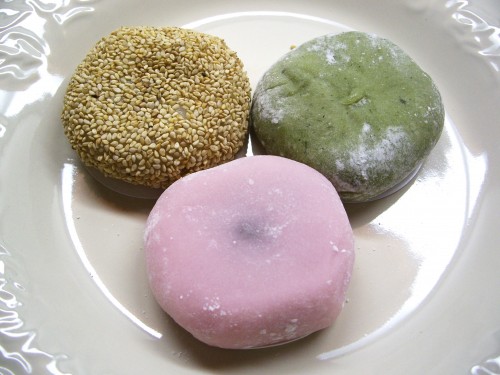

Pink or green, smooth or sesame coated, the daifukus are good companions for chrysanthemum tea. The plain, chewy sticky rice outer layer damps the sweetness of inner red bean paste. The cold confection enhances the warm drink.
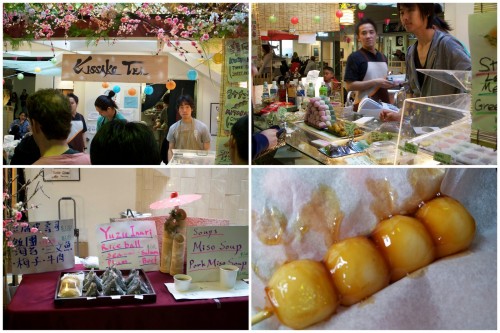
mitarashi dango
On our way out of the mall, we sidestep in line for one last treat at the flowery booth Kissako Tea. They have the little mochi balls in pink, green, and white with red bean paste filling, and they also have the mitarashi dango, which I’ve always been curious about since I read Sugar Bar Diva’s toothsome post. Four simple sticky rice balls on a skewer sounds like a boring snack, but the chewiness dressed in a rich syrup of soy sauce, sugar, and starch is everything but plain. Its taste and texture amazingly resemble malt sugar. It marks a triumphant incorporation of savory condiments into the sweet realm.

At four something in the afternoon, the food bazaar is still going strong. All booths, not just the fish ball and the teriburger, now have a long line. The kids are still with wide open eyes, Hello Kitty headbands, spam musubi and cups of shaved ice. The dogs are still obediently looking at their humans eating beef skewers. The girls in black and white kimonos are still taking pictures between giggles.

And so we march our full tummies a mile back to the parking spot. The sky is blue. The streets are quiet. The wind has ceased its dry cold swirls. The car stands there, with a ticket.

The avocado’s sweet side

April 09, 2010 By: Mai Truong Category: Comfort food, Opinions, RECIPES, sweet snacks and desserts, Vietnamese


Who do you think is more confused about his identity, the penguin or the avocado? The penguin is the prime example of a bird that can’t fly. The avocado is the most commonly known fruit that doesn’t taste like a fruit. It lacks the citric hint of berries and oranges, the crunch of apples, the pulpiness of peaches and plums. If I were an avocado I’d ask myself several times a day, why did mom and dad make me taste like butter and different from every other fruitie at the market?

A good avocado mom tree, like all good moms, would say “Av, being different is a good thing!”.
– But I don’t get to hang out with the other fruits, they say I’m fat.
– The other fruits can’t make Ice Cream by themselves. They’re only side flavors. You can become Ice Cream all by yourself.
– If Sugar helps me.
– Sugar is nice, but you also have what it takes to be a good Ice Cream. And think about what you can do for others if you learn from Butter and Cheese, you have their smoothness too.

If I were an avocado, that’s the story I’d tell when people ask why I decide to join the Sushi corporation and partner with Tortilla Chips. But just between you and me, I actually prefer my alone times with Sugar in the fridge.

3-minute dessert: Avocado “ice cream”:
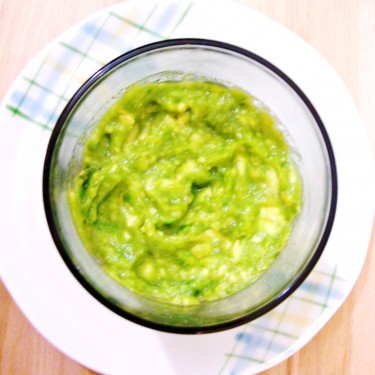
Scoop the avocados out of their peels and into a glass. Add sugar sporadically between layers of avocado, if possible. If not, add sugar on top at the end of the scooping process, but before mashing up the avocado. Mash, taste, add more sugar to liking, taste again.
Refrigerate.
Spoon.
Lick spoon.

Some crepes are better than others

April 06, 2010 By: Mai Truong Category: California - The Bay Area, Comfort food, French, savory snacks


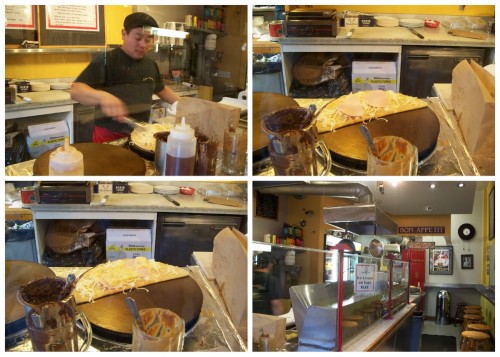
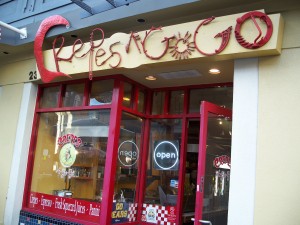
My cravings fluctuate from time to time, and it’s not always rational. One time I bought two kilos of prunes, ate some for a few days, now the rest are sitting patiently in my pantry. Then I used to have a crush on chocolate bars, the result is an almost complete collection of Endangered Species Chocolate wrappers, but a few bars have been on my desk for over six months. As of late, I’ve grown a crepe tooth. A matchbox kitchen fifteen-minute leisure walk from Sather Tower, called Crepes A-Go-Go, is to blame.


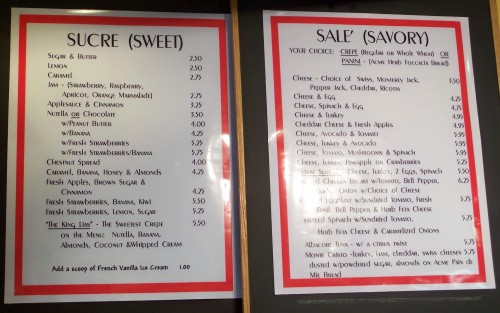
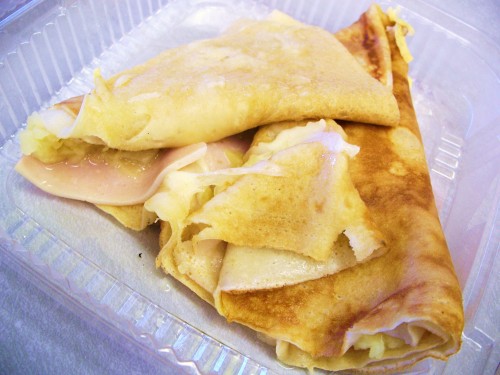
A quick drop of sound sizzles when the spatula folds and presses the fluffy layer. The oversize pancake lies supine. The heat is low. The quiet, stout chef casually sprinkles some Swiss cheese and some pineapple; he seems bored, or maybe I’m just too excited. I like my crepe soft and thick. Heck, I even like my banh xeo soft and thick, no matter how many people tell me that a qualified Vietnamese sizzling crepe should be crispy and paper thin. I watch the cheese melt. The chef lets the doughy pancake rest a minute or two, then deftly folds it again into one sixth of a disc, sweeps and swings it into a clear plastic container. My five-buck-and-a-quarter dinner to go seems sluggish and content like a well-fed baby pig.


And soon I am one happy hog myself. The cheese-turkey-pineapple crepe is a rich and chewy mess. The first bite is so good I ditch the plastic fork (which doesn’t do much at cutting anyway). Pineapple juice streams out at the tip as I scramble to bite sideway, and when the crepe reduces to a sizable conic chunk I use it to wipe clean the juice. The last mouthful is as rewarding and lingering as it can be, my fingers wet with butter and cheese. But my embarrassing story doesn’t just end here.


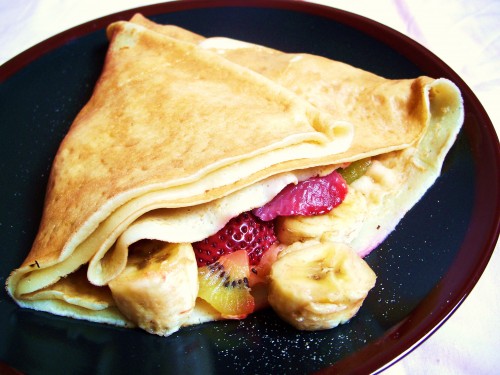
I feel full, yet still want more, but I know better than letting the tongue fool the tummy. So I save the luke warm sweet crepe for later. And I forget about it. It sits in my fridge for over a day. The next morning, filled with guilt, I microwave my sweet crepe. Cut-up fruits don’t behave really well with refrigerating and microwaving, the banana turns overripe, the kiwi and the strawberry taste zealously sour. But the crepe still has its fleece-like texture, buttery, thick, and snuggly. The squirt of lemon juice gives a refreshing fragrant. I scrape off the fruit chunks, sink my teeth, and sheepishly smile.

Seven years and counting:
Crepes A-Go-Go near UC Berkeley campus
2334 Telegraph Avenue (between Durant and Bancroft)
Berkeley, CA 94704
(510) 486-2310

Borrowed from the receipt: Bon Appetit, Bon Journee

Exchange rate:
Cheese-turkey-pinapple crepe: $5.25;
Strawberry-banana-kiwi crepe: $5.50

Other tasty creperies in the Bay Area:
Cafe Grillades in San Bruno
Crêpes Café in Menlo Park

Down the Aisles 2: April’s Fool… or not?

April 01, 2010 By: Mai Truong Category: California - The Bay Area, sweet snacks and desserts


Uh oh, it looks like ink.

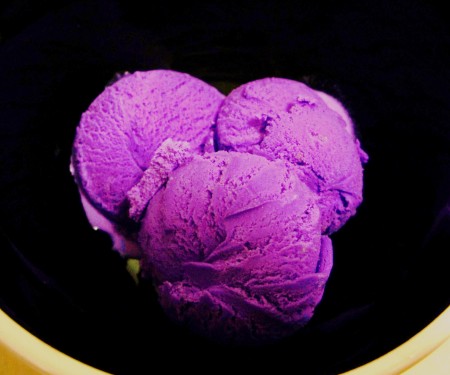
The color is just screaming fake, real taro is faintly purple. My palm stains with indigo dye as I scoop the ice cream out of its cheap plastic tub. Sigh, I take a spoon. Divine. Coconut milk sweeps across the mouth. Nutty and grainy taro filters out all troubled thoughts. I thought taro yogurt with brownie bites at Yogurt Land was unbeatable, but this tops it. I read the ingredient list on the label.

No coconut milk.

Magnolia‘s 1.75-quart taro ice cream: $7.29.

So what would you choose, the real and tasty kind or the artificial and supertasty kind?

Previously on Down the Aisles: Yeast Cookies

Sesame fluff – Chinese snack mi lao

March 29, 2010 By: Mai Truong Category: Chinese, One shot, sweet snacks and desserts


I press my thumbs down, the little egg shape dutifully collapses, but remains in tact, except for a few sesame seeds.

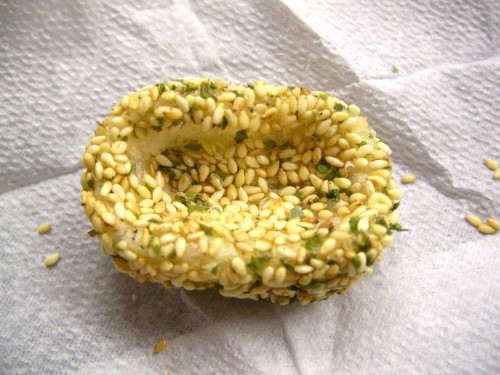
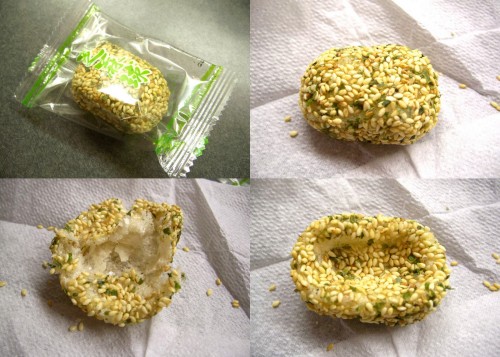
I have deformed a perfect fluff ball out of curiosity. As resilient to breaking as it is, it can’t ever re-inflate like our economy. A bit of guilt creeps in. These little fluff balls come from a lengthy process, as indicated by their name (“佬” – lao). Sticky rice flour is mixed with some other rice flour to make the initial dough and let fermented. My guess is fermentation plays a central role in forming the porous structure, when the dough ball gets deep fried. As malt sugar and lard covers their vulnerably hot surface, ’em balls are quickly rolled and tossed in roasted sesame seeds. And there, you get a fresh batch of mi lao, sesame (sticky rice) fluff. (*)

Originally, the sesame fluffs were meant to be a part of the Lunar New Year offerings in China, but who wouldn’t welcome a snack like this year round, so different spin-offs roll out of street stalls in Taiwan, like peanut-lao, almond-lao, rice-lao. Tiny bits of dried laver (nori) creatively dimple the nutty coat, adding subtle salty notes to the fluff.


Light, chewy, sticky, the deformable birdie beach ball turns into a tooth glue upon each bite. Only eight dollars for sixty little packets, the fluffs can start someone’s good day at work, some fun email exchange, a new friendship, and a blog post. They did for me.

* Many thanks to my friend Chihway Chang, whose amicable nature and fluency in the Chinese languages has made this post possible. The fluffs came from her, too. 🙂

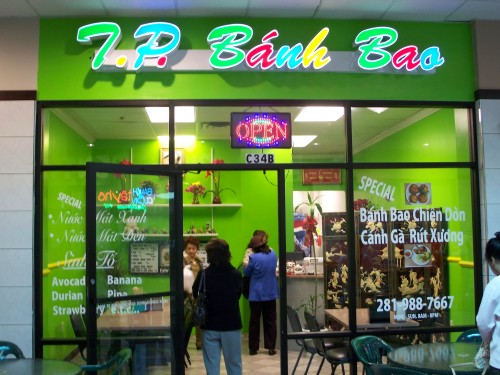
T.P. Banh Bao

March 17, 2010 By: Mai Truong Category: Houston, savory snacks, Texas, Vietnamese


Mini steam buns, as big as a clementine, stuffed with interesting fillings, sold like hotcakes at a mini store inside the Bellaire Hong Kong Mall. Well, they are essentially hot cakes after all.

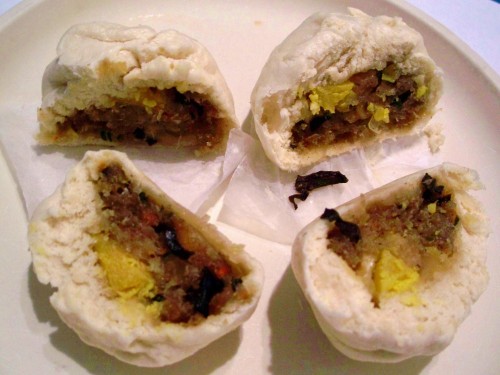
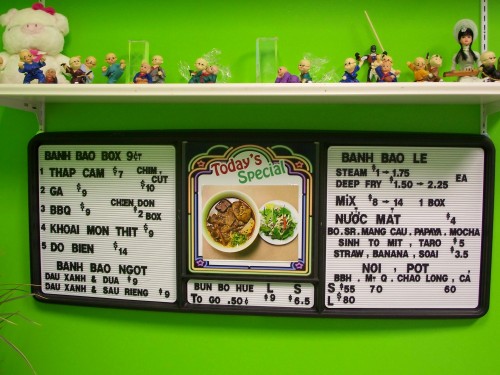
TP Banh Bao have many kinds of banh bao, but most were sold out by midday when we got there. We were lucky enough to get 3 different kinds: seafood (đồ biển), taro and pork (khoai môn thịt), and original, i.e. pork and chinese sausage (thập cẩm). However, we couldn’t tell which was which. They put them in the same box, no marking, the bun skin and the innards looked the same for all three kinds. They also tasted the same. Good, but indistinguishable.


On the door is an exciting advertisement of their specials: deep fried banh bao and deboned chicken wings, but few seem to come here for those. I’d imagine even fewer would come here for bun bo Hue, mi Quang, chao long (offal porridge) and chao ca (fish porridge). It’d be just as funny if McDonald serves spaghetti.


A box of 9 banh bao sets back your bank anywhere between $7 -14. Although a little pricey, these bite-size buns make a reasonable, savory but not so fatty snack, maybe breakfast if you eat three or four.  I’m curious about the sweet kinds, with mung bean paste and either coconut or durian.

Address: T.P. Banh Bao (inside HongKong Mall, near Banh Cuon Tay Ho #18)
11209 Bellaire Blvd
Houston, TX 77072
(281) 988-7667

While you’re in the Hong Kong Mall area, check out the butter-fried soft shell crab at Tay Do restaurant.

Tags:

Cafe Grillades – Crepe a bite after a long flight

March 09, 2010 By: Mai Truong Category: California - The Bay Area, French, sweet snacks and desserts, Vegan


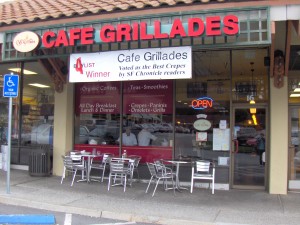
The San Francisco airport is a great excuse to eat out on the other side of the bay. Catching a morning flight? Breakfast at Milbrae Pancake House. Picking up parents and wanting to show them around at mid day? Lunch at La Boheme in Burlingame. Arriving in a lazy afternoon after four hours confined in the airplane’s seat with a neck cramp and in the mood for something nice, light but hearty? A crepe at Cafe Grillades of San Bruno sounds just right.

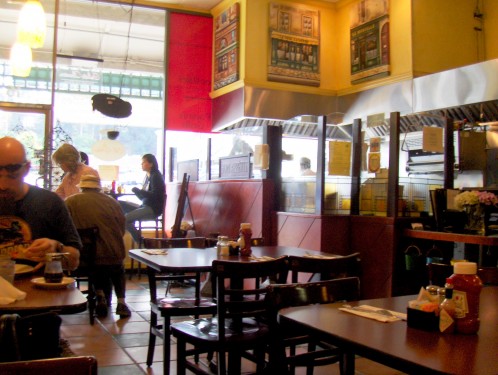
It’s one of those homey places where you can nibble a panini while reading the chronicles, sit by the window and gaze at a quiet parking lot, or meet someone for a casual interview. It has the boureks and the Algerian couscous if you want to impress old friends with an interesting order, but it also serves classic ham and cheese on toast all day. It will satisfy both the burger hunger and the vegan healtheist. It has the West European facade, the Mediterranean sum up, the North Saharan novelty, the San Franciscan appeal. In plain view, Cafe Grillades has a pretty good all-inclusive menu.

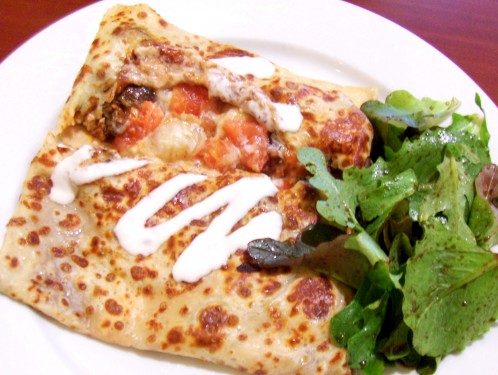
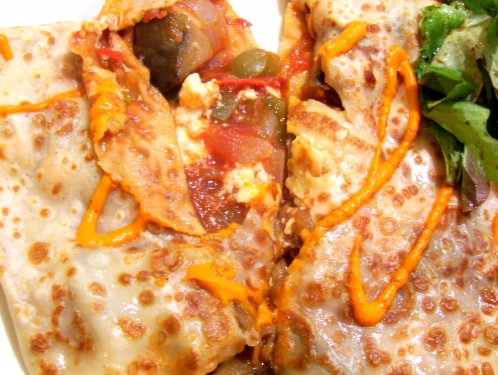
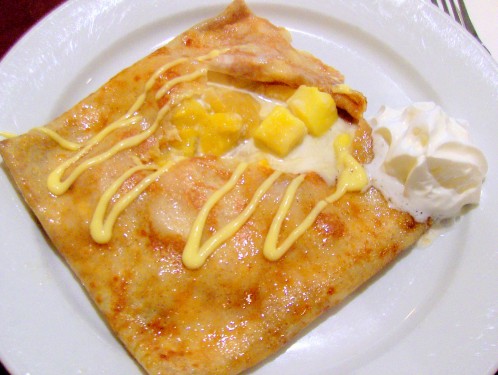
But we came here for crepes, and get crepes we did. Somehow the herbivore in Mudpie and the carnivore in me switched place that day. Mudpie decidedly took on the Algiers Merguez, spicy lamb and beef sausage mingled with chunky potatoes,  mushy tomatoes, and slabs of onions in crème fraiche (first picture). I, feeling betrayed by the chicken burrito on the plane, went down the defiant path with a ratatouille flat square hot pocket.

My reasoning was simple: I like meat, so if I like something sans meat then that vegan thing must be really good. And it was. In fact, it was better than the Merguez sausage crepe. Eggplant was one of those healthy veggies my mom had to funnel down my throat, but here it fit in so well with zucchini, bell pepper, and more onion. Feta cheese clumped a few tangy notes. The crepe innards were definitive of satisfaction.


Gratified, we charged onto dessert. A mango crepe brulee with brown sugar, creme fraiche, and caramelized top. This mix between a tart freshness and a fixating sweetness, some chewy underripe fruit and a thin malleable encasing,  is, my friends, the best any sweet crepe can be.

Cafe Grillades
851 Cherry Ave #16
San Bruno, CA 94066
(650) 589-3778

Pocket thinning:
Ratatouille (8.95)
+ Spicy Algiers (9.50)
+ Mango crepe brulee (7.95) = $28.84

Bánh dầy giò – sticky rice bun with sausage

February 24, 2010 By: Mai Truong Category: Houston, Northern Vietnamese, One shot, savory snacks, sticky rice concoctions, Texas, Vietnamese

banh day 3
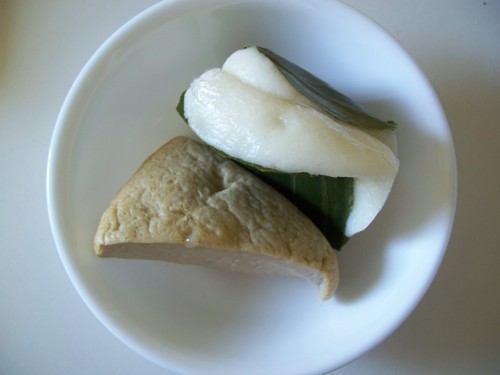
It’s just a white bun made from sticky rice, loosely wrapped in banana leaf so that it doesn’t attach indefinitely to your fingers, ready to sandwich a thick cut of cha lua. The purpose of the bun is purely a textural enjoyment, it has neither taste nor smell. All flavors come from the sausage. Eating the bun alone would be like chewing an incredibly huge piece of gum, the only difference is you can swallow the bun. Come to think of it, we can make a bunch of bite size sticky rice “gum” for American school kids, they can chew until they’re bored, and swallow it, no unfortunate mess under the desks and your shoes. Cool, innit?

Because of either its simplicity or its antiqueness, the bánh dầy is not quite a favorable snack among the young Vietnamese these days. Or perhaps because it is a treat from the North? Southerners have a sweet tooth and are attracted to fatty, rich, flavor-compact concoctions. Bánh dầy is none of that. When I was in Saigon I knew of bánh dầy through three sources: the extremely common tale of bánh chưng bánh dầy, the book “Hanoi 36 streets” by Thạch Lam, and the tiny buns filled with bean paste (bánh dầy đậu) Little Mother got for me from Ngọc Sáng bakery in District 1. Another case of cross cultural similarity: compare the banh day dau with the Japanese daifuku: the sticky rice coat is exactly like mochi, the mung bean filling is salty while daifuku’s filling is sweetened.

banh day 4

For something the size of a can bottom, banh day makes a dense snack (just like its pyramid shape cousin, banh it). We got both at Giò Chả Đức Hương in Houston, but banh day is not always there. The reason might be the good amount of work in making those simple looking buns. An authentic banh day is supposed to be made by pounding cooked sticky rice to a goo, although the packages of sticky rice flour in stores would do the job. I’m not sure which method  Đức Hương used. I also wrongfully microwaved it once, the result was a plain thick blob that could possibly rival superglue. Yep, banh day is supposed to be eaten at room temperature (not for folks who want a warm meal).

Address: Đức Hương Giò Chả (Houston)
11369 Bellaire Blvd, Ste 950
Houston, TX 77072