
Two hours with Korean tea ceremony
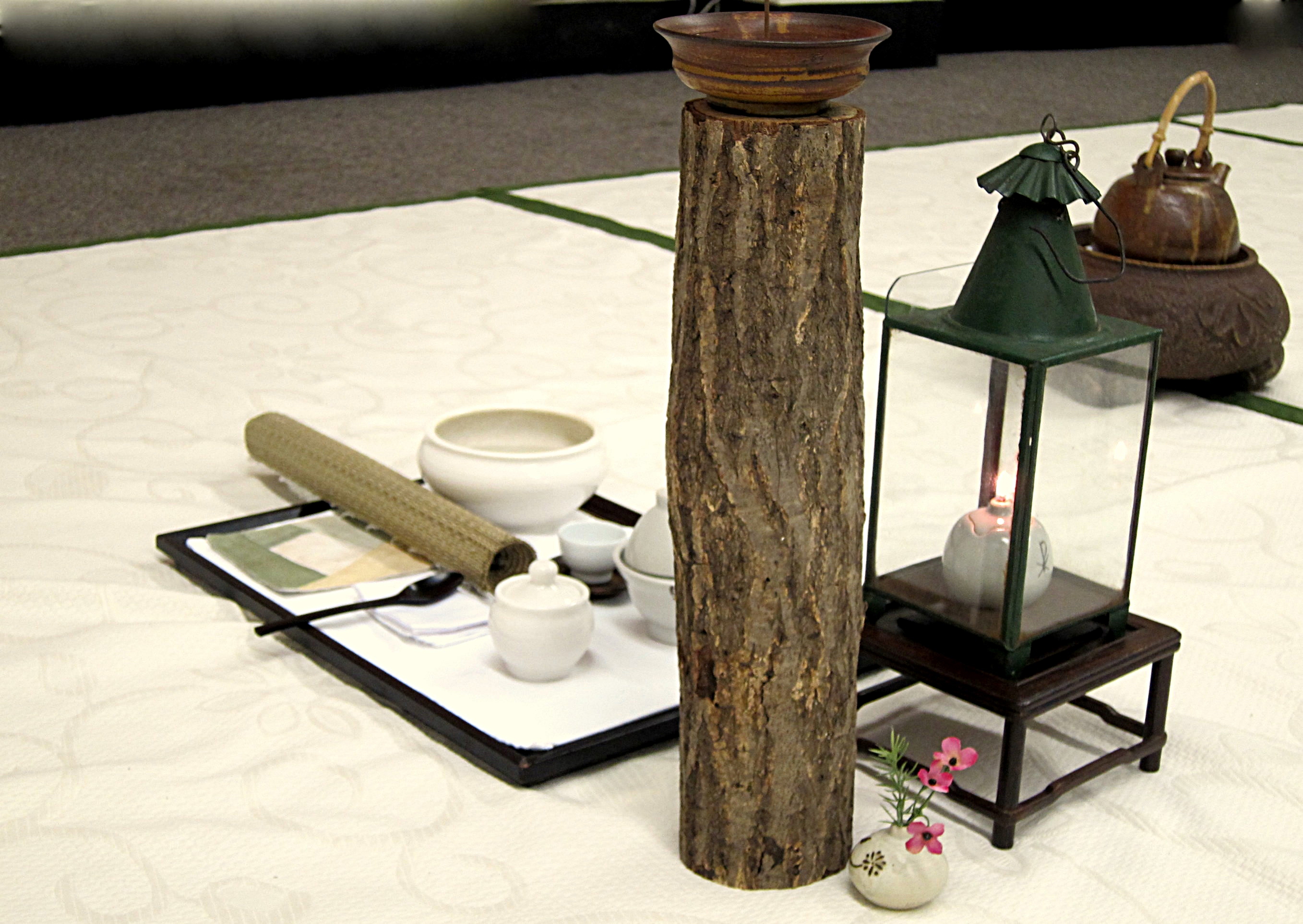
Between 4 and 6 PM today was the most interesting 2 hours I’ve had this week, and also the most effortless educational experience I’ve had in a long time. That’s how the Korean tea ceremony is meant to be, as I’ve learned: formal but relaxing, and ceremonious but natural. The rules are rather simple to get acquainted to, the movements make sense, and just watching made my mind feel nothing but calmly pleasant. The kind of pleasant feeling one would get gazing off into space alone, on a grassy hillside, on a cloudy day.
Now for the logistics. Inje University‘s Traditional Korean Tea Society (TKTS) gave a 2-hour presentation at Berkeley today as part of the “Dew of Wisdom” tour, Stanford and California State University got their tea before us. During the first 40 minutes, the students of TKTS demonstrated two types of tea ceremonies, both accompanied by the slow, deep, hardy rhythm of a 6-string zither 거문고 (geomungo).
The first type, 들차회 (deulchahue), is to be enjoyed with friends and relatives outdoor during spring and autumn. The setting is lighthearted, the purpose is to relax and to appreciate nature, the gathering comprises both men and women, and both hands are used during the preparation, serving, and tasting of tea.
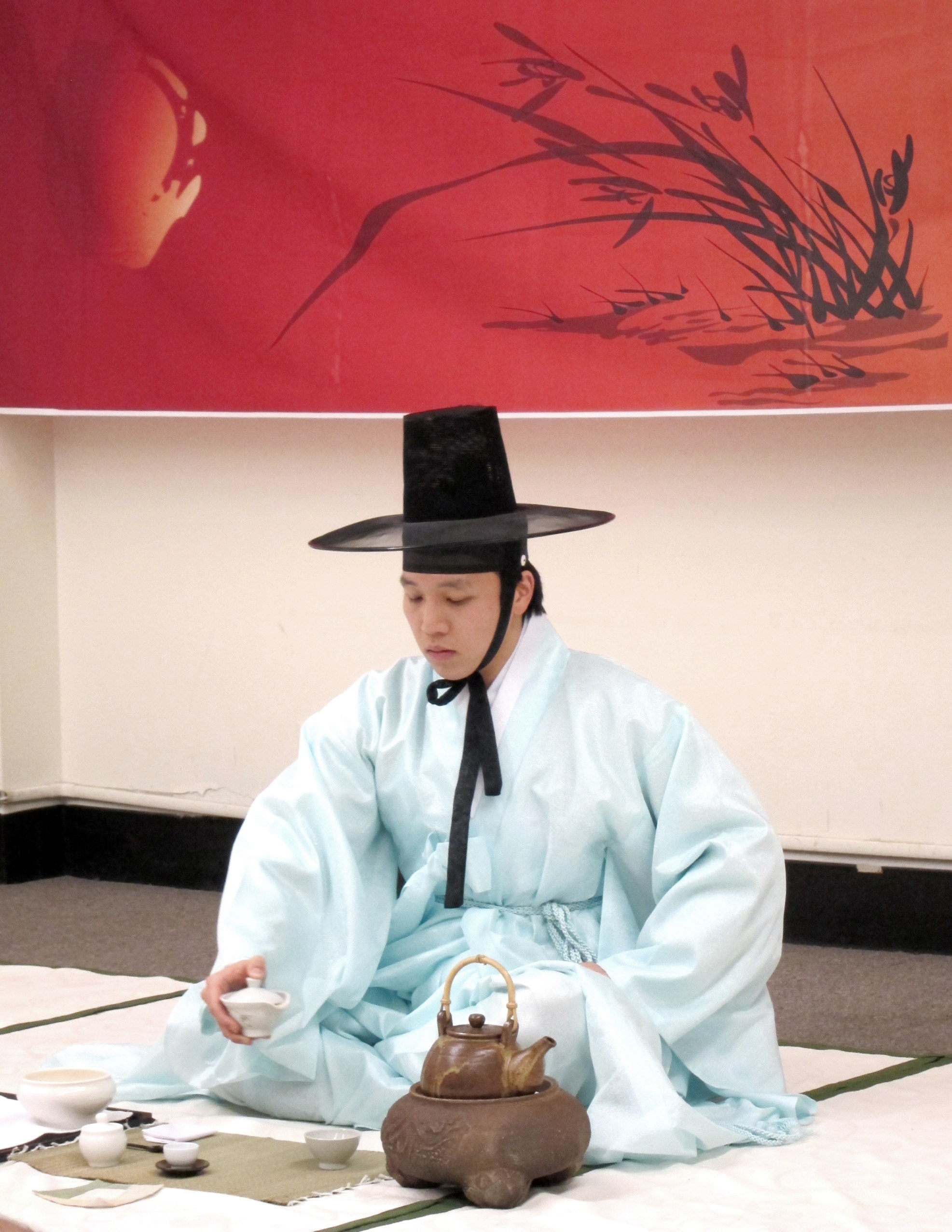
The second type, 선비다례 (seonbi darye), or “Scholar’s tea ceremony”, is practiced by noblemen to clear their mind and heighten their wisdom. The setting is dignified, and the man uses only his right hand to prepare and serve, signifying a more profound status than that in deulchahue. In both cases, the movements are fluid, slow, and steady.
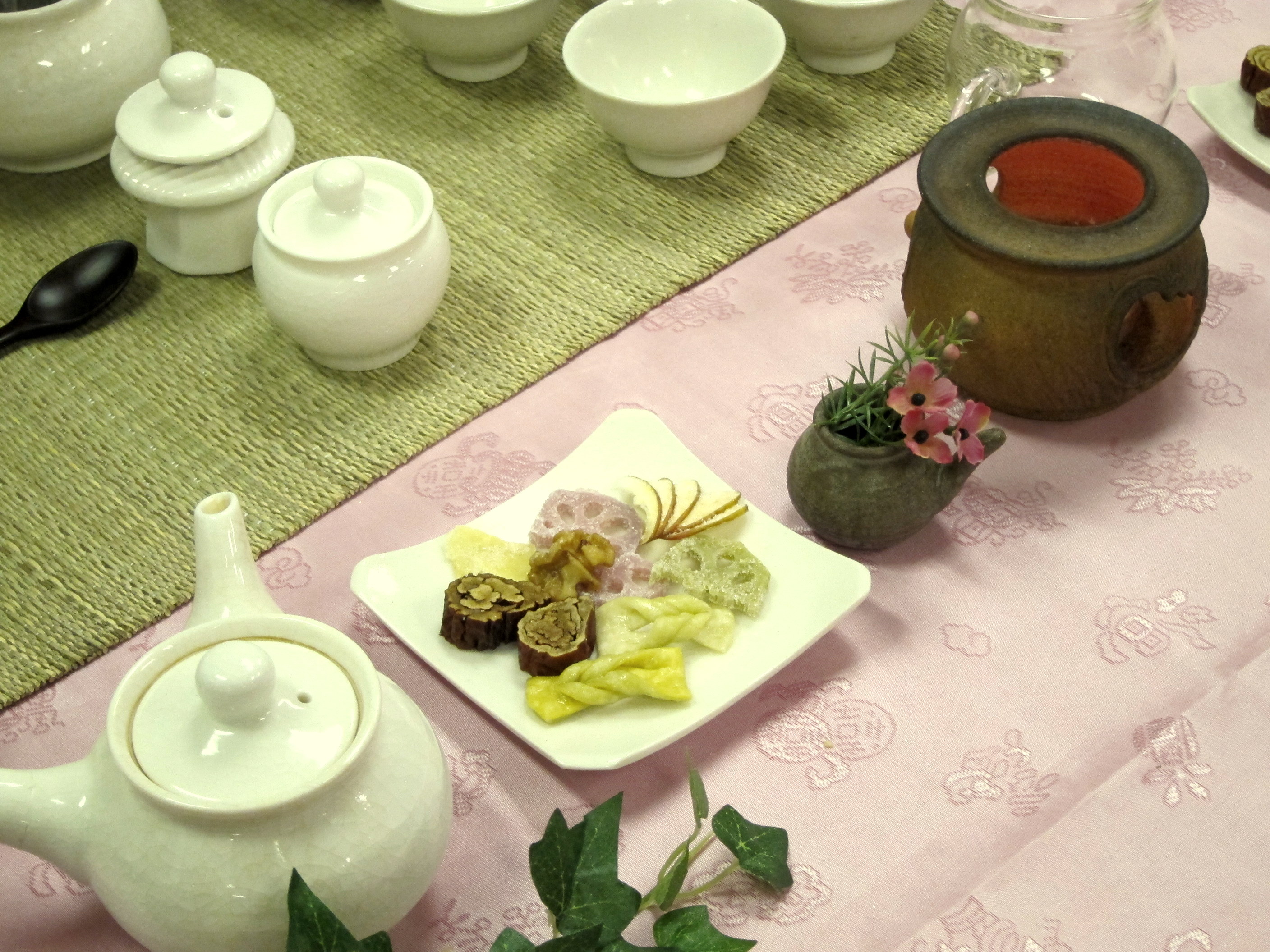
During the next 20 minutes, the guests were invited to taste green tea and yellow tea with a variety of 다식 (dasik), tea snack: candied lotus root, dried apple, dried jujube, and a kind of fried chips that I’d only seen in the drama Sungkyungkwan Scandal (성균관 스캔들). The green tea, unoxidized, looks and tastes clear with a very light herbal hint, like a white tea. The yellow tea, about 50% oxidized, similar to Tieguanyin, has an upfront sweetness and a deep citrine hue. Each batch of tea is brewed for about 2 minutes in 60-70°C water, as boiling water would induce a bitter taste.
After ample tea had been served, the guests came back to their seats for a brief presentation from Prof. Jaesup Pak, President of TKTS, on Korean tea production and ceremonial methods. I scribbled like mad, and here’s what little knowledge I’ve gained:
There are 3 major tea plantation regions in Korea: Boseong, Hadong, and Jeju. Boseong is the largest and most respected tea plantation, producing roughly 40% of Korean tea in 5.3 million square meter of hillside. Hadong, second in line, has produced wild tea for over 1200 years, and from its neighboring town Hwagae originated the Korean green tea culture. The tea here is grown completely natural on rocky 400-500 meter high mountainsides and harvested by hand. In contrast, Jeju‘s tea is grown with chemicals and fertilizers on rich volcanic island soil, plucked and chopped by machines, and heated and dried with steam.
Regardless of regions, tea leaves are plucked young between April and May because fully developed leaves are too coarse to use. Different grades of green tea are categorized based on their youngness. Ujeon (우전), the first grade, comes from the first harvest, which means it is picked by hand before April 20 for a delicate flavor. Sejak (새작), the second grade and the most popular type, is picked early May. Sejak means “Sparrow’s Tongue”, referring to the pointed shape of the young leaves at this stage. And finally, Jungjak (중작), the third grade, is picked mid May. The tea offered to the guests at the colloquium today was Sejak from Hadong.
The production process involves 6 steps: plucking, withering, parching, rolling, separating, and drying. Hand plucking tea is meticulous, even the most skilled women can pick only 2 kg per day. Within 24 hours after plucking, the leaves are left to wither in open air. Then they are tossed and stirred constantly in an iron cauldron over wood (traditionally) or gas fire at 200°C to soften. Rolling comes afterwards to intensify the taste, where the leaves are rubbed and rolled for 3-4 times on straw mats. This process makes the leaves stick together, thus separating must be done to help moisture evaporate from the leaves. Finally, the leaves are spread out and dried naturally on paper on a heated floor for 4-5 hours or overnight.
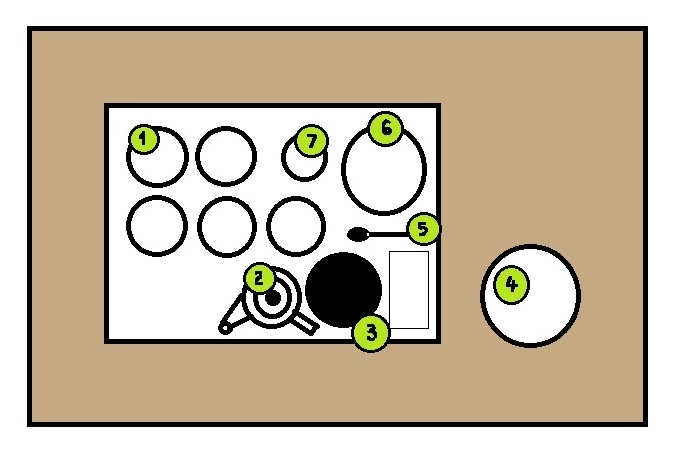
The teaware, or chagi (차기), are typically arranged as shown in the diagram above:
(1) Tea cups: usually 3 or 5 cups per set
(2) Tea pot for brewing. The teapot and kettle should be on the right side and closer to the host.
(3) Tea cup saucer, on which the filled tea cup is placed and received.
(4) Large bowl, into which the water used for warming the pot and cups is discarded.
(5) Tea spoon for taking tea leaves
(6) Smaller bowl for cooling the water and the tea, and for pouring the tea into the cups
(7) Tea caddy, which contains the tea leaves.
The small rectangle represents a napkin for tidiness.
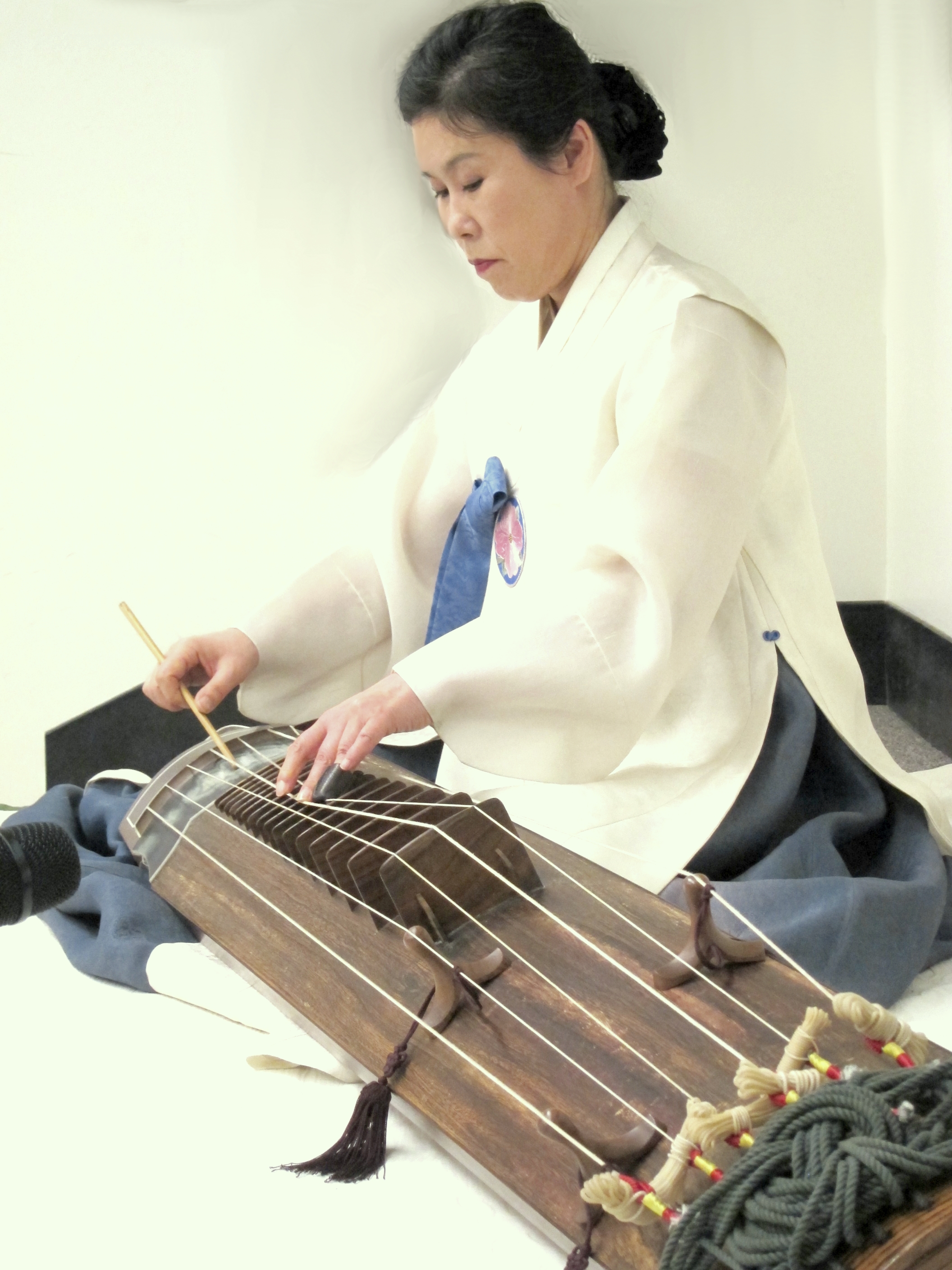
Professor Hyeyoung Shin (Chuncheon National University of Education) performing da-ak (다악, tea music) on a geomungo at the colloquium
The preparation after the arrangement begins with pouring hot water into the cooling bowl and letting it cool for under 2 minutes. Then the teapot, ready with 1-2 spoons of leaves, receives the cooled water; the lid is closed, and the leaves are brewed for a few minutes. While serving, the tea is poured into warmed cups from a high distance to create bubbles in the tea, which are believed to confer good luck. The receiver should hold the cup with the right hand and support it with the left hand, inhale the aroma, take a sip that is about one third of the cup, and drink 3 times from each cup served. I think I did it in more than 3 times… I was savoring the flavor a little too carefully.
At the end, we got to take our cups home as a souvenir. A cute little white tea cup to commemorate a sweet, delicate two-hour lesson. 🙂
This post also appears in Tea & Mai


It is really a great and useful piece of information. I am glad that you shared this helpful information with us. Please keep us up to date like this. Thank you for sharing.
1I will immediately grab your rss feed as I can not in finding your email subscription hyperlink or e-newsletter service. Do you have any? Kindly let me recognize in order that I may subscribe. Thanks.
2I got what you intend, regards for putting up.Woh I am thankful to find this website through google. “Those who corrupt the public mind are just as evil as those who steal from the public.” by Theodor Wiesengrund Adorno.
3I together with my friends appeared to be checking out the great information found on the blog and all of the sudden I had a horrible suspicion I had not thanked the web blog owner for those tips. These young boys are actually as a result happy to learn all of them and have in effect absolutely been making the most of these things. I appreciate you for simply being indeed considerate and for picking out this form of awesome subject matter millions of individuals are really needing to know about. Our honest regret for not expressing gratitude to you earlier.
4Very nice post. I just stumbled upon your blog and wished to say that I have truly enjoyed surfing around your blog posts. In any case I’ll be subscribing to your rss feed and I hope you write again soon!
5Hi, I think your site might be having browser compatibility issues. When I look at your website in Safari, it looks fine but when opening in Internet Explorer, it has some overlapping. I just wanted to give you a quick heads up! Other then that, fantastic blog!
6Hi , I do believe this is an excellent blog. I stumbled upon it on Yahoo , i will come back once again. Money and freedom is the best way to change, may you be rich and help other people.
7Deference to op, some fantastic information .
8I have read several just right stuff here. Certainly worth bookmarking for revisiting. I wonder how so much effort you put to make the sort of wonderful informative website.
9소액결제현금화(휴대폰깡·모바일깡)의 뜻과 수법, 정보통신망법 위반 처벌 수위, 실제 처벌 사례와 이용자 피해, 급전 필요 시 합법 대안까지 정리했습니다.
10누누티비의 서비스 종료 이력과 같은 이름의 사이트를 확인할 때 알아둘 내용을 정리했습니다. 드라마·영화 다시보기 제공 여부, 회차·자막·화질 확인 방법과 자주 묻는 질문을 살펴보세요.
11부산오피를 검색하며 부산 지역 일반 마사지·스파를 알아보는 분들을 위한 안내입니다. 프로그램 선택, 관리 시간과 비용, 시설·위생, 주차, 예약 전 확인사항과 자주 묻는 질문을 정리했습니다.
12광주호빠를 찾는 분을 위한 광주광역시 예약 안내. 라운지 분위기, 인원별 공간 선택, 가격 상담, 첫 방문 준비와 자주 묻는 질문을 확인하고 원하는 일정에 맞춰 문의
13광주호빠를 찾는 분을 위한 광주광역시 예약 안내. 라운지 분위기, 인원별 공간 선택, 가격 상담, 첫 방문 준비와 자주 묻는 질문을 확인하고 원하는 일정에 맞춰 문의
14대밤·대구의밤을 찾는 분들을 위한 대구 지역 정보. 동성로·수성못·동대구역·달서구의 저녁 여가와 지역별 특징, 후기 비교 기준, 가격·운영시간·교통 확인사항 및 자주 묻는 질문을 살펴보세요.
15I am not sure where you’re getting your info, but great topic. I needs to spend some time learning more or understanding more. Thanks for great info I was looking for this information for my mission.
16This is a topic close to my heart cheers, where are your contact details though?
17Very interesting details you have mentioned, thanks for putting up.
18I appreciate the clear writing and useful examples in this article. Nice write-up, keep it up.
19There’s noticeably a bundle to learn about this. I assume you made sure nice factors in features also.
20We’re a group of volunteers and opening a new scheme in our community. Your web site offered us with valuable information to work on. You’ve done an impressive job and our whole community will be thankful to you.
21I like this post, enjoyed this one thanks for putting up. “Fear not for the future, weep not for the past.” by Percy Bysshe Shelley.
22I’ve recently started a web site, the info you provide on this site has helped me tremendously. Thank you for all of your time & work. “One of the greatest pains to human nature is the pain of a new idea.” by Walter Bagehot.
23Thanks for sharing this useful information. I will definitely visit again. Thanks for sharing this useful information.
24I’m really inspired with your writing abilities and also with the structure for your weblog. Is this a paid subject or did you customize it yourself? Anyway stay up the excellent high quality writing, it is uncommon to peer a nice blog like this one nowadays..
25Hi there! This post couldn’t be written any better! Reading through this post reminds me of my previous room mate! He always kept talking about this. I will forward this article to him. Pretty sure he will have a good read. Thank you for sharing!
26Simply want to say your article is as astounding. The clearness in your post is just excellent and i can assume you are an expert on this subject. Well with your permission let me to grab your feed to keep up to date with forthcoming post. Thanks a million and please keep up the enjoyable work.
27I don’t commonly comment but I gotta state thanks for the post on this special one :D.
28Some genuinely howling work on behalf of the owner of this web site, perfectly great content material.
29Aw, this was a really nice post. In concept I would like to put in writing like this additionally – taking time and precise effort to make an excellent article… however what can I say… I procrastinate alot and under no circumstances appear to get one thing done.
30I truly appreciate this post. I’ve been looking everywhere for this! Thank goodness I found it on Bing. You’ve made my day! Thx again
31Thank you for sharing excellent informations. Your web site is so cool. I’m impressed by the details that you’ve on this site. It reveals how nicely you understand this subject. Bookmarked this web page, will come back for extra articles. You, my friend, ROCK! I found simply the info I already searched everywhere and just could not come across. What a great site.
32Simply wish to say your article is as astonishing. The clarity in your post is simply nice and i can assume you’re an expert on this subject. Well with your permission allow me to grab your RSS feed to keep up to date with forthcoming post. Thanks a million and please continue the gratifying work.
33구미오피는 이 페이지에서 구미의 오피스텔 형태 공간에서 일반 관리 서비스를 제공하는 곳을 뜻합니다. 프로그램 이름만 보고 결정하기 어렵다면 관리 항목과 실제
34Yeah bookmaking this wasn’t a speculative conclusion great post! .
35