
Two hours with Korean tea ceremony
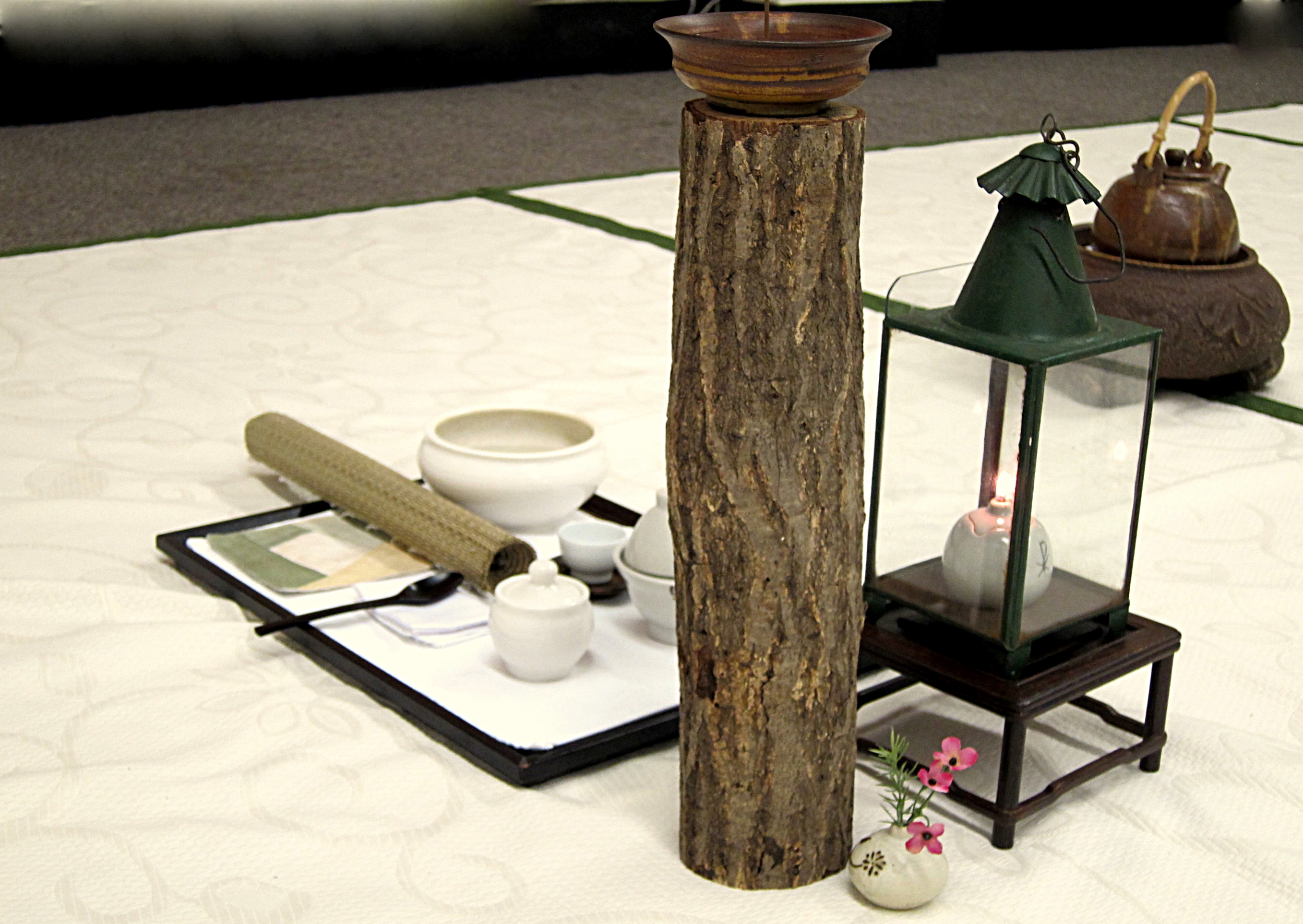
Between 4 and 6 PM today was the most interesting 2 hours I’ve had this week, and also the most effortless educational experience I’ve had in a long time. That’s how the Korean tea ceremony is meant to be, as I’ve learned: formal but relaxing, and ceremonious but natural. The rules are rather simple to get acquainted to, the movements make sense, and just watching made my mind feel nothing but calmly pleasant. The kind of pleasant feeling one would get gazing off into space alone, on a grassy hillside, on a cloudy day.
Now for the logistics. Inje University‘s Traditional Korean Tea Society (TKTS) gave a 2-hour presentation at Berkeley today as part of the “Dew of Wisdom” tour, Stanford and California State University got their tea before us. During the first 40 minutes, the students of TKTS demonstrated two types of tea ceremonies, both accompanied by the slow, deep, hardy rhythm of a 6-string zither 거문고 (geomungo).
The first type, 들차회 (deulchahue), is to be enjoyed with friends and relatives outdoor during spring and autumn. The setting is lighthearted, the purpose is to relax and to appreciate nature, the gathering comprises both men and women, and both hands are used during the preparation, serving, and tasting of tea.
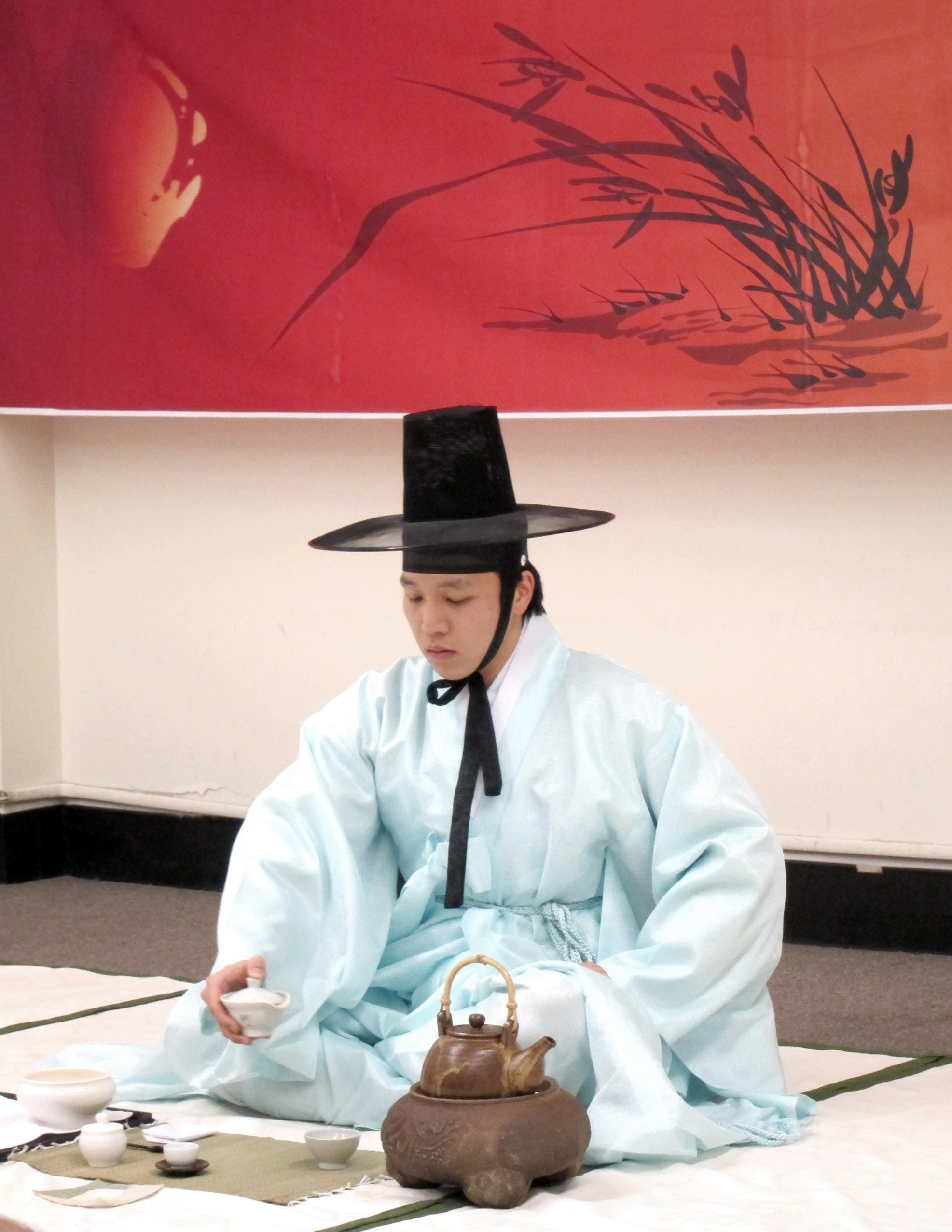
The second type, 선비다례 (seonbi darye), or “Scholar’s tea ceremony”, is practiced by noblemen to clear their mind and heighten their wisdom. The setting is dignified, and the man uses only his right hand to prepare and serve, signifying a more profound status than that in deulchahue. In both cases, the movements are fluid, slow, and steady.
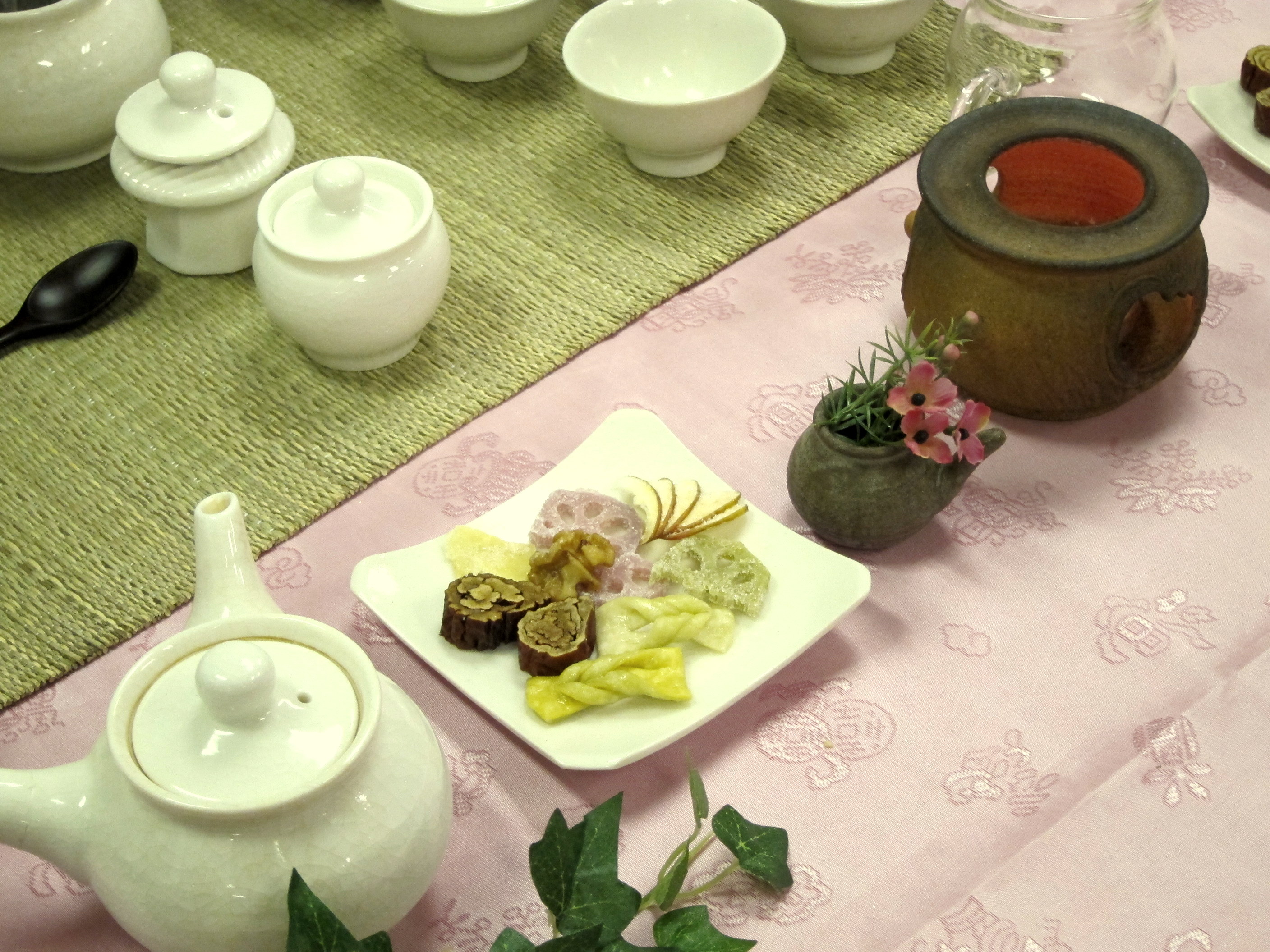
During the next 20 minutes, the guests were invited to taste green tea and yellow tea with a variety of 다식 (dasik), tea snack: candied lotus root, dried apple, dried jujube, and a kind of fried chips that I’d only seen in the drama Sungkyungkwan Scandal (성균관 스캔들). The green tea, unoxidized, looks and tastes clear with a very light herbal hint, like a white tea. The yellow tea, about 50% oxidized, similar to Tieguanyin, has an upfront sweetness and a deep citrine hue. Each batch of tea is brewed for about 2 minutes in 60-70°C water, as boiling water would induce a bitter taste.
After ample tea had been served, the guests came back to their seats for a brief presentation from Prof. Jaesup Pak, President of TKTS, on Korean tea production and ceremonial methods. I scribbled like mad, and here’s what little knowledge I’ve gained:
There are 3 major tea plantation regions in Korea: Boseong, Hadong, and Jeju. Boseong is the largest and most respected tea plantation, producing roughly 40% of Korean tea in 5.3 million square meter of hillside. Hadong, second in line, has produced wild tea for over 1200 years, and from its neighboring town Hwagae originated the Korean green tea culture. The tea here is grown completely natural on rocky 400-500 meter high mountainsides and harvested by hand. In contrast, Jeju‘s tea is grown with chemicals and fertilizers on rich volcanic island soil, plucked and chopped by machines, and heated and dried with steam.
Regardless of regions, tea leaves are plucked young between April and May because fully developed leaves are too coarse to use. Different grades of green tea are categorized based on their youngness. Ujeon (우전), the first grade, comes from the first harvest, which means it is picked by hand before April 20 for a delicate flavor. Sejak (새작), the second grade and the most popular type, is picked early May. Sejak means “Sparrow’s Tongue”, referring to the pointed shape of the young leaves at this stage. And finally, Jungjak (중작), the third grade, is picked mid May. The tea offered to the guests at the colloquium today was Sejak from Hadong.
The production process involves 6 steps: plucking, withering, parching, rolling, separating, and drying. Hand plucking tea is meticulous, even the most skilled women can pick only 2 kg per day. Within 24 hours after plucking, the leaves are left to wither in open air. Then they are tossed and stirred constantly in an iron cauldron over wood (traditionally) or gas fire at 200°C to soften. Rolling comes afterwards to intensify the taste, where the leaves are rubbed and rolled for 3-4 times on straw mats. This process makes the leaves stick together, thus separating must be done to help moisture evaporate from the leaves. Finally, the leaves are spread out and dried naturally on paper on a heated floor for 4-5 hours or overnight.
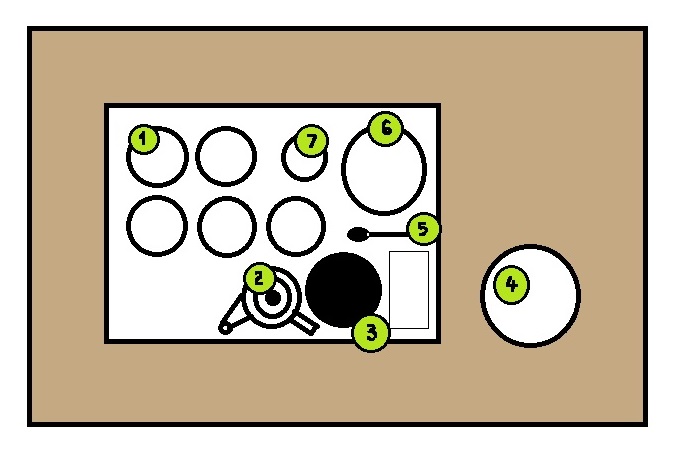
The teaware, or chagi (차기), are typically arranged as shown in the diagram above:
(1) Tea cups: usually 3 or 5 cups per set
(2) Tea pot for brewing. The teapot and kettle should be on the right side and closer to the host.
(3) Tea cup saucer, on which the filled tea cup is placed and received.
(4) Large bowl, into which the water used for warming the pot and cups is discarded.
(5) Tea spoon for taking tea leaves
(6) Smaller bowl for cooling the water and the tea, and for pouring the tea into the cups
(7) Tea caddy, which contains the tea leaves.
The small rectangle represents a napkin for tidiness.
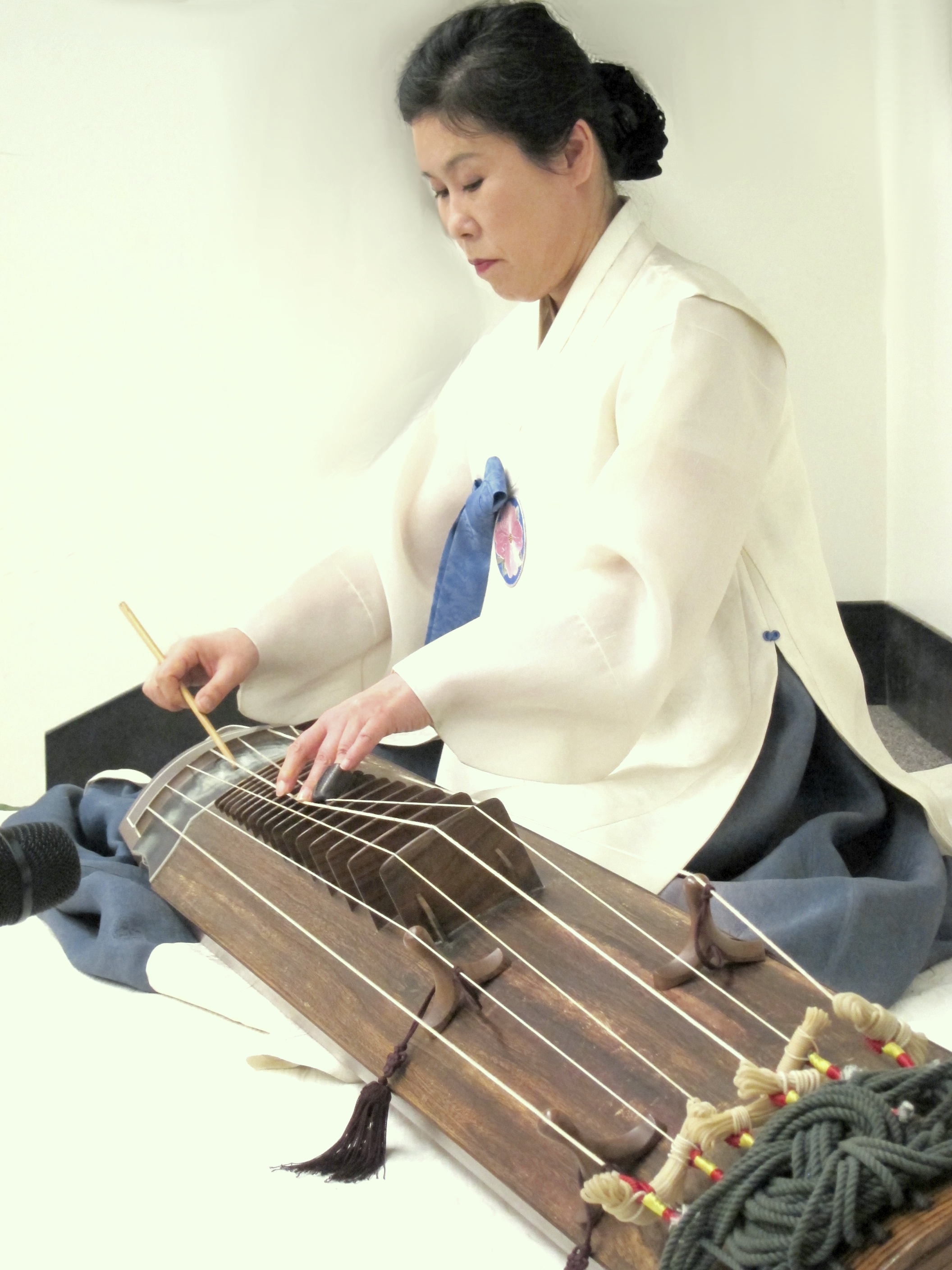
Professor Hyeyoung Shin (Chuncheon National University of Education) performing da-ak (다악, tea music) on a geomungo at the colloquium
The preparation after the arrangement begins with pouring hot water into the cooling bowl and letting it cool for under 2 minutes. Then the teapot, ready with 1-2 spoons of leaves, receives the cooled water; the lid is closed, and the leaves are brewed for a few minutes. While serving, the tea is poured into warmed cups from a high distance to create bubbles in the tea, which are believed to confer good luck. The receiver should hold the cup with the right hand and support it with the left hand, inhale the aroma, take a sip that is about one third of the cup, and drink 3 times from each cup served. I think I did it in more than 3 times… I was savoring the flavor a little too carefully.
At the end, we got to take our cups home as a souvenir. A cute little white tea cup to commemorate a sweet, delicate two-hour lesson. 🙂
This post also appears in Tea & Mai


Aw, this was a very nice post. In idea I wish to put in writing like this additionally – taking time and precise effort to make an excellent article… but what can I say… I procrastinate alot and under no circumstances seem to get one thing done.
1whoah this blog is magnificent i love reading your posts. Keep up the great work! You recognize, lots of people are searching round for this information, you could help them greatly.
2You completed various nice points there. I did a search on the topic and found nearly all folks will go along with with your blog.
3What’s Happening i am new to this, I stumbled upon this I’ve found It absolutely useful and it has aided me out loads. I hope to contribute & aid other users like its aided me. Great job.
4I like the valuable information you provide in your articles. I will bookmark your weblog and check again here regularly. I’m quite certain I will learn many new stuff right here! Best of luck for the next!
5I’m really impressed with your writing skills and also with the layout on your blog. Is this a paid theme or did you customize it yourself? Anyway keep up the nice quality writing, it is rare to see a nice blog like this one these days..
6Appreciate it for this post, I am a big fan of this site would like to go on updated.
7Right now it seems like Drupal is the best blogging platform out there right now. (from what I’ve read) Is that what you are using on your blog?
8Simply want to say your article is as astounding. The clearness on your put up is simply nice and that i can assume you’re knowledgeable on this subject. Fine with your permission allow me to snatch your RSS feed to stay up to date with impending post. Thanks a million and please carry on the gratifying work.
9I’d perpetually want to be update on new posts on this site, saved to my bookmarks! .
10I truly appreciate this post. I have been looking all over for this! Thank goodness I found it on Bing. You’ve made my day! Thanks again
11I like the helpful information you provide in your articles. I’ll bookmark your weblog and check again here frequently. I am quite certain I’ll learn many new stuff right here! Best of luck for the next!
12There are certainly a variety of particulars like that to take into consideration. That could be a great point to convey up. I provide the ideas above as basic inspiration however clearly there are questions just like the one you deliver up where the most important thing will be working in sincere good faith. I don?t know if greatest practices have emerged round issues like that, but I’m certain that your job is clearly identified as a fair game. Each girls and boys really feel the impact of just a moment’s pleasure, for the remainder of their lives.
13You have brought up a very fantastic details, thanks for the post.
14It’s really a nice and helpful piece of info. I’m satisfied that you shared this helpful information with us. Please stay us up to date like this. Thanks for sharing.
15But a smiling visitant here to share the love (:, btw outstanding style and design.
16obviously like your web-site but you have to check the spelling on quite a few of your posts. Many of them are rife with spelling problems and I find it very bothersome to tell the truth nevertheless I’ll definitely come back again.
17I’m very happy to read this. This is the type of manual that needs to be given and not the accidental misinformation that is at the other blogs. Appreciate your sharing this greatest doc.
18Spot on with this write-up, I really think this web site needs rather more consideration. I’ll probably be once more to learn rather more, thanks for that info.
19A powerful share, I just given this onto a colleague who was doing somewhat evaluation on this. And he actually purchased me breakfast as a result of I discovered it for him.. smile. So let me reword that: Thnx for the treat! But yeah Thnkx for spending the time to debate this, I really feel strongly about it and love studying more on this topic. If attainable, as you grow to be expertise, would you thoughts updating your weblog with extra particulars? It’s extremely useful for me. Big thumb up for this blog post!
20I couldn’t resist commenting
21I love your writing style truly loving this site.
22I like this site its a master peace ! Glad I observed this on google .
23Wonderful beat ! I wish to apprentice whilst you amend your website, how could i subscribe for a weblog web site? The account aided me a appropriate deal. I had been a little bit familiar of this your broadcast offered shiny transparent idea
24Hi there! Do you use Twitter? I’d like to follow you if that would be ok. I’m undoubtedly enjoying your blog and look forward to new posts.
25Real fantastic info can be found on blog. “I believe in nothing, everything is sacred. I believe in everything, nothing is sacred.” by Tom Robbins.
26Hey very nice site!! Man .. Beautiful .. Superb .. I will bookmark your blog and take the feeds additionally…I’m happy to search out so many useful information here within the put up, we’d like work out more techniques in this regard, thank you for sharing. . . . . .
27Thanks for another informative web site. Where else could I get that kind of information written in such an ideal way? I’ve a project that I’m just now working on, and I have been on the look out for such information.
28It’s really a nice and useful piece of info. I’m glad that you shared this helpful info with us. Please keep us up to date like this. Thanks for sharing.
29Loving the information on this web site, you have done great job on the content.
30What i don’t realize is if truth be told how you are now not actually a lot more neatly-appreciated than you may be right now. You’re so intelligent. You know thus significantly in terms of this topic, produced me for my part imagine it from so many various angles. Its like women and men don’t seem to be fascinated unless it is something to accomplish with Lady gaga! Your personal stuffs excellent. All the time take care of it up!
31I really enjoy reading through on this website, it has got excellent content. “And all the winds go sighing, For sweet things dying.” by Christina Georgina Rossetti.
32Of course, what a splendid site and illuminating posts, I definitely will bookmark your site.All the Best!
33I’ve recently started a site, the info you provide on this website has helped me greatly. Thanks for all of your time & work.
34Hello, i read your blog from time to time and i own a similar one and i was just wondering if you get a lot of spam feedback? If so how do you reduce it, any plugin or anything you can suggest? I get so much lately it’s driving me mad so any help is very much appreciated.
35Hey, you used to write magnificent, but the last few posts have been kinda boringK I miss your tremendous writings. Past several posts are just a bit out of track! come on!
36I like this web site very much, Its a rattling nice post to read and find information.
37Hey there I am so excited I found your webpage, I really found you by accident, while I was looking on Aol for something else, Anyhow I am here now and would just like to say thanks for a incredible post and a all round interesting blog (I also love the theme/design), I don’t have time to browse it all at the moment but I have saved it and also added your RSS feeds, so when I have time I will be back to read more, Please do keep up the excellent job.
38You could definitely see your enthusiasm in the paintings you write. The world hopes for even more passionate writers like you who aren’t afraid to say how they believe. Always go after your heart. “If you feel yourself falling, let go and glide.” by Steffen Francisco.
39I am perpetually thought about this, thankyou for posting.
40I truly appreciate this post. I’ve been looking everywhere for this! Thank goodness I found it on Bing. You have made my day! Thank you again!
41hey there and thanks to your info – I have definitely picked up anything new from proper here. I did alternatively expertise several technical issues the use of this website, as I experienced to reload the web site lots of instances prior to I may get it to load properly. I have been thinking about if your hosting is OK? Not that I am complaining, however slow loading cases instances will sometimes have an effect on your placement in google and can injury your high quality score if ads and ***********|advertising|advertising|advertising and *********** with Adwords. Well I’m including this RSS to my e-mail and could look out for much extra of your respective fascinating content. Ensure that you update this once more soon..
42I’ve been exploring for a little bit for any high quality articles or blog posts on this sort of house . Exploring in Yahoo I at last stumbled upon this website. Reading this information So i am satisfied to convey that I’ve a very just right uncanny feeling I came upon exactly what I needed. I most unquestionably will make sure to don’t disregard this site and give it a glance on a continuing basis.
43Hi, I think your site might be having browser compatibility issues. When I look at your website in Safari, it looks fine but when opening in Internet Explorer, it has some overlapping. I just wanted to give you a quick heads up! Other then that, fantastic blog!
44I used to be suggested this website by my cousin. I’m now not positive whether or not this put up is written through him as nobody else recognise such targeted about my trouble. You are incredible! Thank you!
45Some truly nice stuff on this web site, I enjoy it.
46hey there and thank you for your information – I’ve definitely picked up anything new from right here. I did however expertise a few technical points using this web site, as I experienced to reload the website lots of times previous to I could get it to load correctly. I had been wondering if your web hosting is OK? Not that I am complaining, but sluggish loading instances times will often affect your placement in google and could damage your quality score if ads and marketing with Adwords. Anyway I am adding this RSS to my email and can look out for a lot more of your respective fascinating content. Ensure that you update this again very soon..
47Perfectly pent articles, thankyou for selective information.
48When I originally commented I clicked the -Notify me when new feedback are added- checkbox and now every time a remark is added I get four emails with the identical comment. Is there any means you possibly can remove me from that service? Thanks!
49When I originally commented I clicked the -Notify me when new comments are added- checkbox and now each time a comment is added I get four emails with the same comment. Is there any way you can remove me from that service? Thanks!
50