Flavor Boulevard

We Asians like to talk food.
Subscribe

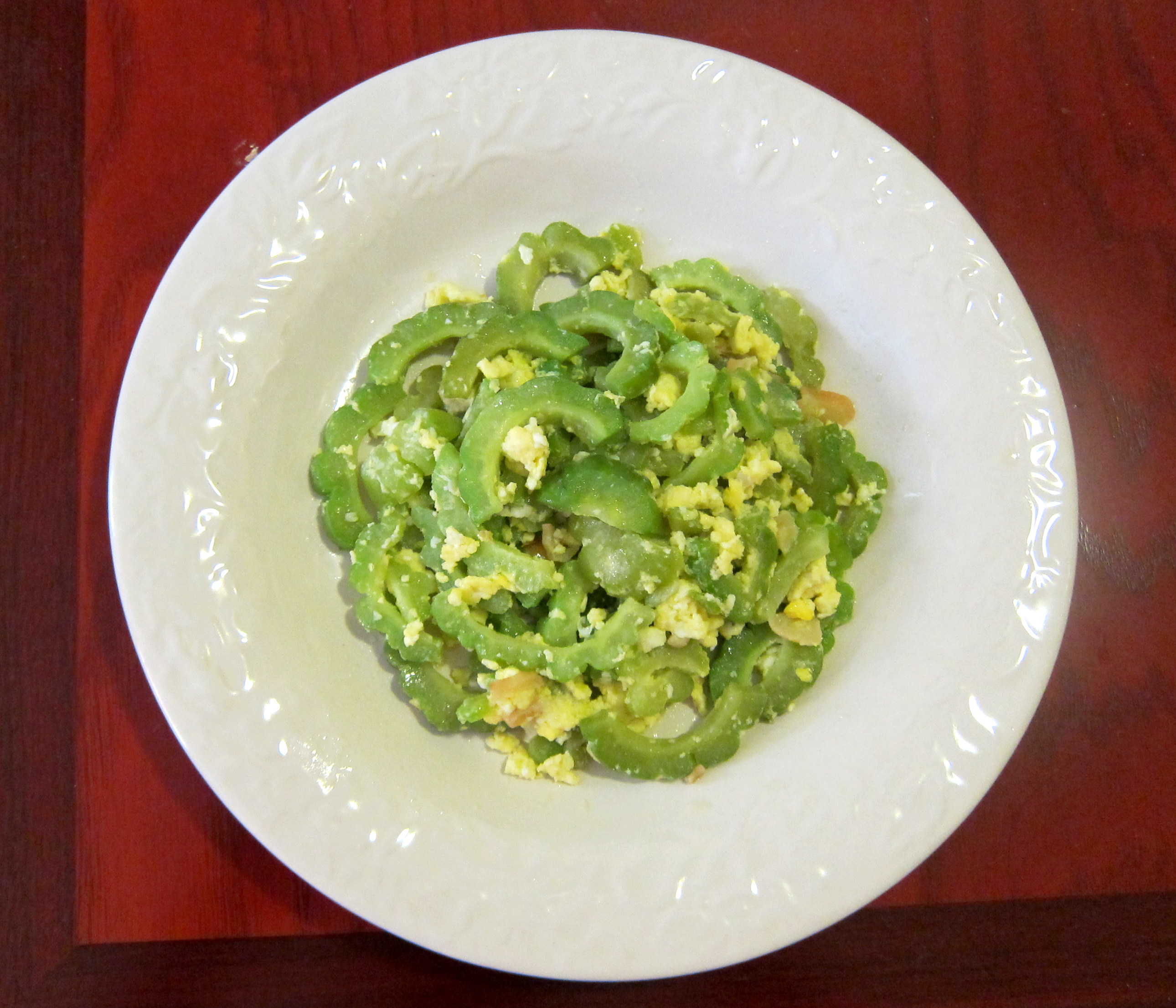
Recipe: Stir-fried bitter melon and egg (kho qua xao trung)
May 25, 2015 By: Mai Truong Category: RECIPES, Vietnamese

stirfried-bittermelon
Bitter melon is another thing that you either love or hate. Among my friends and relatives who have tried bitter melon, 42 percent(*) find it too bitter to try a second time. My mom is a special case. She used to shun it, then little me got a bad fever and had to eat it to help lowering my temperature (bitter melon has medicinal effects), mom was so worried that I wouldn’t eat it (like every toddler, I didn’t like food), but I chowed it down at first try, mom got curious, tried and started liking it too. That’s the story she told me, but I think she started liking it because she started making it, and everything she makes tastes great.
East-Asian-bittermelon
Even in the Bay Area, bitter melon is somewhat rare and expensive. The only restaurant I know of that has bitter melon is China Village on Solano, and a plate costs 10.95 with 70% egg and 30% bitter melon. Sushi California used to have it as an Okinawan specialty but had to cut it due to low demand. 🙁 Chinese and Vietnamese markets have them, but they can be far. Thankfully, today Berkeley Bowl has a small box of maybe 40 counts, so I grabbed a few.

Stir-fried bitter melon with eggs (in Vietnamese: Khổ qua xào trứng)

INGREDIENTS (8 servings):
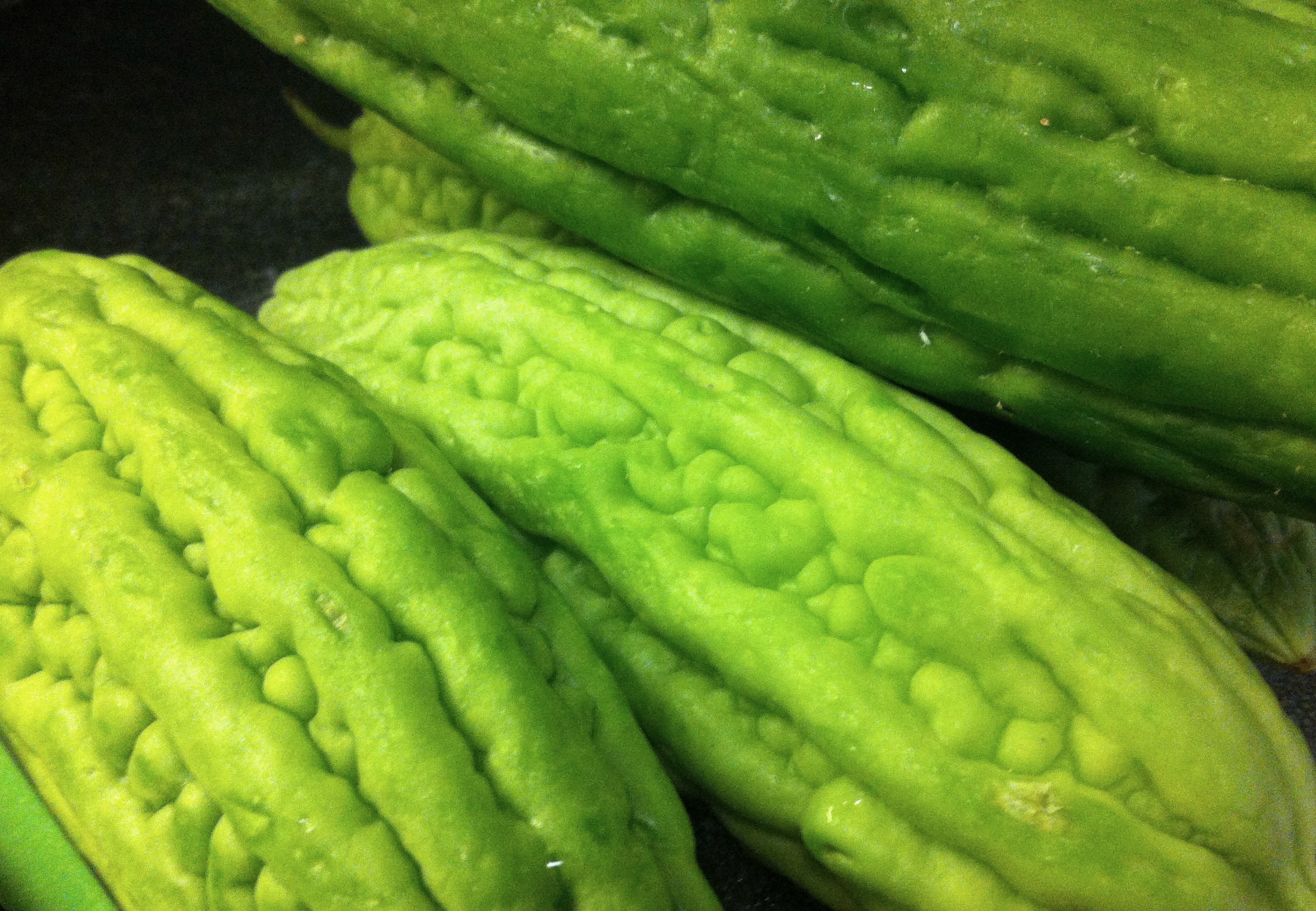
– 5 bitter melons (less green ones with fat stripes, i.e., the East Asian variety, are much less bitter than the skinny ridged subcontinent counterpart)
– 5 eggs (or however many you like)
– 12 cloves of garlic (I just happen to like garlic a lot)
– Salt
– 1/3 cups of olive oil

PREPARATION:
– Wash the bitter melons, cut off both ends of each fruit.
– Cut each fruit length-wise in half.
ripe-and-unripe-bittermelon
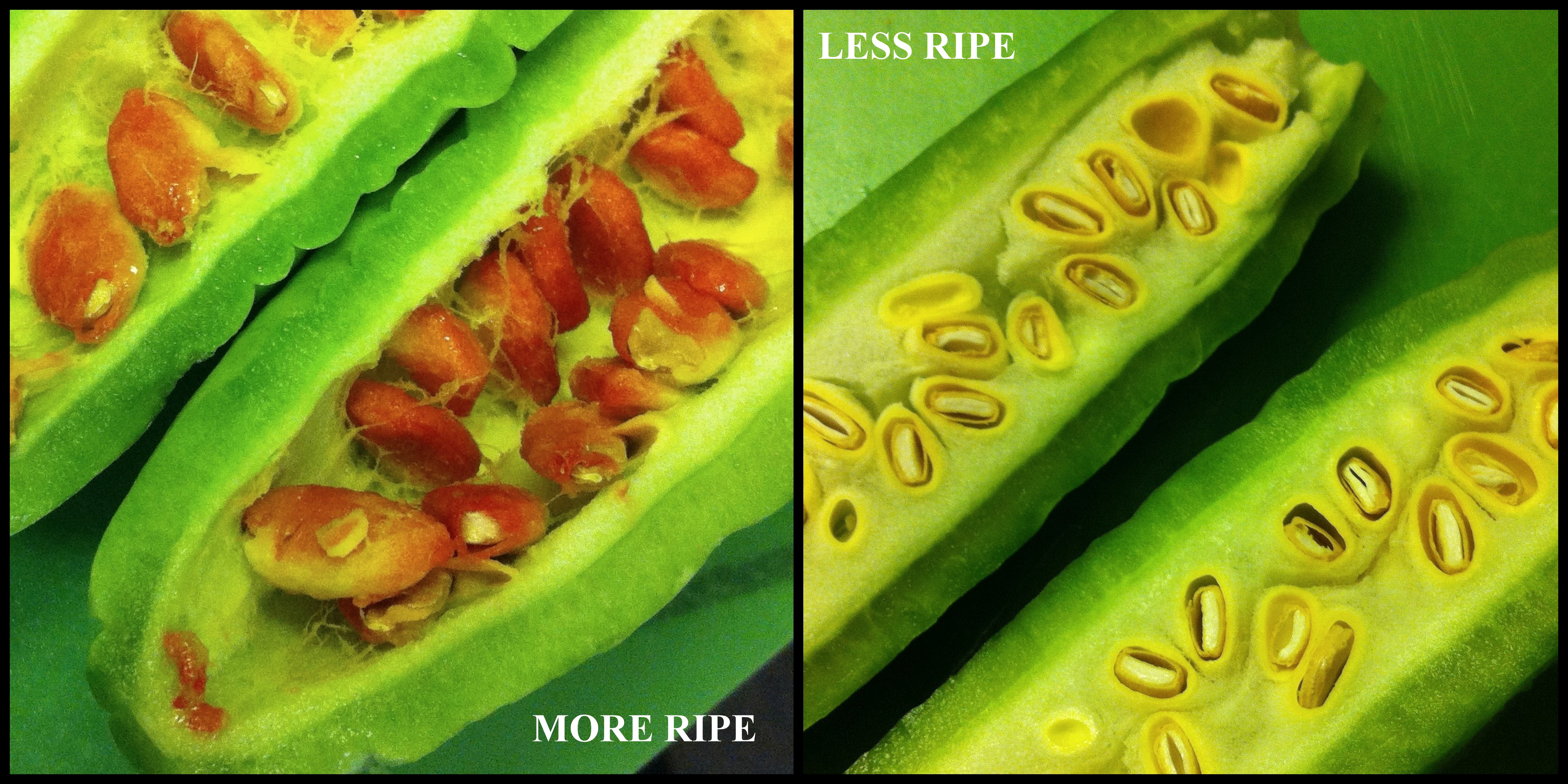
– Use a spoon to scoop out the seeds (along with the fluffy white part). Redder seeds mean riper and less bitter melons. The red film outside the seeds are edible (I’ve eaten them while prepping the melons), but their mildly sweet taste is not much to talk to about.
– Slice each half into crescents of ~ 3-4 mm (1/8 inch) thick
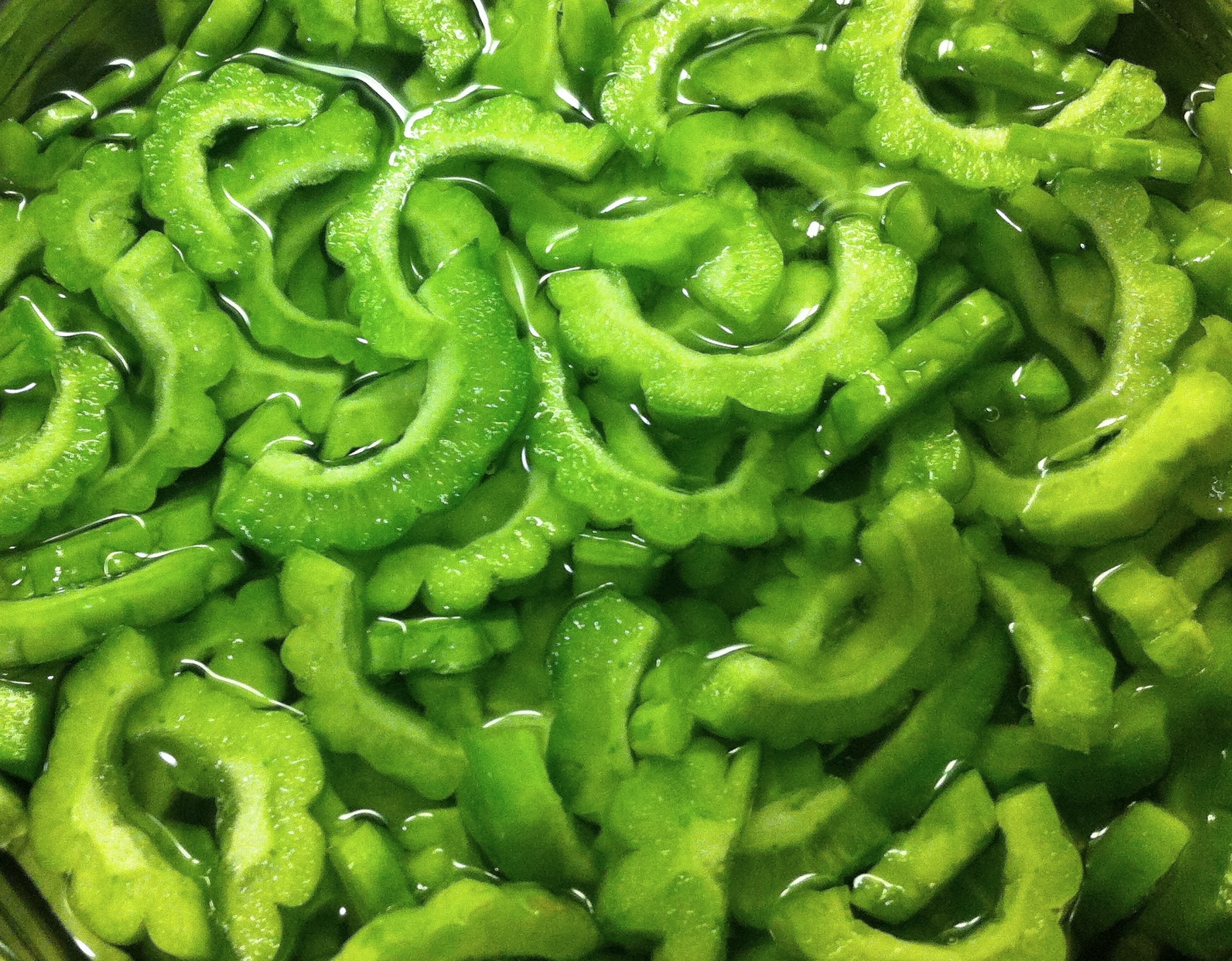
soaked-bittermelon
– Soak the slices in water (with a bit of salt) for ~ 30 minutes to partially remove the bitterness.
– Peel and slice garlic, set aside.

COOKING:
– Put oil in a skillet, medium heat, wait for oil to get hot and throw in the garlic to brown.
– Drain and add the bitter melon into the skillet.
– Lightly mix so that the melon slices at the bottom don’t just sit in oil while the top ones hang out.
– Cover and cook for ~ 5 minutes.
– Uncover, stir.
– Add 5 eggs as you would make scramble eggs.
– Scramble the eggs with the melons until the eggs are fully cooked.
– Sprinkle salt to taste.
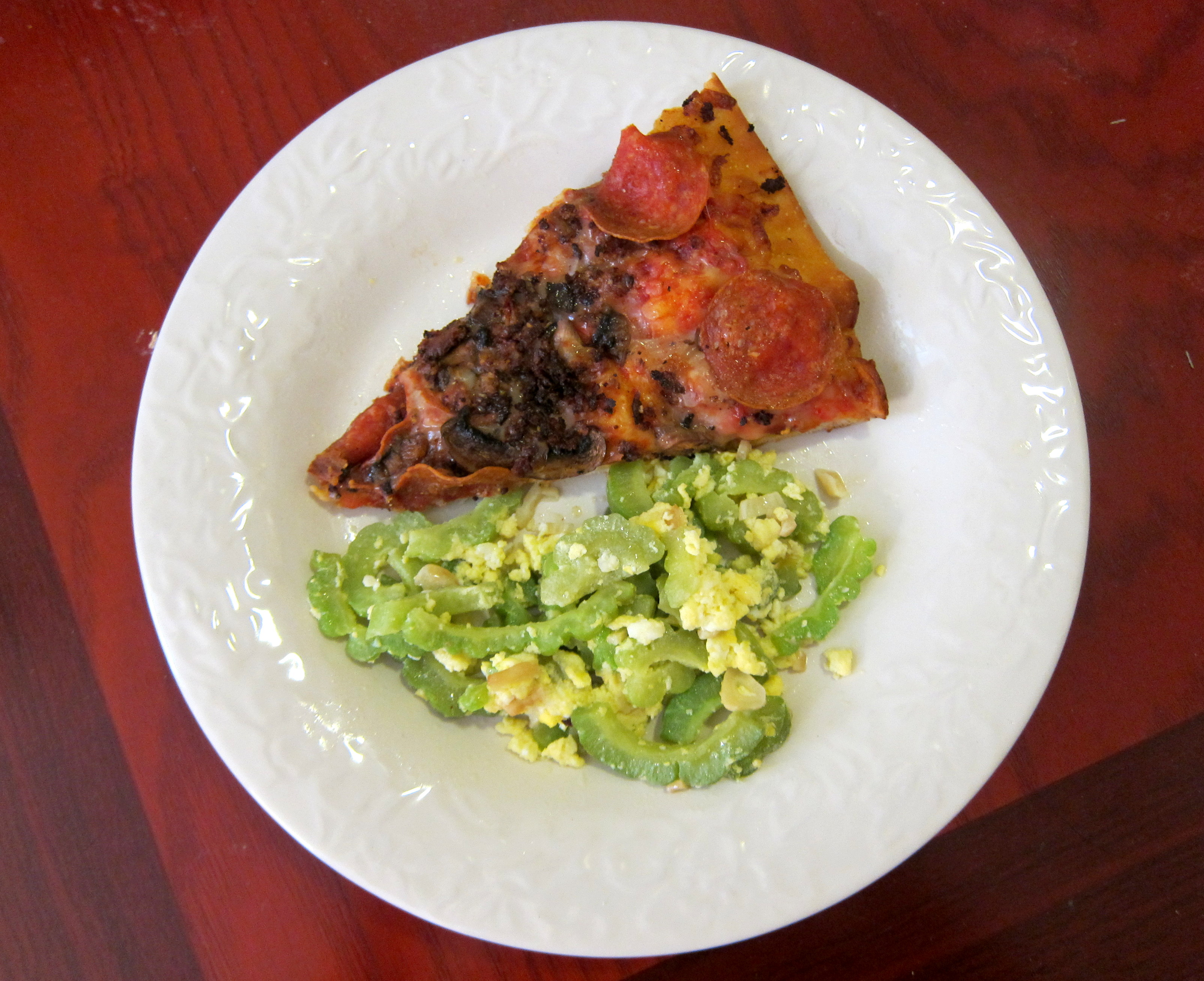
bittermelon-with-pizza
For colors, add pizza. 😉

Foodnote:
(*) This is not a fabricated statistics. I counted 12 people (excluding me) who have tried it and given me confirmed opinions on bitter melon. Five of them grimaced when the word was mentioned. If you’ve tried it and decided to be on either side, let me know so I can update my statistics.
(**) Total cost: bitter melons: 2.06 lb x $2.59/lb = $5.34; box of 12 cage-free large eggs: $3.19; prep time + waiting time: 40 minutes; cook time: 10 minutes; cleaning time: 10 minutes.

Went home to eat

January 27, 2013 By: Mai Truong Category: Comfort food, Houston, Japanese, Korean, Vietnamese

homemade-food
Been one measly week since I got back to the West Coast, and my stomach is already shifting in discomfort with the regular irregular dining pattern of a student, or perhaps of just someone living alone.

At home, on weekdays, we have dinner at 5 while watching TV. For lunch there are banh bao that Mom made, each as big as a small fist with a pork ball and a half an egg inside, refrigerated. I just need to microwave it for 1 minute. On Saturday or Sunday, I’m in charge of choosing a restaurant for lunch, preferably somewhere near Bellaire, where Mom buys a couple of banh gio, which I can also have for lunch during the week, and a pound of cha lua. For dinner, usually something small, since we are already too full from lunch. This time home, my favorite dinner has been toasted french bread with pâté and cha lua. (Mom tucked 2 cans of pâté into my backpack before the flight. Airport security didn’t like the look of them on screen so they had to do a bag check. The lady asked me, “what is this?” I said, “pâté”. “What is it?” “Pâté…” Her quizzical look… “Um… you know… like… a paste?” “When you open it, is it liquid or a chunk?” “It’s a chunk” – well, this is liver pâté, it’s not exactly a chunk, but I know what answer would give me my pâté in tact – “Ok… cuz if it’s like guacamole then we can’t let it pass…” “No no it’s not like guacamole.” I got to keep my cans. I’m still not entirely sure if pâté is like guacamole.)

Anyway, the meals at home…

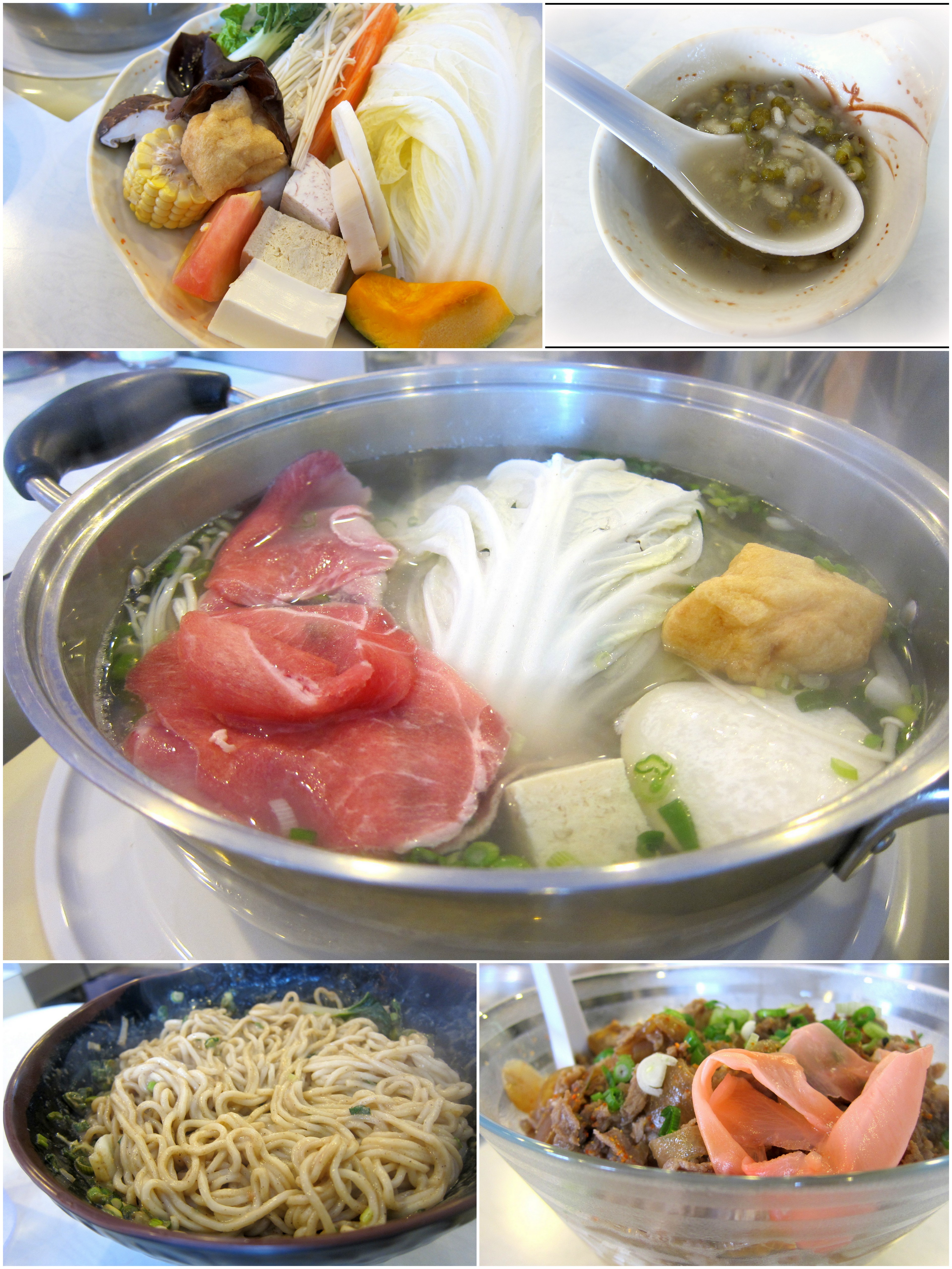
It goes without saying that the meals at “home” home were Vietnamese. Rice, rice paper rolls with slow-cooked pork and pickles, mung bean xoi with sesame mix, pho, mi Quang, homemade jam from fruits in the garden. But when we went out, somehow it all turned to Japanese(*). Hibachi in Port Arthur, shabu on Christmas Eve, and sort-of-izakaya on the Sunday before I flew out because Red Lantern, a Vietnamese restaurant downtown, closes on Sundays. (I don’t understand restaurants that close on Sundays.)

shabu-house-houston
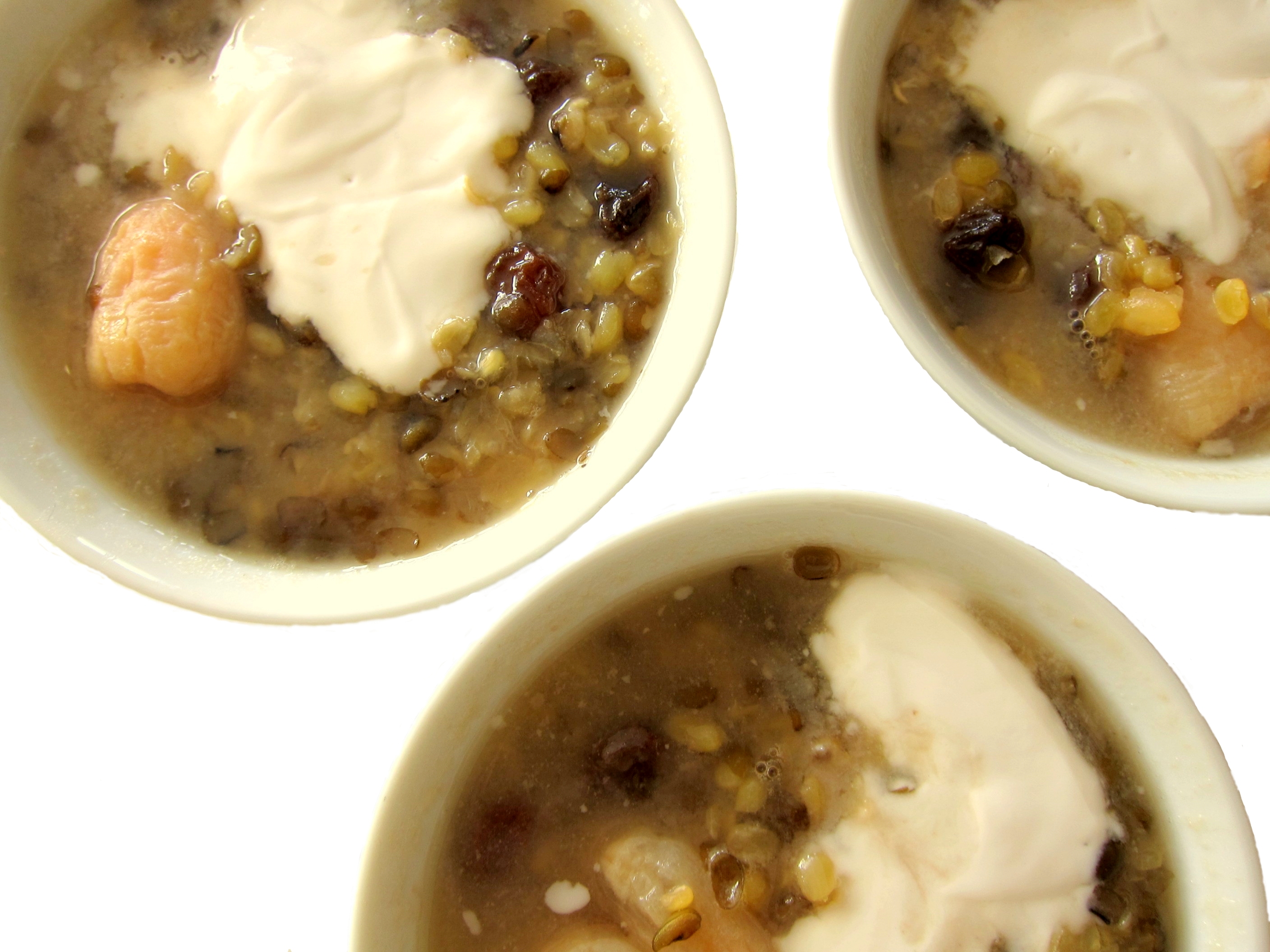
At Shabu House, we asked for desserts. The girl pulled out a pot from under the bar counter where we sat, a fading aluminum pot that looks like something you would see grandma uses to boil eggs. She ladled a soupy mung-bean-and-rice pudding into three bowls.

– Oh? Is this Japanese?! We have something just like this too.
*Smile*
– No, it’s Taiwanese…
– Oh… are you… Taiwanese?
– No, I’m Korean. *grin*

The dessert was too bland in Mom’s and Dad’s standard. Actually, yeah, it was bland, maybe 10 sugar grains per bowl or something. But I thought it was the perfect cooling end to a hot pot lunch. I also like that pot. So homey.

Or maybe it’s just because I was eating with my parents that I was more forgiving of the food. Company matters. 😉

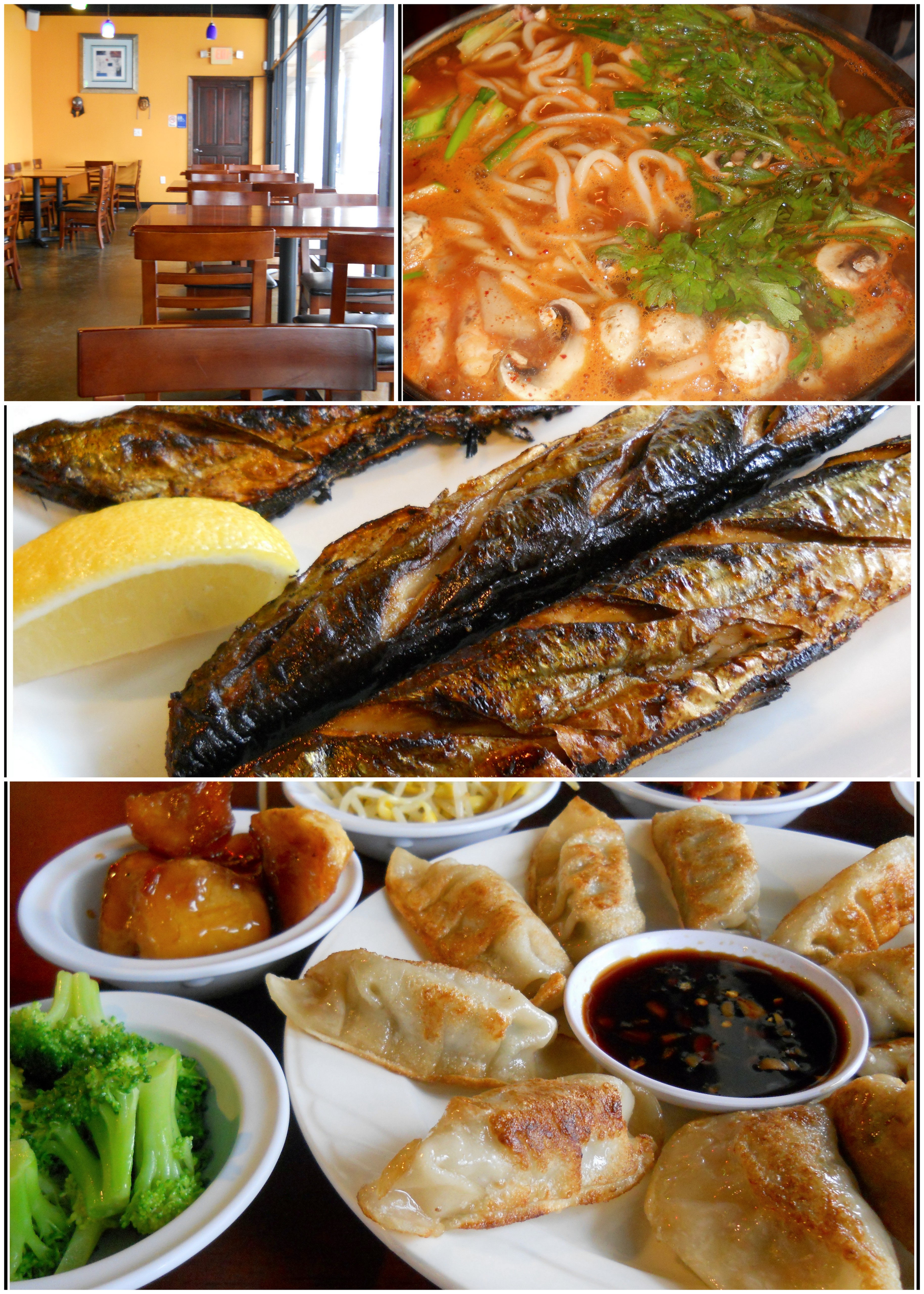
seoul-house-houston
(*) Ach no, I lied. There was one Korean lunch. The mandu was too oily, the grilled fish too charred, the seafood jeongol too spicy. But there was one very good thing about Seoul House: the banchan cart next to the wall where you can get as much and whatever kind of kimchi and other side dishes as you want. And I like their sweet soy sauce potato (gamja jorim). In fact, I like all gamja jorim. 😉

Addresses:
Shabu House
9889 Bellaire Blvd
Houston, TX 77036
(713) 995-5428
Lunch for three with dessert: $33.51

Seoul House
10603 Bellaire #107
Houston, TX 77072
(281) 575-8077
Lunch for three: $51.80

Lychee and mung bean che (Chè đậu xanh trái vải)

January 24, 2012 By: Mai Truong Category: RECIPES, sweet snacks and desserts, Vegan, Vietnamese


This dessert requires no skill in the making, but it ranks way up in the chè hierarchy, topping taro che and my own banana tapioca pudding. Beside the fact that Little Mom invented it, I always like things with lychee. 😉

Because everyone’s sweet tooth differs, it doesn’t make sense to have a fixed recipe for this simple dessert. One package of halved mung bean (with the green skin on), 1 can of whole lychee, 1 can of coconut milk, raisins, sugar and water are all there is to the pot.

The mung bean need to be soaked in water overnight to soften and cook faster. The coconut milk and the syrup from the lychee can are mixed with water to cook the bean. More or less water depends on how thick you like your chè; the more liquidy chè served cold, which I prefer, is suitable as a palate cleanser after a big meal, and the thicker version is best as a midday snack. When the mixture boils and the bean becomes soft enough to dissolve in your mouth, add raisins and sugar to taste. Wait until it boils again to add the lychees, and you’re done cooking.

If the famous Chinese imperial consort Yang Guifei could have a taste of this chè, I’m sure it’d become her favorite dessert. 😉 Happy Tết! May the Year of the Dragon be sweet for everyone!

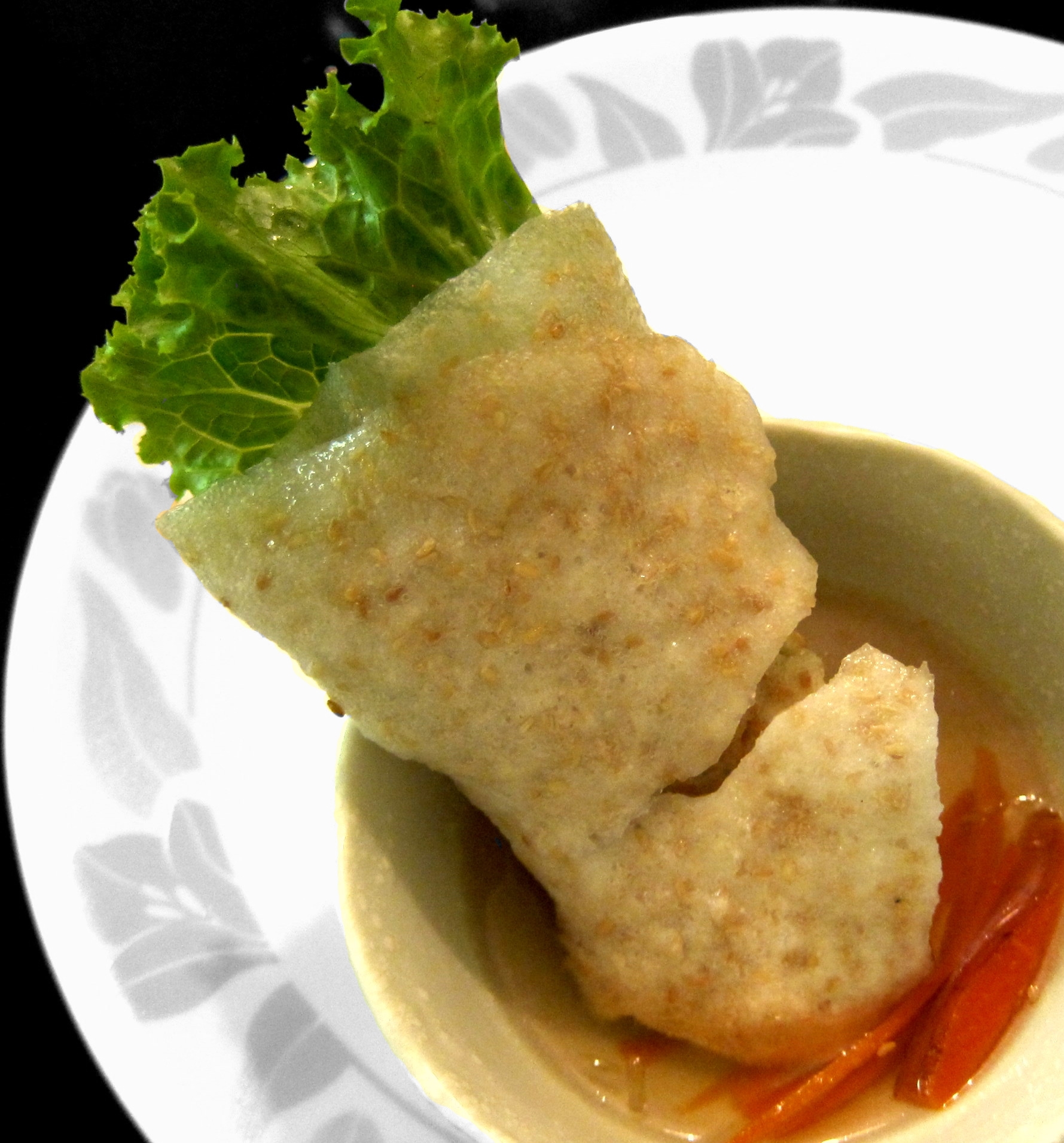
Central Vietnamese rice cracker roll (bánh đa cuốn thịt)

January 22, 2012 By: Mai Truong Category: Central Vietnamese, RECIPES


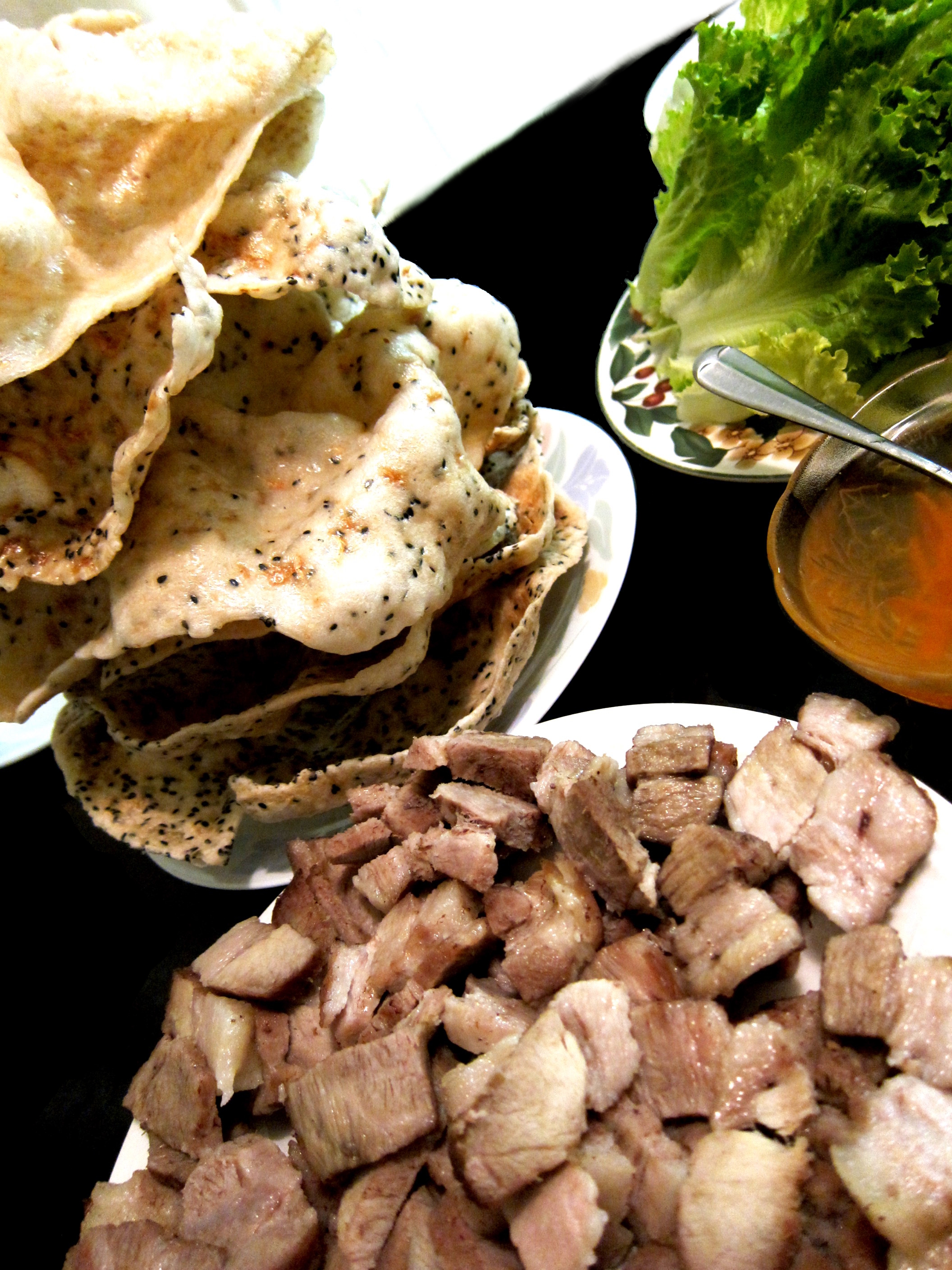
It’s the 29th of the 12th month in the lunar calendar. The last day of the Year of the Cat. The last day before Tet officially starts. But the preparation for Tet is also Tet. Having a good time is also Tet. Being home is also Tet. 🙂 One of the best parts of being home is not just getting to eat a lot. It’s getting to eat a lot of food that I would never have known otherwise. This time, Little Mom introduced me to the Central Vietnamese fun of a rice cracker roll.

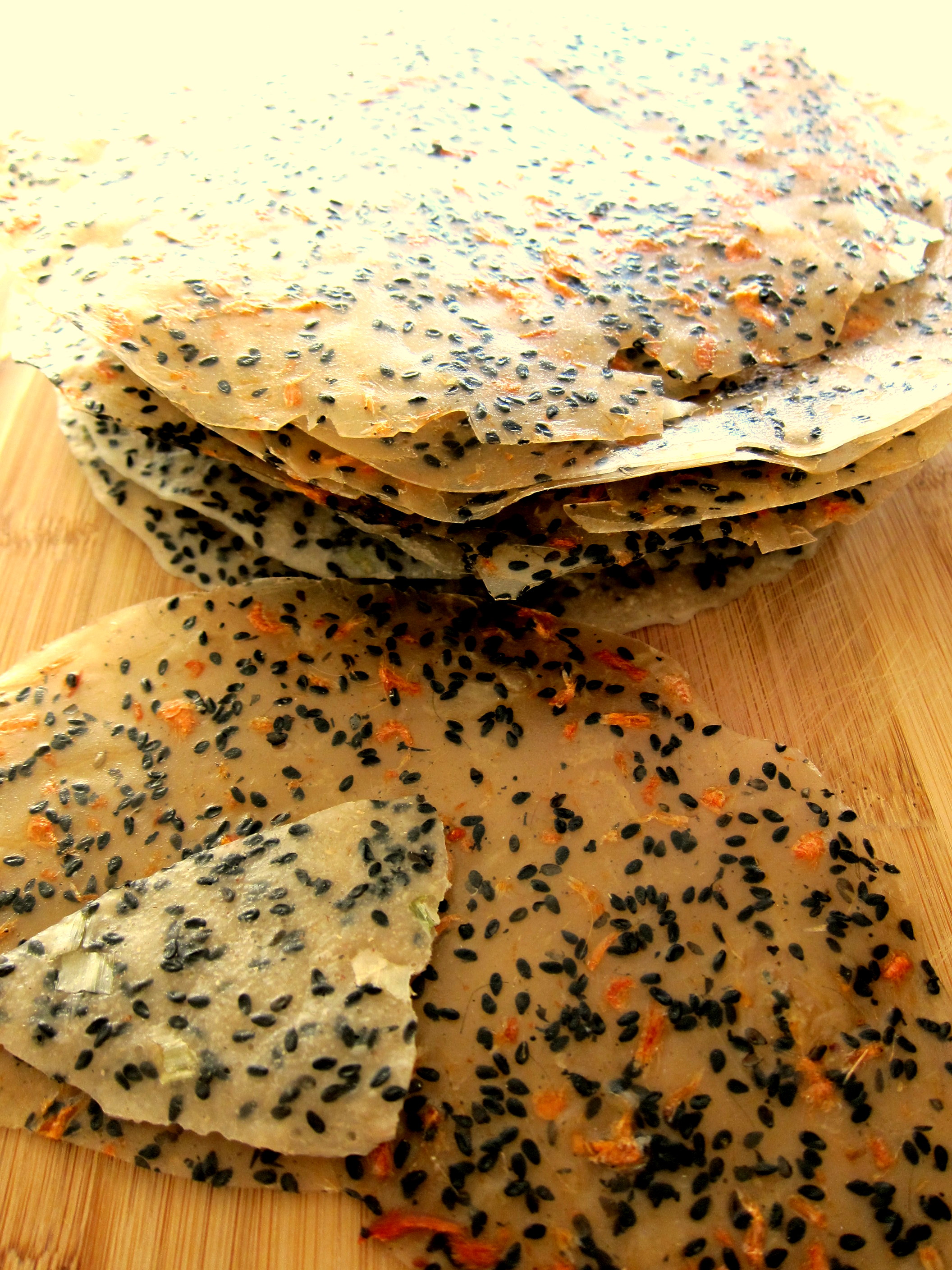
When I first heard the name, I thought I heard it wrong: how can you make a roll out of a stiff, crunchy, airy rice cracker (which we call a bánh tráng nướng in the South, or bánh đa in the North)? Simple. You dip it into water. Just like you would with the normal dry rice papers to make gỏi cuốn or chả giò.


Except in this case, you get an extra thick roll with some crunch and air in the bite, and the nuttiness of thousands of sesame seeds ingrained in every bánh đa. The filling is simple, too: boiled pork and fresh greens. Then dip it into the ever-flavorful mixed fish sauce. Mmmmm… Delicious Lunar New Year!


P.S.: Toasting a rice cracker on open fire is cool but not exactly easy to do (for example, I only have an electric stove). So we toast them in the microwave, 1 minute each side for even crunchiness. 😉 It’ll pop like firecrackers in the mouth. 😀

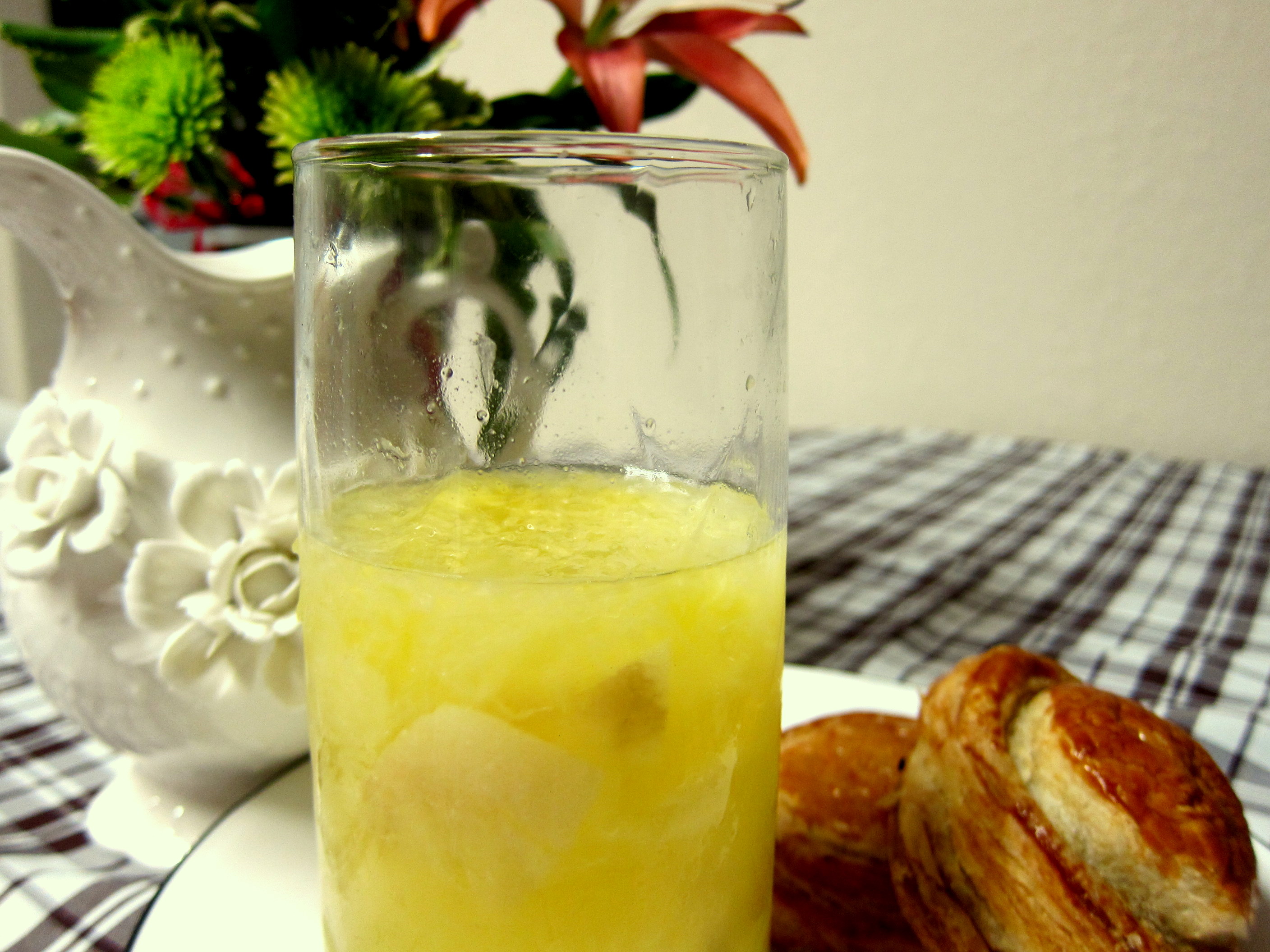
Tricitronnade – Three-in-one Lemonade

January 08, 2012 By: Mai Truong Category: Drinks, RECIPES, Vietnamese


The triple punch from Little Mom: orange, lemon, and salted lime.

Like instant ramen and popsicles, it all started from the leftovers: half a glass of a-little-too-salty salted lime drink, half a too-sour-to-eat orange, another half glass of normal lemonade (although Little Mom’s lemonade is not quite like any other lemonade, in a good way), and an ounce of reasoning. There was no sense in keeping them separately. The combined power shines a sweet yellow of tourmaline, smells like an orchard near the harvesting season, and tastes good enough to get me all poetically cheesy.

Below is Little Mom’s recipe for the salted lime. As for the recipe of this “tricitronnade”, I would imagine that the orange doesn’t have to be sour. 😉

Vietnamese Salted Lime (Chanh muối)

Step 1: zest the limes. You can do this by shaving off the zest (flavedo) with a peeler or rubbing the limes on a rough surface until it loses most of its green color. But keep the white pith (albedo) in tact; if the albedo breaks and the juice leaks out, that lime is no good to make salted lime.
Step 2: blanch the zested limes. Then leave them out to cool.
Step 3:
– Boil salt water. For every 12 limes, mix 14 cups of water with 1 cup of salt and boil.
– Let the salt water cool.
– In a clear plastic/glass jar, submerge the blanched limes in the salt water. Cover.
– Put the jar under sunlight for 1 week. I asked Mom if the jar can be opaque (like a clay jar), and she said that she has only seen chanh muối made in translucent jars. I guess you want the limes to see the sun, not just feel the heat. 🙂
– Discard the liquid after 1 week.

Repeat Step 3 three times, but for the last week, keep the liquid. By now the limes should expand to the size of lemons, their peels are melting soft, they can be eaten whole, and they stay good forever. Smash up one lime in water and add sugar to make 2 glasses of chanh muối.

Year in, year out, savoring the savoriest of pork

December 31, 2011 By: Mai Truong Category: Comfort food, One shot, Southern Vietnamese


If you had to choose, what is the most Vietnamese dish? If you are a Vietnamese expat, what would make your mouth water the most just thinking about? What is the food, the smell, the taste that when you see or hear some stranger is savoring, you’d immediately think, “hey, he must be my fellow countryman”?

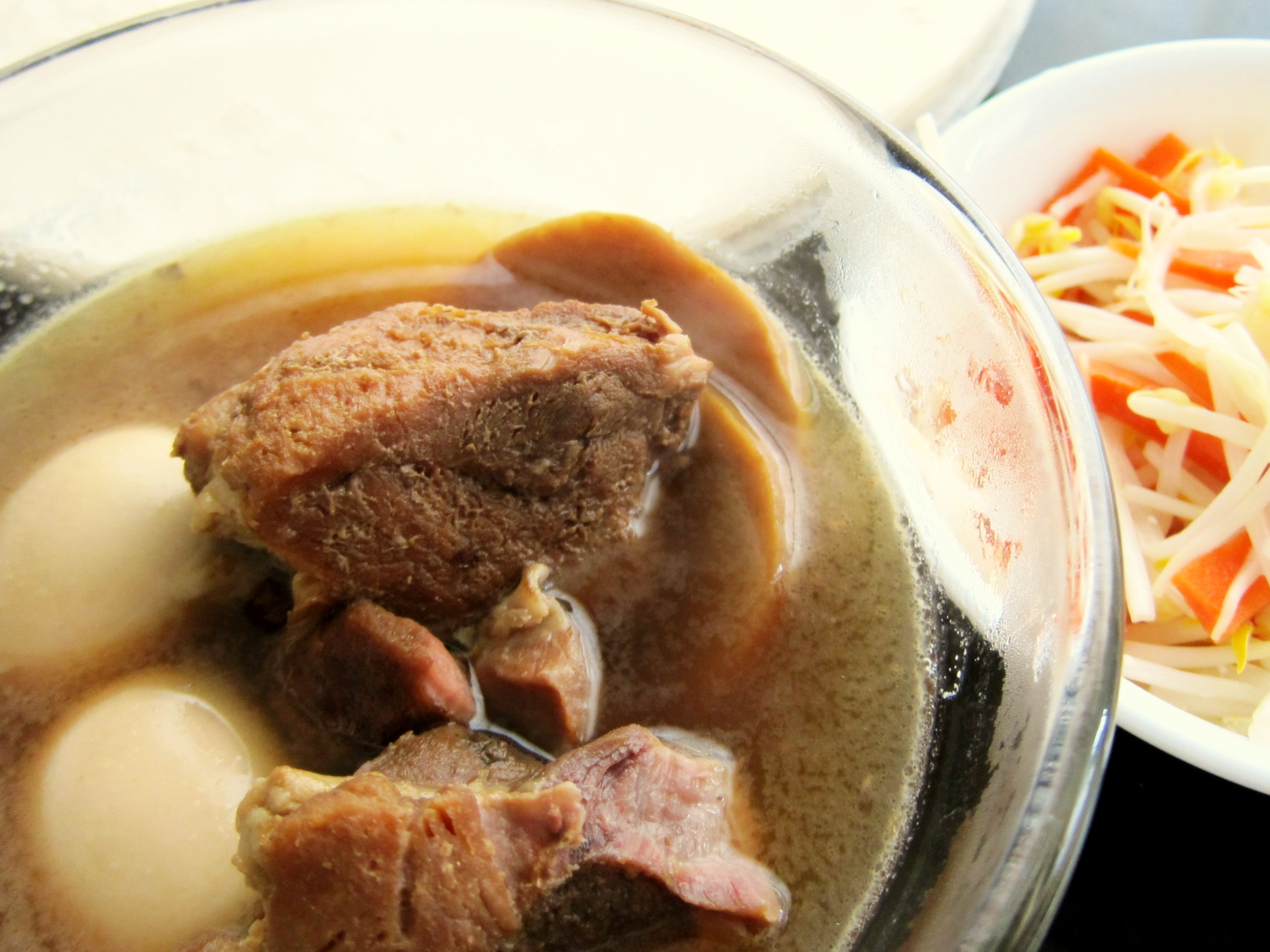
One of my friends lives in Freiburg, Germany. There is one Vietnamese restaurant 1 km away from the University, der Reis-Garten, and it is the only Vietnamese restaurant in a 40-km radius (the next one is across the border: Le Bol d’Or in Wintzenheim, France). For over 6 years living away from home, he survived on pasta and tomato sauce, students don’t have time. One day, external circumstances have finally driven him to decide that he no longer needs to suppress his cravings out of consideration towards his Germanic housemates. He bought a bottle of fish sauce. The next day he made thịt kho. That makes it official: he’s Vietnamese, and he hasn’t forgotten it.


“Success?” “Did you add coconut juice?” “Do you have eggs in the pot?” “Do you have chả lụa too?” The questions come showering on Facebook. We cheered him on with the same salivating imagination no matter which region of Vietnam we are from and where we are living: the fatty chunks of pork so tender that a plastic chopstick can cut through, the amber sauce, with which the hard boiled eggs are imbrued from yolk to white. The fatty, sweet, and salty pork must be freshened up with the crunchy, sour, cold dưa giá (pickled beansprout). The pure fish sauce makes an intoxicating savory smell that permeates the whole house, seeps through the window into the courtyard to the next door neighbor, induces a Vietnamese to lick his lips thinking of his mother’s meals and perhaps, a Westerner to cringe. But why should a cringe matter? The pure fish sauce deepens the savoriness of the meat sauce, making it the best thing to pour over a steamy bowl of white rice. My friend said all he need is this amber meat sauce and dưa giá to down a few bowlfuls. Of course, I agree.

The first weekend I got home, Little Mom sat me down in front of thịt kho, dưa giá, rice, and rice paper. All kinds of rice papers come from all over Asia, but those are for calligraphy and painting. Edible rice paper comes from Vietnam and Vietnam only. A pet peeve of mine is getting served those “spring rolls” made with wonton wrappers in American Vietnamese eateries, like a lumpia. A Vietnamese spring roll must be rolled with the translucent, veil-thin, made-of-rice-flour rice paper. Rolling it with any other kind of wrapper is an unpatriotic insult to Vietnamese cuisine. Anyway, my mom sat me down in front of her succulent slow braised pork, pickled beansprout, rice, and rice paper. Then she said go for it, and boy did I go. I made little wraps of pork and sprouts to dip into the sauce. I poured the sauce over rice. I dipped plain rice paper into the sauce. I made some more wraps and filled another rice bowl. It’s almost barbaric. The comfort of an old country taste is multiplied by the comfort of home. The eyes and tongue are no longer the principle critics, but all five senses are involved: the smell of the sauce, the sound of the sprouts collapsing between bites, the delicate touch much needed in rolling the rice paper. Each bite I took embodied the ordinary, simple, honest Southern cooking and the skillfully honed tradition of hundreds of years: thịt kho is a must-have in our Tet feast, like the turkey at Thanksgiving, the songpyeon on Chuseok, or the ozoni for Shogatsu. Well, it’s not Lunar New Year now, but it is a New Year. Maybe I’ve grown old, but I find that nothing beats celebrating the holidays at your family’s dinner table with family comfort food. 🙂

As I’m writing this post, the fireworks are going off right outside the windows, talk about food setting off fireworks ;-). Happy 2012! And may Vietnam be delicious always! 🙂

Little red riding seeds

May 15, 2010 By: Mai Truong Category: RECIPES, Vegan


It has the texture of corn germs (the flat yellow seed inside each corn kernel). With the tiny mahogany peel cracked open just a little, each quinoa seed spills out its soft white flesh, the combination gets amusing. It’s like broken rice but more vigorous and inhomogeneous, or sesame but more fleshy. It goes well with walnuts either mixed in at the beginning or added at the end. If you think hard about it, it even tastes like clariid catfish eggs.

Several ideas spring up: quinoa chè? quinoa xôi (sticky rice with quinoa or quinoa with mung bean)? quinoa bread, quinoa pie?

Have you cooked with quinoa before? What is your experience with it?

Mudpie’s Red Quinoa with crushed walnuts
(recipe adapted from Suzy’s special red quinoa)

Ingredients

  • 2 cups water
  • 1 1/2 teaspoons butter
  • 1 tablespoon Chinese five-spice powder
  • 1/4 teaspoon ground ginger
  • 1/4 teaspoon black pepper
  • 1 cube beef bouillon (or more if you like)
  • 1 cup red quinoa, rinsed and drained

Mudpie notes that you shouldn’t go light on the seasonings, especially the beef bouillon. And if you’re not a fan of cinnamon like me, then star anise, cloves, and a tad of pepper powder can kick the Chinese five-spice powder out of the pot.

Directions

Rinse the quinoa grains carefully before cooking, as the saponin coating on the seeds can give an unpleasant bitter taste.

Place the water, butter, five-spice powder, ginger, black pepper, and beef bouillon cube into a saucepan over medium heat, and bring to a boil. Stir the mixture to dissolve the bouillon cube, then add the quinoa and crushed walnuts. Reduce heat to a simmer, cover, and cook until all the water is absorbed, about 20 minutes.

The avocado’s sweet side

April 09, 2010 By: Mai Truong Category: Comfort food, Opinions, RECIPES, sweet snacks and desserts, Vietnamese


Who do you think is more confused about his identity, the penguin or the avocado? The penguin is the prime example of a bird that can’t fly. The avocado is the most commonly known fruit that doesn’t taste like a fruit. It lacks the citric hint of berries and oranges, the crunch of apples, the pulpiness of peaches and plums. If I were an avocado I’d ask myself several times a day, why did mom and dad make me taste like butter and different from every other fruitie at the market?

A good avocado mom tree, like all good moms, would say “Av, being different is a good thing!”.
– But I don’t get to hang out with the other fruits, they say I’m fat.
– The other fruits can’t make Ice Cream by themselves. They’re only side flavors. You can become Ice Cream all by yourself.
– If Sugar helps me.
– Sugar is nice, but you also have what it takes to be a good Ice Cream. And think about what you can do for others if you learn from Butter and Cheese, you have their smoothness too.

If I were an avocado, that’s the story I’d tell when people ask why I decide to join the Sushi corporation and partner with Tortilla Chips. But just between you and me, I actually prefer my alone times with Sugar in the fridge.

3-minute dessert: Avocado “ice cream”:
Scoop the avocados out of their peels and into a glass. Add sugar sporadically between layers of avocado, if possible. If not, add sugar on top at the end of the scooping process, but before mashing up the avocado. Mash, taste, add more sugar to liking, taste again.
Refrigerate.
Spoon.
Lick spoon.

Cha lua kimbap

June 30, 2009 By: Mai Truong Category: Korean, RECIPES, savory snacks

3 cups of rice, 3/4 lbs cha lua, 1.25 cucumbers, 3 avocados. Made 10 fat rolls of kimbap. We used long grained rice because we didn’t want to bother buying short grains, giving the rice a little more water than what the cooker says, and it’s sticky, but gotta roll quickly or the rice would dry out, perhaps in hindsight short grain would do the job better? Seasoning the rice calls for sugar, salt, and vinegar, but ubercmuc detests the taste of vinegar, hence water substituted. Inadvertently, my rolls deviate from Maangchi’s by a great distance.

Cha lua (also labelled giò lụa) was bought at a local Vietnamese shop in Little Saigon, hot and fresh from the steamer. Don’t buy those frozen things at the Asian supermarkets, who knows how long they’ve been there. I cut up the cha lua and boiled the slices to lessen the nuoc-mam flavor (which is only a wisp to begin with). It is a much better meaty core than crab stick.

We weren’t sure if we got nori or kim, the sheets are green instead of black, salty, and have a noticable taste of the sea. A 27cm x 27cm sushi mat was well sufficient. We have yet to master the art of slicing a roll of rice, stuffing, and seaweed without breaking them apart, but I found that a cling-wrapped, refrigerated roll, microwaved for 2 minutes, then cut with a wet knife, turned out to be much more beautiful than those cut fresh or cold. Microwaved kimbap also tastes as good as new, at least to a foreign mouth.

On the subject of the skillet

November 30, 2008 By: Mai Truong Category: savory snacks, Vietnamese

1. This is real, homemade chả giò – fried rolls of ground pork, shrimp, carrots, and jicama wrapped in rice paper (not the stuff made with thick yellow sheets called “egg roll” in restaurants). These won’t make the cut for a roll beauty contest, the grease will probably fatten your blood clots, but to me they’re worth a few years of life. I like them freshly fried and crunchy, I like them microwaved and chewy, and I like them cold, too. My mom makes supersized cha gio, five little piglets and you’ll lie flat on your back rubbing your tummy.

2. Fried wonton: here’s where the yellow flour sheet comes on stage to be a wrapper. Same stuffing as the cha gio, different shape, different texture. They make great bite-sized snack, both by themselves and wrapped in lettuce. Yay for more fat. But remember, Asians are skinny, so what to be afraid?