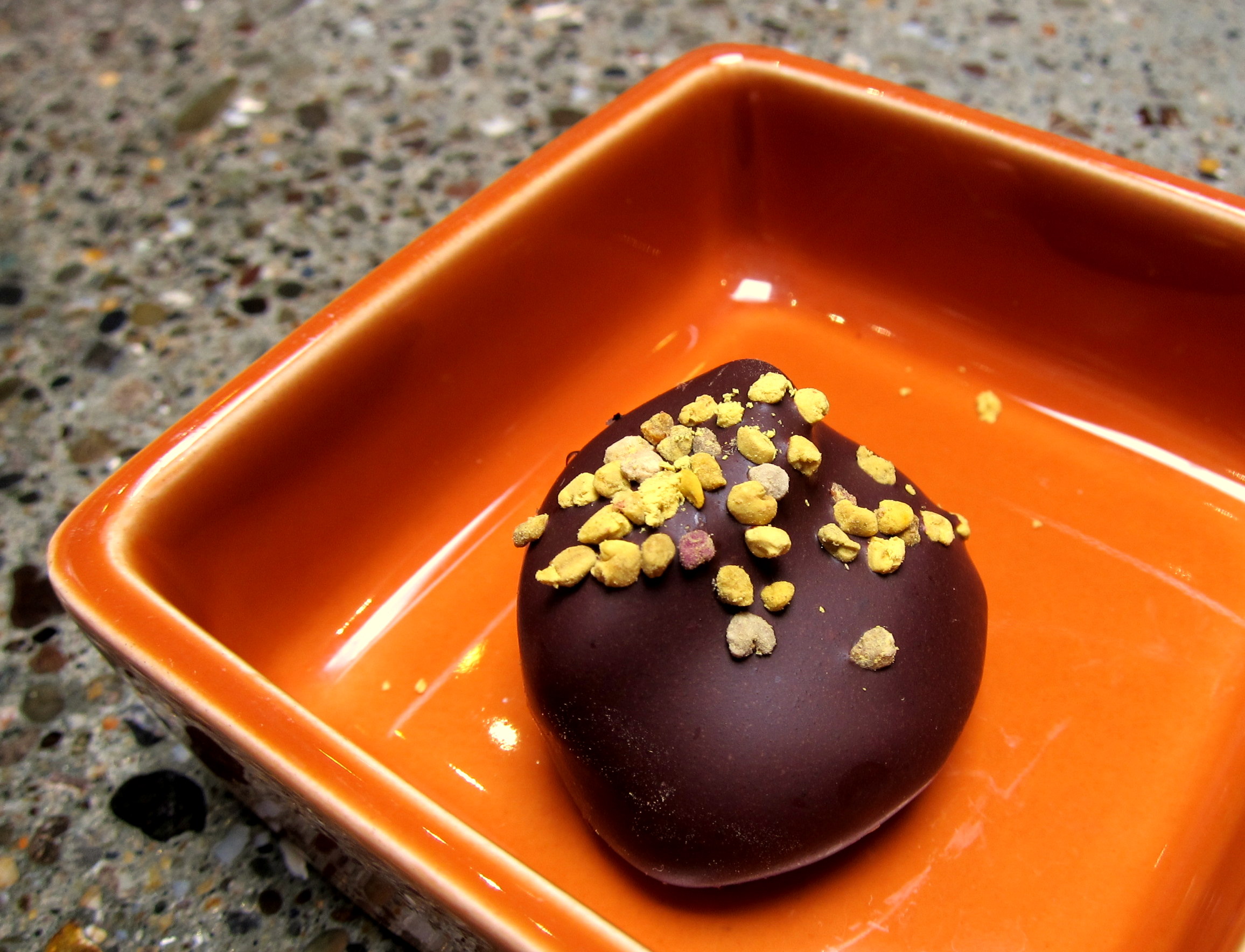
The best (known) green tea of China. The cream of the cream of the crop. I feel sophisticated just drinking it. Paired with a tangerine bee pollen truffle and I almost hear little cherubim playing the lyre.
You can read the whole story in my journal Tea & Mai. I’m off to dance in my head.
The third pairing of mochi and Japanese green tea. Perfect!
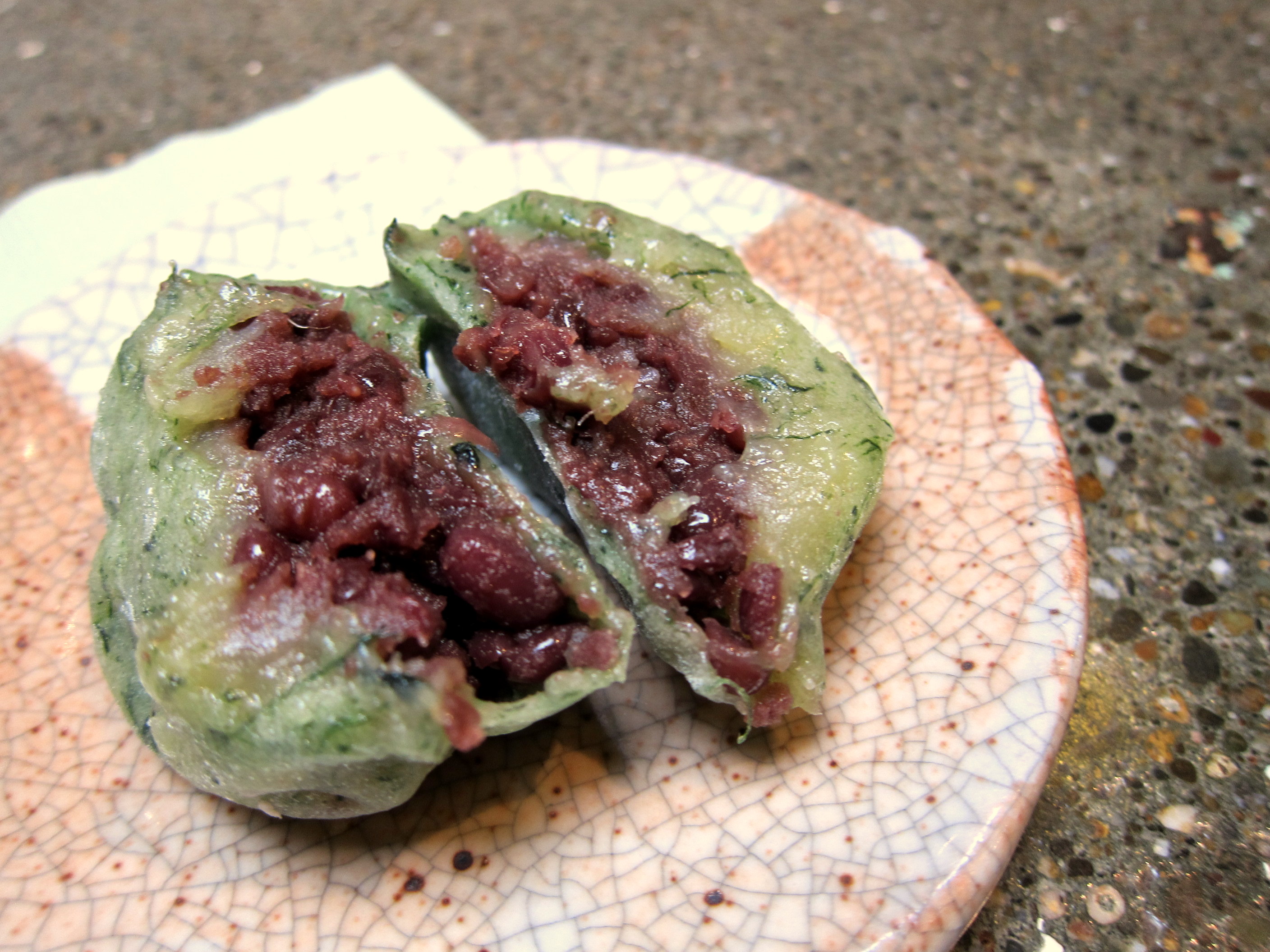
Yes, finally a mochi that goes perfectly with sencha. Yomogi (Japanese mugwort), julienned into tiny strings and mixed with the mochi dough, gives the mochi a clean, refreshing taste, which reminds me of the tip of a Vietnamese bánh ít or a bánh ít gai (*).
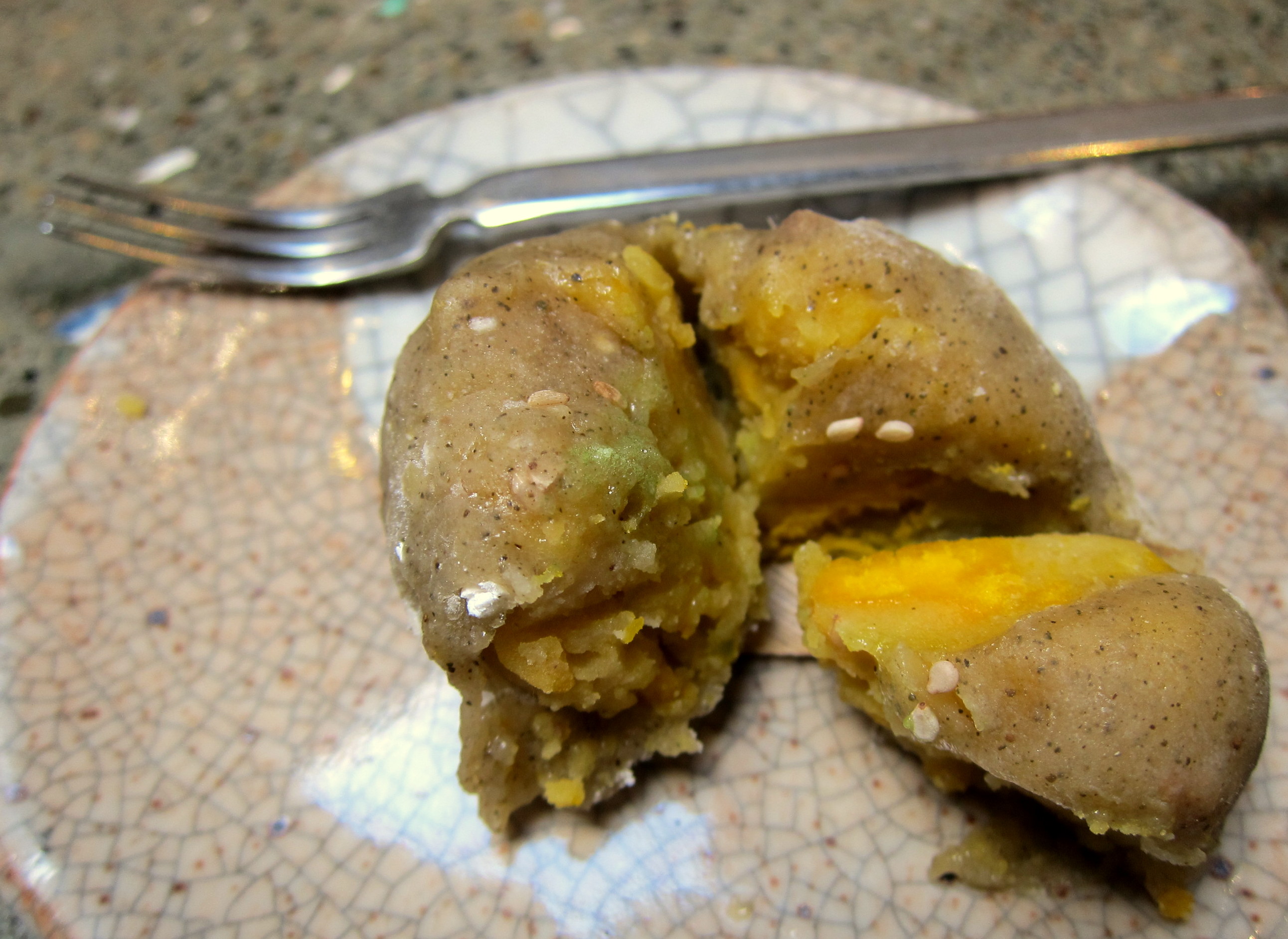
However, what struck me was the filling: red bean and sweet potato paste. The red bean is the main factor, the sweet potato is only at the top, closest to the doughy coat. The azuki sweetness subdues the fishiness (umami) of sencha, and the sencha bitterness subdues the sweetness. Is this why the Japanese use azuki for their desserts so often?
Why didn’t the sencha – matcha-mochi pair work as well? The matcha mochi also has azuki paste, but I think the orange juice and the walnuts distracted me. The yomogi clarifies the taste in a more floral and less bitter way than the matcha; and like saffron, sometimes a spice’s presence isn’t noticeable, but its absence would be. Anyways, this pair also shows that a simpler mochi can be a better mochi.
(*) Like mochi, bánh ít has a sticky rice dough with fillings, which can be sweet (coconut) or salty-sweet (mung bean paste). Unlike mochi, it’s all wrapped up in leaves, and it’s about 4 times bigger than a mochi. Shape-wise, mochi is most similar to bánh quy, whose green color (should) comes from pandan leaf. Similarly, the black color of bánh ít gai comes from the thorn leaf (ramie leaf), but the other ingredients are the same.
P.S. Sencha is interesting. It’s bitter at first and gets nutty later. It tastes odd at first because it’s not what you would expect from a drink, but the more you drink it, the more you’re attracted to it.
P.P.S.Yomogi mochi is also called “kusa mochi” (grass mochi). So Ms. Yuri Vaughn the mochi artist for Teance calls it “yomogi grass mochi”, which made me think that yomogi was a grass.
Another pairing of Japanese tea and Japanese snack. A bowl of matcha is supposed to suffice your daily vegetable need because you’re actually consuming the leaves themselves, in powder form.
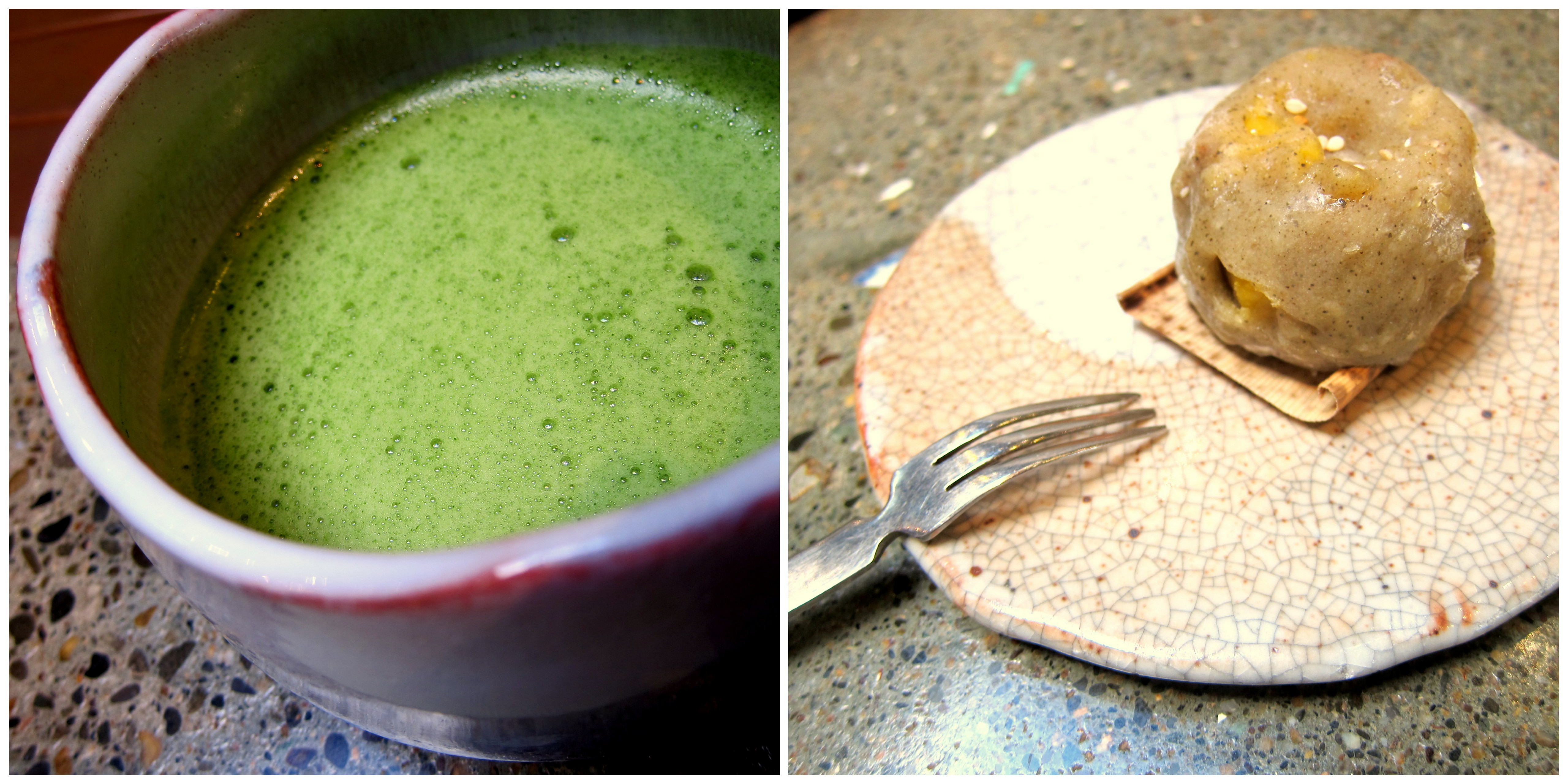
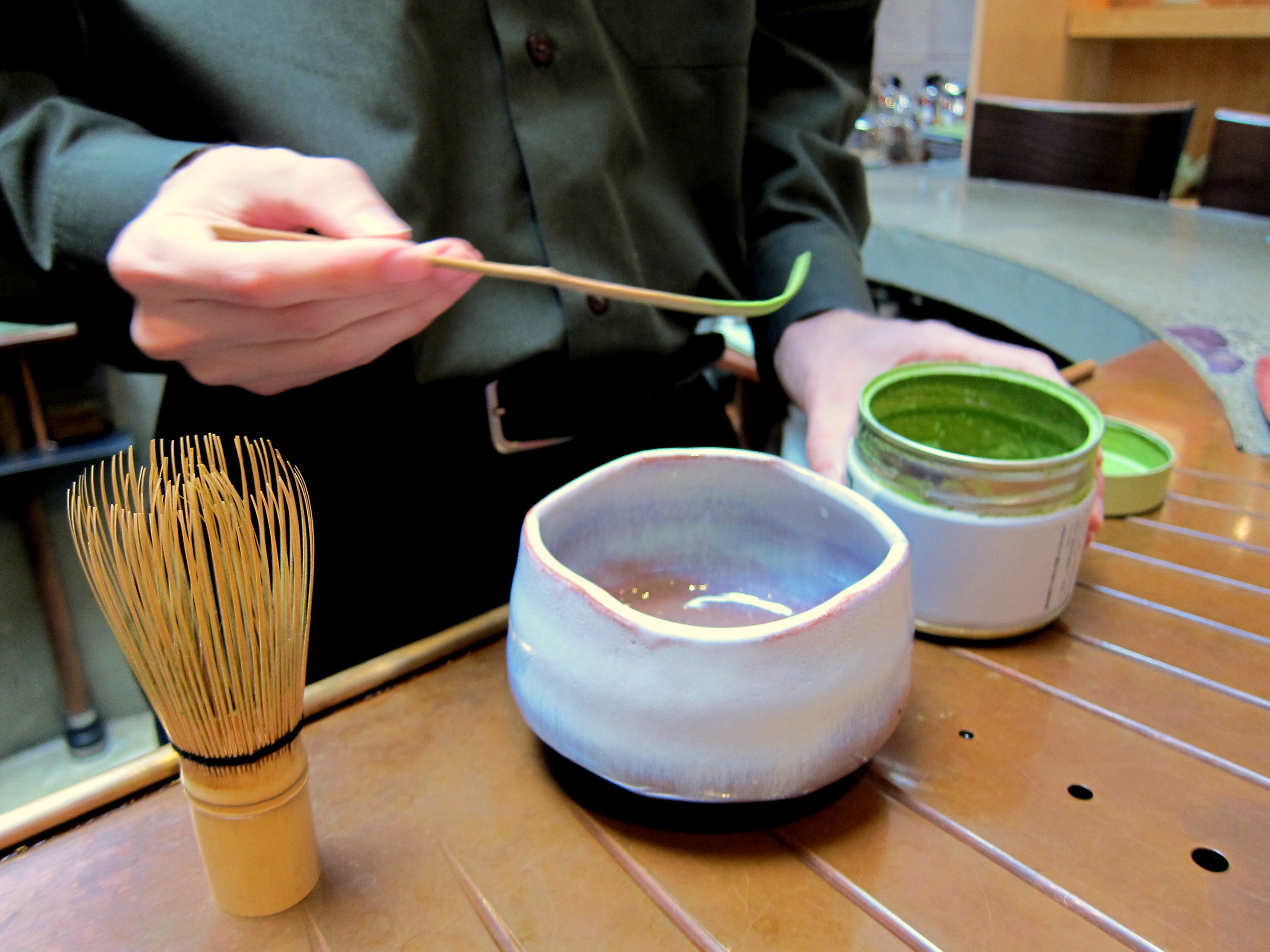
Matcha is served in a bowl. Mix water (205 F) with the matcha powder using a whisk, whose look reminds me of a yard broom in Vietnam, and there is no steeping time to watch out for, which I like. The whisk makes the tea foam up. The lady sitting next to me said that the foam turns her off visually, but actually the foam adds an interesting dimension to the tea. For one, it abates the seaweed taste because the foam is a cushion layer between the tea and the palate, preventing the palate to fully experience the tea. Secondly, together with the powder, it enhances the nuttiness of the tea. Near the end of the bowl, when there is more powder, the tea is extra nutty, akin to mungbean milk.
Unfortunately, this nuttiness does not enhance the nuttiness of the kabocha mochi but competes with it. The mochi this time has a hojicha-flavored coat and a filling of cinnamon, walnut and kabocha (a kind of winter squash, also known as the Japanese pumpkin). Contrary to my hesitance, the cinnamon was too faint to be detected (no, I don’t like cinnamon), and the mochi is mild overall. It is not too sweet.
Instead of being steamed-dried like other Japanese teas, hojicha is roasted in porcelain over charcoal, so the green tea becomes much milder than sencha. The kabocha is similar to a plain, grainy, white sweet potato in both taste and texture. (The red mushy sweet potato is sweeter than the white kind.) Because both the tea and the snack are grainy, matcha-kabocha mochi is not a good match together, although I really like them both separately.
A better pairing would be matcha with matcha mochi, and sencha with hojicha-kabocha mochi, because you want something sweet tempered by something a tad bitter, and something clear with something nutty. Nonetheless, I still think that sencha is an entree tea, not a dessert tea. So the hojicha-kabocha mochi would be better enhanced by something strong in fragrance like jasmine green tea.
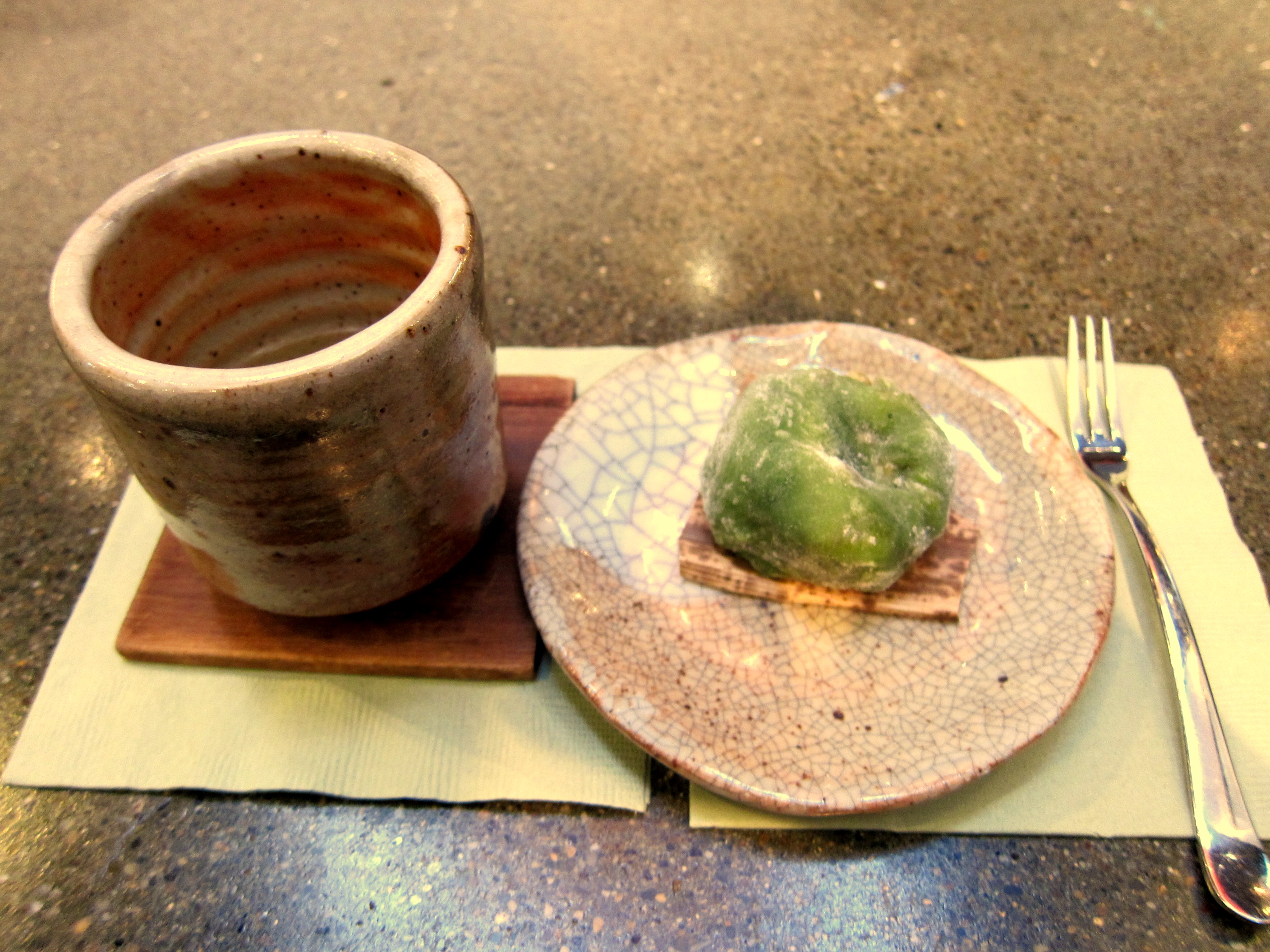
Sencha in yunomi, a typical Japanese thick, tall teacup, whose name I’ve yet to find out, accompanied by a matcha mochi, whose fillings include: satsuma sweet potato, red bean paste, orange juice and walnuts. (Thanks Masaaki for telling me the name of the cup in Japanese.)
The mochi, handmade and delivered by a mochi lady every week to Teance, is refreshing both in look and in taste. The green tea flavored chewy coat is cool and light. The filling, although dominated by red bean, is not too sweet. I opted for one with less nuts because I didn’t think that I would want such contrast in texture. The mochi lady is a small, timid Asian lady, who smiled so happily when I described her mochi as “refreshing”, and who showed me that I should dip my fork into tea or water before cutting the mochi so that it would not be sticky. Yes, it worked, the fork went straight through with such ease. Now it makes sense why we can chew without the mochi sticking to the teeth.
This is my second time having sencha, if we don’t count the time I had genmaichaat Ippuku (genmaicha is lower-grade sencha with roasted rice), and the seaweed taste of sencha has grown on me. However, I am not convinced that the sencha is a good match for the mochi. Both are good by themselves, but I think the sencha should be an entree tea, not a dessert tea. Its seaweed taste would enhance something savory. A mochi would fare much better with a light, floral tea that isn’t too dry, like Yellow Gold, Royal Courtesan, or Darjeeling First Flush.
Sidenote: this sencha at Teance is the hand-picked Yakichi sencha, named after the farm “founded by Mr. Shimooka[…]. Yakichi sencha is an eight-time Ministry of Agriculture award winner, and also the winner of the highest agricultural award, the Imperial Prize. […] This traditional Japanese tea is shade grown (kabuse) in the mountains above Uji.” (description from Teance webpage)
Meghan explained to me that shade grown leaves are of higher quality because when the plant is shaded, it has to produce more chlorophyll to balance the lack of sunlight, resulting in a greener leaf (or maybe a darker green leaf?). According to The Tea Detective, “the increased green chlorophyll pigment changes the natural balance of caffeine, sugars, and flavanols in the leaf. It also increases L-theanine, an amino acid found naturally in tea, that adds a unique vegetal quality to the flavor, and helps counteract some of the stimulant effects of caffeine, thus having a relaxing effect on the body, yet an alert state of mind. Photosynthesis reduces L-theanine and increases tannins, the compounds responsible for teas astringency.” Basically, kabuse (shade grown tea) is sweeter, less bitter, and less dry.
Address: Teance Fine Teas Store
1780 Fourth Street
Berkeley, CA 94710
510-524-2832
Money matter: the mochi is $4 each. A little pricey, but somehow it seems reasonable to me.
Between 4 and 6 PM today was the most interesting 2 hours I’ve had this week, and also the most effortless educational experience I’ve had in a long time. That’s how the Korean tea ceremony is meant to be, as I’ve learned: formal but relaxing, and ceremonious but natural. The rules are rather simple to get acquainted to, the movements make sense, and just watching made my mind feel nothing but calmly pleasant. The kind of pleasant feeling one would get gazing off into space alone, on a grassy hillside, on a cloudy day.
Now for the logistics. Inje University‘s Traditional Korean Tea Society (TKTS) gave a 2-hour presentation at Berkeley today as part of the “Dew of Wisdom” tour, Stanford and California State University got their tea before us. During the first 40 minutes, the students of TKTS demonstrated two types of tea ceremonies, both accompanied by the slow, deep, hardy rhythm of a 6-string zither 거문고 (geomungo).
The first type, 들차회 (deulchahue), is to be enjoyed with friends and relatives outdoor during spring and autumn. The setting is lighthearted, the purpose is to relax and to appreciate nature, the gathering comprises both men and women, and both hands are used during the preparation, serving, and tasting of tea.
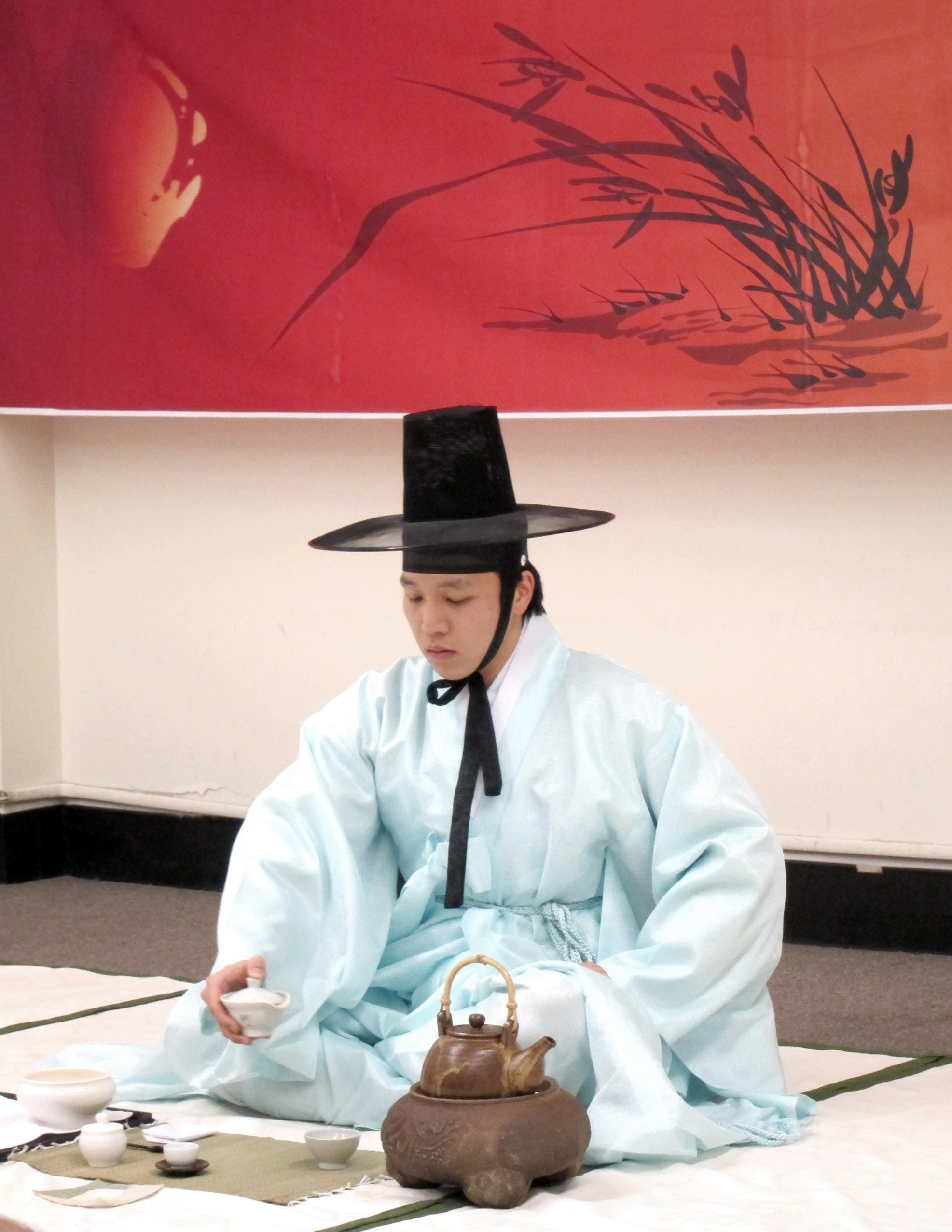
The second type, 선비다례 (seonbi darye), or “Scholar’s tea ceremony”, is practiced by noblemen to clear their mind and heighten their wisdom. The setting is dignified, and the man uses only his right hand to prepare and serve, signifying a more profound status than that in deulchahue. In both cases, the movements are fluid, slow, and steady.
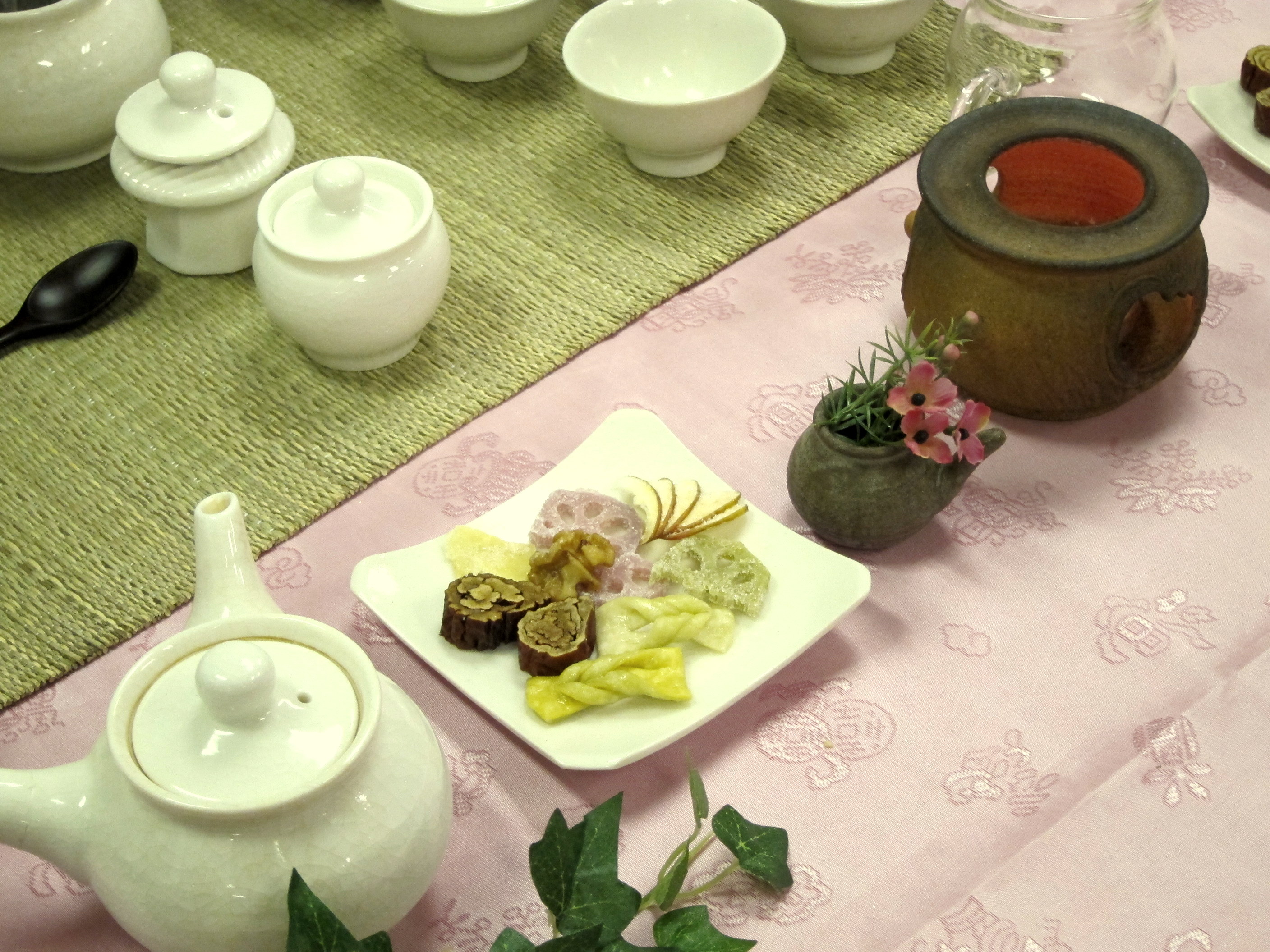
During the next 20 minutes, the guests were invited to taste green tea and yellow tea with a variety of 다식 (dasik), tea snack: candied lotus root, dried apple, dried jujube, and a kind of fried chips that I’d only seen in the drama Sungkyungkwan Scandal (성균관 스캔들). The green tea, unoxidized, looks and tastes clear with a very light herbal hint, like a white tea. The yellow tea, about 50% oxidized, similar to Tieguanyin, has an upfront sweetness and a deep citrine hue. Each batch of tea is brewed for about 2 minutes in 60-70°C water, as boiling water would induce a bitter taste.
After ample tea had been served, the guests came back to their seats for a brief presentation from Prof. Jaesup Pak, President of TKTS, on Korean tea production and ceremonial methods. I scribbled like mad, and here’s what little knowledge I’ve gained:
There are 3 major tea plantation regions in Korea: Boseong, Hadong, and Jeju. Boseong is the largest and most respected tea plantation, producing roughly 40% of Korean tea in 5.3 million square meter of hillside. Hadong, second in line, has produced wild tea for over 1200 years, and from its neighboring town Hwagae originated the Korean green tea culture. The tea here is grown completely natural on rocky 400-500 meter high mountainsides and harvested by hand. In contrast, Jeju‘s tea is grown with chemicals and fertilizers on rich volcanic island soil, plucked and chopped by machines, and heated and dried with steam.
Regardless of regions, tea leaves are plucked young between April and May because fully developed leaves are too coarse to use. Different grades of green tea are categorized based on their youngness. Ujeon (우전), the first grade, comes from the first harvest, which means it is picked by hand before April 20 for a delicate flavor. Sejak (새작), the second grade and the most popular type, is picked early May. Sejak means “Sparrow’s Tongue”, referring to the pointed shape of the young leaves at this stage. And finally, Jungjak (중작), the third grade, is picked mid May. The tea offered to the guests at the colloquium today was Sejak from Hadong.
The production process involves 6 steps: plucking, withering, parching, rolling, separating, and drying. Hand plucking tea is meticulous, even the most skilled women can pick only 2 kg per day. Within 24 hours after plucking, the leaves are left to wither in open air. Then they are tossed and stirred constantly in an iron cauldron over wood (traditionally) or gas fire at 200°C to soften. Rolling comes afterwards to intensify the taste, where the leaves are rubbed and rolled for 3-4 times on straw mats. This process makes the leaves stick together, thus separating must be done to help moisture evaporate from the leaves. Finally, the leaves are spread out and dried naturally on paper on a heated floor for 4-5 hours or overnight.
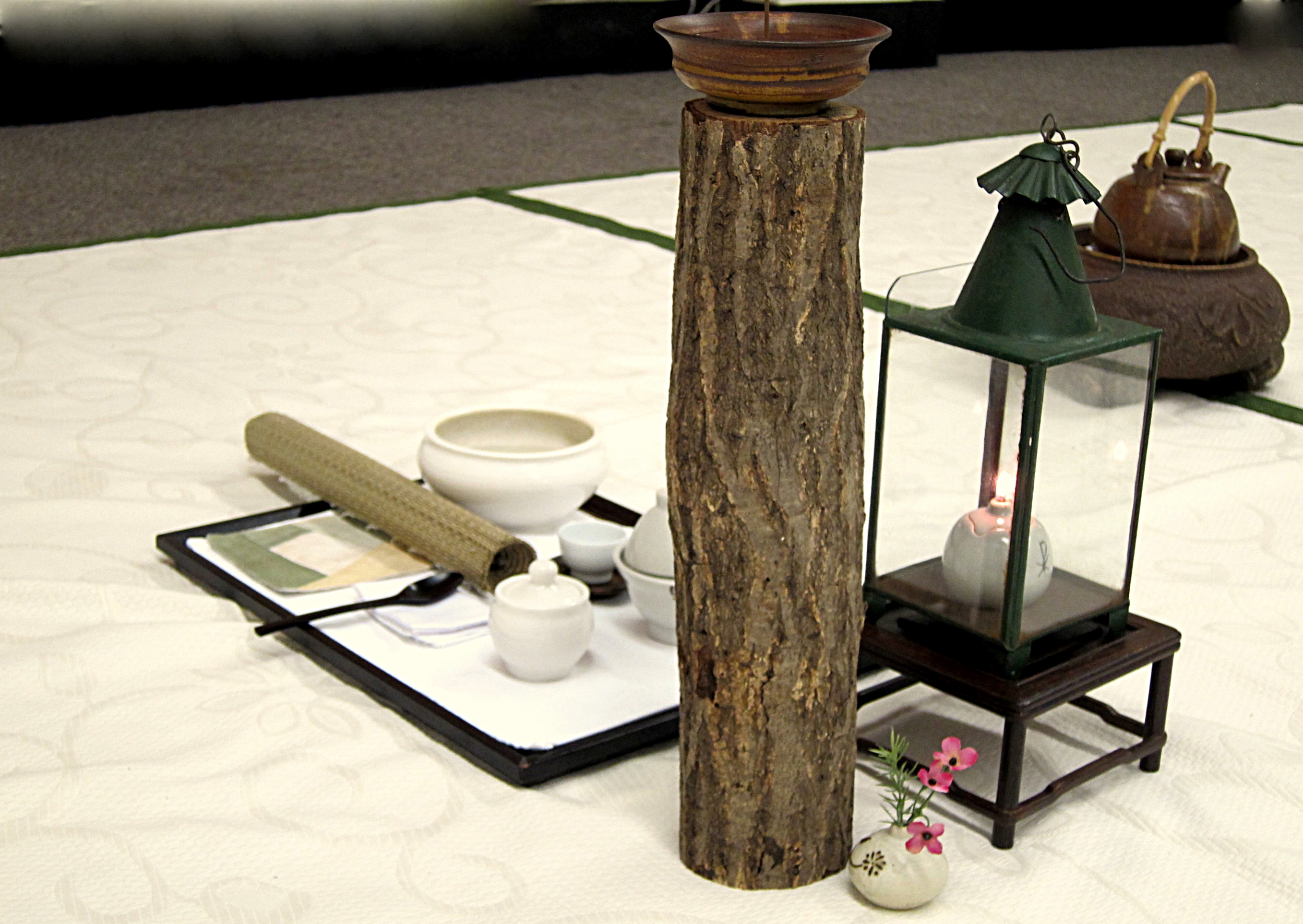
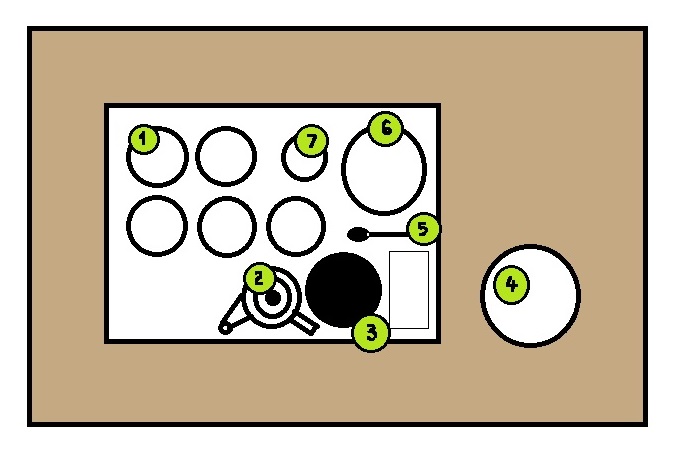
The teaware, or chagi (차기), are typically arranged as shown in the diagram above:
(1) Tea cups: usually 3 or 5 cups per set
(2) Tea pot for brewing. The teapot and kettle should be on the right side and closer to the host.
(3) Tea cup saucer, on which the filled tea cup is placed and received.
(4) Large bowl, into which the water used for warming the pot and cups is discarded.
(5) Tea spoon for taking tea leaves
(6) Smaller bowl for cooling the water and the tea, and for pouring the tea into the cups
(7) Tea caddy, which contains the tea leaves.
The small rectangle represents a napkin for tidiness.
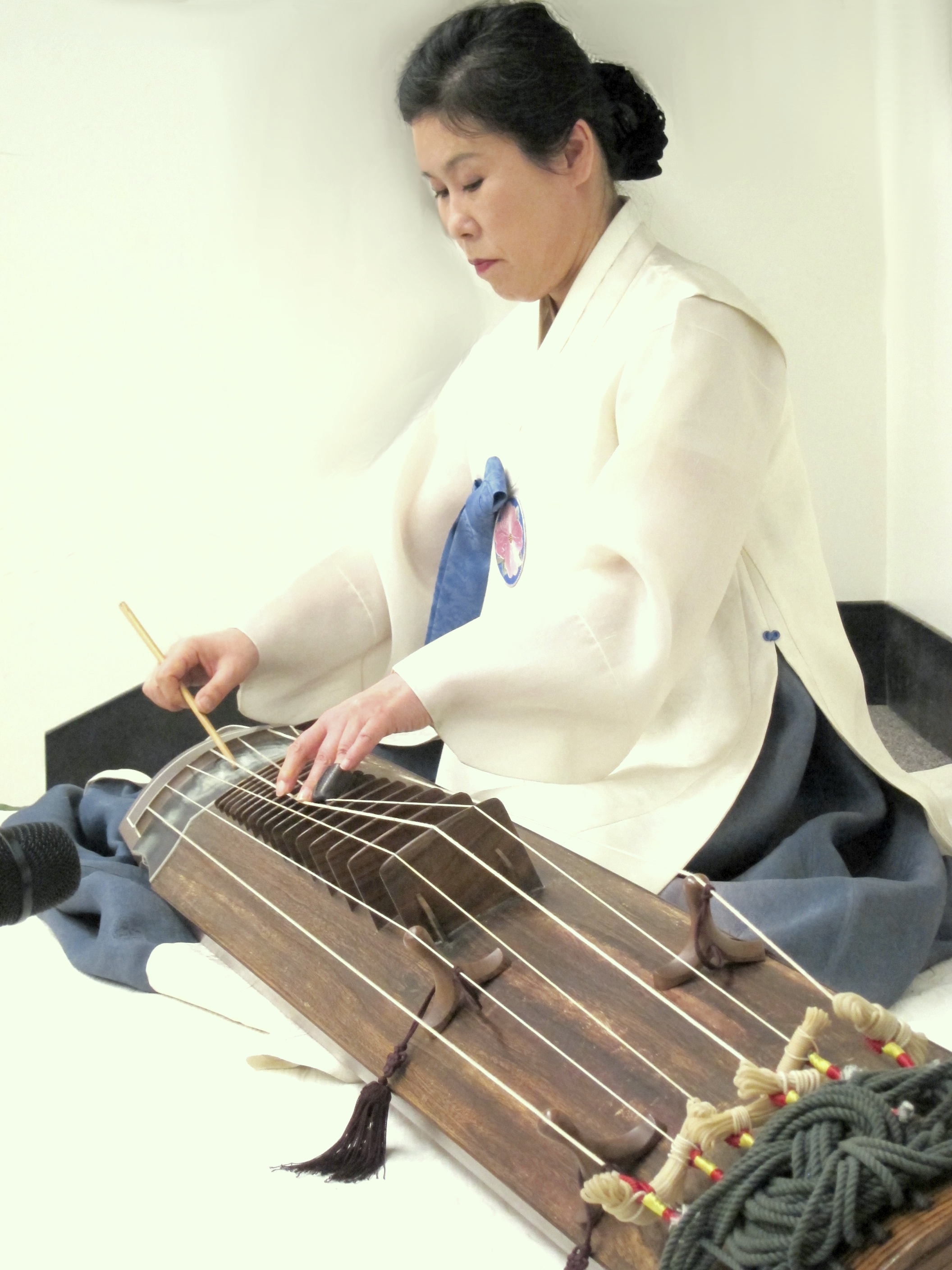
Professor Hyeyoung Shin (Chuncheon National University of Education) performing da-ak (다악, tea music) on a geomungo at the colloquium
The preparation after the arrangement begins with pouring hot water into the cooling bowl and letting it cool for under 2 minutes. Then the teapot, ready with 1-2 spoons of leaves, receives the cooled water; the lid is closed, and the leaves are brewed for a few minutes. While serving, the tea is poured into warmed cups from a high distance to create bubbles in the tea, which are believed to confer good luck. The receiver should hold the cup with the right hand and support it with the left hand, inhale the aroma, take a sip that is about one third of the cup, and drink 3 times from each cup served. I think I did it in more than 3 times… I was savoring the flavor a little too carefully.
At the end, we got to take our cups home as a souvenir. A cute little white tea cup to commemorate a sweet, delicate two-hour lesson. 🙂