Flavor Boulevard

We Asians like to talk food.
Subscribe

one shot: Profiteroles at Cafe Rabelais

December 26, 2013 By: Mai Truong Category: Cafes, French, Houston, One shot, sweet snacks and desserts

cr-profiteroles-001
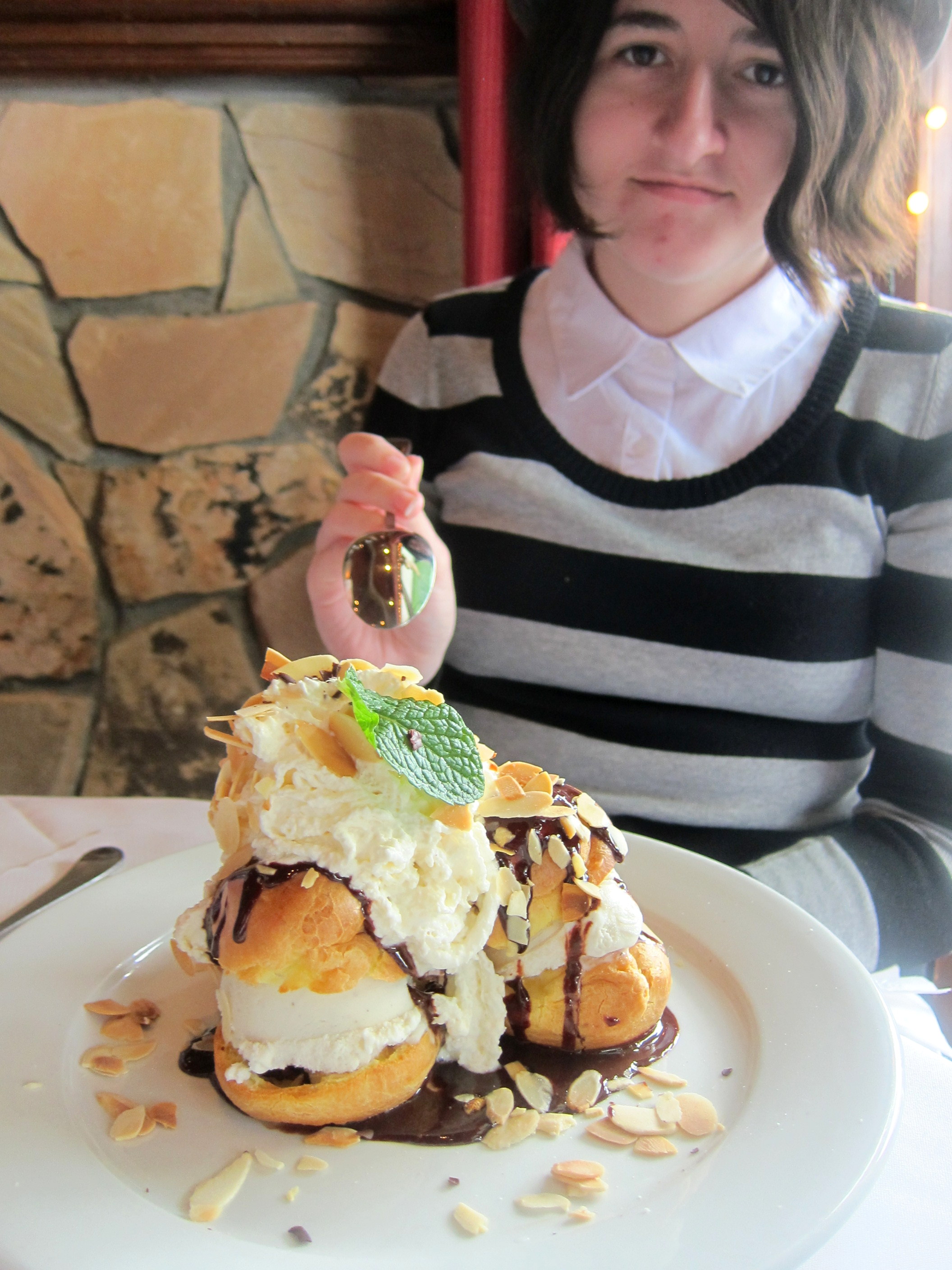
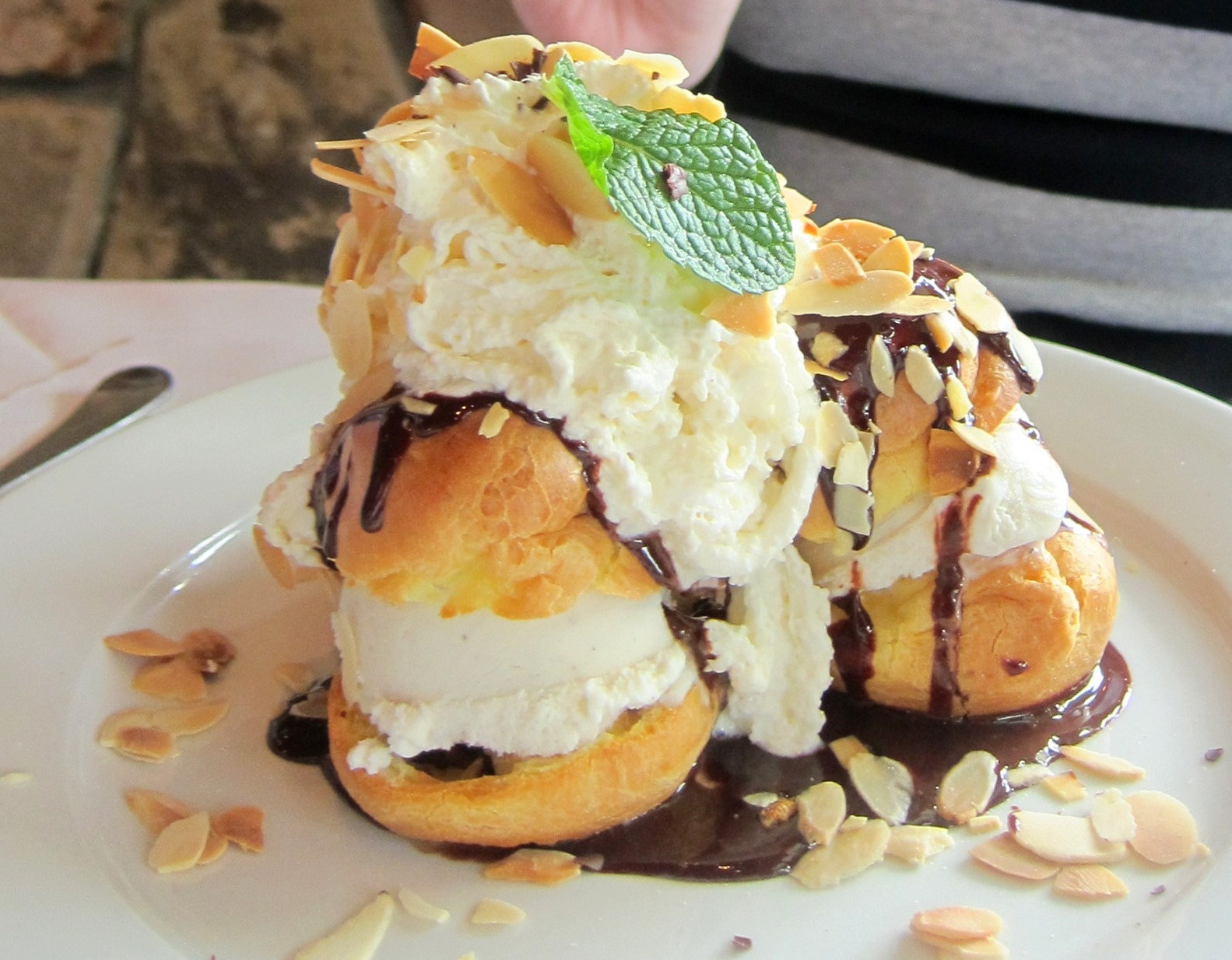
Even if you don’t like anything at Cafe Rabelais (I didn’t), this mini-mountain of profiteroles loaded with ice cream is still as resistible as a pool in the summer, and worth every second you spend with it too.

To top, it’s HUGE. THREE orange-size puffs, for only $6.50! We thought it was going to be just one cream puff, you know, like how desserts are usually portioned… but no, the pastry chef has a heart of gold. Next time I’m at Rive Village, I’ll swing by for a profiterole recharge. 😉

Sidney and the cream puffs. See how big this dessert is?

Sidney and the cream puffs. See how big this dessert is?

Address: Cafe Rabelais
2442 Times Blvd (West University, steps away from the big shopping mall of Rice Village)
Houston, TX 77005
(713) 520-8841 (They don’t take reservation though)

———\\–//———-
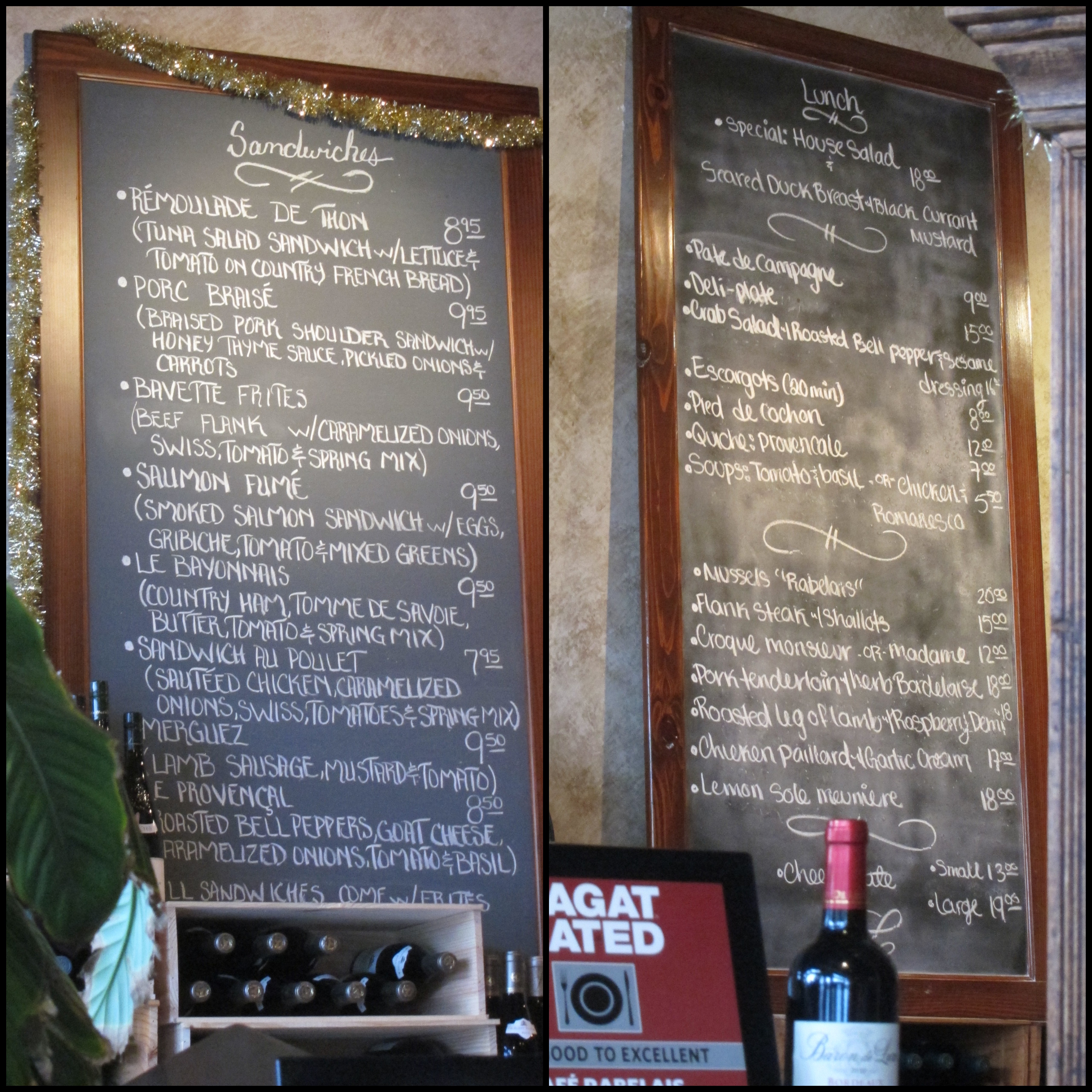
Now… a few more shots of Rabelais’ foods, but the menu varies daily and is only written on the blackboard so we might never see these dishes again:

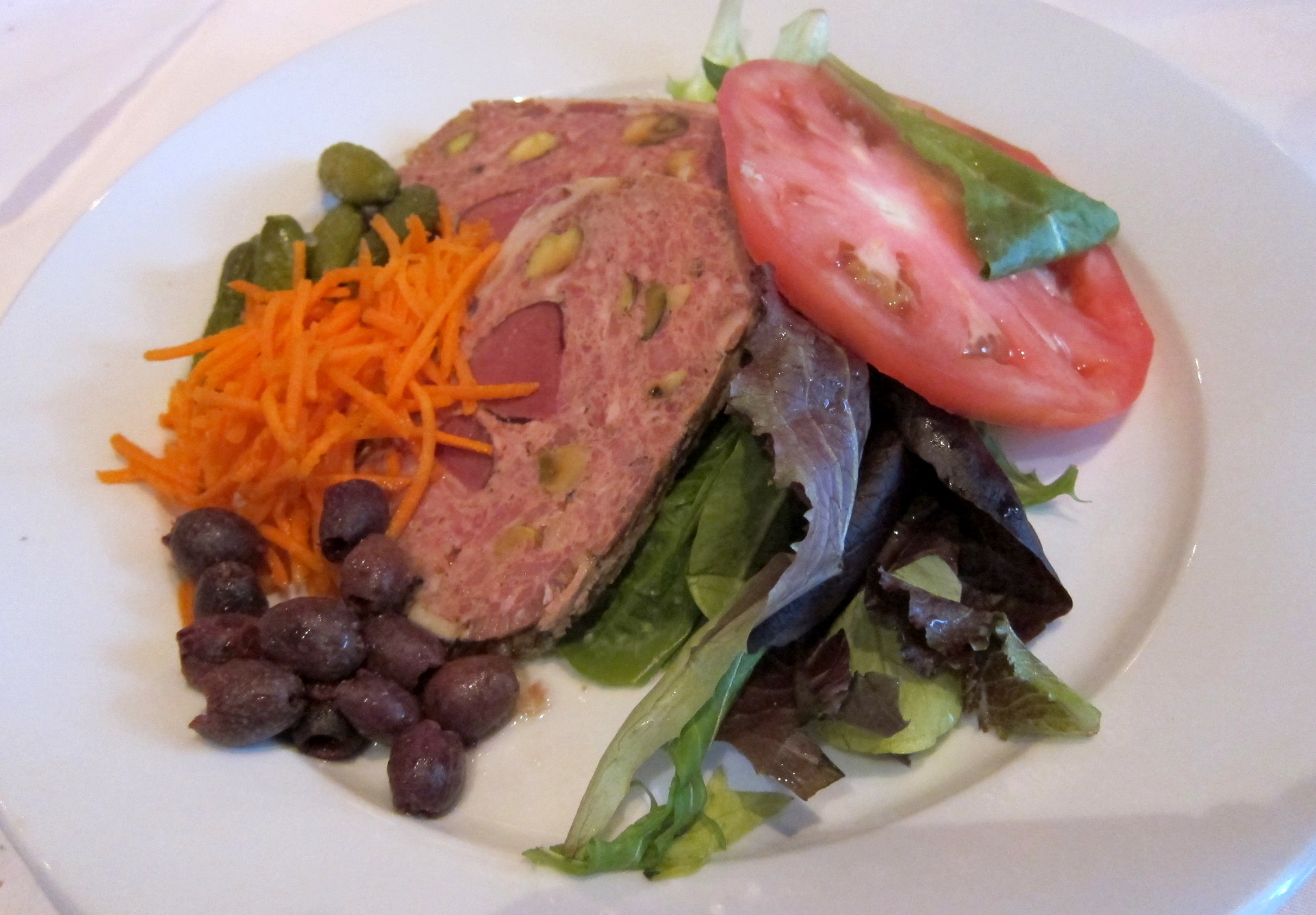
Pate de campagne - meaty and well seasoned.

Pate de campagne – meaty and well seasoned.

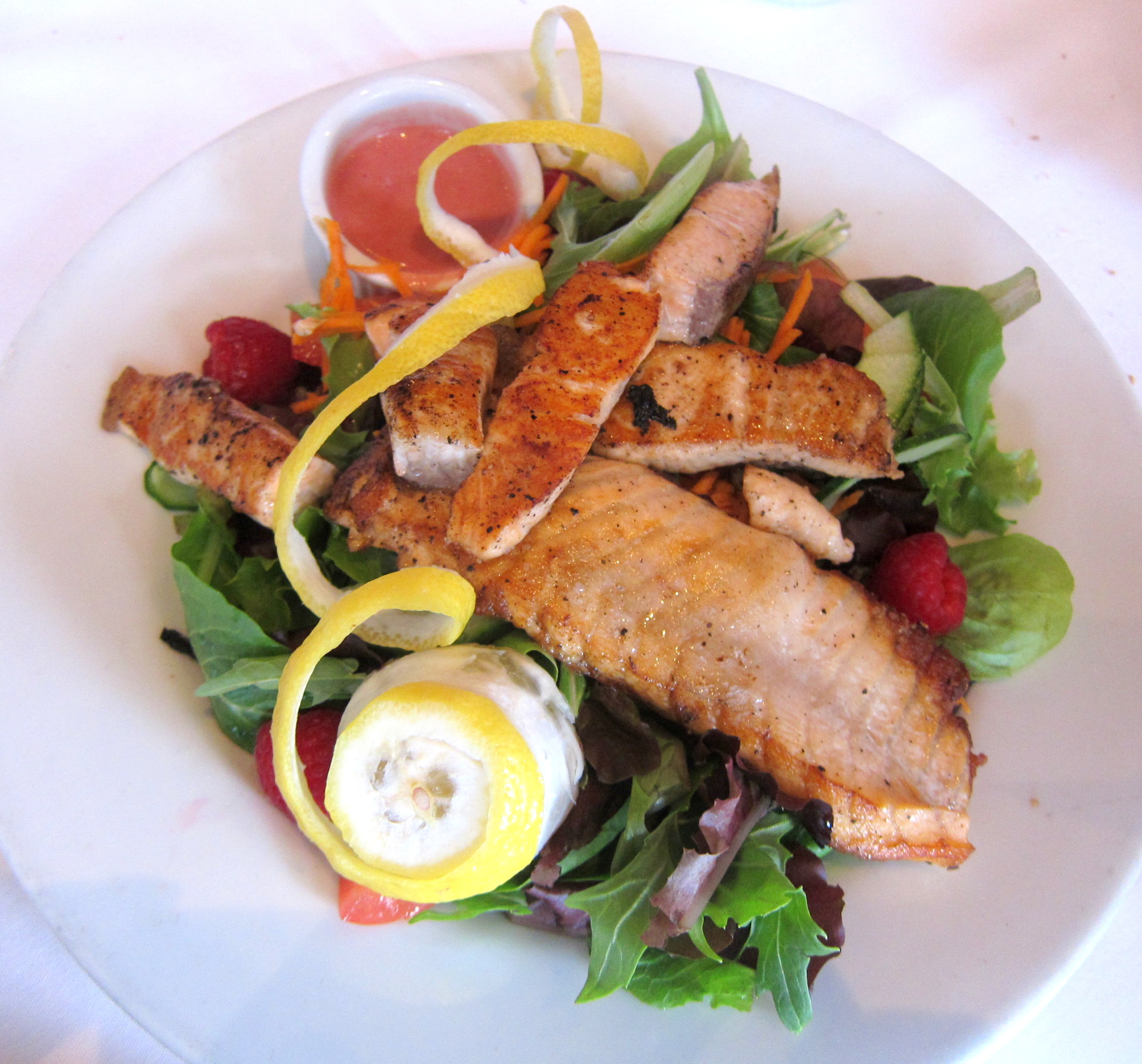
Salmon salad with raspberry vinaigrette.

Salmon salad with raspberry vinaigrette.

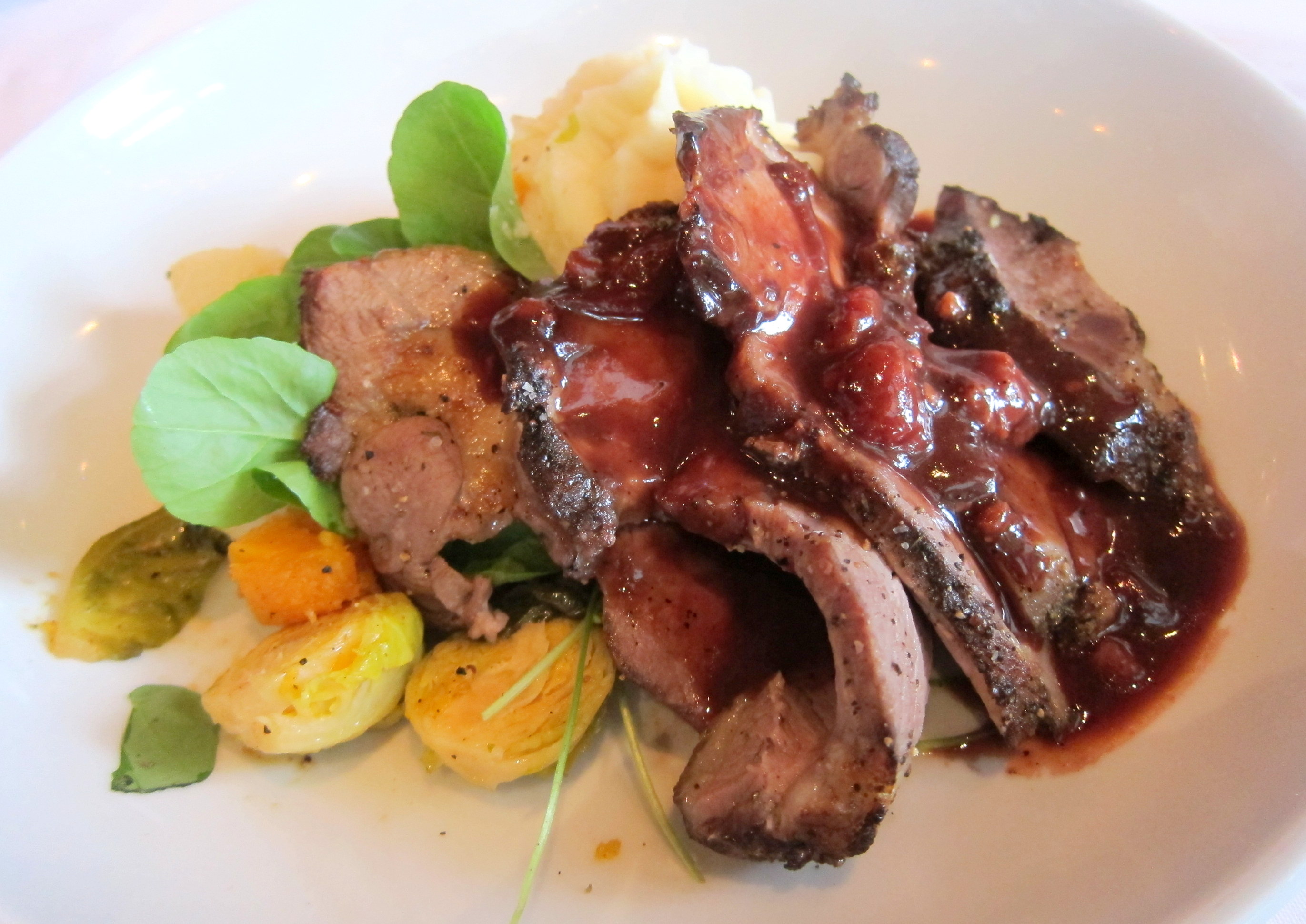
"Roasted leg of lamb with raspberry demi" - Well, I don't like the smell of lamb and this one hasn't changed that.

“Roasted leg of lamb with raspberry demi” – Well, I don’t like the smell of lamb and this one didn’t change that.

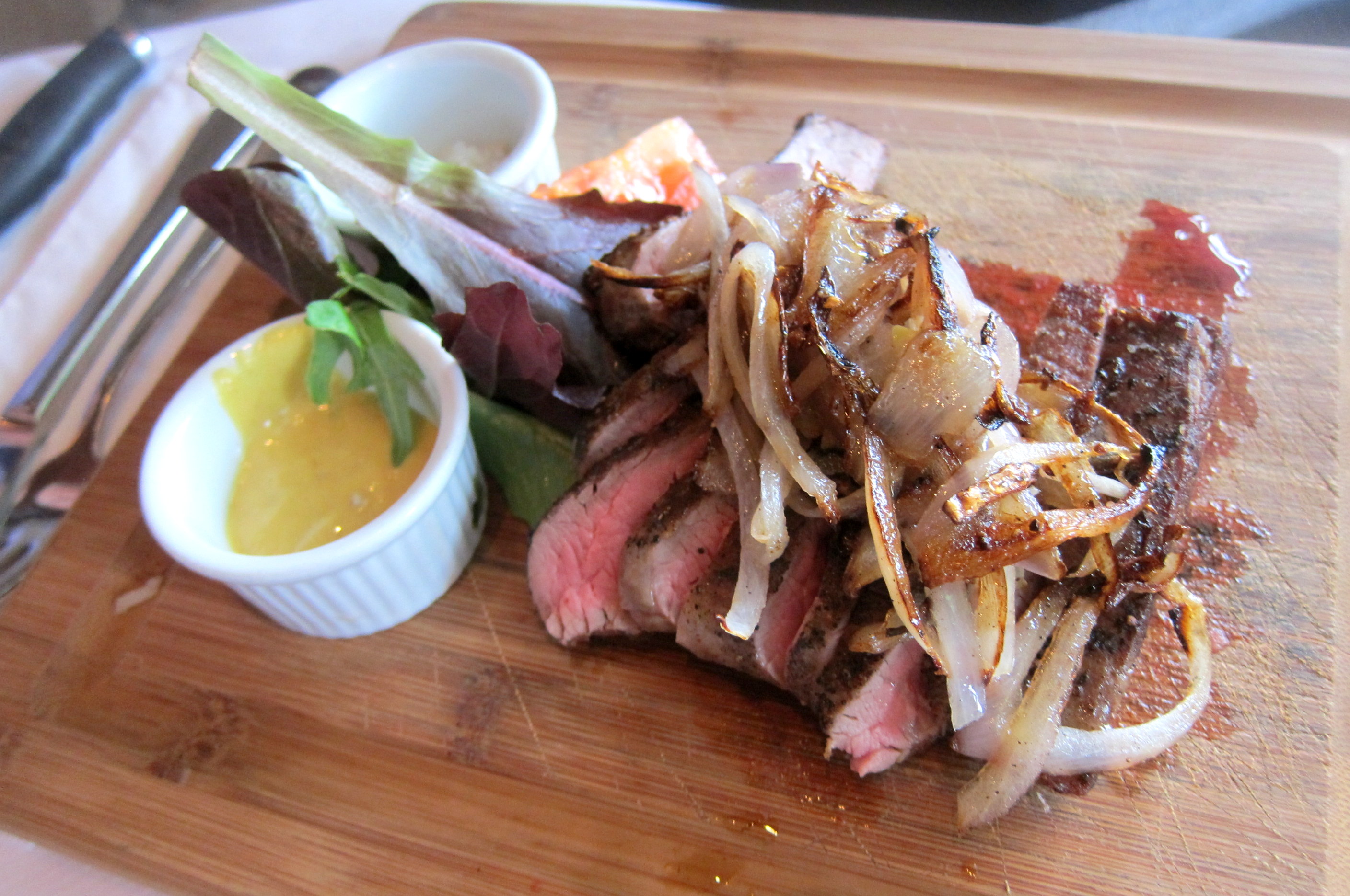
Bavette steaks with caramelized onion.

Bavette steaks with caramelized onion.

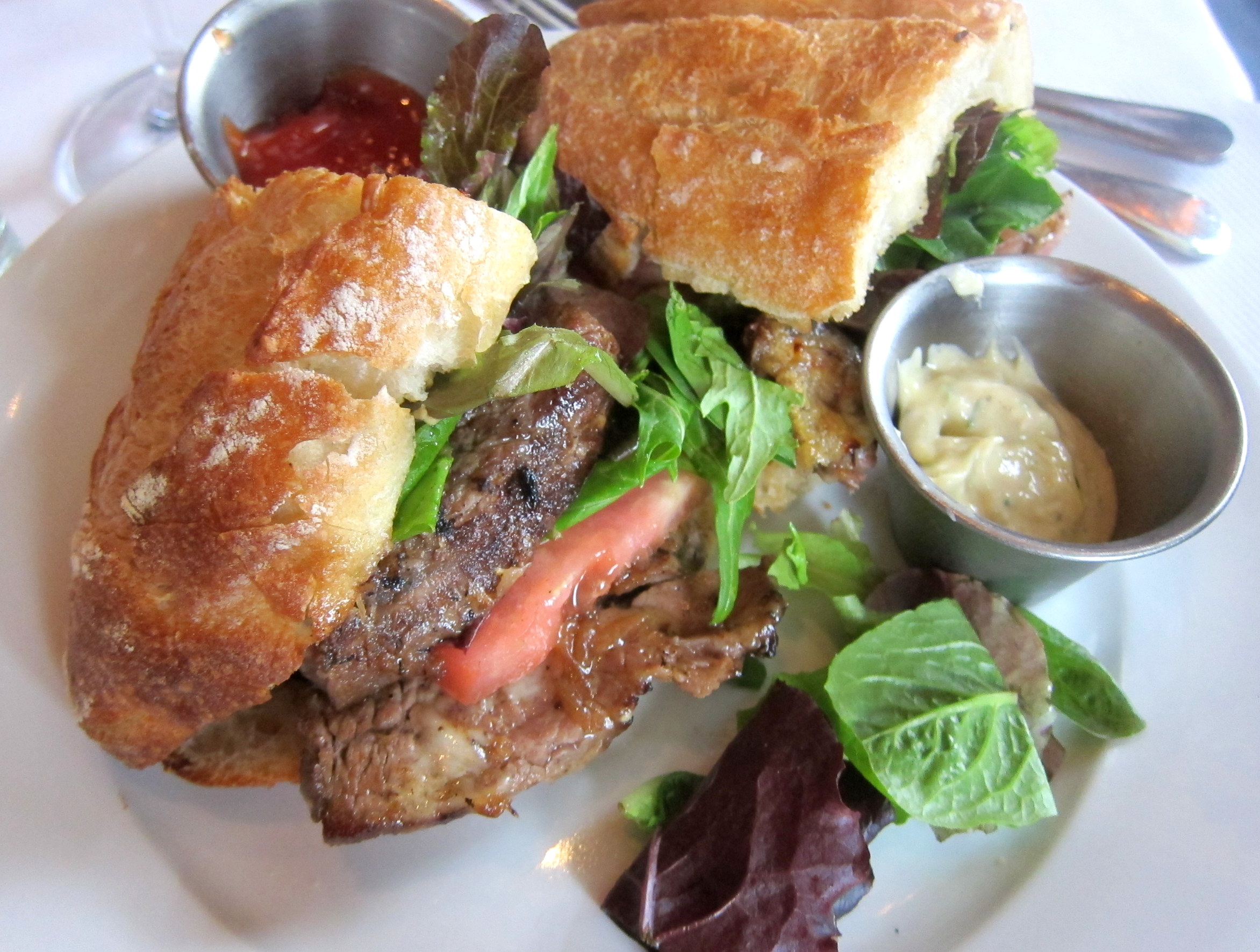
The above steak, in bread. Looks tough.

The above steak, in bread. Looks tough.

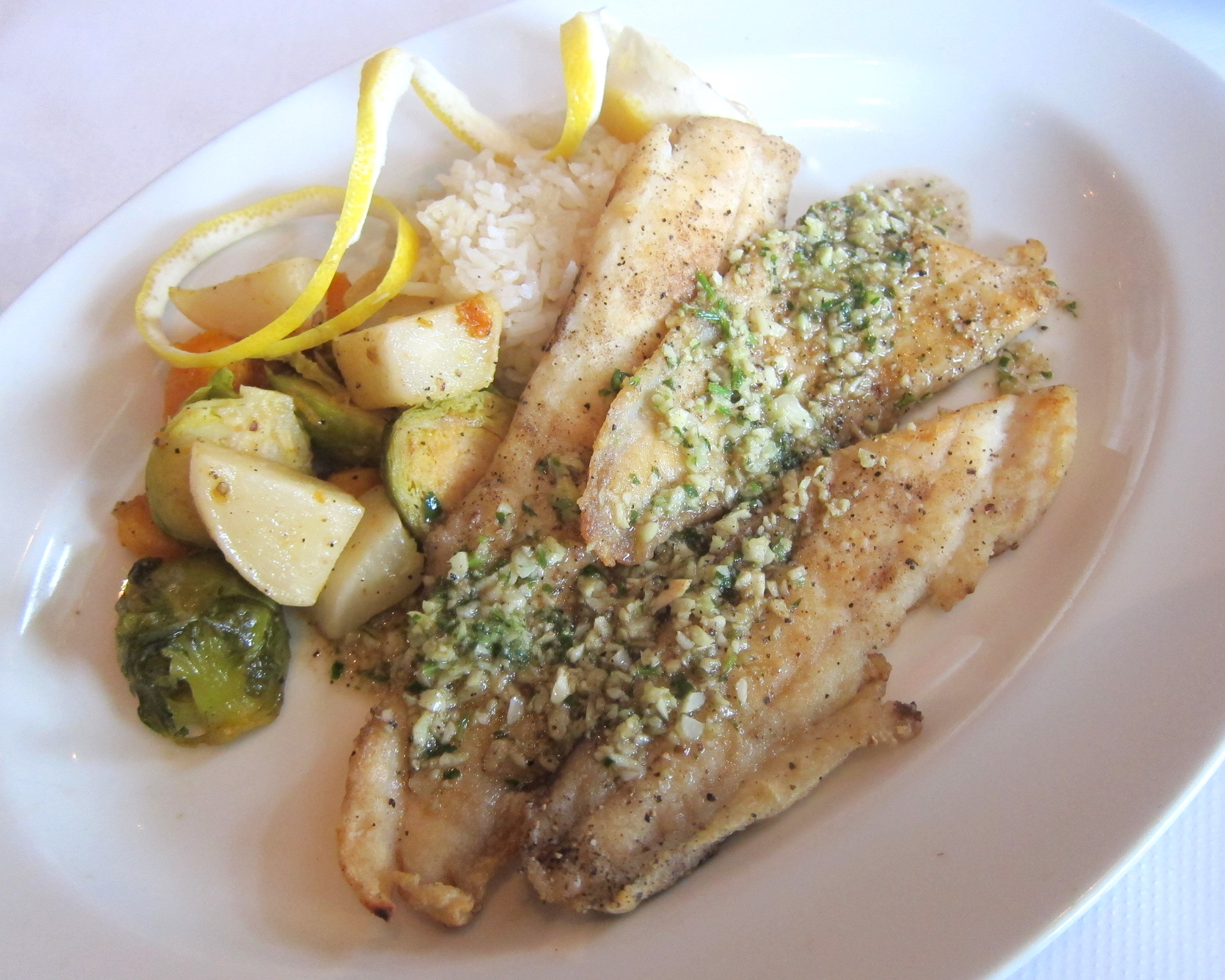
Lemon sole meuniere - too much lemongrass, lemon and salt, but so much more edible than the lamb.

Lemon sole meuniere – too much lemongrass, lemon and salt, but so much more edible than the lamb.

Cafe-Rabelais-menu

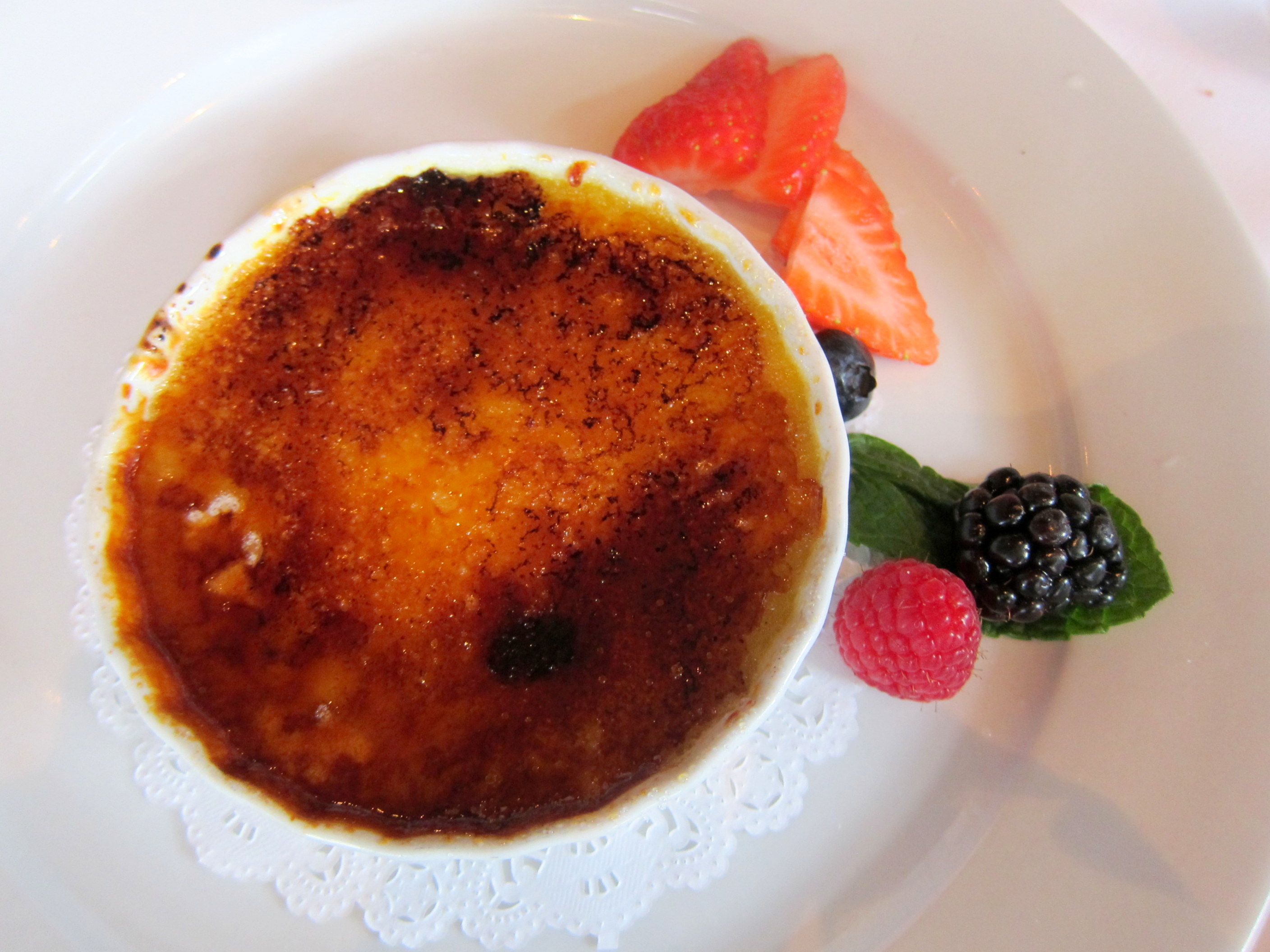
Creme brulee. Too sweet, of course.

Creme brulee. Too sweet, of course.

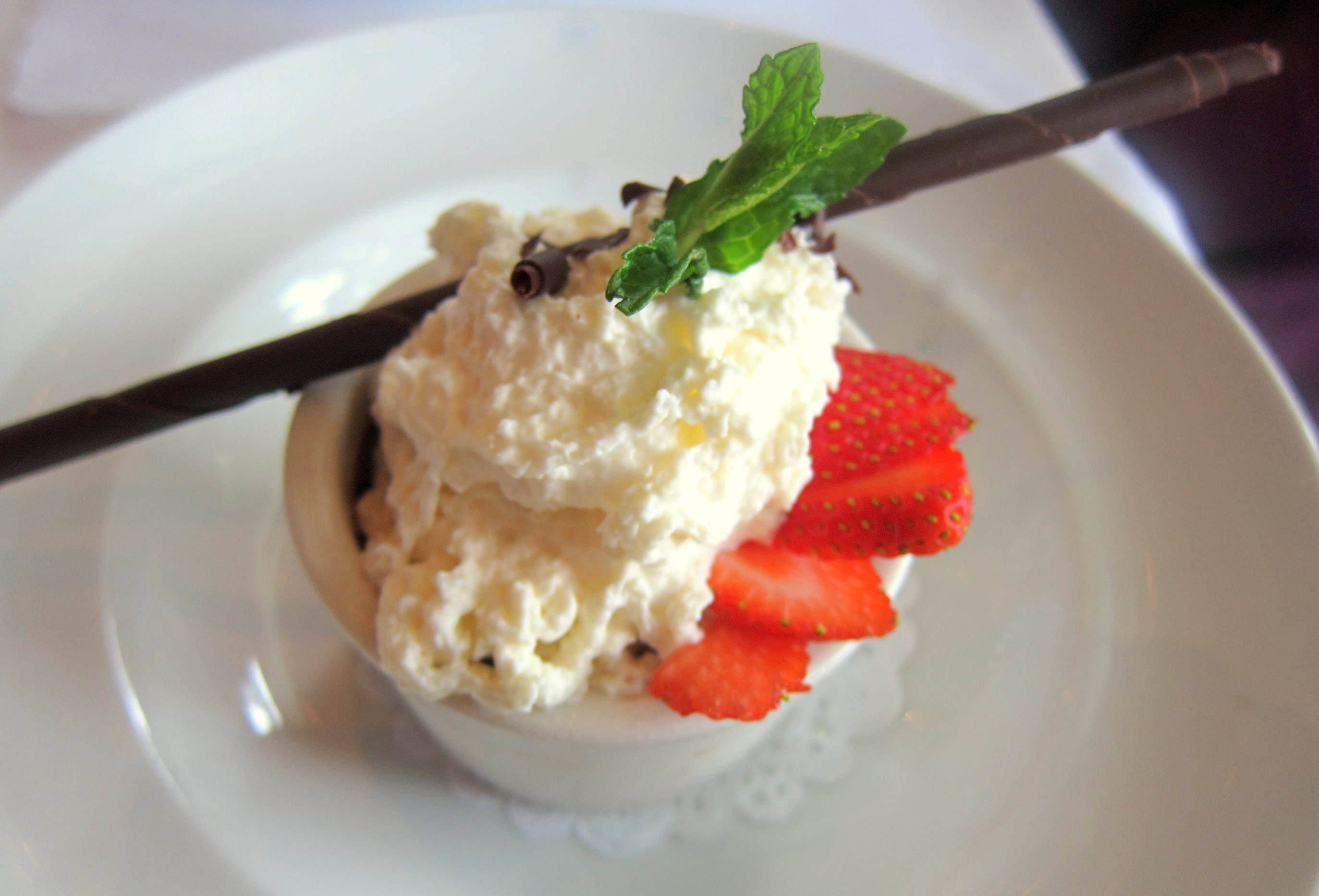
Chocolate mousse - I might as well swim in sugar. I like the chocolate stick though!

Chocolate mousse – I might as well swim in sugar. I like the chocolate stick though!

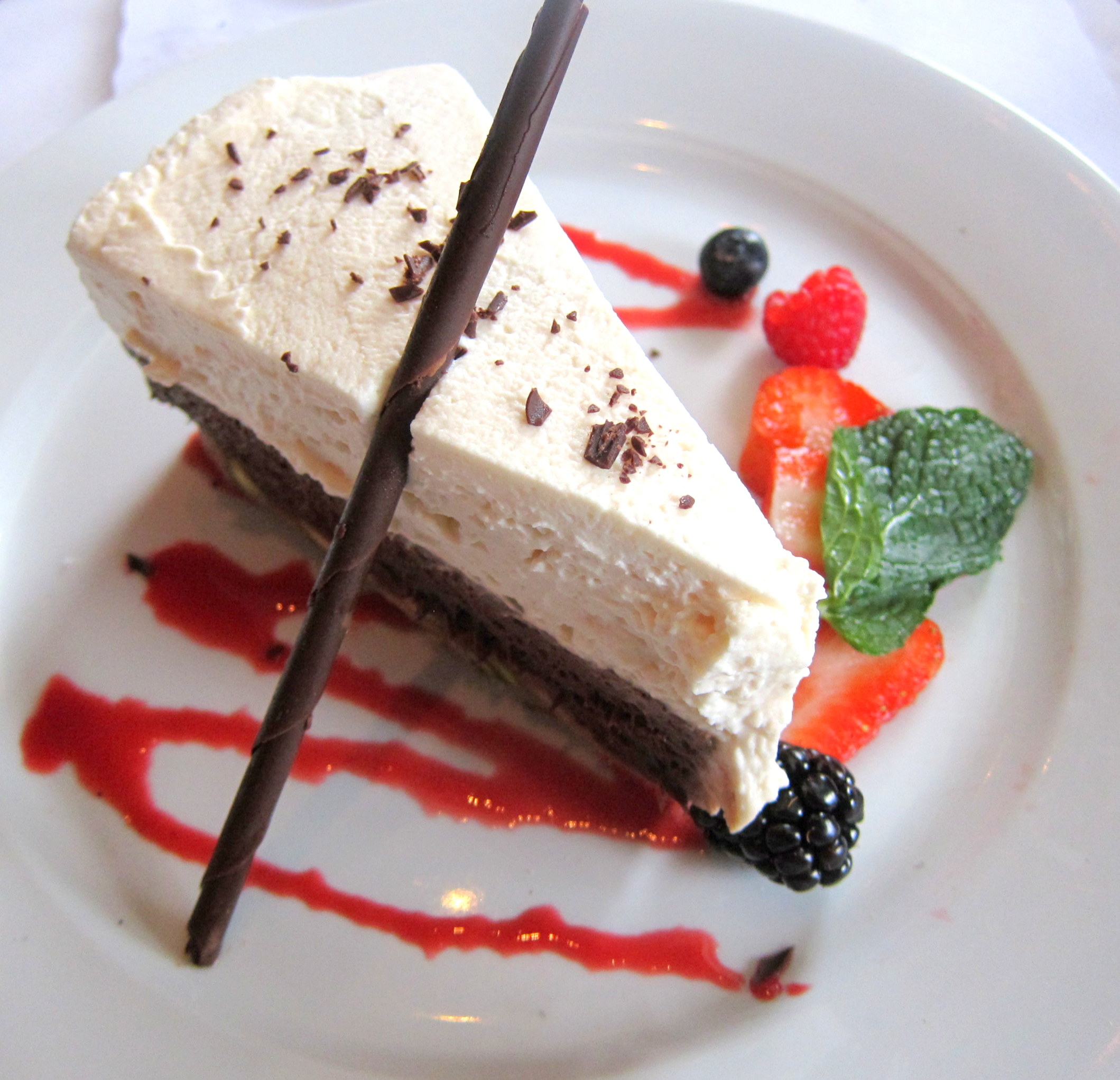
Chocolate pie - basically the chocolate mousse on a nut crust.

“Fondant au Chocolat sur Croute de Noix” – basically the chocolate mousse on a nut crust.

By the way, the service is just plain negligence. But if you come only for the profiteroles, you won’t see the waitress enough to notice the service anyway. 😉

Beautiful meals at Iyasare

December 23, 2013 By: Mai Truong Category: California - The Bay Area, Japanese

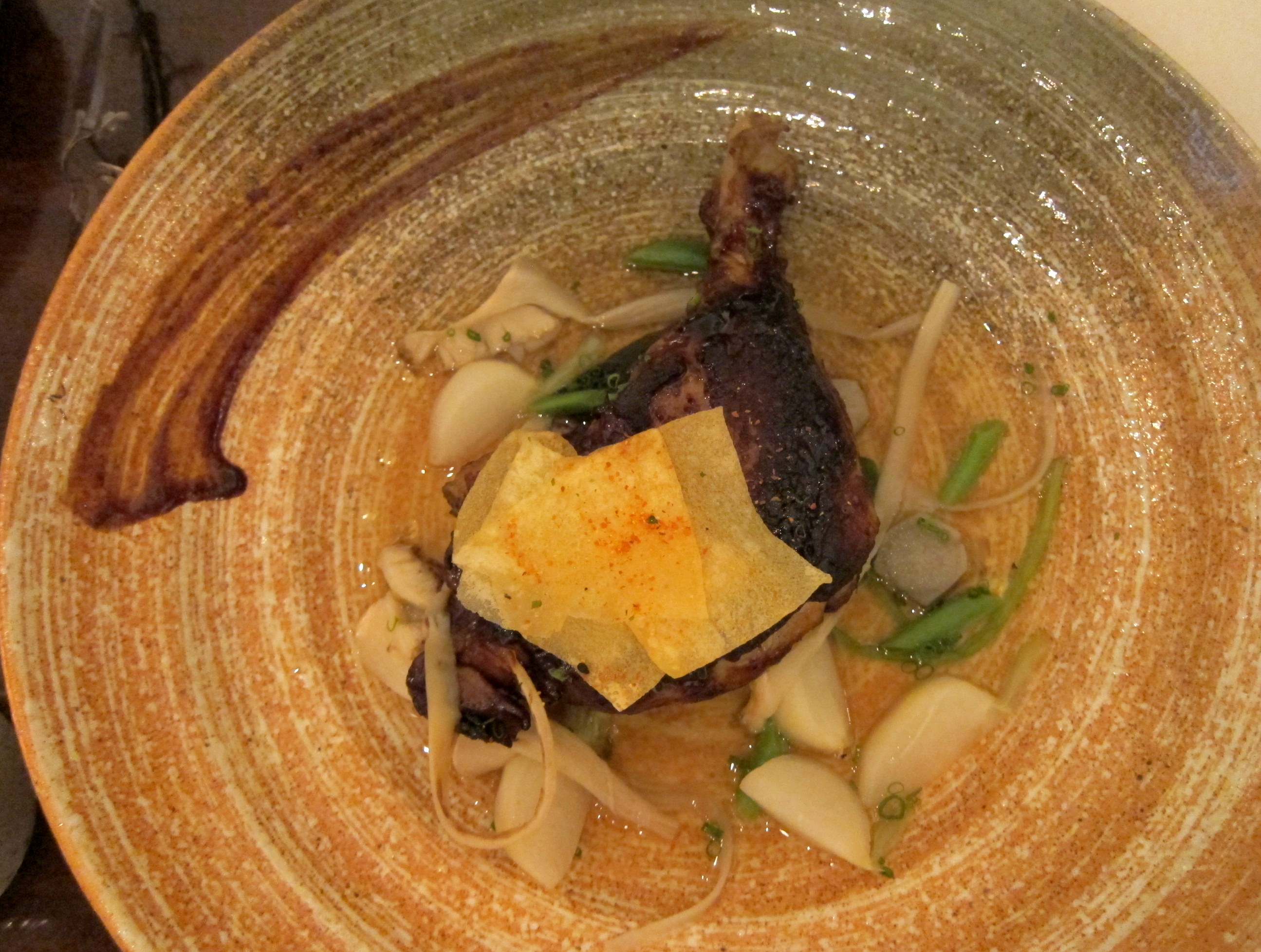
iayasare-miso-glazed-duck
In less than a month since its opening, everybody I know on 4th Street has been to Iyasare, from the regular shoppers to the shop owners, and everybody praises it. The restaurant, operated by former Yoshi’s executive chef Shotaro Kamio, replaces the equally cute and also Japanese O Chame. The two restaurants have different concepts, of course, and experiencing both in the same space – reminiscing on O Chame’s menu and atmosphere while savoring Iyasare’s – was like tasting the fleeting grandeur of ukiyo-e aesthetics in the most delicious way possible.

iyasare-sashimi
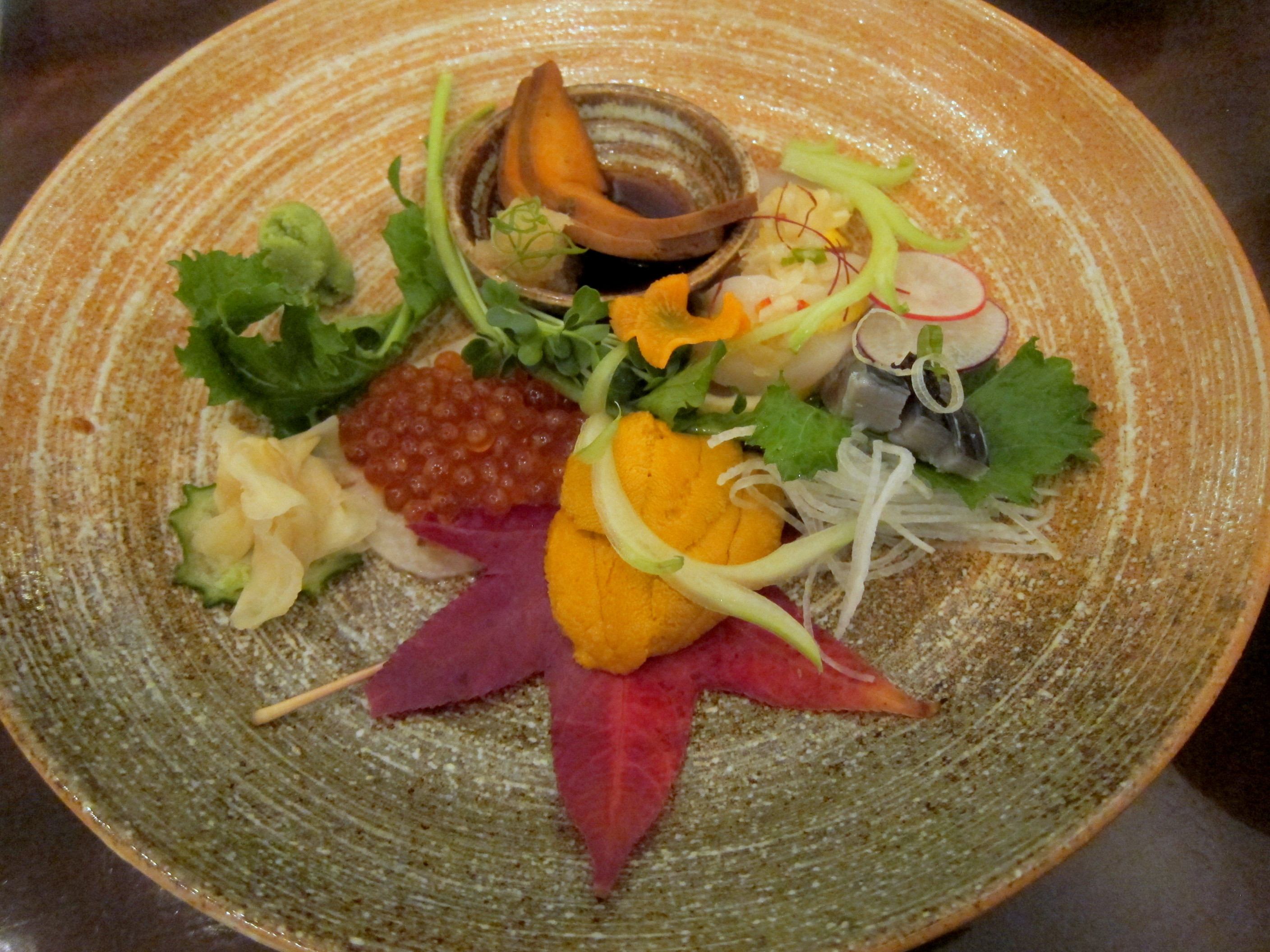
A beautiful arrangement: ikura (salmon roe), ankimo (monkfish liver), hotate (scallop, the white thing that is barely visible next to razor-thin slices of radish), mackerel (silvery grey, also almost invisible under the radish), and 4 beautiful sweet lobes of uni (sea urchin roe, on the maple leaf) ($22). The ankimo has a thick and dried rind, its flavors were a tad salty and smokey for my taste.(*) The uni was extra-creamy but a little too soft. The ikura was some lovely bubbles.

You can order a side of sushi rice with the sashimi. Or just sushi rice. Actually, I ate every single last grain of rice in that bowl, and I’d be happy to skip the sashimi.

iyasare-apple-seaweed-salad
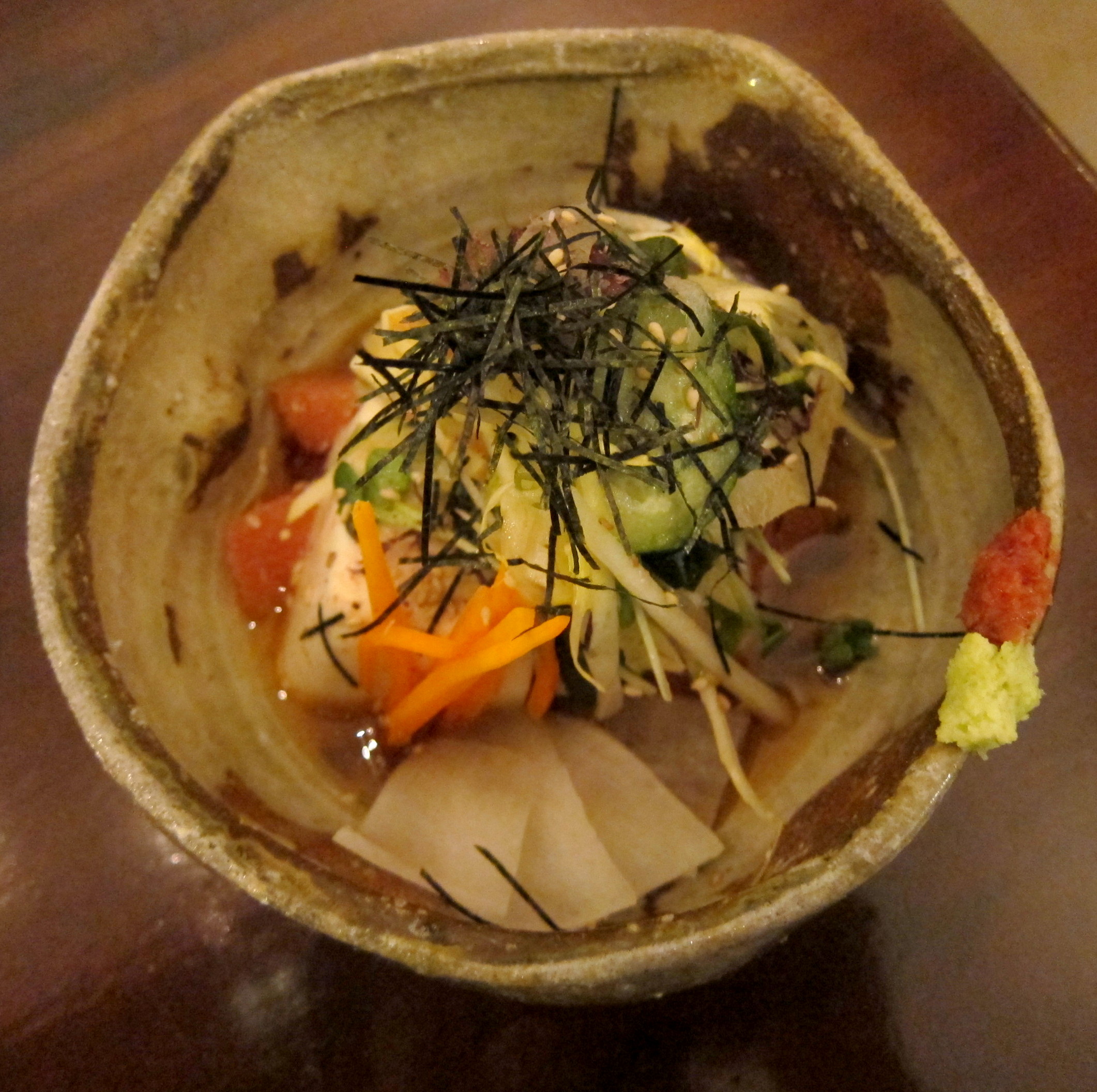
Apple seaweed salad with fennel, pickled daikon and carrots, shaved bonito, citrus brown rice vinaigrette with fresh bits of blood orange, and two silken tofu cubes ($9). Nothing to complain here.

iyasare-beef-tataki
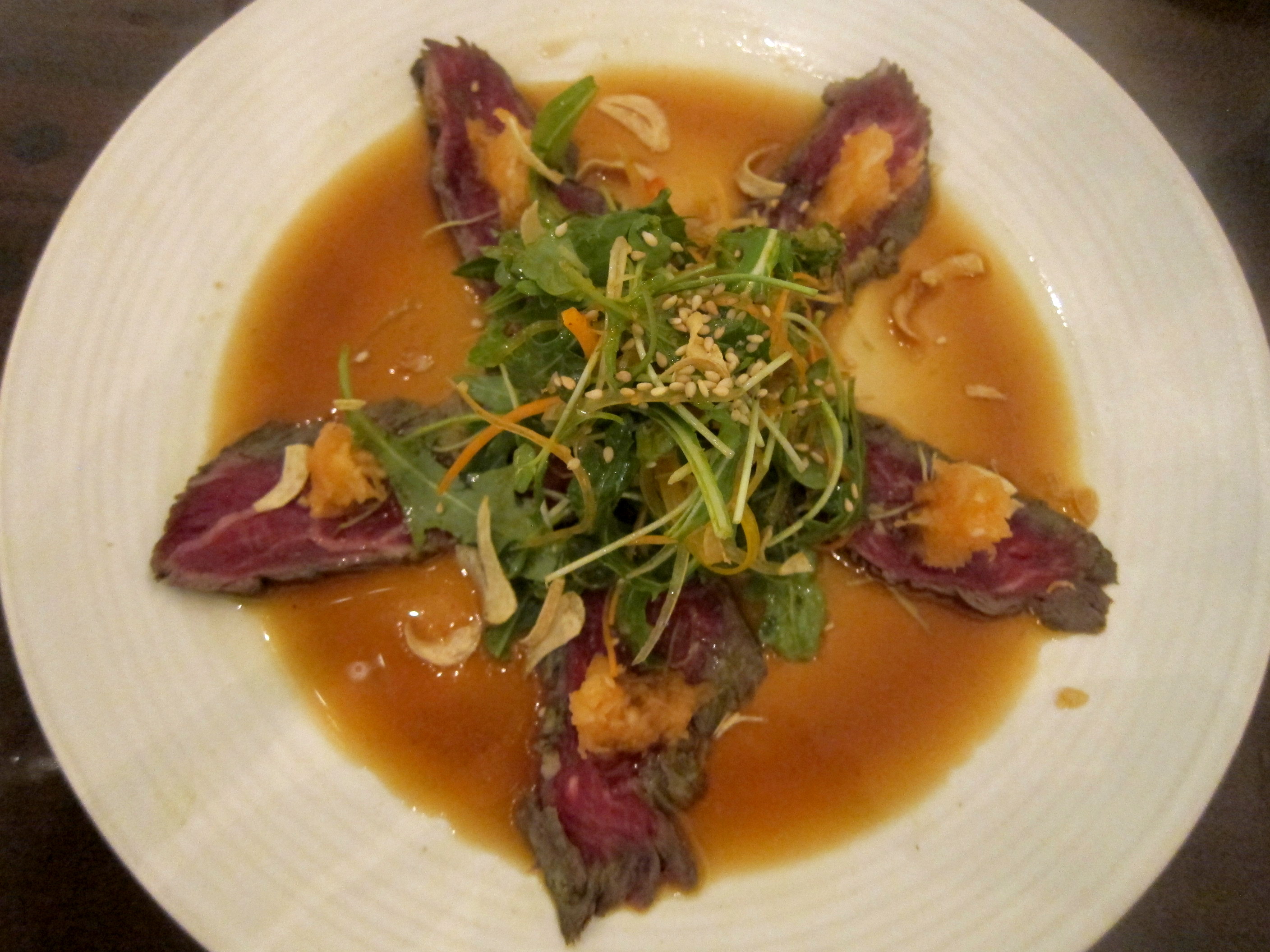
Wagyu beef tataki ($13), slightly seared; the best way to eat them, we found, is:
1. Place a tuft of green stringy stuff (julienned wasabi leaves, wasabi sprout, chicory, whatever leafy things) and a sliver of crispy garlic on a slice of beef,
2. Daintily use your chopsticks to roll the beef to enclose the greens and the tangerine bits,
3. Still using the chopsticks, turn the beef roll 2 times around to soak in the ponzu (the brown sauce).
4. Stuff it in your mouth (if you manage to keep it together this far). Delicious.

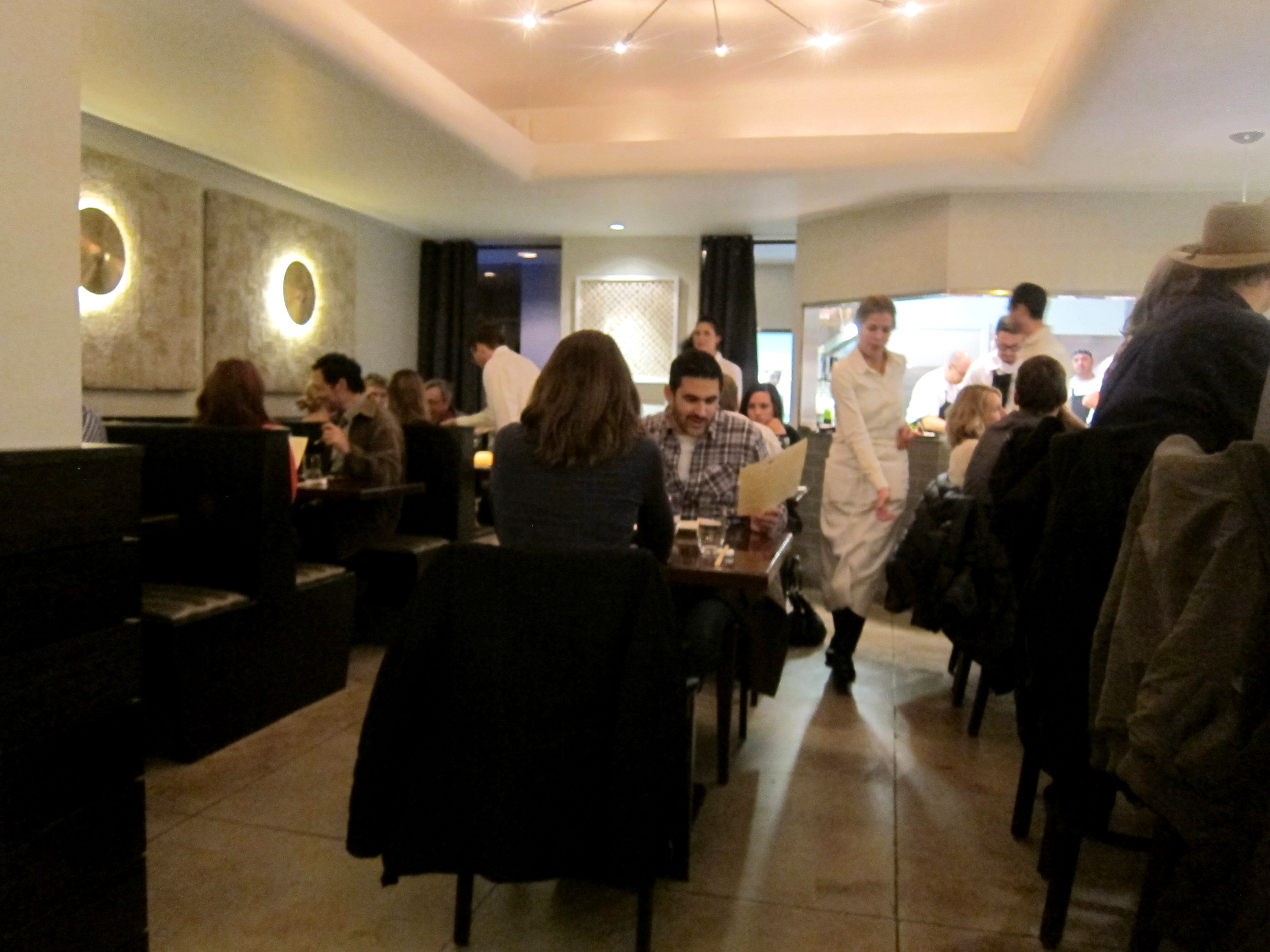
Our waitress weaving back and forth through the dinner rush hour.

Our waitress weaving back and forth through the dinner rush hour.

It was a Wednesday night, Iyasare was pretty peaceful and devoid of people, but only until about 7. Then, everybody in town poured in, the waitresses started to lose track of things, brought us things we didn’t order and simply couldn’t see us anymore.

iyasare-duck
Miso-glazed Maple Leaf duck confit ($20). Embarassingly, we thought the “Maple Leaf” was part of the dish (but no, it’s the name of the duck farm). In our defense, the maple leaf in the sashimi plate led us astray. 😛

I wasn’t too thrilled by the Tokyo turnip, the green beans and the gobo (burdock) in this dish. A length-wise-cut gobo would have been crunchier, and the turnip was cooked a hair too long. On the bright side, very rarely does a duck dish go wrong, and when it’s glazed with miso like this? Heavenly.

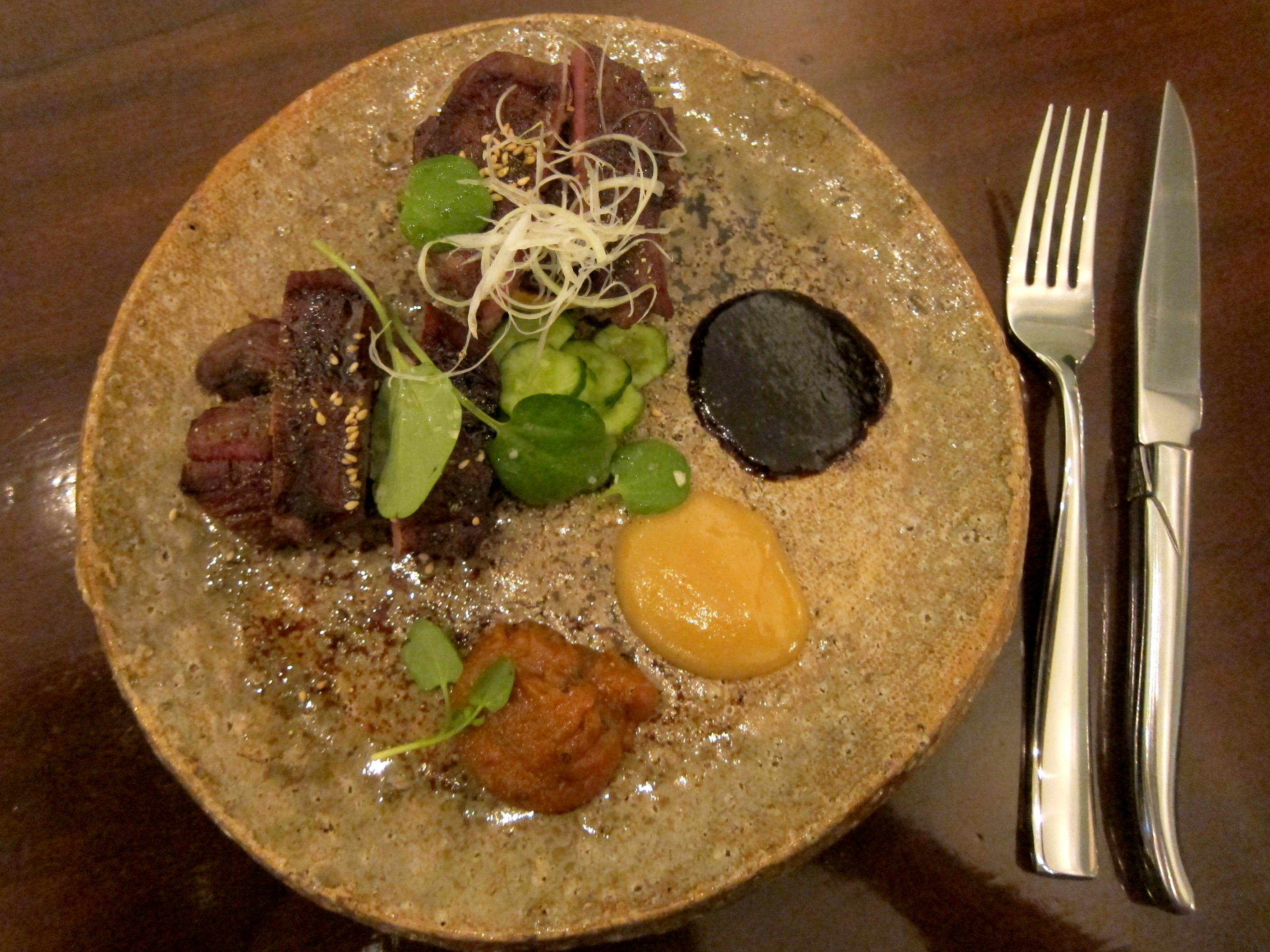
iyasare-gyutan
The BEST of the night: gyutan (grilled beef tongue) ($17). Well, I always love beef tongue, so I’m biased. Maybe the duck was better. But this beef tongue dish was perfect as a whole, from the quick-pickled cucumber to the trio of miso (the black akamiso had the deepest, richest flavor among the three). When you cut into a slice of gyutan, you could feel through your knife how tender it was. I even ate a fourth of the grilled lemon (under the right piles of gyutan).

iyasare
We skipped desserts.

Address: Iyasare
1830 Fourth Street
Berkeley, CA 94710
(510) 845-8100

FOODNOTE:
(*) For comparison, B-dama’s ankimo is still the champion on the East Bay, and Musashi’s ankimo is surprisingly satisfactory for its price mark.

A more comprehensive “map” of what we shared is on Ponga.

Judy and Loving Live Treats

December 16, 2013 By: Mai Truong Category: American, California - The Bay Area, Food product, sweet snacks and desserts, Vegan

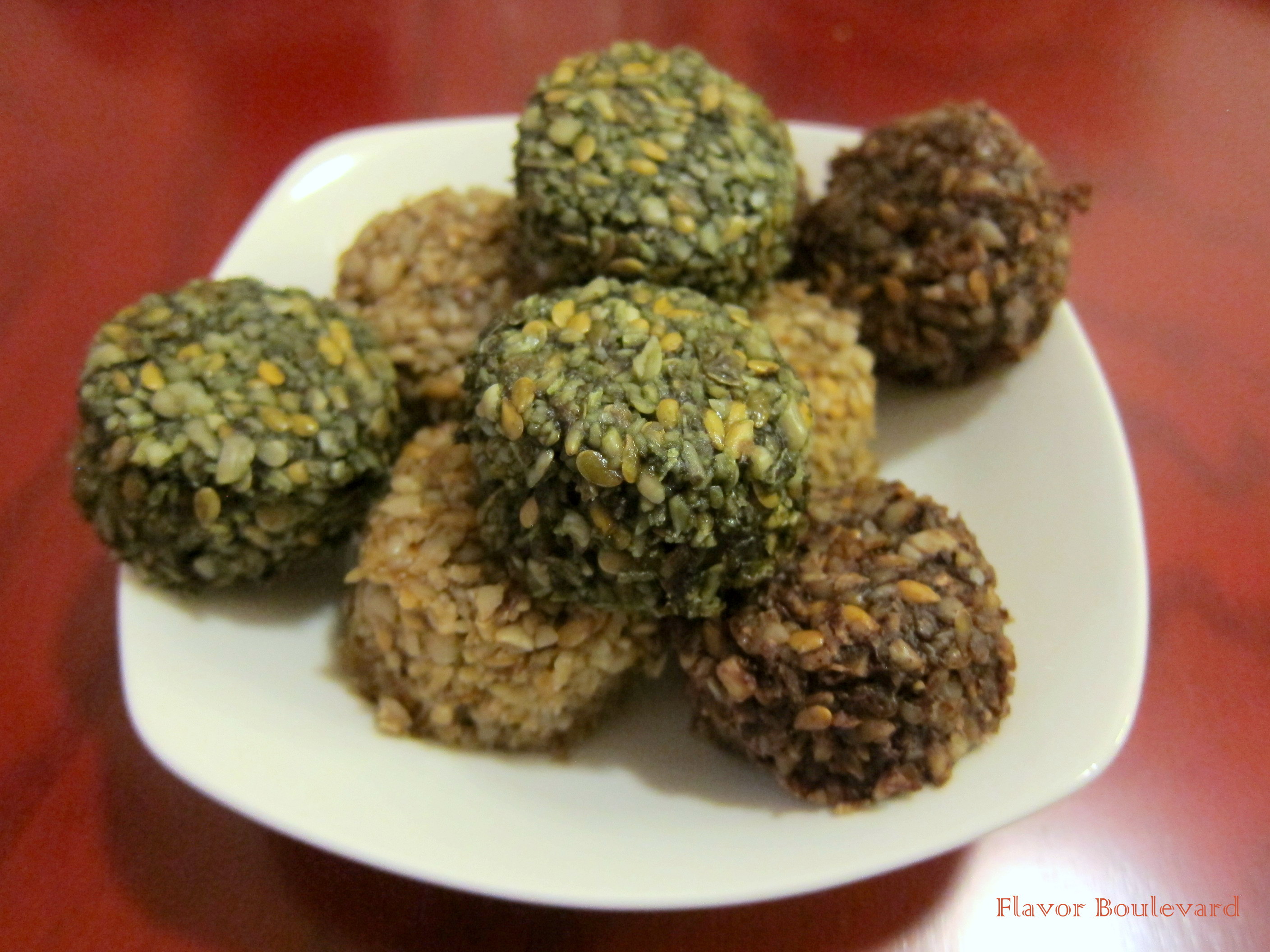
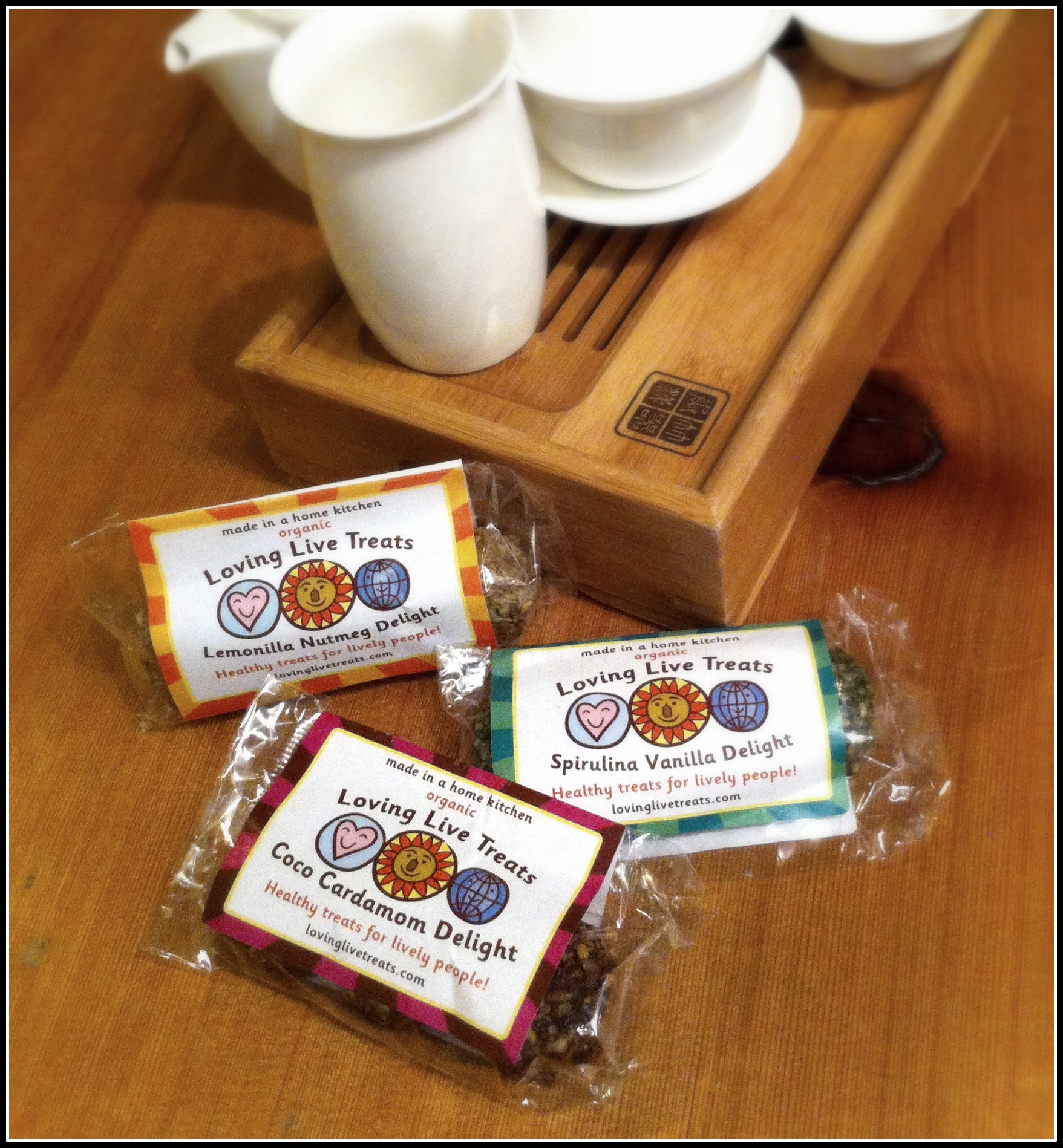
lovinglivetreats-3flavors
I met Judy in early November. I happened to sit down next to her at Teance, when she was just about to leave and I had just arrived. For some reason, Judy offered me a small, homemade cookie to try. The cookie was interesting, and so is Judy. We exchanged business cards.

With this post, I’m going to risk sounding like a sarong-wearing 62-year-old white-male yoga preacher [there are many of them in Berkeley, sometimes they start talking to you on the street and make everybody uncomfortable], because you know what, some philosophies are beautiful and there’s nothing wrong with appreciating them. With that said, if your patience runs low on the subjects of philosophy, spiritual growth or simply good feelings in general, skip ahead to Part II.

Part I – The Story behind the Treats

After September 11, 2001, Judy Fleischman moved from Oregon to New York, began training as a healthcare chaplain.

“I was on the go a lot,” said Judy. “I needed to bring food with me so that I wouldn’t go broke. In Oregon I got introduced to raw foods, so I started experimenting with making raw healthy snacks to keep me going… Snacks that weren’t just a sugar crash.”

After making batches of these raw, vegan treats with sprouted seeds for herself, she began sharing them with family and friends and began to feel what she called “the gift of giving”.

“Now when I think of the word ‘healthy’, it’s not just the food but the relationship with the people and the ingredients,” Judy said.

Judy’s inspiration stemmed from wagashi – petite, graceful Japanese sweets for tea ceremony that appeal to all five senses, and the philosophy of “mindful eating” in zen training, which she explains as knowing “the difference between a craving and real nourishment”.(*)

In the midst of working as a healthcare chaplain and interacting with stressed people, Judy felt that the treats she made were “wholesome”, and that she “had the urge to share and give to others”, so she started making single packagings to give them out to people at farmers’ markets. As part of the Sensing Wonder group, she was also giving out cups of iced jasmine tea at the Imagine Circle. The more she gave, the more fulfilling she felt.

Loving Live Treats “sprouted from this personal transformation and interaction with the community” to become what Judy hopes to be a mean to sustain her livelihood. Economically, we all need to make a living; spiritually, Judy appreciates and finds it enriching to be able to share what she makes with others – a way of life that she wants to pursue and believes that many others do. That’s why the cookies are wrapped in packages of three – one can surprisingly satiate your hunger (I was amazed myself, considering each is only 0.6 oz [about 17 grams]!), and there are two more to share with friends.

Or share with strangers. Over a month ago, Judy randomly shared it with me, a complete stranger. Somehow, we create new friendships that way, however temporary. Loving Live Treats from start to finish revolves around friendship, whether it was momentarily like the interaction with people at the Imagine Circle, or long-term like with Rodney Alan Greenblat, the artist who designed the label. Perhaps partly because it revolves around friendship, that Judy is happy when she makes them. That happiness shows in the treats, from the playful, childlike label inwards.
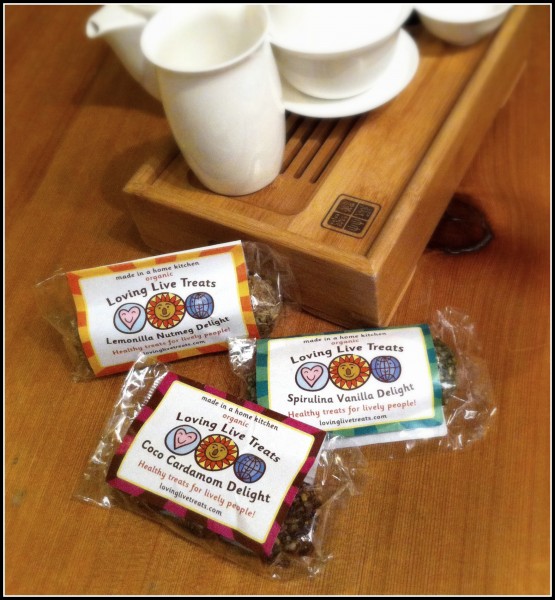
lovinglivetreats-packaged
Part II – The Treats

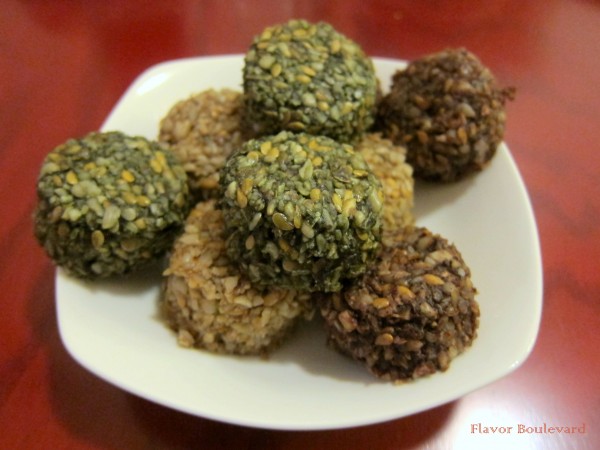
Sprouted sunflower and golden flax seeds, coconut, agave nectar, Himalayan salt, low-temperature dehydrated and compressed into circular cubes (if you know a better word for this shape – not “cylinder”!, please tell me ^_^). There are three different flavors: lemon-vanilla-nutmeg, spirulina-vanilla, and cacao-cardamom. My personal favorites are the Coco Cardamom and the Spirulina (sorry, Nutmeg!), but they’re all precious actually, and the differences are about as pronounced as those between Chinese oolongs and Taiwanese oolongs. That’s the point – nothing too sweet, nothing too strong, just little seeds cozily nudged together. Satisfying on their own and a delicate but reassuring accompaniment to tea.

They’re the opposite of a chocolate chip cookie, which gives you instant satisfaction and an even bigger craving five seconds later. Recently, I watched this Japanese movie “I Wish” by director Hirokazu Koreeda (the Japanese title is Kiseki (奇跡)**), there’s a small detail that I can’t forget: the boys’ grandfather made karukan (a sweet rice-flour sponge cake), at first the older brother thought it wasn’t sweet enough, but Grandfather wouldn’t change his way. Near the end of the movie, the older brother gave a piece to his younger brother. The younger boy also found it “mellow”, i.e., a little bland. Afterwards, when the grandfather asked the older brother what his younger brother thought of the karukan, he smiled and replied “he’s still young”.

When I have an ice cream craving, and I have it ALL the time, admittedly I don’t always reach for an LLT Lemonilla Nutmeg. Like the younger brother in Kiseki, I’m still wet behind the ears when it comes to appreciating the finer things. But when I do reach for an LLT, I get surprised every time – it gratifies in the most pleasant way possible.

–/–

Loving Live Treats by Judy Fleischman: can be ordered for home delivery from GratefulGreens.com, found at the monthly Bay Area Homemade Market, and soon to be served at Teance and Asha Tea House (Berkeley).

–/–

FOODNOTES:

(*) According to the philosophy of mindful eating, there are six types of hunger – eye hunger, mouth hunger, nose hunger, stomach hunger, cellular hunger mind hunger and heart hunger. My guess is to satisfy a craving means you satisfy only one type of hunger, whereas real nourishment satisfies all six.

(**) For now, you can watch Kiseki here. You know how after watching some movie, someone would ask “did you like it?”, and all you can honestly say is “hmmm…”? Well, Kiseki is that kind of movie. It’s not loaded with laughters or gunshots or flying dragons or tear-jerking moments, but let it sit for a few days and the sweetness slowly steeps throughout your veins. Like the grandfather’s mellow karukan.

one shot: Revival’s desserts

December 12, 2013 By: Mai Truong Category: American, California - The Bay Area, One shot, sweet snacks and desserts

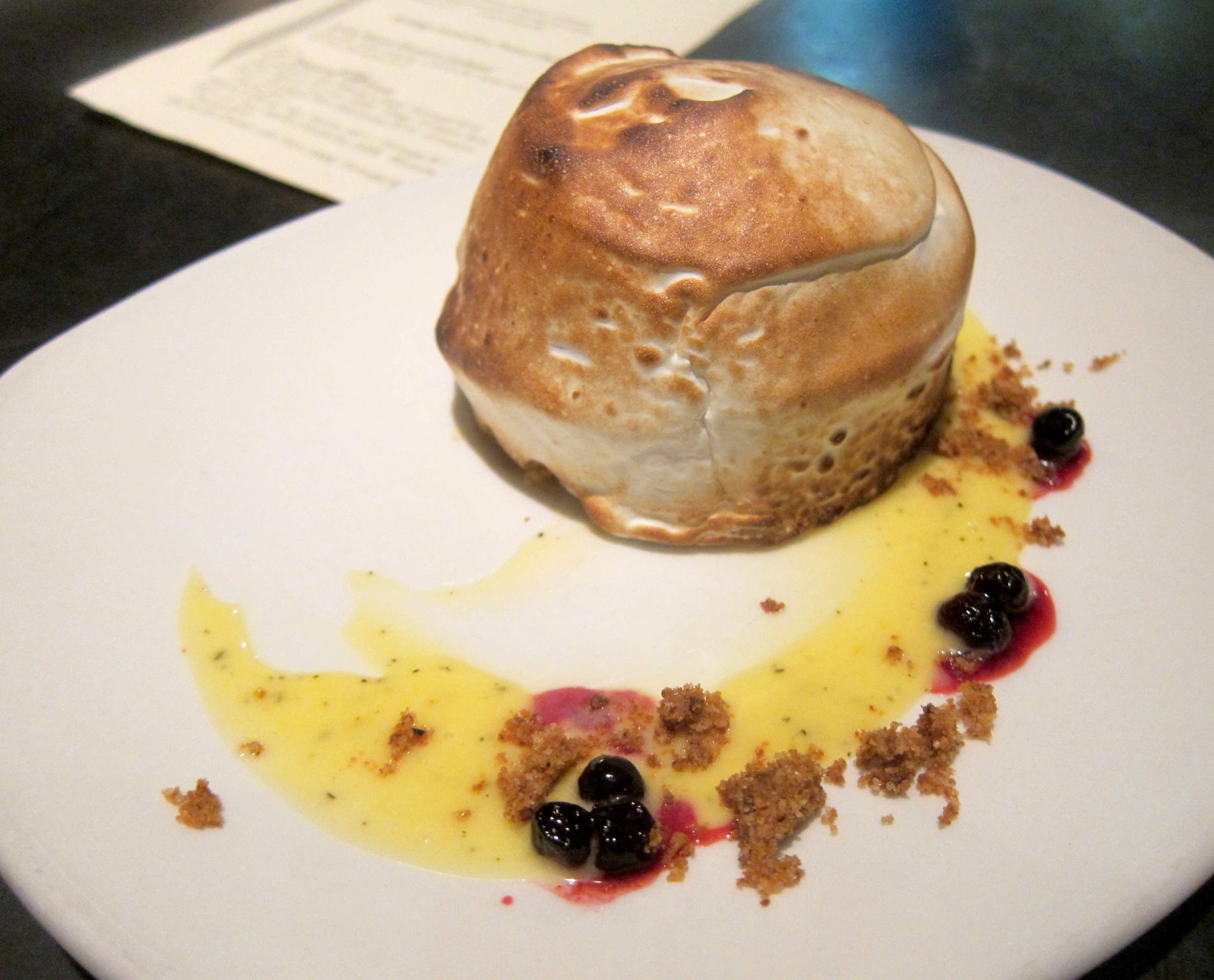
revival-baked-alaska
Technically four shots total, not one, but it’s not a meal, and it’s just a quick shout-out to what Kristen called “the best dessert she’s had” (“in a while”, I think?).

We first went to Revival a year and a half ago. Just like that time, we re-confirm this time that Revival excels at food jellies/sorbet/basically anything fruit and sweet.

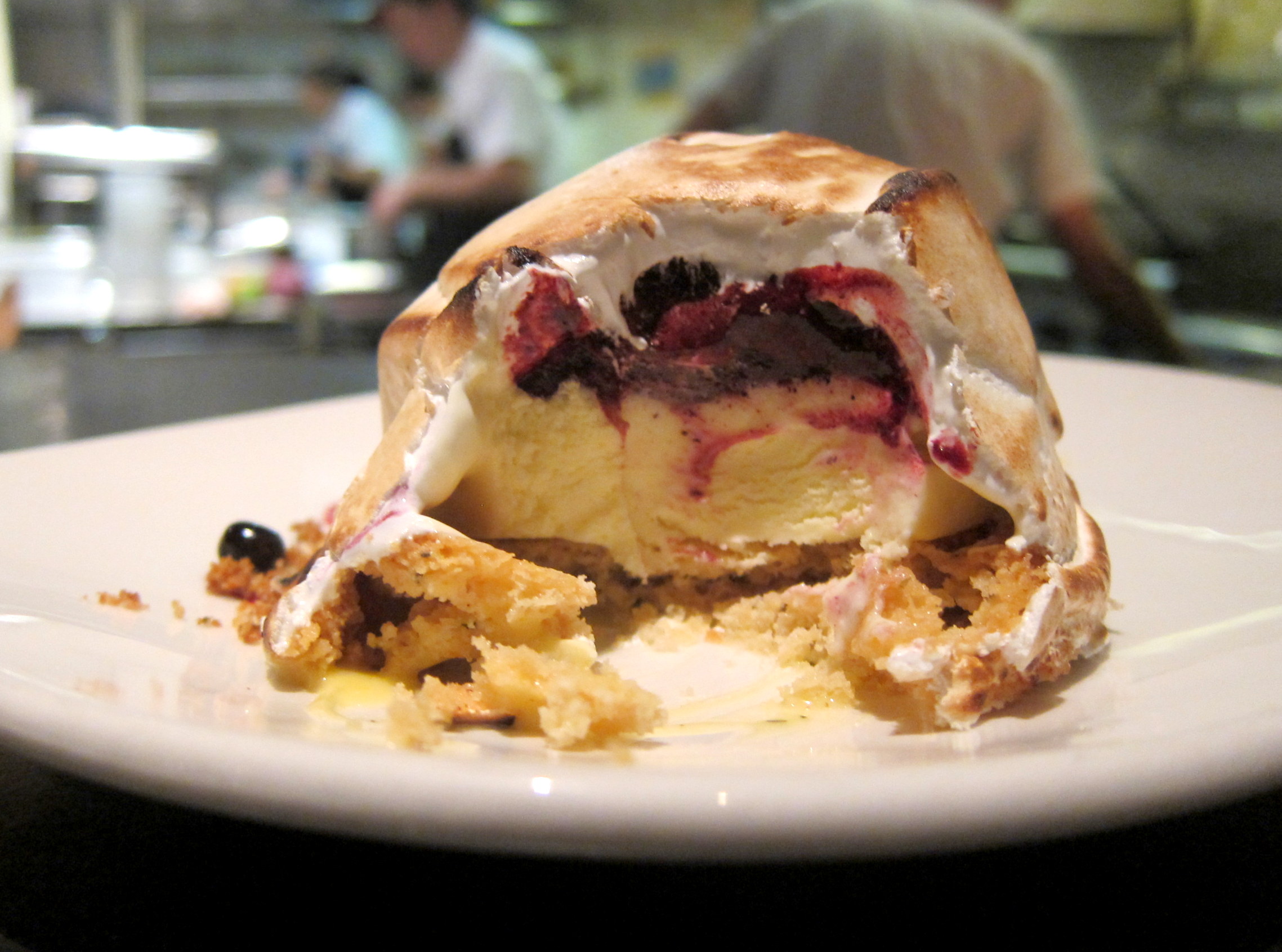
revival-baked-alaska-inside
The best dessert in Kristen’s opinion – Baked Alaska. (My heart died the day I knew Ippuku stopped serving black sesame ice cream, and I refuse to get attached to any other dessert.) The baked alaska is a layered ice cream and sponge cake (or whatever you can layer) in a meringue shell. In Revival’s case, from top down, it’s huckleberry sorbet, lemon-thyme ice cream and almond shortbread. If this is not Refreshing, nothing is. (Well, Ippuku’s black sesame ice cream was.)

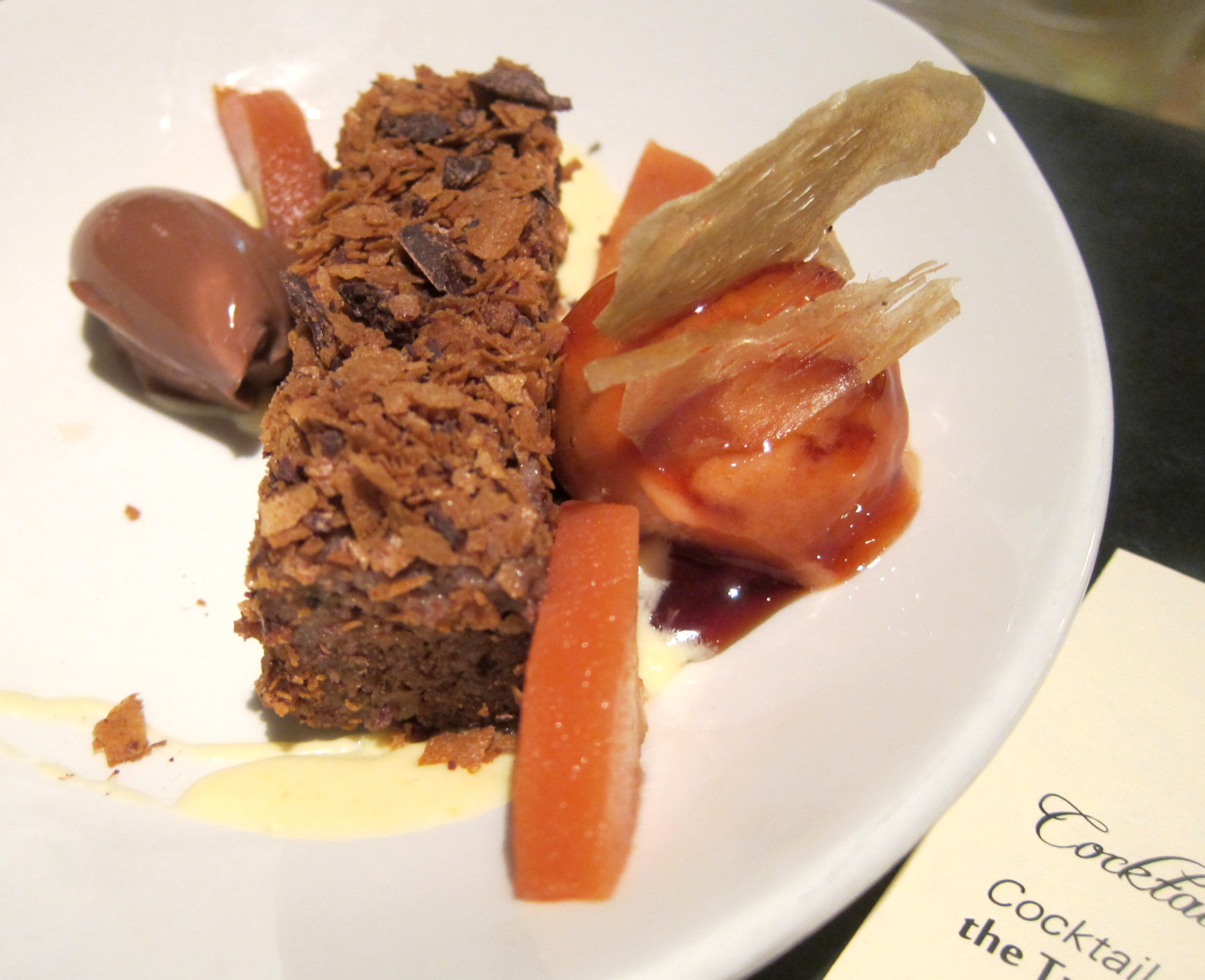
revival-chocolate-tres-leches
Chocolate Tres Leches Cake with ginger sabayon, quince sorbet and ginger-chocolate crĂŠmeaux. Now it’s up to you to decide which on the plate is which. I have no idea. (We suspect the fruit slices are poached pear/quince, and the crispy looking things are ginger, but sabayon is a sauce)

revival-cotillion
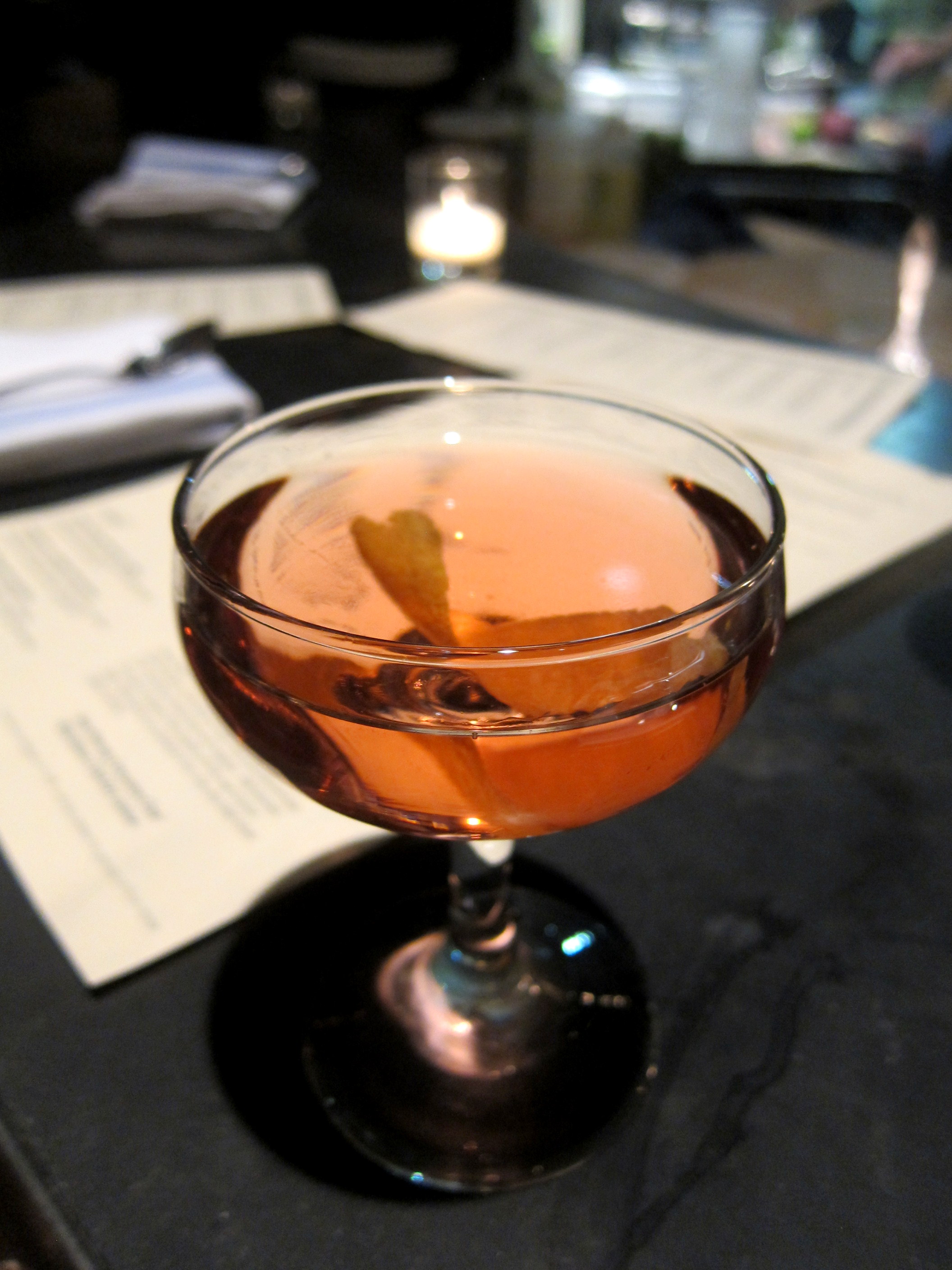
It’s a pretty drink with a pretty-sounding name: Cotillion, like the French fluffy merry dance in the 18th century. Square One botanical vodka, Dolin Blanc vermouth, St. Germain elderflower liqueur, and creme de violette. Smell fantastically flowery but is actually quite strong – I can still see Kristen, Alice and Kendra cringing at every sip. 😀

revival-friendly
Address: Revival Bar & Kitchen
2102 Shattuck Avenue
Berkeley, CA 94704
(510) 549-9950
Dessert for four: $8 per dessert, $10 for the Cotillion. A great chat with the friendly chefs if you’re sitting at the kitchen counter (or whatever it’s called).
UPDATE (2 days later)

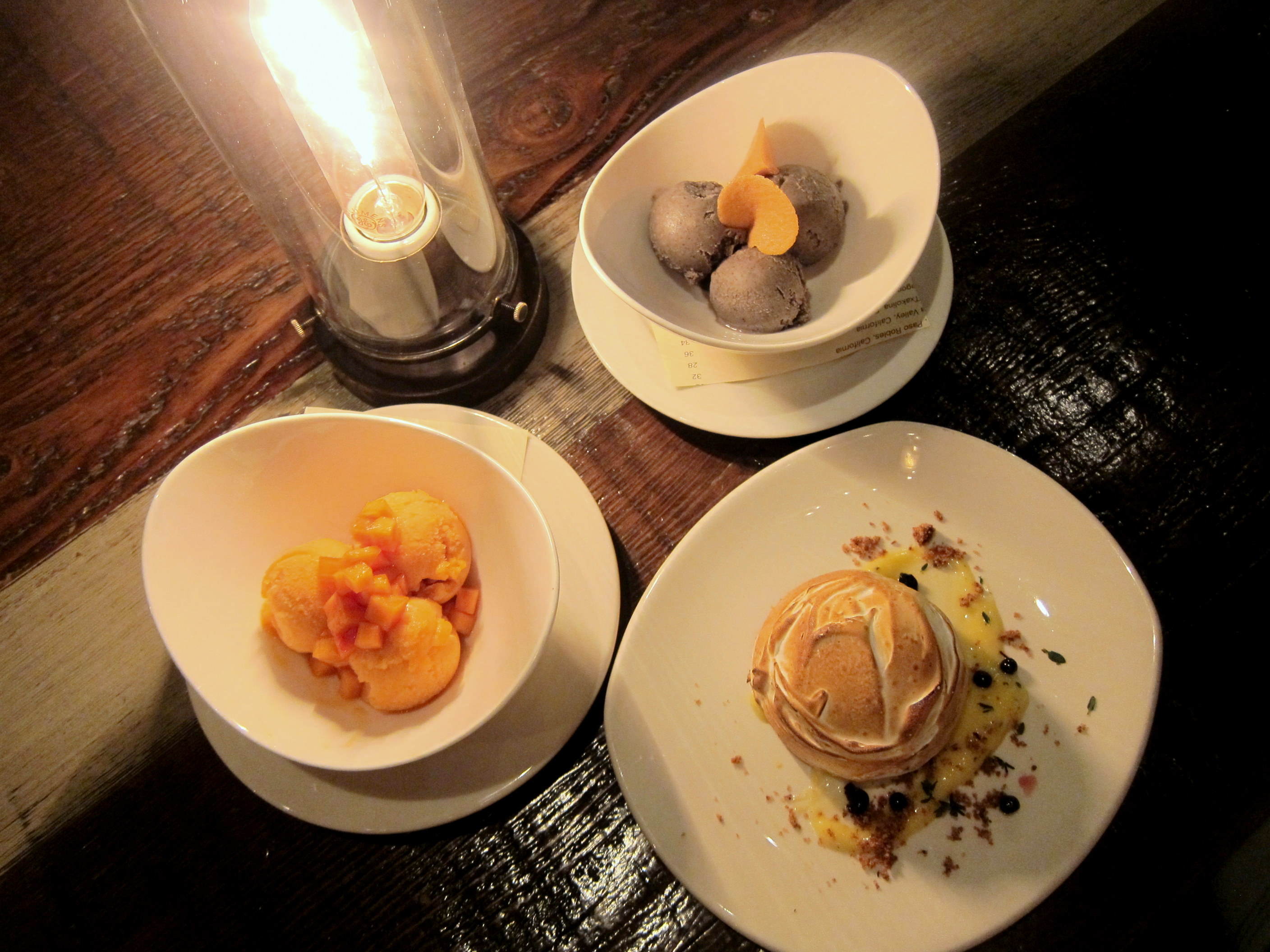
Persimmon sorbet, black sesame ice cream and baked alaska.

Persimmon sorbet, black sesame ice cream and baked alaska.


The black sesame ice cream was too mealy and not cold enough, it tasted more like mooncake filling than ice cream. But the persimmon sorbet was perfect. (Again, Revival has a way with fruits 😉 )

Tags:

Non-baked avocado pie with nut crust

November 29, 2013 By: Mai Truong Category: Fruits, RECIPES, sweet snacks and desserts

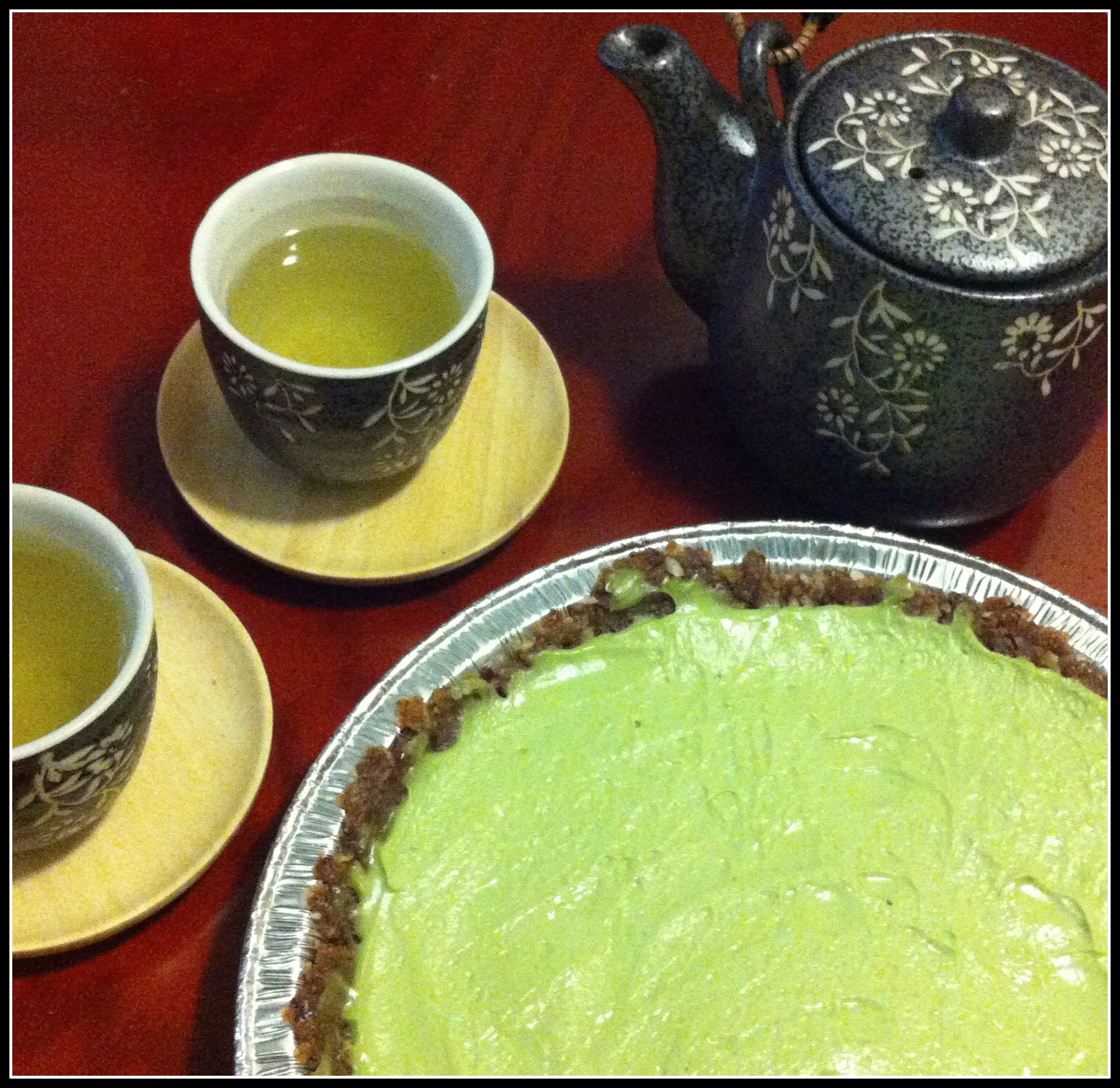
Avocado pie with gyokuro.

Avocado pie with gyokuro.

Thanksgiving. Gatherings. I was asked, “can you make dessert?” “Sure, I can make dessert.”

Yeah right. Five seconds later, “OH EM GEE. WhatcanImake!” It’s a Western party with Western people. I had never made a Western dessert before, not even chocolate chip cookies from dough that comes out of a tub (and then you just shape it into cookies and bake them, or not – one of the weirdest things about American people is that they love eating raw cookie dough like the Vietnamese like noodle soups. I don’t get it). So of course I did the same thing I do everyday at work – and also what I tell my students to do when they ask me homework questions: I googled.

The credit should go first to Cheryl. She once told me that a pastry chef at her previous job made an awesome avocado pie. Pie is common at Thanksgiving, and avocado is not too sweet and still around (the very tail end of the season, though), I figured at least I would like it.

Some part of me was wishing I could make a savory dish instead, one that I could taste and see the final product. (With pies, you can taste the components before you assemble them together, and then it’s in the hands of Fate.) The nice thing about dessert, though, is that I can make it the day before, and if I fall flat on my face, I’d still have a day to do it again. Thinking so at least helped me regain my composure to make it work.

Everyone at the party was quizzical about the green thing. I told everyone to try it to figure out what made it green (mainly I just wanted my pie to be eaten). A few people just went through a list of green things they could think of, including artificial colorings. It was fun. 😀 (And yes, they liked it too. 😉 )

Non-Baked Avocado Pie with Nut Crust
[to fill a 9-inch pie pan]

1. Brazil nut and date crust: (inspired by this Veggie Blackboard recipe)

  • 35 Brazil nuts
  • a handful of dried tart cherries
  • 45 pitted dates (it doesn’t have to be Medjool dates, I used Deglet dates, which is far cheaper per pound)

In a blender/food processor, grind the nuts into crumbs, blend in the dates and cherries until it becomes a sticky crumbly bunch. [You can substitute the dates with pitted prunes and cherries with raisins, dried blueberries, etc. or nothing. Basically, you need nuts and dried fruits.] Press the “dough” into the foil pie pan to shape the crust. Refrigerate while making the filling.

2. Filling: (inspired by this Kirbie’s Cravings recipe and one of the comments to that post)

  • 2 large Hass avocados
  • 2 lemons – to make 1/3 cup lemon juice
  • 1/2 can sweetened condensed milk

Blend them together into a smooth, thick paste. The lemon juice keeps the paste from discoloring (it stays green forever!). The avocado makes it luscious and not too sweet.
Fill the crust. Cover and refrigerate until serve.

Comfort food at the Taiwan Restaurant

November 20, 2013 By: Mai Truong Category: California - The Bay Area, Chinese, Comfort food

twr-starters
Partly because of my busy schedule, partly because of the lack of good Vietnamese food in Berkeley, I haven’t had Vietnamese food for months. I miss it, of course. Luckily, the neighboring cuisines share so much similarities that my “comfort food” category has steadily expanded to enclose most of East Asia. If for some reason America and I don’t get along, I think I can happily merge into Taiwan and Japan (not sure about Korea – their food is too spicy…).

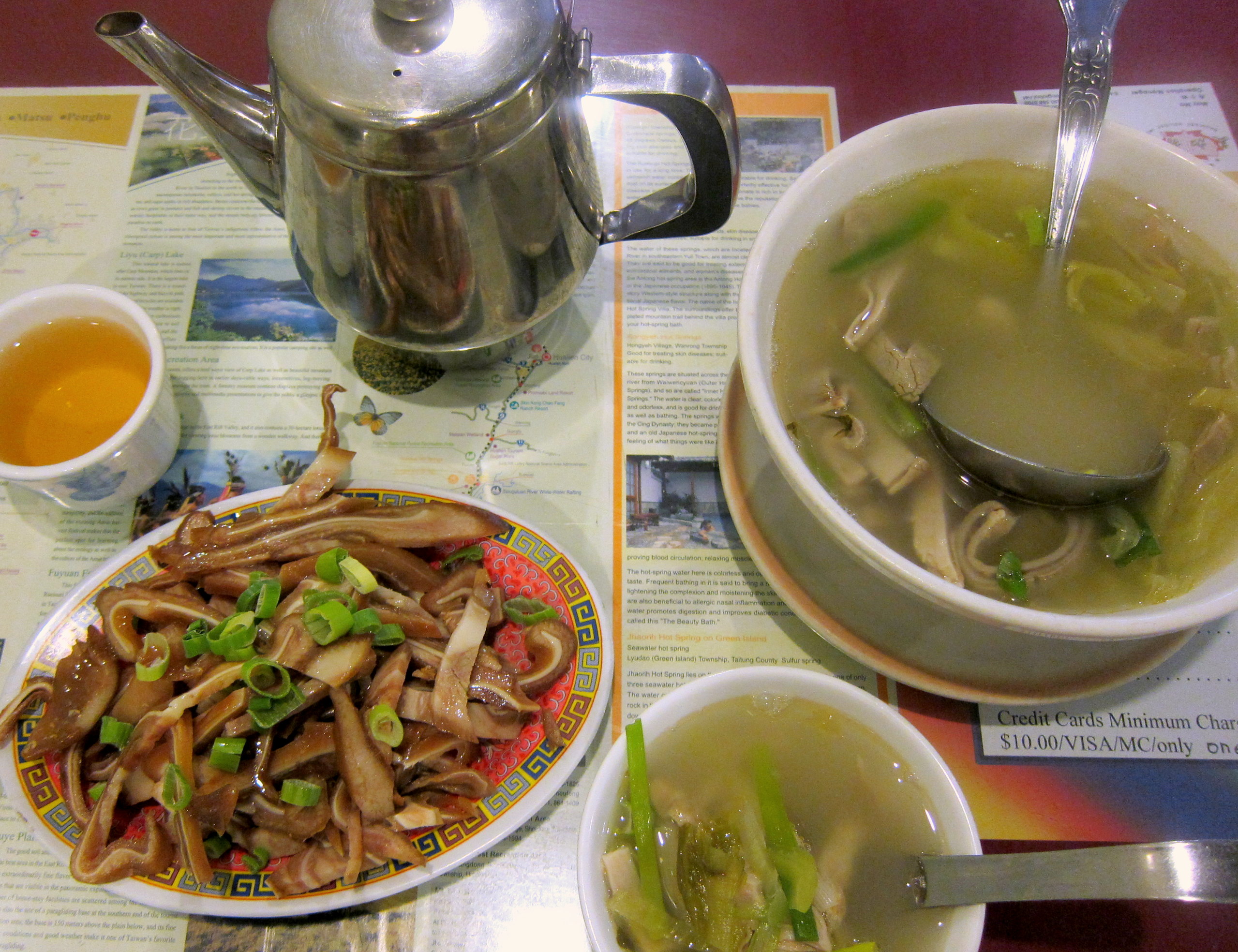
So when I crave comfort food, if it’s Sunday or Monday and Musashi is closed, I go down University Avenue to the Taiwan Restaurant. It’s the purple building next to Anh Hong, and it’s another case of generic-names-hence-don’t-go-there type of restaurant. However, two Taiwanese told me that it was “good enough” – the owner of Asha Tea House across the street, and Kristen. As with any Asian eating establishment, you have to know what to get at the Taiwan Restaurant, otherwise you end up with oily overload. I haven’t strayed once out of the usuals. It’s comfort food, there’s no need to change it. In fact, I come here just for one type of soup: the pickled cabbage soup with tripe.

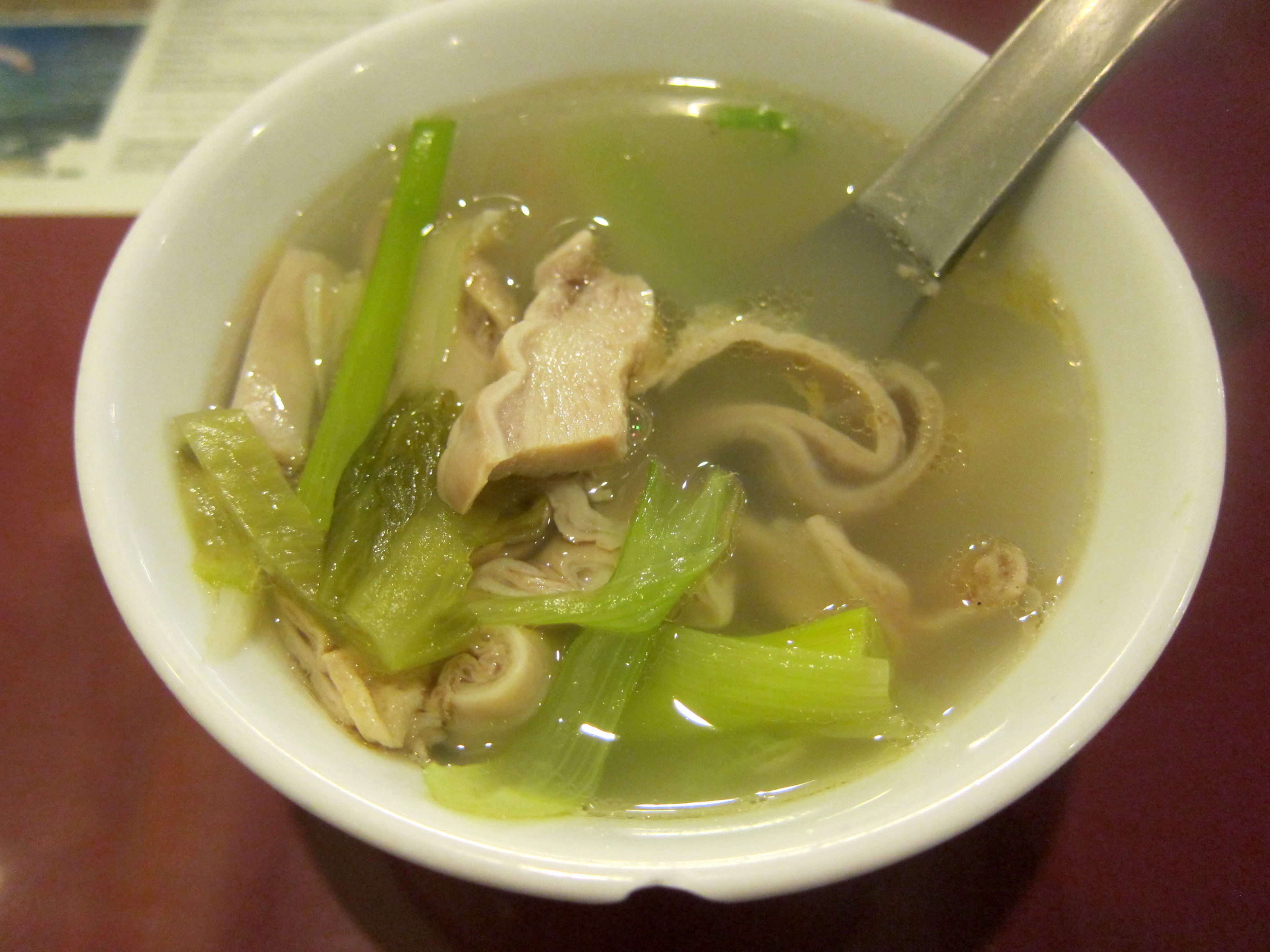
twr-pickled-cabbage-soup
Currently, this is my favorite soup in the whole Bay Area (not counting noodle soups, of course!). Nowhere else serves it. (The second time I ordered it, the waiter skeptically asked me if I knew what it was.) The pickled cabbage (Chinese pickled cabbage, similar to Vietnamese dưa muối) makes the broth sour and clear, the pork tripe is chewy and smooth. I would drink it to the last drop, and it delights even a grumpy stomach.

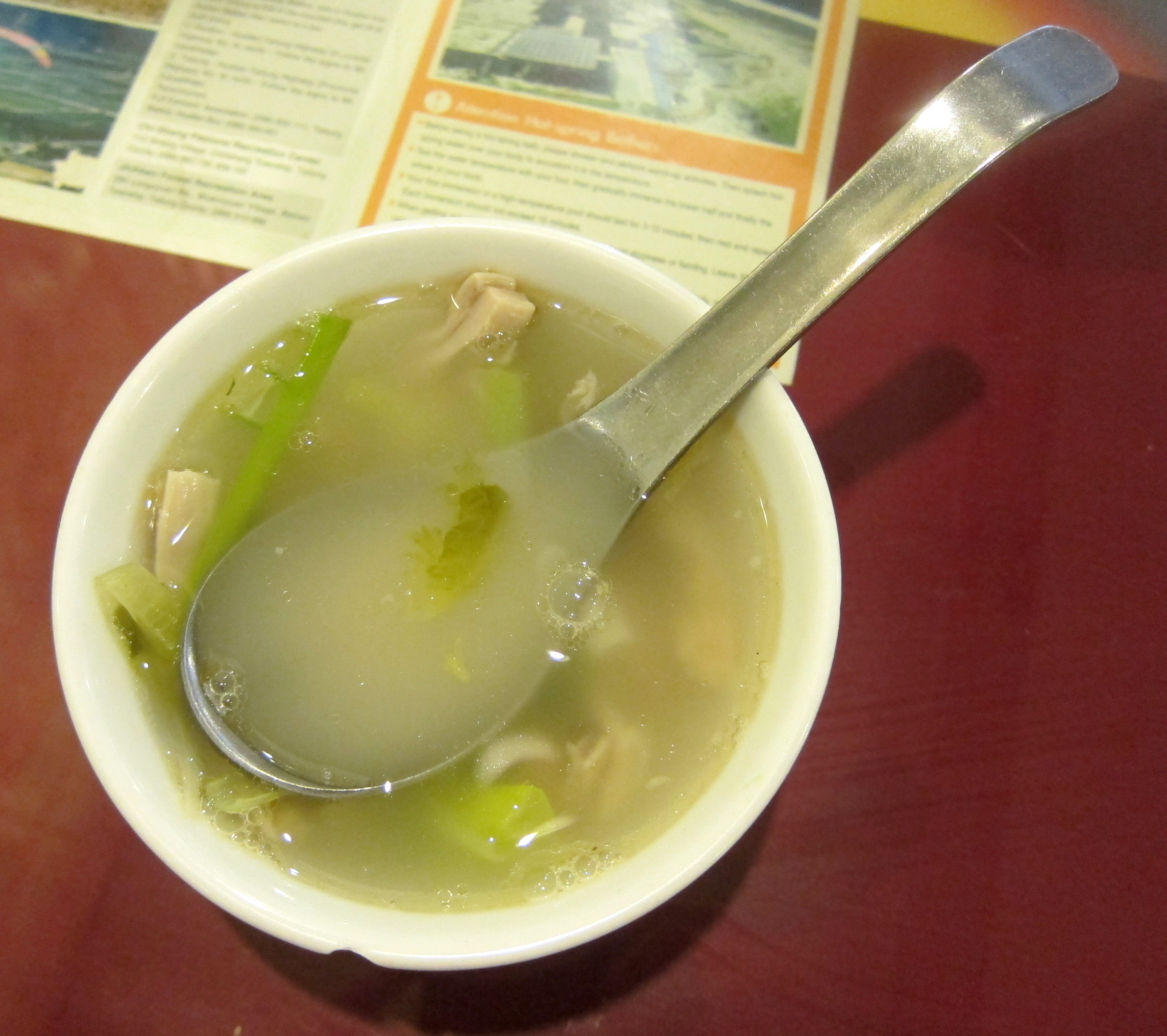
twr-soup-spoon
I’ve never seen such a spoon before.

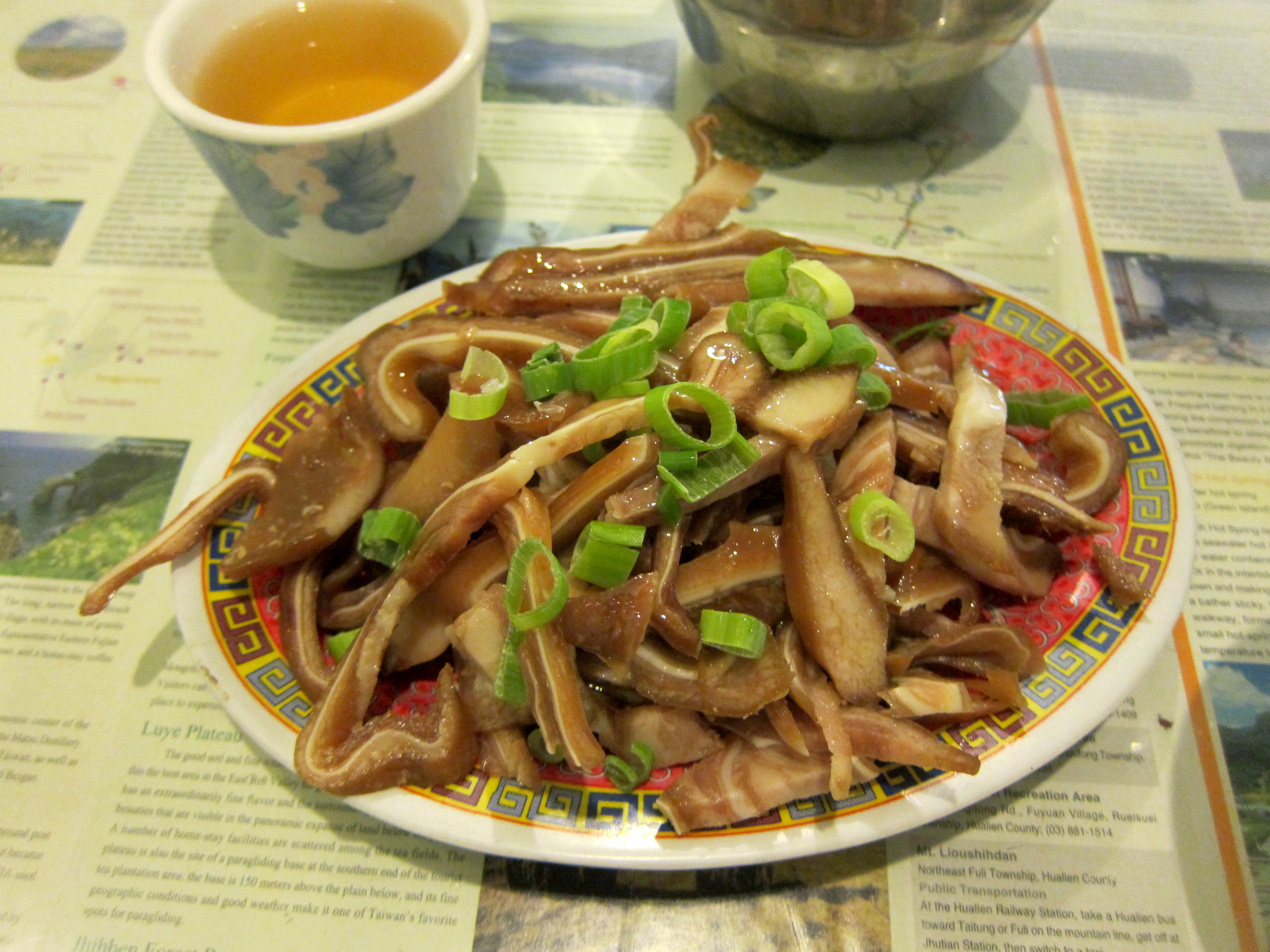
twr-pig-ears
Much to Mom’s chargrin, I pay no heed to the cleanliness behind the scene when I order at restaurants. Pig ears are crunchy and not so fatty – good enough for me (^_^).

twr-fried-pork-chops
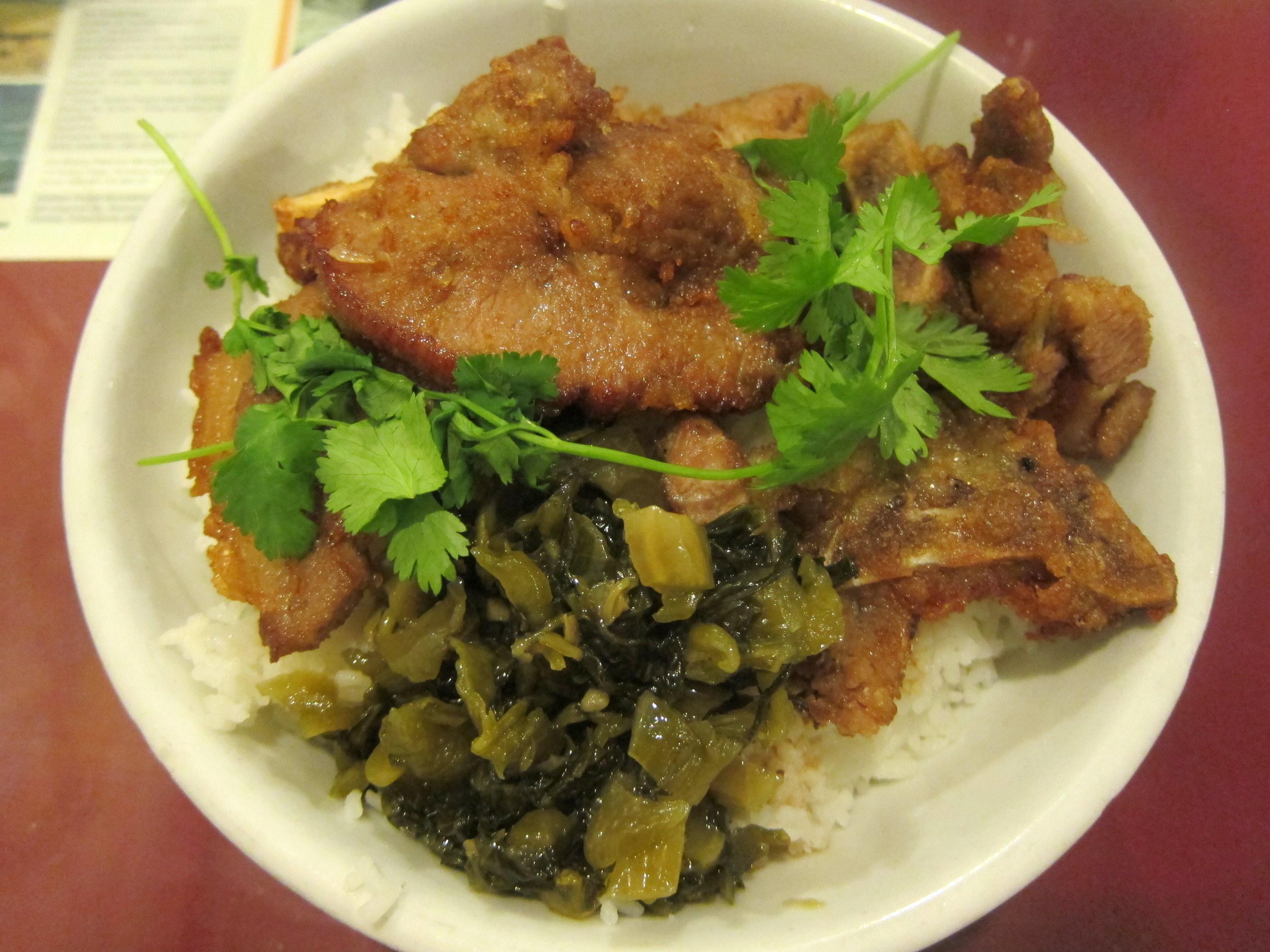
Kristen introduced me to this dish – fried pork cutlet on rice with sweet pickled greens. It’s actually pretty oily, but the rice is soaked with the sweet and savory pork sauce… I intended to save half for the next day but in the end I cleaned up the bowl.

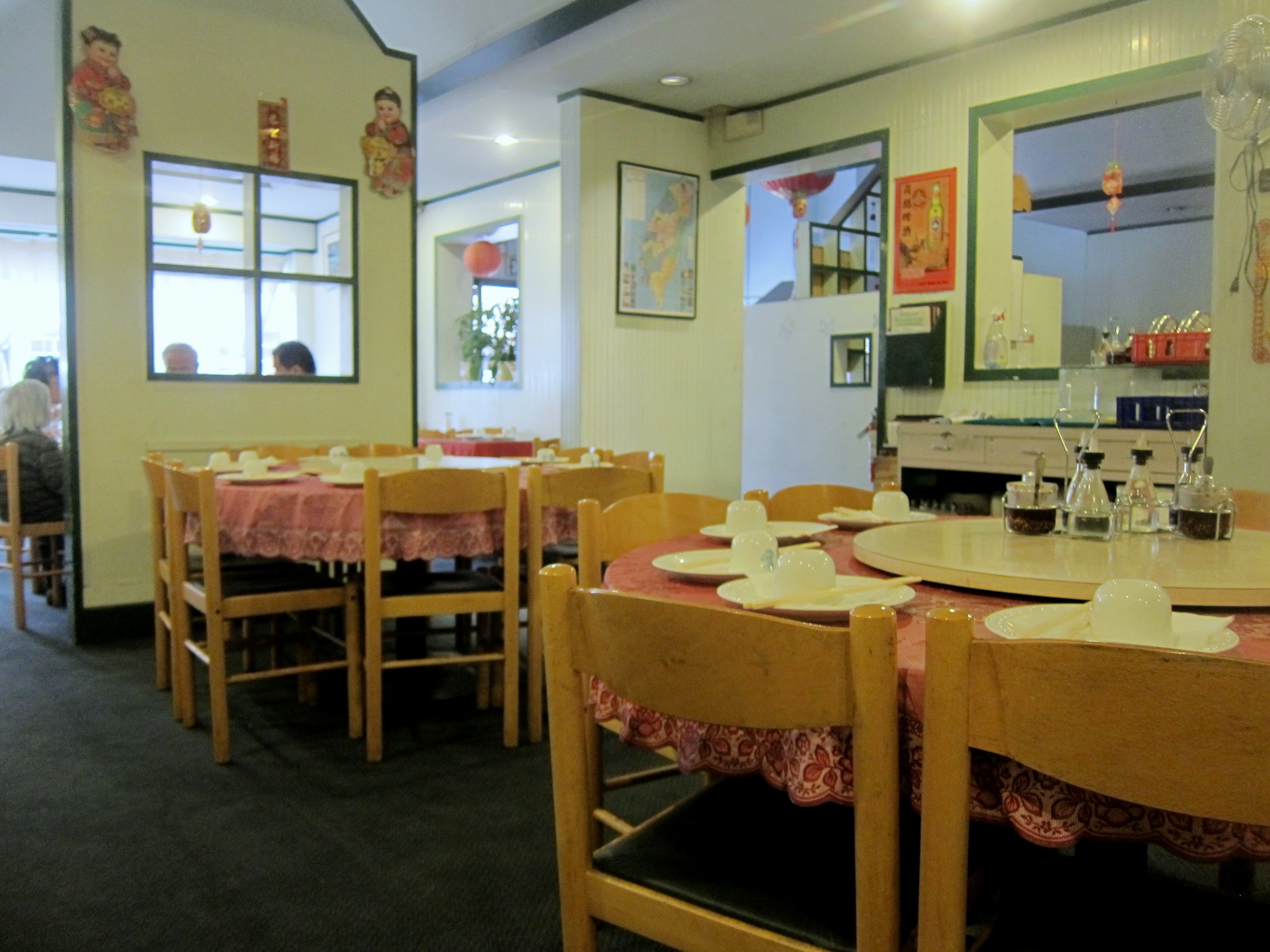
taiwan-restaurant-berkeleyThe last time I went, I paid a little more attention to the decoration (because the server forgot to bring me my pork, and I was just sitting there nibbling on the pig ears pretending to be cool). It looks rather classically Chinese – red lanterns and red table-clothed tables, all faded into a shade of cerise – hinting at some forgotten intention of being on the higher end. At the very least, it was set up to be a restaurant, not a simple food shack. Yet the food is cheap (these 3 dishes plus tip cost a meager $20.66), the atmosphere is utterly casual, and customers like me don’t ever think of its food as more than comfort food. The Taiwan Restaurant is, as its website claims, “the first restaurant in this country to serve Taiwan’s version of China’s epicurean delights”. I felt somewhat sad thinking that it has lost the glory that it might have once had.

The most pleasant surprise that prompted me to write about it was actually its tea. You know how all Chinese restaurants serve some kind of watered down “tea”, usually jasmine-flavored? The Taiwan restaurant actually serves Baochong. Watered down, but it’s still a legitimate Taiwanese oolong. I don’t know why I didn’t notice this before, but now that I have, I have enough reasons to recommend this restaurant to everyone. It is indeed “good enough”.

Address: Taiwan Restaurant
2071 University Avenue,
Berkeley, California
(510) 845-1456

One shot: Ramen burger – is it worth the hype?

November 13, 2013 By: Mai Truong Category: California - The Bay Area, Japanese, sandwiches

sooishi-pulledporkburger
Through words of mouth (from a kid that comes to my office hour, to be precise), I learned that the ramen burger is here in Berkeley. Hah, you don’t have to be in LA or NY or SF to eat this (relatively) new craze(*). Mashable has a guide to make it yourself, but why go through the trouble when you can buy it?

Unlike all other hypes that turn out to be various degrees of meh (in no order, truffles, caviar, foie gras, Cheeseboard, M.Y. China, Fentons, et cetera), the ramen burger is delicious. I gorged it down, completely defeated. Farewell, my hype-bashing days.

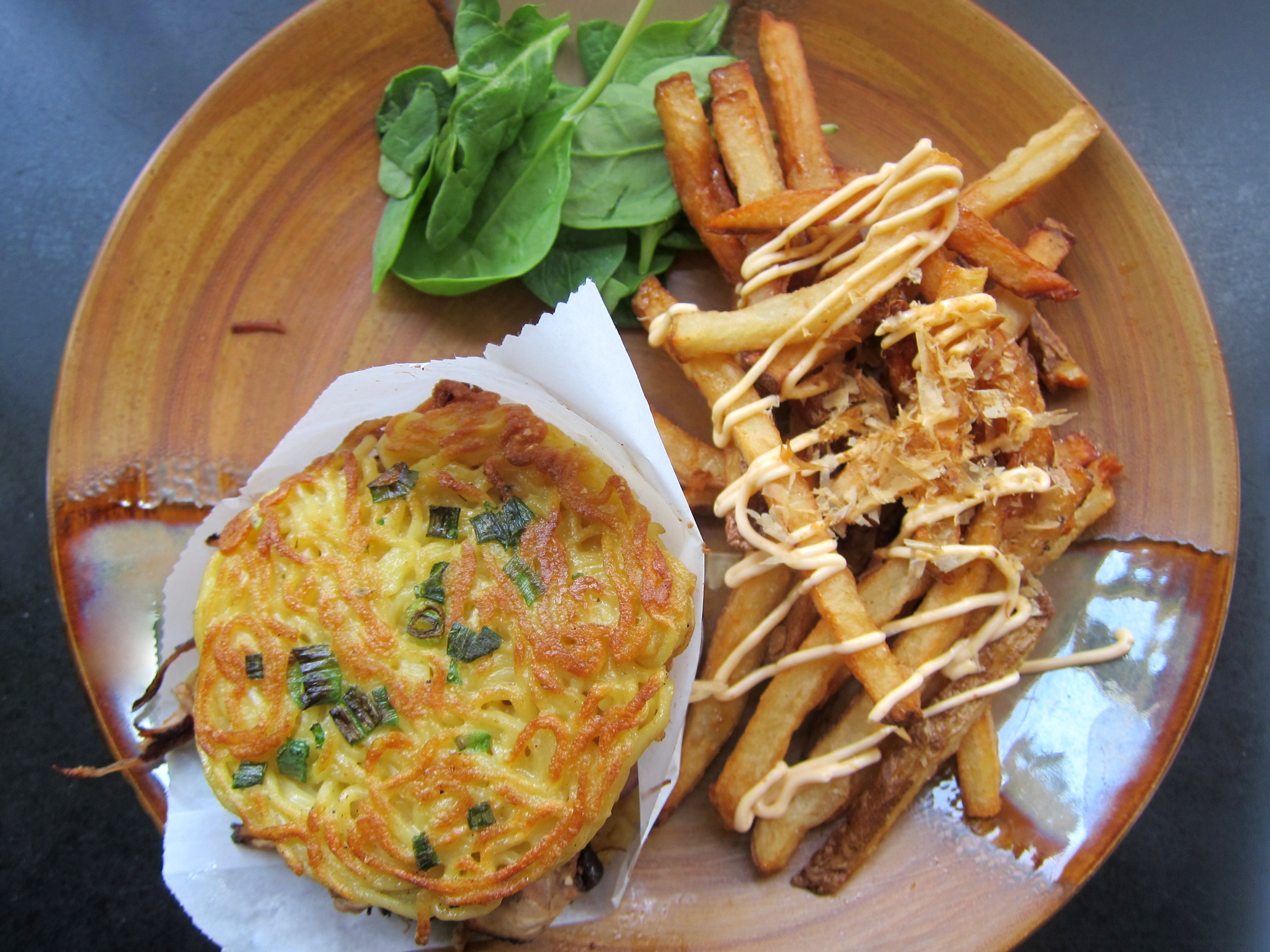
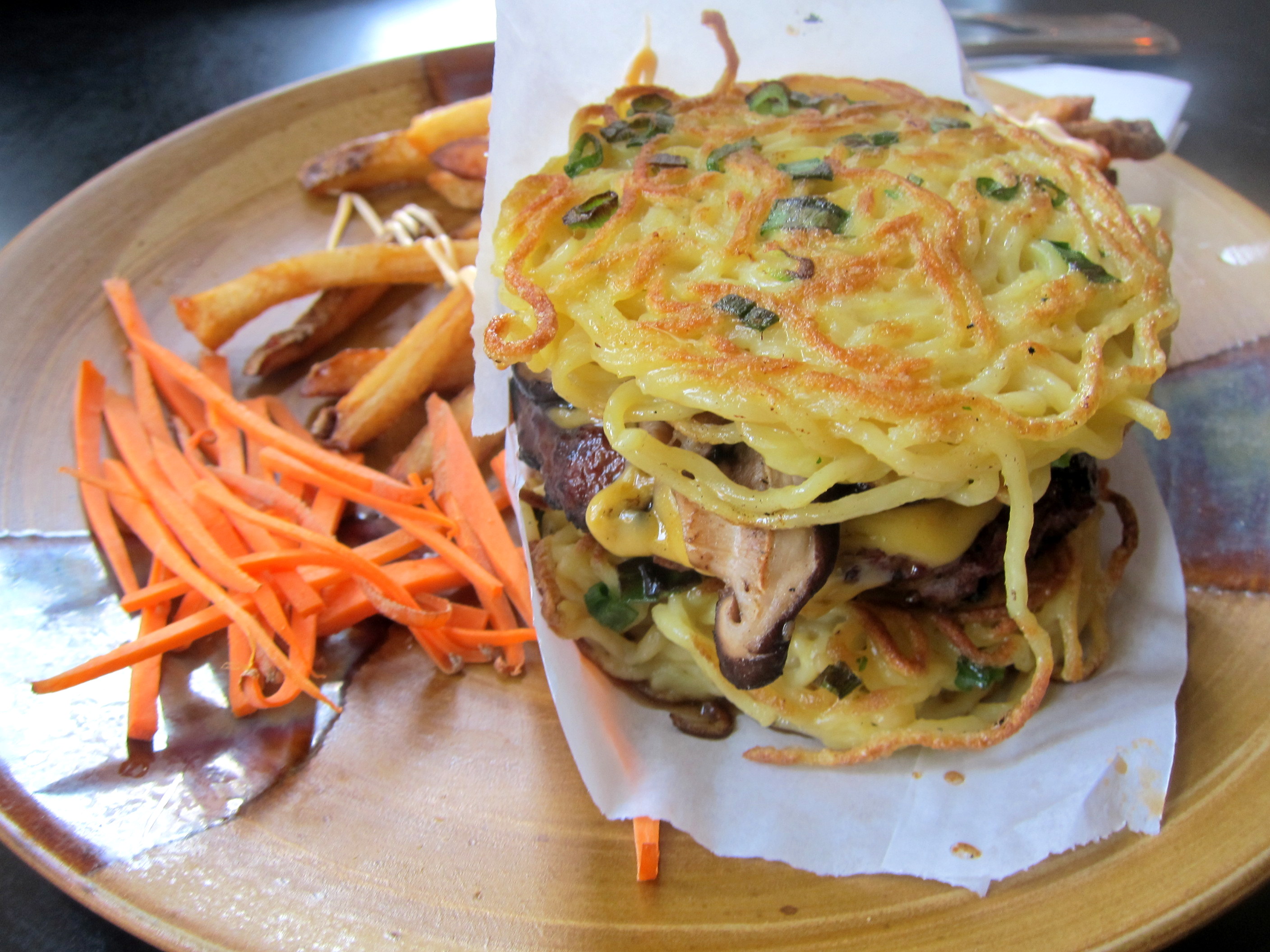
So Oishi in Berkeley dishes out 3 types of ramen burgers ($9 each): pulled pork (with wasabi mayo), grilled chicken (with ginger miso sauce), and the usual beef patty (with teriyaki sauce). (You can ask them to swap the sauce.) We had enough sense to avoid the chicken burger (who wouldn’t?!), and were split between pork and beef. Both types contain sauteed mushroom and come with “Japanese fries” (katsuobushi and Japanese mayo). Both sides finished with complete satisfaction.

sooishi-beefburger
They give you fork and knife, too, because unless you’re very skilled (or just take mousy bites), the burger will fall apart sooner or later and you get a sort of yakisoba with meat. Still delicious, just harder to eat by hand.

A personal plus: So Oishi sprouted from the same spot that used to house my old favorite (albeit barely average) Berkel Berkel.
A not-so-personal minus: they claim to be “the very first authentic Japanese ramen soup, ramen bun burger and sushi burrito restaurant… in Berkeley, CA”. Well if you want to be authentic, make sure you can spell. “Oishii” (おいしい、which means “delicious”) has two i’s, not one.

Good fries, though!

Address: So Oishi
2428 Telegraph Ave (next to Thai Noodle 2 and across the street from Rasputin Music)
Berkeley, CA
(510) 644-8278

Foodnote: (*) Keizo Shimamoto first invented it in NY late July – it’s been that long already?!

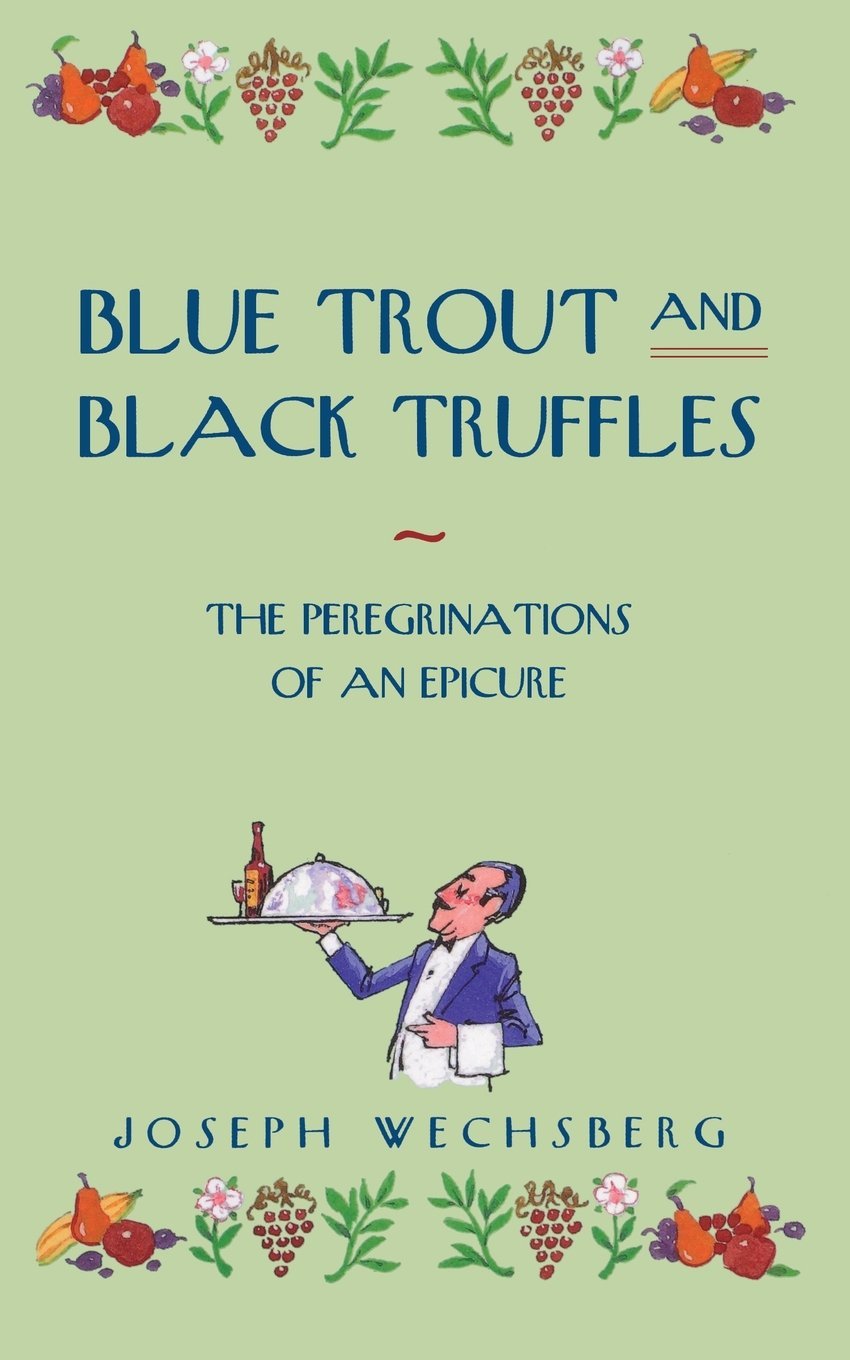
Blue Trout and Black Truffles – a journey through Europe in 300 pages

November 06, 2013 By: Mai Truong Category: Book

Blue Trout and Black Truffles by J. Wechsberg (Academy Chicago Publishers, Second printing 2001), but the book seems to have been published in German as well (Forelle blau und schwarze TrĂźffeln (1964)), as Wechsberg also wrote in French, German and Czech (although a majority of his works is in English).

Blue Trout and Black Truffles by J. Wechsberg (Academy Chicago Publishers, Second printing 2001), but the book seems to have been published in German as well (Forelle blau und schwarze TrĂźffeln (1964)), as Wechsberg also wrote in French, German and Czech (although a majority of his works is in English).

When I was little, and even now, my mom would tell me about the regional specialties of provinces in Vietnam and even other countries. She’s not a traveller, those were places that she has never been to, but she read about them in books and she has the uncanny memory to remember every detail of what she reads and recite it with such enthusiasm and emotion that makes you feel like you’re reading the book yourself. So I never felt the need to travel. (The only thing you can’t really experience from reading is the smell – it’s often the hardest sense to put into words, and any word description is always an understatement of the actual smell.)

Good writers can make you want to travel to the place they describe, taste the food they praise, meet the people they talked to. And then there are the really good writers who pull you into the story. When you read their books, you’re already at that place, eating what they’re eating, listening into their conversation.

When I read “Blue Trout and Black Truffles” by Joseph Wechsberg, I was in Vienna eating Tafelspitz (you have to capitalize the word because it’s German, and did you know that there are 24 different varieties of boiled beef, only one of which is Tafelspitz? [I admire the precision but I’m not convinced of the taste…]), then I was in Prague stuffing down knedlĂ­ky (dumplings that contain small cubes of fried bread, dumplings filled with whole plums, cherries, sweet cabbage [?!] or nuts, dumplings made of butter, egg yolk, dry cottage cheese, salted and “almost as light as a soufflĂŠ” [!]). I was strolling through the woodlands of PĂŠrigord, following a little pig named Mignon in search for black truffles (and almost got convinced that truffle tasted good). Wechsberg, with his gentle, objective humor and a hidden whiff of discerning aloofness, took me from Ostrava before World War I to Budapest in 1946 (when Hungary was still inside the Iron Curtain), then south to Genoa, “where the skies were blue and the people still knew how to laugh” (and made supposedly phenomenal ravioli), then northwest to Paris and Bordeaux and Lyon. I don’t know French and could only silently mumble through the included menus as I read, I’m not even that much into European cuisines, but like an old Roman chapel near L’Oustau de Baumanière in Les Baux-de-Provence, where “even the unbelieving feel the urge to kneel down”, this book makes even the non-drinker feel the urge to hold a champagne flute by the base (and never at the stem!) [I actually can’t picture how that works (-_-‘)].

At 8 am, I finished the last page. I took a shower until 8:45, then went out to lunch with Cheryl at 11. We had soba at Ippuku. I felt like reciting the old Hungarian proverb, “We are poor, but we live well.”

–.–.–.–.–

A few favorite tidbits:

  • “Prague’s women had great charm and vivacity, but they were rarely slim and long-stemmed. Dumplings were the national indoor amusement; to eat twenty or thirty dumplings at one sitting was considered a feat of virility.” (84)
  • “… as they say in Bordeaux, people take on the color of the wine that they ‘work’ and drink. M. Landèche’s face had the reddish color of the grapes of Château Lafite-Rothschild. And M. Henriot’s hue reflected the golden glow of the wines of Château d’Yquem.” (190)
  • “[La Tour d’Argent] was an immediate success and always jammed, but there was always a way of getting a table. A cavalier who had neglected to make his reservation would pull up his horse, walk in, challenge one of the guests to a duel, kill him with sword or lance, and take his place.” (227)
  • Wild goose with plum sauce at La Tour d’Argent was Cardinal Richelieu’s favorite. (228) [To encourage me to eat, my mom would tell me “The Three Musketeers” story (by Alexandre Dumas) while spoon-feeding me. After that story finished, we continued to (and consequentially finished) its two sequel novels, also by Dumas. Ah the good old days…]
  • “You can export all the ingredients, and even the cook, but you cannot seal in a can the shining of the Sun or the blue of the sky and the sea, and pour it into the saucepan.” (127) <– EXACTLY why I would only consider food made by Japanese in Japan truly authentic Japanese food, and likewise with other cuisines.
  • “A Balatoni Fogas to Start with” really resonated with me, perhaps because I’m from Vietnam and know first- (and second-) hand the detrimental effects of communism on Culture [yes, capitalized Culture].
  • “One Moment in Heaven”, “Afternoon at Château d’Yquem” and “Provence without Garlic” are lovely pieces on wine and France [I think… as if I knew anything about wine].

A little bit about the author:

Joseph Wechsberg worked as the European correspondent of The New Yorker from 1949 to 1983. He studied Law and Economics in Prague, Vienna and Paris, then he studied violin at the Wiener Konservatorium, played music in Parisian nightclubs and later on cruise ships to New York and the Far East. His well-travelled experience gave him great advantage in becoming a journalist and a writer. “Blue Trout and Black Truffles” is a collection of essays, some of which originally appeared in The Atlantic, Cosmopolitan, Gourmet, Holiday, and The New Yorker. [I feel incredibly inspired, but that means I need to start traveling and collecting some world(ly) experience soon. (-_-‘)]

Why I Love Fried Rice

November 03, 2013 By: Kristen Category: Comfort food, Korean, RECIPES

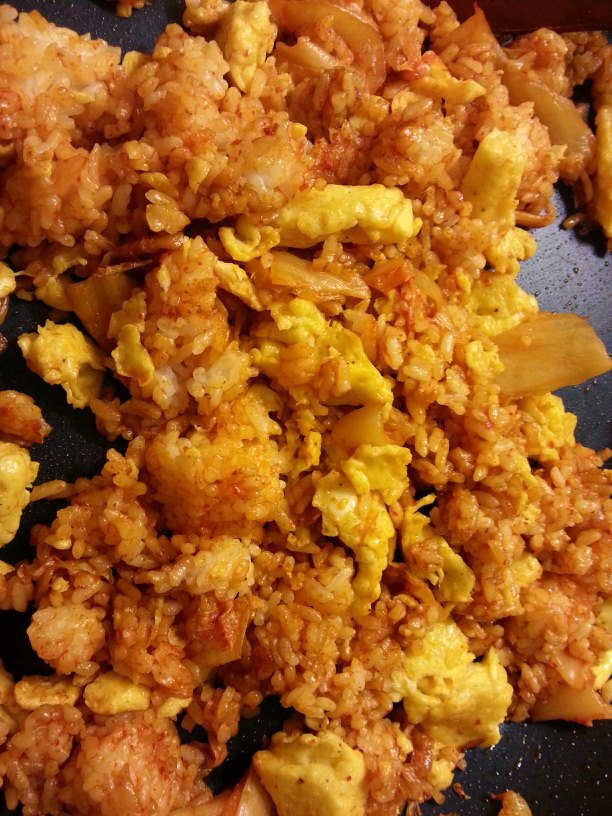
Yangzhou fried rice, kimchi fried rice, chicken and salt cod fried rice, whatever-that’s-in-your-refrigerator fried rice…I love it all. Fried rice is the ultimate comfort food – it’s filling, healthy-ish (if you put in a lot of vegetables), and just hits the spot every time. Perhaps the best thing about fried rice is how easy it is to make at home!

As someone who is still really learning how to cook, trying out a new recipe usually means that I’ll be spending anywhere from 30min – 2 hours in the kitchen (actually sometimes it takes me 30min just to prep everything because of my lack of knife skills). So for me, when I want a quick meal because I need to get back to reading or studying, or just because I don’t feel like devoting that much time to cooking, my go-to is always making fried rice. It usually takes me 15-20 minutes to cook fried rice at the most and while it probably is not the healthiest meal to eat every day, I usually end up making some kind of stir fry or fried rice at least 3-4 times a week because of how easy it is. Also, since fried rice is by nature something that requires the usage of pantry ingredients, I never have to worry about buying fancy ingredients.

1004545_10151924810260733_669571591_n

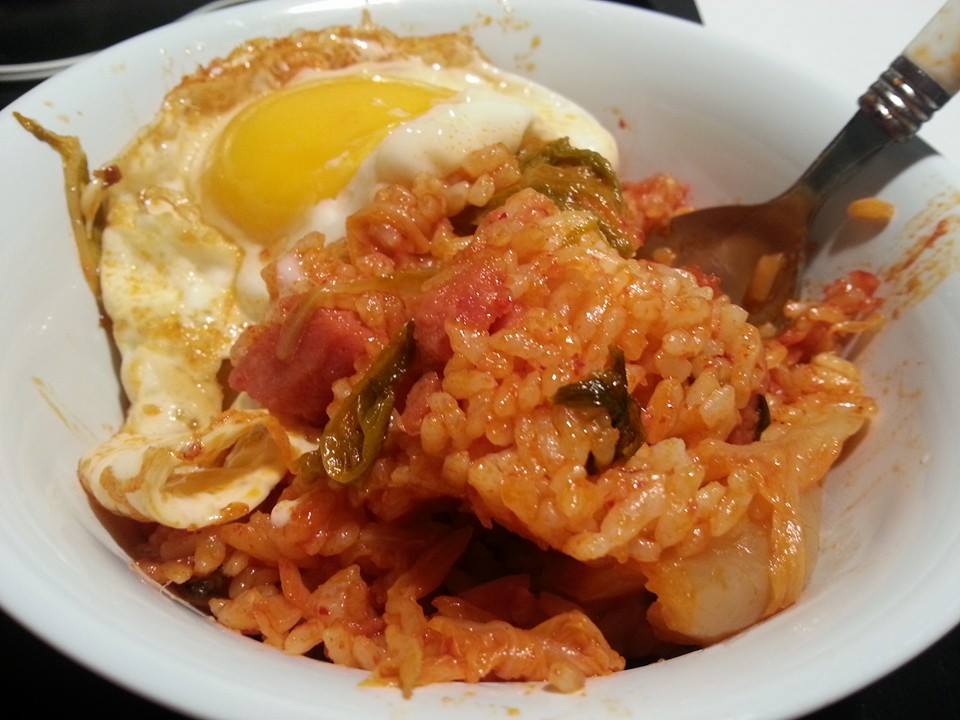
Here’s my very simple kimchi and spam fried rice recipe! It’s spicy, sweet, and salty and takes about 20 minutes altogether to make from prep to cooking (and probably 10 minutes for washing up afterwards or less if you eat straight from the pan, which I do sometimes when I’m lazy).

Spam and Kimchi Fried Rice Recipe – serves 2

I’ve made this recipe countless times and I’ve gotten to the point where I can probably do it in my sleep. I don’t have a source for this recipe since I’ve based the taste off of the kimchi fried rice from Kimchi Garden and then the more I made it the more I changed it to suit my taste. I tend to not follow recipes very well and work mostly from look and taste, so my measurements may not be entirely accurate and may not suit everyone’s taste, so some adjusting may be needed depending on how spicy, sweet, sesame oily, kimchi-y, etc. tasting you want it.

Ingredients:

  • Rice: 1 cup (My rice cooker makes 2 cups and I usually take half of that for 2 people. Also, I tend to use fresh rice more than refrigerated rice and never really noticed that much of a difference, but maybe it’s because I prefer my fried rice to still be a little sticky.)
  • Kimchi: About 2 cups roughly chopped kimchi or enough to suit your taste.
  • Spam: 1/3 of a block of Spam, diced
  • 2 teaspoons toasted (or regular) sesame oil (1 for initial stir-frying, 1 for finishing)
  • 1 teaspoon brown sugar or regular sugar (use less or more depending how much kimchi you use)
  • 1 tablespoon gochujang (more or less depending on how spicy you like it – 1 tablespoon makes for a *pretty* spicy fried rice)
  • 2 eggs
  • 1 teaspoon olive oil (or any kind of oil, including sesame) for the eggs

Instructions:

  1. Heat up 1 teaspoon of sesame oil over medium high in a relatively large frying pan or wok. I always prefer woks instead of pans because when I flip over the rice with my spatula, it doesn’t fall over the sides.
  2. When oil starts to crackle a little, put 2 cups of kimchi and diced Spam into wok. Stir-fry, making sure that nothing is burning (adjust heat if necessary to medium).
  3. When the kimchi begins to release some liquid and starts turning a little translucent, add in a teaspoon of brown sugar. A caramel-y thick sauce should start forming with the kimchi liquid. Stir-fry a bit longer (about 3-5 min) until Spam starts browning a bit.
  4. When the kimchi and Spam look like they’re cooked enough to eat on its own, add the rice in. Break  up clumps of rice with spatula and mix thoroughly. Leave some of the rice at the button to get it a little burned or crispy if you like it (it’s my favorite!). If not, keep on stirring!
  5. Add in tablespoon of gochujang and mix thoroughly so that it distributes evenly. It’s a thick sauce so it may take quite a bit of stirring before it’s fully incorporated. (Usually this process from when you add the rice to fully incorporating the gochujang takes about 5-7 min.)
  6. The mixture will probably be looking a little dry, so add another teaspoon of sesame oil and mix thoroughly. Set burner to “warm” or remove from heat.
  7. In another pan, add a teaspoon of sesame oil or regular olive oil. Crack 1 or 2 eggs and cook like you would normally to whatever level of doneness you prefer. (I make sunny-side-up fried eggs by cooking for about ~2 minutes on medium high heat and then ~2-3 minutes on medium low with a lid.)
  8. Place egg on top of fried rice and you’re ready to eat!
581935_10151498636045733_927445069_n

Kimchi fried rice is the best~

One shot: soba lunch at Ippuku

October 30, 2013 By: Mai Truong Category: California - The Bay Area, Japanese

ippuku-tenzaru-soba
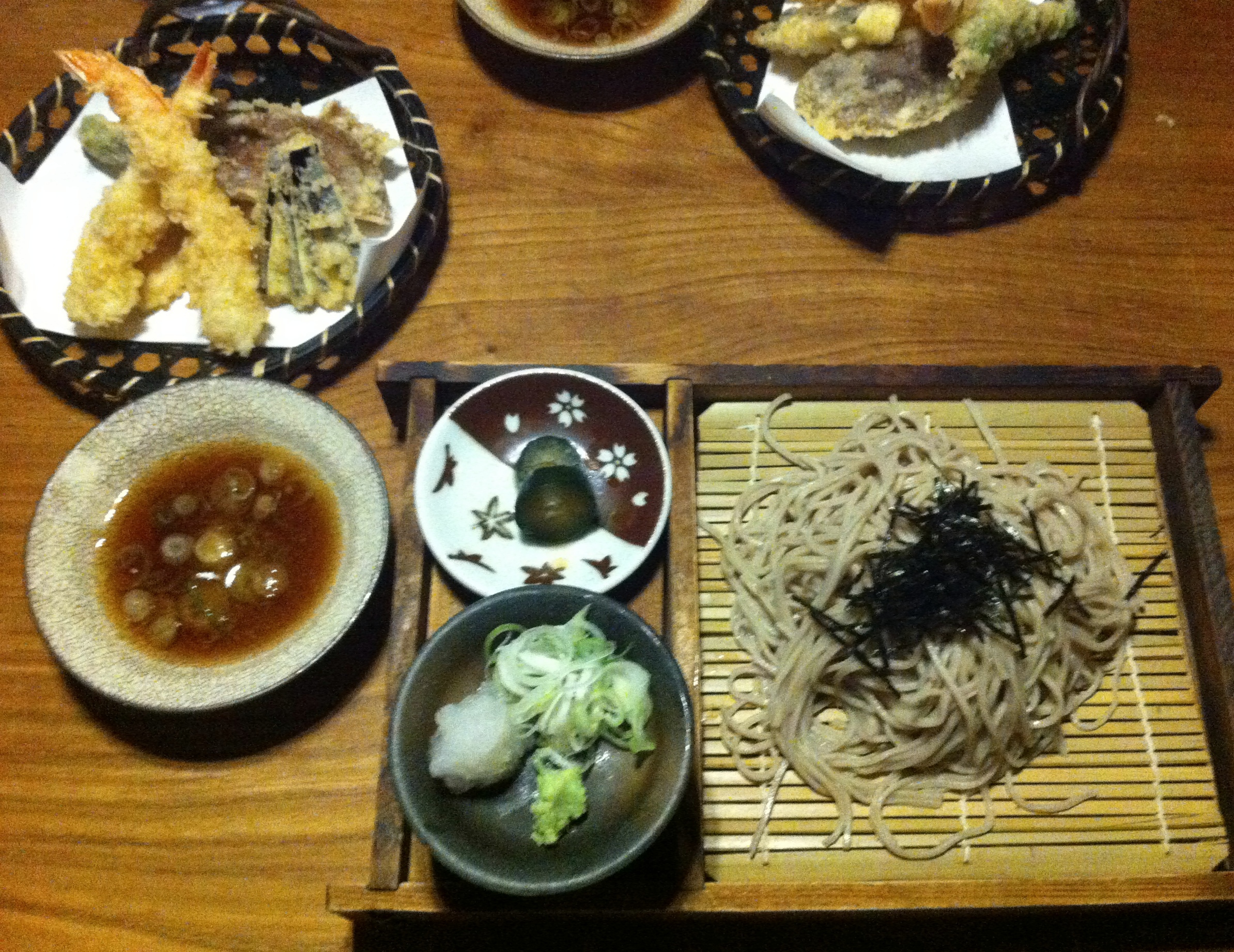
The luxury of cold noodles on colder days. Everything was perfect, from the taste of wasabi in the noodle dipping sauce to the tail end of those shrimps. So perfect that I couldn’t properly focus my camera phone.

Too bad Chef Koichi Ishii only makes the soba on Friday and Saturday from 11 am to 1 pm.

Pictured: Ten zaru soba (soba with tempura shrimps and vegetables) – $18. More details on what’s in the picture are here.

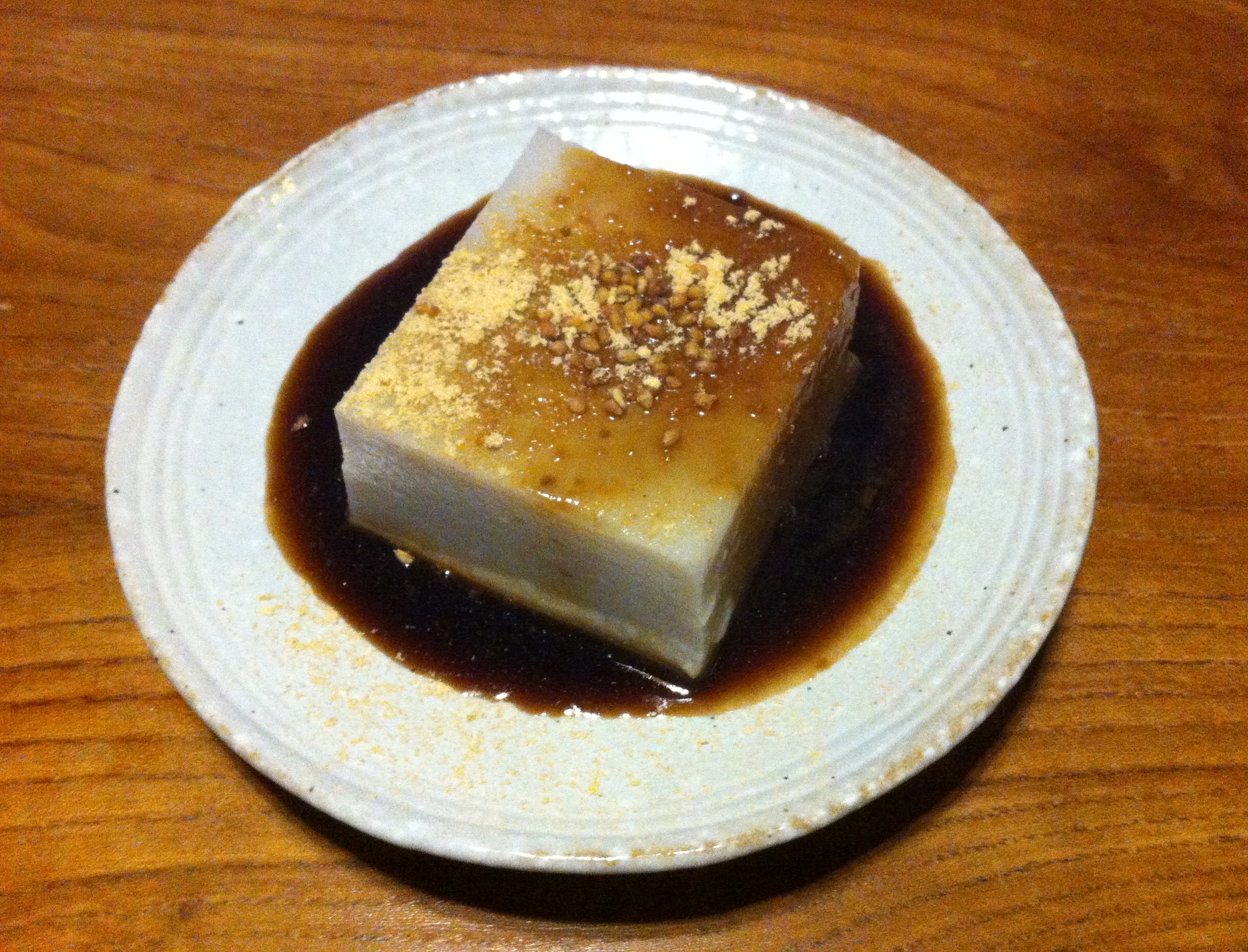
For dessert, we had soba tofu (tofu made from buckwheat instead of soy) with white sesame and kinako (roasted soybean flour), drenched in melted brown sugar. (^_^)

ippuku-soba-tofu