Flavor Boulevard

We Asians like to talk food.
Subscribe

Archive for the ‘One shot’

Steak Search 1 – The Alley
April 28, 2010 By: Mai Truong Category: American, California - The Bay Area, One shot


Once a Texan, you’re always a Texan.
Earlier last week I exchanged a few words with my friend about our food logging endeavour, and I got reminded of steak. (Yes, Sarah, you’re responsible ;-)). I thought it was gone. That evil desire of eating an innocent cow who just a few days ago was wandering the meadow with dreamy eyes. It has resurfaced. Granted I recently enjoy the occasional meatballs from Ikea, a Whopper at the Burger King on San Pablo, and various Top Dog‘s sausages, I haven’t had a chunky slab of steak for months. Now that’s serious. When I’m in Houston, we go to Potatoe Patch almost every other week. When I’m in College Station, I can always rely on Sodolak’s for a hearty fill. Where can I go in Berkeley?

Yelp reveals a gargantuan list of six “steak” locations in the area (for comparison, Humble (TX) has twelve, and Humble is half the area of Berkeley). So starting today I will eat at and blog about every steak house East of the Bay, alphabetically. First stop: The Alley.
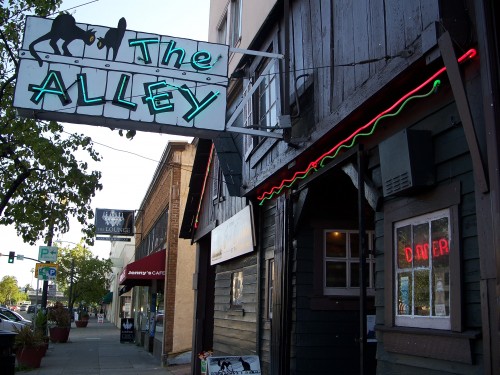

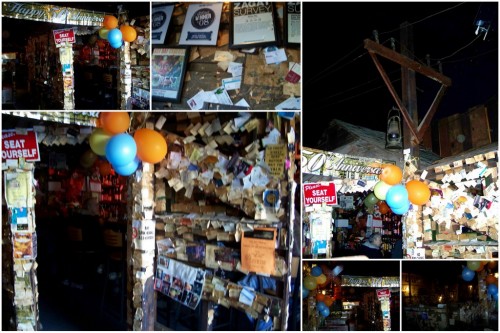
It’s the shadiest little hole in the wall I’ve ever been to. The inside is dark and frumpy like the sluggish voice of old black men at the bar counter sharing stories about job and children. The walls are blackish wooden planks, covered in thousands of staples and business cards, like a flaky fish deep fried with scales on and forgotten until it turns ivory with mildew dots. How do they say it, this place got character.

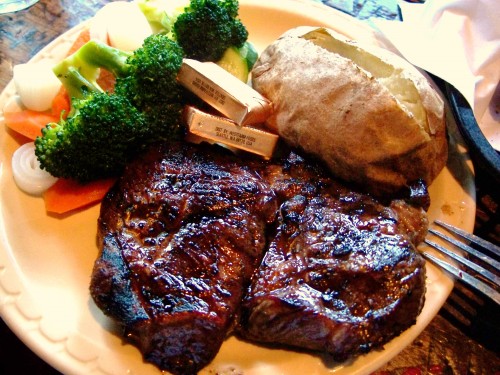
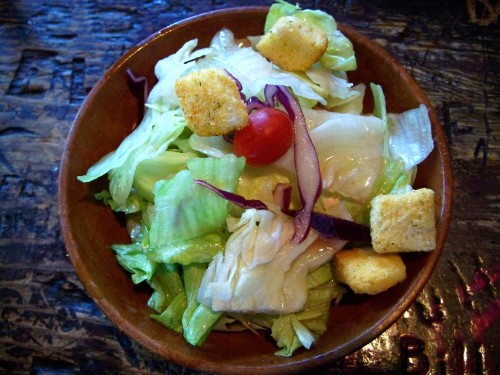
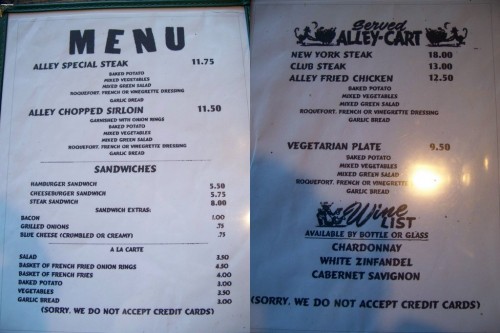
Whatever, I just want my steak. The Alley Special comes with a small bundle of iceberg lettuce, a slice of cucumber, and one cherry tomato. The typical salad of guilt that always comes with cheap steaks and dressed in crocodile’s tears of vinaigrette. For 11.75 we get a 12 oz slab, some half cooked vegetable, garlic bread, and a baked potato.

We ask for no sour cream on our potato, but I’m not sure if that was necessary, as the potato comes simple and spare. No cheese, no chives, no bacon bits, two butter packets still wrapped and melting on the hot steak. We are also given one skimpy knife and one fork each, the knife blade is narrow like a snake’s tongue.
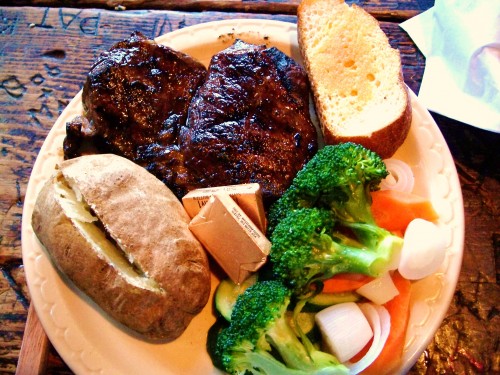

We slice and chew, industriously. This is steak that you can make into mattresses, springy and resilient, and taste like hard work. The steak juice flavors well the half cooked onion, broccoli, and carrots. The garlic bread feels hasty. The bare baked potato fits stupendously beautiful with butter and generous shakings of salt, as it should. Its burnt skin, soaked with steak juice, is something I’ve learned to eat and enjoy, but this time it easily peels off to reveal the tastiest part of a perfect baked potato: the dry, hard shell between the skin and the moist flesh. It’s like pie crust without gooey sugar mess.

So that’s it. The Alley lives true to its name: a dark hangout that only accepts cash in exchange for a recharge reeking of grill smoke, cigarette smoke, beer, old men’s stories, and our backstreet side.

Address: The Alley
3325 Grand Avenue (between Elwood and Lake Park)
Oakland, CA 94610
(510) 444-8505
(parking on the street)

Next on Steak Search: Buckhorn Grill (Emeryville)
Tags: ,

Sugarcane juice is sweetest at the throat

March 30, 2010 By: Mai Truong Category: California - The Bay Area, Comfort food, Drinks, One shot, Vietnamese


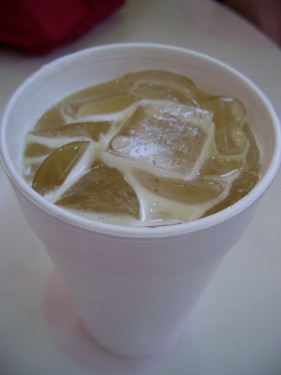
At first you taste a field of lush wet grass, then sweetness creeps in and lingers. It is neither rich nor plain. It is not colorful or sparkling. It has no charm in a 16-oz styrofoam cup. You will never be its addict. It relieves thirst better than coke, and contains nothing but natural hymn. It is the girl-next-door drink.

Where I’m from, nuoc mia carts usually park in front of school gates. They have a bucket of yard-long sugarcane stalks, some ready-to-go nylon bags filled with the yellow tinged juice, tied with a rubber band and equipped with a straw, a glass box to store the inch cuts of decorticated sugarcane – cheap, all-natural energy snack for school kids.  The sugarcane ladies, usually in cone hats with their faces charred by sunlight and sidewalk heat, can reel sugarcane stalks through the grinding wheels so fast and so rhythmically, like a skilled tailor drawing cloth through a sewing machine. I used to marvel those ladies and their cool sweet drink, from a distance, as my mother doesn’t believe in street food. I may recall one or two instances of drinking sugarcane juice over the years, some vague memory of how wonderful the taste was after you added a teeny pinch of salt. There were times my mom would buy whole sugarcanes from the market and peel off the outer shell with one heck of a mean-looking sharp knife, then cut them into bite-sized chunks that I could chew and suck. The juice was heavenly. Its memory just wouldn’t let me rest.

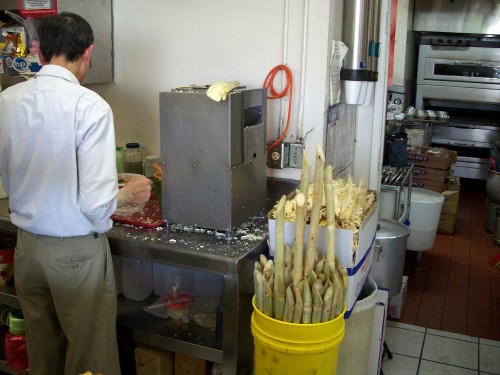
Around lunch time we arrive at CD Bakery. As soon as I ask the cashier lady for one “nước mía”, she yells out the order to the juice man, who starts sticking and pulling sugarcane stalks into the grinding wheels boxed up with metal walls.


After running the stalks a couple of times through, the juice man reaches into the tin box to grab a plastic jug filled with lightly foaming juice, pours it into a styrofoam cup with a few ice cubes, closes the lid and dunks a straw. Three-dollar-and-three-minute soft drink. The only way to beat this minimal procedure would be to lick maple sap from a living tree, or chew on some sweet grass. The cashier lady asks if I want kumquat (salted, perhaps?) in my nuoc mia too, but after a split second of thought I go with No. Sugarcane juice can make it on its own. That is its beauty, and it deserves my trust. How would the aged, salty, bitter, sour kumquat tantalization fuse with the tingling, deeply soothing, freshly pressed, sweet sugarcane nectar?

I’ll try it next time.

Address: CD Bakery & Deli (also called Dao Bakery & Deli LLC)
(in the Lion Market Plaza on Tully & King)
1816 Tully Road, Store #198
San Jose, CA 95122
(408) 238-1484
Open everyday from 8am to 8pm

Sesame fluff – Chinese snack mi lao

March 29, 2010 By: Mai Truong Category: Chinese, One shot, sweet snacks and desserts


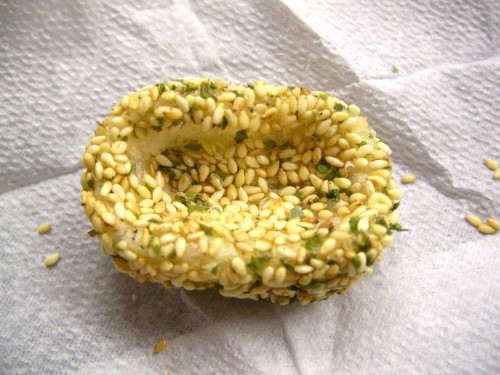
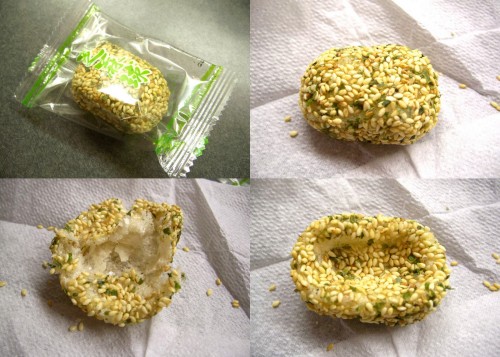
I press my thumbs down, the little egg shape dutifully collapses, but remains in tact, except for a few sesame seeds.

I have deformed a perfect fluff ball out of curiosity. As resilient to breaking as it is, it can’t ever re-inflate like our economy. A bit of guilt creeps in. These little fluff balls come from a lengthy process, as indicated by their name (“佬” – lao). Sticky rice flour is mixed with some other rice flour to make the initial dough and let fermented. My guess is fermentation plays a central role in forming the porous structure, when the dough ball gets deep fried. As malt sugar and lard covers their vulnerably hot surface, ’em balls are quickly rolled and tossed in roasted sesame seeds. And there, you get a fresh batch of mi lao, sesame (sticky rice) fluff. (*)

Originally, the sesame fluffs were meant to be a part of the Lunar New Year offerings in China, but who wouldn’t welcome a snack like this year round, so different spin-offs roll out of street stalls in Taiwan, like peanut-lao, almond-lao, rice-lao. Tiny bits of dried laver (nori) creatively dimple the nutty coat, adding subtle salty notes to the fluff.


Light, chewy, sticky, the deformable birdie beach ball turns into a tooth glue upon each bite. Only eight dollars for sixty little packets, the fluffs can start someone’s good day at work, some fun email exchange, a new friendship, and a blog post. They did for me.

* Many thanks to my friend Chihway Chang, whose amicable nature and fluency in the Chinese languages has made this post possible. The fluffs came from her, too. 🙂

Bánh dầy giò – sticky rice bun with sausage

February 24, 2010 By: Mai Truong Category: Houston, Northern Vietnamese, One shot, savory snacks, sticky rice concoctions, Texas, Vietnamese

banh day 3
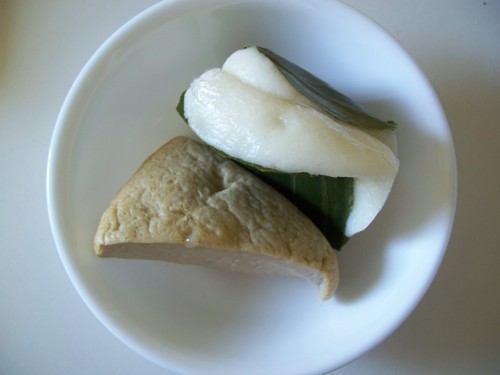
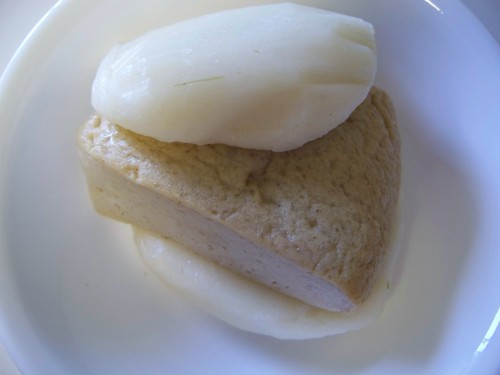
It’s just a white bun made from sticky rice, loosely wrapped in banana leaf so that it doesn’t attach indefinitely to your fingers, ready to sandwich a thick cut of cha lua. The purpose of the bun is purely a textural enjoyment, it has neither taste nor smell. All flavors come from the sausage. Eating the bun alone would be like chewing an incredibly huge piece of gum, the only difference is you can swallow the bun. Come to think of it, we can make a bunch of bite size sticky rice “gum” for American school kids, they can chew until they’re bored, and swallow it, no unfortunate mess under the desks and your shoes. Cool, innit?

Because of either its simplicity or its antiqueness, the bánh dầy is not quite a favorable snack among the young Vietnamese these days. Or perhaps because it is a treat from the North? Southerners have a sweet tooth and are attracted to fatty, rich, flavor-compact concoctions. Bánh dầy is none of that. When I was in Saigon I knew of bánh dầy through three sources: the extremely common tale of bánh chưng bánh dầy, the book “Hanoi 36 streets” by Thạch Lam, and the tiny buns filled with bean paste (bánh dầy đậu) Little Mother got for me from Ngọc Sáng bakery in District 1. Another case of cross cultural similarity: compare the banh day dau with the Japanese daifuku: the sticky rice coat is exactly like mochi, the mung bean filling is salty while daifuku’s filling is sweetened.

banh day 4

For something the size of a can bottom, banh day makes a dense snack (just like its pyramid shape cousin, banh it). We got both at Giò Chả Đức Hương in Houston, but banh day is not always there. The reason might be the good amount of work in making those simple looking buns. An authentic banh day is supposed to be made by pounding cooked sticky rice to a goo, although the packages of sticky rice flour in stores would do the job. I’m not sure which method  Đức Hương used. I also wrongfully microwaved it once, the result was a plain thick blob that could possibly rival superglue. Yep, banh day is supposed to be eaten at room temperature (not for folks who want a warm meal).

Address: Đức Hương Giò Chả (Houston)
11369 Bellaire Blvd, Ste 950
Houston, TX 77072

Down the Aisles 1: The fun of bánh men (yeast cookie)

February 19, 2010 By: Mai Truong Category: One shot, sweet snacks and desserts, Vegan, Vietnamese

banh_men
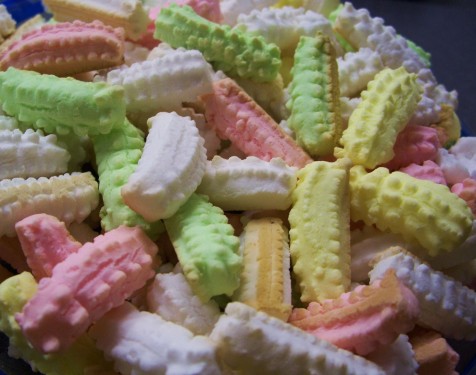
Despite the name, banh men are quite girly cookies. Just look at how colorful they are: pink for strawberry, yellow for durian, white for plain coconut, green for pandan leaf. The literal translation “yeast cookie” is also a misnomer because there is no yeast, just tapioca flour, sugar, coconut milk and water.  Somewhere between your teeth and your tongue they would transform from crunchy to melting, all of a sudden that crisp cookie disappears, a sweet lingering gently passes by. And that’s it, you wouldn’t even know that you’ve just had a cookie.

My mother’s girl friends at work love these. The cute bites come in all shapes: worm, button (like the ones made by tt at PlayingWithMyFood, and spiky caterpillar (banh men gai, the ones I got). Ch3rry Blossoms made flowers of them. Extremely light and mild, they are a convenient snack, my fingers just have a go at the bowl next to my laptop without me even noticing. The label on the box says: “Serving size: 150g, Serving per container: 1”. There are about 150 cookies in there, so I can be proud that at least I didn’t follow the label.  A container like this at Lion Food market sells for less than two bucks. What’s better than a cheap sweet treat?

Claypot fish is now upscale

February 11, 2010 By: Mai Truong Category: California - The Bay Area, Comfort food, One shot, Opinions, Southern Vietnamese, Vietnamese

ca_kho_to_claypot_fish
You know how some dishes just instantly come up when you think of certain places? Those are the dishes that always get served when you go on tours to the region they’re associated with, like barbecue in Texas, crawfish in Louisiana, crab in Maryland, clam in the little island Nantucket of Massachusetts. Well, in the deep south Mekong delta of Vietnam, where there are more rivers and canals than Venice, freshwater fish multiply like crazy and the countryside inhabitants make fish dishes like crazy. But for some reason, the name “Mekong Delta” is always linked with “cá kho tộ” (fish simmered in claypot). Why?

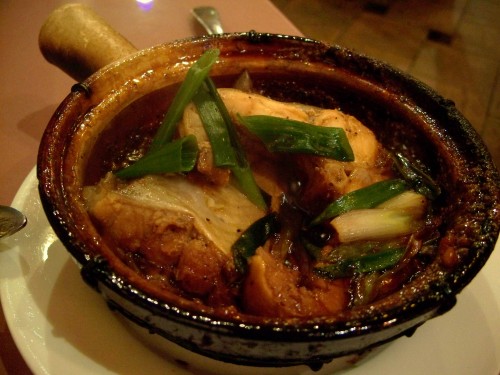
The fish (usually catfish) is cut up into thick sections across the body, skin and bone intact (scales off, though), simmered in fish sauce and caramel sauce until it turns beautifully brown inside and out. The mixed sauce is thick and savory, it’s sweet, it’s salty, it can spike up your senses if you add a fillip of chili pepper. Some might argue that fish can taste good by themselves, but this sauce alone would make every mouth water. I’d take the sauce and the sauce-soaked skin anytime over the flesh.

Then again, I had never thought about eating it when I was in Vietnam. Footless animals don’t appeal to me, footless animals with stinky needle bones ready to get stuck in my esophagus appeal to me even less. Footless animals with stinky needle bones were also too abundant, too cheap, and too easy to get when I was there, that boredom won over appreciation of taste. Pick any little food shack for workers on the streets of Saigon, any family-owned eatery by the side of the highway, any book about Southern Vietnamese cuisine, you’re bound to find two things: cá kho tộ and canh chua. It became trite. Little did I know that one day I’d only find it  again in an expensive restaurant in Berkeley.

A few restaurants in Bellaire advertise claypot fish in their menus, but usually say they’re out when you order. It could just be because the dish takes quite some time to make, and scrubbing away those little clay pots with caramelized sauce and fish isn’t really a desirable job. So I was ecstatic when they actually had it at Le Regal (just one good meal after another). The pot came out hot and sizzling, two slabs of fish steaks snuggled in the bubbling golden brown addiction. Fish had never smelled so good. The order does not come with rice, but plain white rice is a must, unless you want to slowly take in nibbles and licks overpacked with flavors.  Be sure to save a bit of rice to clean the pot after all the fish is gone.

Price: about $12-13. (This menu is completely out of date on the price, and does not have all the dishes currently served, but nonetheless it can give you an idea of what they have.)

Address: Le Regal
2126 Center Street, Berkeley, CA 94704
(510) 845-4020

Click here to read Holy Basil‘s recipe of ca kho to.

Frosting all the way – La buche de Noel

December 24, 2009 By: Mai Truong Category: French, Houston, One shot, Opinions, sweet snacks and desserts, Texas, Vietnamese

The French colonizers brought many things to Vietnam – Catholic churches, potatoes, veston, coffee and rubber tree plantations, to name a few – but perhaps their baking recipes have left the sweetest memories. Some of those recipes were modified, like the baguette with extra leavening became the crisp and light banh mi, or the croissant with extra butter which is crisp at the two horns (to match its Vietnamese name – “water buffalo’s horn”), golden and shiny at the bottom, more substantial inside, subtly salty, and smells delicious from several feet away. Some names have mysteriously disappeared from the world wide web of delicacies and can only be found in Vietnamese conversations, Vietnamese bakeries, and Vietnamese food blogsthe pâte chaud falls into this category. But many stay true to their origin, like the choux à la crème, the gâteau, and the buche de Noel.

There’s the frosting. It can be white chocolate, coffee, hazelnut, even durian flavor, but the traditional dark chocolate ganache is best in my opinion. There’s the middle layer to resemble tree rings, chocolate again is great but pineapple jam if you like it fruity but not too sweet. There’s the layer of spongy génoise, soft, light, plain, a levee to keep the palates from a sugar flood. As for decoration, powder sugar would make a good snow, meringue mushroom to look more botanical, a couple of icing roses, branches, or pine trees to be Christmasy, some fresh raspberries for a little tart.

The Vietnamese keep the tradition of a strictly European réveillon even after the French left, no member of spring rolls, rice noodle, sticky rice, sweet bean paste and the gang are allowed, but goose is extremely welcome and buche de Noel is a must. Then we crossed the sea and here in America although Christmas desserts are overwhelming – fruitcakes, gingerbread, pumpkin pies, mince pies, banana bread, candies and cookies – la buche de Noel doesn’t exist. Why is that? We brought over the turkey, the ham, the Christmas tree, even the actual Yule log to be burnt in the fireplace, why is the edible and delicious Yule log left behind?

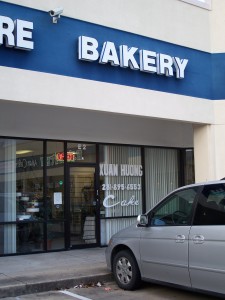
Xuan_Huong_Bakery Anyway, our little homesick craving has been found in a Vietnamese bakery northwest of Houston. Made by preorder, each log costs $29 at Xuan Huong.
Address: Xuân Hương Bakery
13480 Veterans Memorial Dr. Suite D
(in the same shopping center with Hong Kong Market #3)
Houston, TX 77014

(281) 895-6553

Banh mi ba chi pate

October 05, 2008 By: Mai Truong Category: Houston, One shot, sandwiches, Texas, Vietnamese

Lee’s sandwiches has different kinds of banh mi on their menu, and although I’m a stingy about chances to try out varieties (after finding out my favorite, of course), my mom often surprises me by how open-minded she is on a few things. For example, despite my usual fondness of banh mi thit nuong, this time she got me an extra: banh mi ba chi pate, the new and only item on Lee’s menu that has pate in it. I’m not sure if I would even have seen that on the menu myself. “Ba chỉ” literally means “three threads,” which I loosely understand as three layers, because there’s one really thin layer of skin, then there’s fat and meat. That’s right, sometimes words reflect great imagination of whoever made up the word originally. Just to confuse you, this type of meat is also called “ba rọi” in the south, and I have no clue what a “rọi” is, maybe a mispronunciation of “loại” – “type”? I digress. The meat is so thinly sliced that skin and fat can almost go unnoticed in your mouth. My gut instinct (well… not quite, just something I feel like I know but can’t remember from where or how I knew) tells me that the fatty pork is smoked Update: the pork is cured, but I don’t know if that explains the almost-too-attractive-to-be-natural red colour, which reddened the edge of the baguette as well. What is a banh mi with lipstick? Should you vote for it? Anyhow, I could taste little pate in there, and it would take a lot more pate to overpower the sour bickering of the shiny red slices. My loyalty with good ol’ grilled pork banh mi remains.

Eat banh it

October 02, 2008 By: Mai Truong Category: Houston, One shot, savory snacks, Southern Vietnamese, sticky rice concoctions, Texas, Vietnamese


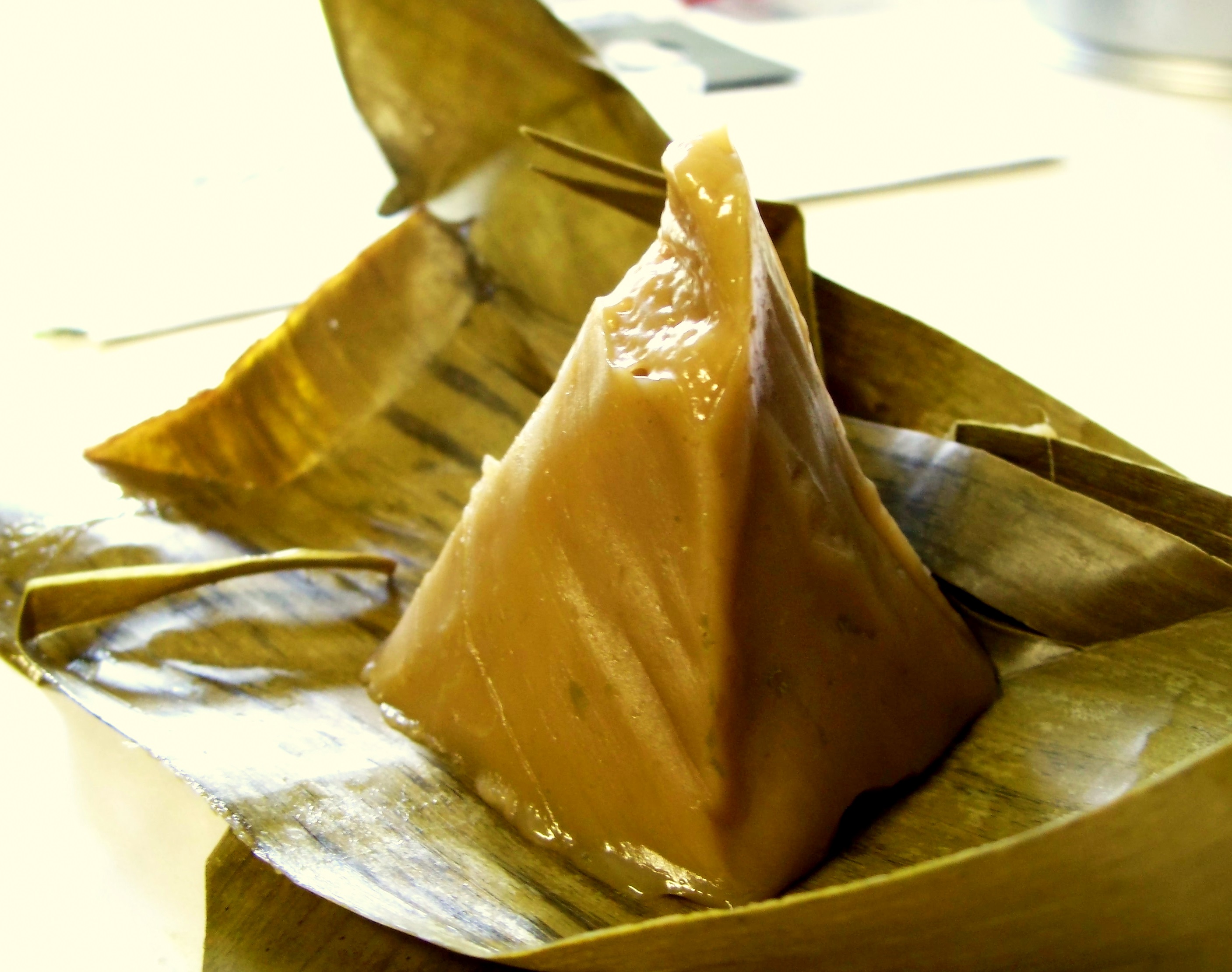
It’s a very simple name: banh it (it literally means “few” or “a little”, banh in Vietnamese is a term used for anything made of any kind of flour, in any shape and size, cooked in any way imaginable, so “cake,” “pastry”, “pie,” “bread,” and similar terms are not equivalent translations, in fact I’m still looking for a correct corresponding term). I digress. This banh it we got from Gio Cha Duc Huong (Bellaire Blvd, Houston) has a pyramid shape, similar to the ones I’d had in Saigon. Once again I don’t know how the banh maker can shape these things up in banana leaves, and an American bonus, cling wrap.


They’re certainly not ancient world’s wonder, but they’re quite resilient, at least against my attempt to dissect and take a picture of the interior.


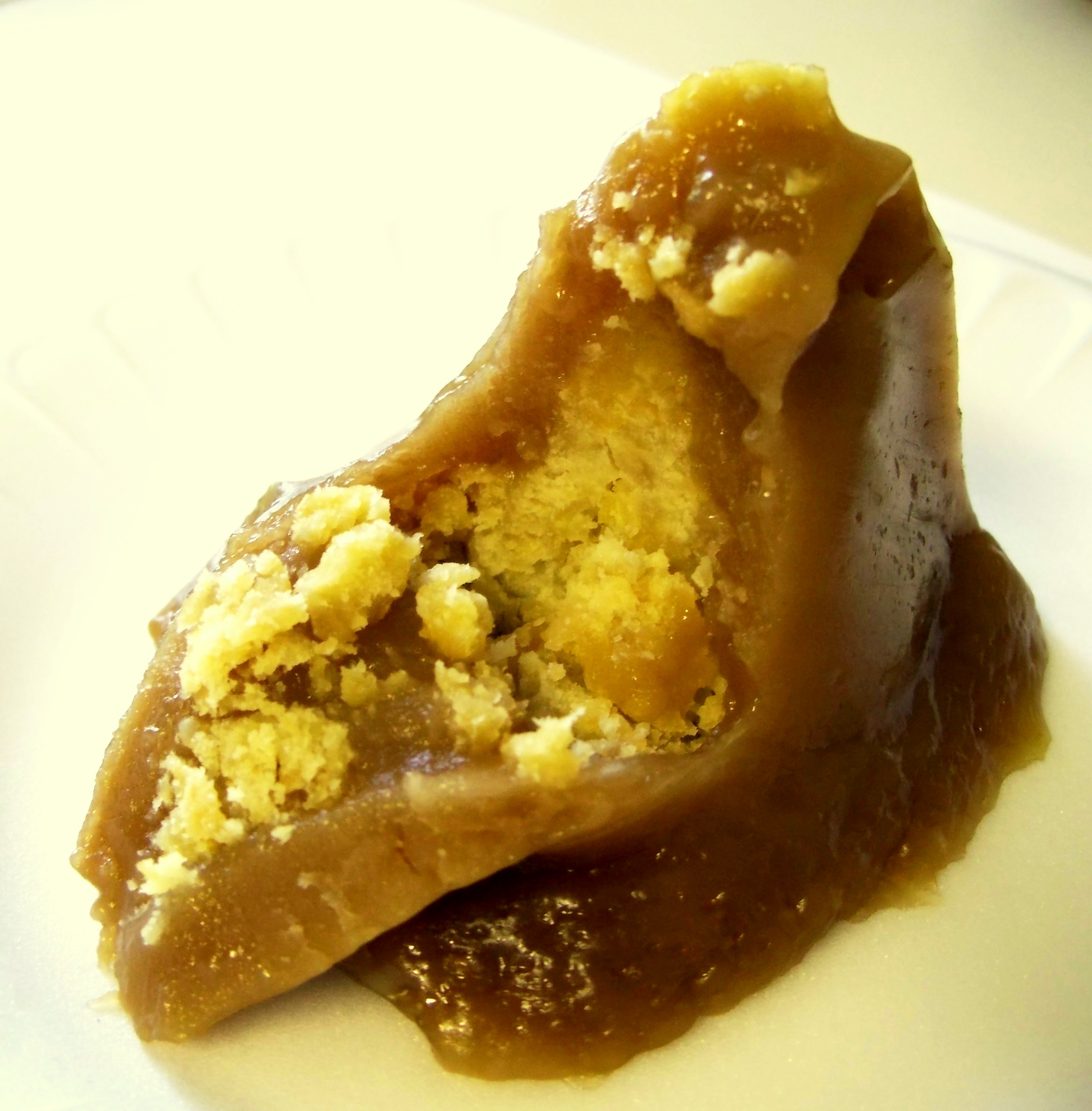
It is as simple as a child’s treat can be. A clump of mung bean paste concealed by a layer of sticky rice flour. I believe brown sugar is added to the dough to make the color. (Update: indeed there is sugar, but I’m pretty sure there is no la gai in this little one.) The mung bean paste is also a little sweetened, but dry and scrumptious to the extent of powdery (so yeah, not really a “paste”). The dough coat is, you guess it, sticky. And a little plain if, at all possible, eaten without the bean paste. I enjoyed the mixing of texture in my mouth, mostly because of the filling’s nuttiness. The pyramid is only about 4 inch high and at most 9 square inch at the base, but it hits you hard and sound in the tummy. It is powerful. It makes me wonder about Vietnamese children. If these are their snacks, how come they’re so skinny? I suppose because it’s just sticky rice, bean, and very it sugar. Last note: if you want to savour food with your hand like a good traditional Indian, be prepared for some meticulous finger rubbing with soap and water, it sticks with you.

Bánh giò – Boiled pork rice pie

September 29, 2008 By: Mai Truong Category: Comfort food, Houston, Northern Vietnamese, One shot, savory snacks, Texas, Vietnamese


Instead of choosing among a few dozen types and brands of cereal, the traditional Vietnamese children choose among a few dozen kinds of stuff made of rice flour and often containing meat for the morning energizer. Meat and rice in the morning, what? You must be be kidding… Well… we have breakfast croissant, breakfast burrito, breakfast sausage and cheese biscuit, sausage and cheese kolache, pancake with sausage and/or bacon and definitely butter, and probably more things out there with meat and dairy. The only difference is rice and wheat, but unless you count your calorie intakes and all, grain is grain.

Banh cuon certainly doesn’t have any cheese or butter in it. I’m still waiting for the day McDonald comes up with MacBanhCuon (MaCuon, maybe?), then banh cuon will have cheese, egg, sausage, and bacon, probably pickles too, but I think the flour sheet is too delicate to be mass produced like the buns. Anyway, I digress. My schooldays back then often started with pho, hu tiu (a noodle soup with pork instead of beef and slightly sweet broth), banh cuon, and occasionally when I was young we had banh gio. There’s not much I could remember about it because it was rare to find a street vendor with trustworthy cleanliness, and it was rare, if ever, to find a store selling banh gio. Yes, it is almost exclusively street food, until it gets to America.


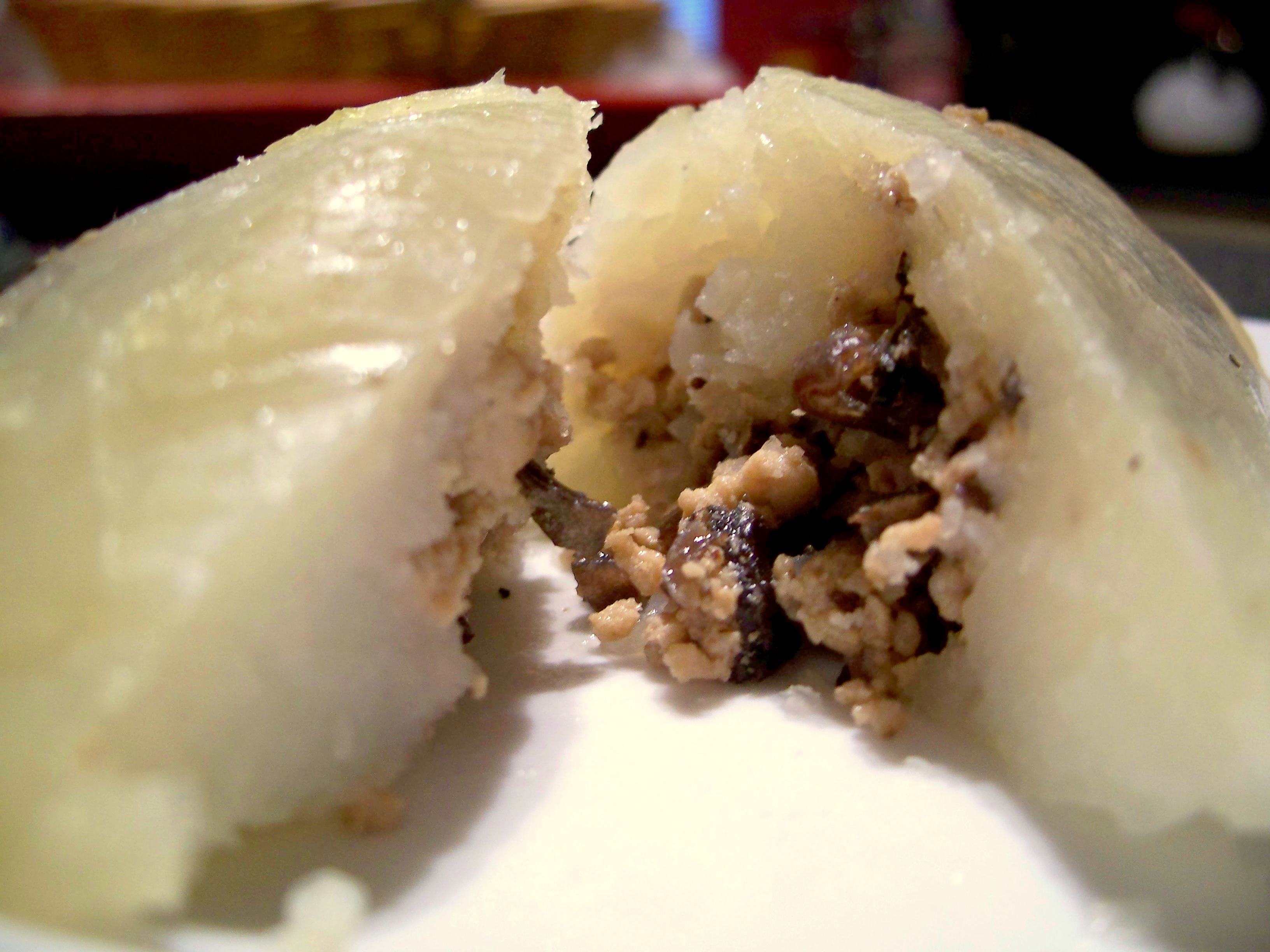
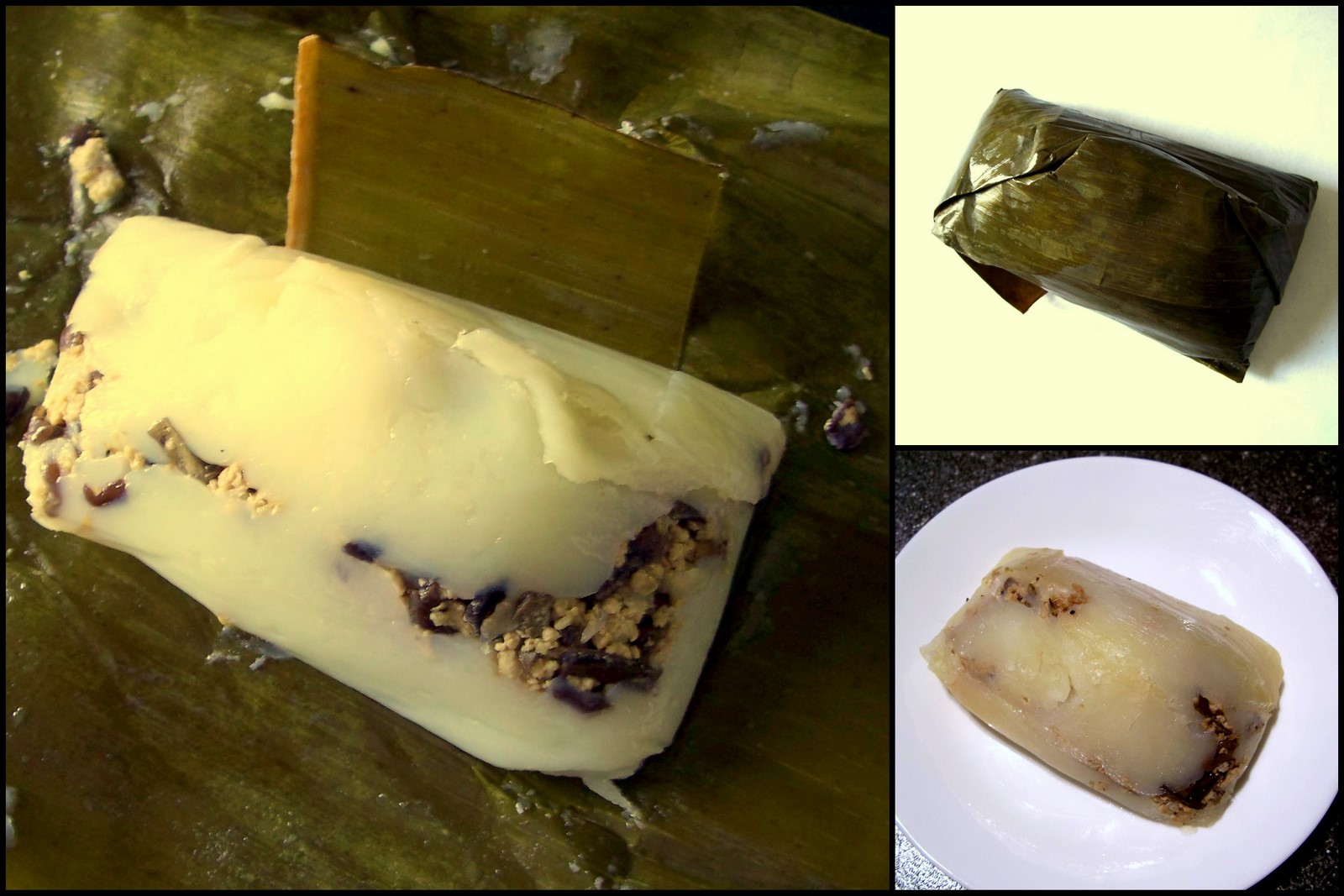
We got our banh gio from a small food shop in Bellaire, downtown Houston, named Gio Cha Duc Huong. A triangular cylinder is its basic shape, a thick coat of rice flour with ground pork and minced woodear mushroom inside, with a little bit wandering too close out to be visible. In all splendor the banh gio is a coarser, thicker, chubbier, more stern and fulfilling version of a roll of banh cuon. I know what it is made of, and I know it is boiled, but I have no idea how they put the liquid mixture of rice flour and water outside a few spoonfuls of meat stuffing to form a pudding wrapped and cooked in banana leaves. The flour coat is bland, but the stuffing makes up for it just right. No condiment is needed, and I don’t know if it has ever been eaten with any kind of condiment. The whole package is somewhat like a student who just pulled an allnighter, rather easily shattered and just collapses in your mouth. A spoon would be much more useful than a fork, and I can’t imagine using chopsticks with this. But its endurance is remarkable: it was made and cooked the same day we bought, it stayed good in the fridge three days later, and its twin brother stayed good one day later at room temperature.

Banh gio is a kind, guileless meal. Unless you eat 3 in one sitting or something oversize like that, it won’t make you feel like carrying a stone around the rest of the day. Its lightness will never betray you.

Sold at most banh mi stores in the States.