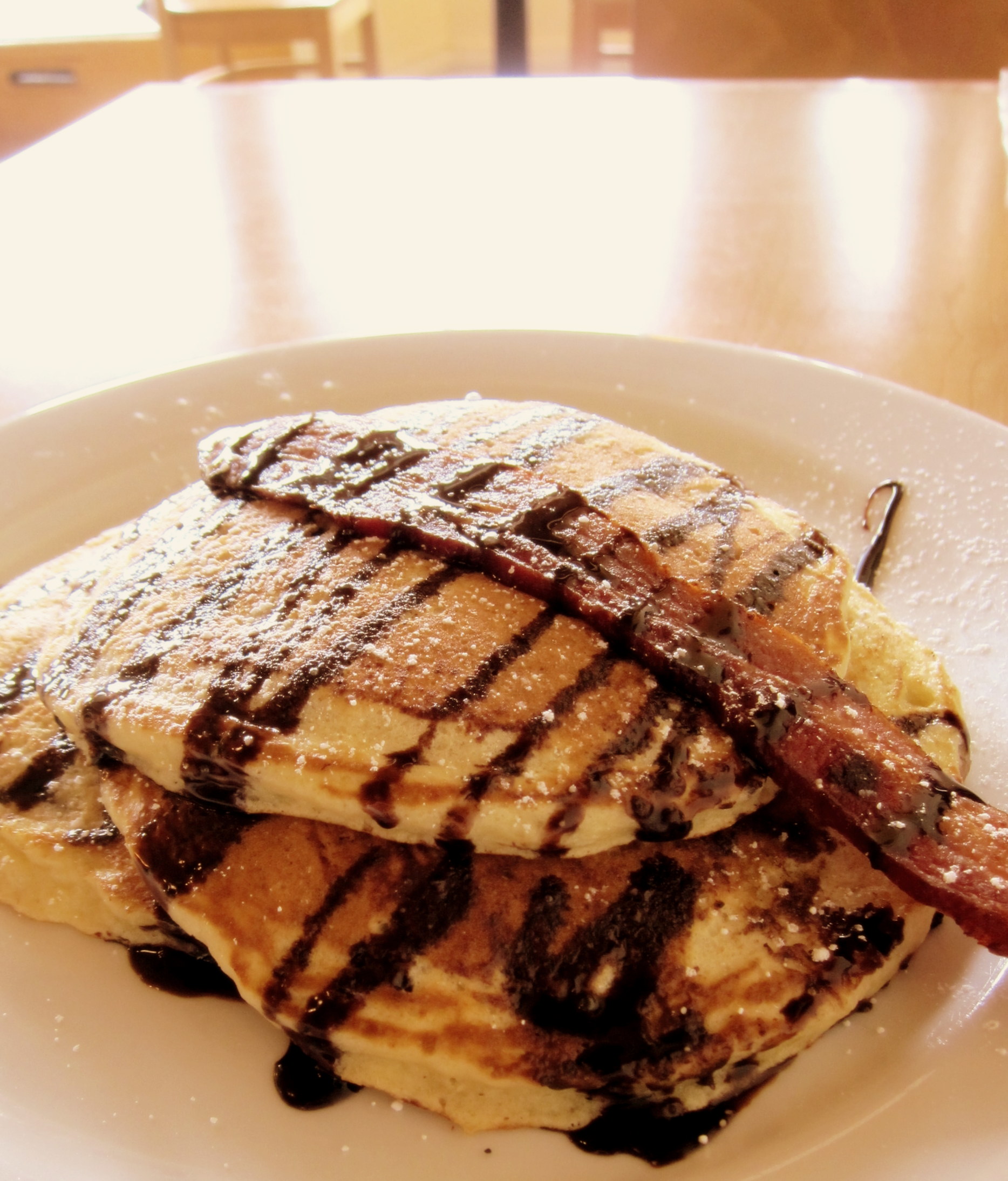
The sky is grey. The ipod plays Gustav Mahler’s piano quartet in A minor. One hand turns the page to Der Prokurator. The other hand maneuvers the fork into a stack of three pancakes. Oozing chocolate chips and a thick strip of bacon.
Bistro 1491 sits, in fact, at 1491 Solano Avenue. Somehow I keep thinking that the name is 1941. It feels so. The burn orange walls, the abstract paintings, the white-haired ladies by the window.
The pancakes are fluffy, soft, good at first, the bacon is at the right saltiness. The maple syrup errs on the watery side, or maybe it’s just overwhelmed by what’s supposed to be dark chocolate but turns out too sweet. About 60% dark. A heavy feel sets in after the pancakes are gone, what’s left on the plate are messy streaks of brown chocolate and faint yellow syrup. It could almost make a hasty painting. But hasty does not suit this scene.
Address: Bistro 1491
1491 Solano Ave
(between Santa Fe Ave & Curtis St)
Albany, CA 94706
(510) 526-9601
Breakfast at noon: dark chocolate & bacon pancakes – $8.65
Dressed in black and white patterns from walls to chairs, FIVE spots a slightly older, more refined atmosphere for casual hotel dining just above the Berkeley BART station. I meant to go here after someone said that he finally understood the rave behind “chicken and waffle” after he had it during FIVE’s After Hour Happy Hour. If that dry white meat and cake-like bread at FIVE was that good, then surely the other things wouldn’t disappoint. Now nothing on the regular dinner menu costs 5 bucks like the Happy Hour (7-9 pm) nosh, but I got hungry before 7 pm, so I dashed in on what seemed to be a busy night. The hotel is hosting some conference. Nobody wanted to eat with me today, but one beauty of going alone is that you can always get a table.
That said, if you have a party of 4 or less and would like to raid FIVE, which you should, I have a FIVE Vip Card “valid for a 20% discount in FIVE” to give you. Here’s how to get it:
Leave me a comment below by midnight March 31, and if the number of comments is more than 1, which would make me ecstatic :D, then the winner will be chosen by a random number generator. The card is valid until July 31st, 2012. The winner will receive the card by mail or in person.
Here’s why you should eat at FIVE:
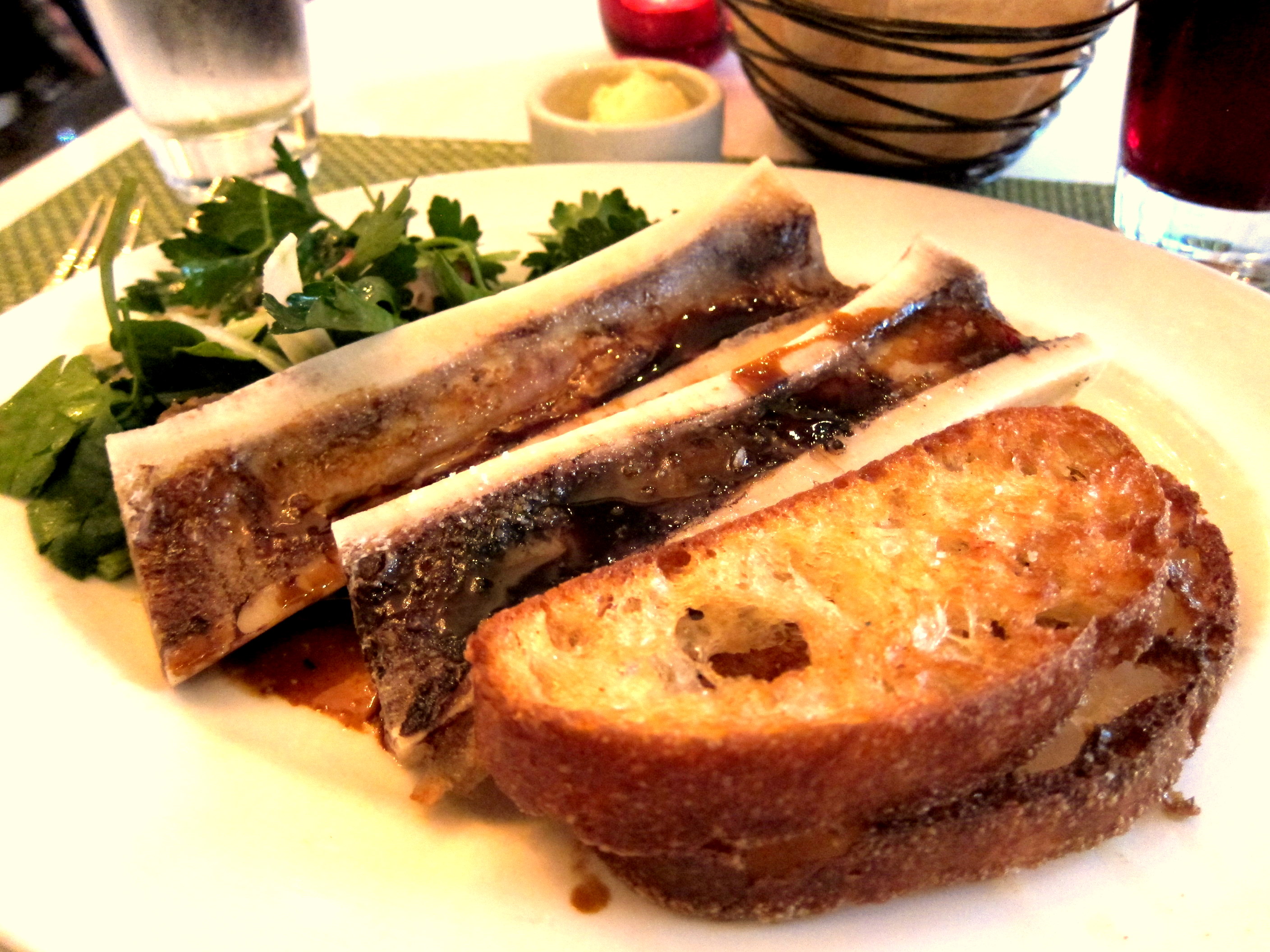
Appetizer: roasted bone marrow on crunchy fried bread with parsley and pickled shallot salad ($9). The bone marrow is rich and fatty, as expected from a cow leg bone. The salad is dressed in a light bordelaise, sweet, taut, and feisty. The fried toast is a guilty pleasure.
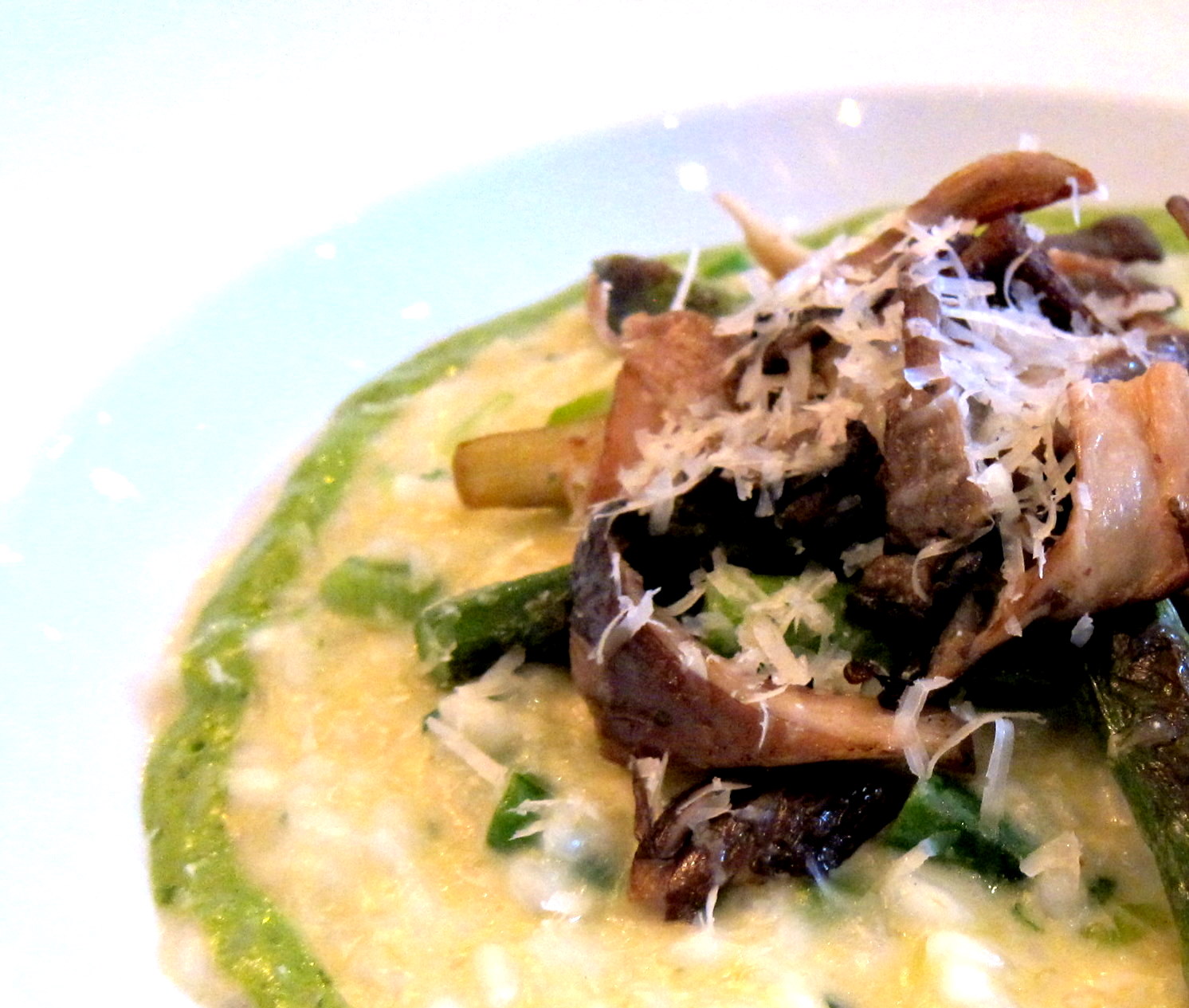
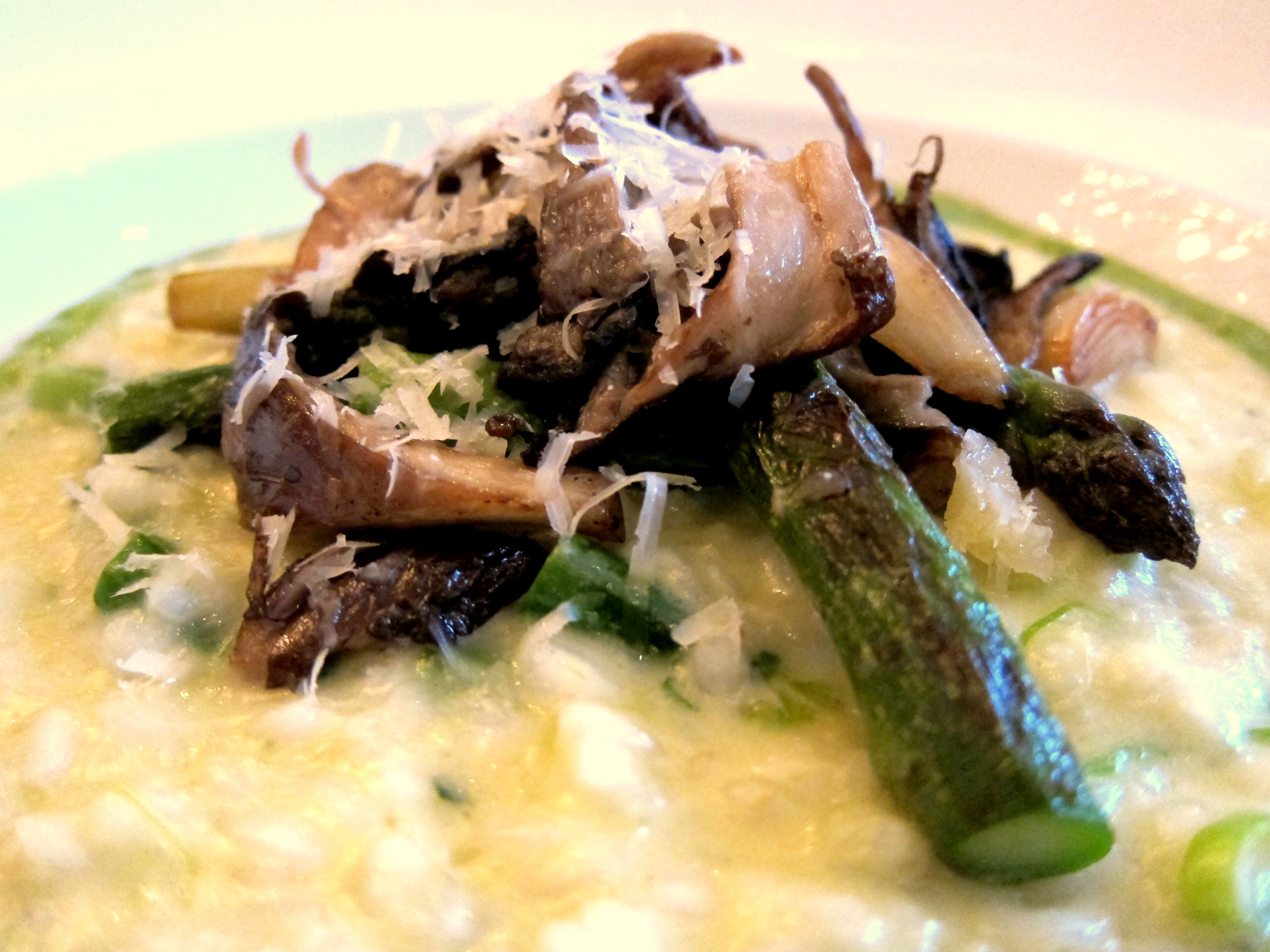
Main: creamy green garlic risotto with grilled asparagus, oyster mushroom, shallot, and pesto aioli ($16). The ladies next to me got the prix fixe, which also featured this risotto with shrimp, and they kept complimenting how good it was. The charred, salted touch of the vegetables is the highlight.
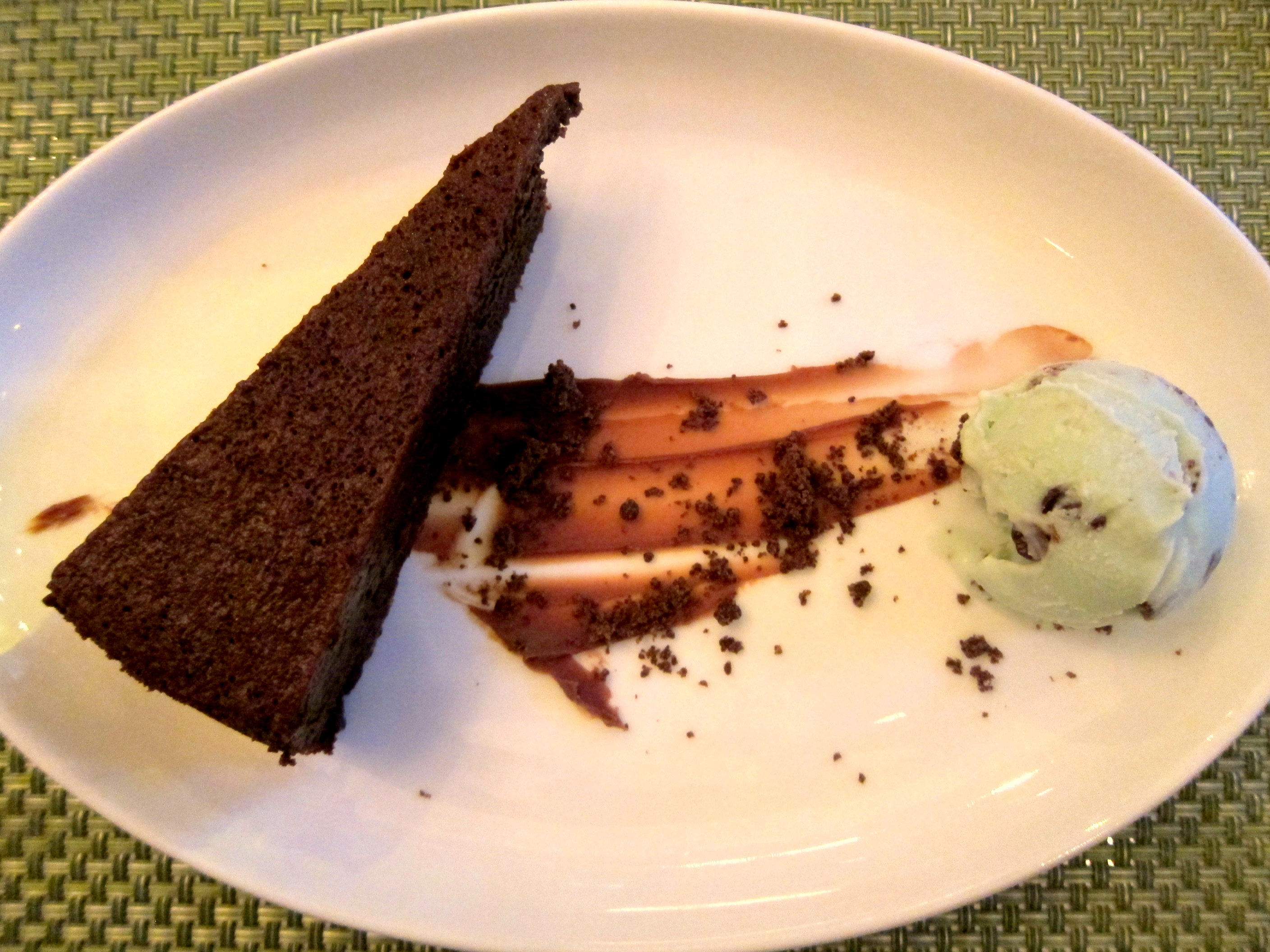
Dessert: dark chocolate torte with a milk chocolate ganache and mint chocolate chip ice cream ($8). I asked my server what was the least sweet desserts tonight (the other choices were butterscotch pudding, walnut carrot cake, and coconut cream pie), and he suggested this torte. It is rich, but it is indeed not too sweet. My only complaint is that the ice cream scoop is too far away from the cake, making it difficult to get both cake and ice cream in one bite. At the end, I had a puddle on my plate.
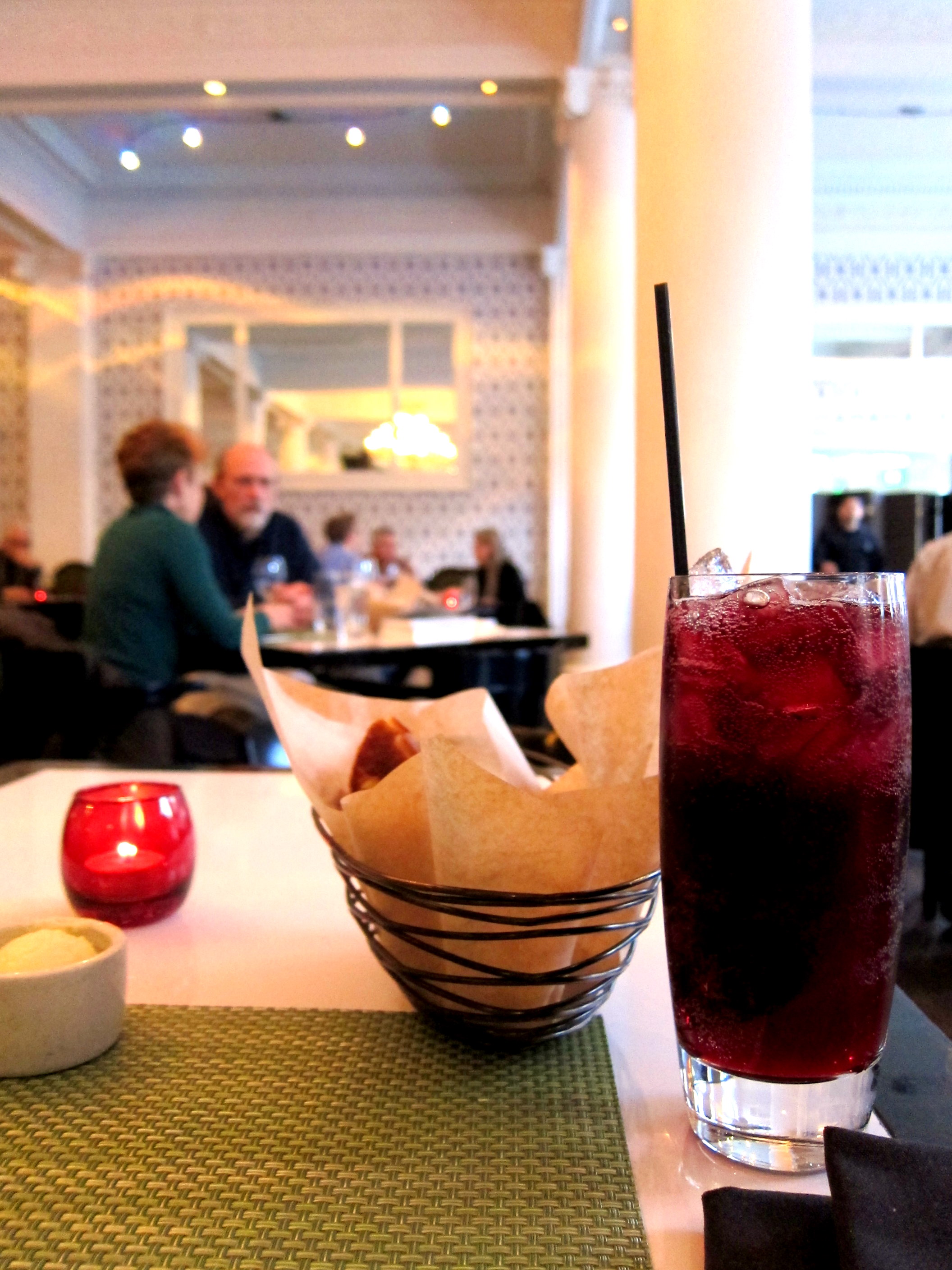
The starter bread is crunchy on the outside, soft and airy on the inside, and perfect without butter. Now that I think about it, FIVE must be quite good with breads: waffle, starter bread, and the fried toast with bone marrow are proof. Because the restaurant had run out of pear sparkle, I might have made a mistake ordering the blood orange sparkle instead of the apple kind; I also chose the pretty simple stuff, nonetheless, it was a pleasing meal. So the more interesting things like monkfish wrapped in prosciutto or herb roasted pork loin might be even better. 😉
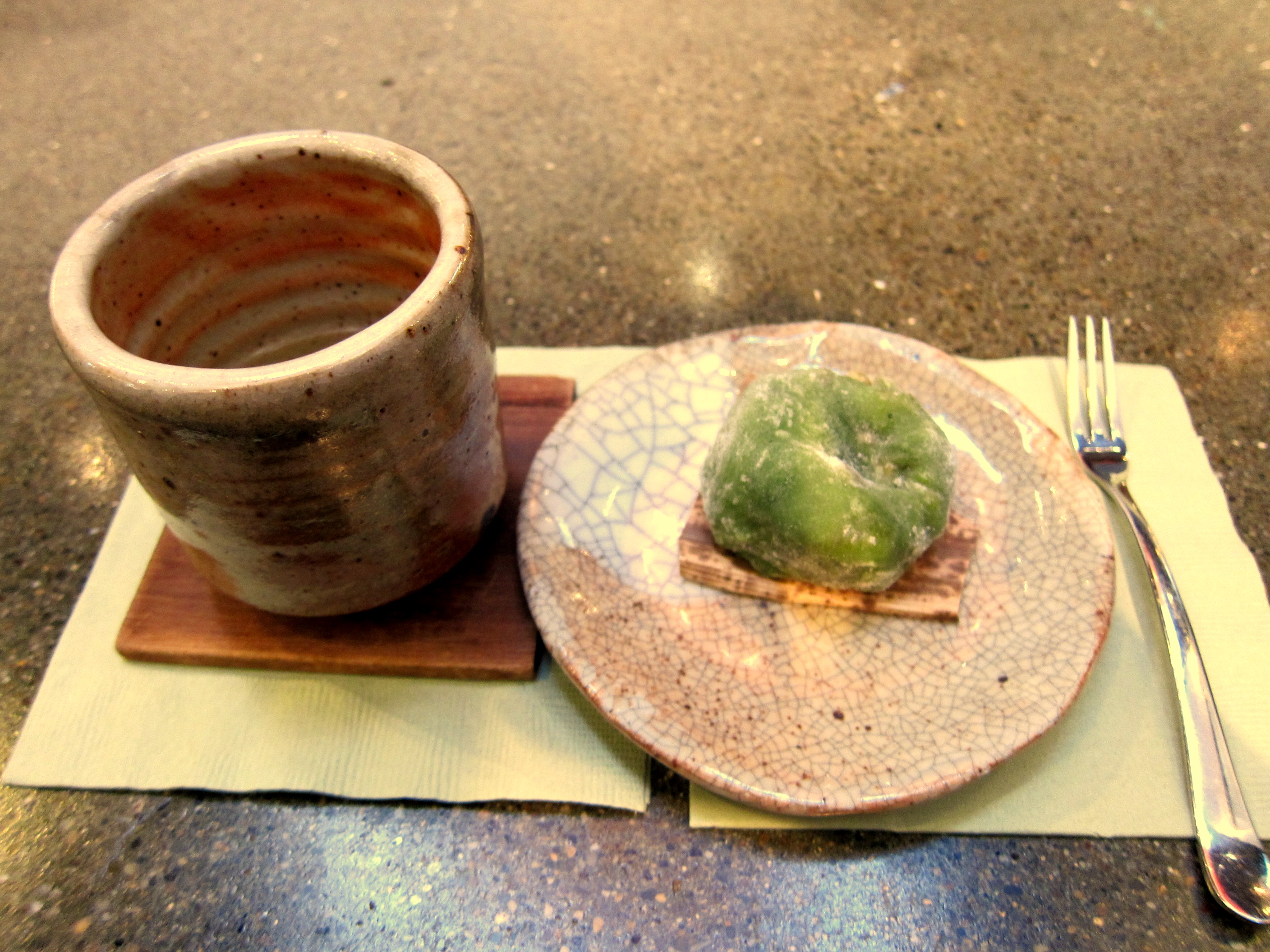
Sencha in yunomi, a typical Japanese thick, tall teacup, whose name I’ve yet to find out, accompanied by a matcha mochi, whose fillings include: satsuma sweet potato, red bean paste, orange juice and walnuts. (Thanks Masaaki for telling me the name of the cup in Japanese.)
The mochi, handmade and delivered by a mochi lady every week to Teance, is refreshing both in look and in taste. The green tea flavored chewy coat is cool and light. The filling, although dominated by red bean, is not too sweet. I opted for one with less nuts because I didn’t think that I would want such contrast in texture. The mochi lady is a small, timid Asian lady, who smiled so happily when I described her mochi as “refreshing”, and who showed me that I should dip my fork into tea or water before cutting the mochi so that it would not be sticky. Yes, it worked, the fork went straight through with such ease. Now it makes sense why we can chew without the mochi sticking to the teeth.
This is my second time having sencha, if we don’t count the time I had genmaichaat Ippuku (genmaicha is lower-grade sencha with roasted rice), and the seaweed taste of sencha has grown on me. However, I am not convinced that the sencha is a good match for the mochi. Both are good by themselves, but I think the sencha should be an entree tea, not a dessert tea. Its seaweed taste would enhance something savory. A mochi would fare much better with a light, floral tea that isn’t too dry, like Yellow Gold, Royal Courtesan, or Darjeeling First Flush.
Sidenote: this sencha at Teance is the hand-picked Yakichi sencha, named after the farm “founded by Mr. Shimooka[…]. Yakichi sencha is an eight-time Ministry of Agriculture award winner, and also the winner of the highest agricultural award, the Imperial Prize. […] This traditional Japanese tea is shade grown (kabuse) in the mountains above Uji.” (description from Teance webpage)
Meghan explained to me that shade grown leaves are of higher quality because when the plant is shaded, it has to produce more chlorophyll to balance the lack of sunlight, resulting in a greener leaf (or maybe a darker green leaf?). According to The Tea Detective, “the increased green chlorophyll pigment changes the natural balance of caffeine, sugars, and flavanols in the leaf. It also increases L-theanine, an amino acid found naturally in tea, that adds a unique vegetal quality to the flavor, and helps counteract some of the stimulant effects of caffeine, thus having a relaxing effect on the body, yet an alert state of mind. Photosynthesis reduces L-theanine and increases tannins, the compounds responsible for teas astringency.” Basically, kabuse (shade grown tea) is sweeter, less bitter, and less dry.
Address: Teance Fine Teas Store
1780 Fourth Street
Berkeley, CA 94710
510-524-2832
Money matter: the mochi is $4 each. A little pricey, but somehow it seems reasonable to me.
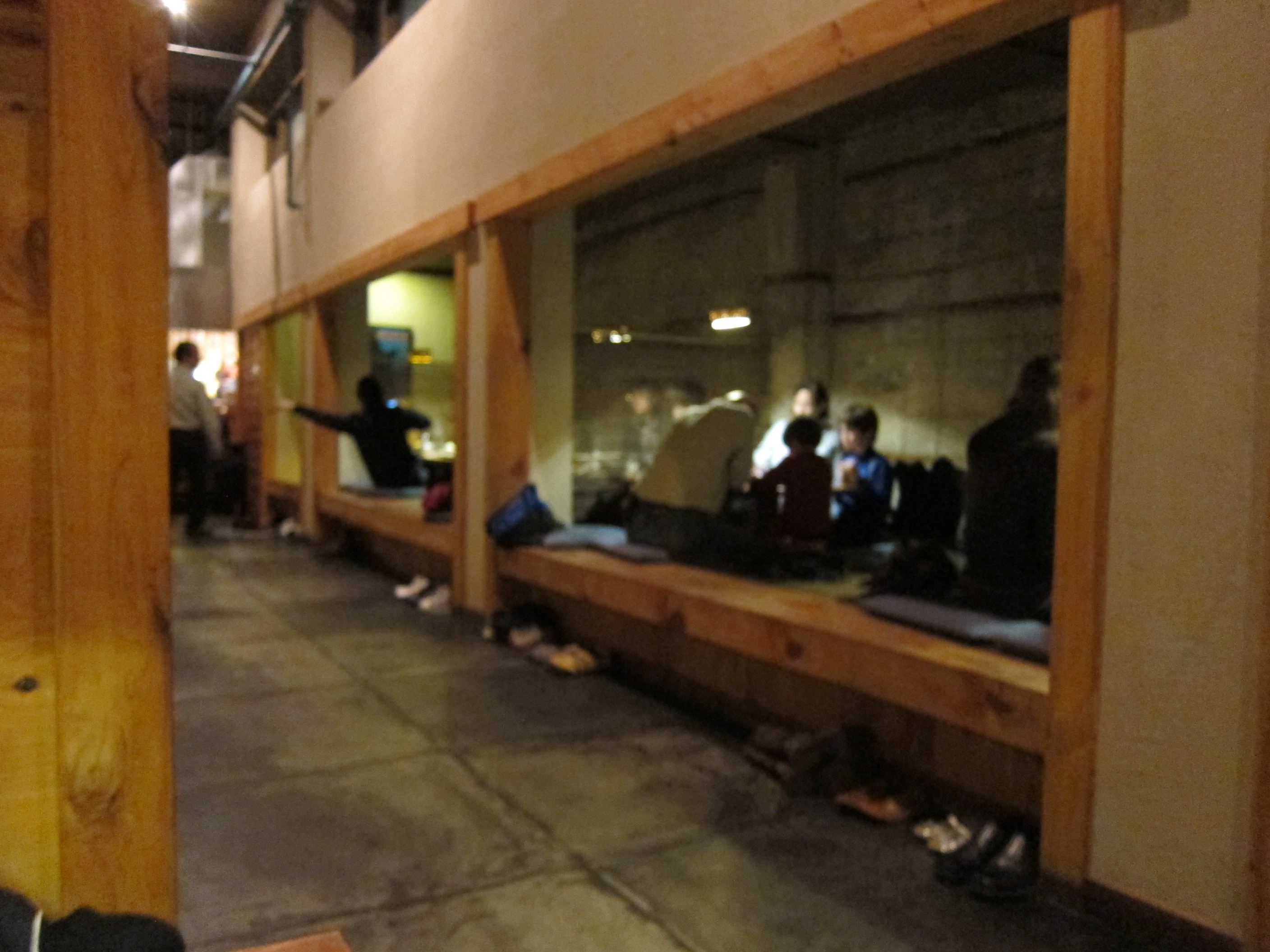
Maybe it’s the signless entrance that camouflages the izakaya in the dark, minus the dimly lit sake bottles on the side and the closed door, which I can never open correctly from the inside. Maybe it’s my distrust of Yelp reviews. But I brushed through the cotton curtains to enter that long, dark, narrow, stark simple structure, saw the half-shadowed faces immersed in quiet enjoyment, and the wooden platform, on which you can sit seiza style (flat kneeling) or dangle your feet under the table like a true Westerner; from that moment, I decided that it’s a lovely place, no matter how the food was. Of course, the food was good.
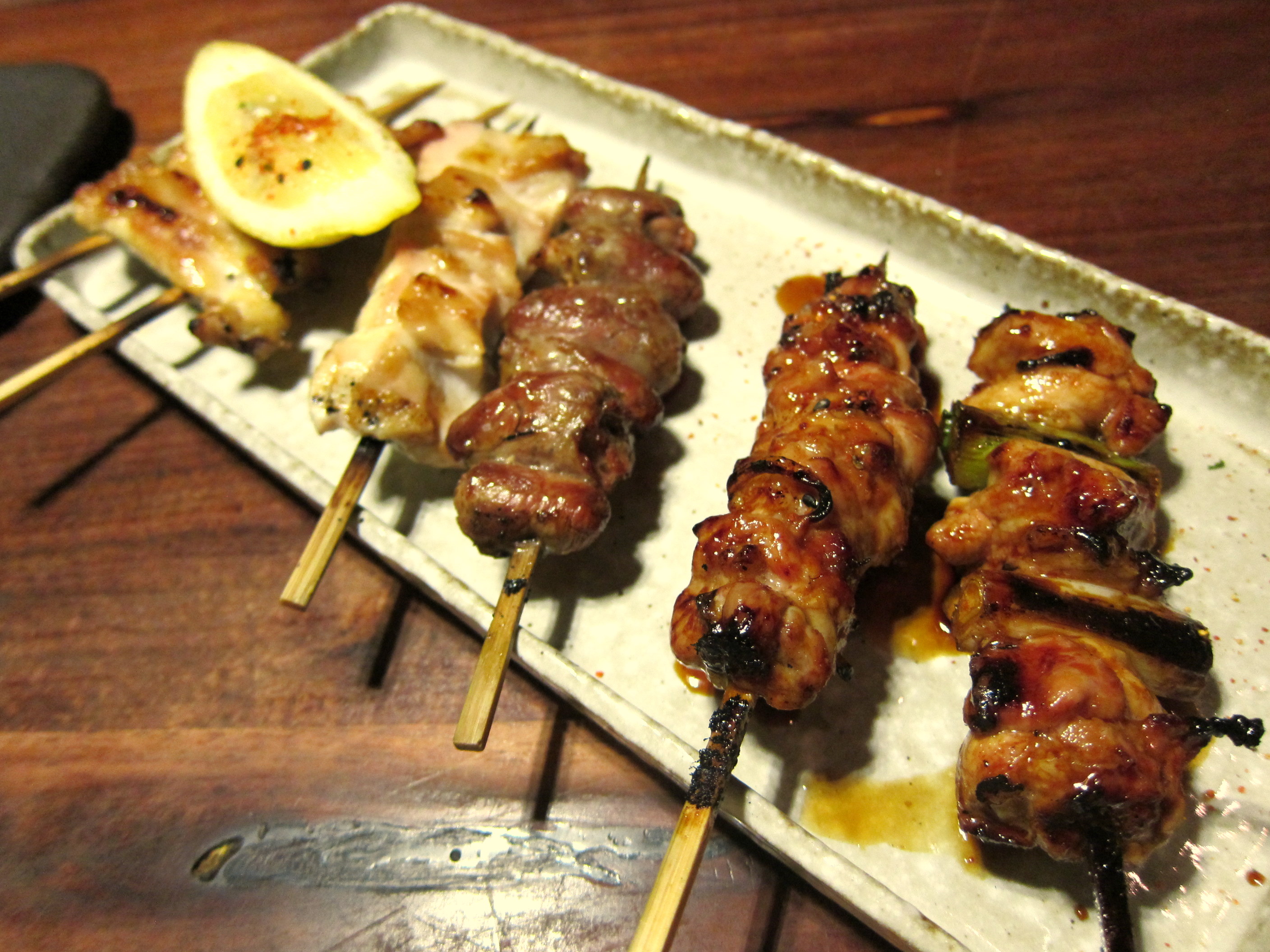
The most written thing about Ippuku must be the collection of all-part chicken edibles. Every single blog and its best buddies have something to say about (and a picture of) the omakase gushi ($14, 5 chef-choice skewers), which might include gizzards ($6.50), hearts ($6.50), shoulders ($6), necks ($6.50), breasts ($6), wings ($6.50), thighs ($6), tails ($7), varying throughout the night. They also have knee cartilage ($7) and breast cartilage ($7), which gets sold out before 6 pm. Growing up, I’ve had my shares
of chicken from head to toe to bone marrow, and I still clean the chicken bones to its dryest whenever possible, so this is old game. It’s not that “Ippuku uses every part of the chicken to its best effect”, Ippuku simply uses every part of the chicken and (hopefully) convinces the Western palate that white meat isn’t everything (if it is anything). The chewy crunchy gizzards and hearts made me feel at home.
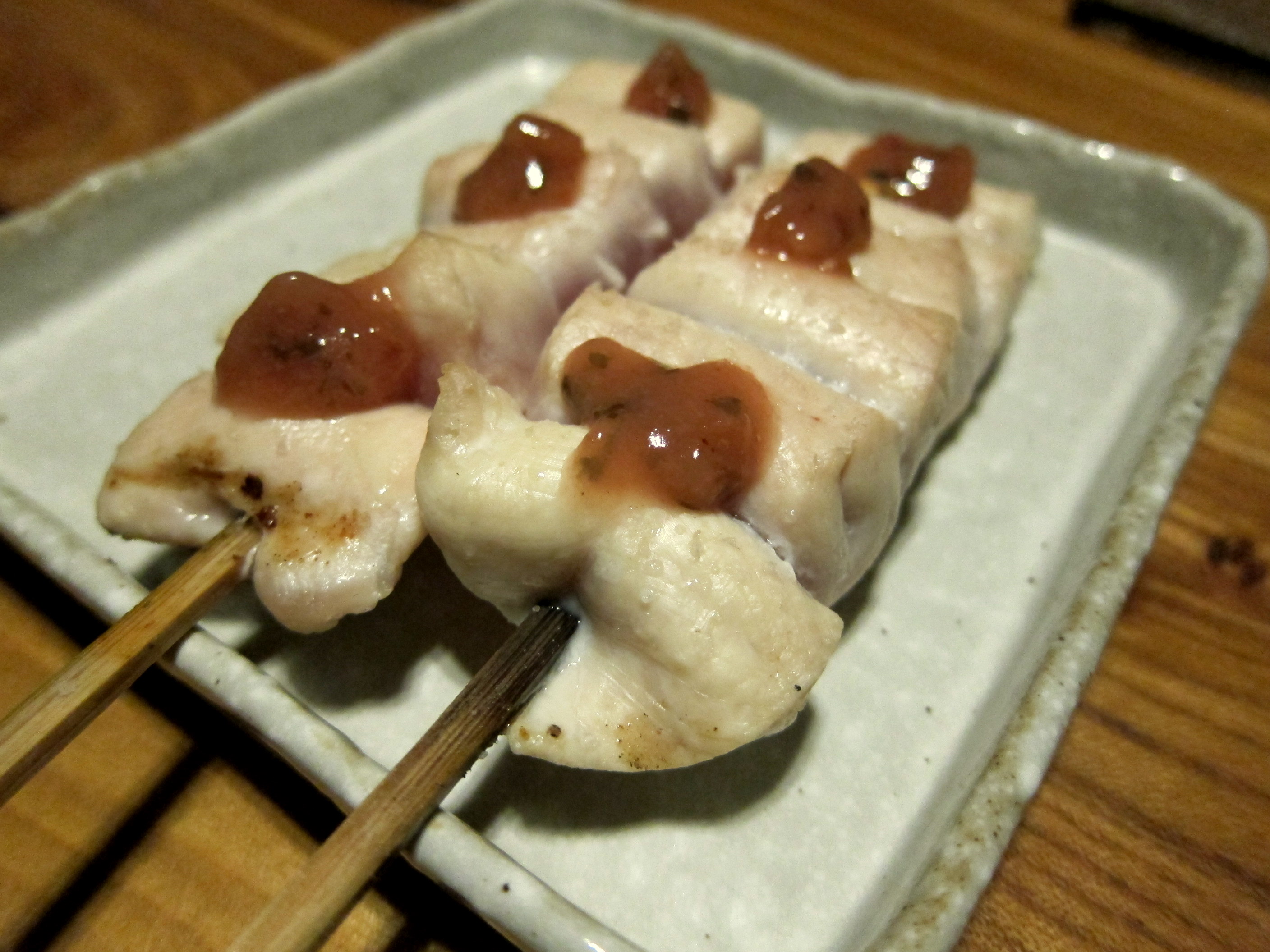
New to me was the lightly seared chicken breast, raw inside, dappled with ume ($8, sasami ume). Its rawness saves the white meat from being all dried up, the salty plum tickles the tongue. I like it more than I expected.
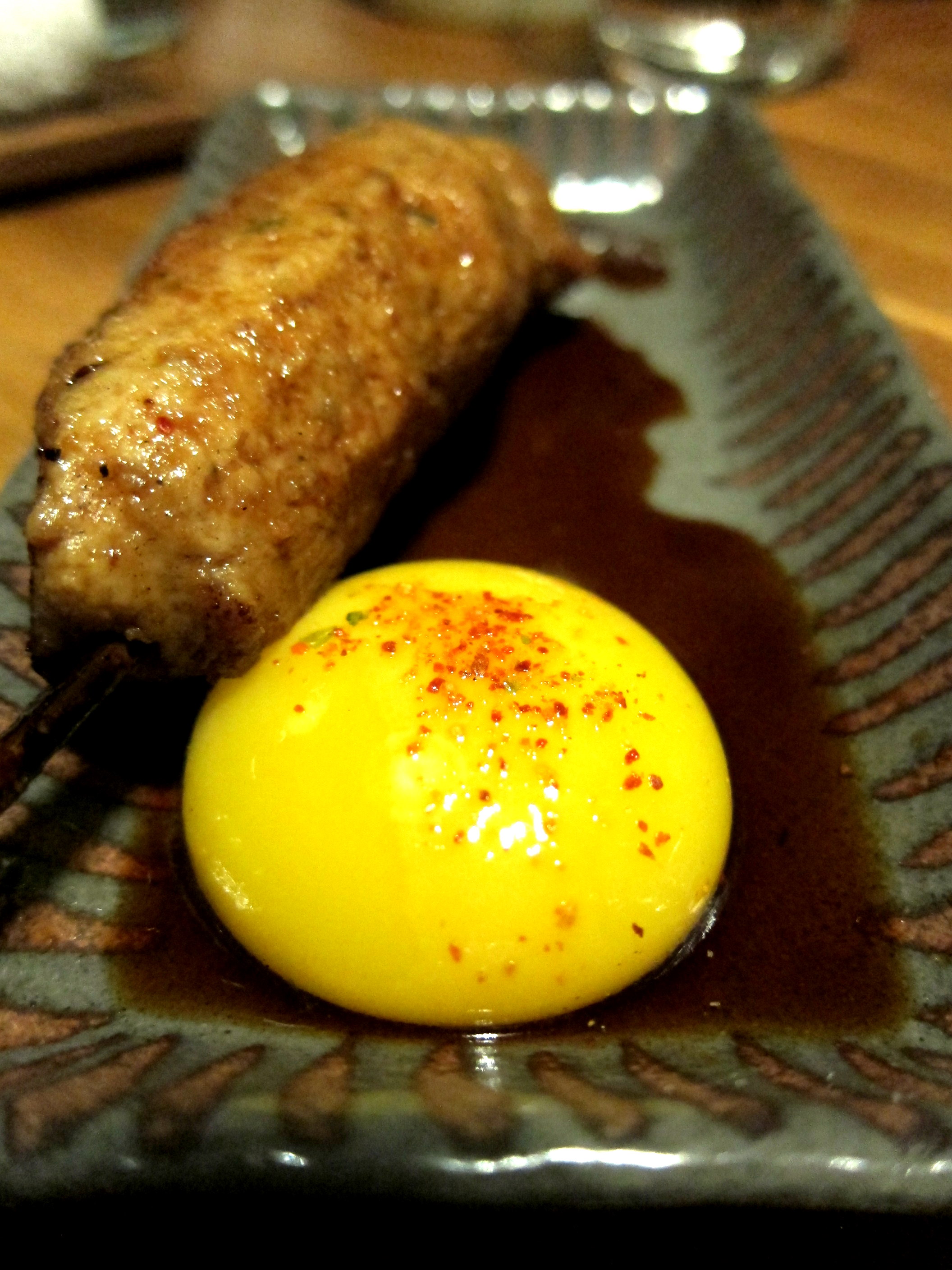
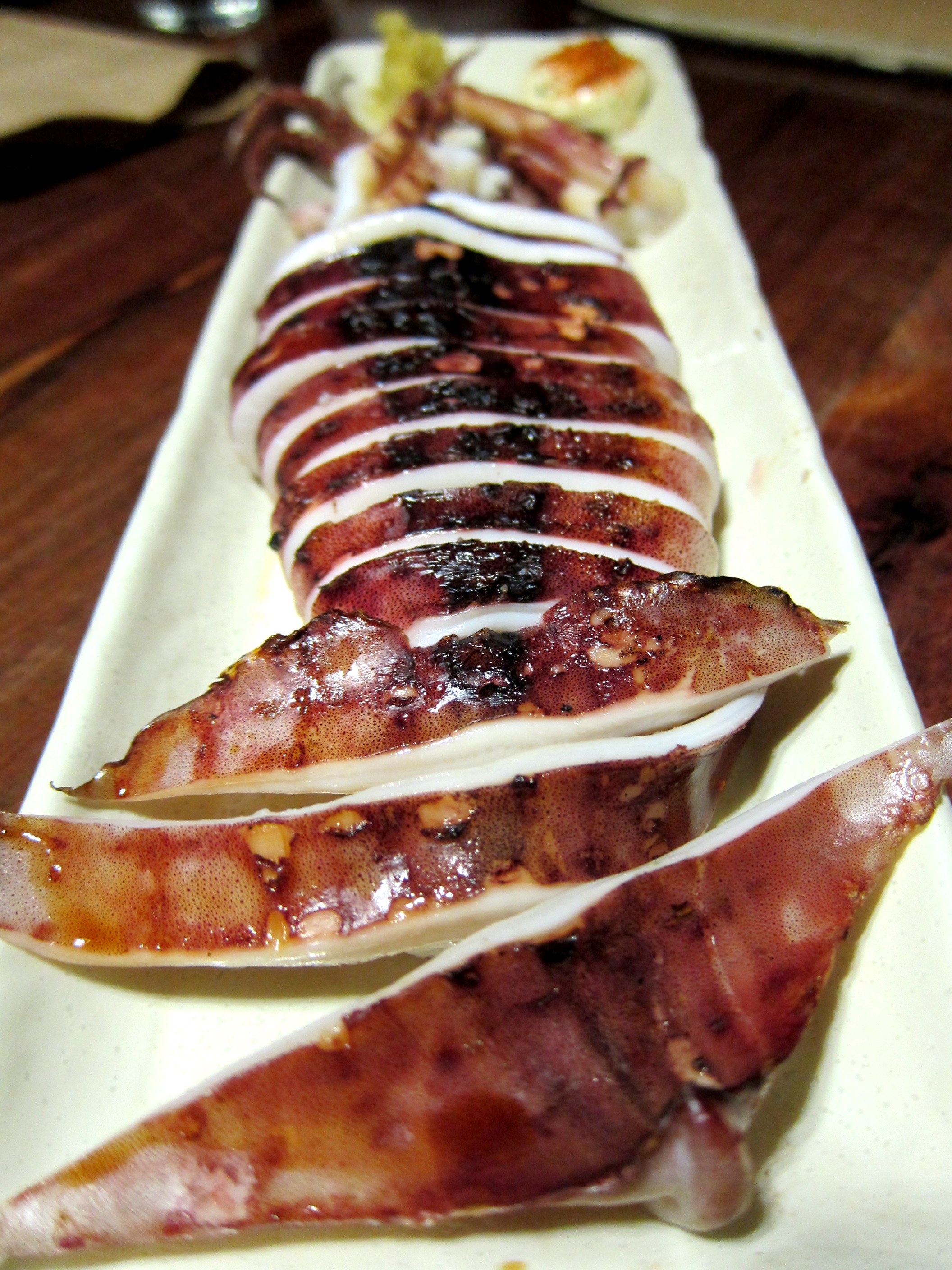
There are some good-but-not-brilliant things, such as the tsukutama ($7, minced chicken with an egg yolk), the negima ($6.50, chicken thigh with leeks), the aosa tenpura ($7, Okinawa styled seaweed tenpura), and the giant grilled Eastern Pacific squid ($10, ikayaki) (ok, so it was giant for 2 girls).
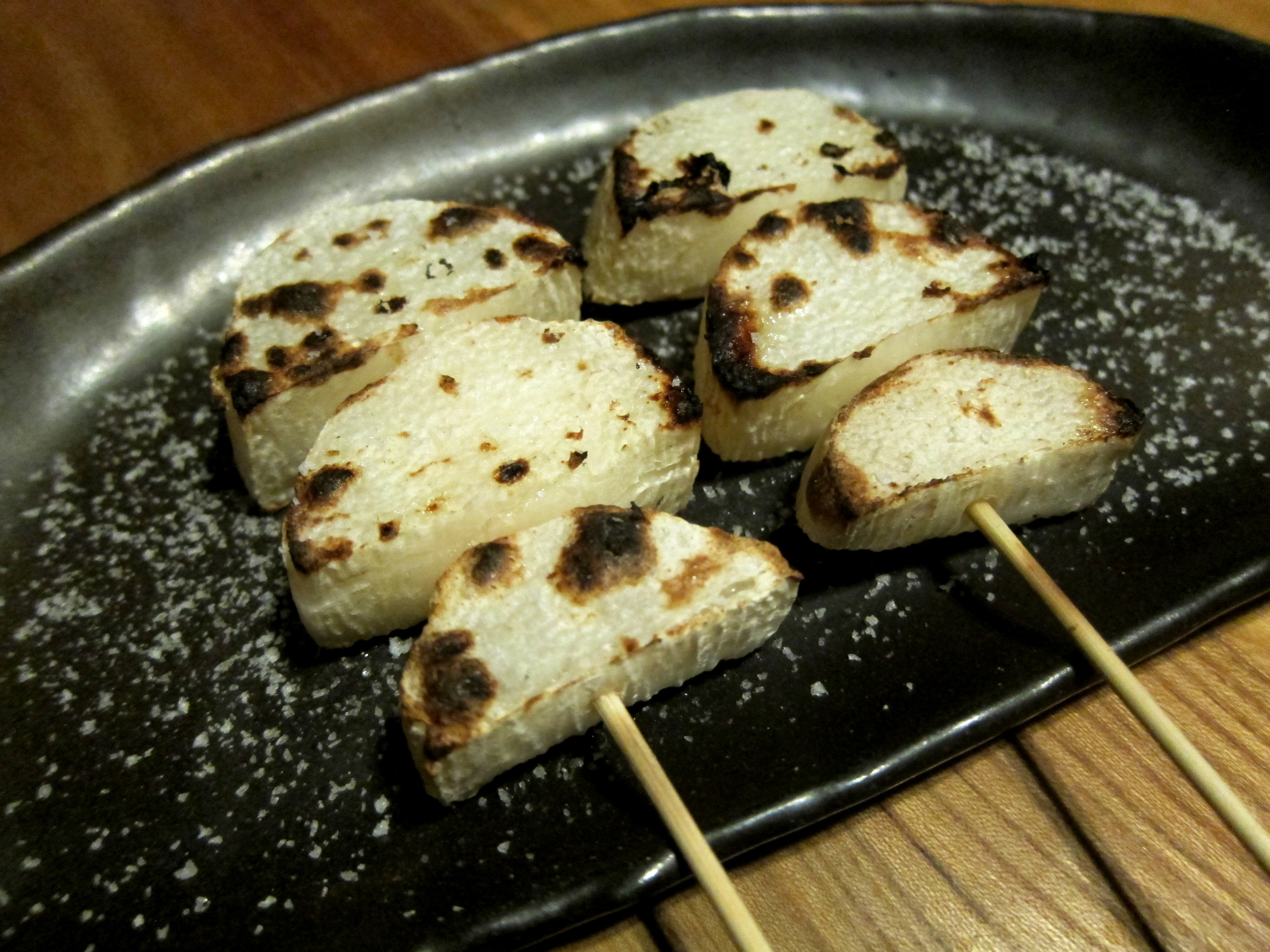
Granted that izakayas in the States are always expensive, there are also the blatant rip-offs: ikada ($5, grilled leeks), which is negi, and none of us knew what “negi” was at the time, or grilled yamaimo ($6), a white yam that is crunchy outside and sorta slimy inside (củ mài in Vietnamese). Oanh said that they’ve had it raw at another izakaya, and I think I would prefer this grilled version dusted with sea salt.
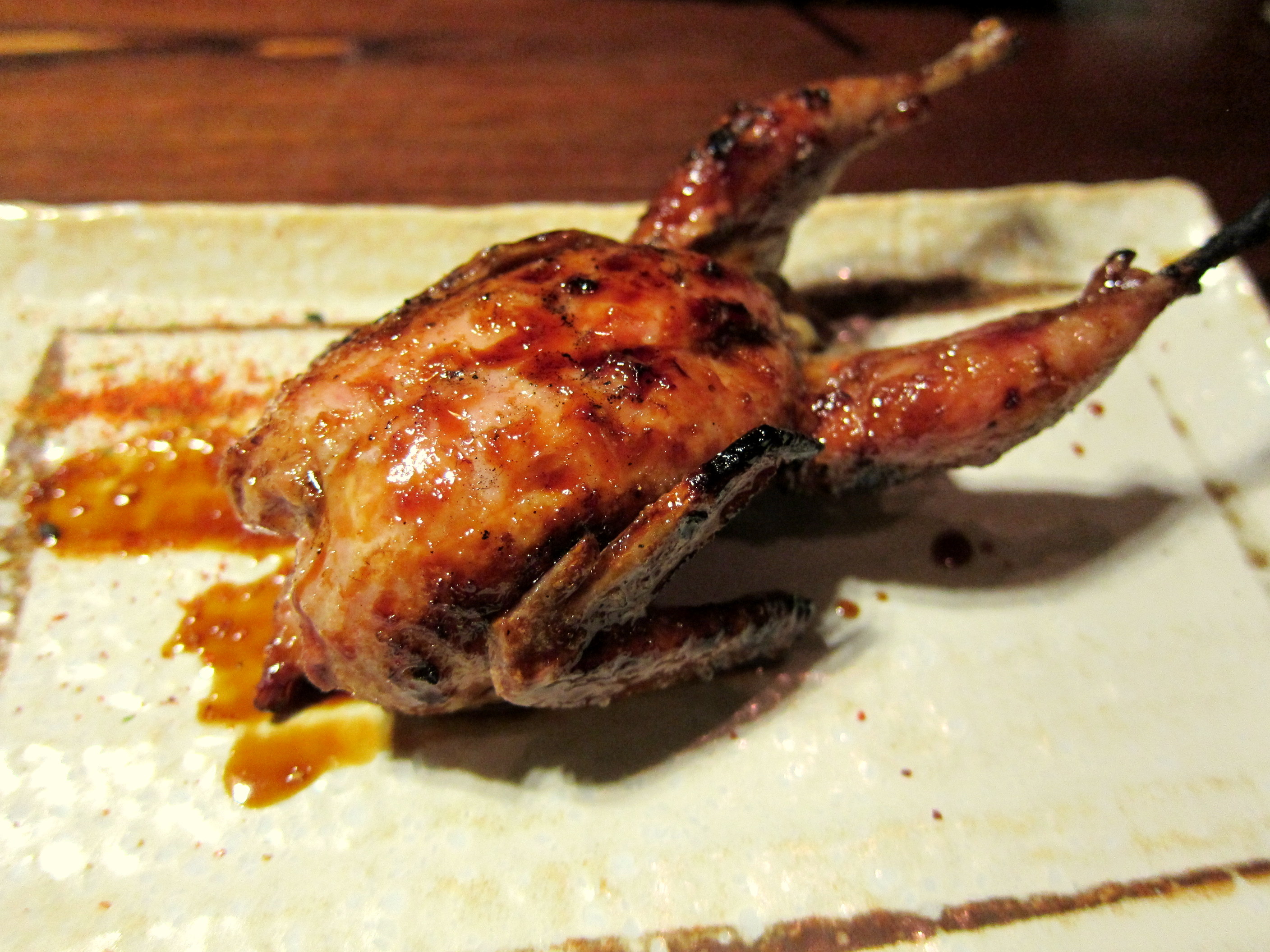
Then there are the oversalted ones: a juicy deboned and grilled quail ($10, uzura maruyaki), which Kristen and I split by each pulling a wing and a leg, and 2 pieces of pork belly ($8, kurobuta bara). But these are best tempered with a sip of genmaicha, whose seaweed flavor might seem strange at first.
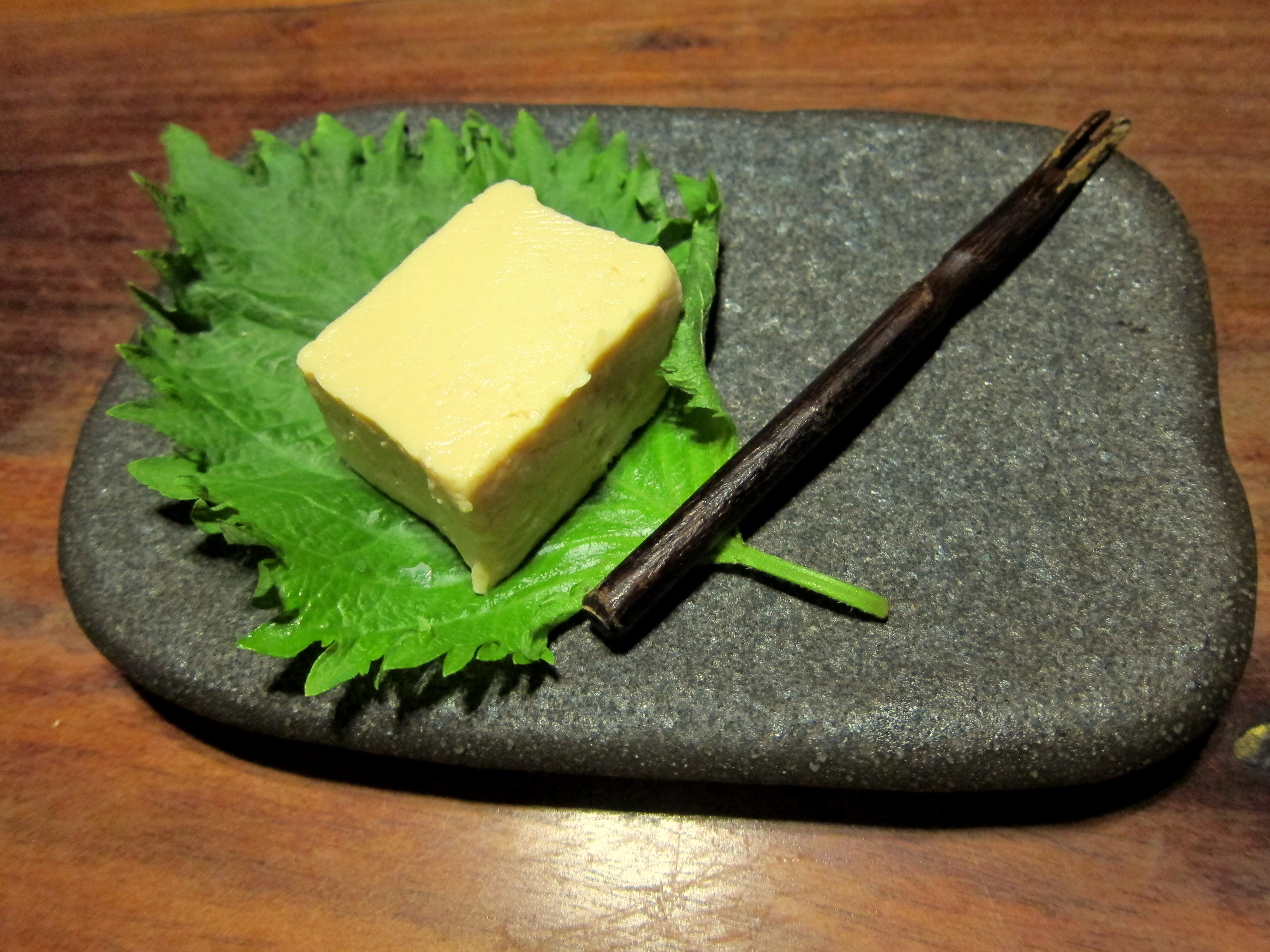
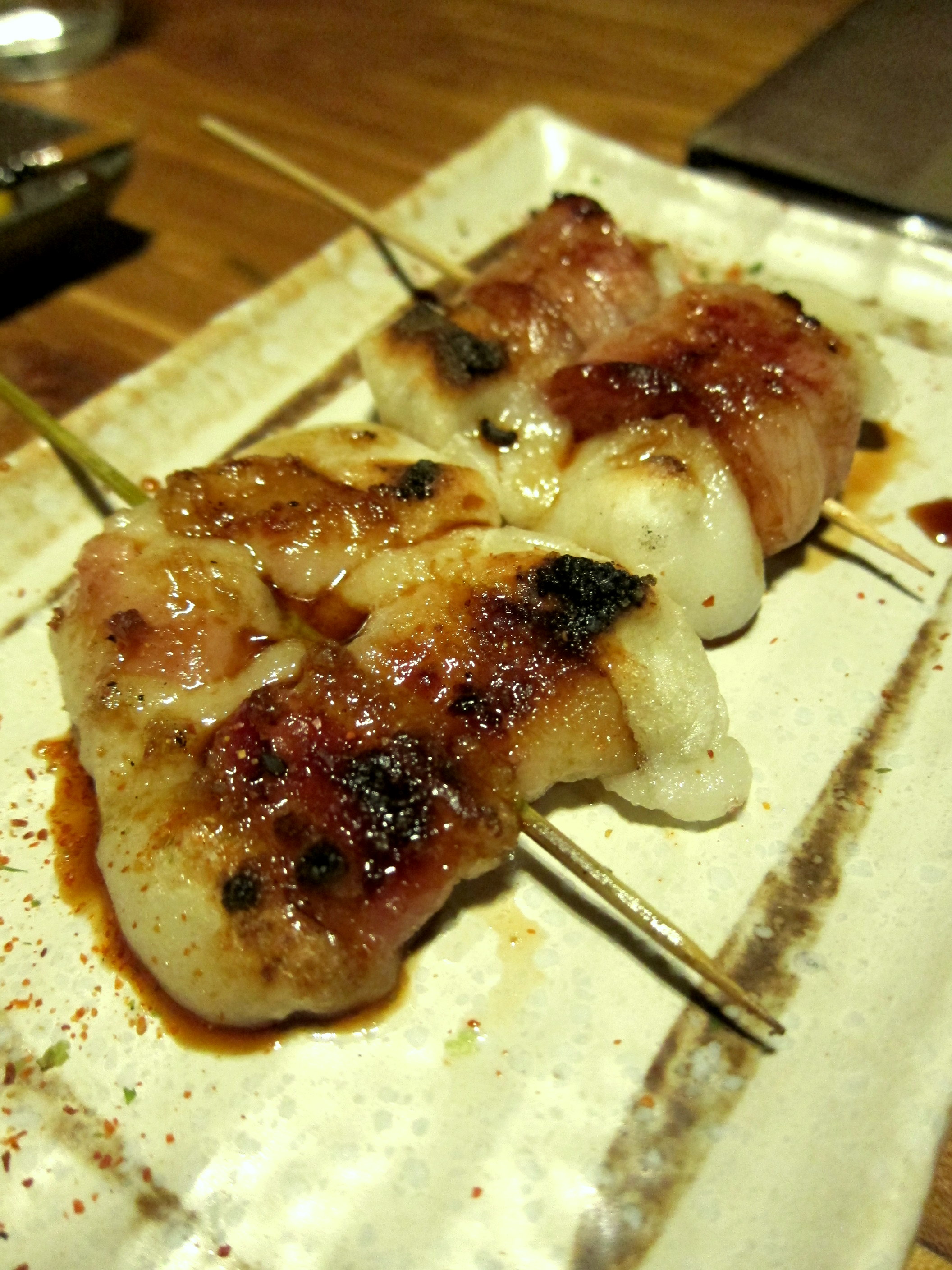
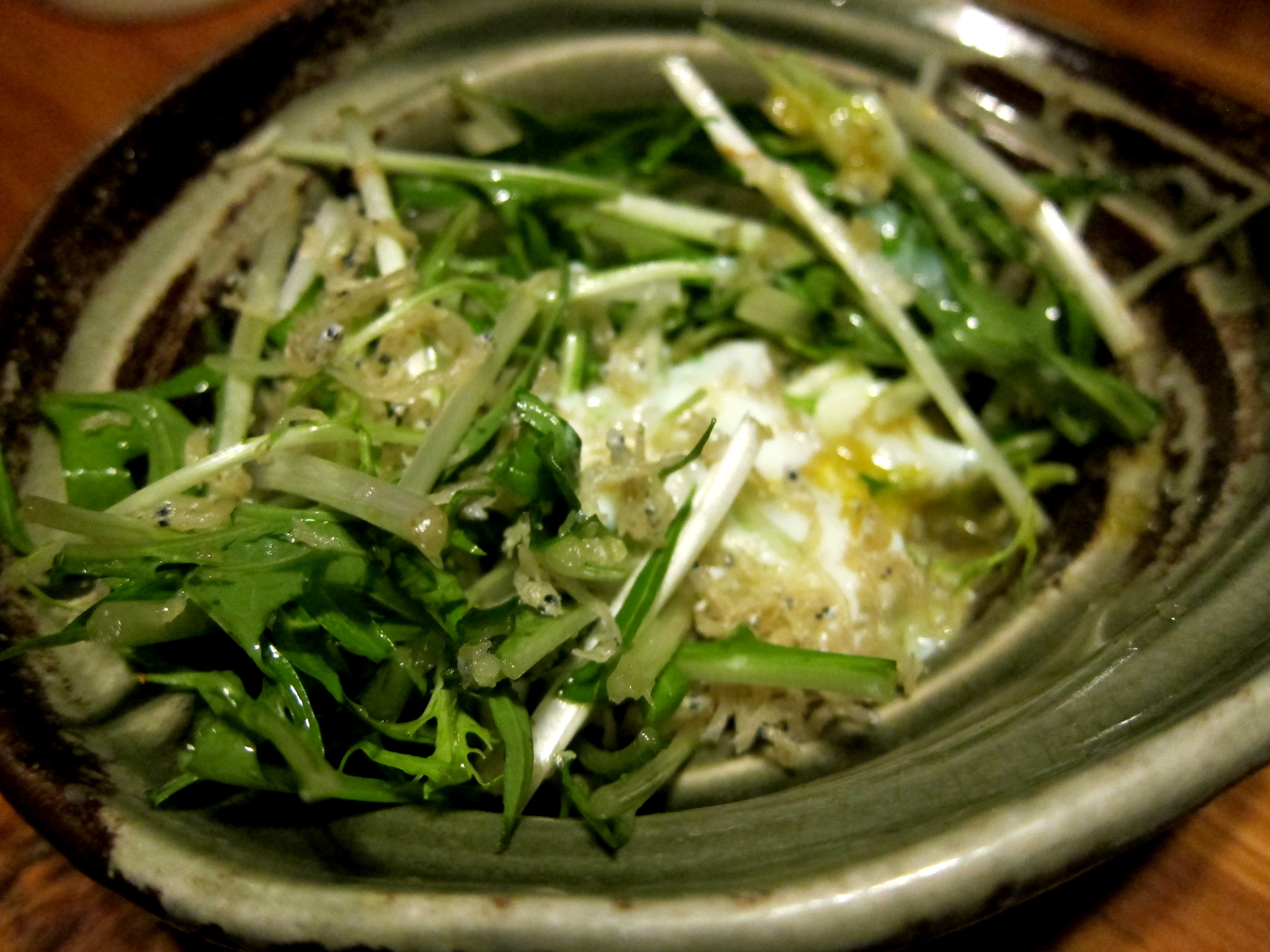
Among my favorites must be the mushy jaga bata ($5, mini potato with butter), which I combined with Rau Om‘s tofu misozuke for a briny but creamy note. The simple but refreshing kyo-salada ($6, “mizuna with onsen egg and crunchy jako“, or water greens with poached egg and crunchy dried anchovy). And the chewy, glistening, charred bekonmochi ($5, bacon-wrapped plain mochi) was magnificent.
The shushoku (post-drinking dishes) are richer than ever: a fatty, sweet, brownish yellow chicken broth for the tori udon ($7) and chunks of beef in the niku jaga ($12, a thick stew of meat and potato).
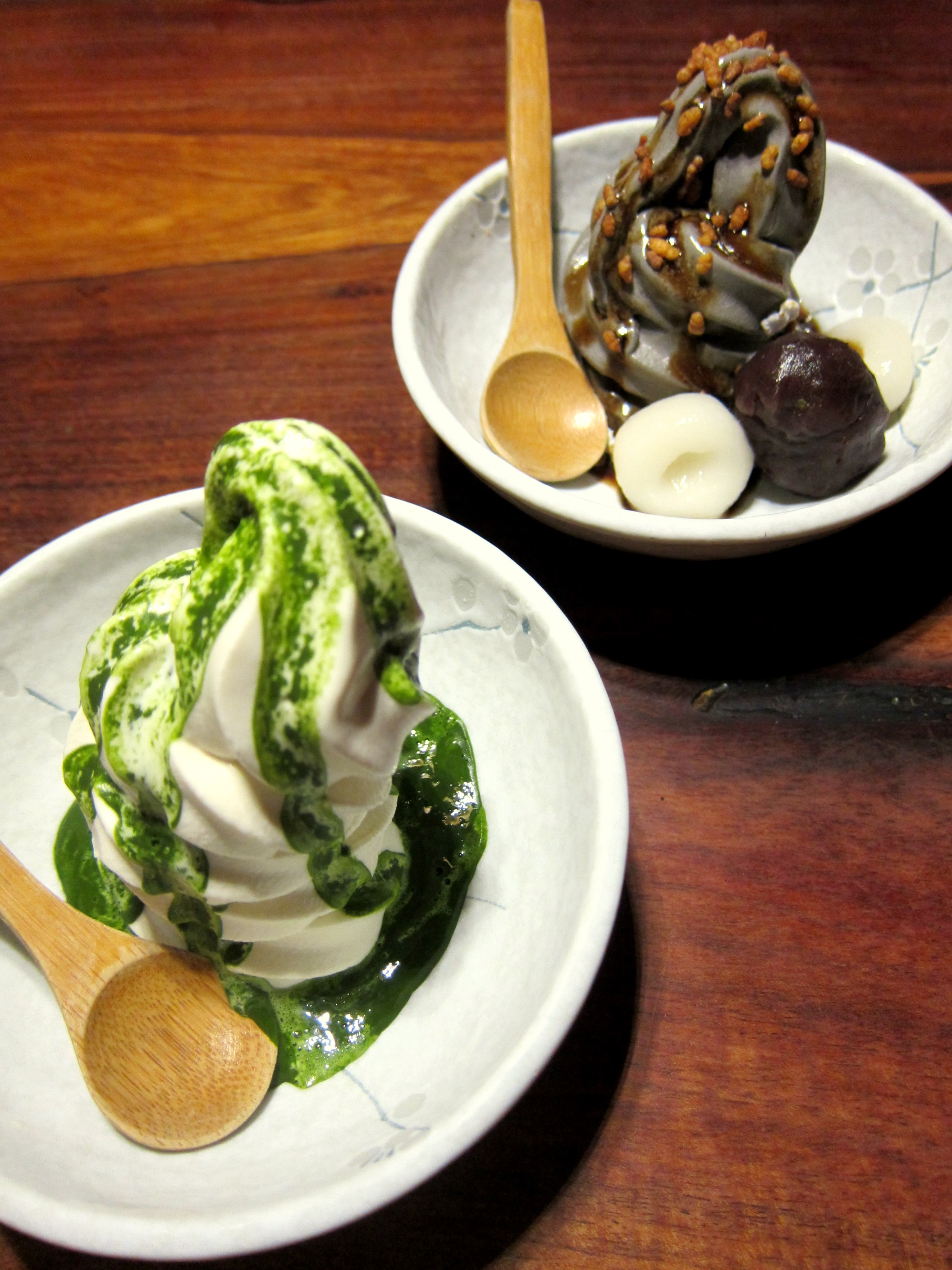
These stomach cementers demand a sweet ending, which we couldn’t afford the first time due to a time constraint, but I made up for it the second time by ordering two desserts ($7 each): a matcha affogato (green tea soft serve), cleansing and herbal, and a kuro goma sundae (black sesame soft serve), gentle and nutty. The kurogoma ice cream came with 2 white mochis and a scoop of anko (red bean paste). I love black sesame ice cream no matter what it comes with.
Photography used to not be allowed? I was taking pictures like crazy. Smoke issue after 7 pm because of the grill? I have been here until 10 pm. Undertrained staff? Our hostesses were helpful both times. Ippuku seems to have ironed out any technical problem it might have had 2 years ago, and although its food isn’t flawless, it is perfect as a whole.
Rice comes as a side dish at Renee’s Place on Solano. I can’t imagine anyone eating orange scallop (it’s like orange chicken, but with scallop) and lion’s head meatball without rice, but whatever, it could just be because I’m Asian. But 3 dollars for what seems to be a cup of rice is just too far. The rice is dry and fluffy and nicely done alright, but *three* dollars?
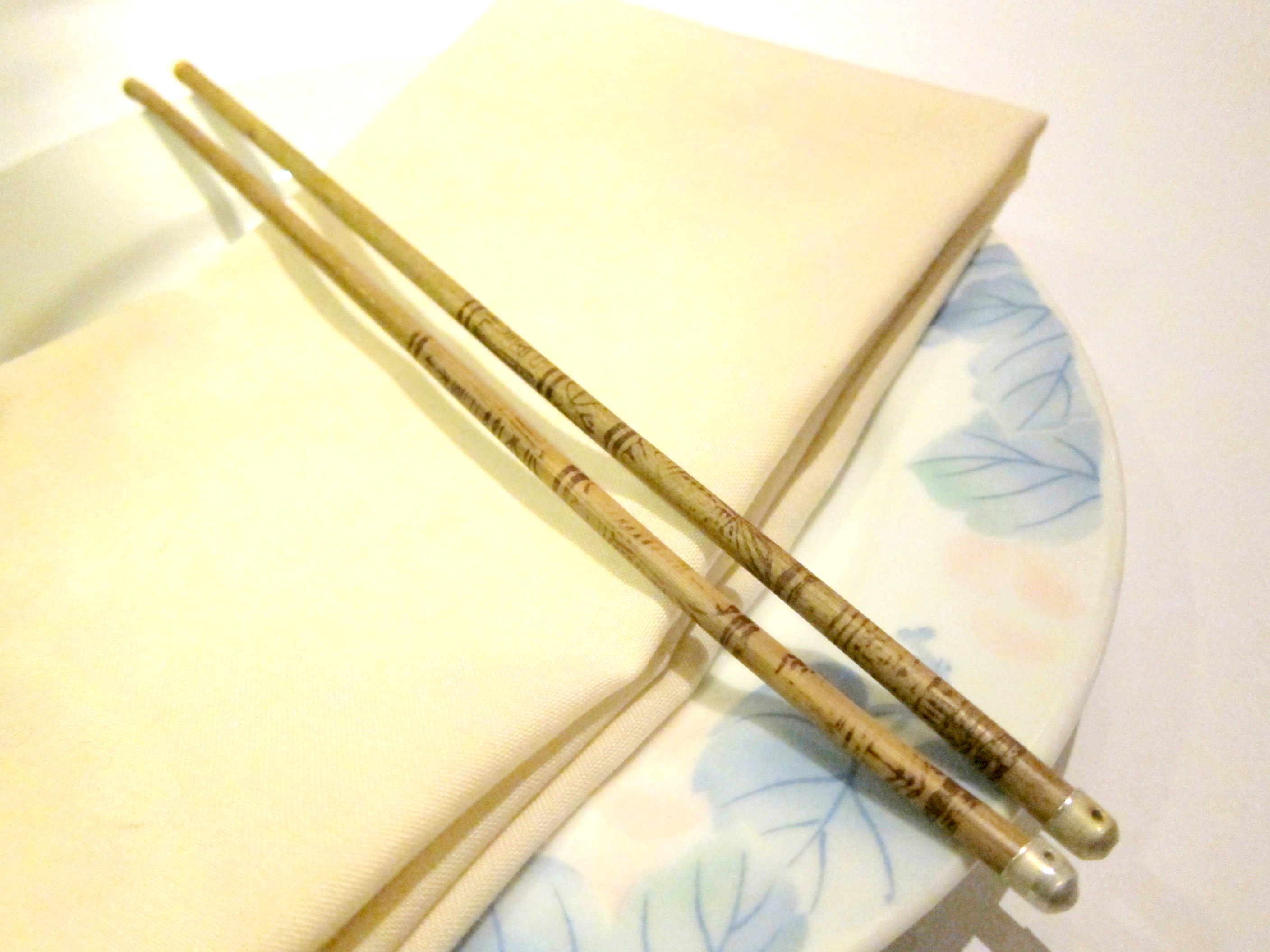
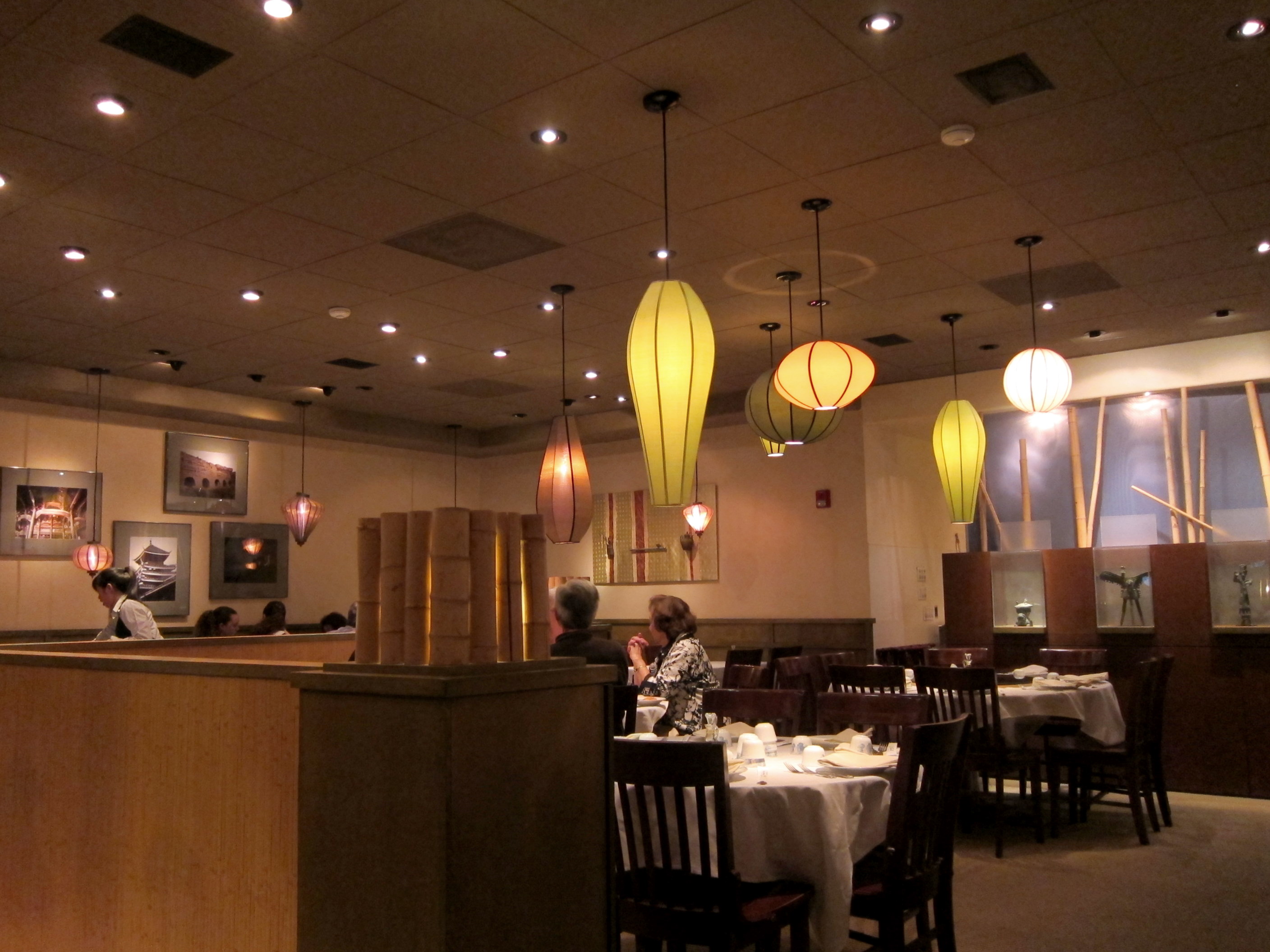
Originally, Kristen and I planned on a Japanese dinner, but it was too crowded and we didn’t have reservation. Then we got on the bus for Korean, but the long line also shied us away… to the Chinese place next door. The bamboo-themed decoration is quite pleasing. They also have the most beautiful bamboo chopsticks I’ve ever seen:
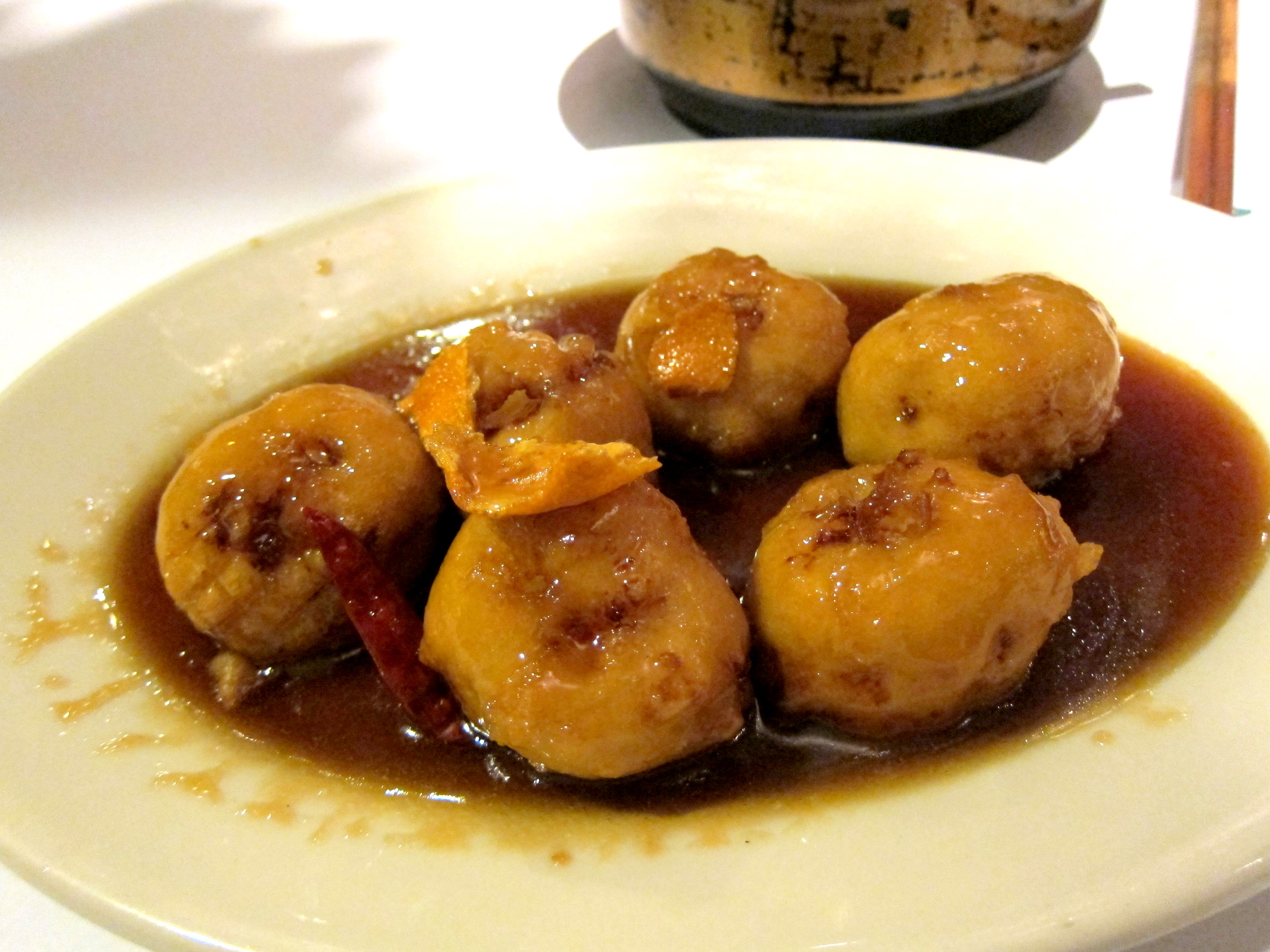
Battered fried scallops in orange and garlic sauce with orange peel.
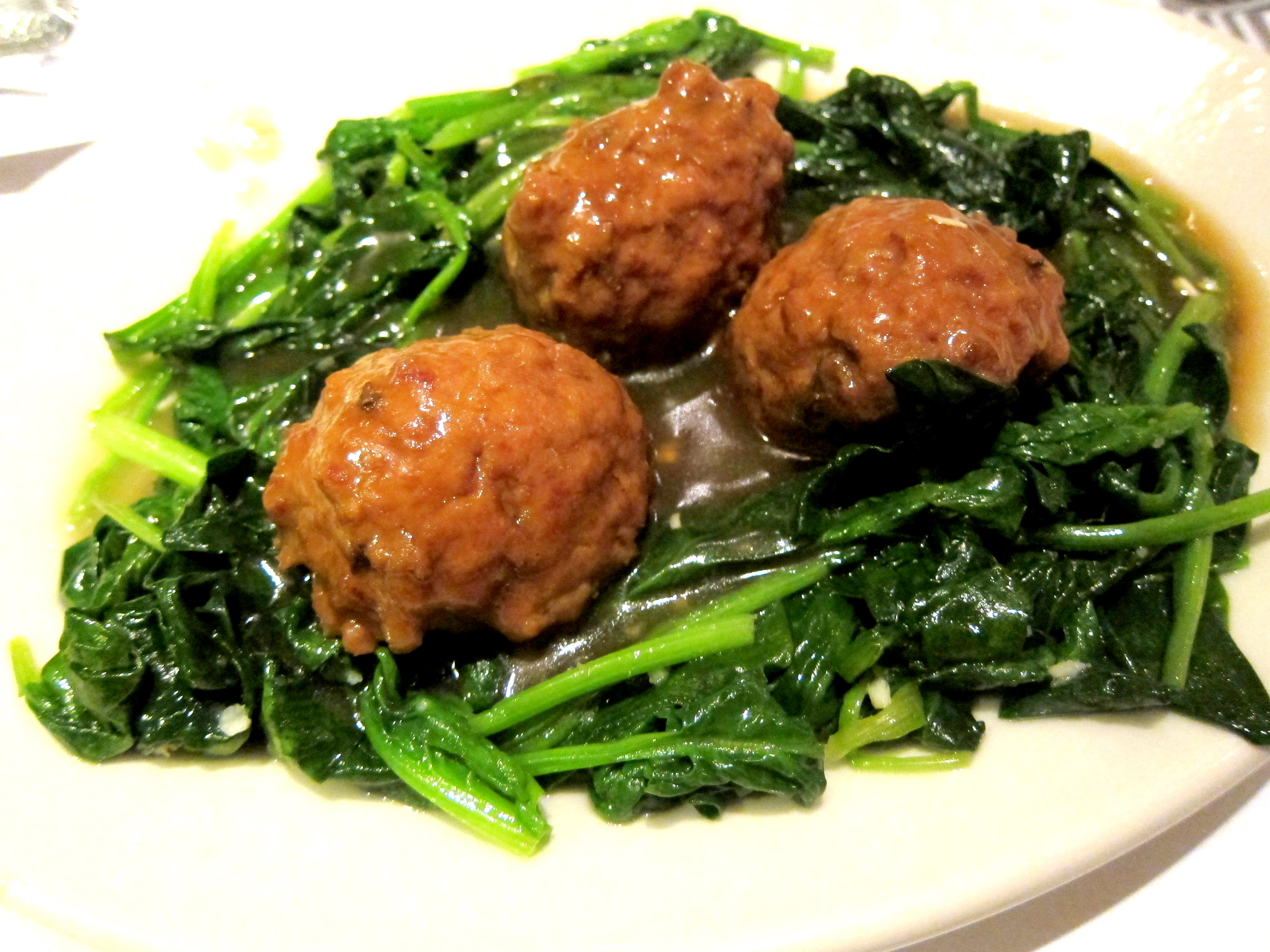
Lion's head pork meatballs with sauteed greens
The food? Meh. The orange peel in the orange scallop is really just dried orange peel with no flavor. The dishes sound and look better than they taste. The water was very good, though.
Address: Renee’s Place (organic Chinese)
1477 Solano Avenue
Albany, CA 94706
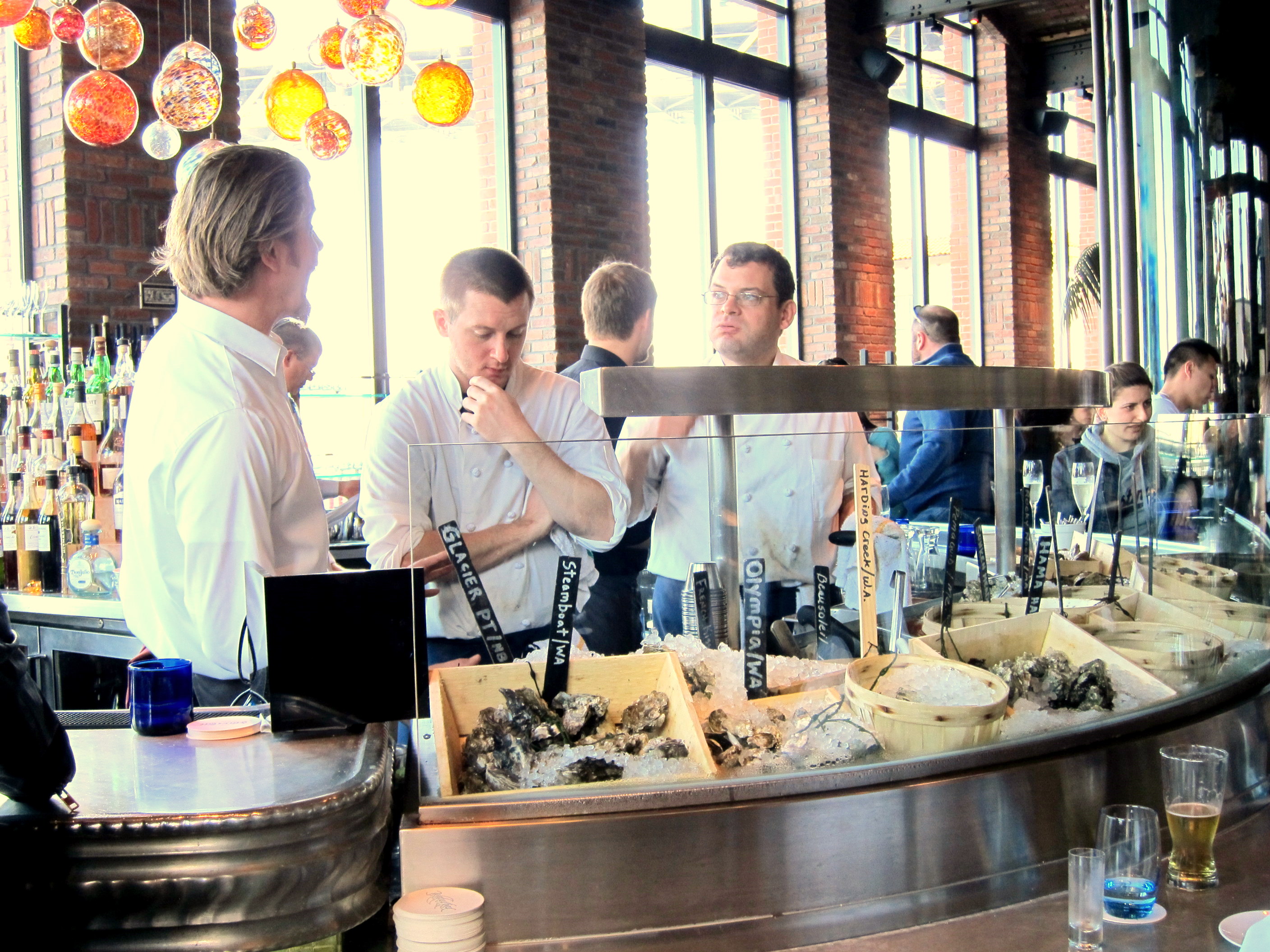
Going to the Waterbar on a nice-weathered Saturday afternoon is a silly idea: everybody and their twice-removed cousins are also hawking for the same precious seats around the bar to get the 1-dollar featured oysters. It’s crowded. Very crowded. It’s like parking in San Francisco. Mr. Global Eats recommended the place during the weekdays, I heeded not his advice and here we were, standing fidgetily, looking awkwardly at people eating oysters, hoping to stare them out of their seats. A couple finished their lunch date; we three hopped in before the server could even wipe the table clean.
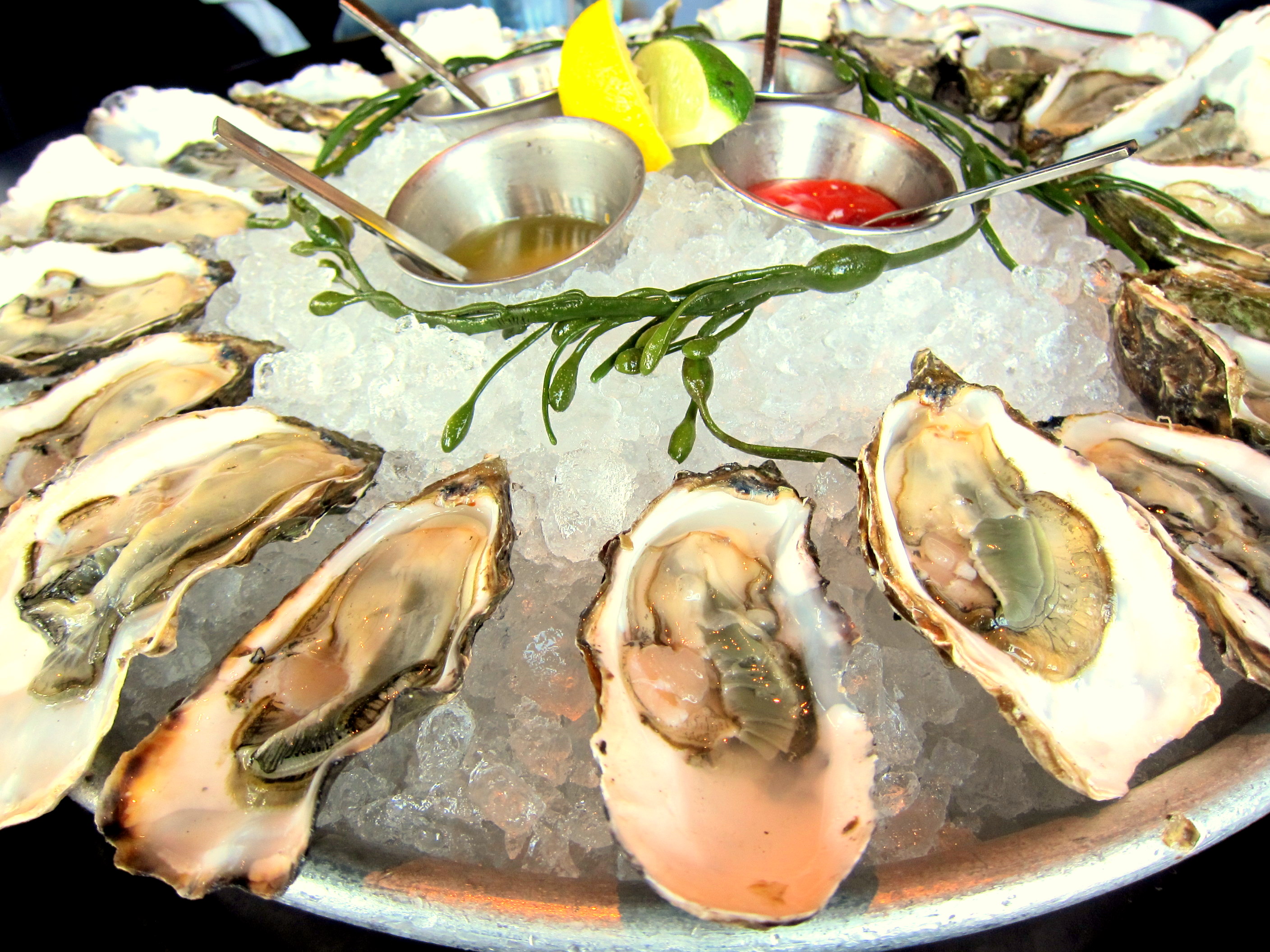
Today’s featured victim was the Cove Miyagi, a California native with a “clean lettuce flavor”. The first time I was ever fooled by the juicy appearance of a raw bivalve (an oyster) to eat one, I had to gather every ounce of self control in me to swallow it down. The second time was a raw clam, and it wasn’t a whole lot better, but I knew what to expect. Today was actually the third time, and I had more than one oyster, so I’m proud of myself. Something about that brackish smell and taste melded with the cocktail sauce, the lemon, and the green onion is romantic.
That said, I almost died from the radish cream sauce. I was in the middle of chatting with the girls and the surprise attack brought me to tears. Such innocent whiteness, such strength punching the nose from the inside.
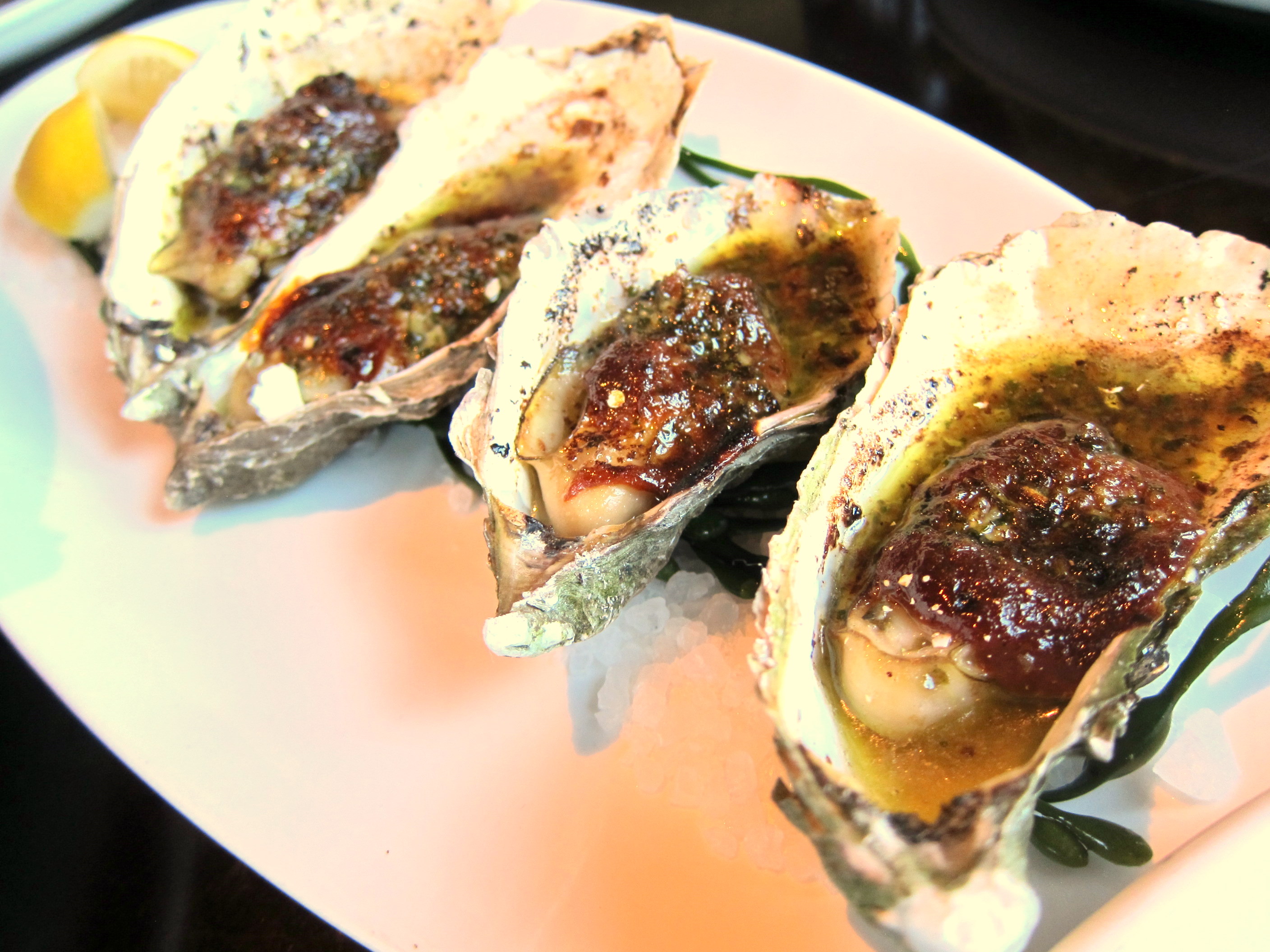
We also shared four BBQ baked oysters drowned in garlic parsley butter, on a bed of salt crystals. These were hands down delicious. They actually smelled good. Humans have indeed learned to use fire for a reason, and butter… But you know what was the best thing here, that we kept talking about even after we left the Bar? The potato chips. Oh man, they were so good that I had to stop by CVS on the way home to get a bag of BBQ Lays. And they were on the house.
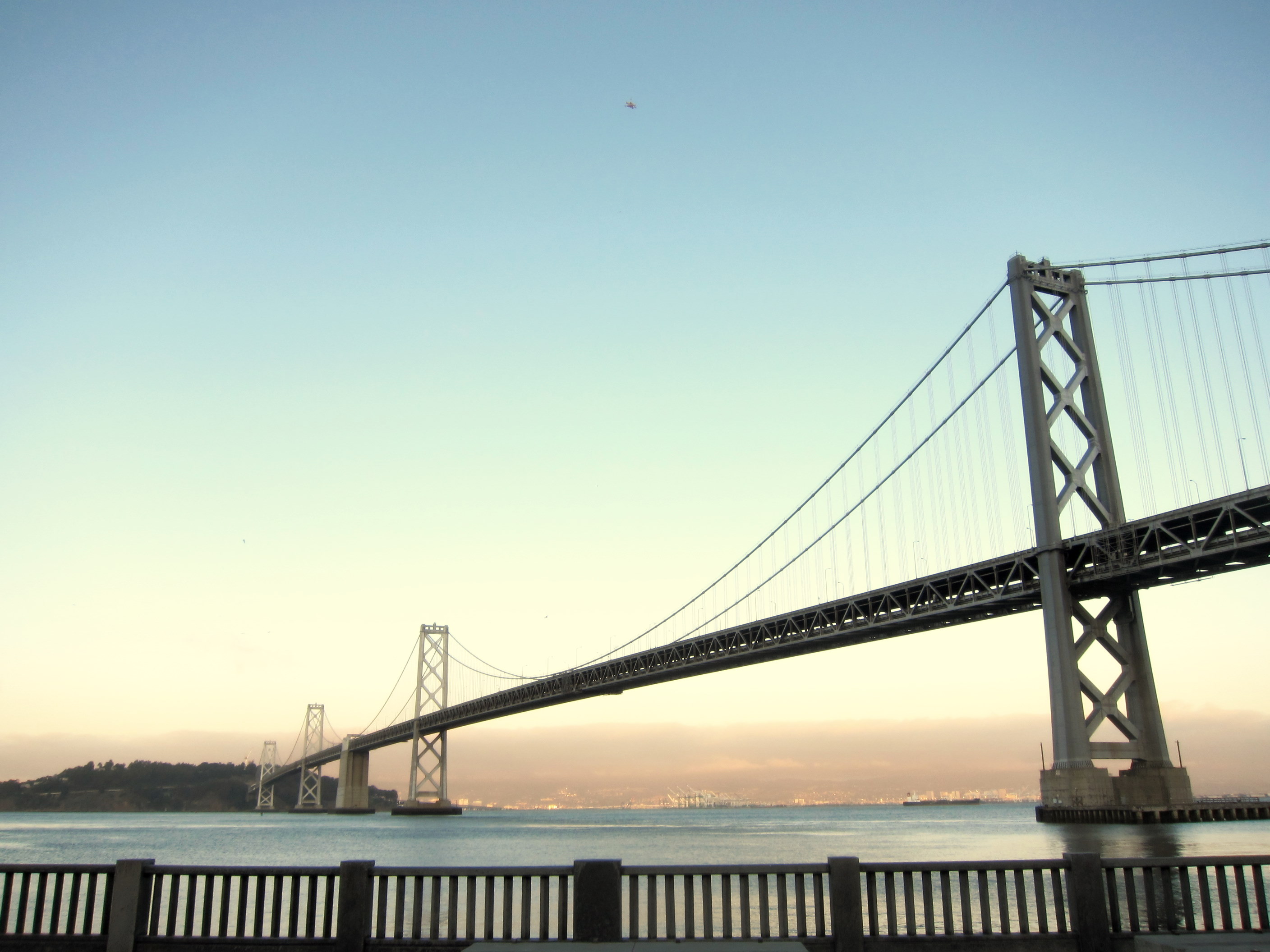
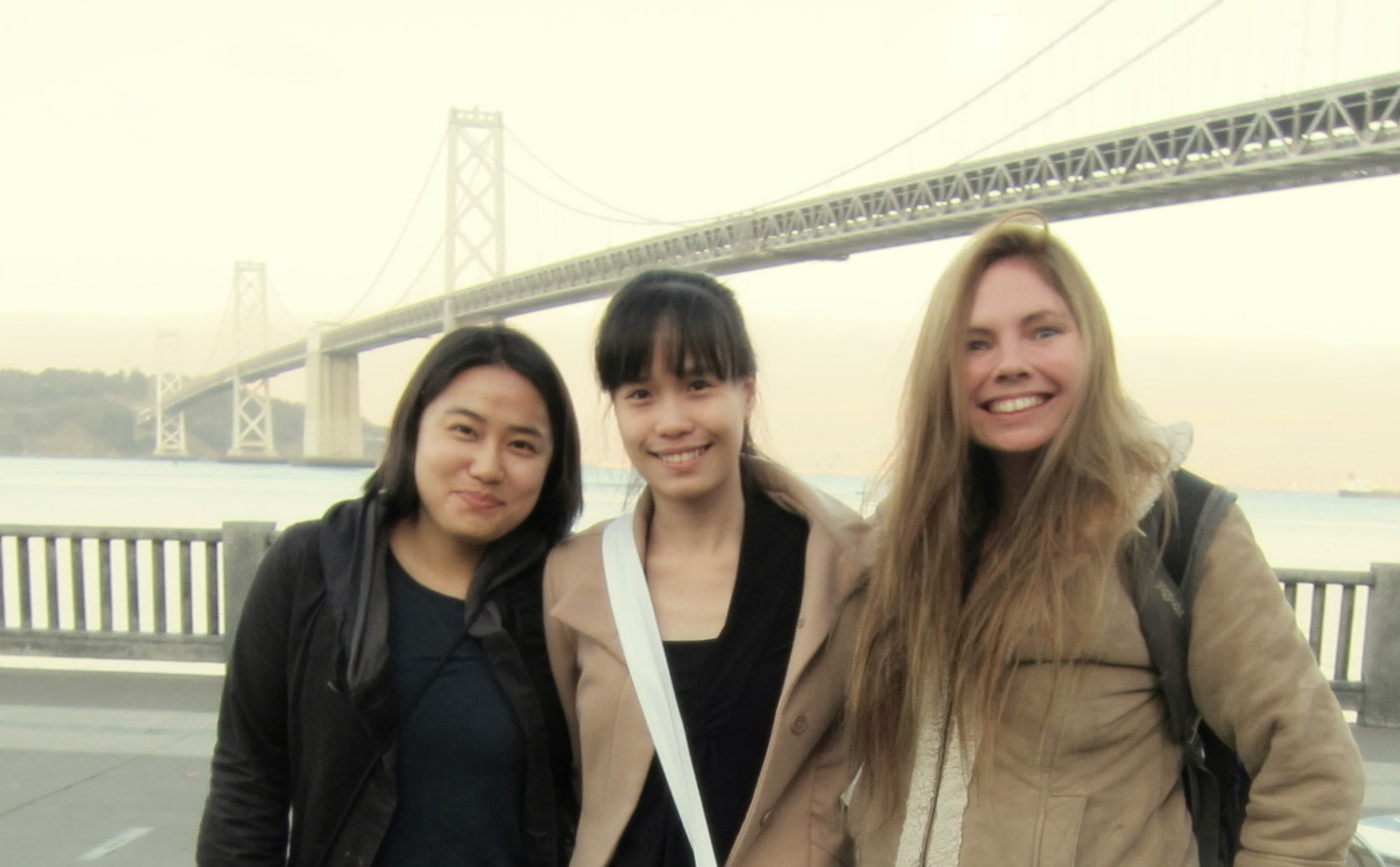
The verdict: the Waterbar hadn’t transformed me into an oyster zealot, but it did transform us into temporary tourists:
View(ed) from the patio.
Dinner for 3: $37.24
Address: Waterbar
399 The Embarcadero South (near Pier 26)
San Francisco, CA 94105
(415) 284-9922
Between 4 and 6 PM today was the most interesting 2 hours I’ve had this week, and also the most effortless educational experience I’ve had in a long time. That’s how the Korean tea ceremony is meant to be, as I’ve learned: formal but relaxing, and ceremonious but natural. The rules are rather simple to get acquainted to, the movements make sense, and just watching made my mind feel nothing but calmly pleasant. The kind of pleasant feeling one would get gazing off into space alone, on a grassy hillside, on a cloudy day.
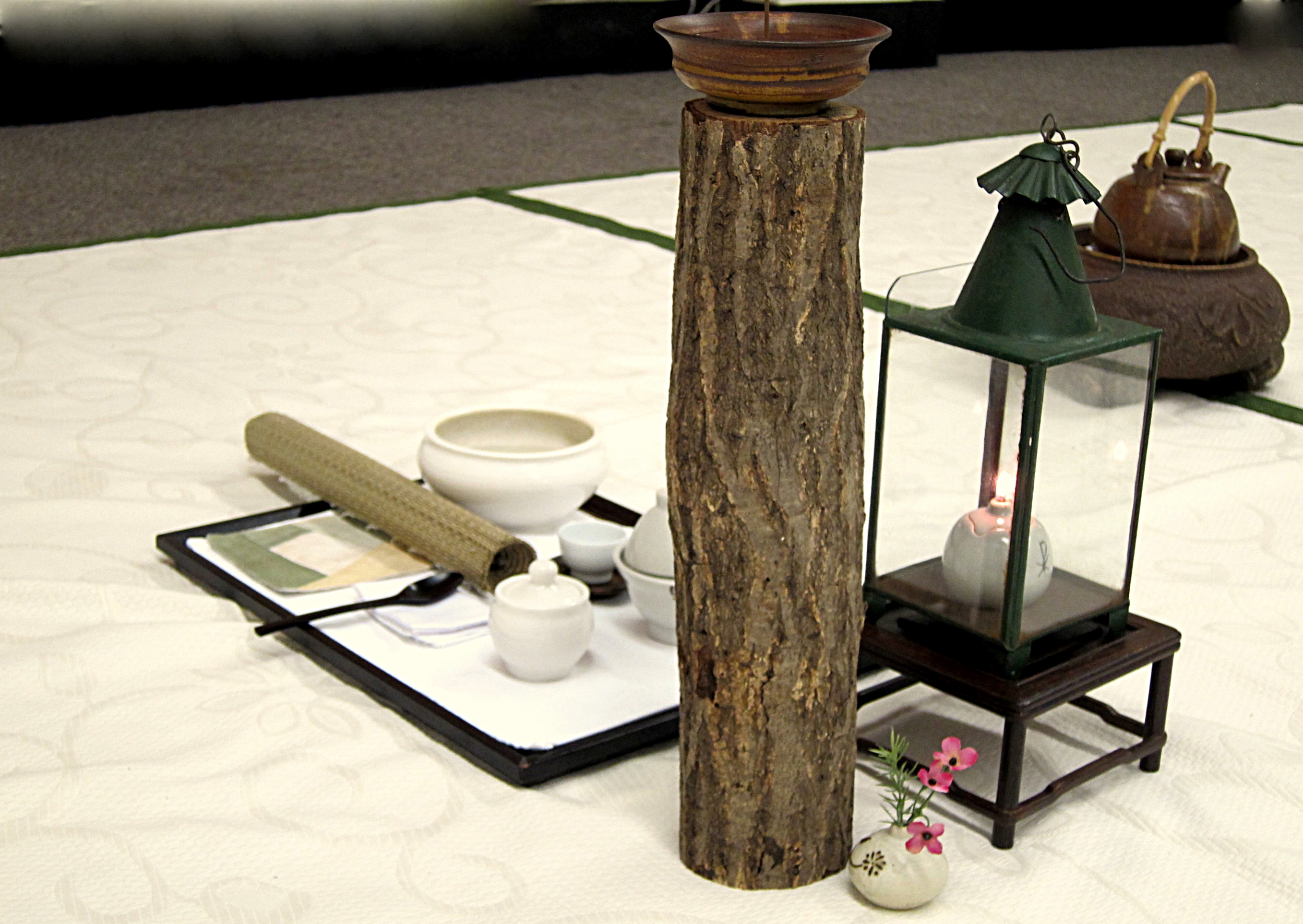
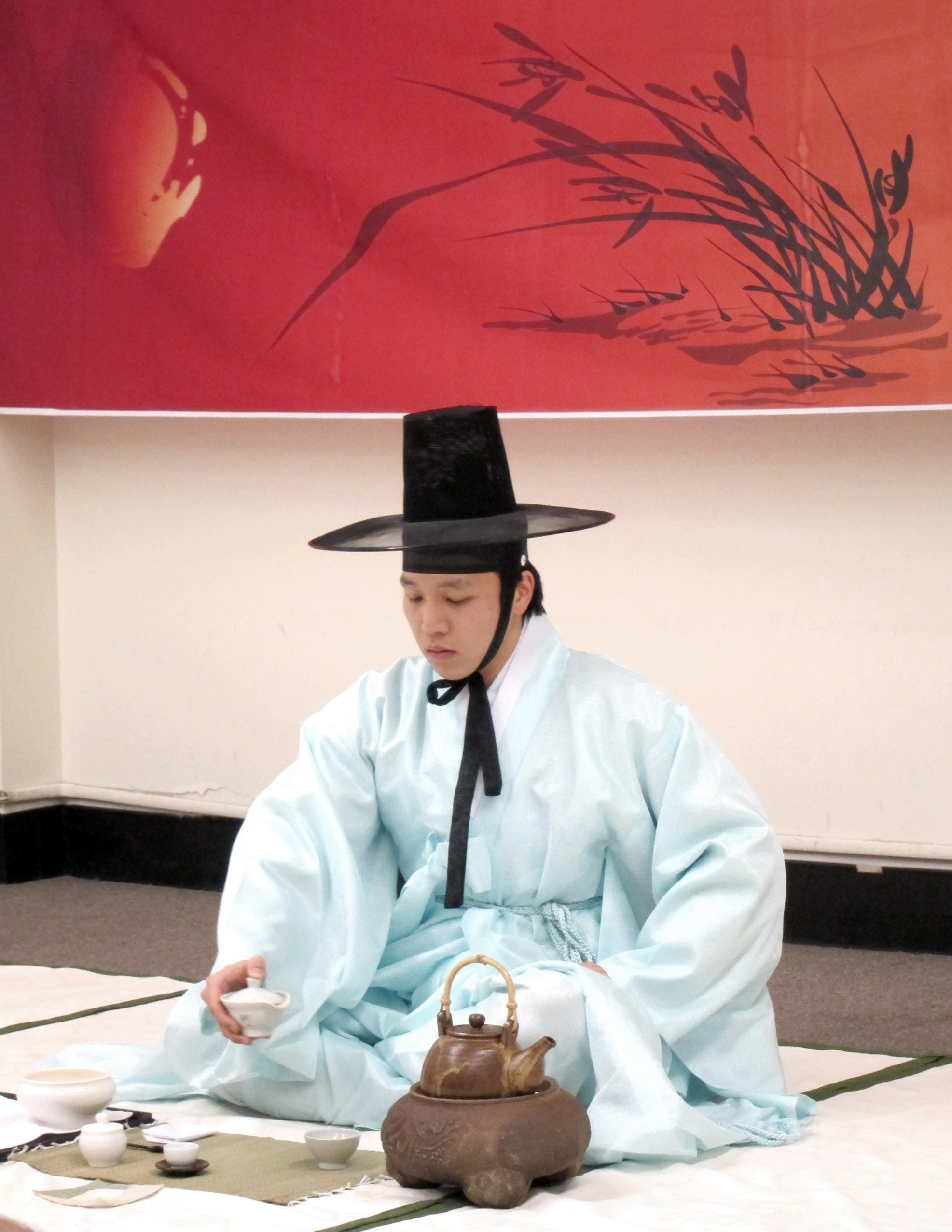
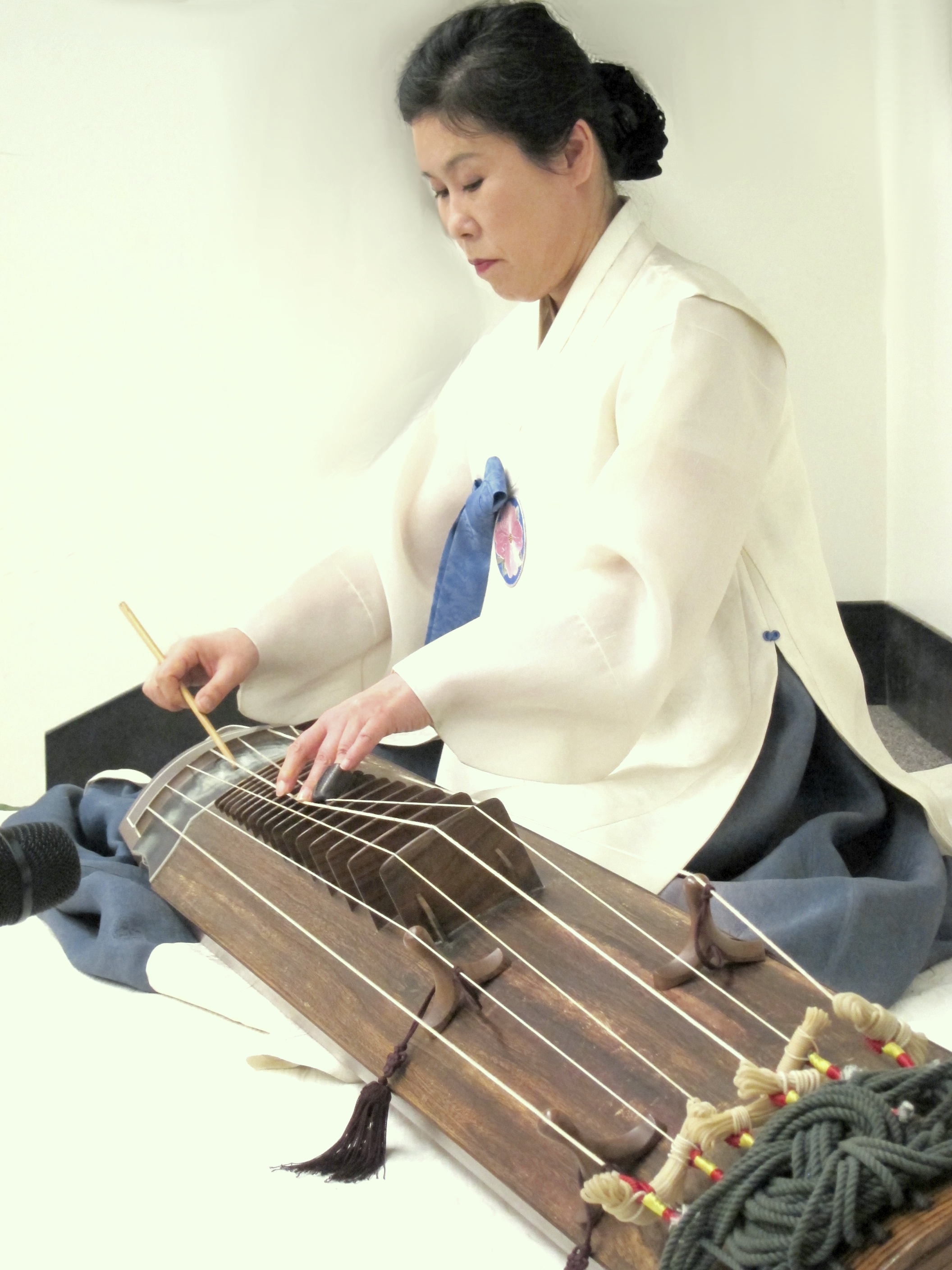
Now for the logistics. Inje University‘s Traditional Korean Tea Society (TKTS) gave a 2-hour presentation at Berkeley today as part of the “Dew of Wisdom” tour, Stanford and California State University got their tea before us. During the first 40 minutes, the students of TKTS demonstrated two types of tea ceremonies, both accompanied by the slow, deep, hardy rhythm of a 6-string zither 거문고 (geomungo).
The first type, 들차회 (deulchahue), is to be enjoyed with friends and relatives outdoor during spring and autumn. The setting is lighthearted, the purpose is to relax and to appreciate nature, the gathering comprises both men and women, and both hands are used during the preparation, serving, and tasting of tea.
The second type, 선비다례 (seonbi darye), or “Scholar’s tea ceremony”, is practiced by noblemen to clear their mind and heighten their wisdom. The setting is dignified, and the man uses only his right hand to prepare and serve, signifying a more profound status than that in deulchahue. In both cases, the movements are fluid, slow, and steady.
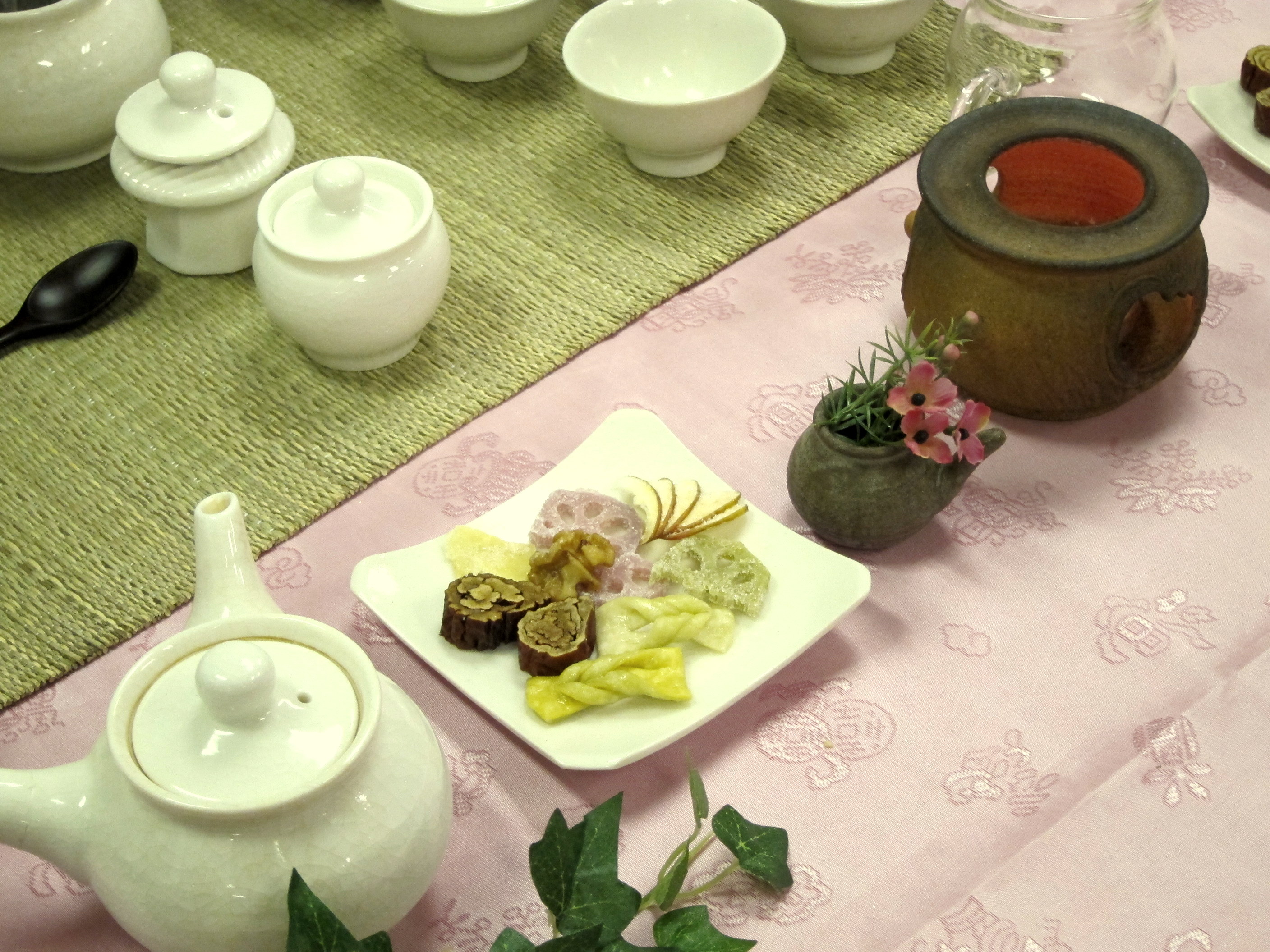
During the next 20 minutes, the guests were invited to taste green tea and yellow tea with a variety of 다식 (dasik), tea snack: candied lotus root, dried apple, dried jujube, and a kind of fried chips that I’d only seen in the drama Sungkyungkwan Scandal (성균관 스캔들). The green tea, unoxidized, looks and tastes clear with a very light herbal hint, like a white tea. The yellow tea, about 50% oxidized, similar to Tieguanyin, has an upfront sweetness and a deep citrine hue. Each batch of tea is brewed for about 2 minutes in 60-70°C water, as boiling water would induce a bitter taste.
After ample tea had been served, the guests came back to their seats for a brief presentation from Prof. Jaesup Pak, President of TKTS, on Korean tea production and ceremonial methods. I scribbled like mad, and here’s what little knowledge I’ve gained:
There are 3 major tea plantation regions in Korea: Boseong, Hadong, and Jeju. Boseong is the largest and most respected tea plantation, producing roughly 40% of Korean tea in 5.3 million square meter of hillside. Hadong, second in line, has produced wild tea for over 1200 years, and from its neighboring town Hwagae originated the Korean green tea culture. The tea here is grown completely natural on rocky 400-500 meter high mountainsides and harvested by hand. In contrast, Jeju‘s tea is grown with chemicals and fertilizers on rich volcanic island soil, plucked and chopped by machines, and heated and dried with steam.
Regardless of regions, tea leaves are plucked young between April and May because fully developed leaves are too coarse to use. Different grades of green tea are categorized based on their youngness. Ujeon (우전), the first grade, comes from the first harvest, which means it is picked by hand before April 20 for a delicate flavor. Sejak (새작), the second grade and the most popular type, is picked early May. Sejak means “Sparrow’s Tongue”, referring to the pointed shape of the young leaves at this stage. And finally, Jungjak (중작), the third grade, is picked mid May. The tea offered to the guests at the colloquium today was Sejak from Hadong.
The production process involves 6 steps: plucking, withering, parching, rolling, separating, and drying. Hand plucking tea is meticulous, even the most skilled women can pick only 2 kg per day. Within 24 hours after plucking, the leaves are left to wither in open air. Then they are tossed and stirred constantly in an iron cauldron over wood (traditionally) or gas fire at 200°C to soften. Rolling comes afterwards to intensify the taste, where the leaves are rubbed and rolled for 3-4 times on straw mats. This process makes the leaves stick together, thus separating must be done to help moisture evaporate from the leaves. Finally, the leaves are spread out and dried naturally on paper on a heated floor for 4-5 hours or overnight.
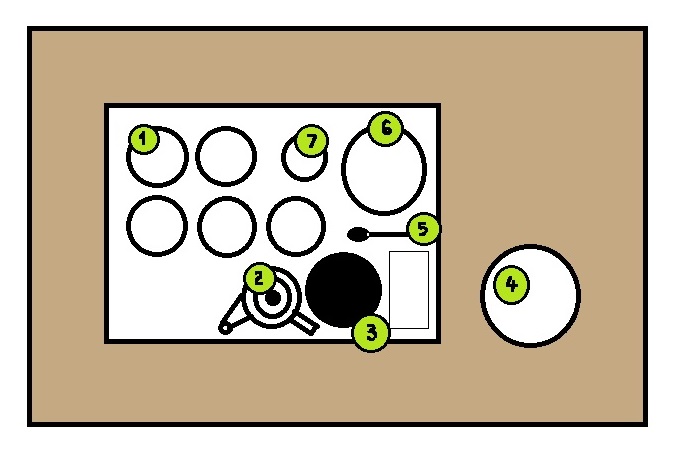
The teaware, or chagi (차기), are typically arranged as shown in the diagram above:
(1) Tea cups: usually 3 or 5 cups per set
(2) Tea pot for brewing. The teapot and kettle should be on the right side and closer to the host.
(3) Tea cup saucer, on which the filled tea cup is placed and received.
(4) Large bowl, into which the water used for warming the pot and cups is discarded.
(5) Tea spoon for taking tea leaves
(6) Smaller bowl for cooling the water and the tea, and for pouring the tea into the cups
(7) Tea caddy, which contains the tea leaves.
The small rectangle represents a napkin for tidiness.
Professor Hyeyoung Shin (Chuncheon National University of Education) performing da-ak (다악, tea music) on a geomungo at the colloquium
The preparation after the arrangement begins with pouring hot water into the cooling bowl and letting it cool for under 2 minutes. Then the teapot, ready with 1-2 spoons of leaves, receives the cooled water; the lid is closed, and the leaves are brewed for a few minutes. While serving, the tea is poured into warmed cups from a high distance to create bubbles in the tea, which are believed to confer good luck. The receiver should hold the cup with the right hand and support it with the left hand, inhale the aroma, take a sip that is about one third of the cup, and drink 3 times from each cup served. I think I did it in more than 3 times… I was savoring the flavor a little too carefully.
At the end, we got to take our cups home as a souvenir. A cute little white tea cup to commemorate a sweet, delicate two-hour lesson. 🙂
There seems to be a new trend in the East Bay restaurant business: it has to be hidden and/or without a sign. First it was embarrassing walking up and down the street to find Commis, and now the same thing happens with Plum. Is this some kind of scavenger hunt joke?
Plum‘s menu is short and sweet like its name. However, the same thing can’t be said about the majority of its dishes, which either tip a bit over to the salty side (pate ciccioli and bacon) or stay way back in plaindom (crispy pig ears and trout). There are bright notes, too. The turnip soup with yuzu kosho, pear and cilantro is a light, heart-warming start. The short ribs with peanuts and sweet potato has a deep Asian flavor. The caramelized brioche with coffee ice cream makes a comforting finish.
Ironically, the yummy dishes didn’t have good pictures. But here’s a small album to get a taste of Plum.
Address: Plum
2214 Broadway
Oakland, California
(510) 444.7586
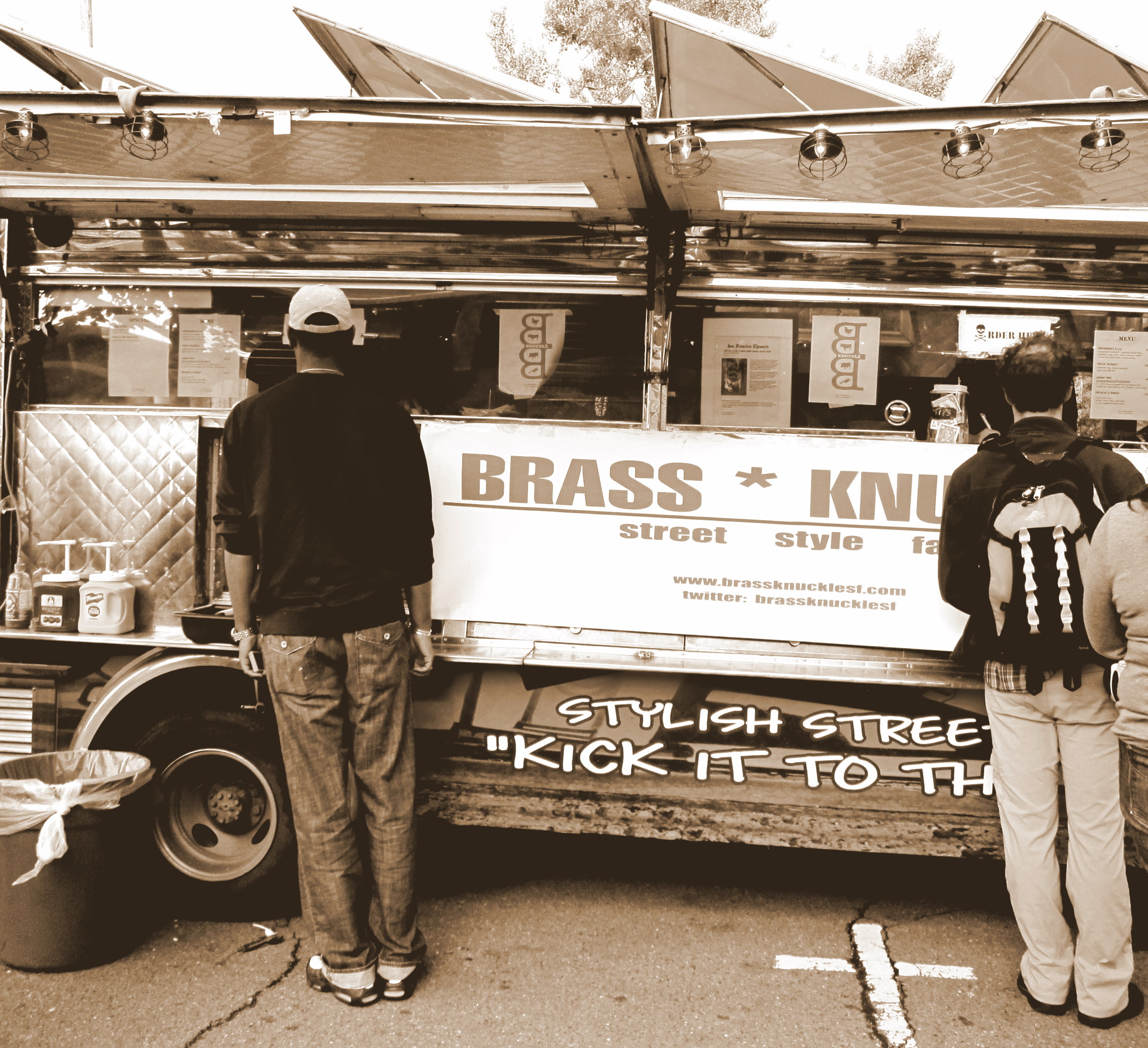
After so many years, and it’s been only a little over three years for me, of actively paying attention to food, I’ve become, unrighteously and shamelessly, somewhat of a food snob: very few things can excite me. And yet, it doesn’t take much more than a sandwich to keep me up at night (that, and my research). Originally, I had a draft for Off the Grid in North Berkeley, then I let it stew for centuries because I thought oh well, it’s just a food truck event, a new fad in town, who knows how long it will last. I still don’t get the name of the event: ten or fewer food trucks and hundreds of Berkeleyans gather where Shattuck meets Rose every Wednesday evening, from 5 to 9. Lines form, some short, some long. I still don’t get all the raves for Cupkates (or any cupcake trucks for that matter). There were things I regretted buying, and things I would never stand in line for. But there’s this sandwich, powerful enough to drag me back to Off the Grid, to stand in line, and to finish my draft.
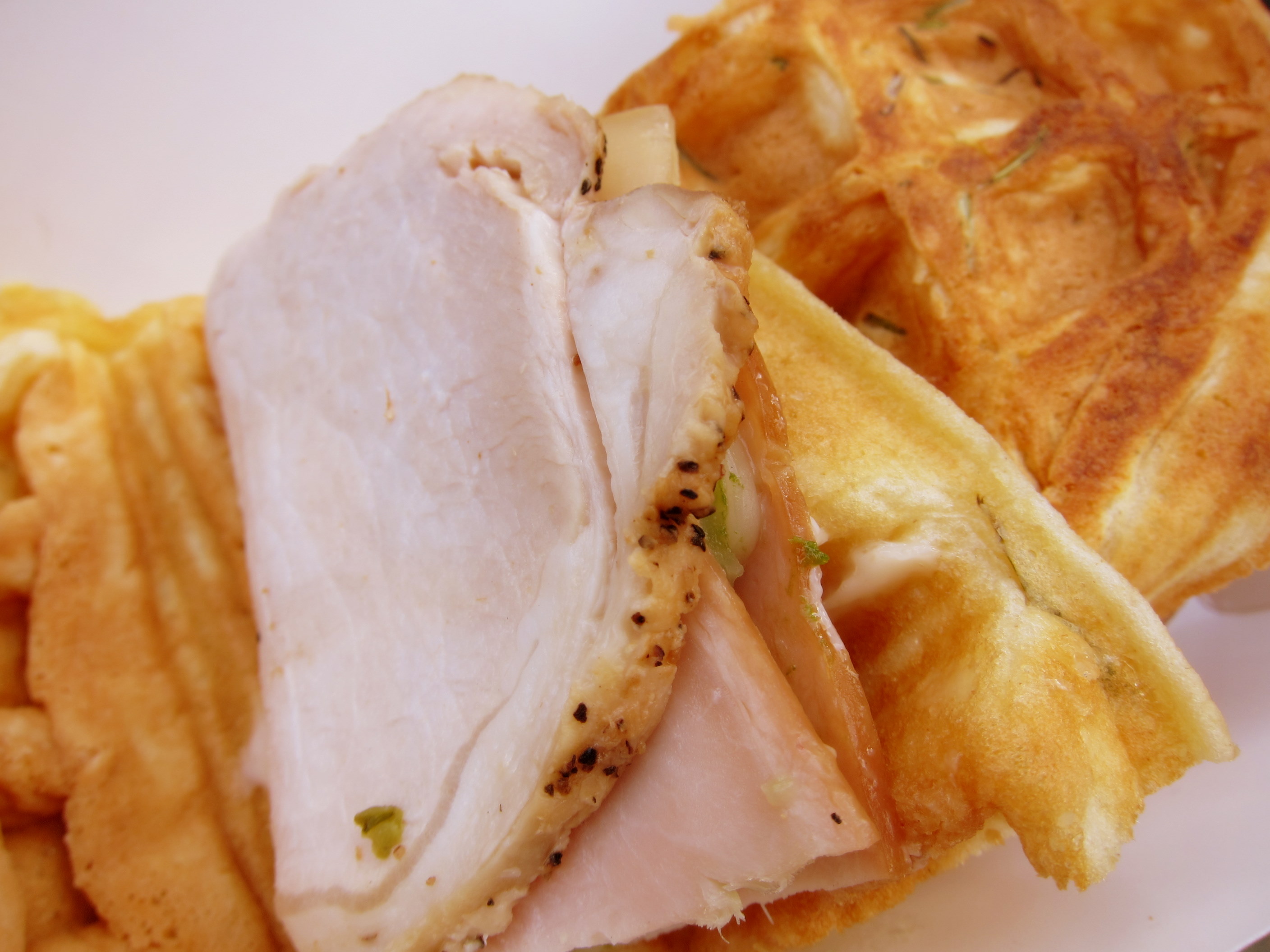
The people in line pronounced it “Pea-Eye-Gee”, I don’t know why. You have to spell out the letters because they’re capitalized? It makes sense to me to be just “pig” because it’s roast pork ham on a waffle. (UPDATE: now that Bob has explained, I know why: I’m just not American.) Anyway, it’s %##$@&* GOOD. The soft, pristine, plump layer of pork. The light, fluffy crisp of the waffle. And the rosemary in the waffle. Oh dear.
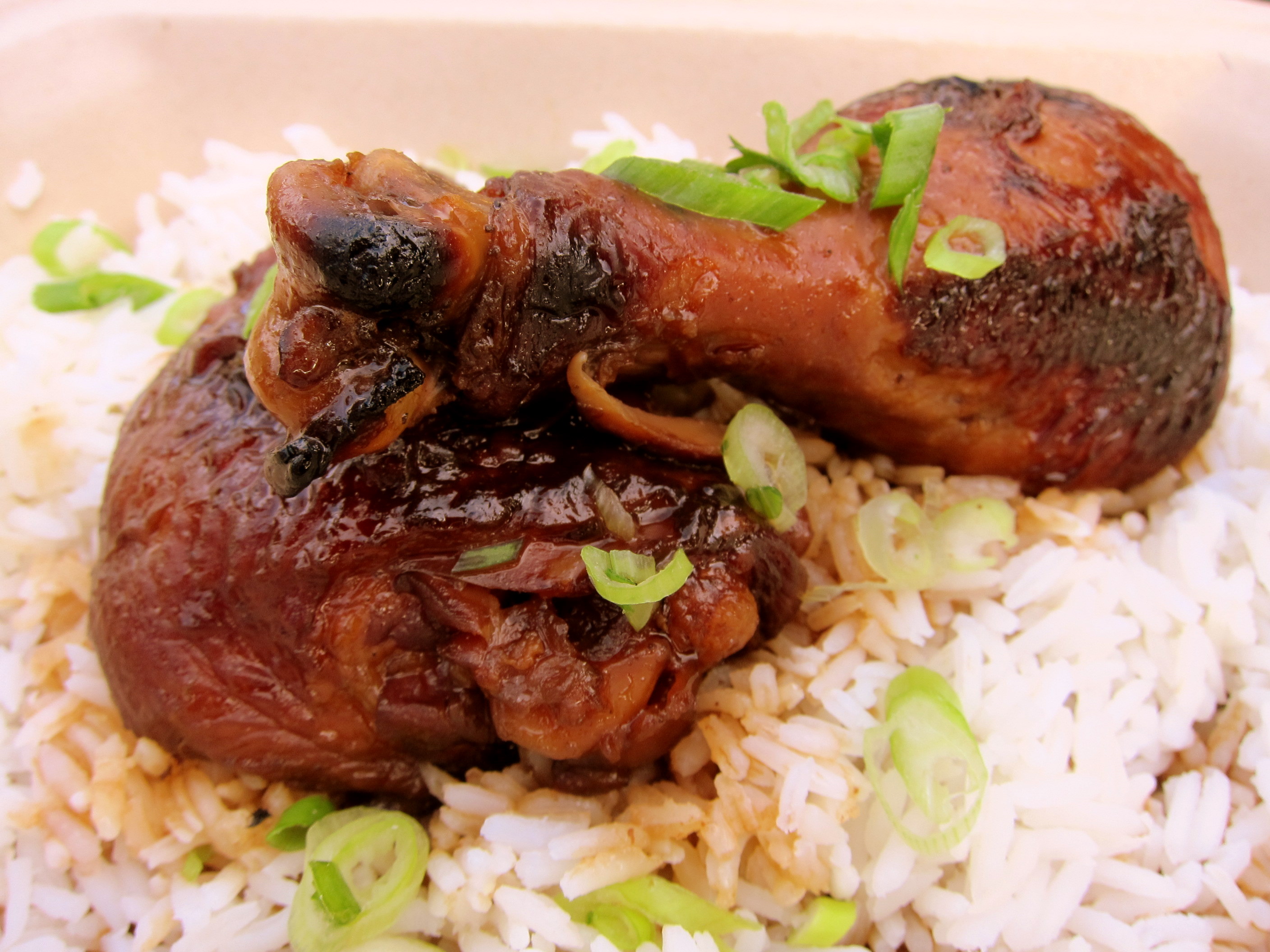
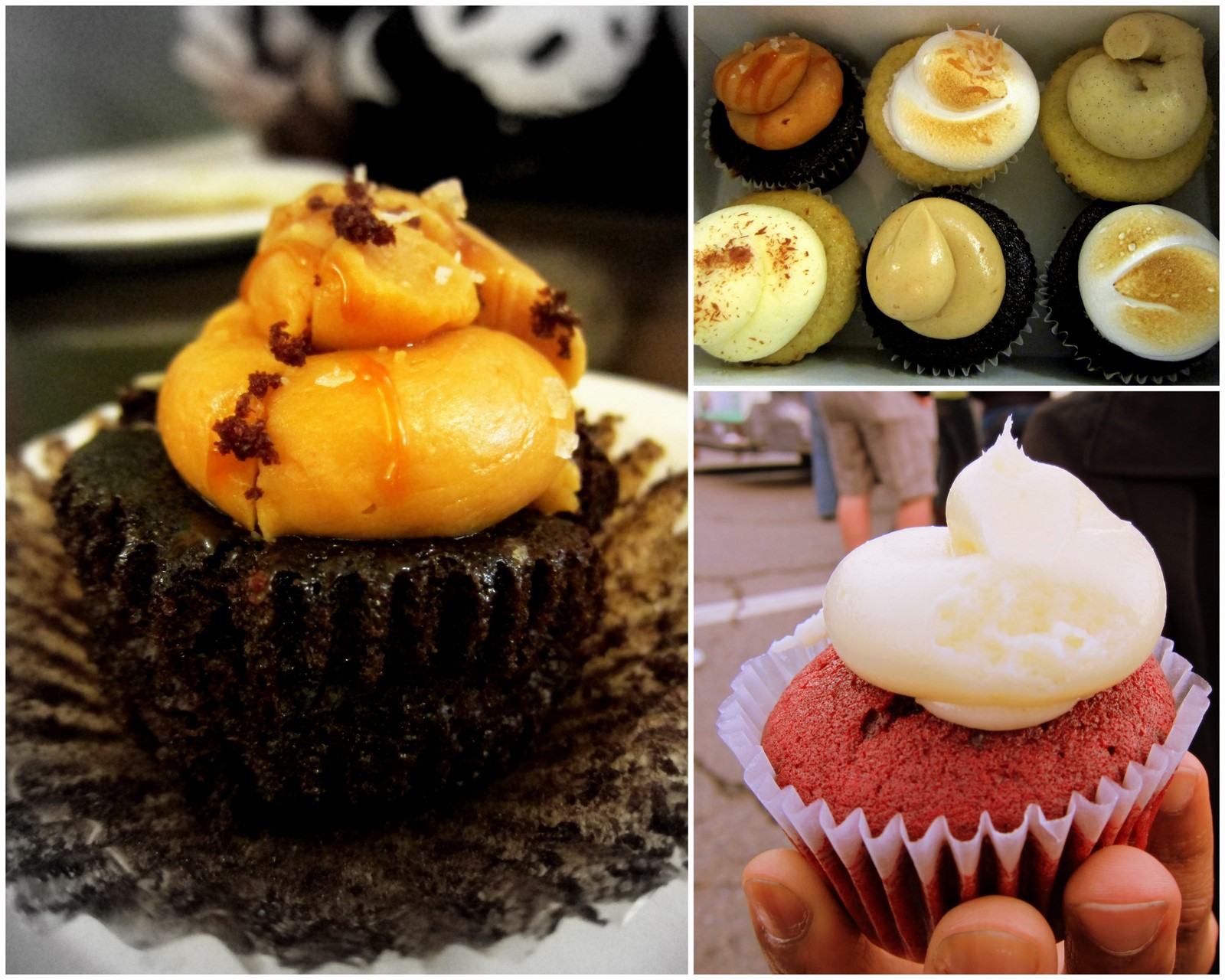
Hapa SF had some yummy chicken adobo. Fins on the Hoof had some terrible peach and goat cheese salad. Cupkates has some seriously sweet cupcakes.
Last time I spent ’bout $40 on various things here. Next time, it’d be $40 on the pork waffle sandwiches alone.
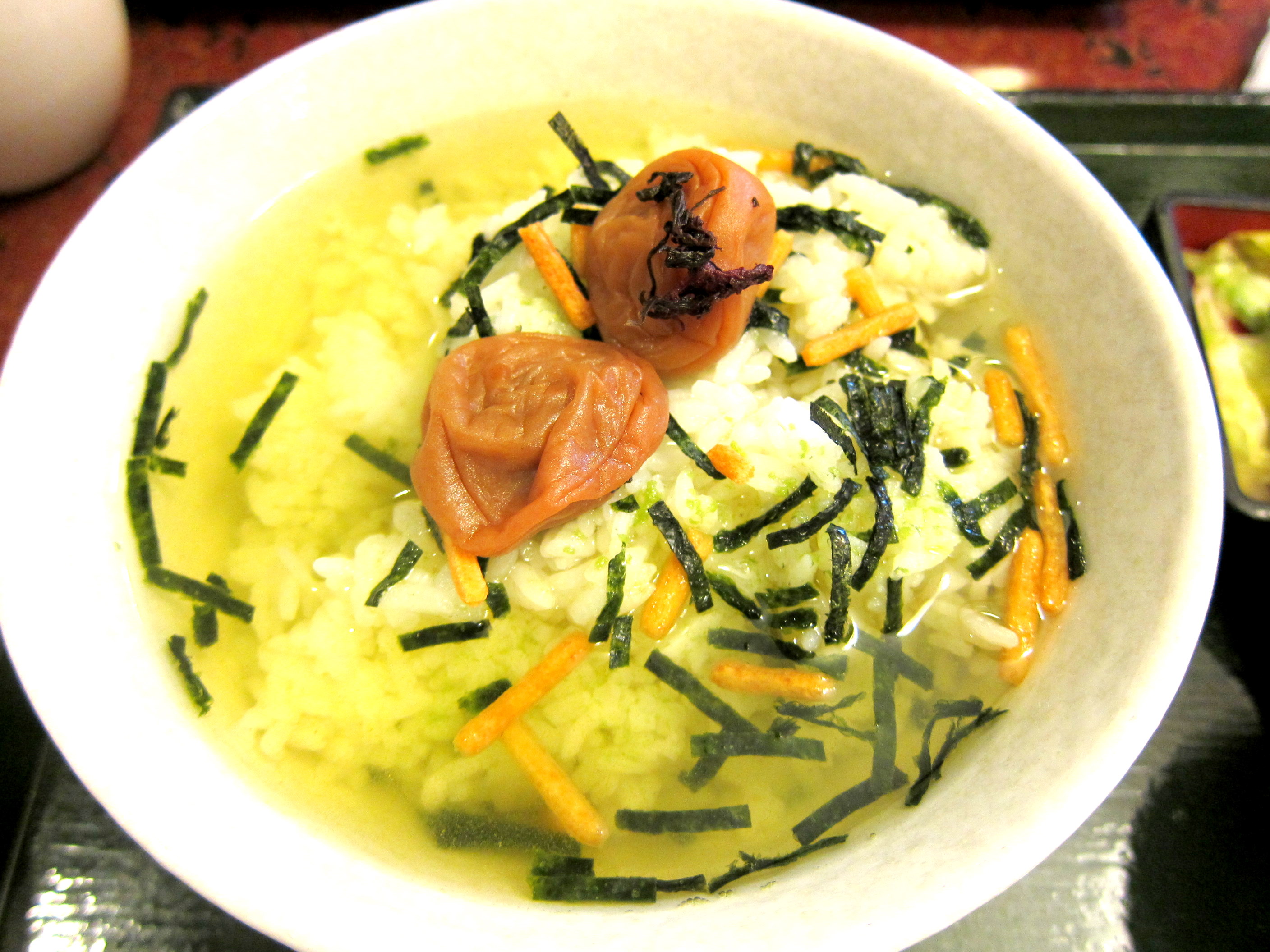
I’m trying to think of the reasons I keep confusing myself between Mifune (San Francisco) and Miyuki (North Berkeley) when I tell people about them. Admittedly they share some obvious similarities, as much as any Japanese restaurant would be similar to another Japanese restaurant. Miyuki is for donburi, and Mifune is for udon and soba. Not only that they’re totally unrelated, I also remember them for different reasons. But that in itself is another similarity: what makes me remember them is not the focus of their menus. When I think of Miyuki, I think of its eggroll and mango icecream dessert. When I think of Mifune, I think of its green tea rice.
Ochazuke (green tea rice) is not uncommon among Japanese and those who know Japanese food, but it’s uncommon in Japanese restaurants in America. In fact, I just now looked at every available menu in San Fran Japantown, and found no ochazuke. Mifune doesn’t have its menu online.
Like kimchi fried rice (and really, any kind of fried rice), ochazuke makes good use of leftover rice. Unlike fried rice, ochazuke is not fried. It’s soupy, with green tea being the soup. When you think about it, it’s not really that strange. A number of Vietnamese people, Little Mom for instance, like to pour the Vietnamese brothy soups (canh) into rice, the rice is thus flavored and not lumped together, making it easy and quick to eat. The Koreans have guk bap (국밥). I understand the principles, but personally, I don’t condone the practice. Rice is rice, soup is soup, and rice isn’t chewy like noodle to go with soups.
And this green tea does very little to flavor the rice. One could say the green tea is the cameraman, not the singer in this bowl, but simply put, it’s just outshone by the salty plum and the nori strips. That said, in hindsight, as much as I was bored by the tea-less taste of a watery rice, and as I’ve never had ochazuke anywhere else, it became a fond definition of Mifune, one that stays dormant for months and certainly has some influence on my next post.
Address: Mifune
1737 Post St.
San Francisco, CA 94115
(inside Japantown)