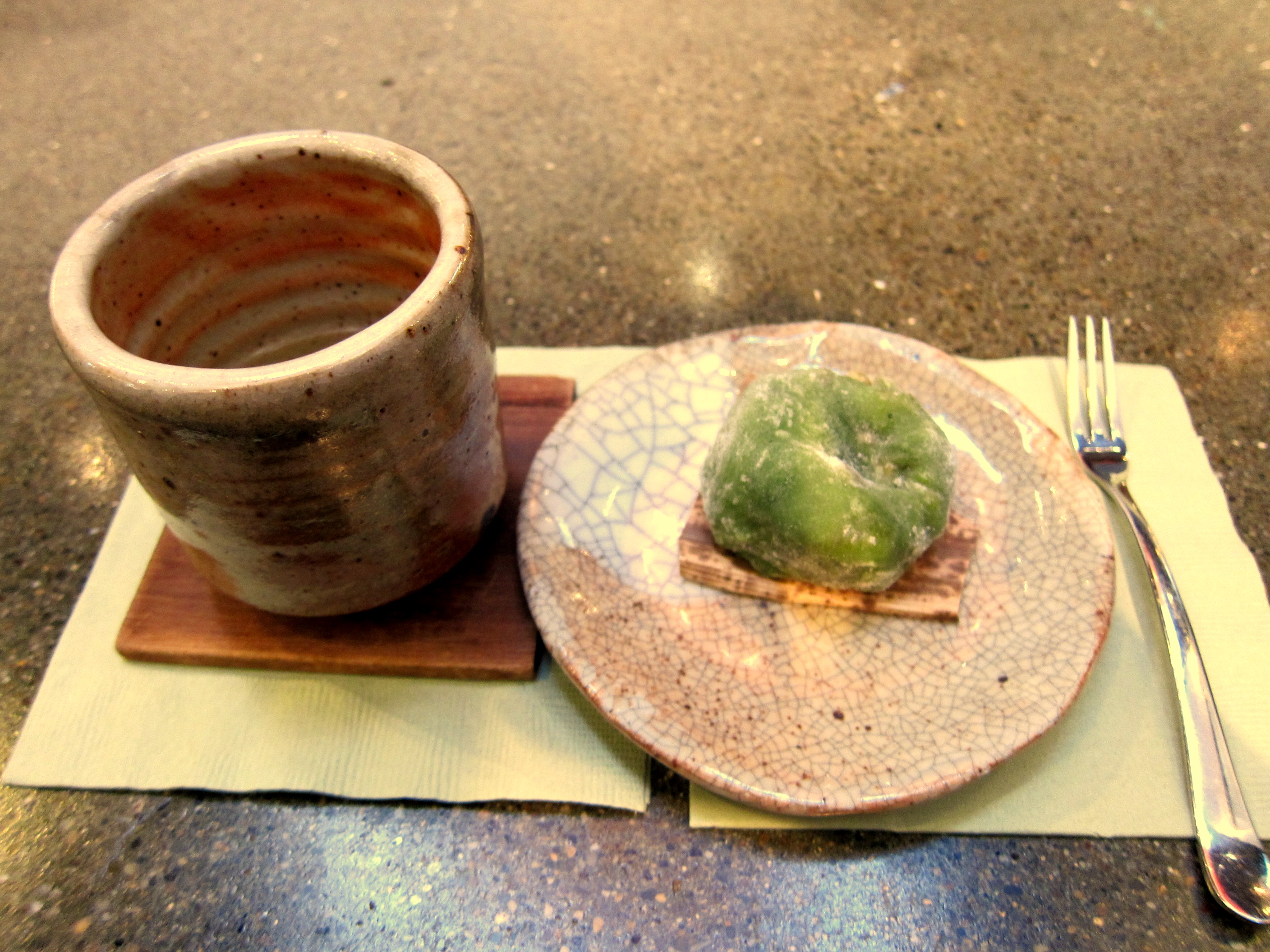
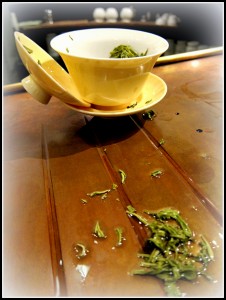
Sencha in yunomi, a typical Japanese thick, tall teacup, whose name I’ve yet to find out, accompanied by a matcha mochi, whose fillings include: satsuma sweet potato, red bean paste, orange juice and walnuts. (Thanks Masaaki for telling me the name of the cup in Japanese.)
The mochi, handmade and delivered by a mochi lady every week to Teance, is refreshing both in look and in taste. The green tea flavored chewy coat is cool and light. The filling, although dominated by red bean, is not too sweet. I opted for one with less nuts because I didn’t think that I would want such contrast in texture. The mochi lady is a small, timid Asian lady, who smiled so happily when I described her mochi as “refreshing”, and who showed me that I should dip my fork into tea or water before cutting the mochi so that it would not be sticky. Yes, it worked, the fork went straight through with such ease. Now it makes sense why we can chew without the mochi sticking to the teeth.
This is my second time having sencha, if we don’t count the time I had genmaichaat Ippuku (genmaicha is lower-grade sencha with roasted rice), and the seaweed taste of sencha has grown on me. However, I am not convinced that the sencha is a good match for the mochi. Both are good by themselves, but I think the sencha should be an entree tea, not a dessert tea. Its seaweed taste would enhance something savory. A mochi would fare much better with a light, floral tea that isn’t too dry, like Yellow Gold, Royal Courtesan, or Darjeeling First Flush.
Sidenote: this sencha at Teance is the hand-picked Yakichi sencha, named after the farm “founded by Mr. Shimooka[…]. Yakichi sencha is an eight-time Ministry of Agriculture award winner, and also the winner of the highest agricultural award, the Imperial Prize. […] This traditional Japanese tea is shade grown (kabuse) in the mountains above Uji.” (description from Teance webpage)
Meghan explained to me that shade grown leaves are of higher quality because when the plant is shaded, it has to produce more chlorophyll to balance the lack of sunlight, resulting in a greener leaf (or maybe a darker green leaf?). According to The Tea Detective, “the increased green chlorophyll pigment changes the natural balance of caffeine, sugars, and flavanols in the leaf. It also increases L-theanine, an amino acid found naturally in tea, that adds a unique vegetal quality to the flavor, and helps counteract some of the stimulant effects of caffeine, thus having a relaxing effect on the body, yet an alert state of mind. Photosynthesis reduces L-theanine and increases tannins, the compounds responsible for teas astringency.” Basically, kabuse (shade grown tea) is sweeter, less bitter, and less dry.
Address: Teance Fine Teas Store
1780 Fourth Street
Berkeley, CA 94710
510-524-2832
Money matter: the mochi is $4 each. A little pricey, but somehow it seems reasonable to me.
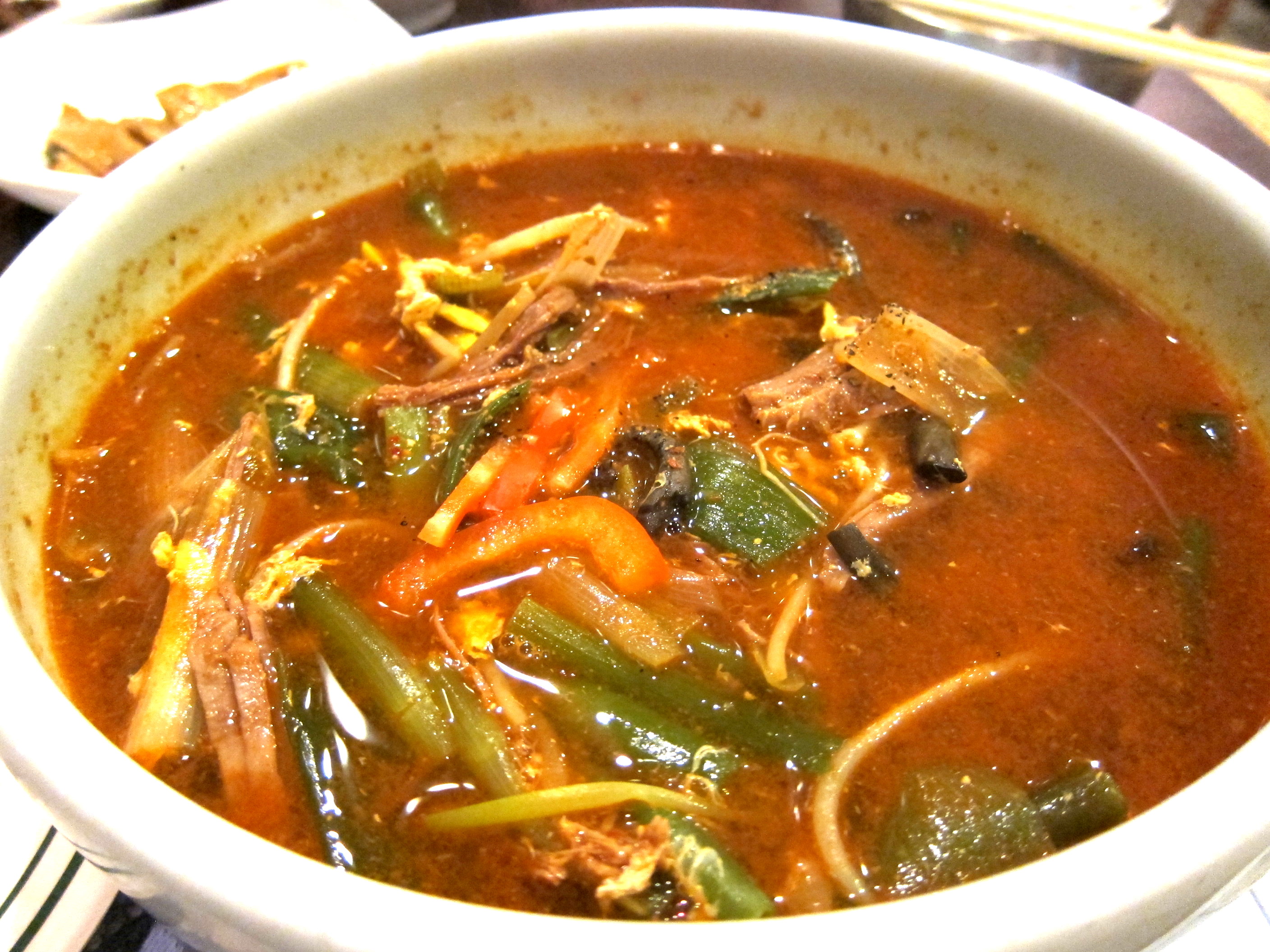
A while ago, I was fairly convinced that of all the different types of spiciness, I can handle the Korean spiciness. Take kimchi for instance, it usually looks scarier than it tastes, and the scorching can be quickly washed away with corn tea. Not an eye was bat when I saw the garnet broth of Il Me Jeong‘s specialty. It’s just loads of shredded beef, sesame leaf, glass noodle, green onions, etc., in a thin soup. Then tears rained down.
No more yuk gae jang (육개장) for Mai. Ever.
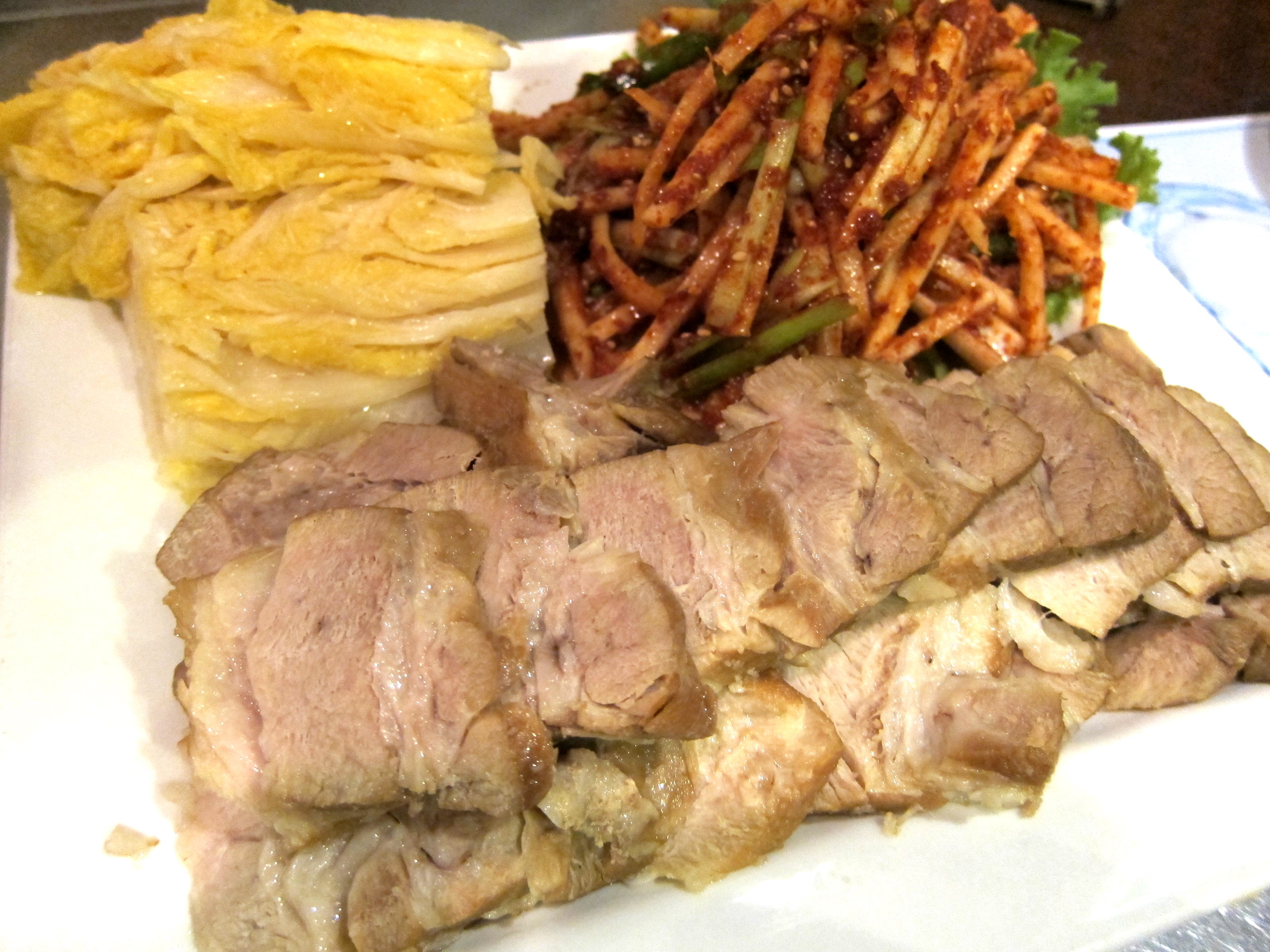
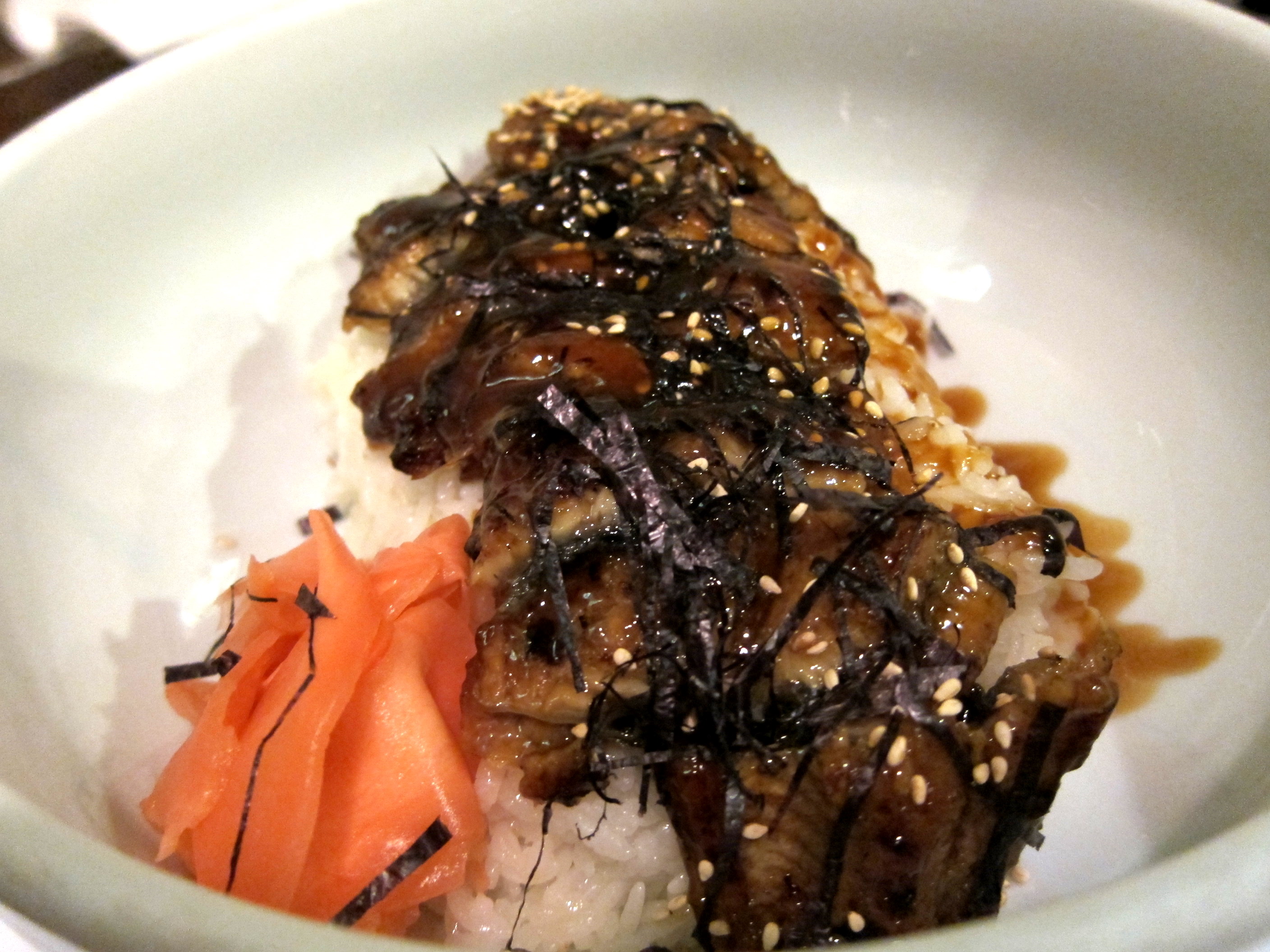
Il Mi Jeong has good unagi don and bossam though. 😉 Go for those instead.
Address: Il Mi Jeong (or Il Mi Jung)
10017 Long Point Road
Houston, TX 77055
(713) 827-8808
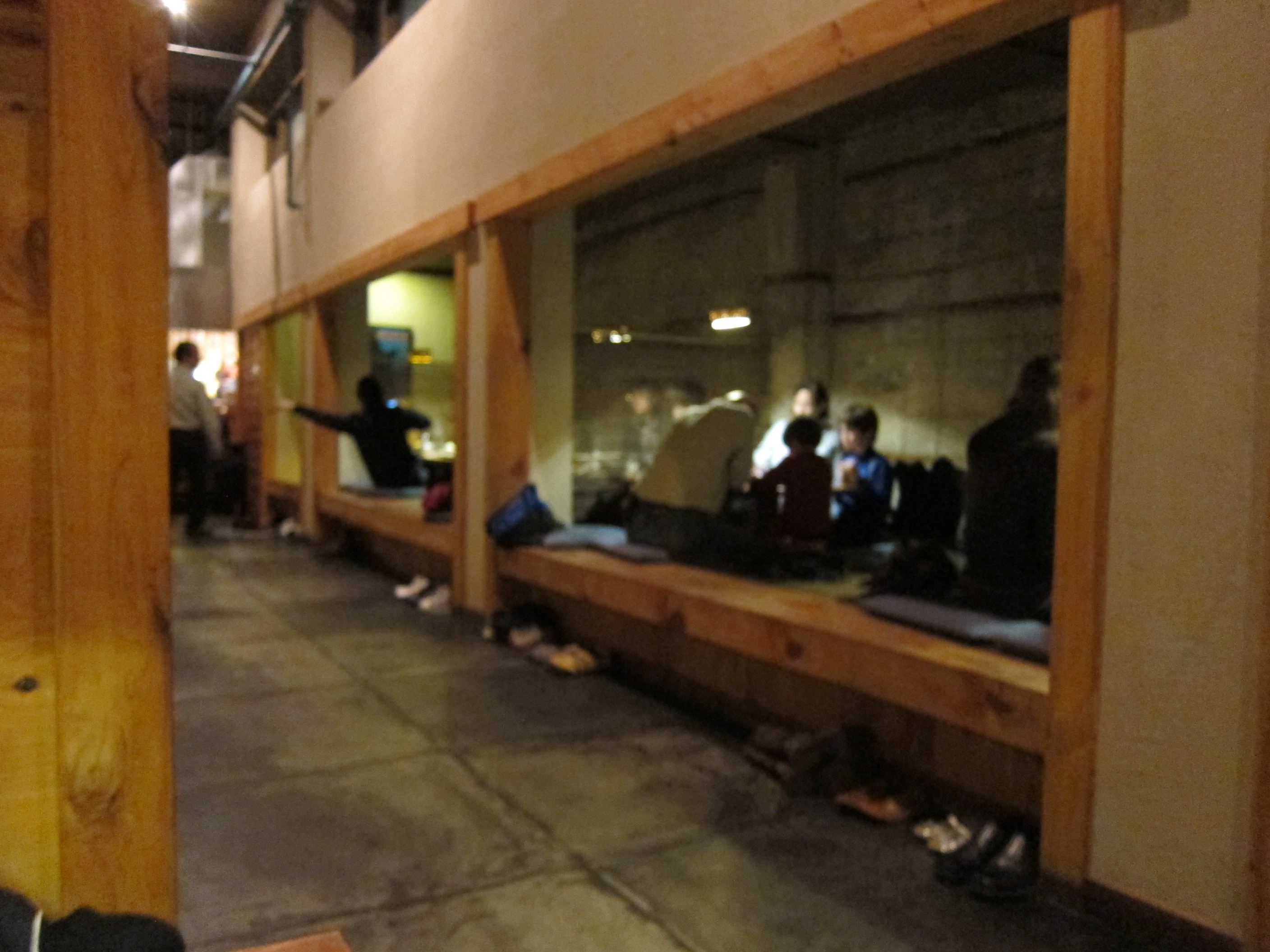
Maybe it’s the signless entrance that camouflages the izakaya in the dark, minus the dimly lit sake bottles on the side and the closed door, which I can never open correctly from the inside. Maybe it’s my distrust of Yelp reviews. But I brushed through the cotton curtains to enter that long, dark, narrow, stark simple structure, saw the half-shadowed faces immersed in quiet enjoyment, and the wooden platform, on which you can sit seiza style (flat kneeling) or dangle your feet under the table like a true Westerner; from that moment, I decided that it’s a lovely place, no matter how the food was. Of course, the food was good.
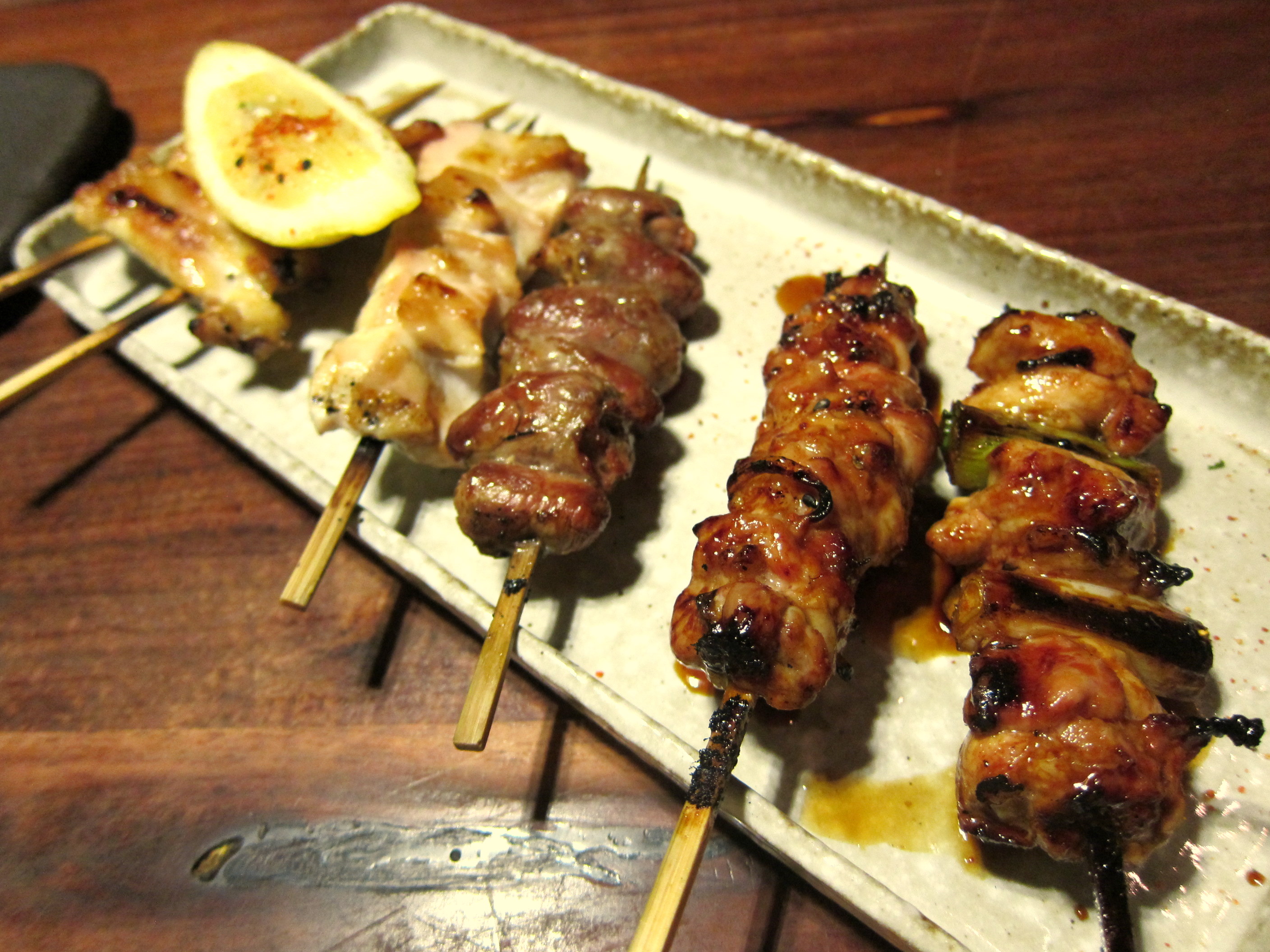
The most written thing about Ippuku must be the collection of all-part chicken edibles. Every single blog and its best buddies have something to say about (and a picture of) the omakase gushi ($14, 5 chef-choice skewers), which might include gizzards ($6.50), hearts ($6.50), shoulders ($6), necks ($6.50), breasts ($6), wings ($6.50), thighs ($6), tails ($7), varying throughout the night. They also have knee cartilage ($7) and breast cartilage ($7), which gets sold out before 6 pm. Growing up, I’ve had my shares
of chicken from head to toe to bone marrow, and I still clean the chicken bones to its dryest whenever possible, so this is old game. It’s not that “Ippuku uses every part of the chicken to its best effect”, Ippuku simply uses every part of the chicken and (hopefully) convinces the Western palate that white meat isn’t everything (if it is anything). The chewy crunchy gizzards and hearts made me feel at home.
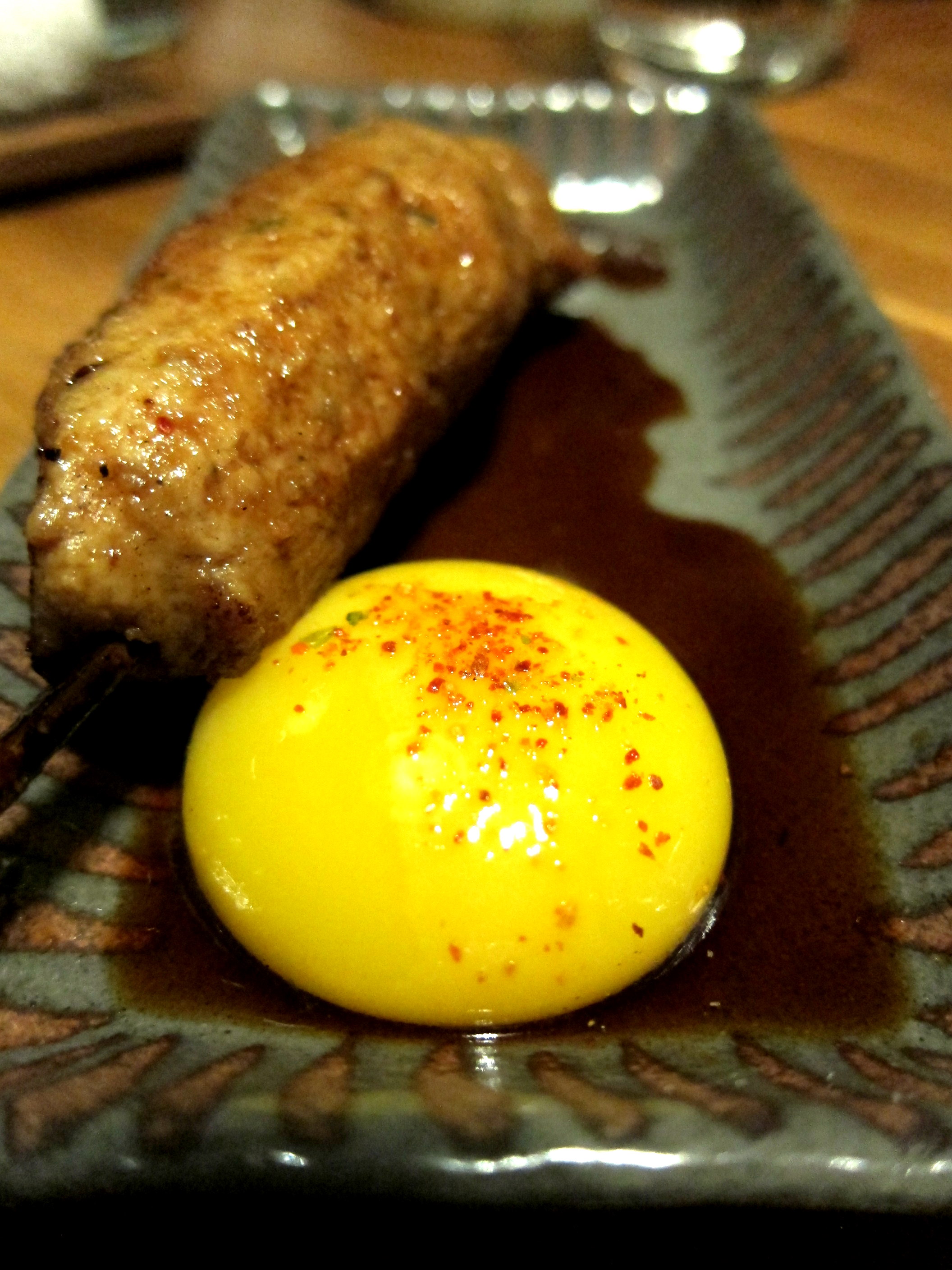
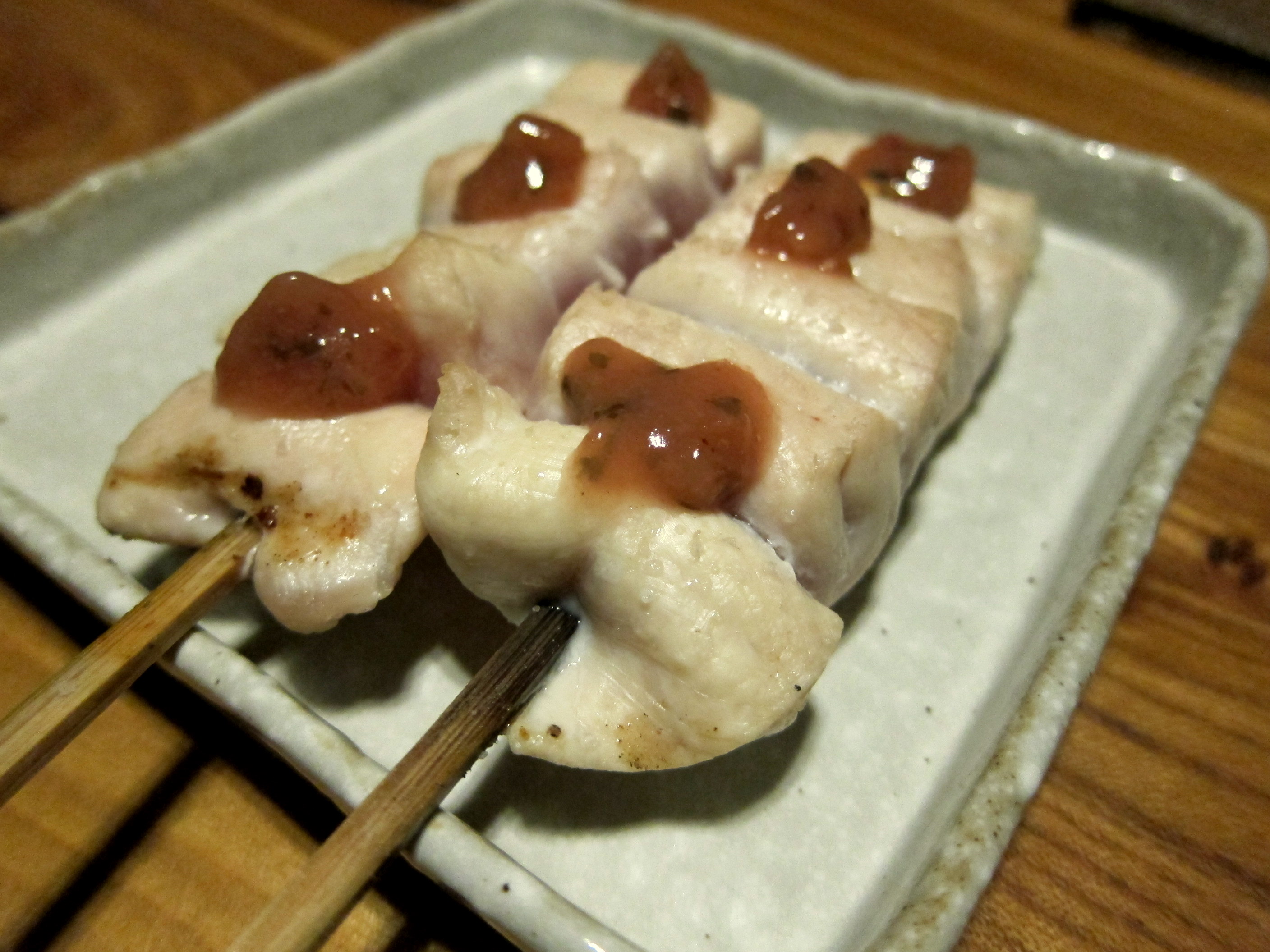
New to me was the lightly seared chicken breast, raw inside, dappled with ume ($8, sasami ume). Its rawness saves the white meat from being all dried up, the salty plum tickles the tongue. I like it more than I expected.
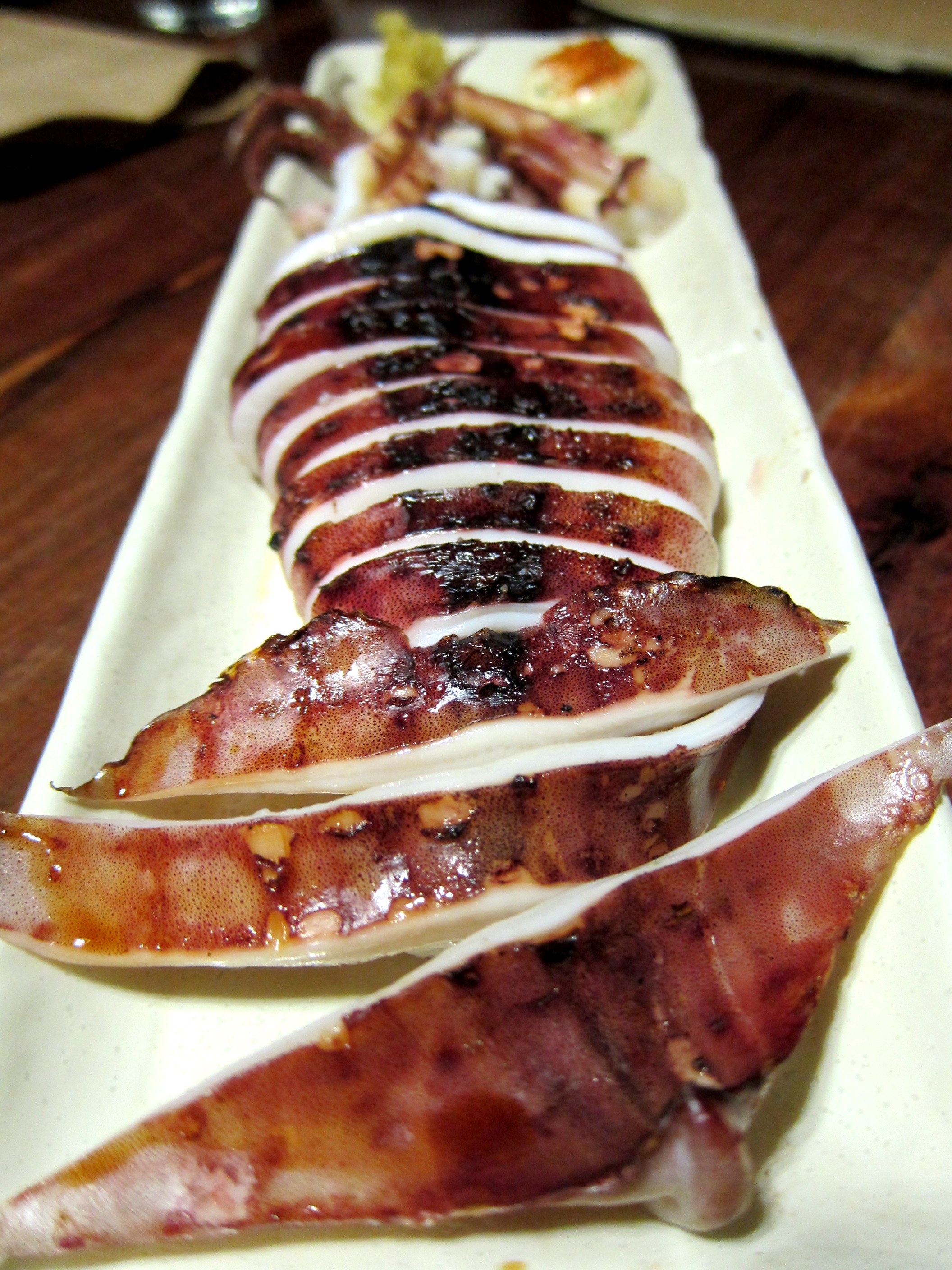
There are some good-but-not-brilliant things, such as the tsukutama ($7, minced chicken with an egg yolk), the negima ($6.50, chicken thigh with leeks), the aosa tenpura ($7, Okinawa styled seaweed tenpura), and the giant grilled Eastern Pacific squid ($10, ikayaki) (ok, so it was giant for 2 girls).
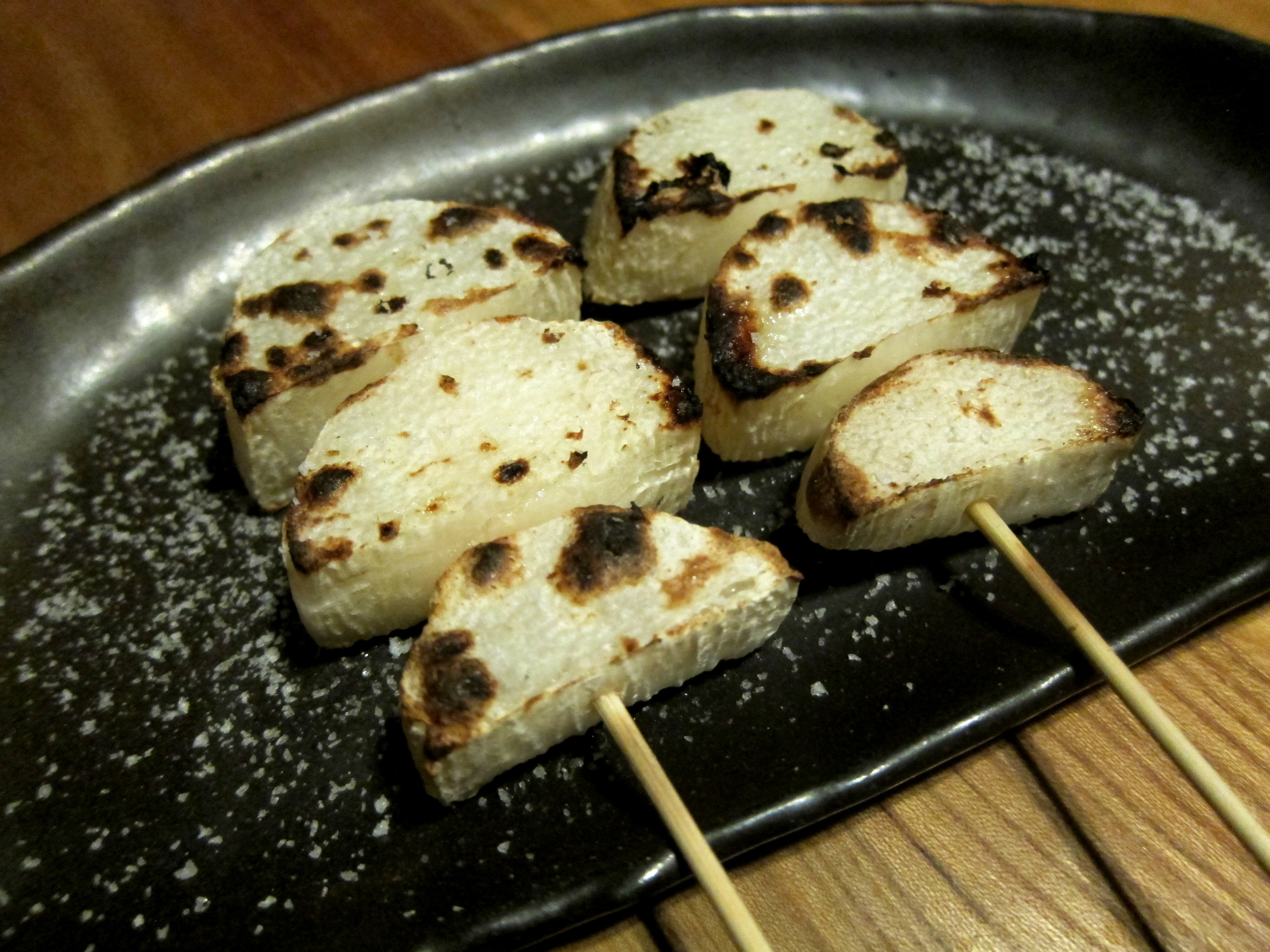
Granted that izakayas in the States are always expensive, there are also the blatant rip-offs: ikada ($5, grilled leeks), which is negi, and none of us knew what “negi” was at the time, or grilled yamaimo ($6), a white yam that is crunchy outside and sorta slimy inside (củ mài in Vietnamese). Oanh said that they’ve had it raw at another izakaya, and I think I would prefer this grilled version dusted with sea salt.
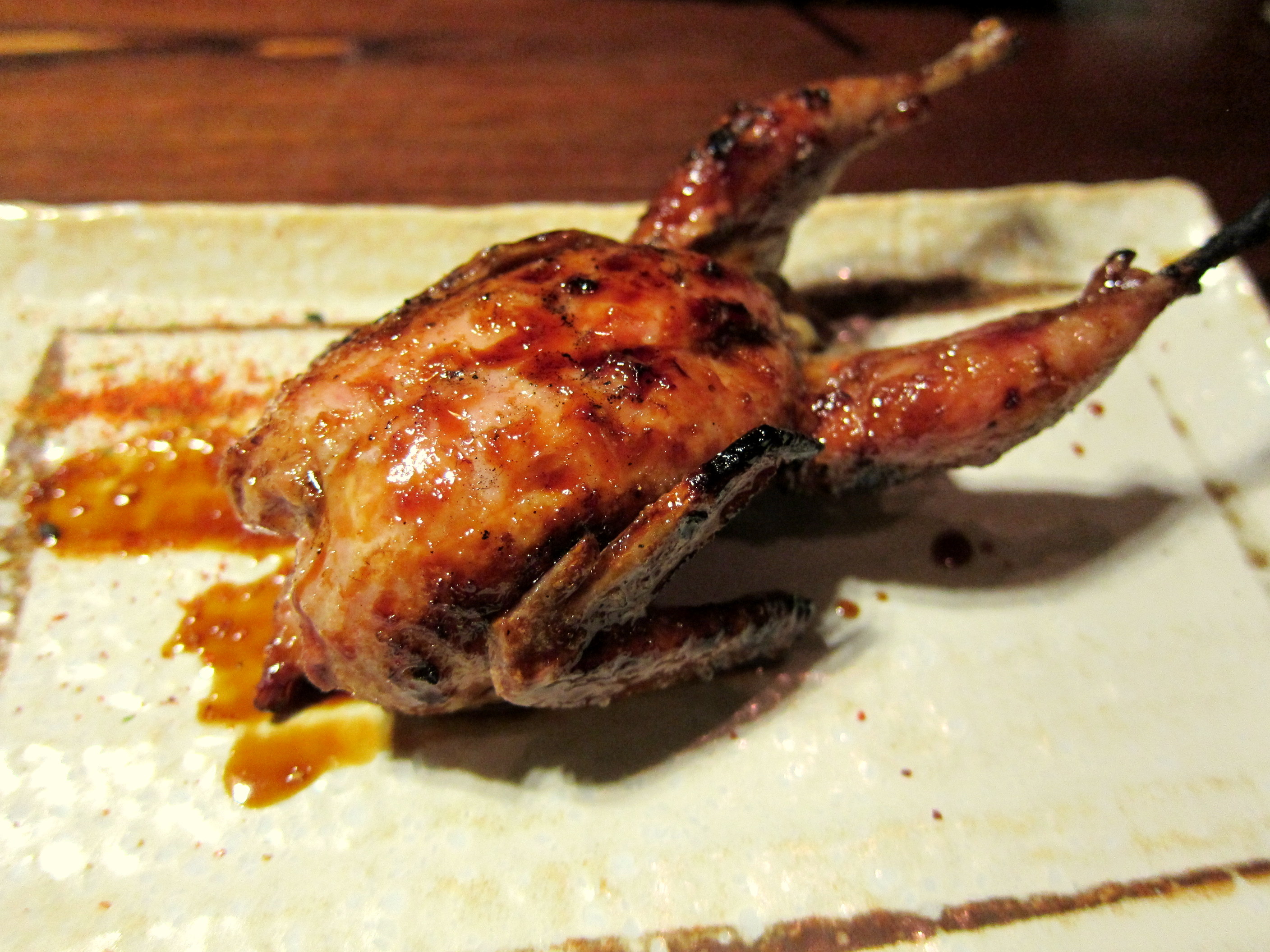
Then there are the oversalted ones: a juicy deboned and grilled quail ($10, uzura maruyaki), which Kristen and I split by each pulling a wing and a leg, and 2 pieces of pork belly ($8, kurobuta bara). But these are best tempered with a sip of genmaicha, whose seaweed flavor might seem strange at first.
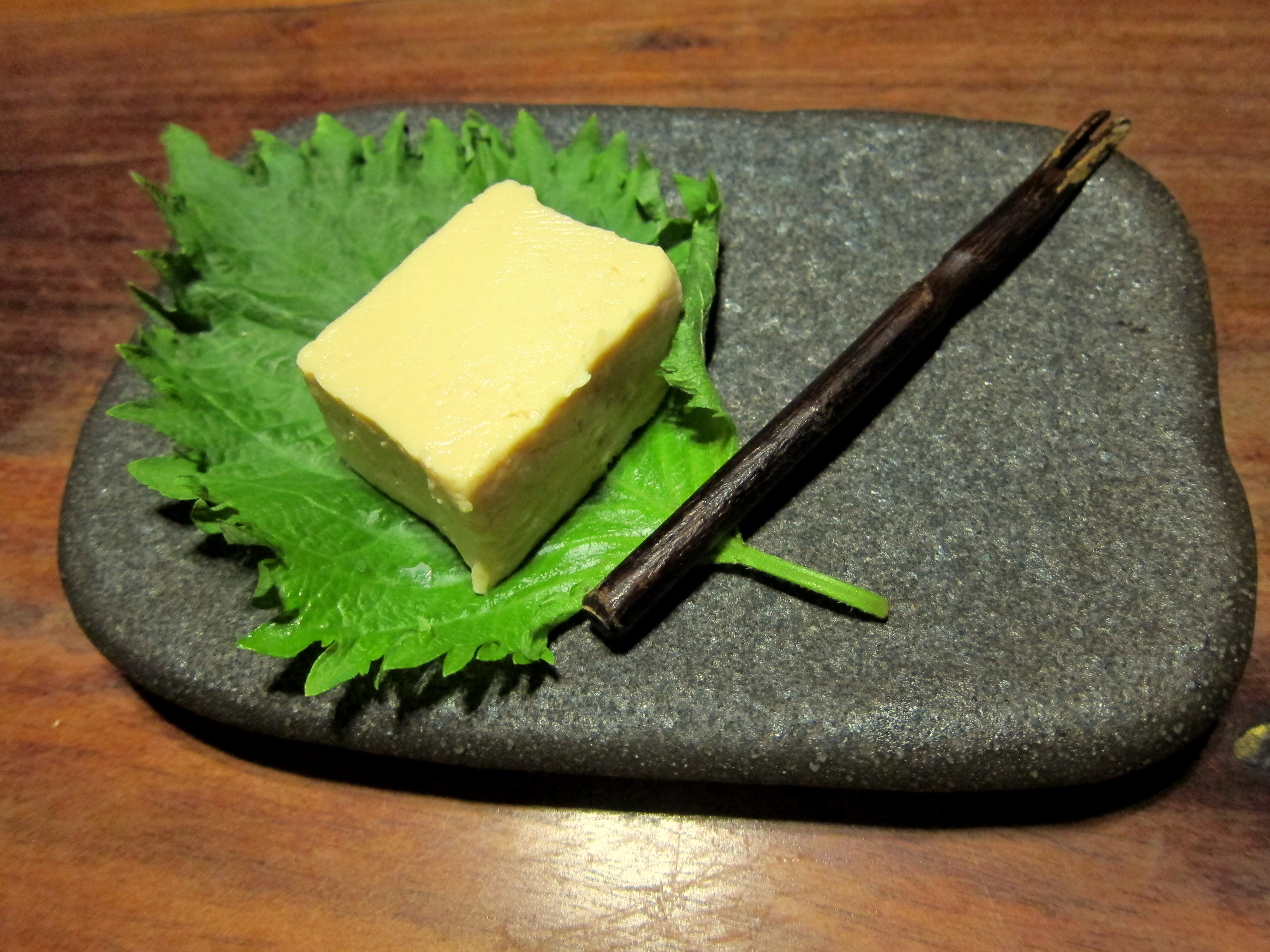
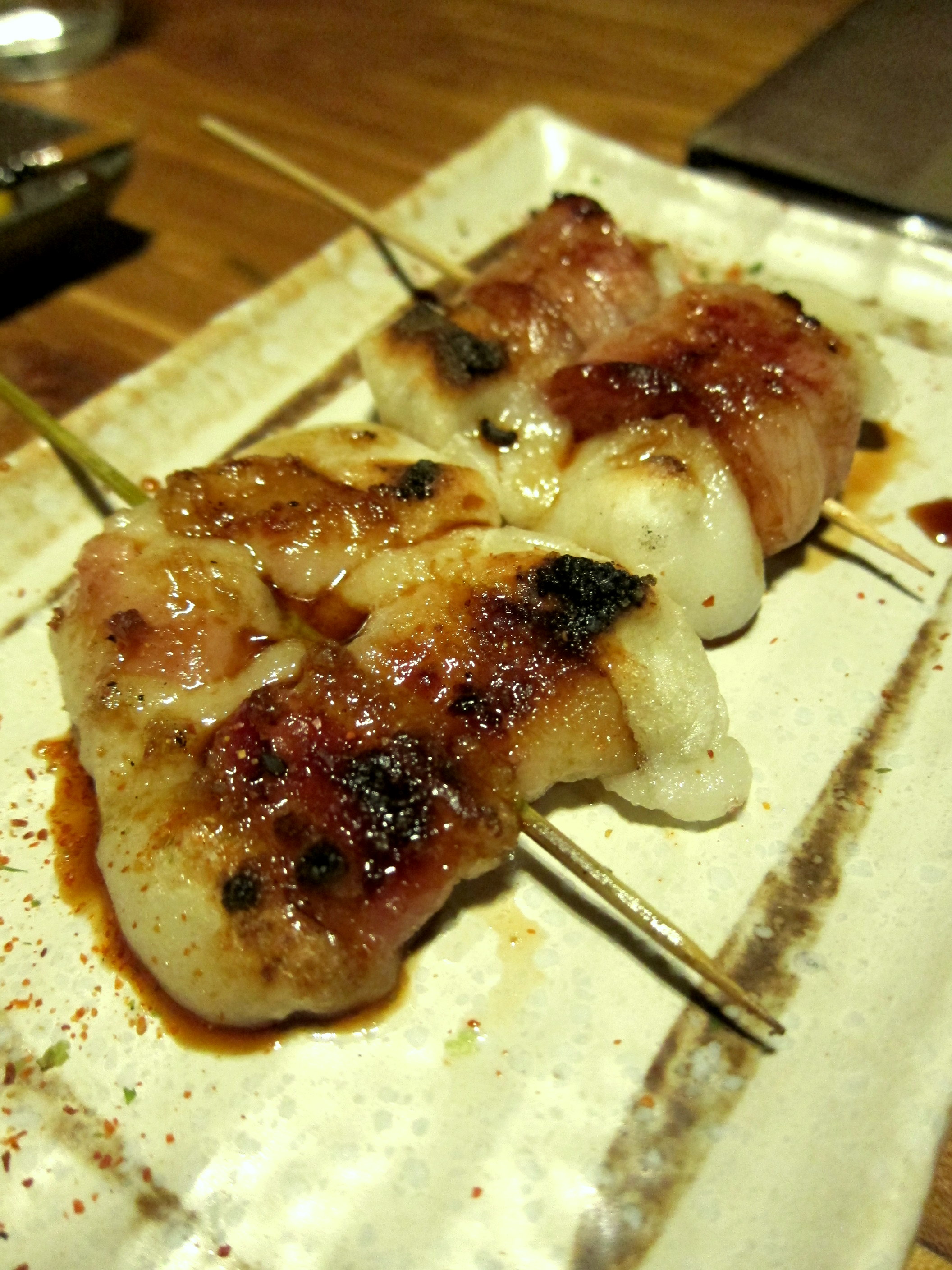
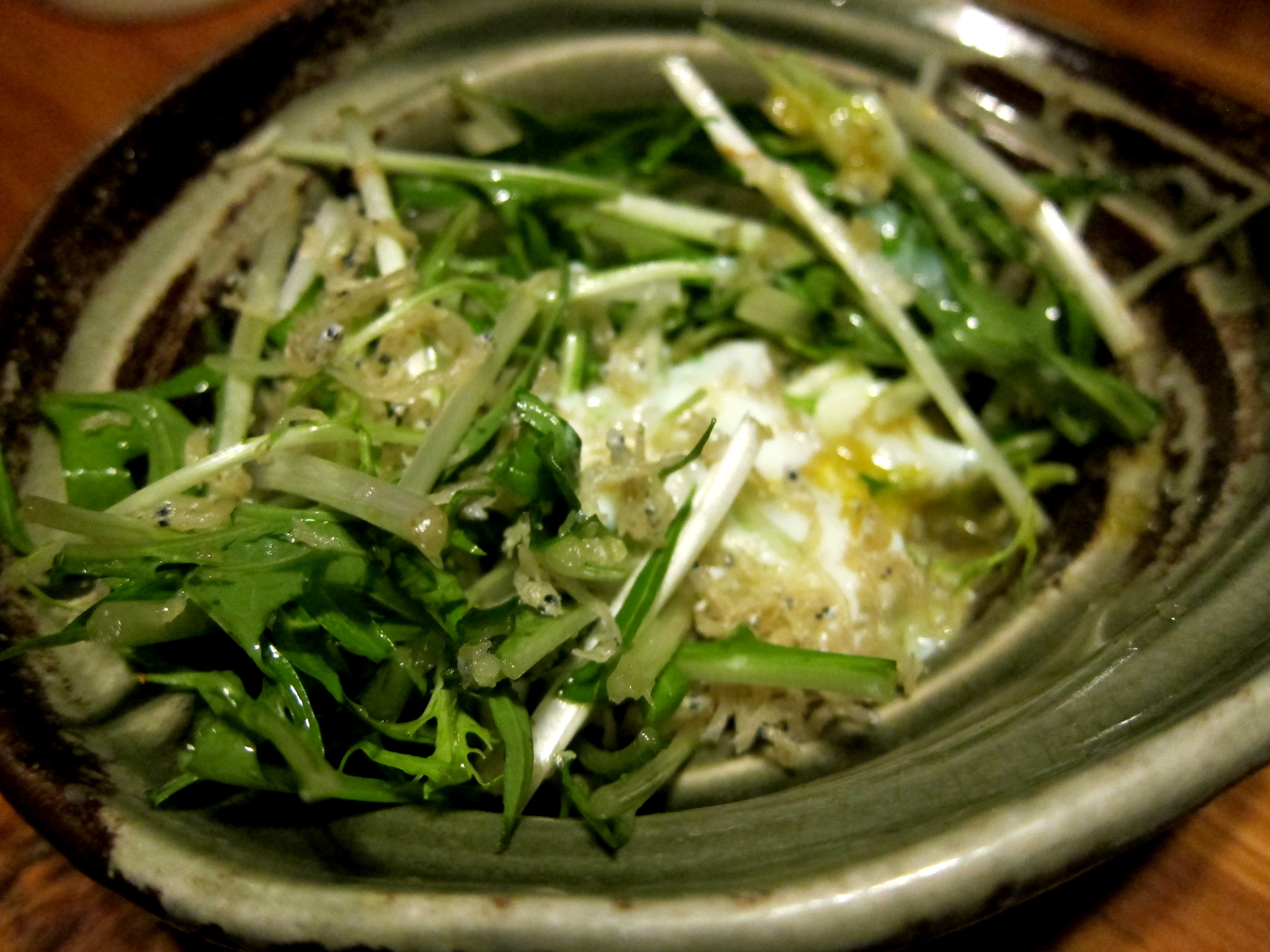
Among my favorites must be the mushy jaga bata ($5, mini potato with butter), which I combined with Rau Om‘s tofu misozuke for a briny but creamy note. The simple but refreshing kyo-salada ($6, “mizuna with onsen egg and crunchy jako“, or water greens with poached egg and crunchy dried anchovy). And the chewy, glistening, charred bekonmochi ($5, bacon-wrapped plain mochi) was magnificent.
The shushoku (post-drinking dishes) are richer than ever: a fatty, sweet, brownish yellow chicken broth for the tori udon ($7) and chunks of beef in the niku jaga ($12, a thick stew of meat and potato).
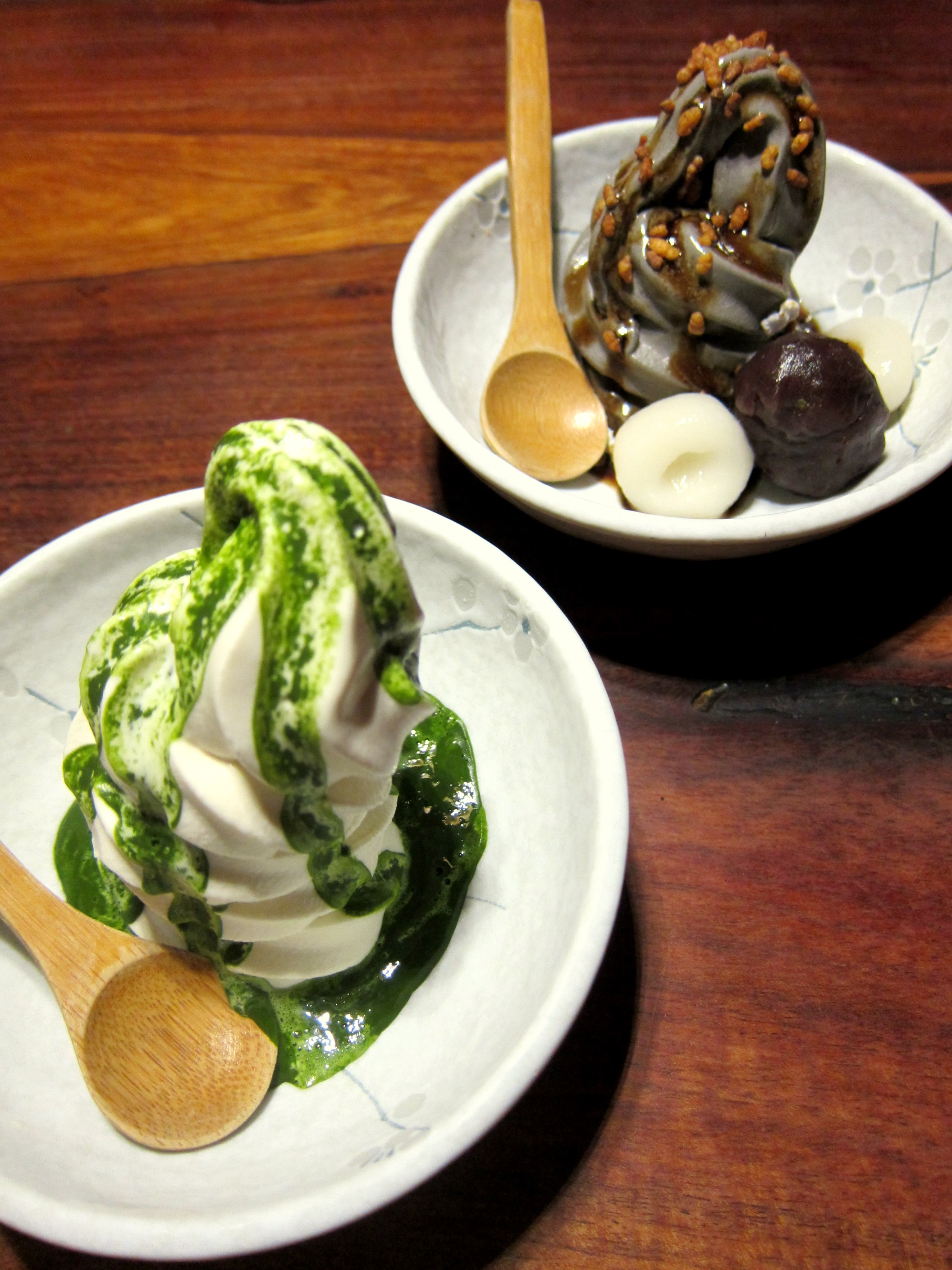
These stomach cementers demand a sweet ending, which we couldn’t afford the first time due to a time constraint, but I made up for it the second time by ordering two desserts ($7 each): a matcha affogato (green tea soft serve), cleansing and herbal, and a kuro goma sundae (black sesame soft serve), gentle and nutty. The kurogoma ice cream came with 2 white mochis and a scoop of anko (red bean paste). I love black sesame ice cream no matter what it comes with.
Photography used to not be allowed? I was taking pictures like crazy. Smoke issue after 7 pm because of the grill? I have been here until 10 pm. Undertrained staff? Our hostesses were helpful both times. Ippuku seems to have ironed out any technical problem it might have had 2 years ago, and although its food isn’t flawless, it is perfect as a whole.
February 22, 2012By: Mai Truong Category: Drinks, Opinions
Introducing a new site I’m working on: Tea and Mai. 🙂
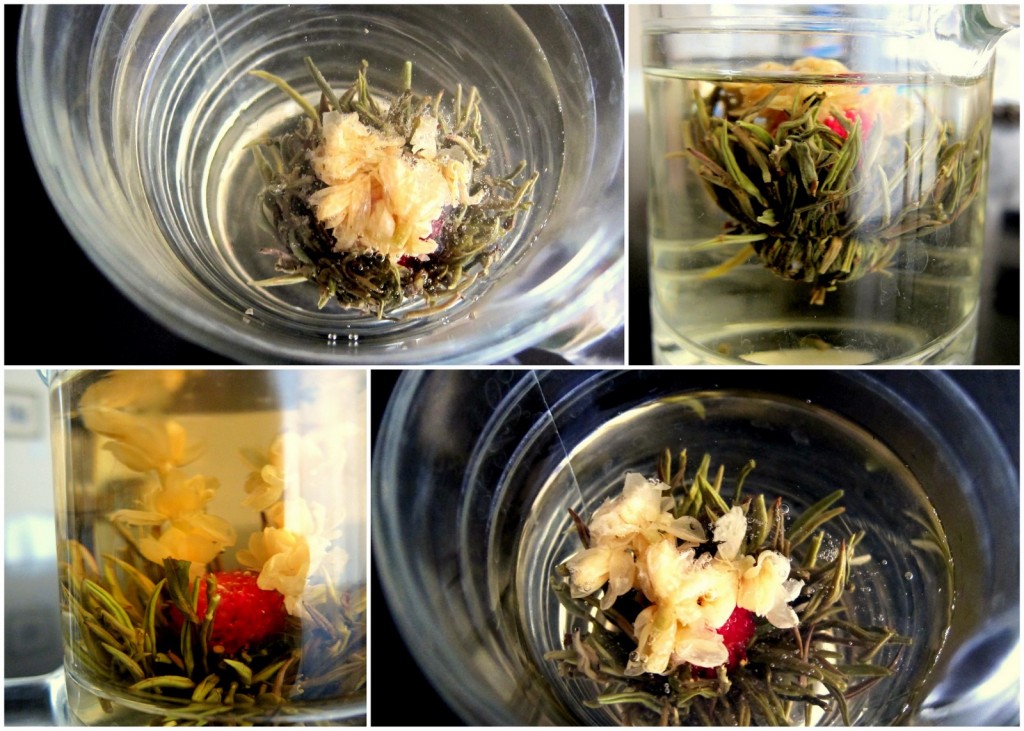
Now that I’m regularly attending a tea class and seriously inspired to learn about tea, I figure that I should write down what I learn instead of trying to memorize everything in vain. Consider it also my little contribution to the environment by going paperless. 😉 Why make a new site? Because I don’t want to turn Flavor Boulevard into chock-fulls of yellow-tinted drinks. On relevant occasions there will be posts shared on both sites though, such as this one in the picture above: a post on a few Blooming Teas.
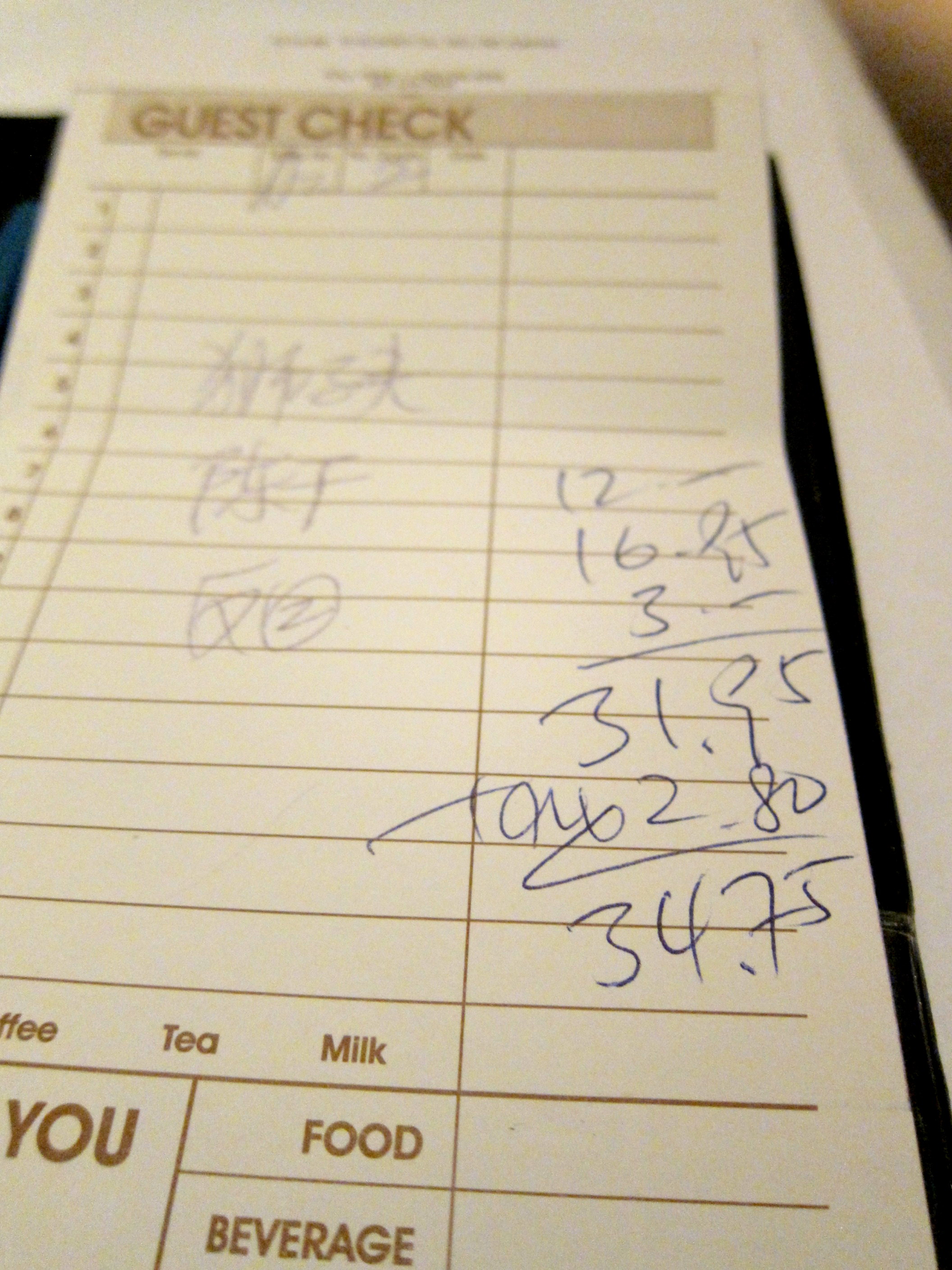
Rice comes as a side dish at Renee’s Place on Solano. I can’t imagine anyone eating orange scallop (it’s like orange chicken, but with scallop) and lion’s head meatball without rice, but whatever, it could just be because I’m Asian. But 3 dollars for what seems to be a cup of rice is just too far. The rice is dry and fluffy and nicely done alright, but *three* dollars?
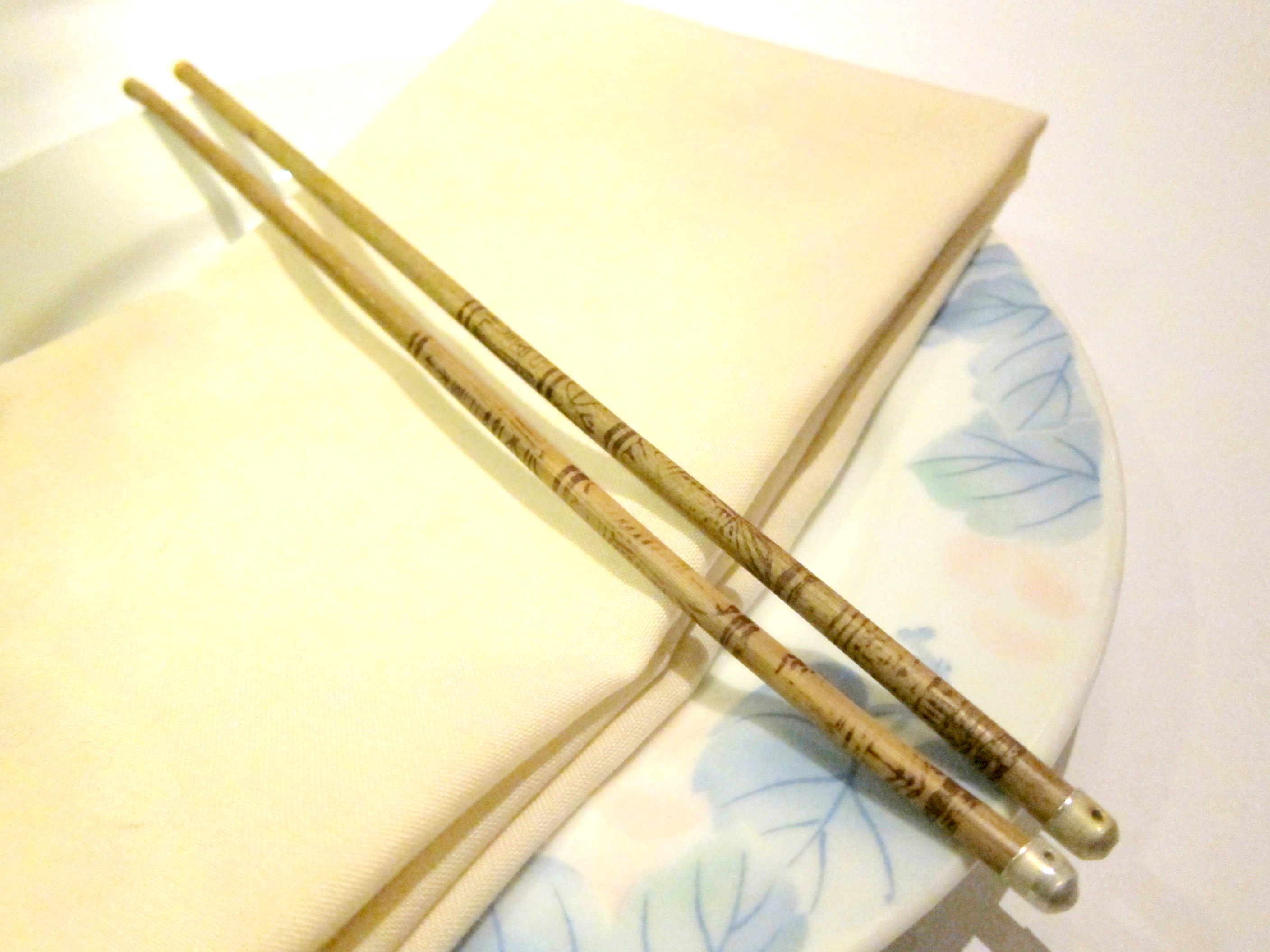
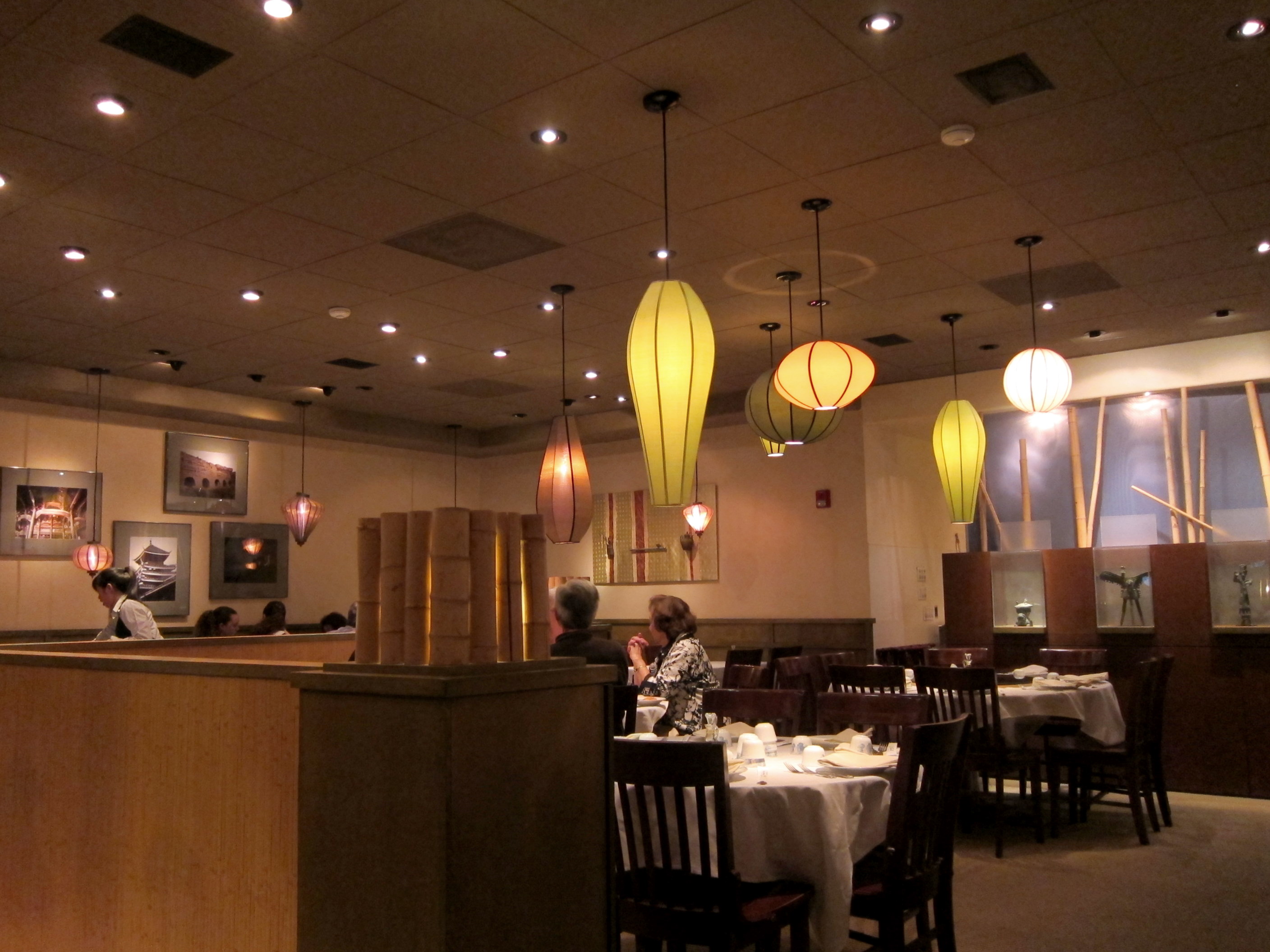
Originally, Kristen and I planned on a Japanese dinner, but it was too crowded and we didn’t have reservation. Then we got on the bus for Korean, but the long line also shied us away… to the Chinese place next door. The bamboo-themed decoration is quite pleasing. They also have the most beautiful bamboo chopsticks I’ve ever seen:
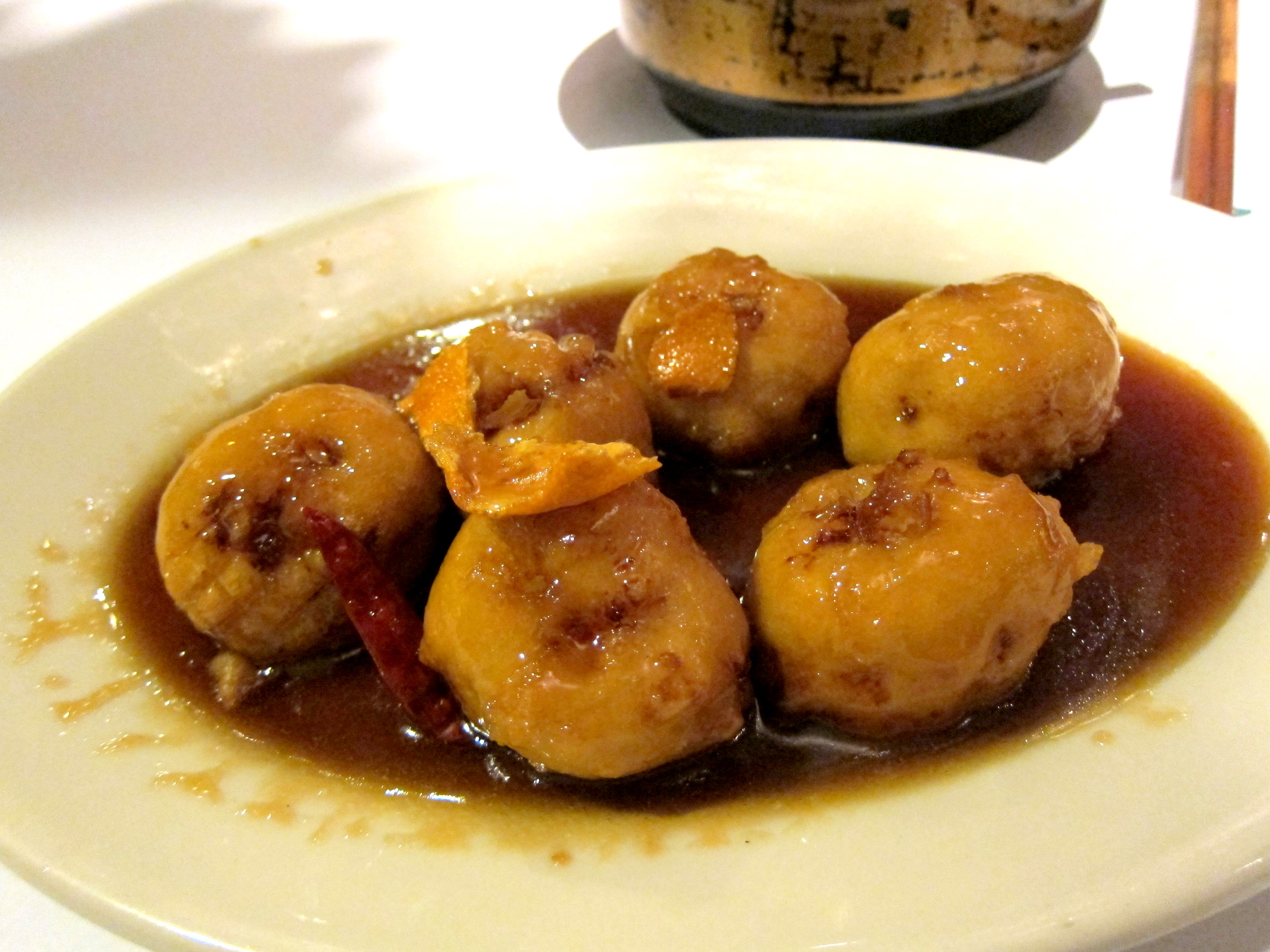
Battered fried scallops in orange and garlic sauce with orange peel.
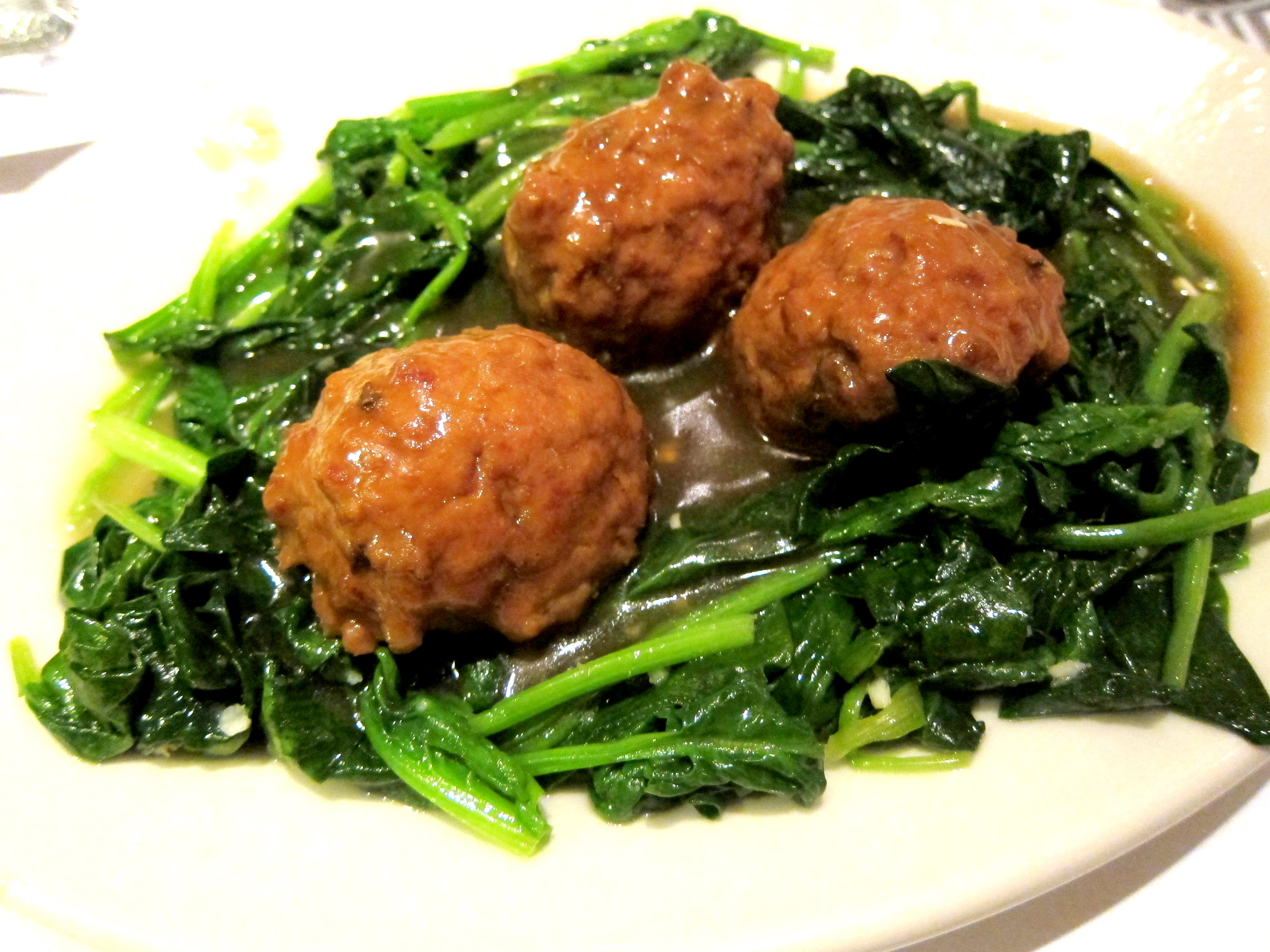
Lion's head pork meatballs with sauteed greens
The food? Meh. The orange peel in the orange scallop is really just dried orange peel with no flavor. The dishes sound and look better than they taste. The water was very good, though.
Address: Renee’s Place (organic Chinese)
1477 Solano Avenue
Albany, CA 94706
… with English subtitles. It’s no secret that I’ve been into tea recently, and the interest is going to last for a while. Just in time for my mini-presentation in the Korean class, the topic was open, and I chose tea. Vietnamese tea, to be precise. Neither my Korean is good enough nor my tea knowledge is broad enough to give a more detailed slideshow, but it’s a start. Both will come, in time. 🙂
The title of the slideshow is “Vietnamese Tea”. I have no idea how bad my Korean pronunciation is, so I’ll just pretend that I don’t sound all *that* bad. 😉 I can understand myself, with the subtitles. 😉
Korean script: (thanks to Yookyung unni for her major help with the translation)
차를 좋아합니까?
베트남 문화에는 일본과 같은 다도 문화는 없지만, 차를 마시는 것은 음악 연주, 체스 놀이, 시 쓰기, 그림 그리기와 같은 일종의 취미 생활이다.
아침이나 저녁에 혼자 차를 마시는 것은 마음을 순화시키고 자신의 본성을 받아들이는 데 도움이 된다. 이러한 점에서 베트남 사람들이 차를 마시는 것은 한국의 선비다례와 유사하다.
친구들과 편안한 대화를 나눌 때에도, 차를 마시면 좋다.
베트남에서는 손님께 존중하는 마음을 표시하기 위해 (항상) 차를 대접한다.
베트남 차 문화에서는 차를 마시는 부분보다는 차를 만드는 것에 중점을 둔다. 보통 베트남 사람들은 평이한 맛의 차보다는 꽃이 첨가된 차를 선호하고, 녹차와 같은 가벼운 맛의 차보다는 홍차와 같은 강한 맛의 차를 선호한다. 보통 녹차에는 향을 위해 쟈스민이나 국화를 첨가하지만, 가장 귀한 차는 연꽃을 첨가한 차이다. 이 연꽃차는 오직 베트남에만 있다.
연꽃차는 연꽃의 수술을 녹차에 섞어 향을 내고, 이미 향이 우러난 수술을 제거한 후 다시 새로운 수술을 섞는 과정을 다섯 번에서 일곱 번 반복함으로써 만들어진다. 킬로그램의 연꽃차를 만들기 위해서는 약 2000송이의 연꽃이 필요하고, 이 연꽃들은 해 뜨기 전에 수확해야한다. 이 과정을 끝내는 데는 2주정도의 시간이 걸리기 때문에(걸릴 수 있기 때문에), 이 차는 매우 비싸고 희소하다.
연꽃차의 향은 쟈스민 차의 향처럼 직접적이고 강하지 않지만, 달콤하며 은은하게 지속된다. 연꽃은 진흙탕에서 자라지만, 그 향때문에 순수함을 상징한다. 그래서 사람들은 연꽃차를 마시면 좀 더 순수해지고 정직해질 수 있다고 믿는다.
차를 마실 때에는 “믙”하고 연꽃의 씨 하고 가벼운 과자 (페이스트리)를 곁들여 먹는다.
보통 한국다기도 일본다기도 오찯잔이 있지만 베트남다기는 사찯잔이나 육찯잔이 있다.
베트남 사람들에게 다기는 존경심과 사랑을 표현하기 위한 선물로 좋다. 우리(나의) 할아버지께서 돌아가시고, 가족이 미국으로 건너올 때, 우리(나의) 어머니는 할아버지의 다기만을 가져오셨다.
나는 베트남의 차에 대해 더 배우고 싶다. 당신은 어떤가? 당신은 어떤 종류의 차를 좋아하는가?
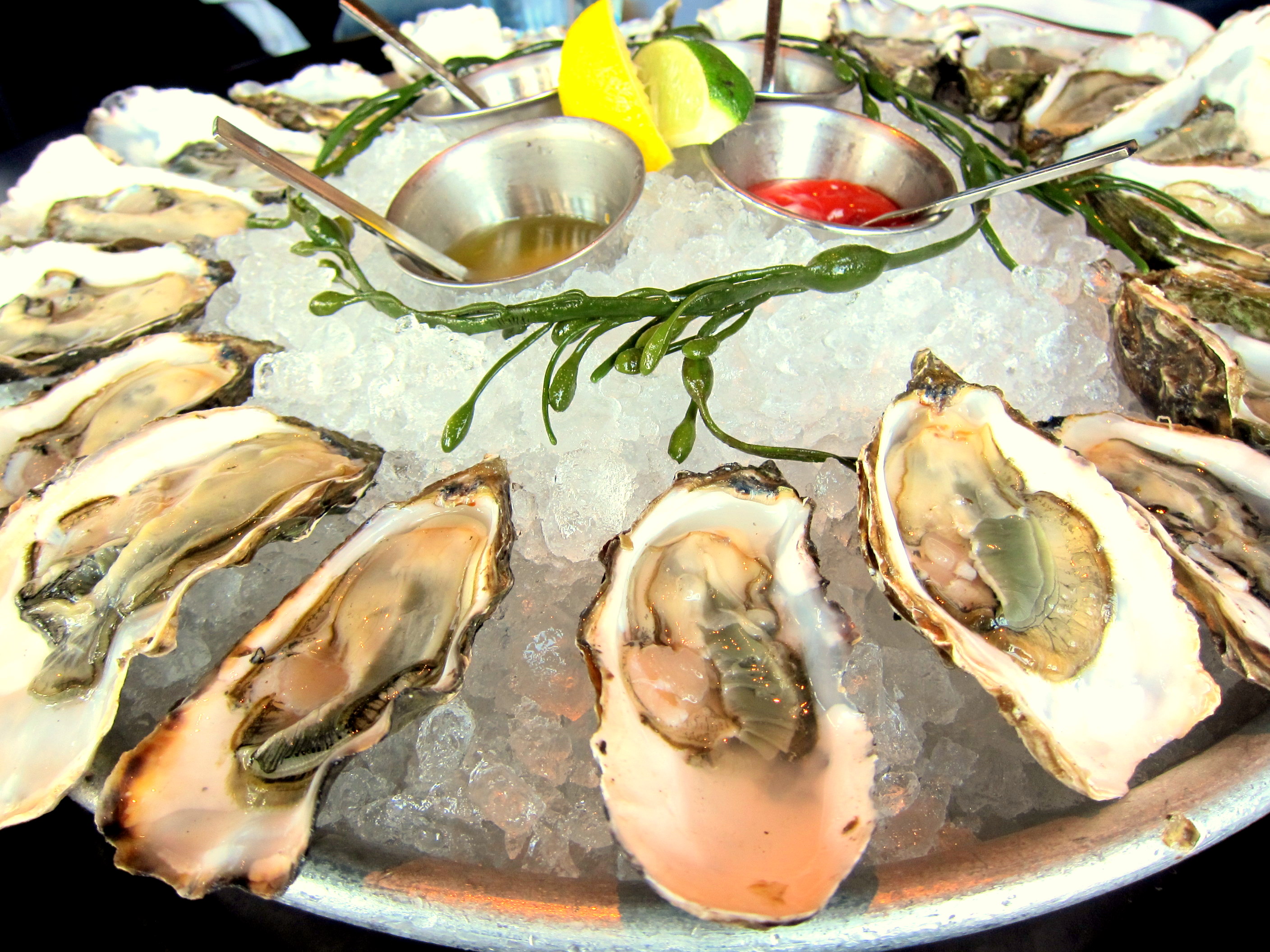
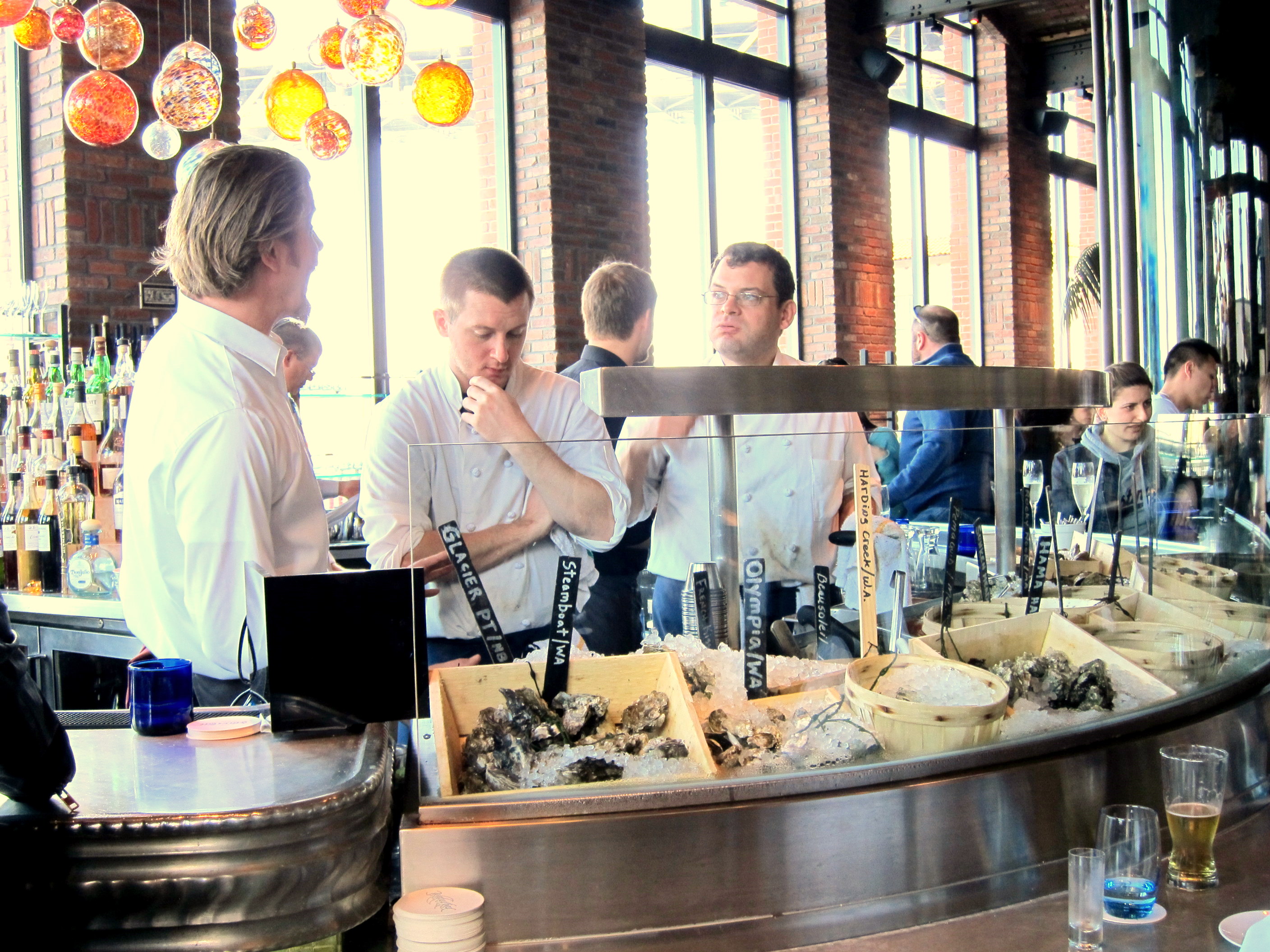
Going to the Waterbar on a nice-weathered Saturday afternoon is a silly idea: everybody and their twice-removed cousins are also hawking for the same precious seats around the bar to get the 1-dollar featured oysters. It’s crowded. Very crowded. It’s like parking in San Francisco. Mr. Global Eats recommended the place during the weekdays, I heeded not his advice and here we were, standing fidgetily, looking awkwardly at people eating oysters, hoping to stare them out of their seats. A couple finished their lunch date; we three hopped in before the server could even wipe the table clean.
Today’s featured victim was the Cove Miyagi, a California native with a “clean lettuce flavor”. The first time I was ever fooled by the juicy appearance of a raw bivalve (an oyster) to eat one, I had to gather every ounce of self control in me to swallow it down. The second time was a raw clam, and it wasn’t a whole lot better, but I knew what to expect. Today was actually the third time, and I had more than one oyster, so I’m proud of myself. Something about that brackish smell and taste melded with the cocktail sauce, the lemon, and the green onion is romantic.
That said, I almost died from the radish cream sauce. I was in the middle of chatting with the girls and the surprise attack brought me to tears. Such innocent whiteness, such strength punching the nose from the inside.
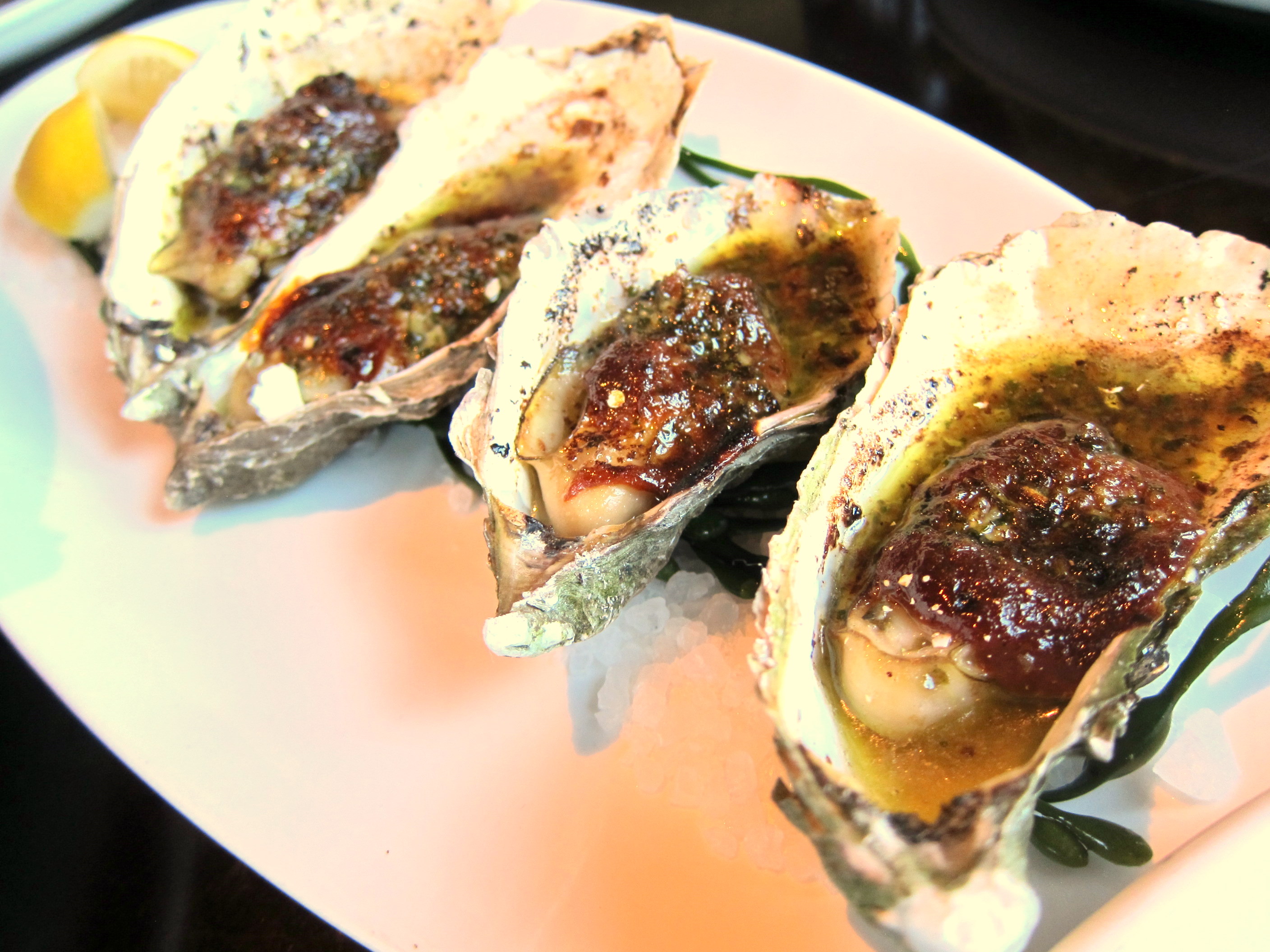
We also shared four BBQ baked oysters drowned in garlic parsley butter, on a bed of salt crystals. These were hands down delicious. They actually smelled good. Humans have indeed learned to use fire for a reason, and butter… But you know what was the best thing here, that we kept talking about even after we left the Bar? The potato chips. Oh man, they were so good that I had to stop by CVS on the way home to get a bag of BBQ Lays. And they were on the house.
The verdict: the Waterbar hadn’t transformed me into an oyster zealot, but it did transform us into temporary tourists:
View(ed) from the patio.
Dinner for 3: $37.24
Address: Waterbar
399 The Embarcadero South (near Pier 26)
San Francisco, CA 94105
(415) 284-9922
Between 4 and 6 PM today was the most interesting 2 hours I’ve had this week, and also the most effortless educational experience I’ve had in a long time. That’s how the Korean tea ceremony is meant to be, as I’ve learned: formal but relaxing, and ceremonious but natural. The rules are rather simple to get acquainted to, the movements make sense, and just watching made my mind feel nothing but calmly pleasant. The kind of pleasant feeling one would get gazing off into space alone, on a grassy hillside, on a cloudy day.
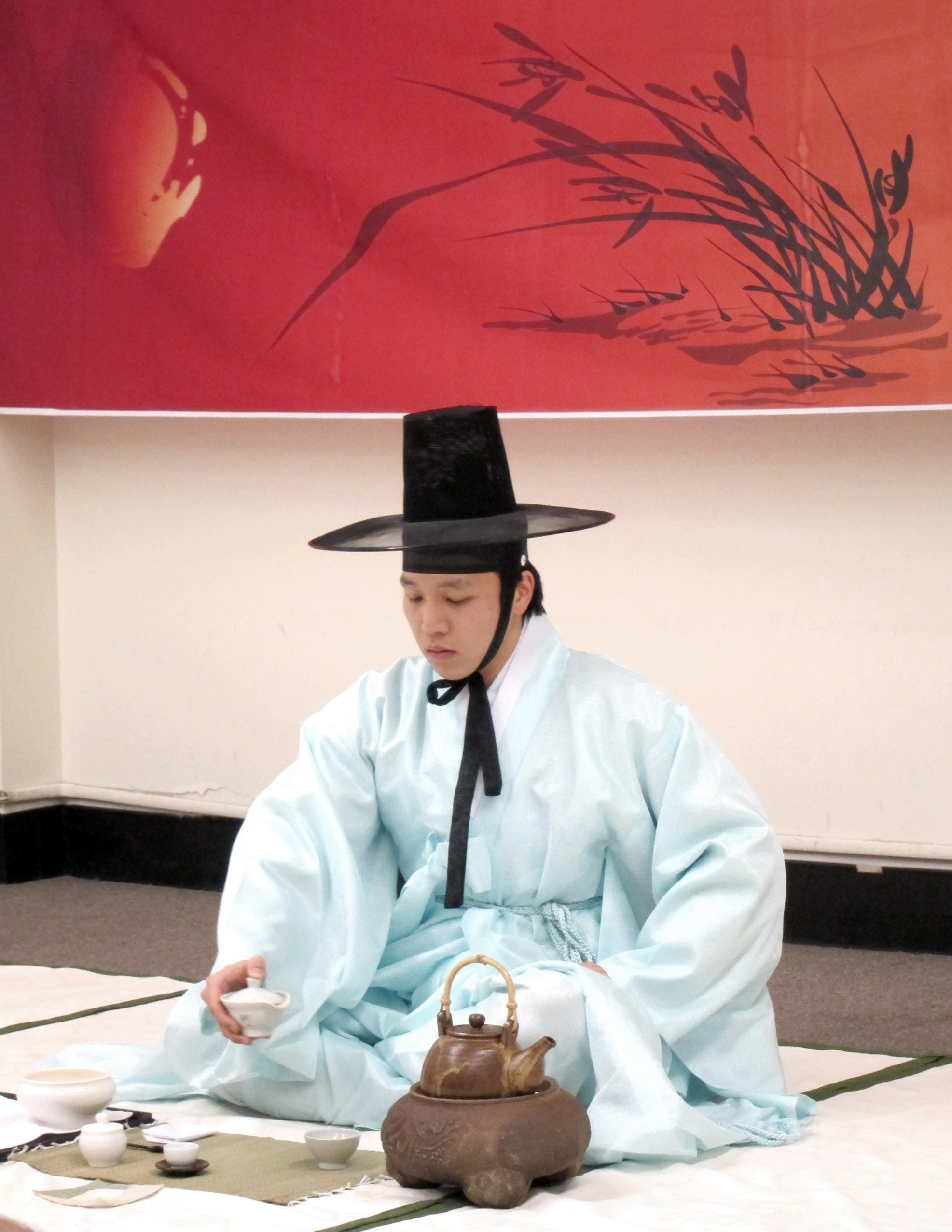
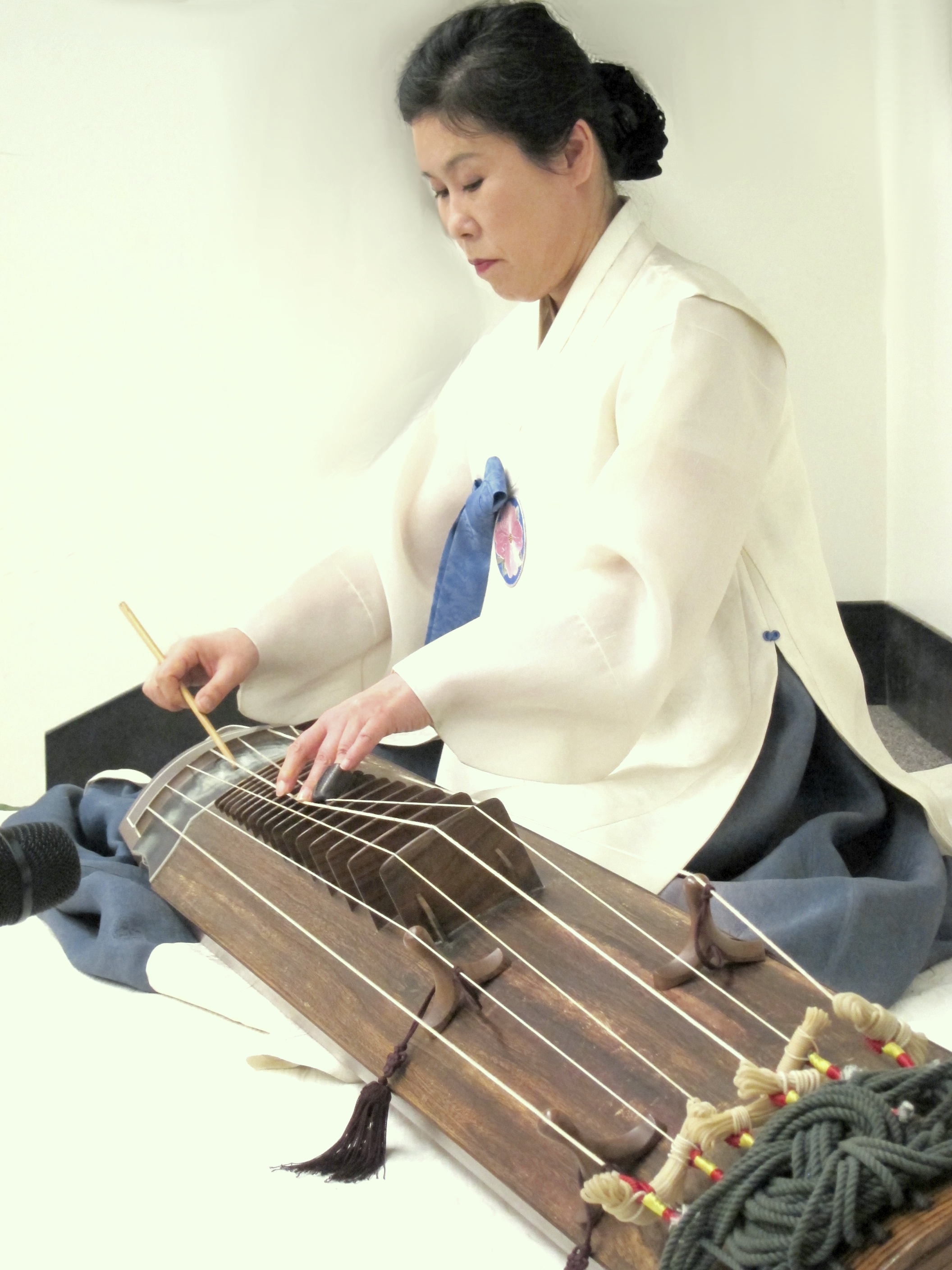
Now for the logistics. Inje University‘s Traditional Korean Tea Society (TKTS) gave a 2-hour presentation at Berkeley today as part of the “Dew of Wisdom” tour, Stanford and California State University got their tea before us. During the first 40 minutes, the students of TKTS demonstrated two types of tea ceremonies, both accompanied by the slow, deep, hardy rhythm of a 6-string zither 거문고 (geomungo).
The first type, 들차회 (deulchahue), is to be enjoyed with friends and relatives outdoor during spring and autumn. The setting is lighthearted, the purpose is to relax and to appreciate nature, the gathering comprises both men and women, and both hands are used during the preparation, serving, and tasting of tea.
The second type, 선비다례 (seonbi darye), or “Scholar’s tea ceremony”, is practiced by noblemen to clear their mind and heighten their wisdom. The setting is dignified, and the man uses only his right hand to prepare and serve, signifying a more profound status than that in deulchahue. In both cases, the movements are fluid, slow, and steady.
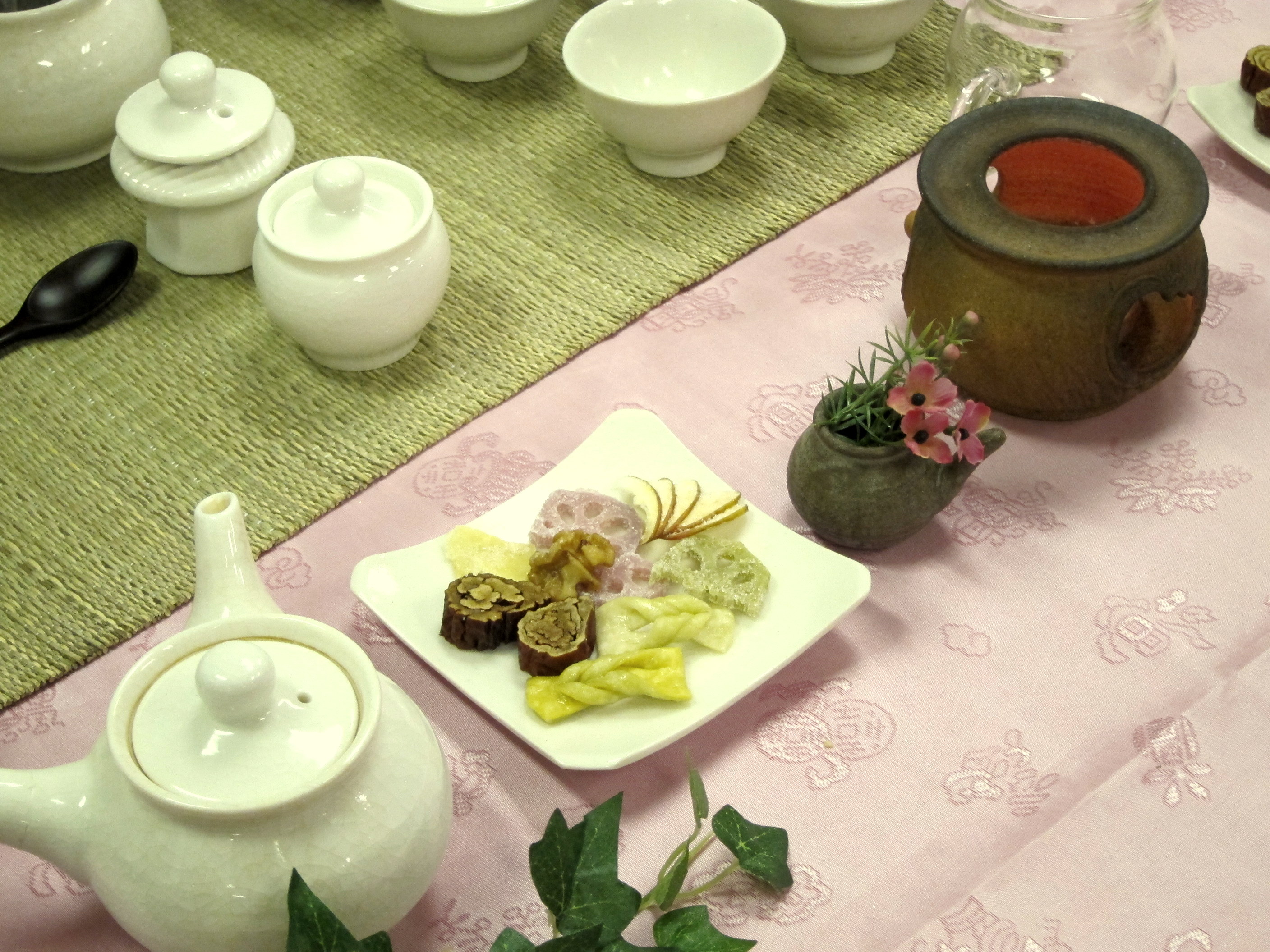
During the next 20 minutes, the guests were invited to taste green tea and yellow tea with a variety of 다식 (dasik), tea snack: candied lotus root, dried apple, dried jujube, and a kind of fried chips that I’d only seen in the drama Sungkyungkwan Scandal (성균관 스캔들). The green tea, unoxidized, looks and tastes clear with a very light herbal hint, like a white tea. The yellow tea, about 50% oxidized, similar to Tieguanyin, has an upfront sweetness and a deep citrine hue. Each batch of tea is brewed for about 2 minutes in 60-70°C water, as boiling water would induce a bitter taste.
After ample tea had been served, the guests came back to their seats for a brief presentation from Prof. Jaesup Pak, President of TKTS, on Korean tea production and ceremonial methods. I scribbled like mad, and here’s what little knowledge I’ve gained:
There are 3 major tea plantation regions in Korea: Boseong, Hadong, and Jeju. Boseong is the largest and most respected tea plantation, producing roughly 40% of Korean tea in 5.3 million square meter of hillside. Hadong, second in line, has produced wild tea for over 1200 years, and from its neighboring town Hwagae originated the Korean green tea culture. The tea here is grown completely natural on rocky 400-500 meter high mountainsides and harvested by hand. In contrast, Jeju‘s tea is grown with chemicals and fertilizers on rich volcanic island soil, plucked and chopped by machines, and heated and dried with steam.
Regardless of regions, tea leaves are plucked young between April and May because fully developed leaves are too coarse to use. Different grades of green tea are categorized based on their youngness. Ujeon (우전), the first grade, comes from the first harvest, which means it is picked by hand before April 20 for a delicate flavor. Sejak (새작), the second grade and the most popular type, is picked early May. Sejak means “Sparrow’s Tongue”, referring to the pointed shape of the young leaves at this stage. And finally, Jungjak (중작), the third grade, is picked mid May. The tea offered to the guests at the colloquium today was Sejak from Hadong.
The production process involves 6 steps: plucking, withering, parching, rolling, separating, and drying. Hand plucking tea is meticulous, even the most skilled women can pick only 2 kg per day. Within 24 hours after plucking, the leaves are left to wither in open air. Then they are tossed and stirred constantly in an iron cauldron over wood (traditionally) or gas fire at 200°C to soften. Rolling comes afterwards to intensify the taste, where the leaves are rubbed and rolled for 3-4 times on straw mats. This process makes the leaves stick together, thus separating must be done to help moisture evaporate from the leaves. Finally, the leaves are spread out and dried naturally on paper on a heated floor for 4-5 hours or overnight.
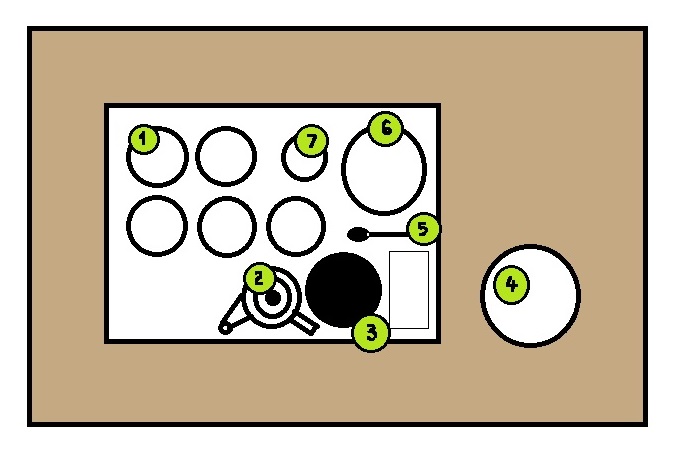
The teaware, or chagi (차기), are typically arranged as shown in the diagram above:
(1) Tea cups: usually 3 or 5 cups per set
(2) Tea pot for brewing. The teapot and kettle should be on the right side and closer to the host.
(3) Tea cup saucer, on which the filled tea cup is placed and received.
(4) Large bowl, into which the water used for warming the pot and cups is discarded.
(5) Tea spoon for taking tea leaves
(6) Smaller bowl for cooling the water and the tea, and for pouring the tea into the cups
(7) Tea caddy, which contains the tea leaves.
The small rectangle represents a napkin for tidiness.
Professor Hyeyoung Shin (Chuncheon National University of Education) performing da-ak (다악, tea music) on a geomungo at the colloquium
The preparation after the arrangement begins with pouring hot water into the cooling bowl and letting it cool for under 2 minutes. Then the teapot, ready with 1-2 spoons of leaves, receives the cooled water; the lid is closed, and the leaves are brewed for a few minutes. While serving, the tea is poured into warmed cups from a high distance to create bubbles in the tea, which are believed to confer good luck. The receiver should hold the cup with the right hand and support it with the left hand, inhale the aroma, take a sip that is about one third of the cup, and drink 3 times from each cup served. I think I did it in more than 3 times… I was savoring the flavor a little too carefully.
At the end, we got to take our cups home as a souvenir. A cute little white tea cup to commemorate a sweet, delicate two-hour lesson. 🙂
Like with most Asian eating establishments, it’s virtually impossible to answer the question “what is the best Vietnamese restaurant in [name of city]?” Let me stay there for about half a year, and I can tell you where to get the best pho, the best cha gio, the best bun thit nuong, the best banh mi, but not the best Vietnamese. Assuming you would agree that I can’t compare a place that specializes in noodle to another that specializes in beef, I would admit: I don’t know what you mean by “the best Vietnamese”. Do you mean everything on the menu is the best of its kind? Everything is good? Everything is cheap and good? Everything is cheap and good and the service is the best? Everything is cheap and good, the service is good, and the ambiance is the best? You see, there are more variables in your generic question than I could possibly control with my subjectivity. And that is not to consider the possibility of you asking that question just because I’m Vietnamese, which doesn’t bother me at all, but I’m usually not sure of how much detail you’d like to receive. (I’ve included the preferred question at the end of this post.)
That said, if you ask me, what is the best Vietnamese restaurant in Houston, which I take that you’ve given me the full freedom to interpret your meaning and exert my subjectivity, I’d say Banh Cuon Hoa. Why? Because they serve the best of my favorite Vietnamese dish, and as I’ve discovered, the “best Vietnamese” shops are those with the best steamed rolls. Steamed rolls are hard to get right, so when they get them right, everything else they have is good. 😉
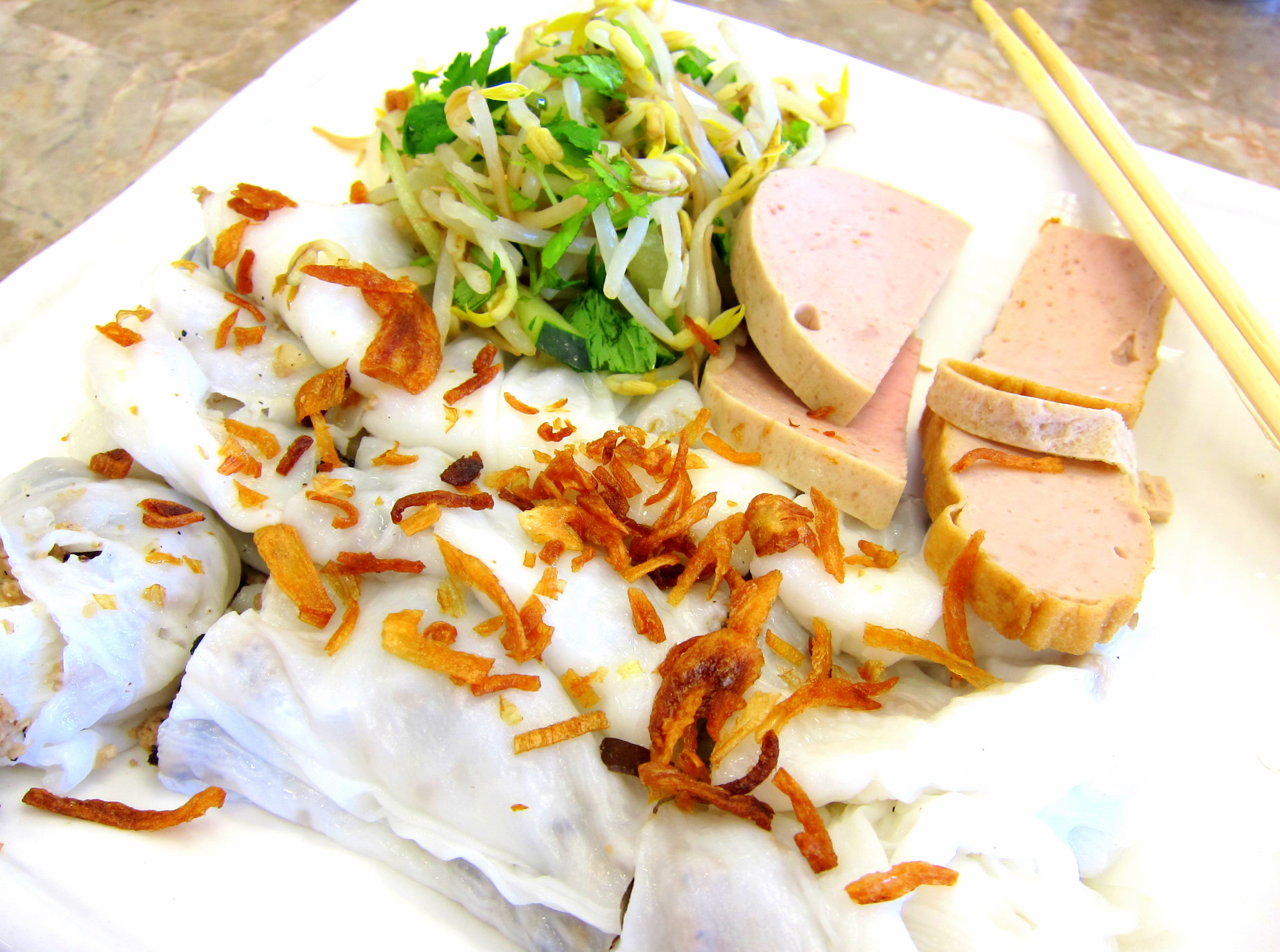
The flour skin is super thin, cool but not sour, and not oily. The pork-and-mushroom stuffing is well seasoned, not too much to bore, and not too little to bore. This banh cuon is better than banh cuon from Tay Ho’s. Ask any Vietnamese person, and they’d agree that that statement is not to be precariously thrown around unless the banh cuon is very good.
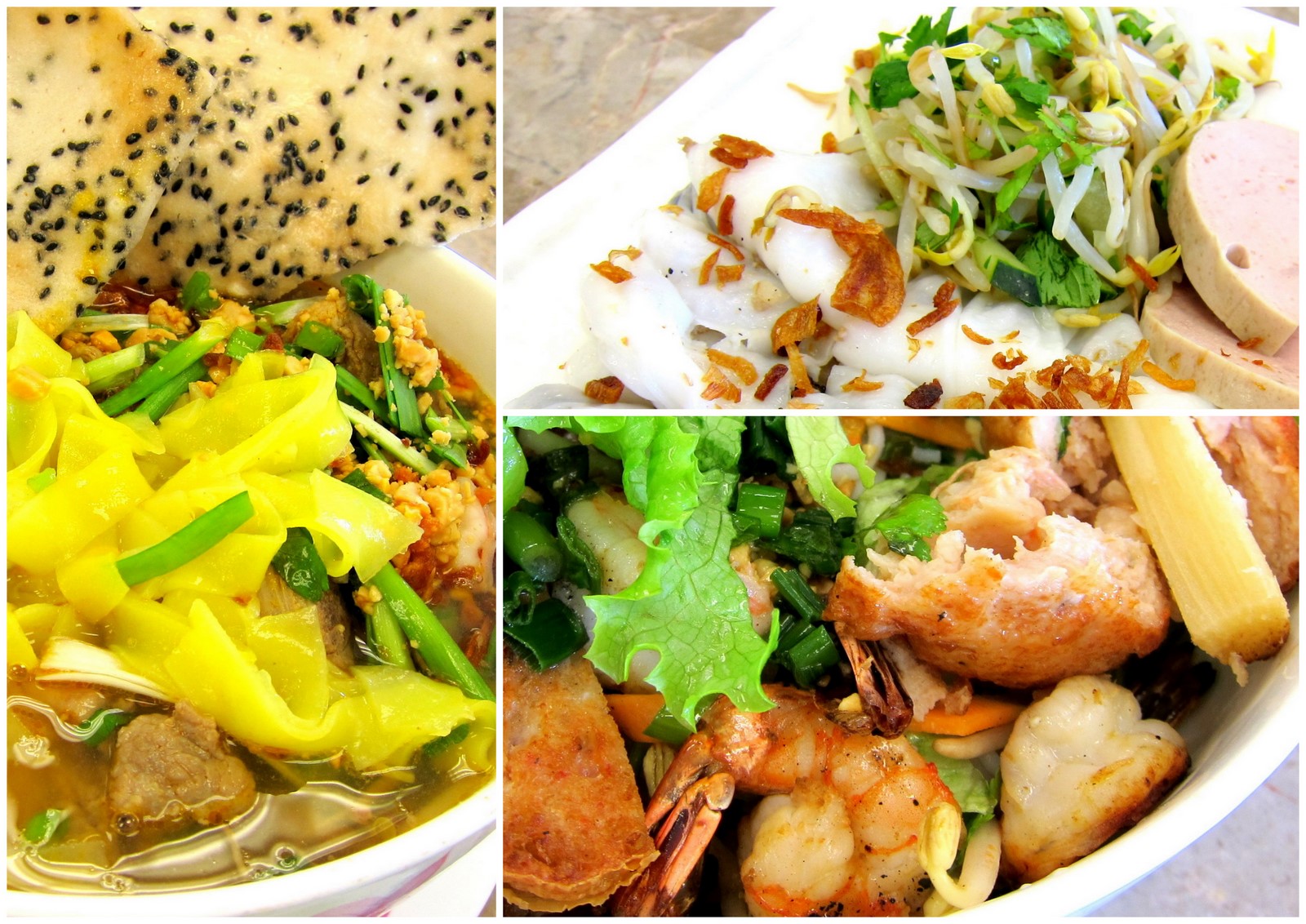
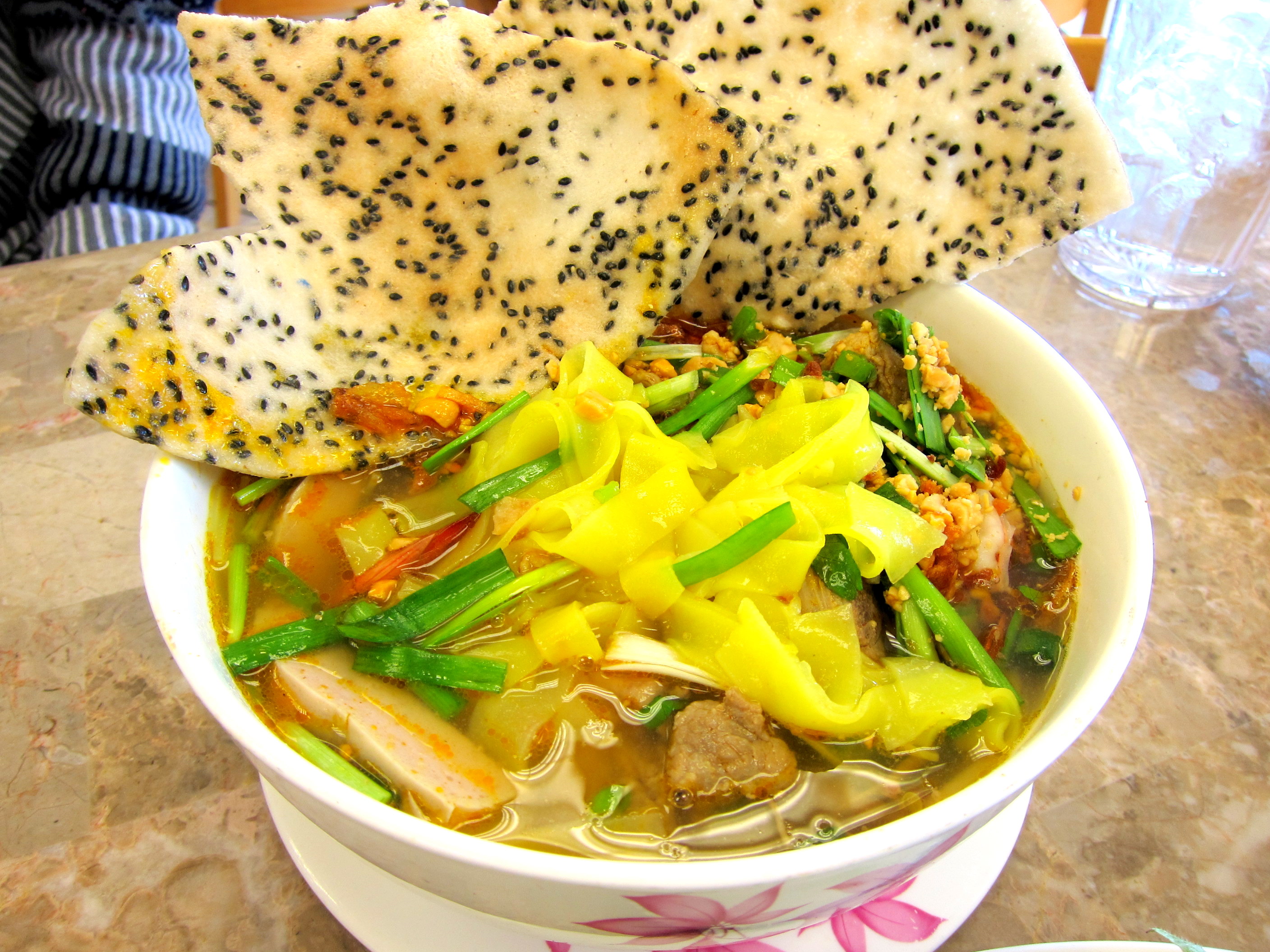
The mi Quang tastes as good as it looks (the yellow noodle). So does the bun chao tom tau hu ky, a shrimp and tofu variant of bun thit nuong. The price? Students can afford this.
Address: Banh Cuon Hoa
11106 Veterans Memorial Dr
Houston, TX 77067
(281) 820-3388
They have another business near Hong Kong Market IV: Banh Cuon Hoa II, but this Hoa is not as good as its sister shop.
Anyway, the question I usually ask my friends is: “Where do you usually go for [type of food]?”
There seems to be a new trend in the East Bay restaurant business: it has to be hidden and/or without a sign. First it was embarrassing walking up and down the street to find Commis, and now the same thing happens with Plum. Is this some kind of scavenger hunt joke?
Plum‘s menu is short and sweet like its name. However, the same thing can’t be said about the majority of its dishes, which either tip a bit over to the salty side (pate ciccioli and bacon) or stay way back in plaindom (crispy pig ears and trout). There are bright notes, too. The turnip soup with yuzu kosho, pear and cilantro is a light, heart-warming start. The short ribs with peanuts and sweet potato has a deep Asian flavor. The caramelized brioche with coffee ice cream makes a comforting finish.
Ironically, the yummy dishes didn’t have good pictures. But here’s a small album to get a taste of Plum.
Address: Plum
2214 Broadway
Oakland, California
(510) 444.7586