
Bánh bèo tips from Mrs. Tự
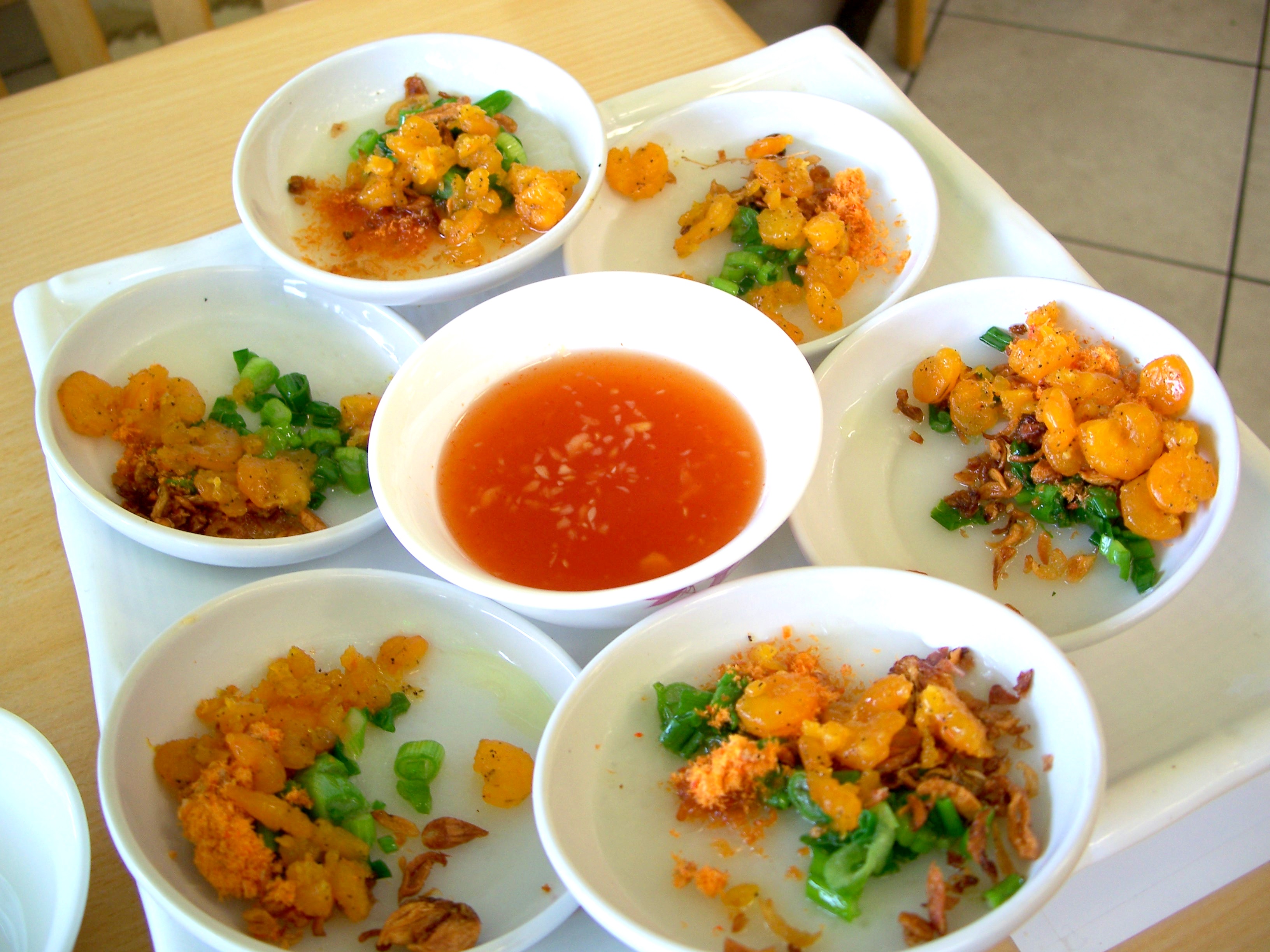
A couple of millimeters thin, chewy, savory, bánh bèo, the waterfern-shaped appetizer, is as familiar to the Vietnamese dining tables as crab cakes to Americans. But not everyone makes it at home because it takes more time than its worth: make the rice flour batter, steam the banh, make the toppings, mix the fish sauce. In fact, I’ve had homemade bánh bèo only once, and it was at my friend’s family restaurant. That said, there are skilled and dedicated grandmas who insist on making everything from scratch for the best bánh bèo. One of them is Mrs. Tự, and Little Mom happened to see one episode of her cooking show on TV last week.
So below are some tips on bánh bèo from Mrs Tự, collected from the show Nghệ Thuật Nấu Ăn Bà Tự (The Cooking Arts of Mrs Tự) on Global TV Houston.
1. Texture:
The thinner bánh bèo is the better bánh bèo. Of course, resilience is a must, it should not be as chewy as a mochi, but it should have enough strength to hold itself together as the eater picks it up with chopsticks. How to make a thin but resilient bánh bèo? Heat the bánh bèo plates (or molds)* in the steamer before pouring in the batter and steaming the bánh. I suspect that this preheating helps cook the batter evenly in all directions, instead of having the bottom cold and cooking it with steam from only the top surface during the first few moments.
2. Toppings:
Bánh bèo of the South has savory mung bean paste for topping, and bánh bèo Huế usually has pan-dried shrimp (tôm chấy), which blogger Tran Ngoc Kha translated as cotton shrimp for its fluffy texture. Fresh shrimp** (with head, legs, shell, everything) goes without saying: while peeling off the shell, you can keep the gạch, a substance located in the head of the shrimp that becomes reddish orange when cooked, to sweeten and fatten the toppings***. How to make the shrimps dry and fluffy? Microwave the peeled shrimps so that the meat is red, plump, and has a spring to it. Then pound the shrimps to break up the bodies, but not to a paste. And fry it on high heat with constant shuffling.
But bánh bèo can also be topped with pork rind. To make the pork rind, Mrs. Tự would slice the skin off the pork belly, boil it, cut into thin strips, refrigerate them, and finally deep fry them. The refrigerating step prevents the fat from shooting everywhere while frying. How to tell when the skin is refrigerated long enough? If you bend the strip and it gives a loud, clean snap, it’s done.
Then there is also topping made with bean paste, meat and tapioca, seen on bánh bèo in Quảng Nam Đà Nẵng. The better tapioca flour (bột năng) is not the white powder straight from the bag, but that which is pan-dried to really rid of moisture. How to know when the flour is dry enough? Mrs. Tự puts either a pandan leaf or a piece of a banana leaf into the wok as she constantly stirs the flour, the heat from the flour vaporizes the moisture in the leaf, when the leaf dries up and becomes crunchy, the flour is done.
(*) Bánh bèo should be made in mini shallow cups (like sauce cups) made of porcelain. The molds are convenient but render a metallic taste, the bánh bèo would be too thick and oily because the molds have to be greased before steaming.
(**) Some places serve up bánh bèo tôm chấy with packaged dried shrimp (tôm khô). Never go there.
(***) Crabs have more gạch than shrimps, so gạch cua (gạch from crabs) is more well-known in Vietnamese cooking. In Japanese, gạch cua is indeed kanimiso, the brownish grey substance that is a mix of the crab’s internal organs (brain, liver, pancreas, intestine, eggs, etc.). Good stuff. 🙂


I’ve been surfing online more than three hours as of late, yet I by no means found any interesting article like yours. It’s beautiful price enough for me. In my view, if all website owners and bloggers made just right content as you did, the internet can be a lot more helpful than ever before. “No nation was ever ruined by trade.” by Benjamin Franklin.
1You are my aspiration, I possess few blogs and infrequently run out from to brand.
2I am usually to running a blog and i really respect your content. The article has actually peaks my interest. I am going to bookmark your website and hold checking for new information.
3Some really nice stuff on this site, I enjoy it.
4Hi there! Thiss posdt couldn’t be written any better!
Looking throygh thiks article reminds mme off myy preious
roommate! He continually kepot preaching about this.
I’ll send his artiicle tto him. Pretty suree
5he’s goiung tto have a goood read. Thsnk youu foor sharing!
xnxx
I like this site because so much useful material on here :D.
6superb post.Never knew this, thankyou for letting me know.
7I really like what you guys tend to be up too. This kind of clever work and coverage! Keep up the great works guys I’ve you guys to my personal blogroll.
8Lovely just what I was searching for.Thanks to the author for taking his clock time on this one.
9Exceptional post however I was wondering if you could write a litte more on this topic? I’d be very grateful if you could elaborate a little bit further. Appreciate it!
10Great wordpress blog here.. It’s hard to find quality writing like yours these days. I really appreciate people like you! take care
11I do enjoy the way you have framed this particular issue and it really does present us a lot of fodder for consideration. Nonetheless, because of what precisely I have observed, I simply just trust as the actual comments pile on that people continue to be on issue and don’t start upon a soap box of some other news of the day. Yet, thank you for this exceptional point and whilst I can not necessarily agree with the idea in totality, I value your point of view.
12I am really loving the theme/design of your blog. Do you ever run into any internet browser compatibility problems? A handful of my blog visitors have complained about my blog not operating correctly in Explorer but looks great in Opera. Do you have any advice to help fix this problem?
13I have been exploring for a little bit for any high quality articles or blog posts in this kind of space . Exploring in Yahoo I eventually stumbled upon this web site. Studying this information So i am satisfied to express that I’ve an incredibly just right uncanny feeling I discovered exactly what I needed. I so much certainly will make sure to do not omit this site and provides it a glance regularly.
14Howdy! This is my 1st comment here so I just wanted to give a quick shout out and tell you I really enjoy reading your articles. Can you suggest any other blogs/websites/forums that deal with the same subjects? Thank you!
15you’re actually a just right webmaster. The site loading velocity is amazing. It seems that you are doing any distinctive trick. Moreover, The contents are masterpiece. you have performed a fantastic activity on this topic!
16Thank you, I’ve recently been looking for info approximately this topic for ages and yours is the best I’ve discovered so far. However, what concerning the conclusion? Are you sure concerning the source?
17Great goods from you, man. I have understand your stuff previous to and you are just too magnificent. I actually like what you’ve acquired here, certainly like what you are stating and the way in which you say it. You make it entertaining and you still care for to keep it sensible. I can’t wait to read much more from you. This is really a great site.
18WONDERFUL Post.thanks for share..extra wait .. …
19Hi would you mind stating which blog platform you’re using? I’m planning to start my own blog in the near future but I’m having a hard time deciding between BlogEngine/Wordpress/B2evolution and Drupal. The reason I ask is because your design and style seems different then most blogs and I’m looking for something completely unique. P.S Sorry for being off-topic but I had to ask!
20I am not very fantastic with English but I line up this real leisurely to understand.
21My brother recommended I may like this blog. He was once totally right. This publish actually made my day. You can not imagine simply how much time I had spent for this information! Thanks!
22I am not sure where you’re getting your information, but good topic. I needs to spend some time learning much more or understanding more. Thanks for fantastic info I was looking for this info for my mission.
23I think this is one of the most vital info for me. And i’m glad reading your article. But wanna remark on some general things, The web site style is great, the articles is really great :D. Good job, cheers
24Appreciate it for helping out, good information. “You must do the things you think you cannot do.” by Eleanor Roosevelt.
25wonderful points altogether, you just gained a new reader. What would you suggest in regards to your post that you made some days ago? Any positive?
26This blog is definitely rather handy since I’m at the moment creating an internet floral website – although I am only starting out therefore it’s really fairly small, nothing like this site. Can link to a few of the posts here as they are quite. Thanks much. Zoey Olsen
27