
Recipe for Bánh ú tro (Vietnamese-adapted jianshui zong)
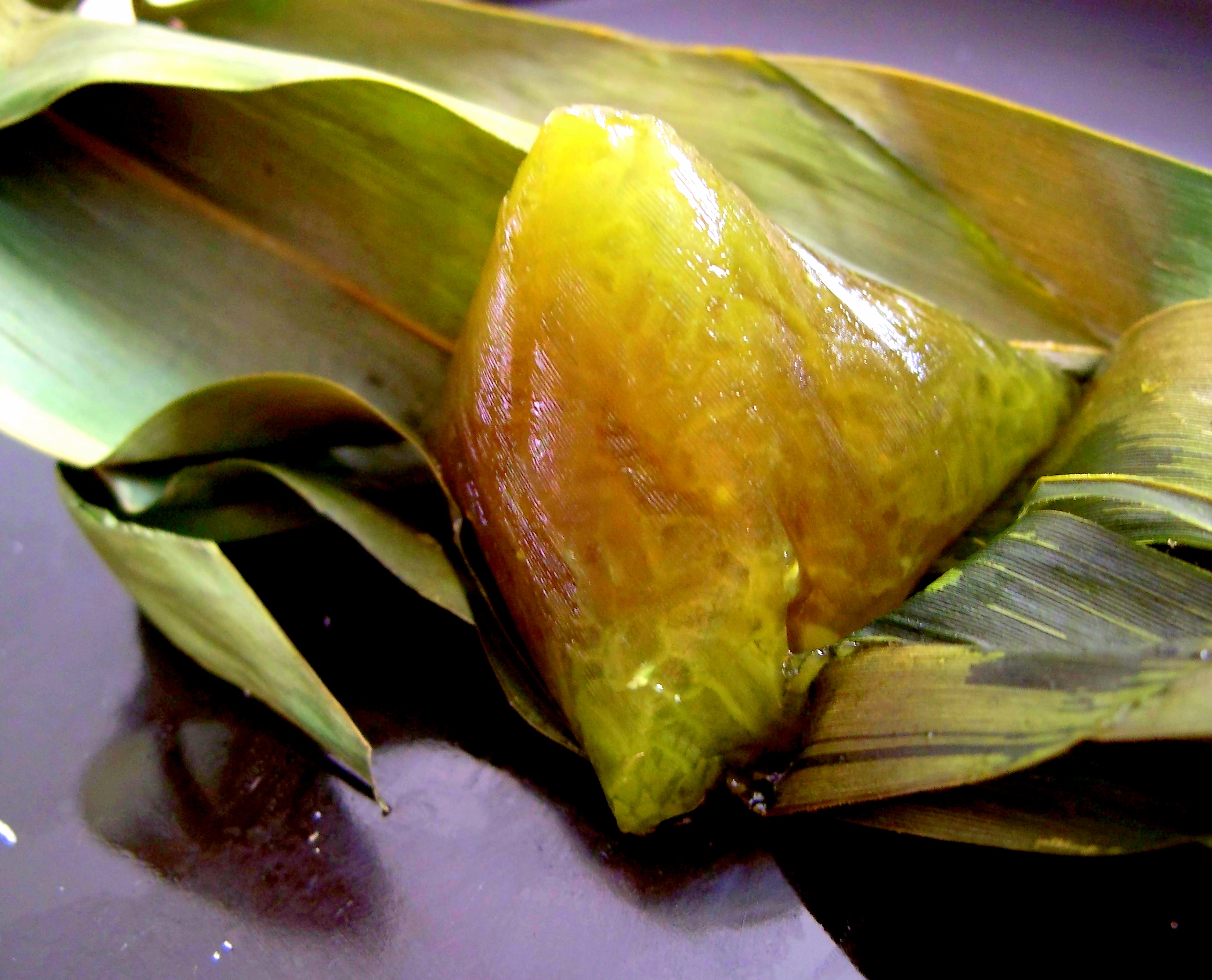
The recipe calls for a lot of prep time (up to a year!), and the products are little triangular pyramids sold for $3.75 a bunch at sandwich shops. But hey, if you can make bánh ú tro, you can enjoy it any time of the year without having to wait until the Fifth of Lunar May.
1. Ash water
Use the fine, soft ash from burnt coal, dissolve in water. The common ratio is 50 grams of ash for every liter of water, but it varies depend on how strong the ash is and how strong you want your banh to be. Let the ash collect at the bottom, leaving a clear solution. Sift the solution to get rid of dirt and coal bits.
You can use lime powder instead of ash. White lime gives bánh ú tro the natural green hues of wrapping leaves, red lime gives them reddish amber hues. The mixing ratio is 20 grams/liter for lime powder.
2. Sticky rice
– Use 1-year-old sticky rice. Such grains are more powdery than new sticky rice. Wash sticky rice with cold water, then soak in ash water overnight or until the grains break easily when you press them between two fingers. Soaking time varies with different ash types and grain types, but beware that grains soaked for too long can make the banh smell like ash.
– After the grains are done soaking, rewash them thoroughly with water and let dry.
3. Sweet filling
Traditional bánh ú tro doesn’t have filling and is eaten with honey or sugar. But bánh ú tro with fillings are arguably tastier than their plain counterparts, and here are a few filling ideas:
– Mung bean paste: split and peeled mung beans are washed and cooked until tender, mashed while it’s still hot and mixed with sugar. The bean-sugar ratio varies to your likings.
– Red bean paste: soak red beans in water overnight to soften them. Wash, cook until tender, mash. In a skillet, add 1 tbs oil and 200g brown sugar for every 500g red bean, stir on low heat until all sugar dissolves. Let cool.
– Grated coconut: boil water and sugar with ratio 1:1 on low heat , stir frequently until all sugar dissolves. Pour the syrup into grated coconut and mix until it becomes a soft sticky ball.
4. Wrapping bánh ú tro
– Use bamboo leaves (about 5-6 cm wide and 30 cm long) or banana leaves cut into similar size. Wash the leaves clean and let dry.
– Bend one end of a leaf into cone shape. Use 2-3 leaves to increase the banh size.
– Put in 2-3 teaspoons of sticky rice for the plain kind. Or 1 tsp sticky rice, followed by 1 tsp filling, then 1 tsp sticky rice on top for the sweet kind.
– Wrap the remainder of the leaf tightly around and over the cone until all faces are covered.
– Tie it up with a nylon string. Then tie every ten banh into a bunch with a long string to easily pull in and out of boiling water.

5. Boiling bánh ú tro
– Cover the bottom of a large pot with banana leaves or bamboo leaves to keep banh from sticking to the metal.
– Arrange banh in the pot. Pour water. Water level should be at least 4 inches above the banh. Make sure banh stay submerged the whole time, you can cover banh with a big sieve and a weight on top to keep banh from floating up.
– Boil banh for 45 minutes to an hour (after the water starts boiling). Add more water if the level gets too low.
Submerge cooked banh in cold water for 10 minutes to aid cooling, then hang them dry. Well made ones can last 2-3 weeks at room temperature.
Recipe translated from source.


Glad to be one of the visitants on this awing website : D.
1This actually answered my downside, thanks!
2I like this web blog very much, Its a very nice billet to read and get information.
3Howdy! Do you know if they make any plugins to help with SEO? I’m trying to get my blog to rank for some targeted keywords but I’m not seeing very good gains. If you know of any please share. Many thanks!
4I love your blog.. very nice colors & theme. Did you create this website yourself? Plz reply back as I’m looking to create my own blog and would like to know wheere u got this from. thanks
5I have recently started a blog, the info you provide on this website has helped me greatly. Thanks for all of your time & work.
6Thankyou for helping out, fantastic information.
7Once I originally commented I clicked the -Notify me when new feedback are added- checkbox and now every time a remark is added I get four emails with the same comment. Is there any manner you can take away me from that service? Thanks!
8Would love to perpetually get updated outstanding website! .
9I’d have to examine with you here. Which is not something I normally do! I take pleasure in studying a publish that may make folks think. Also, thanks for allowing me to remark!
10I like this post, enjoyed this one regards for putting up.
11You made some decent points there. I regarded on the web for the issue and found most individuals will associate with with your website.
12Thank you, I have just been looking for information approximately this topic for a long time and yours is the greatest I’ve found out till now. However, what about the bottom line? Are you certain about the supply?
13예약할 때 날짜와 인원, 도착 시간을 미리 정리해서 전달하면 조건을 확인하기 편합니다. 제주 가라오케 예약 전 체크사항도 함께 참고해 보세요.
14I really appreciate your work, Great post.
15I’m no longer sure the place you are getting your info, however good topic. I must spend some time finding out much more or understanding more. Thank you for magnificent info I used to be looking for this information for my mission.
16I enjoy the efforts you have put in this, appreciate it for all the great blog posts.
17F*ckin’ amazing things here. I’m very glad to look your article. Thank you so much and i’m having a look ahead to contact you. Will you please drop me a mail?
18I’ll right away seize your rss feed as I can not find your e-mail subscription link or e-newsletter service. Do you’ve any? Kindly let me recognize in order that I may subscribe. Thanks.
19Thanks a lot for sharing this with all people you really realize what you’re speaking about! Bookmarked. Kindly also talk over with my site =). We may have a hyperlink trade agreement between us!
20Thank you a lot for providing individuals with a very splendid possiblity to discover important secrets from this website. It’s always very superb and as well , full of a great time for me personally and my office peers to visit the blog not less than thrice per week to learn the newest secrets you have got. And indeed, I’m so certainly motivated considering the brilliant strategies you give. Certain 4 tips on this page are without a doubt the finest I’ve ever had.
21I genuinely enjoy looking at on this internet site, it holds great posts. “For Brutus is an honourable man So are they all, all honourable men.” by William Shakespeare.
22It’s hard to find knowledgeable people on this topic, but you sound like you know what you’re talking about! Thanks
23Good day! Would you mind if I share your blog with my twitter group? There’s a lot of people that I think would really enjoy your content. Please let me know. Many thanks
24Unquestionably believe that which you said. Your favorite justification appeared to be on the internet the simplest thing to be aware of. I say to you, I certainly get annoyed while people consider worries that they plainly don’t know about. You managed to hit the nail upon the top as well as defined out the whole thing without having side-effects , people could take a signal. Will probably be back to get more. Thanks
25There are certainly plenty of particulars like that to take into consideration. That could be a great level to deliver up. I supply the thoughts above as basic inspiration however clearly there are questions just like the one you convey up the place crucial factor might be working in honest good faith. I don?t know if greatest practices have emerged round things like that, however I am certain that your job is clearly recognized as a good game. Each boys and girls feel the influence of just a second’s pleasure, for the rest of their lives.
26I love your blog.. very nice colors & theme. Did you create this website yourself? Plz reply back as I’m looking to create my own blog and would like to know wheere u got this from. thanks
27Hey! This is kind of off topic but I need some help from an established blog. Is it very hard to set up your own blog? I’m not very techincal but I can figure things out pretty fast. I’m thinking about creating my own but I’m not sure where to start. Do you have any points or suggestions? With thanks
28Hey there are using WordPress for your blog platform? I’m new to the blog world but I’m trying to get started and create my own. Do you require any html coding knowledge to make your own blog? Any help would be really appreciated!
29Some truly marvelous work on behalf of the owner of this internet site, dead outstanding subject matter.
30Nice post. I was checking continuously this blog and I’m inspired! Very helpful info particularly the final phase 🙂 I handle such info much. I was looking for this particular info for a long time. Thank you and good luck.
31