Flavor Boulevard

We Asians like to talk food.
Subscribe

Archive for the ‘savory snacks’

Rolling business in Tay Ho Oakland

December 11, 2010 By: Mai Truong Category: California - The Bay Area, Comfort food, Northern Vietnamese, savory snacks, Vietnamese


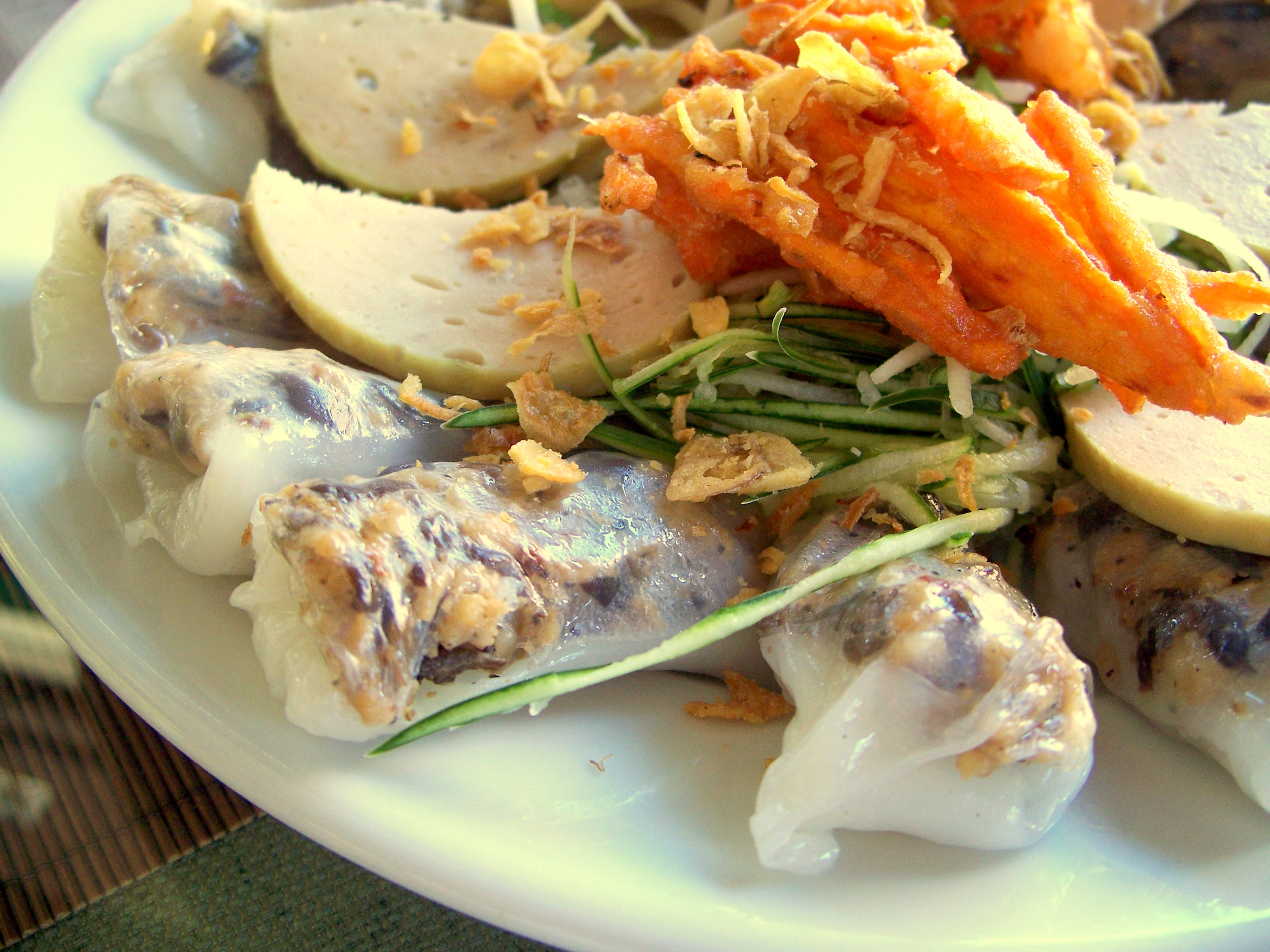
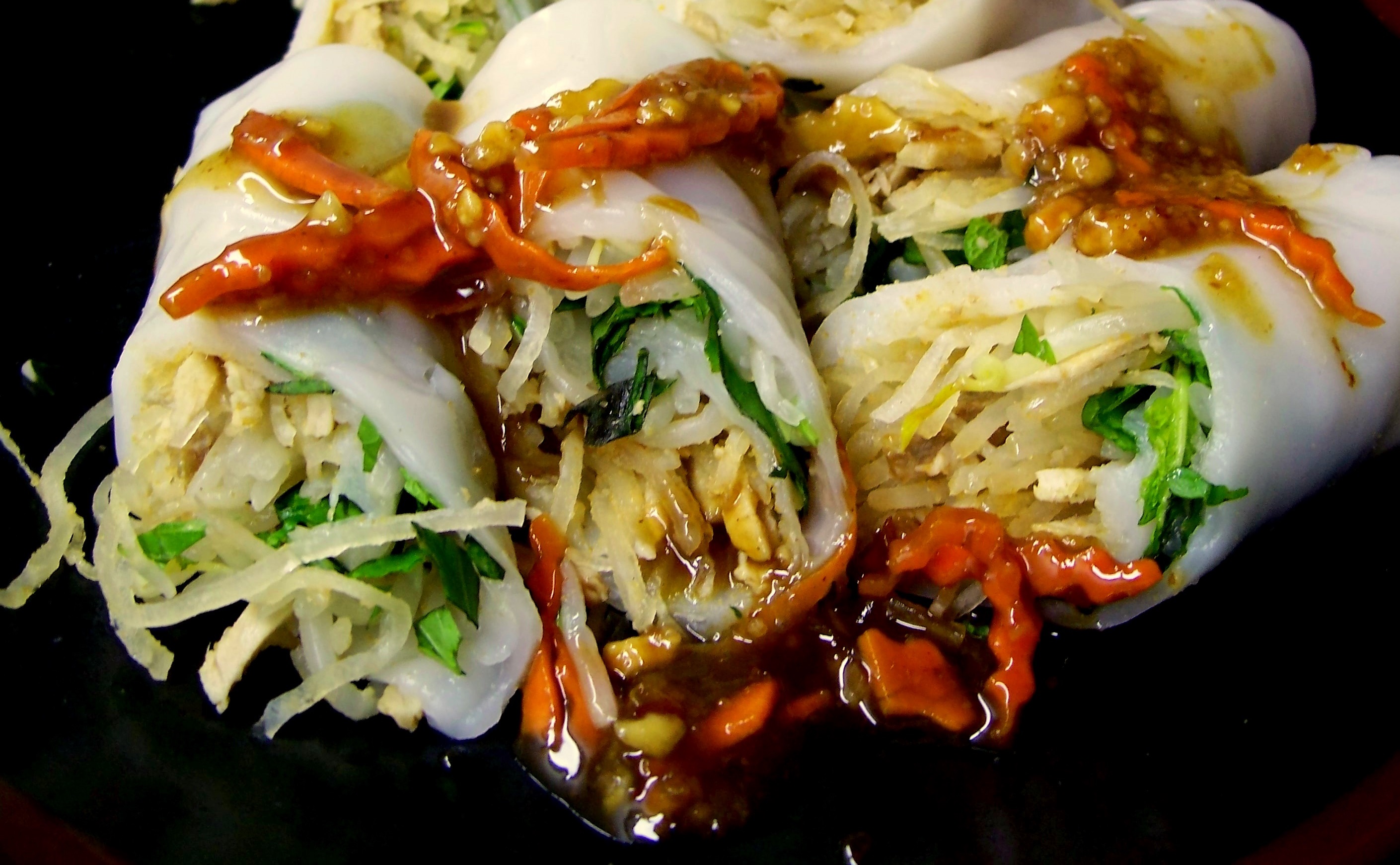
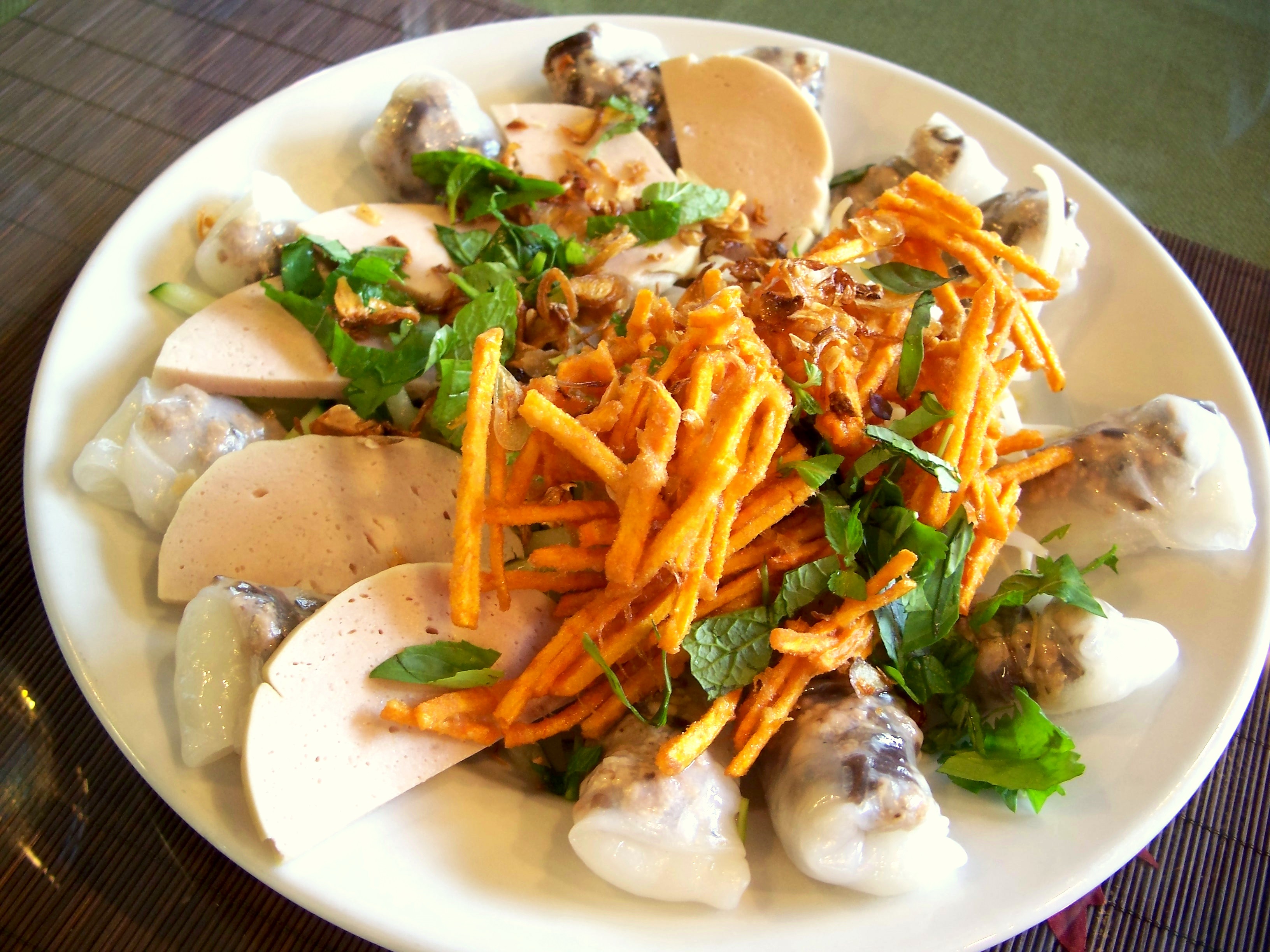
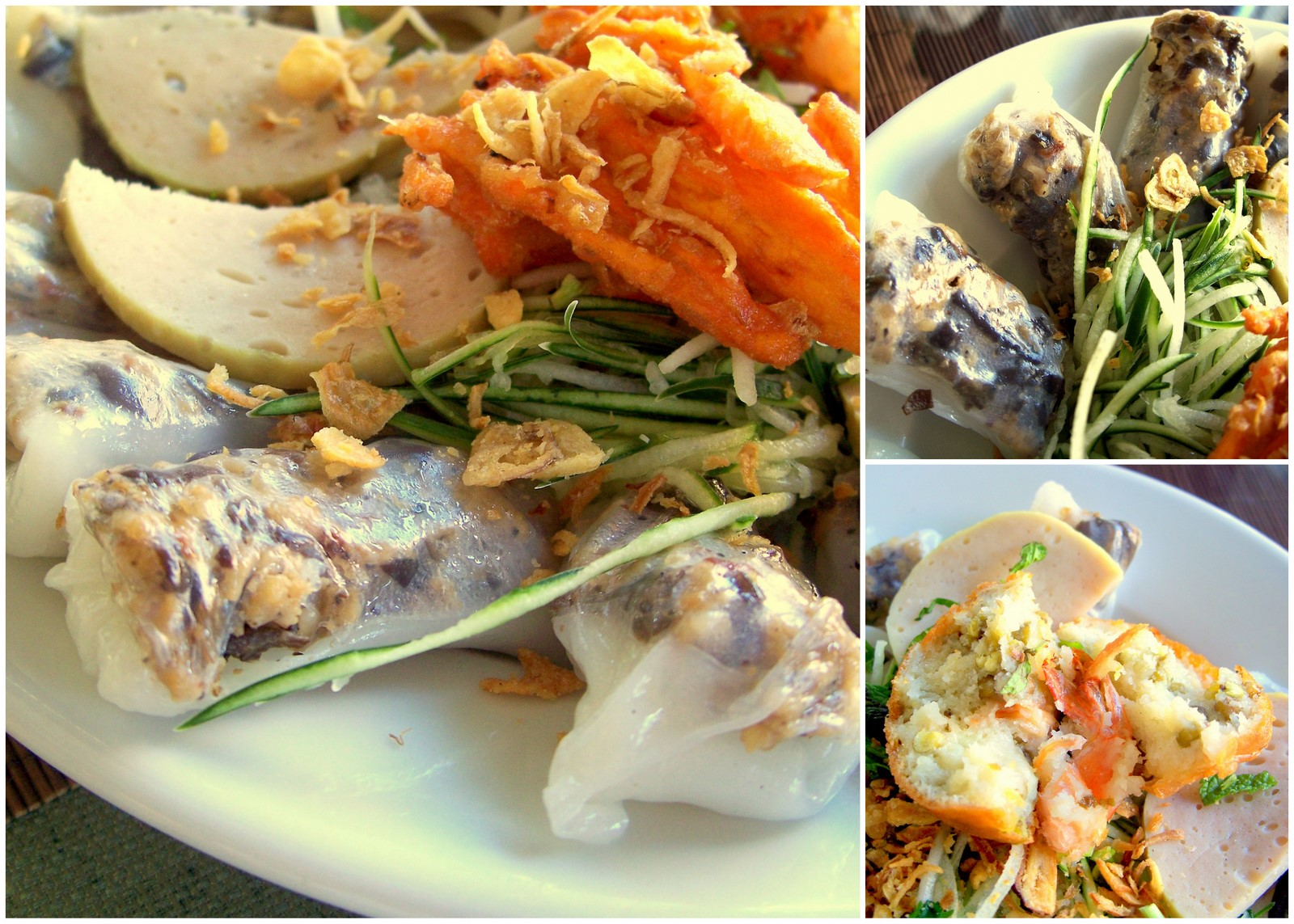
Not many Vietnamese diners roll out steamed rice leaves stuffed with pork and mushroom, and among those that do, not many actually do it right. A good roll of banh cuon must be slick but not oily, delicate but not crumbly, the flour leaf thin but springy, the stuffing visible, almost poking through, on one side and hidden on the other, served warm. A good nuoc cham must be more sweet than salty, with a little zest of lime, and spicy is not necessary. You then pour as much of that honey-colored dipping sauce as you want all over the plate, soaking the cucumber, the bean sprout, the cha lua, and especially the rolls. You then savour. When it comes to banh cuon, Tay Ho rules, from Vietnam to America. But among the Tay Ho’s of the Bay, Tay Ho #9 in Oakland makes it best.


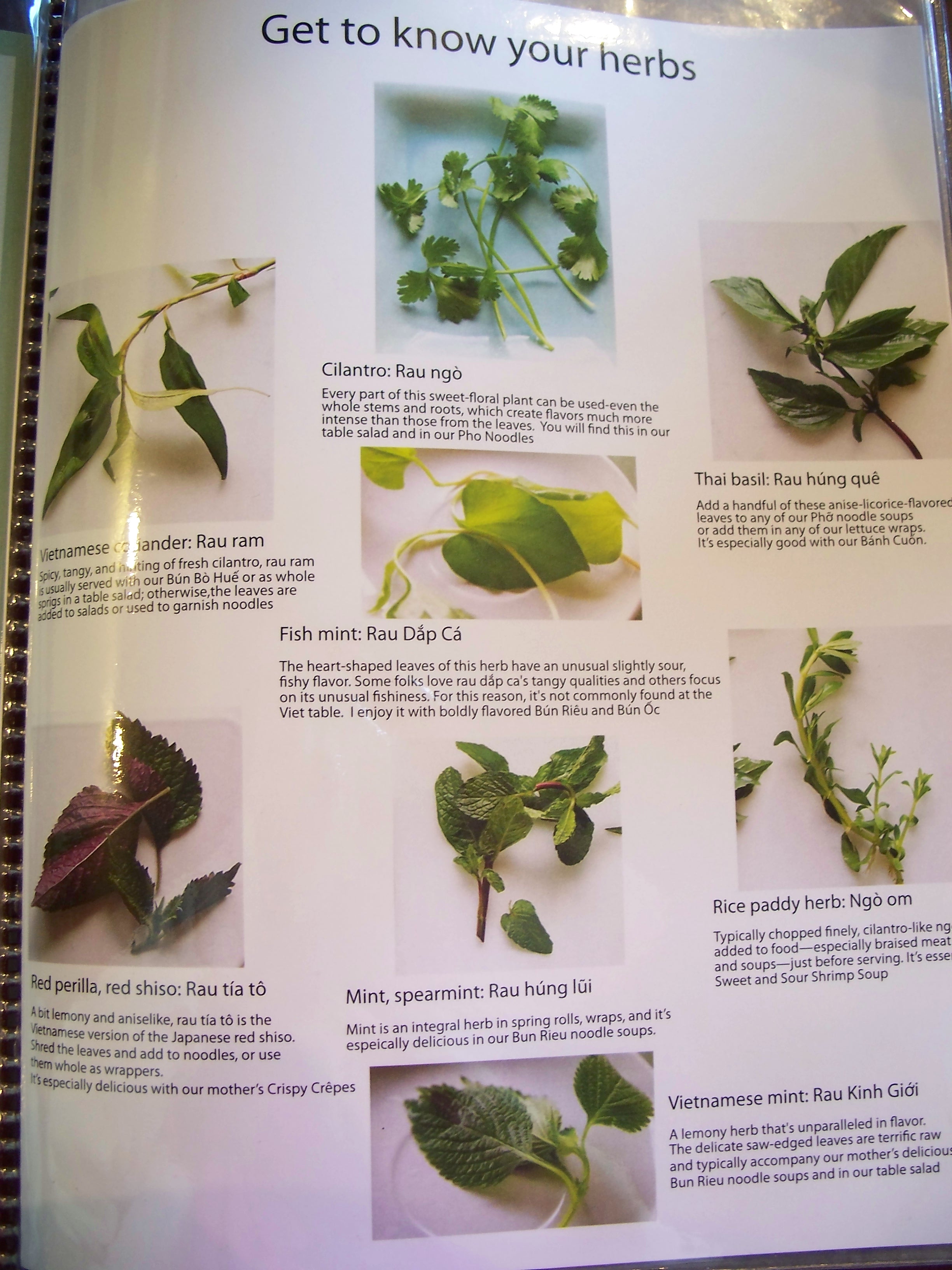
After taking over the business from her aunt, Duyên transforms Tay Ho Oakland into an all-American restaurant with fluent-English-speaking staff (herself on weekdays and with another girl on weekends), attentive service, credit card accepting, and a list of common herbs on the last page of the menu, something I haven’t seen at any other Vietnamese restaurant. It helps me at least, finally after 24 years I know which name goes with which plant. (Click on image for full-sized version). The food authenticity, of course, is preserved.


The menu features four types of banh cuon. The first, order #8, is the definitive authentic unadulterated version of steamed rolls that the Northerners had created and the whole country has fallen in love with: bánh cuốn nhân thịt (steamed rolls with meat). The more I eat it the more I crave it. The best part: flat, slick, crunchy pieces of wood-ear mushroom that accidentally fall out of the rolls.


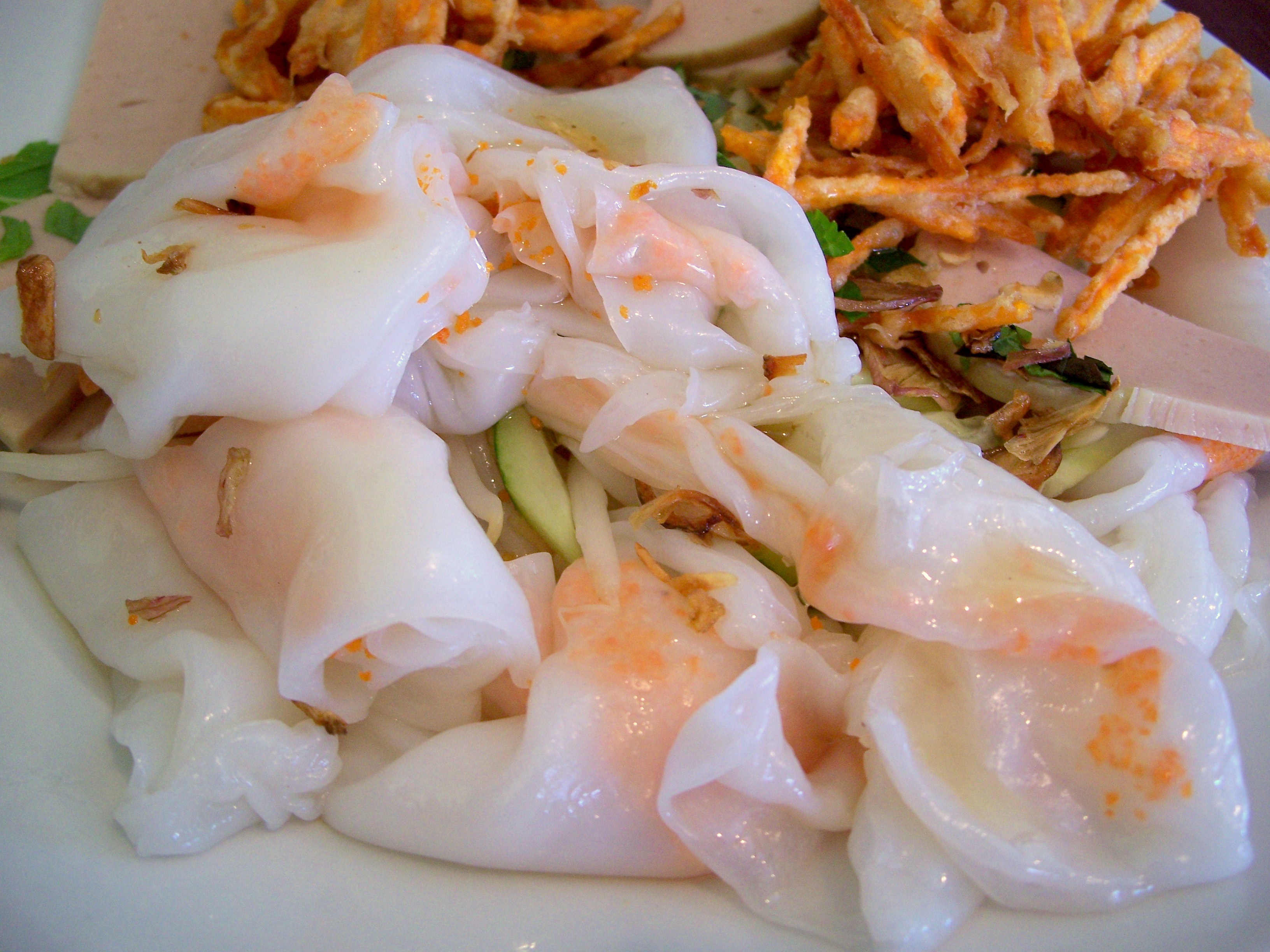
The second type of banh cuon, for non-meat-lovers like my mother, is bánh cuốn tôm chấy (rolls with dry-fried shrimp). The shrimps, peeled and fried without oil or any liquid, get dried up and broken into a flossy powdery entanglement. That’s if you make it at home. Here I suspect the kitchen uses some prepackaged shrimp powder for efficiency, which has a beautiful scarlet hue but little texture and flavor. The rolls, though practically just steamed rice leaves, are still savourastic when soaked and glossed in that honey-colored sweet and salty nước chấm.


The third type is a modern spinoff with thicker rice leaf, bigger rolls, stockier stuffing that features grilled pork, bean sprout, and cucumber all in one, also at a heftier price (4 rolls for $6.95). Bánh cuốn thịt nướng is more of a filler than a delighter, but who says it can’t lift your mood while settling your stomach. Instead of grilled pork, shredded pork skin is also used, making the fourth type: bánh cuốn bì.


If banh cuon thit nuong‘s savoriness from grilled pork saves it from getting drowned in nuoc cham, the shredded pork skin (with some meat) in banh cuon bi are merely for textural pleasure, leaving chilipeppered peanut sauce to dress up the rolls. I have faith that nuoc cham would be a better roll-dresser though.


Occasionally I like to fool around with these variations, but in the end banh cuon nhan thit is still the winner in taste, just as Tay Ho Oakland is the winner in reliability.

Address: Tây Hồ Restaurant – Bánh Cuốn Tây Hồ #9
344B 12th Street
Oakland, CA 94607
(510) 836-6388

Sandwich shop goodies 12 – Chuối nếp nướng (grilled banana in sticky rice)

November 30, 2010 By: Mai Truong Category: California - The Bay Area, One shot, savory snacks, Southern Vietnamese, sticky rice concoctions, Vegan


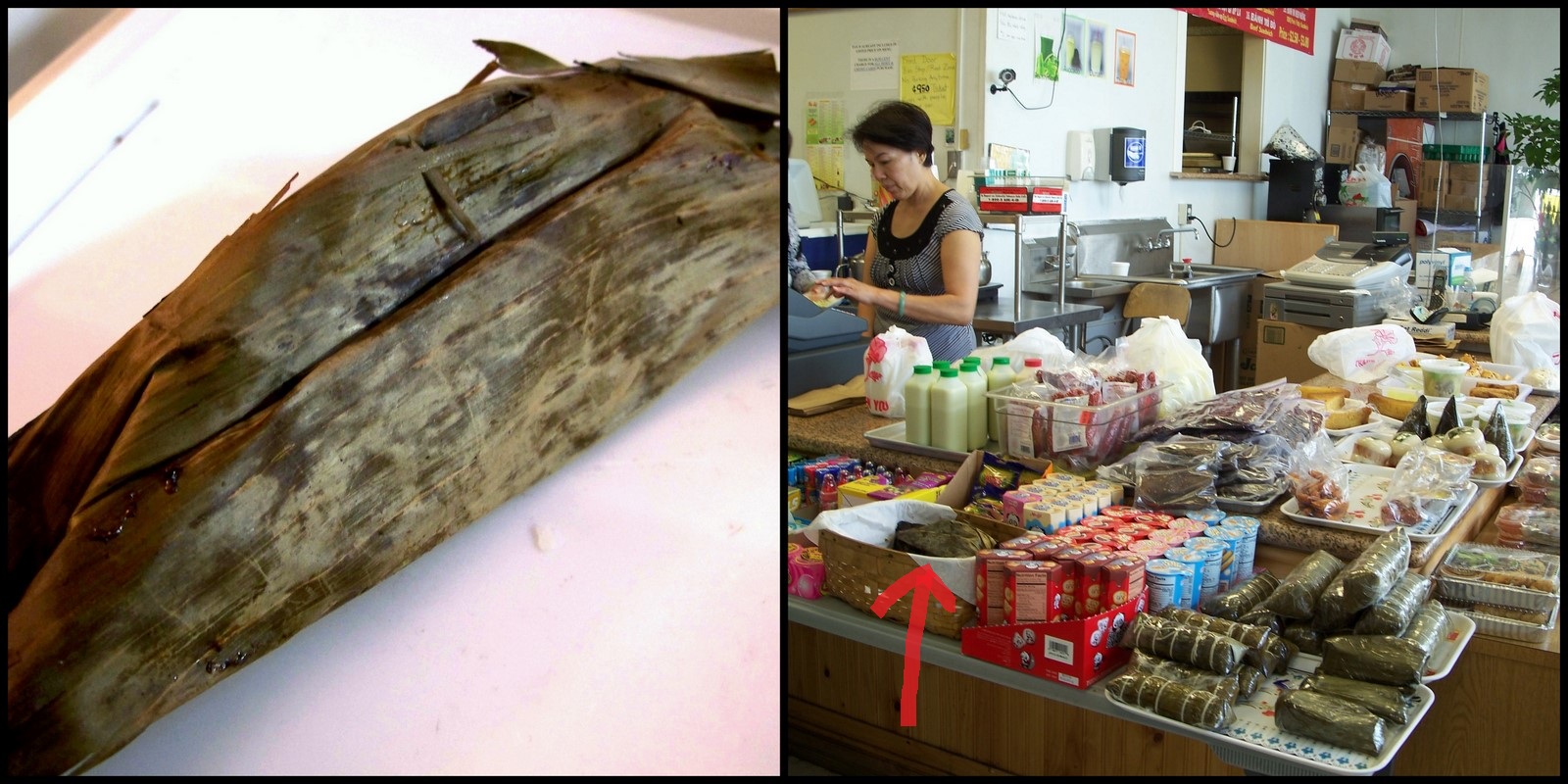
They all look the same. A myriad of things wrapped in wilted banana leaves sitting on the counter at a banh mi shop. Few patrons seem to notice the snacks as they occupy themselves with sandwich orders and the more meal-like rice or noodle to-gos, so much to the extent that the sellers too have little interest in selling their counter treats. Humbly, I point to these slender, charred and dry parcels piled in a box near the Pockys and inquire about their name. The hostess throws me half a glance infused with boredom, “Chuối nướng,” she moves her lips. So “grilled banana” they are.


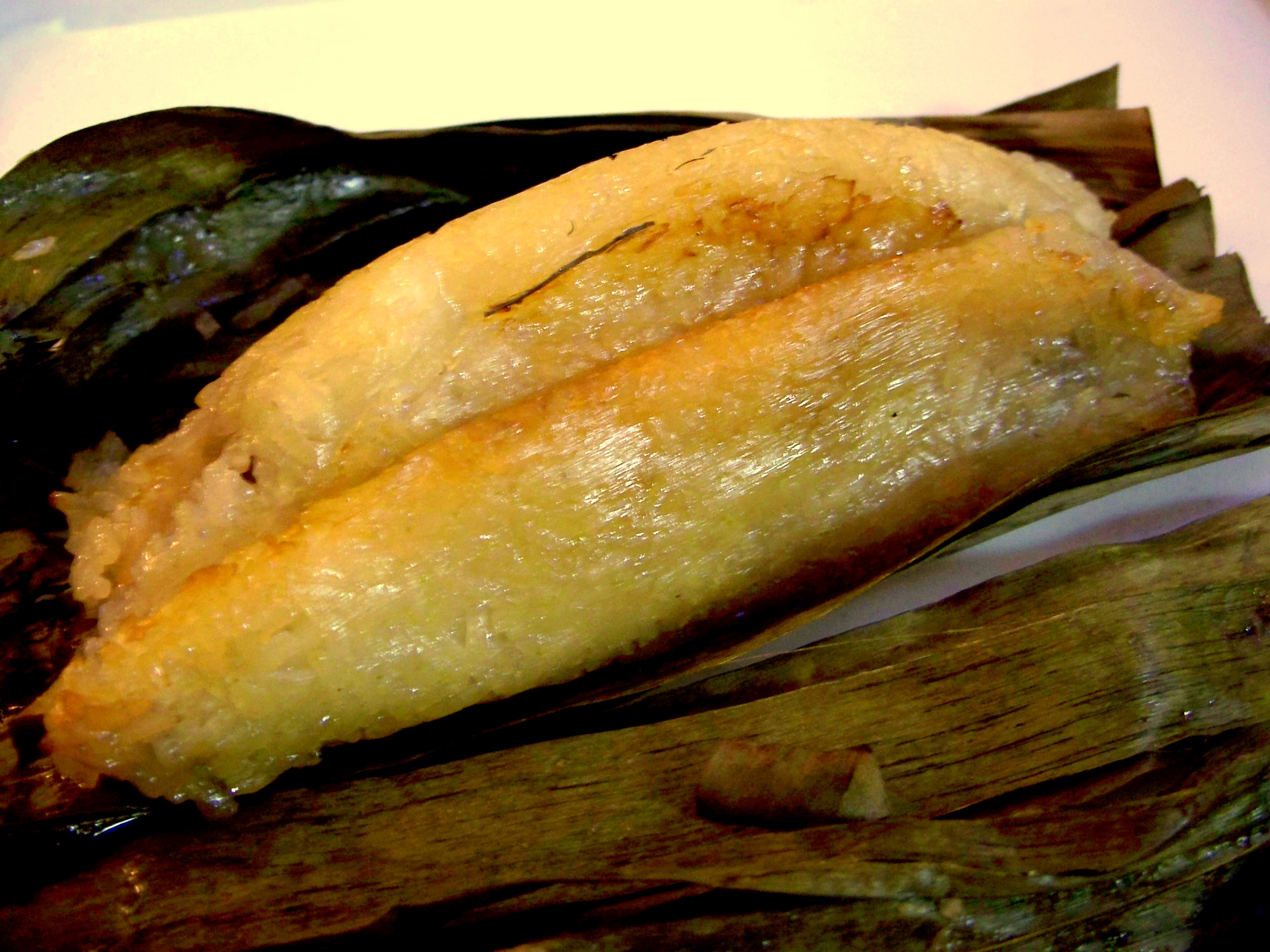
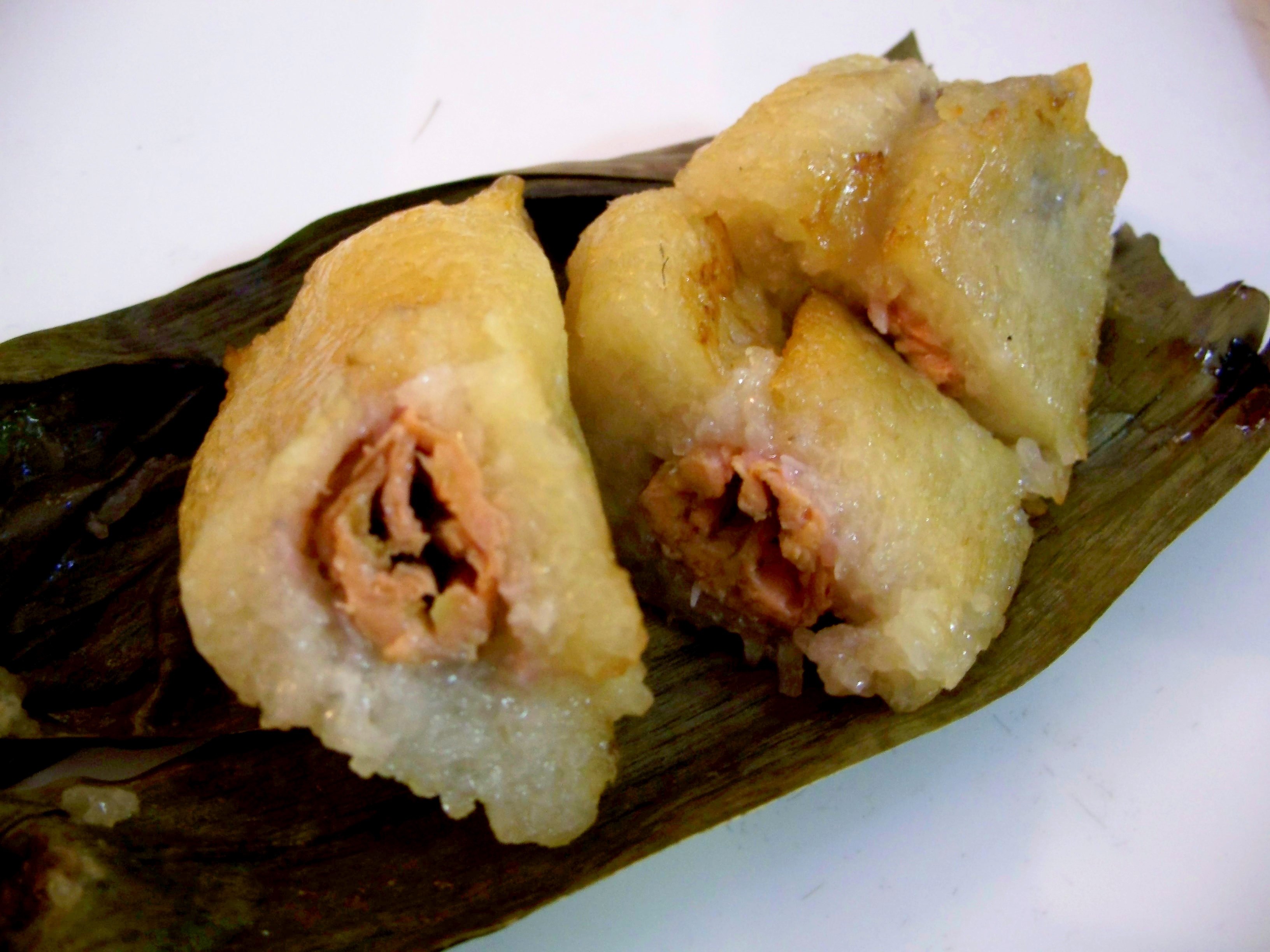
It takes an utterly simple form: a banana inside a sticky rice shell inside a banana leaf, charcoal grilled. Crispy, then chewy, then gooey sweet it goes as you sink your teeth through the bounteousness. It’s the factoriless meatless corn dog sans wooden stick of Southern Vietnam. Children would wait around old grandmas in the ‘hood to watch them grill the banana dogs and drool; adults would grab the banana dogs for breakfast, lunch, or late night snack when a wind chills and the grill warms.

It’s one of those things that can’t go wrong. Some cook the sticky rice plain, then serve the grilled dog sectioned and bathed in coconut milk with a pinch of sesame salt or peanut salt. Others do it My Tho style: the sticky rice is cooked in coconut milk and later mixed with coconut shavings before wrapped and grilled. Many cloth their nana dogs with just a band of nana leaf, mainly for easy handling of the sticky rice on the grill and near other dogs, but the dogs get crispier too. Meanwhile, Ba Lẹ ladies bundle up their dogs like they would with bánh tét, less charred, more aroma from the leaves.


Like banana bread pudding, banana dogs are exclusively made with chuoi su, a solid, stout, dense and white banana that grows like weed in the Asian tropics but is nonexistent in the States. The sad substitute Cavendish lacks consistency and sweetness and gooeyness. Yet, chuối nếp nướng still hits the spot like waltzing in the rain.

These nana ricewiches, as Noodlepie lovingly nicknamed, were 2000VND a steal (~10 US cents with the current exchange rate) in 2005. In 2007 the Gastronomer took the bite for 3000VND. I have no idea how much they cost now on the Saigon streets, with crazy inflation it might just be 10000 for all I know. But here at Bánh Mì Ba Lẹ in Oakland, nana dogs will go home with you for $1.75 each.

Address: Bánh Mì Ba Lẹ (East Oakland)
1909 International Blvd
Oakland, CA 94606
(510) 261-9800

Previously on Sandwich Shop Goodies: khoai mì hấp (steamed cassava)
Next on Sandwich Shop Goodies: Bánh xu xê (couple cookie)

Sandwich shop goodies 11 – Steamed cassava

November 09, 2010 By: Mai Truong Category: California - The Bay Area, Comfort food, One shot, savory snacks, Southern Vietnamese, Vegan, Vietnamese


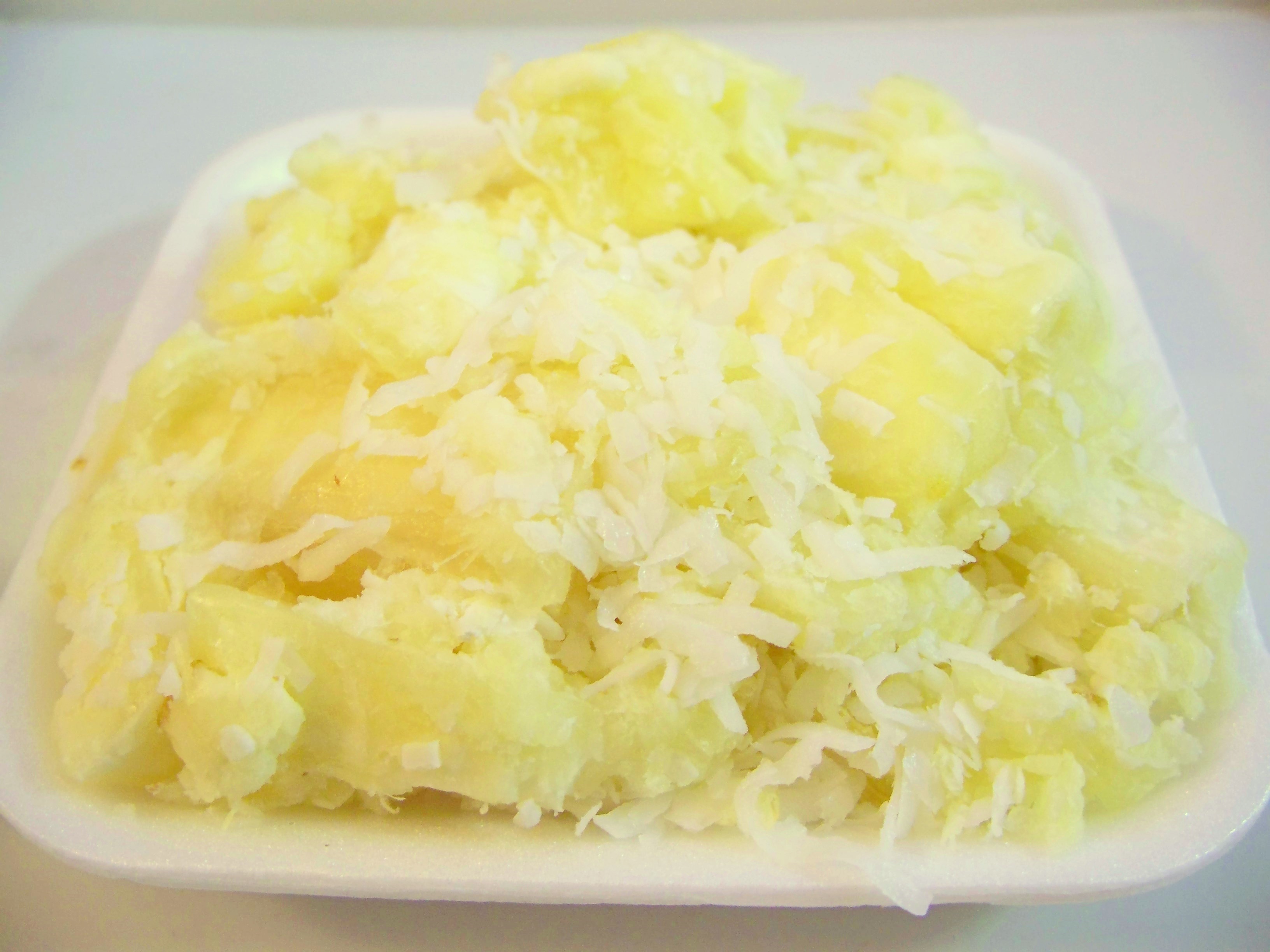
My mom is a skeptic about street snacks, most of the time because of the fingers handling them, but this thing passed. Like xoi, it should always be served hot right out of the steamer. Cool it down with a few blows of air and hurry it in the mouth; it may be wet and chewy, or it may be floury and nutty. But it’s distinctively cassava.

Back home, khoai mì hấp (steamed cassava) is among the cheapest Saigon street scoffs, because khoai mì (cassava root) is cheap (2000VND/kg these days, about 5 cents/lb), and the making is beyond simple. You boil the roots, then keep it warm and moist in a steamer. Unlike banh bao vendors, you keep the lid open to let out burly rolls of steam and invitation. The cone hat ladies sometimes add pandan leaves in the water, those ivory chunks then smell as sweet as spring rains. A customer comes, you scoop him a few palmfuls into a nylon bag and forget not the coconut shavings and the classic salt-sugar-sesame mix. A true street scoffer would eat with his fingers, probably holding the thick center string (the root’s woody cordon) to nibble on without touching its hot flesh.

I mix salt, sugar and my memory of what steamed cassava should taste like into the $1 prepackaged clump at Bánh Mì Ba Lẹ in Oakland, after microwaving it for one minute. The roots are dry and flavorless, probably out from a frozen section. But I taste only my younger days.

Address: Bánh Mì Ba Lẹ (East Oakland)
1909 International Blvd
Oakland, CA 94606
(510) 261-9800

Previously on Sandwich shop goodies: Bánh chuối nướng (Vietnamese banana bread pudding)
Next on Sandwich shop goodies: chuối nếp nướng (grilled banana in sticky rice – banana dog)

Down the Aisles 6: Asian markets’ hits and misses

October 08, 2010 By: Mai Truong Category: California - The Bay Area, Chinese, Korean, savory snacks, sweet snacks and desserts


I’ve been lying low on the blogging front for the past couple of weeks, because the school front is under serious bombarding. Having classes is one thing; having to teach, applying for stuff, looking to join a research group on top of classes is a whole different level of war. Not that I lose my appetite, but when twenty deadlines are approaching like a flock of Luftwaffe‘s Bf 109, quick filling meals trump elaborate dishes. Loco moco is a winner, but even I know that I can rely solely on gravy, egg, and hamburger patty for so long before a heart attack. Hence the deli section in supermarkets gain appeals.

But if you’re gonna buy cheap store-made food, you gotta do it in style. Apple pies, rotisserie chicken, turkey sandwiches, or those mushy bean-and-pasta salads are so 2009 (I used to buy a rotisserie chicken every week last year :-P). This year we hit up the delis in Koreana Plaza and 99 Ranch Market.


Entree 1 – kimchi big dumpling ($3.99 for 4) from Koreana. Each is as big as my fist, the dough is springy and leathery with a sour hint, the innard is not kimchi but a mixture of glass noodle with some egg/shrimp/tofu-like paste. Overall it’s rather bland.


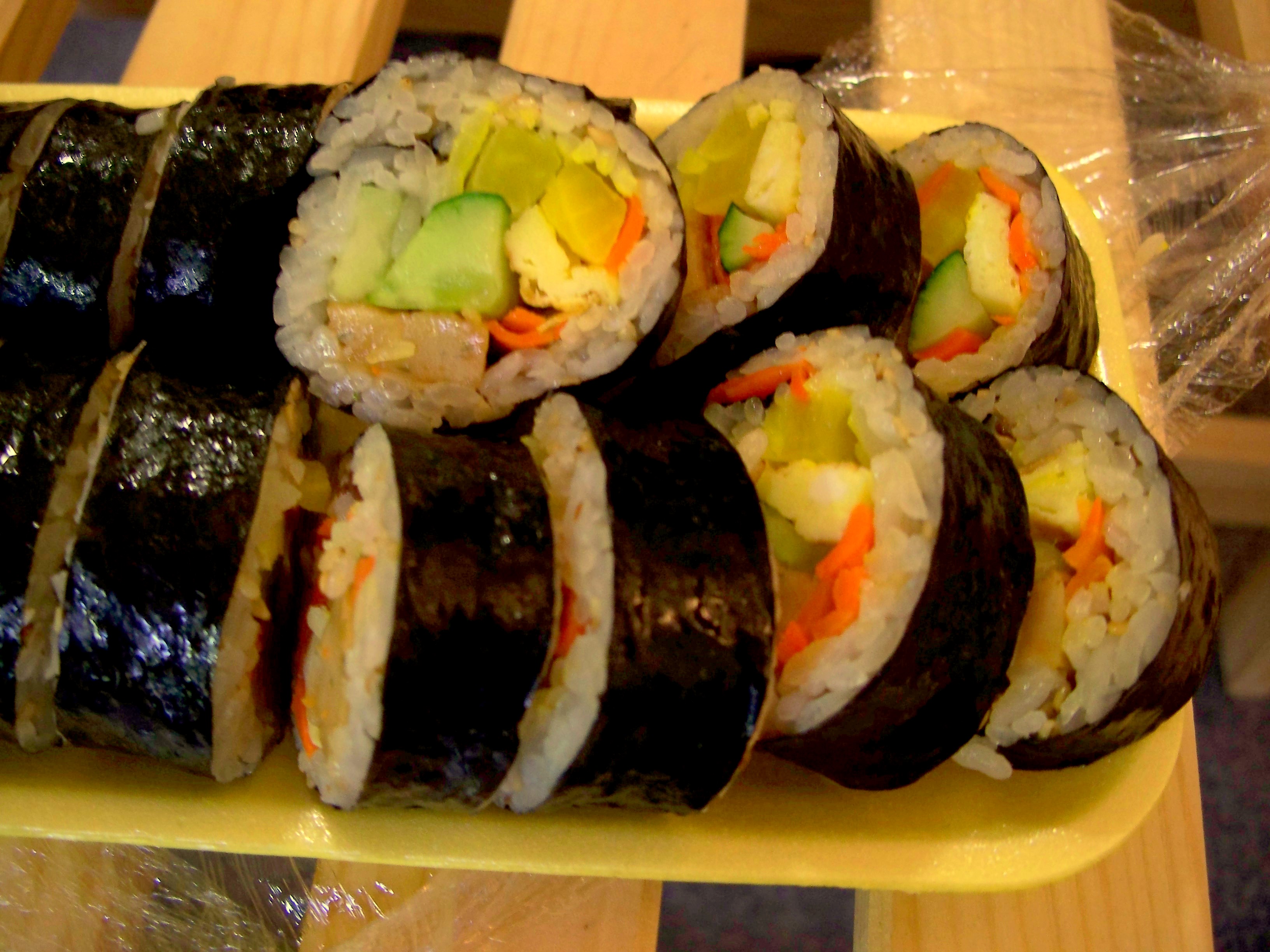
Entree 2 – kimbab ($3.99 for 2 rolls – 20 pieces) from Koreana. The kim (seaweed) always smells like the sea, but it adds an unparalleled savoriness to rice. Love it. 🙂


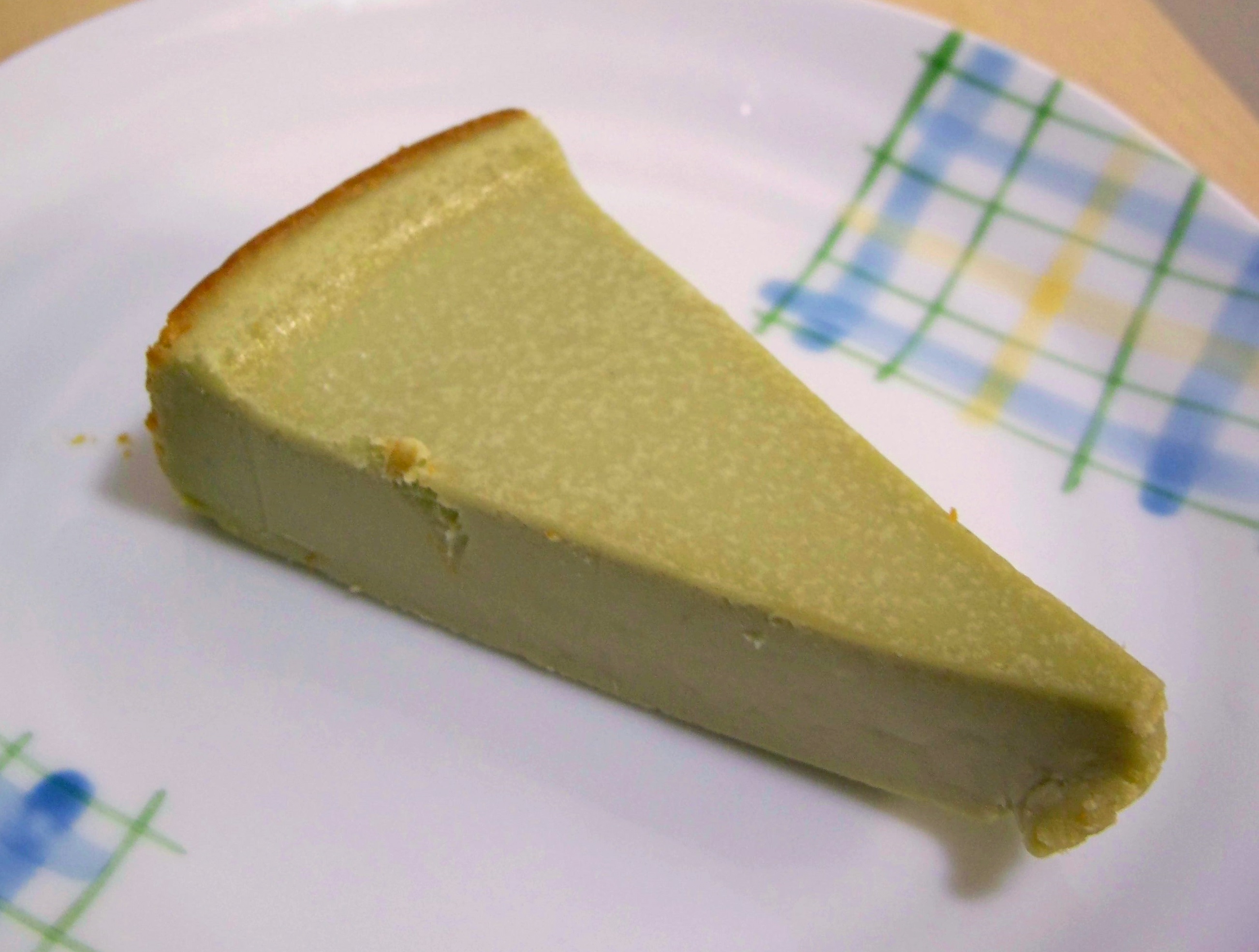
Dessert 1 – green tea cheesecake ($1.50/slice) from 99RM. The slice is only three fingers at its widest but solid as a butter stick. It’s really just like eating a wedge of gouda with some distant herbal call.


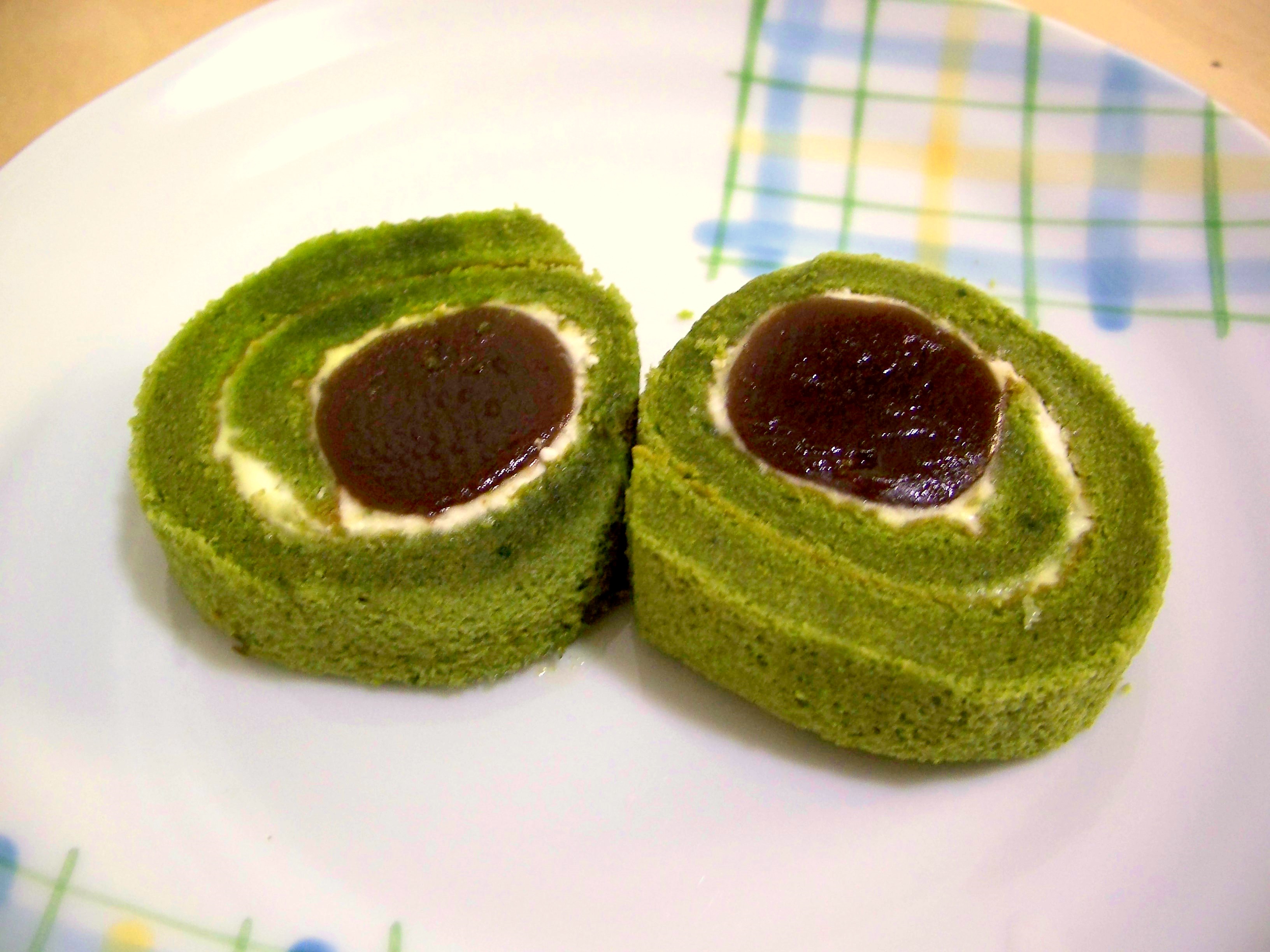
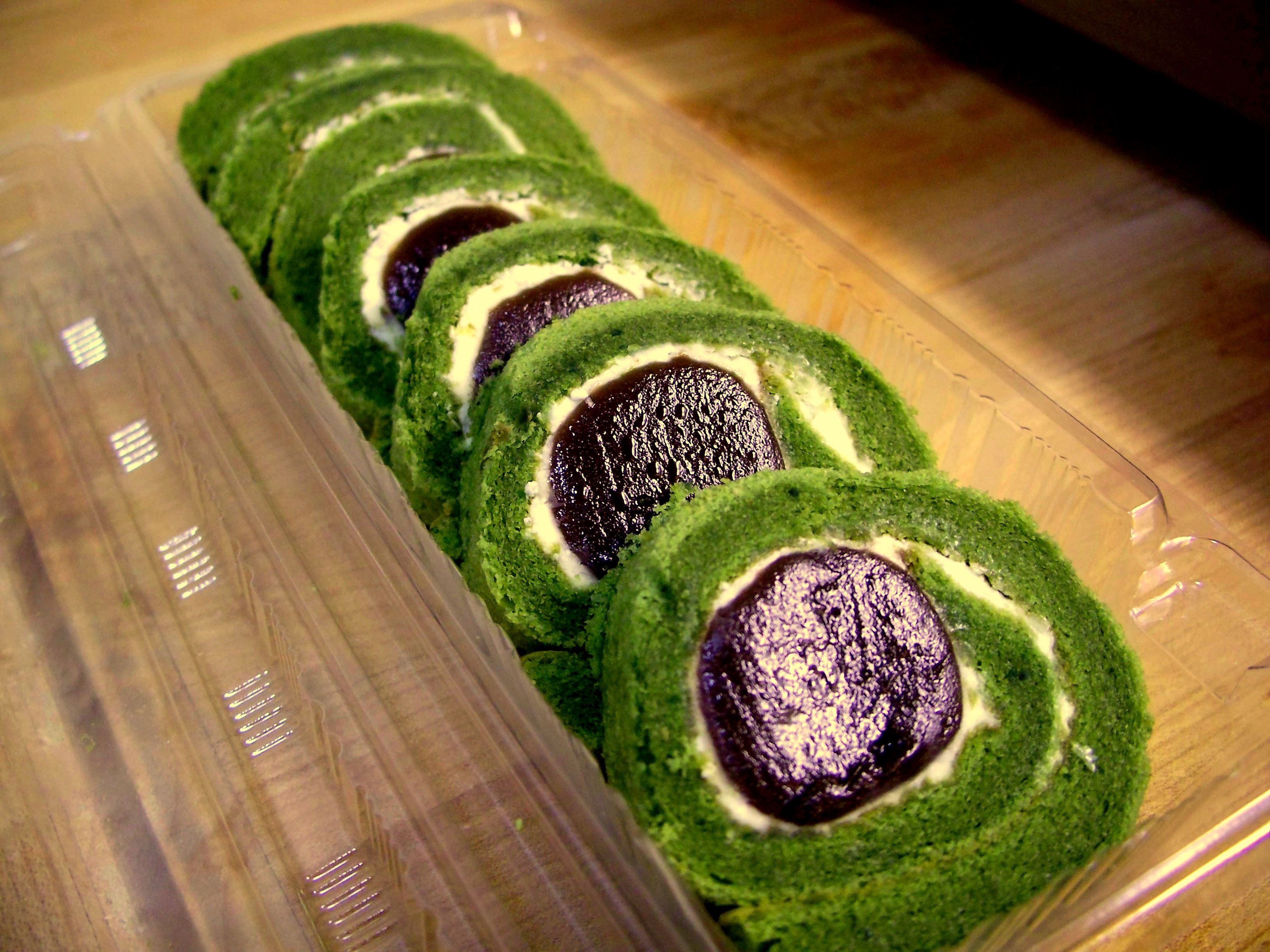
Dessert 2 – green tea red bean roll from 99RM. Sweet and chewy red bean paste, grassy plain and pillowy green tea dough, with a hair thin layer of milky cream. Petite and adorable. 🙂

Side comment, I was cheap so I was contented with drooling at the sight of the 99RM cakes. Don’t know about tastes, but the 99 Ranch’s bakery got some cake decorating skillz that make all American supermarket bakeries look like child plays.

Koreana Plaza (Oakland)
2370 Telegraph Ave (between 23rd St & 24th St)
Oakland, CA 94612
(510) 986-1234

99 Ranch Market (Richmond)
3288 Pierce St # 99
Richmond, CA 94804
(510) 558-2120

Previously on Down the Aisles: It’s It

Sandwich shop goodies 7 – Bắp hầm (Vietnamese whole kernel grits)

July 19, 2010 By: Mai Truong Category: California - The Bay Area, Comfort food, One shot, savory snacks, Vegan, Vietnamese


Corn must be my favorite grain. Growing up with very limited access to street food, I used to fix my eyes on the corn carts and baskets of market women near home, secretly drooling. They had a big steamer packed with corn ears still wrapped in their wilted yellow husks and brown silk, sometimes a glass shelf with peeled ones, white and shiny and plump. I was always so happy when Dad bought xôi bắp, sweet corn and sticky rice, for breakfast. Then at night there was corn-on-the-cobs grilled by coal fire and smothered with lard and green onions. It’s better than butter, no doubt. At che stalls there was corn pudding with coconut milk, which I like when it’s warm and gooey. And that was all the Vietnamese corn stuff I knew.

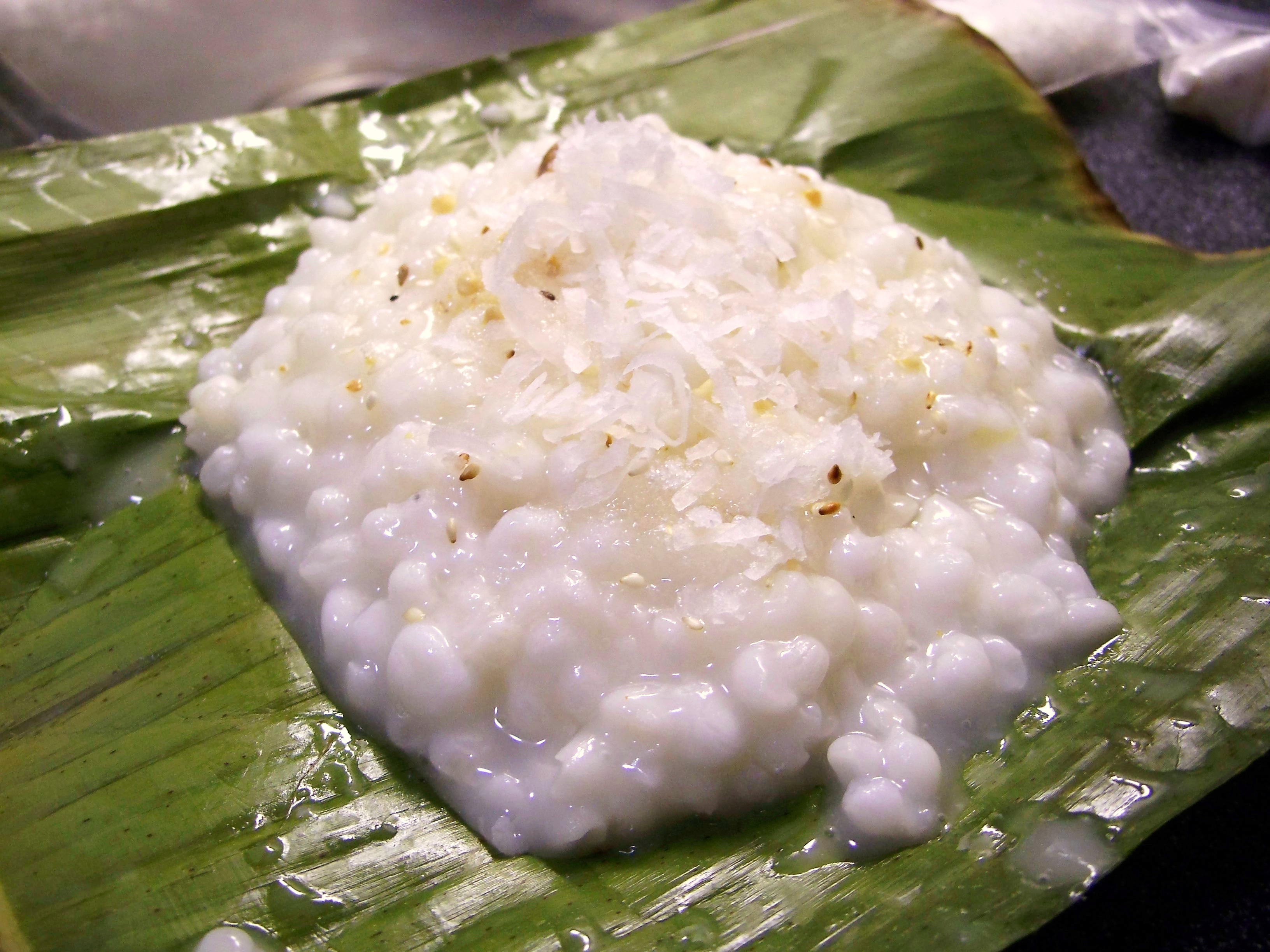
Not until recently that I came across another corn thing, a midfielder between chè bắp (corn pudding) and xôi bắp, and porridge too. I hate porridge, but I love this stuff.

Some people just call it “bắp nấu”, “cooked corn”, either to make sure that we know we’re not eating raw ones or to confuse questioners with the boiled whole ears, also known as bắp nấu. The more careful gourmands label it “bắp hầm“, literally “simmered corn”, since the hulled kernels are slow cooked until saturated with water and soft like a canned sweet pea. But it’s not mush, the corn still retains a tiny bit of chewiness that entertains the gums.


The classic vendor look is a ladle of hot white bubbly goo half wrapped in banana leaf, a few spoons of SSS (sugar-salt-sesame) mix huskily dumped on top, a tuft of coconut shreds on top of all, and a finger-long piece of banana leaf stem to scoop.

The sandwich store look has the SSS mix and coconut in tiny Ziploc pouches, a half pound of corn in banana leaves, all cling wrapped on a styrofoam plate and sent home with a plastic spoon.  It’s sleek alright.

Makes awesome meals on vegetarian days!

The white easy package sells for two bucks at Huong Lan Sandwich #4 in Milpitas (41 Serra Way, Suite 108, CA 95035). My guess would be 2000VND (~11 cents) if you buy it in Vietnam, anyone knows?

Previously on Sandwich Shop Goodies: bánh dừa (coconut sticky rice stick)
Next on Sandwich Shop Goodies: bánh bao chỉ (loh mai chi – Chinese sticky rice flour ball with sweet fillings)

Sandwich Shop Goodies 6 – bánh dừa (coconut sticky rice stick)

July 15, 2010 By: Mai Truong Category: California - The Bay Area, One shot, savory snacks, sticky rice concoctions, Vegan, Vietnamese


If anything can be called the Vietnamese granola bar, it’s bánh dừa.

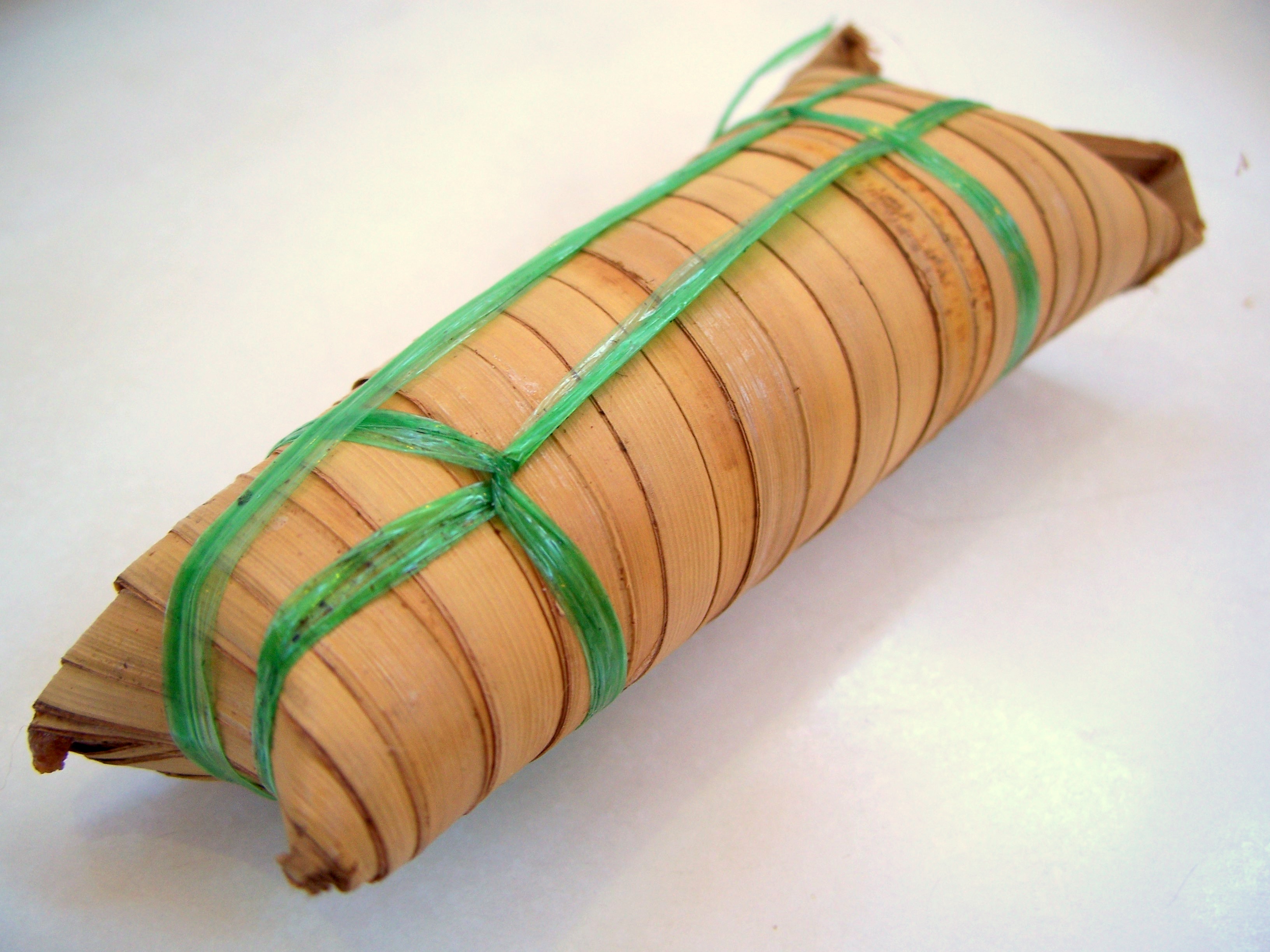
Coconut bánh. The simple name lends room for innocent confusions with the French Coco au Miel, the Malaysian kuih binka gandum, the coconut cookies, and a whole flock of other Vietnamese coconut treats also known as bánh dừa (with some additives like “grilled”, “honeyed”, or “lemon”). People of the deep south don’t get too fancy with names: when the bánh has coconut milk mixed with sticky rice and is wrapped in coconut leaves, it has every right to be call a coconut bánh. Besides, children identify it by the unique look.

A stiff, almost cylindrical case, as long as a palm and almost two fingers wide, is made from wrapping one single young coconut leaf around hours of training, to protect the glutinous rice and bean paste core for days in the tropics’ heat. The one I bought stays good for two weeks in the fridge, unwrapped.


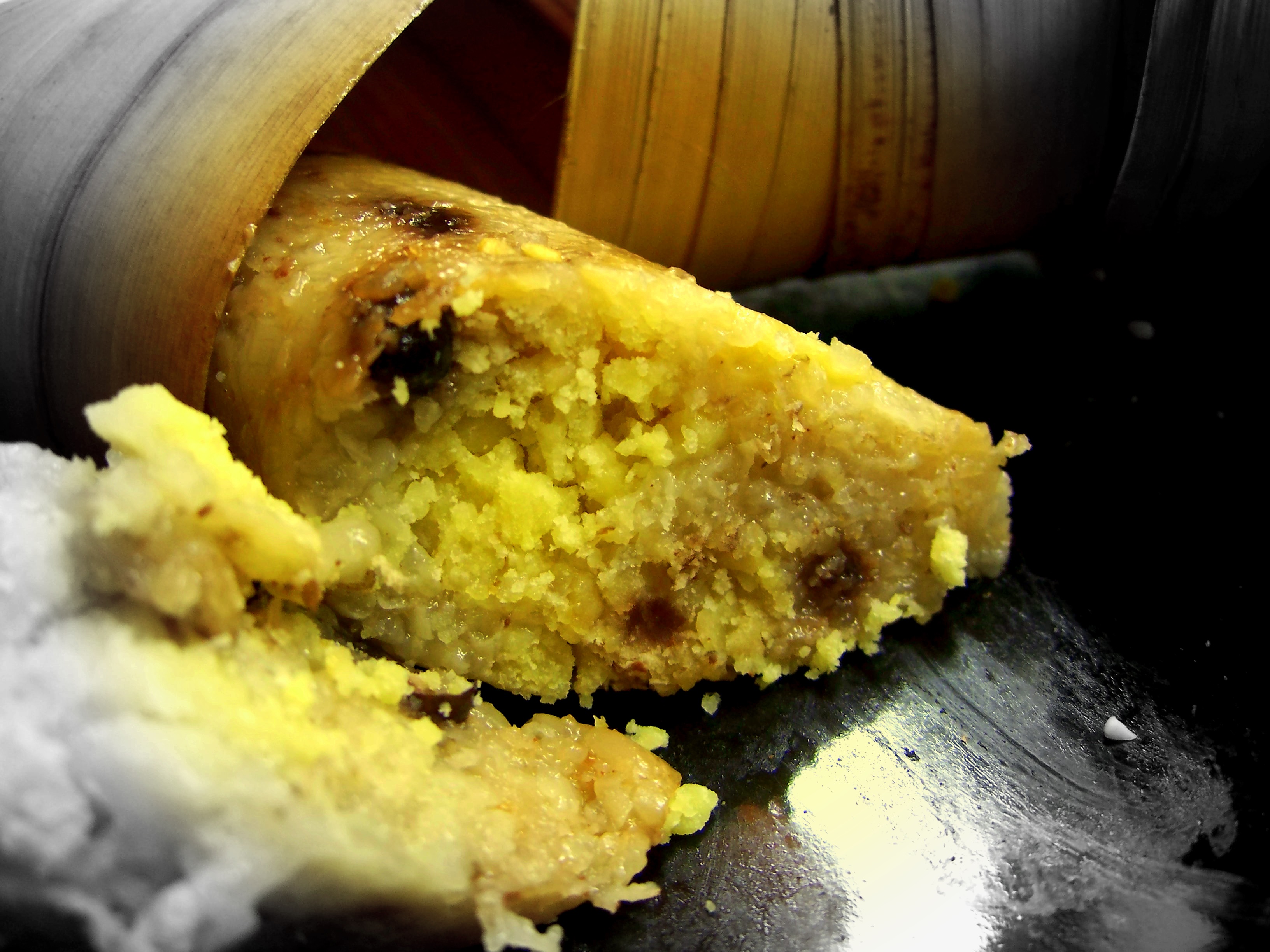
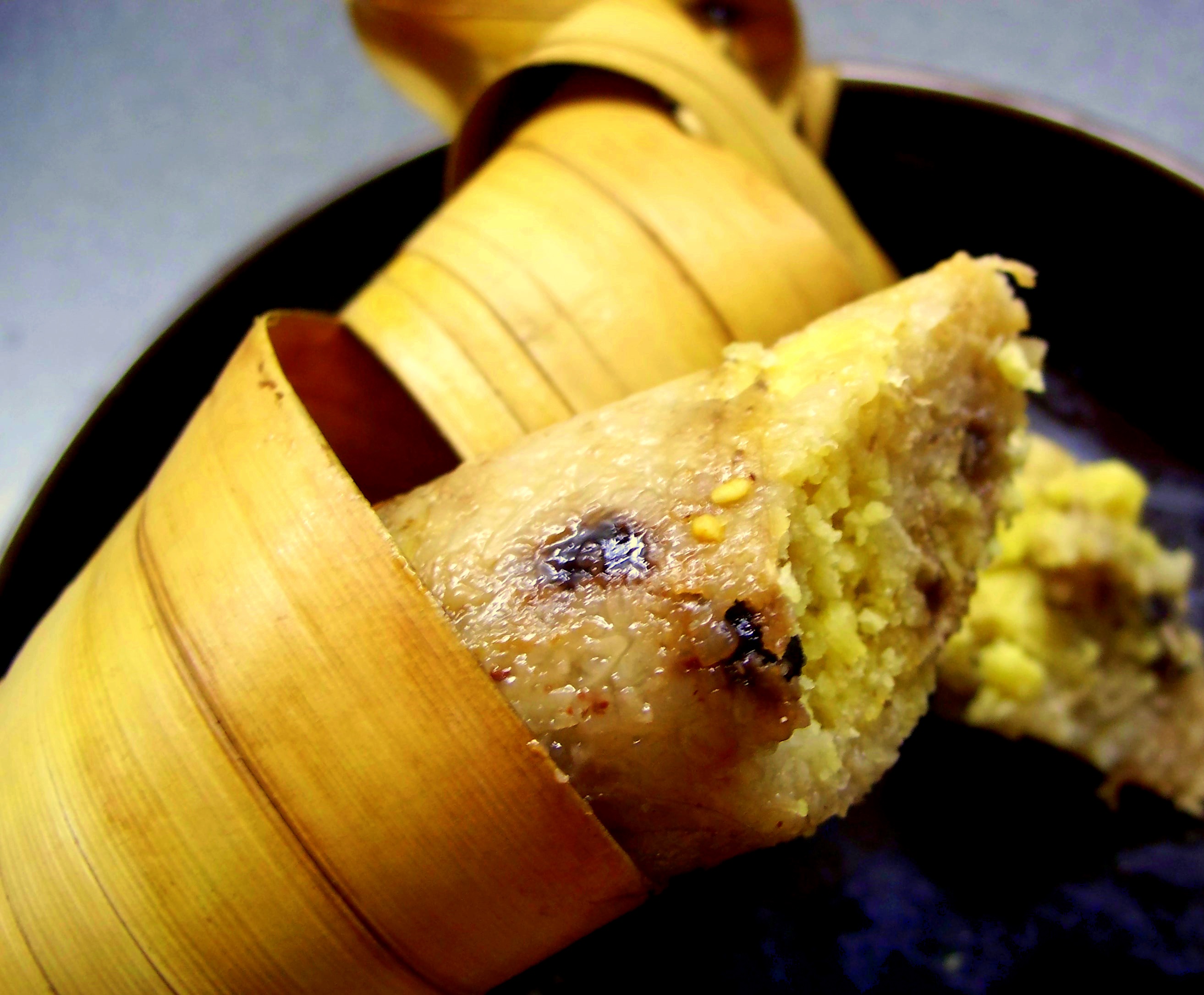
Such longevity expectedly costs a good deal of skill and time. Wax sticky rice, a special cultivar in Vĩnh Long known for its gumminess and fragrance, is soaked in water at midnight. The banh makers wake up at 4am to wash the sticky rice as carefully as six to seven times to get rid of bran and dirt, the first step to delay spoilage. Washed sticky rice is then air dried, while the banh makers squeeze coconut milk out of grated coconut and wrap up the leafy tubes, which could turn an ugly wilting purple unless put in the shade. Dried sticky rice is mixed with coconut milk, salt and sugar, sometimes black beans, into a gooey mess to be portioned into the tubes. The first one third of the tube is sticky rice, then comes mung bean paste or half a ripe banana, and more sticky rice to fill up the tube. I will forever be puzzled by how to make the sweet filling perfectly in the middle of the sticky rice layer. There is also no clear instruction on how to tie up the banh with a string, but rest assured that there are many ways to get it wrong. If the string is too tight, sticky rice can’t rise and your bánh dừa is one dry stick. If the string is too loose, water vapor seeps in while steaming, your bánh dừa becomes half-porridge and spoils fast.

By 7am all wrapping is done, banh makers throw their sticks, now strung together in small bundles, into the boiling steamer for a solid 5 hours. The steam water is often mixed with alum to keep the case’s healthy yellow color, but too much alum can make the banh turn sour. At noon, fresh bánh dừa is ready for the markets.


Holding the light and compact banh in hand, I picture country kids of the Mekong Delta stick these coconut sticky rice sticks in their pockets and school bags for an early morning in the rice paddies, an afterlunch snack, a quick filler while running around with the kites. The coconut leaf unwraps swiftly with no effort, reveal a firm and chewy, fatty and nutty, salty and earthy treat that requires no reheating  or refrigerating. Some may see it as merely a miniature bánh tét, but the coconut leaf gives bánh dừa its signature fragrance and a deserving separation from the banana leaf wrappers.

Bánh dừa is cheap. Ten years ago the Southern Vietnamese villagers sold them for 500VND a stick. Inflation brings it up to 2000VND these days, roughly 11 US cents.  The ones in San Jose banh mi stores cost one wild buck each, but they often lie on the counter unnoticed for who knows how long. “Posh” customers don’t go for the leafy wrapped treats when plastic and styrofoam and colorful packaging look more sanitized. City kids are not attracted to these because they don’t scream chocolate and sugar. Like the old country ham of North Carolina, bánh dừa has fallen out of the trend, and most of their makers have long put away the steamers for something more profitable.

I had a bánh dừa for dinner today. How much longer will its kind stay in the market to compete against the Western sweets? I don’t know.

————————–

Got it from: Kim’s Sandwiches
(in the Lion Supermarket area)
1816 Tully Rd 182, San Jose, CA 95111
(408) 270-8903

—————————
Previously on Sandwich Shop Goodies: bánh khảo/bánh in
Next on Sandwich Shop Goodies: bắp hầm (Vietnamese whole kernel grits)

Satsuki Bazaar on Channing Way

May 25, 2010 By: Mai Truong Category: California - The Bay Area, Festivals, Japanese, Opinions, savory snacks, sticky rice concoctions, sweet snacks and desserts


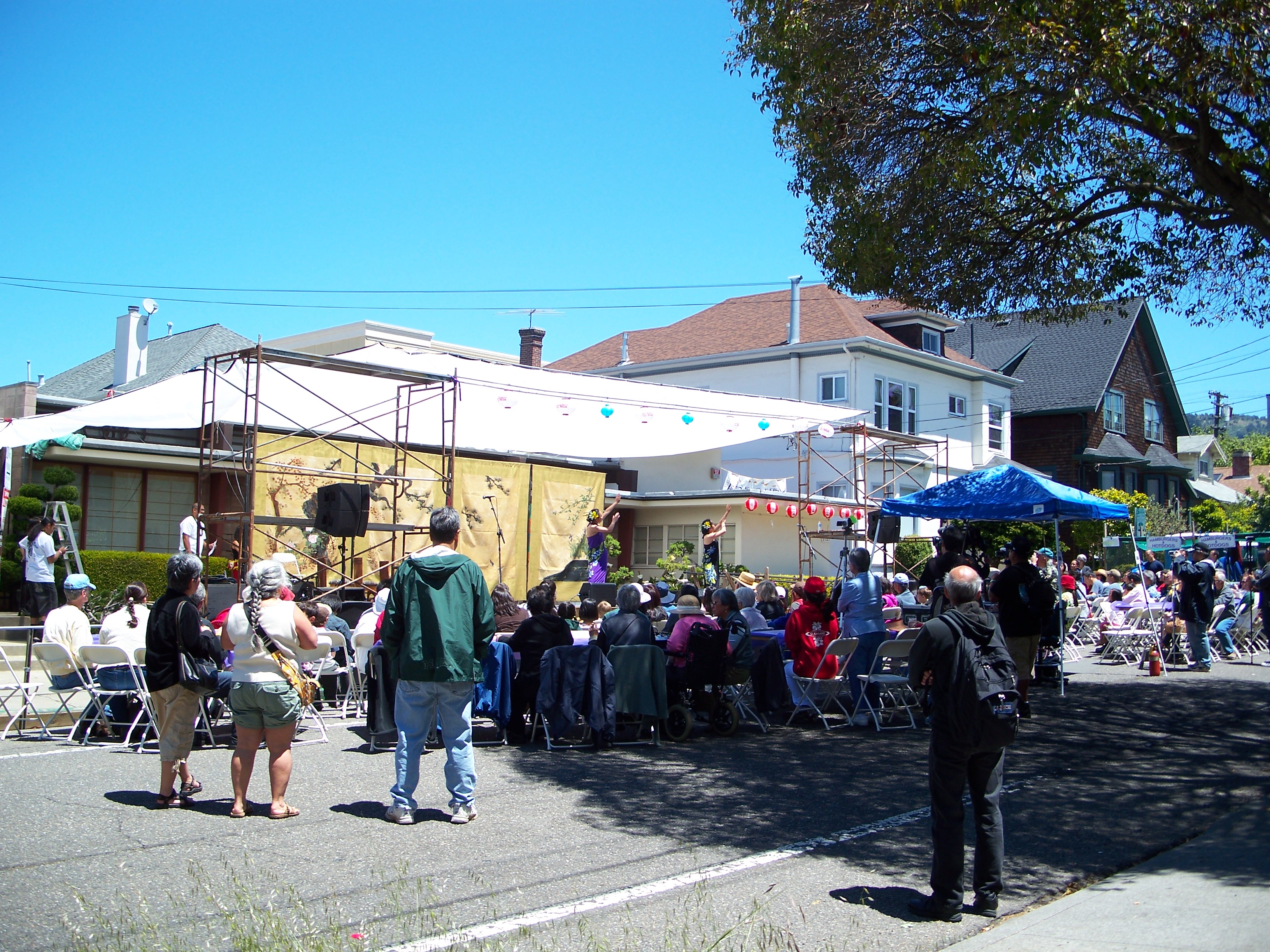
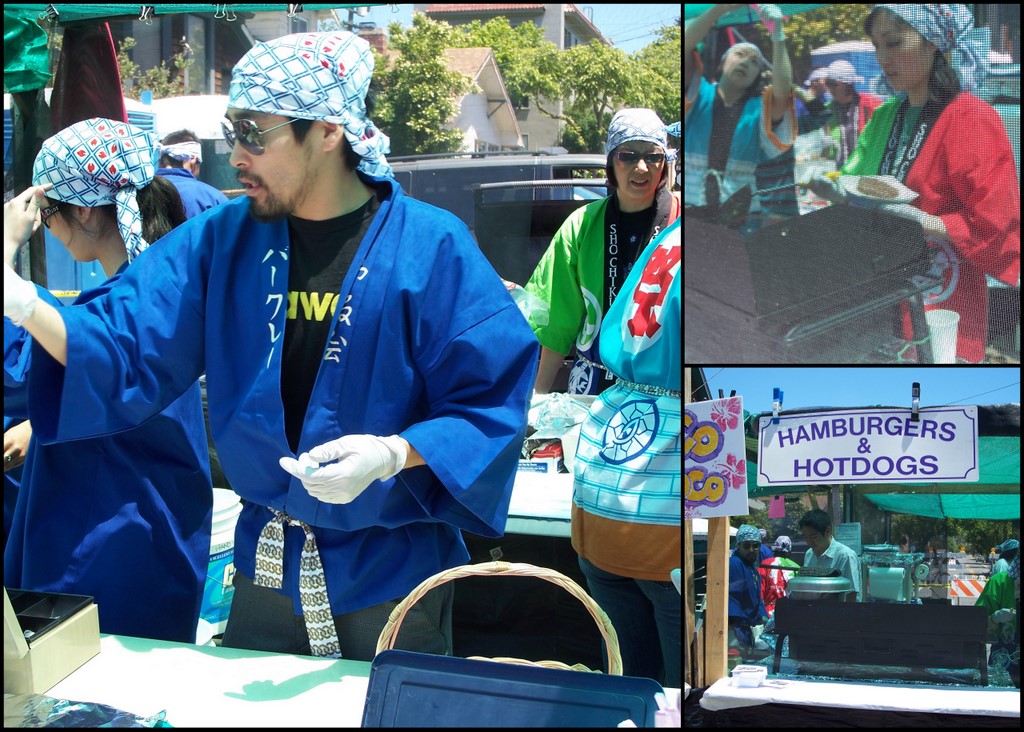
One blue-sky Sunday in May. A section of Channing Way, between Shattuck and Fulton, was blocked. Two girls draped in summery garments danced to joyous Hawaiian tunes on a sunlit wooden stage, surrounded by a small crowd of both familiar spectators and curious passing pedestrians. The seductive smell of grill beef got caught in the wind here and there.


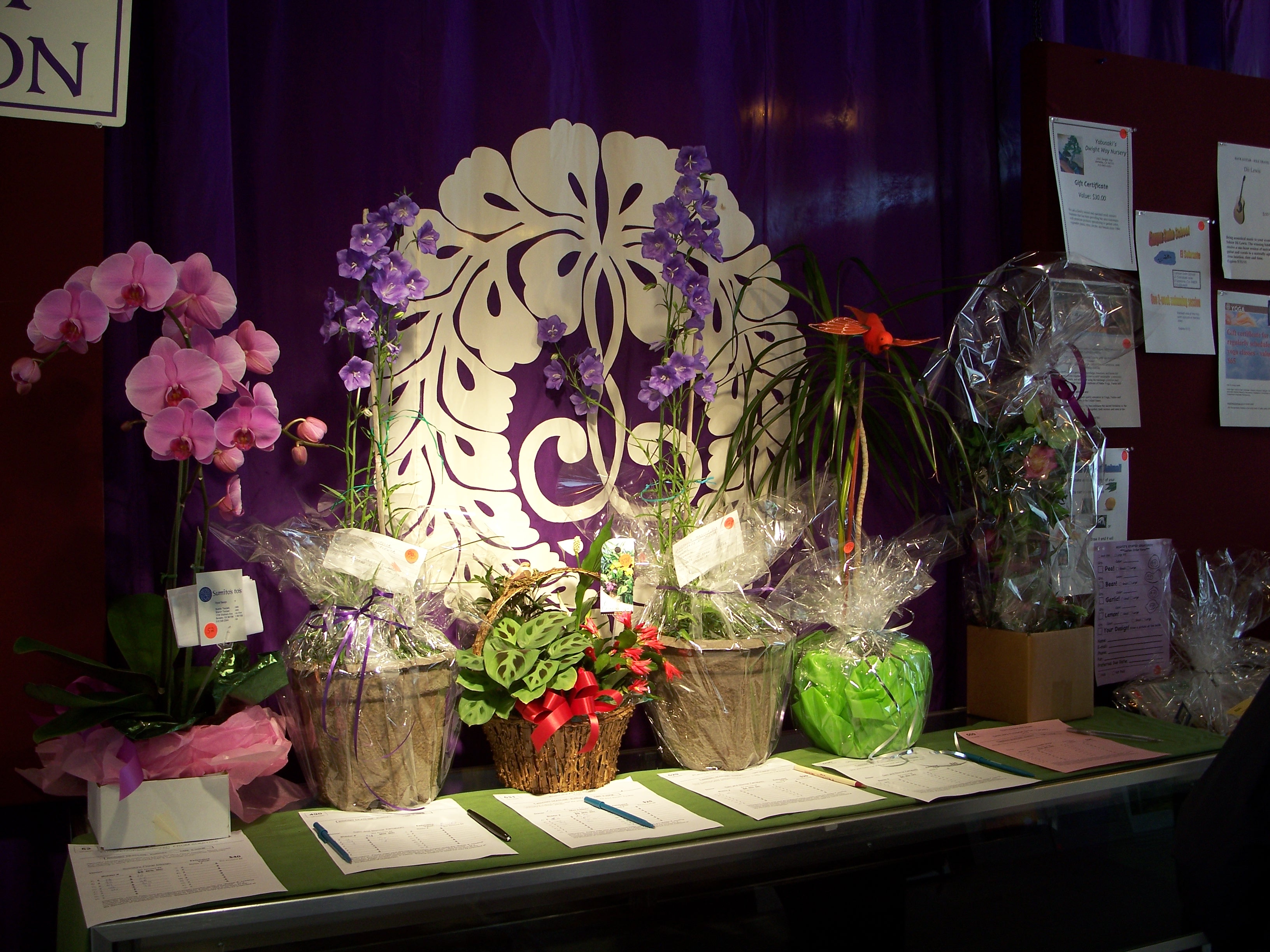
So it was the street front of the 61st annual Satsuki Bazaar and Arts Festival at the Berkeley Jodo Shinshu Buddhist Temple on Channing Way. Inside the temple, a multitude of items displayed for silent auction held visitors’ footsteps, starting with orchids, matted photos and paintings, gift cards to sushi bars and diving lessons…


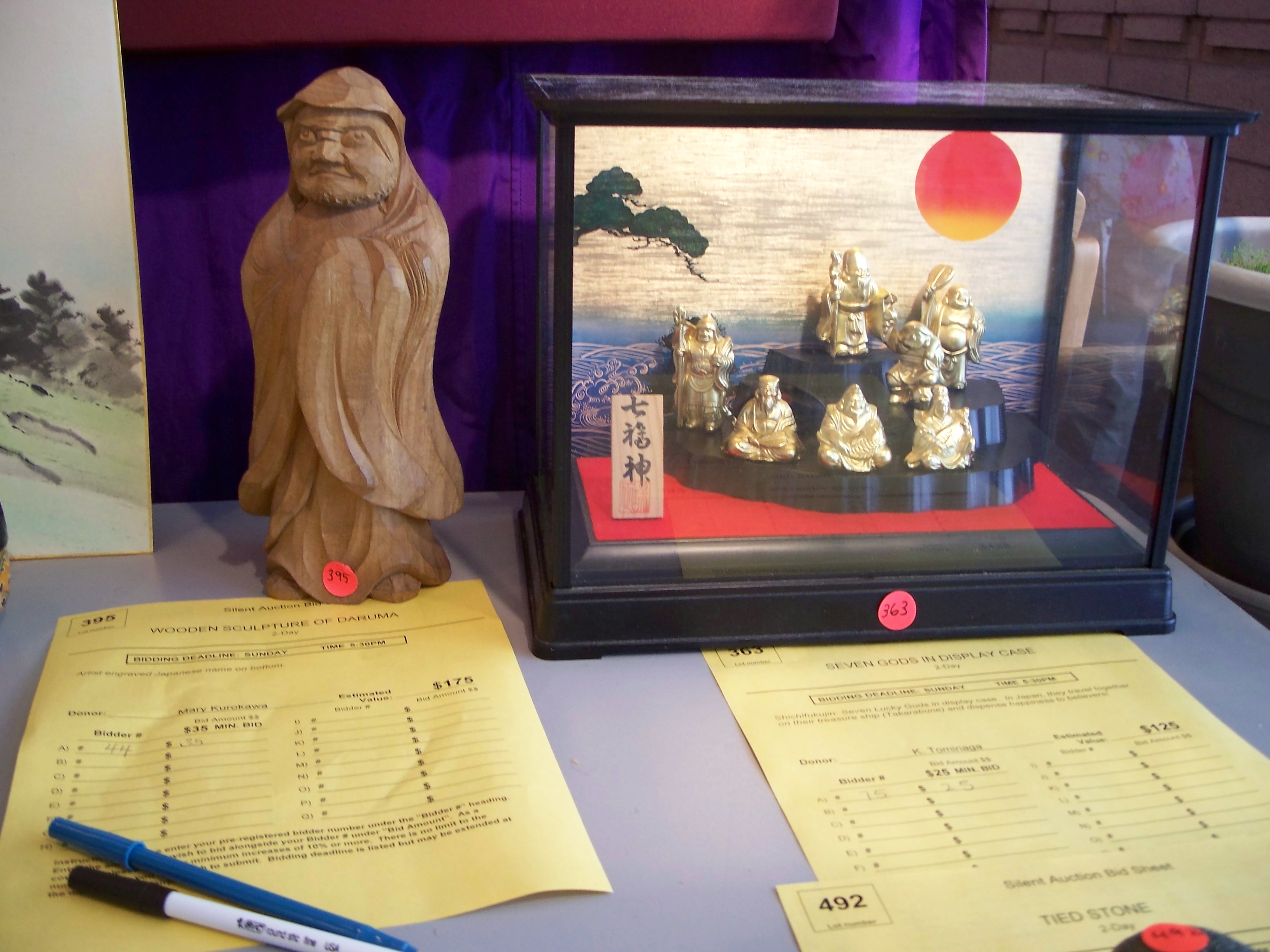
…to porcelain sets, stuffed toys, a wooden sculpture of Daruma, and Shichi Fukujin in a glass box.


But few things can attract everybody like food. The “dining hall” was packed to the door like a beehive overflowed with nectar.


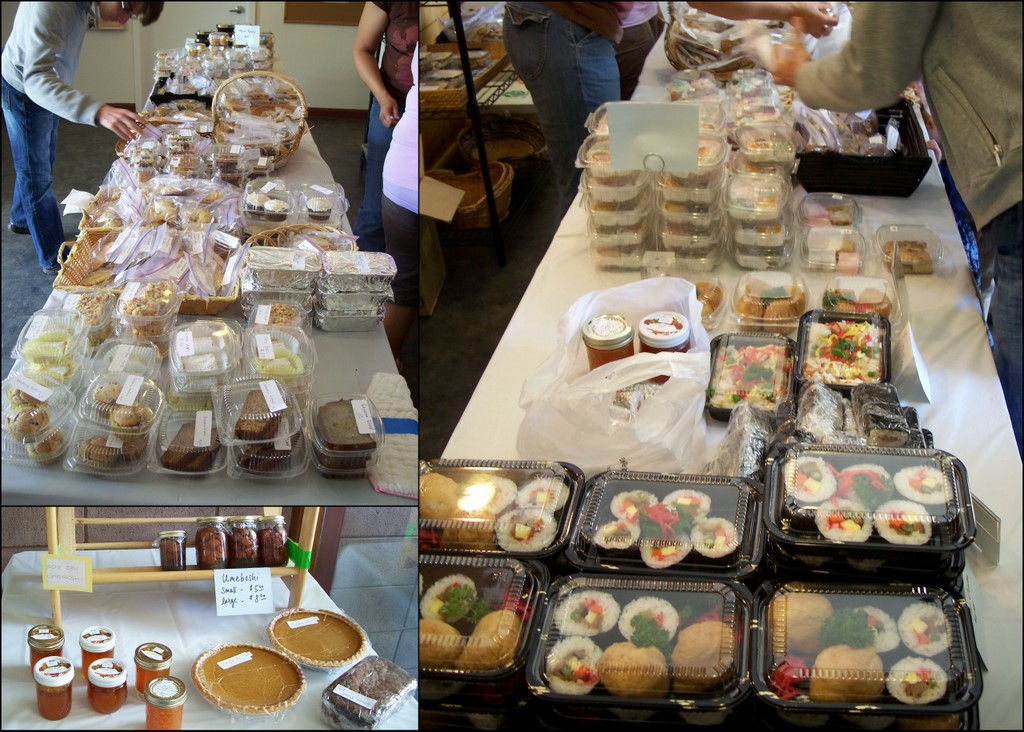
Every few minutes there were tiny old ladies weaving among the crowd with big trays of musubi and sweets from the dining hall to the “bakery”, a front desk covered with homemade edible goods, baked, rolled, fried, pickled, and jarred.


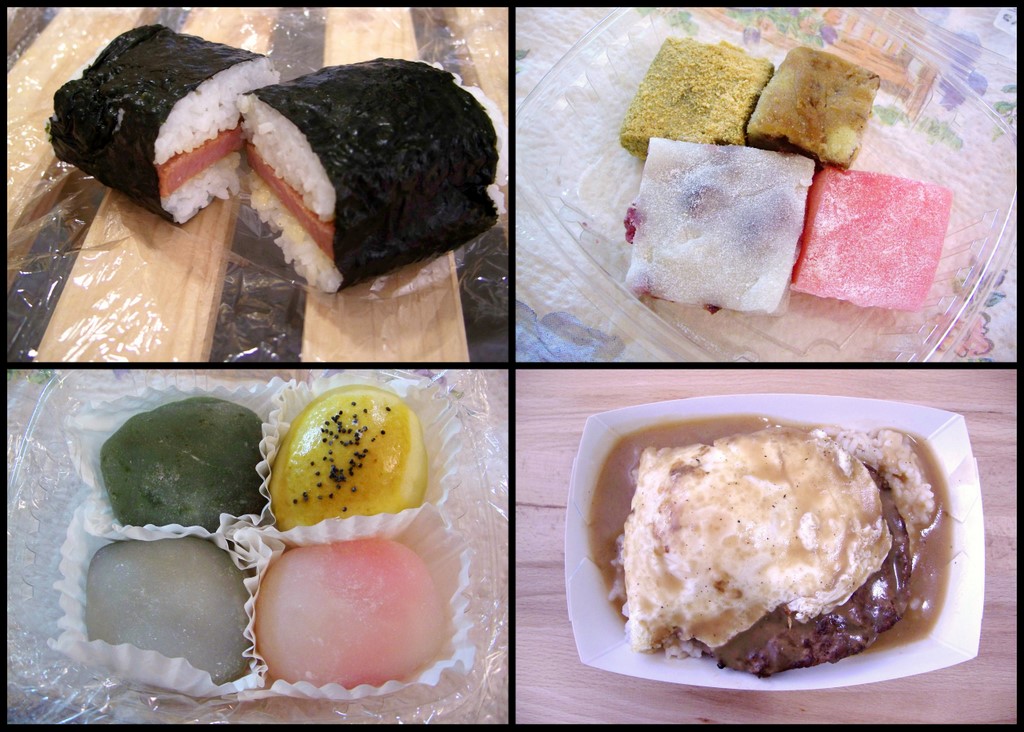
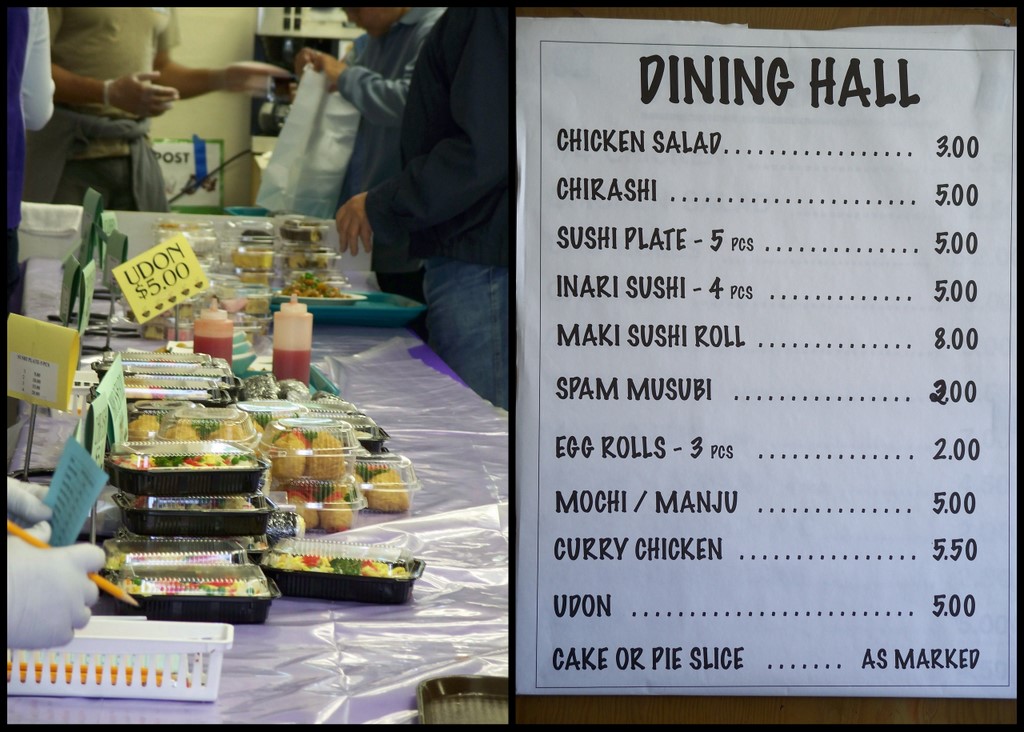
We just couldn’t help it. The umeboshi (pickled plum) was going fast at $5 per small jar and $8 per big one. Mudpie hungrily grabbed onto two jelly jars, kumquat ($4) and persimmon-pineapple-apricot ($5), which have the exact same color. Then we started loading pastries into our bag…


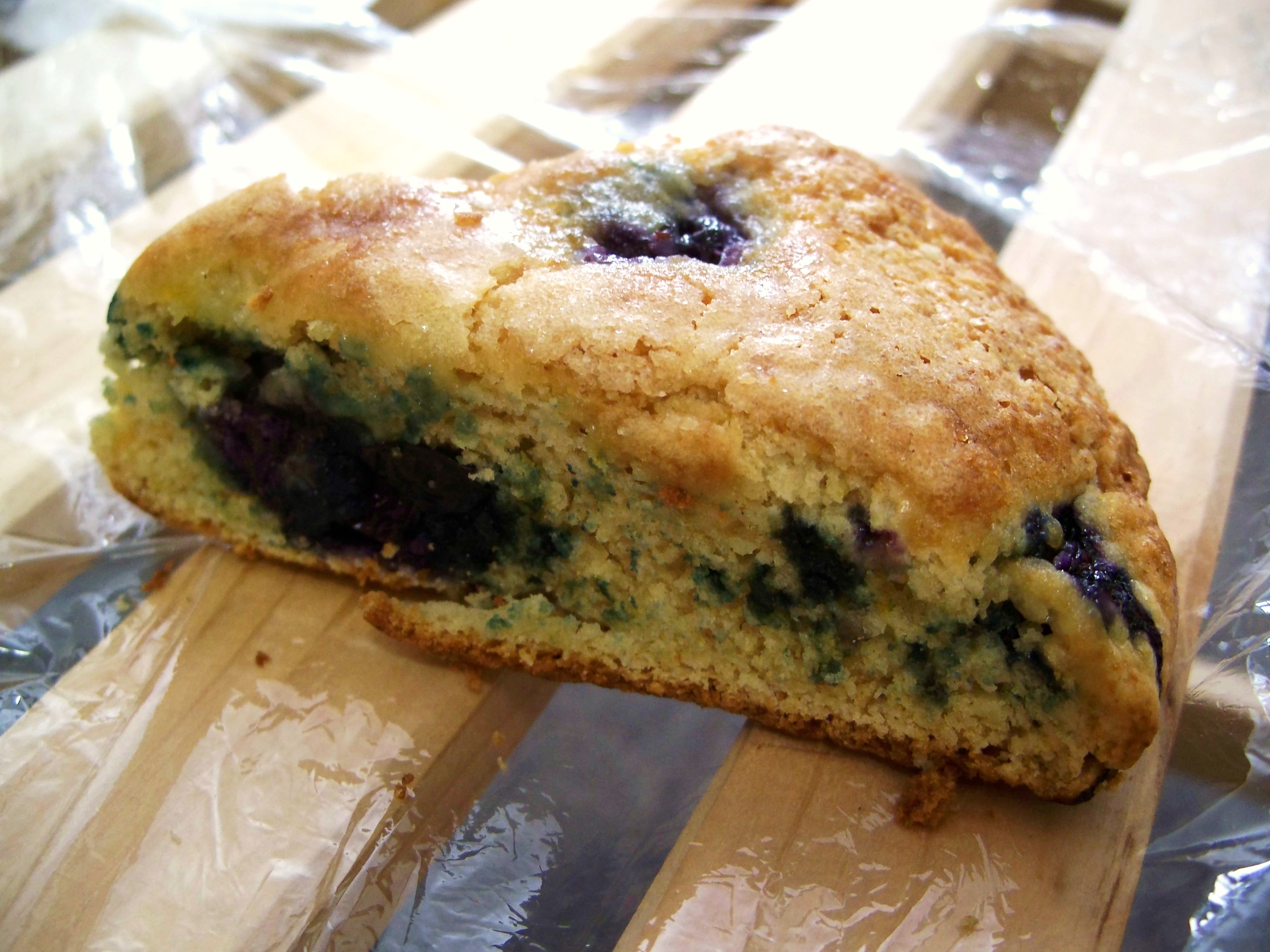
First came the blueberry scone, which tasted like wet sand, but we paid only one buck for it, can’t complain.


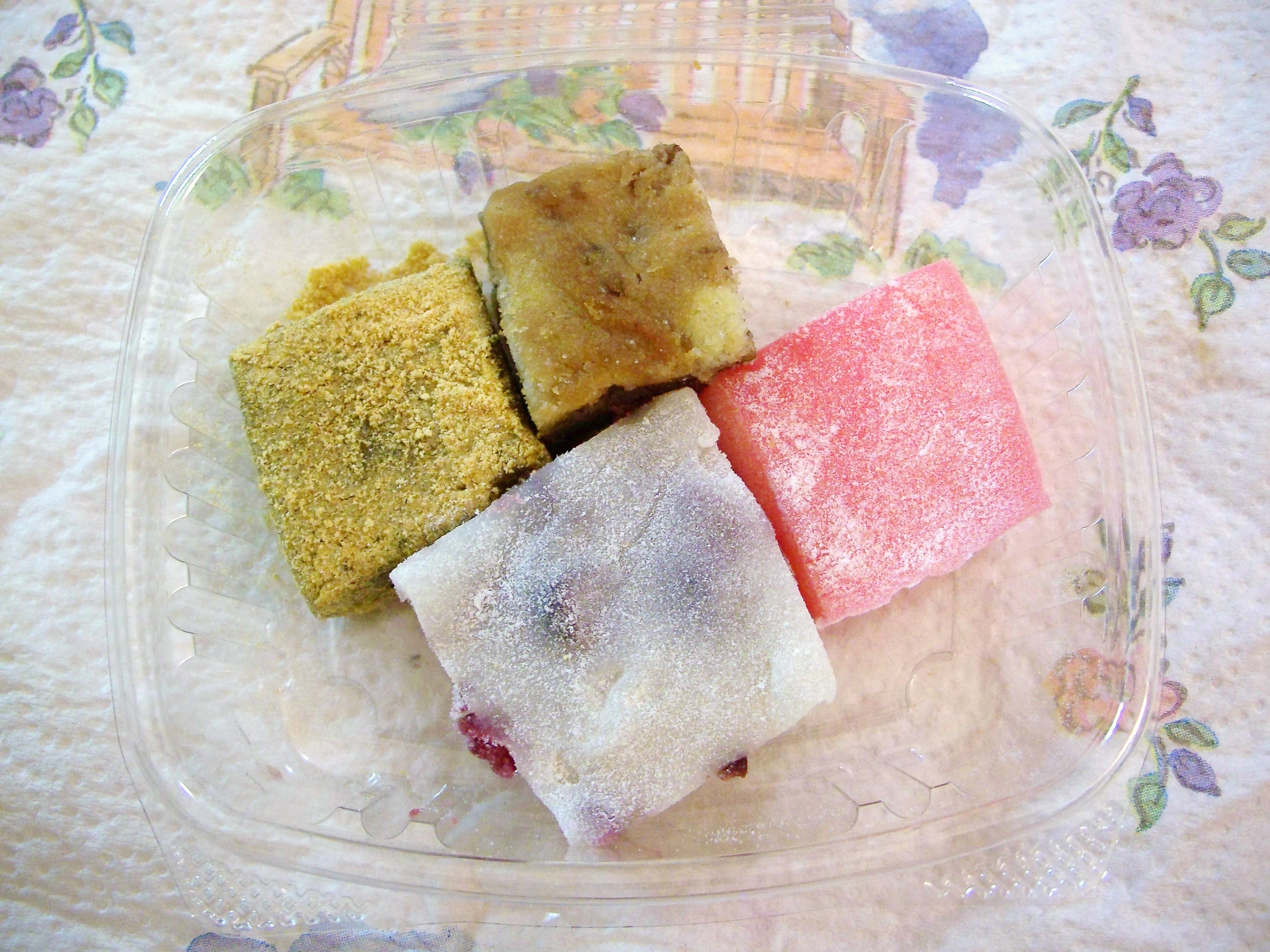
Then there were little squares of mochi (and a lonely piece of brown banana cake). Each square cost a buck too (and they are about 20 times smaller than the scone), but none was as good as the mochi cubes in front of Cafe Hana. Pretty scrumptious lonely piece of brown banana cake though.


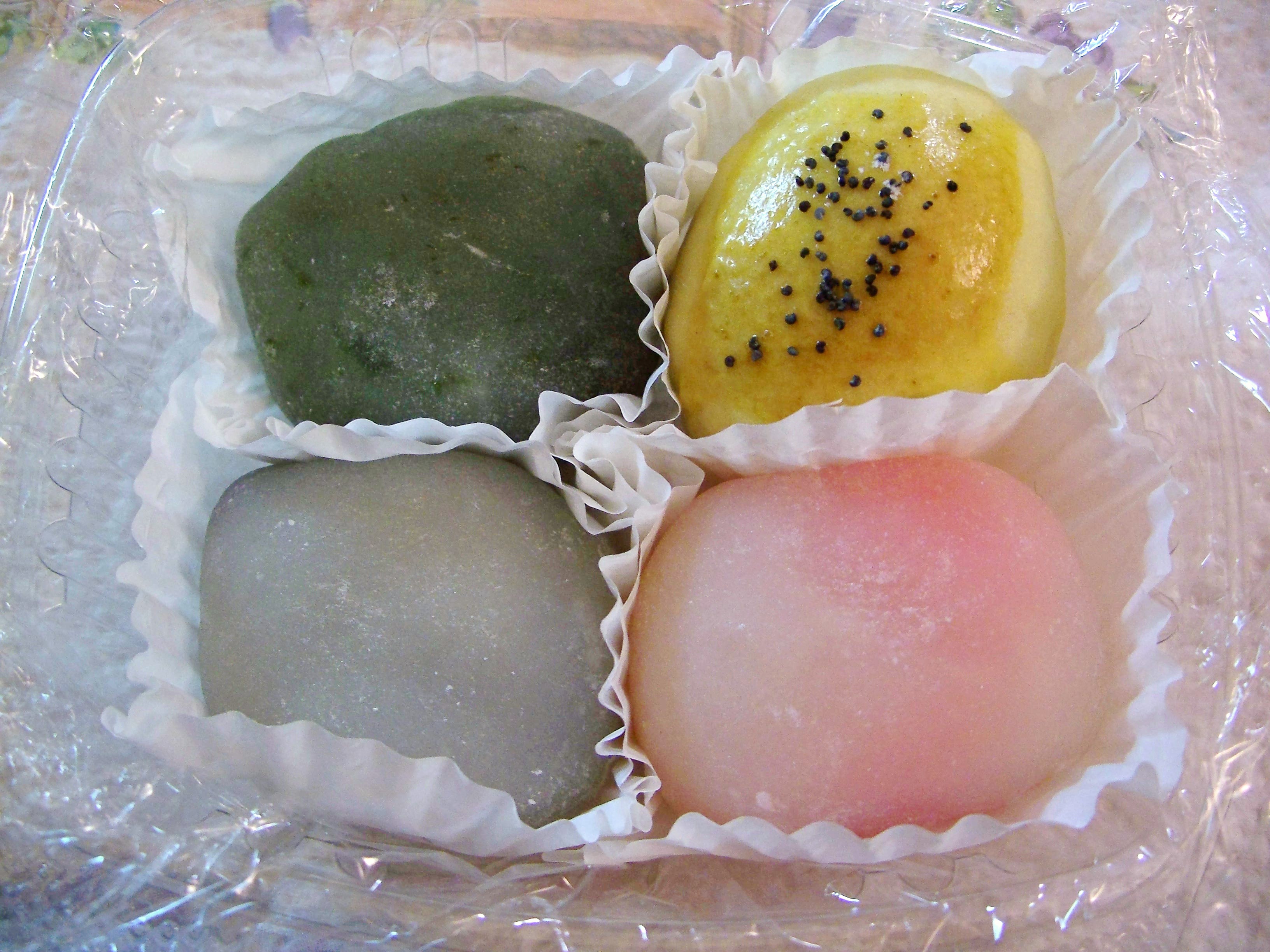
Now these are the real disappointment. The manju, mochi balls with red bean paste, looked so much better than they tasted. Is the yellow egg-shaped pastry dotted with poppy seed and filled with sweetened taro paste also a manju? Guess how much they were. $1.25 each. Sugar excess.


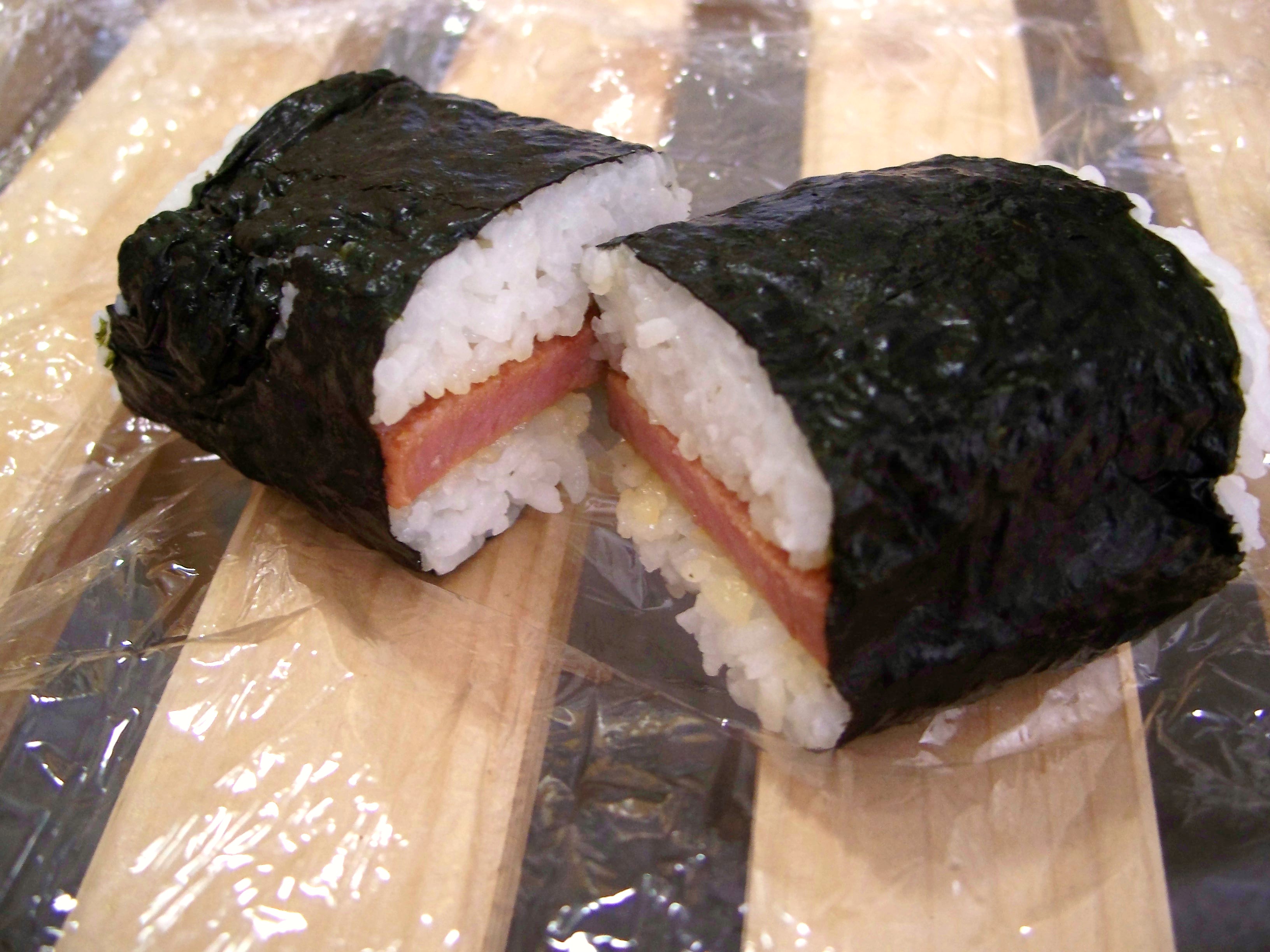
Fortunately the savory side is a greener pasture. The 2-dollar spam musubi hit the spot just right (processed meat always tastes so good after you reprocess it with sugar and soy sauce). The nori was mild, thick, and moist.


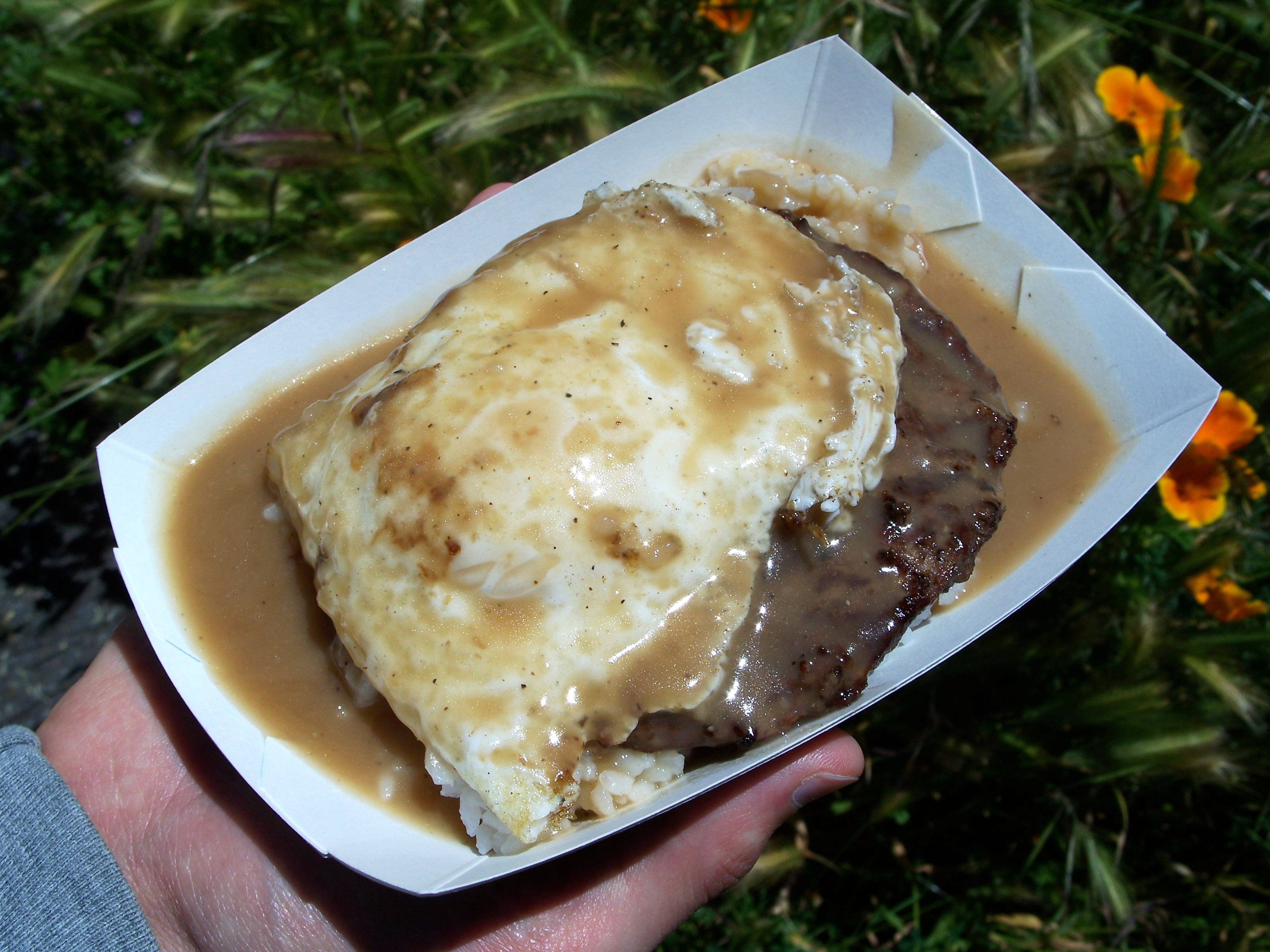
We top things off with a lustrous loco moco, a burger patty squatted on a bed of extremely moist short-grained rice, covered with a runny egg and a ladle of beef gravy. After one spoonful, Mudpie couldn’t stop thinking about it for the rest of the afternoon. The whole thing was like a peppery, creamy, rich butter boat. All for $5, and honestly it would be just as spoon-licking without the grilled meat.


And so I learned something new. At Vietnamese Buddhist pagodas, you can find only vegan food regardless of festive occasions or normal days. Here at a Jodo Shinshu Buddhist temple, there is plenty of meat, crackling and sizzling on one blue-sky Sunday in May.

61st Annual Satsuki Bazaar and Arts Festival, May 22-23, 2009
Berkeley Buddhist Temple
2121 Channing Way
Berkeley, CA 94704
(510) 841-1356

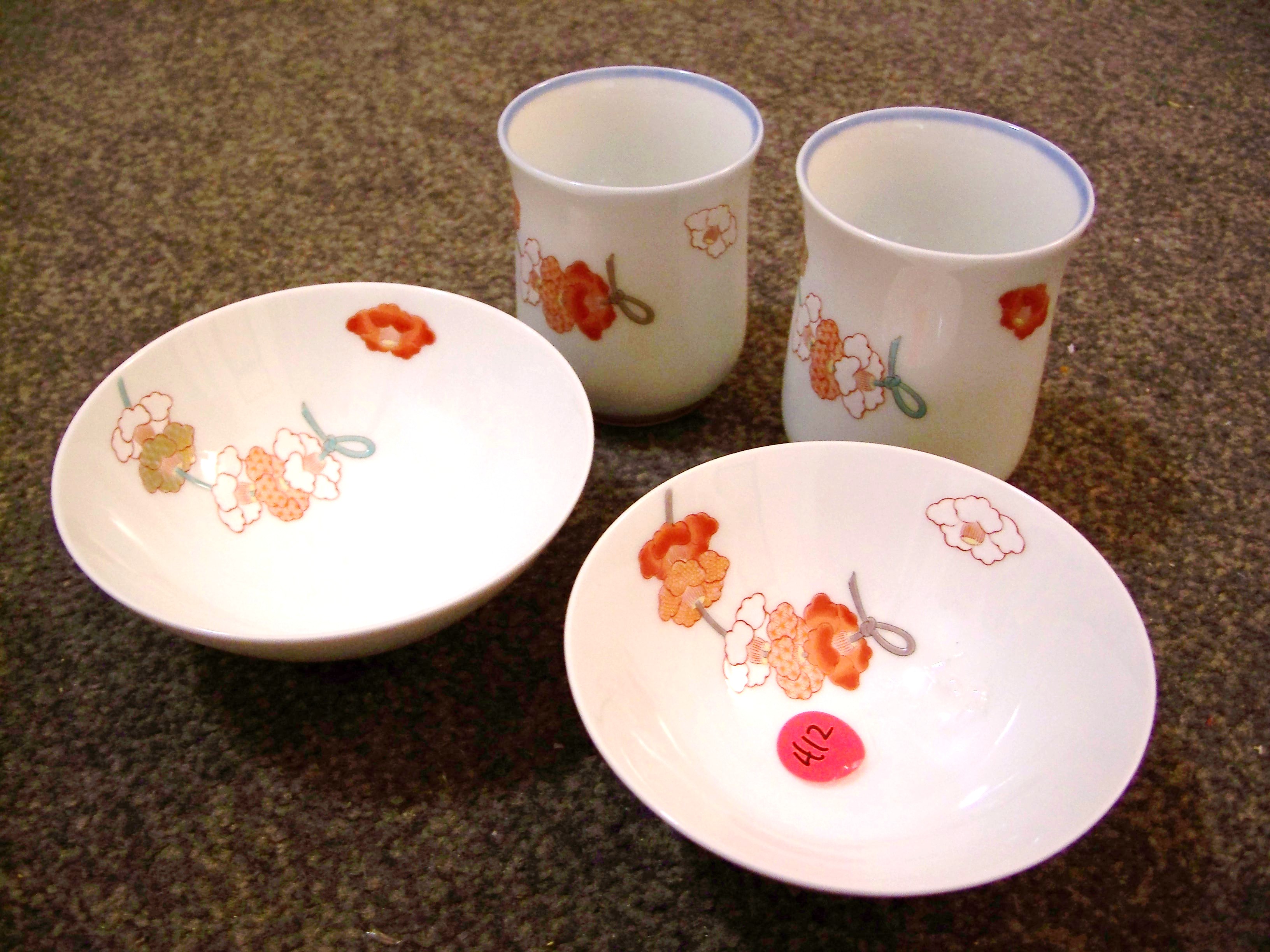
Update: I WON something in the silent auction: an adorable set of tea cups and tea bowls, notice the matching pairs with one tea cup slightly taller than the other. The visit was a success!

When the blossoms bloom

April 15, 2010 By: Mai Truong Category: California - The Bay Area, Festivals, Japanese, Opinions, savory snacks, sticky rice concoctions, sweet snacks and desserts


One Saturday we shove our homework into a corner and make a dash for San Francisco before another spring storm takes over the bay. Parking is as easy as hiking with a twisted ankle, but all that matters is we find a spot, then stroll a mile to the food bazaar on Webster street, Japan Town, arriving just a little bit before noon. Up from the steep sidewalk we see rows of white tents and white chairs, smoke rolling above the grills covered with beef and pork riblets, a line getting long on one side of the conglomeration. It is still early in the first morning of the Cherry Blossom Festival.
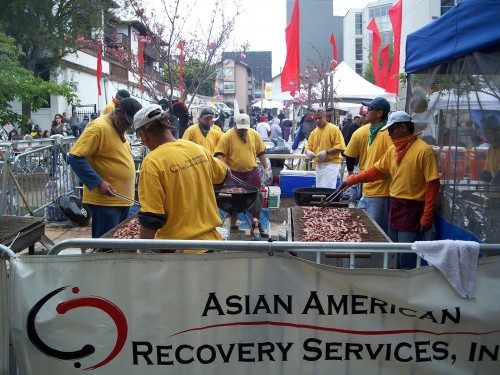

The carnivore instinct leads me right to the grill. It’s never too early to eat meat. The first booth whips out rice bowls with either ribs or unagi, braised eel cut into palm long chunks. We don’t feel like filling up with a rice bowl just yet, so we walk further down the row eying signs, then back track to the Nihonmachi Little Friends’ booth for three skewers of grilled beef at a mere five bucks.
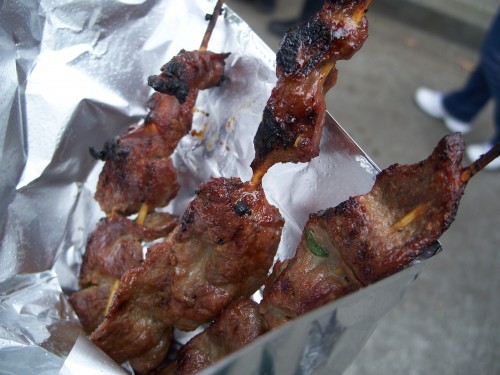

Crispy-charred-edge marinated beef, though erring a little on the chewy side, delight my feet after that hike from our parking spot. The downright old school meatiness would have well enhanced the kiddie dollar snack omusubi, wedges of plain white rice mixed with nori bits, which Mudpie buys way after we finished the skewers. Waste not want not, the musubi will find its place in my lunch this week, after I wrap it up in nori sheets and maybe with a slice of fried spam. My idea sprouts from seeing at least three booths selling spam musubi and dozens of family walking around with golden brown sauce at the corner of their mouths. I, however, fall victim to the facile yakisoba, soft stir fry noodle with crunchy cabbage dressed only with soy sauce and seaweed sprinkles. The noodle tastes flatter than it looks, and certainly flatter than the wad of six dollar bills we pay for it, but it is a good pacifier for the empty stomach.

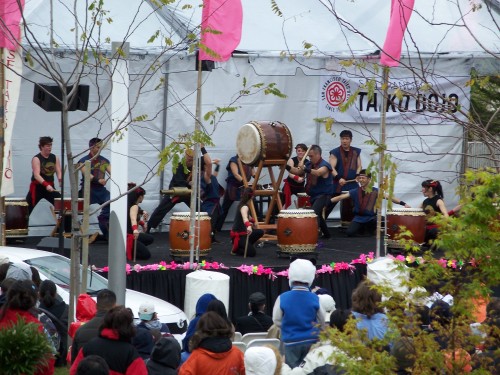
One block east of the food tents, the San Francisco Taiko Dojo artists are pounding their drums on stage. Their vigorous sincerity pumps rhythmic waves of festive air into the onwatchers’ lungs. To the hundreds of Japanese gathering there, I wonder if the drums have the same effect as the firecrackers we set off on Lunar New Year’s Eve, a simple string of sound that brings both excitement and quietude. The drums do halt my hungry thoughts for a moment, until I see some kids weaving about the crowd holding teriyaki burgers and shaved ice.

We’re back to Webster. The teriburger line wraps around one end of the food square, and Mudpie refuses to take one for the team. The fried fish ball line is no better, but I want to find out what the frenzy is all about, whether Mudpie does or not.
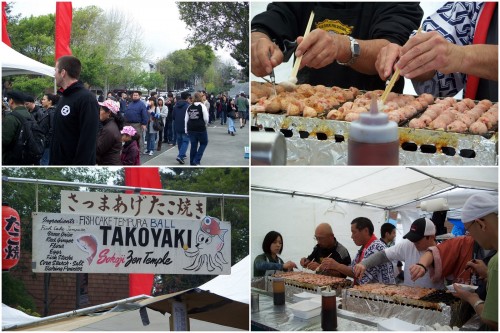
Just as we get in line, a lady asks us if we know the fish balls are any good. We don’t. So during the twenty-five minute wait the lady and Mudpie go over what is up with the LHC in Geneva, current status of the string theory job market, Berkeley Bowl, the beautiful harmony between Eastern religions and sciences, Francis Collins, and which patisserie is the best in San Fran. Meanwhile I can’t take my eyes off her unagi rice bowl, the eel skin shines gloriously in its rich brown sauce. Slowly but solidly we get to the tent where all the pouring, flipping, and toothpicking take place. The cast iron molds are just as busy as the deft hands hovering over them.
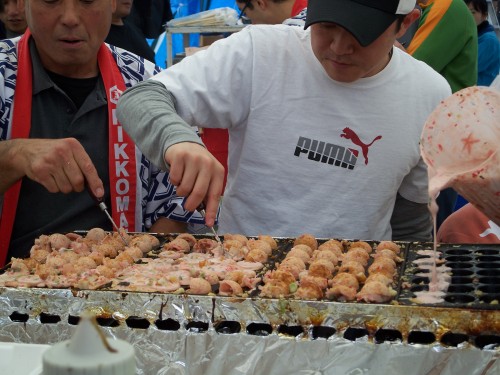
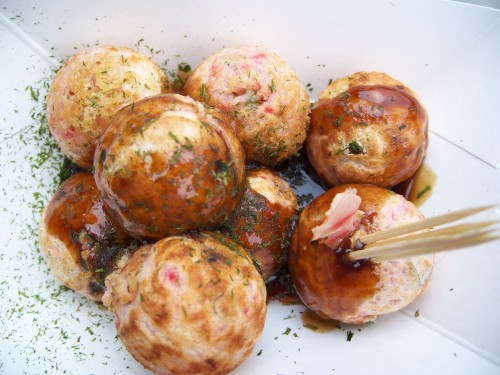
Although the man jokingly says it’s a secret recipe from Japan while he collects orders, this fish ball booth is the only booth with a crystal clear ingredient list on the banner. Although it is called takoyaki (“fried octopus”), it’s a simple ball of batter, fish stock, egg, and seasonings. (Still, it resembles an octopus head, intentionally or not.) Although it looks perfectly solid, it has an air pocket inside, resulting from the flipping of the hemisphere while the batter is still runny. Although it is fried, it is soft. Although the long line suggests that it is amazingly worth the wait, it is not. The seaweed sprinkles, red ginger and green onion do little more than cosmetics, the okonomiyaki sauce is rather too tart. Its goodness lies solely in the warmth to battle those crisp wind blows. In hindsight we probably should have stood in the teriburger line.

As the tongue craves for some sweets, we walk around to the grilled beef and yakisoba side, this time to stand in line for a red bean pancake, imagawa yaki.
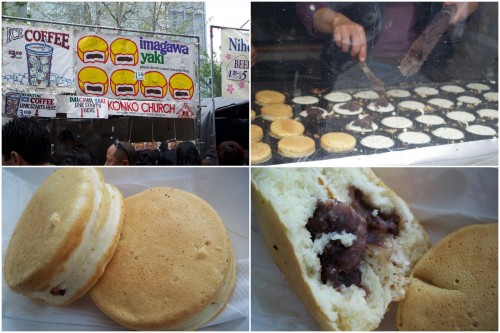
imagawa-yaki (pancake with red bean paste)
The fluffy dough is just like any pancake our mothers make for breakfast on special days. The making process, like those fish balls, is fun to watch. They pour the batter into rows of circular iron molds, wait a few minutes for the batter to semi-solidify, then comes this semi-circular trough, looking  like a cracked-open bone filled with marrow, from which they spoon some red bean paste onto half of the cooking pancakes. The other half are flipped over to make the pancake tops. The batter turns solid, the division between two halves is sealed, three bucks are handed over for exchange of two blowing hot cakes. Mudpie loves the bean stuff. So much that he insists on looking for more inside the Kintetsu mall. I feel more inclined to sitting down, and those benches near the Kinokuniya bookstore and Izumiya have never sounded better. So into the mall we go.

But boy am I a fool. On days like this benches are a luxury, and it’s just rude to fight over a seat with the petite ladies in colorful kimonos and huge wooden zōri, or families with babies. The mall is packed. The human flow is like a school of salmon. My tiny stature serves me well in whizzing through elbows and shoulders, but I would have missed the best catch of the day had Mudpie not spotted the nameless but busy tables in front of Cafe Hana.
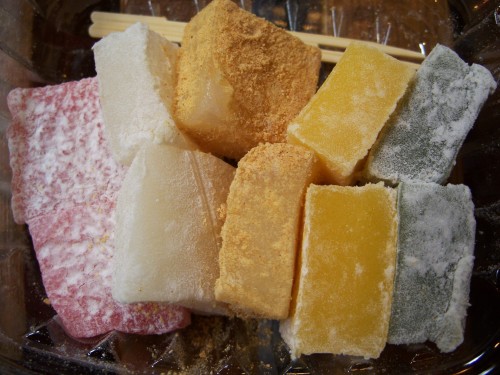

Ten bite sized cubes of cold mochi, five different flavors. From right to left: 1. yomogi (mugwort) – tastes as grassy as its alternate name kusa mochi – “grass mochi”, 2. mango – tastes more like jackfruit or longan, 3. kinako – actually this is warabimochi (jelly-like sweet made of bracken starch instead of sticky rice), covered in soybean flour (kinako) which tastes like peanut butter, 4. lychee – the second tastiest, and 5. strawberry – the tastiest. Chewy, refreshing, gently sweet like a rose petal, I would eat these all day. The best part: it is assembled upon request. The confectionery magistrates, who may be part of Cafe Hana’s team, cut and roll these slabs of sweets in powder and into the plastic boxes, each containing only one flavor. But if you kindly ask, they’ll throw together a mixed box for you at the same price. Top it off with a three dollar scoop of lychee ice cream, as we do, and you’ll feel ten or fifteen years younger. You know, those days of hustling about the school cafeteria, eating cheap treats, feeling fresh and complete. If there’s anything I don’t regret buying at this fair, it’s the lychee ice cream and the mochi at those tables in front of Cafe Hana.

If there’s anything Mudpie doesn’t regret buying at this fair, I think it’s the daifuku, also from those tables in front of Cafe Hana. That red bean addiction is strong.
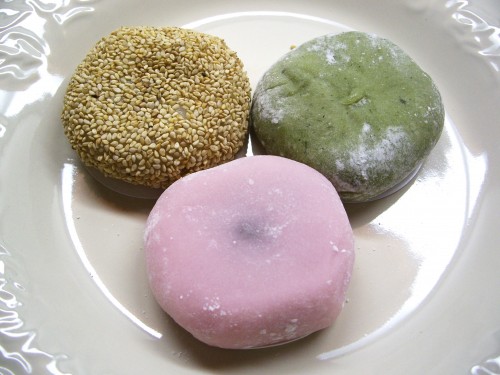

Pink or green, smooth or sesame coated, the daifukus are good companions for chrysanthemum tea. The plain, chewy sticky rice outer layer damps the sweetness of inner red bean paste. The cold confection enhances the warm drink.
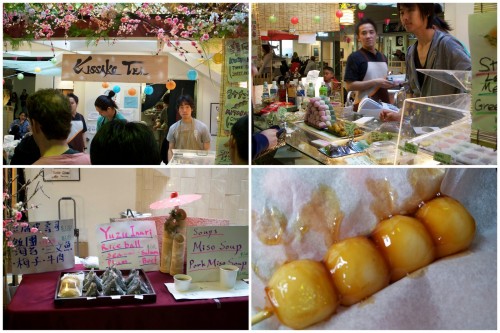
mitarashi dango
On our way out of the mall, we sidestep in line for one last treat at the flowery booth Kissako Tea. They have the little mochi balls in pink, green, and white with red bean paste filling, and they also have the mitarashi dango, which I’ve always been curious about since I read Sugar Bar Diva’s toothsome post. Four simple sticky rice balls on a skewer sounds like a boring snack, but the chewiness dressed in a rich syrup of soy sauce, sugar, and starch is everything but plain. Its taste and texture amazingly resemble malt sugar. It marks a triumphant incorporation of savory condiments into the sweet realm.

At four something in the afternoon, the food bazaar is still going strong. All booths, not just the fish ball and the teriburger, now have a long line. The kids are still with wide open eyes, Hello Kitty headbands, spam musubi and cups of shaved ice. The dogs are still obediently looking at their humans eating beef skewers. The girls in black and white kimonos are still taking pictures between giggles.

And so we march our full tummies a mile back to the parking spot. The sky is blue. The streets are quiet. The wind has ceased its dry cold swirls. The car stands there, with a ticket.

Some crepes are better than others

April 06, 2010 By: Mai Truong Category: California - The Bay Area, Comfort food, French, savory snacks


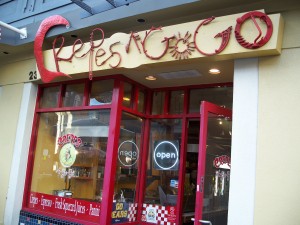
My cravings fluctuate from time to time, and it’s not always rational. One time I bought two kilos of prunes, ate some for a few days, now the rest are sitting patiently in my pantry. Then I used to have a crush on chocolate bars, the result is an almost complete collection of Endangered Species Chocolate wrappers, but a few bars have been on my desk for over six months. As of late, I’ve grown a crepe tooth. A matchbox kitchen fifteen-minute leisure walk from Sather Tower, called Crepes A-Go-Go, is to blame.


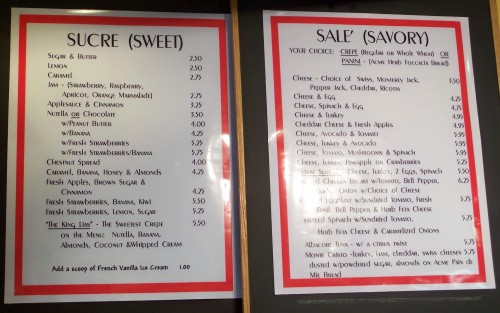
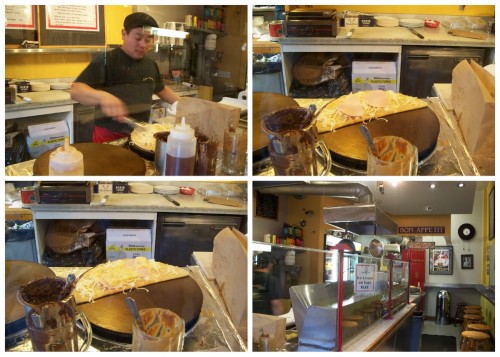
A quick drop of sound sizzles when the spatula folds and presses the fluffy layer. The oversize pancake lies supine. The heat is low. The quiet, stout chef casually sprinkles some Swiss cheese and some pineapple; he seems bored, or maybe I’m just too excited. I like my crepe soft and thick. Heck, I even like my banh xeo soft and thick, no matter how many people tell me that a qualified Vietnamese sizzling crepe should be crispy and paper thin. I watch the cheese melt. The chef lets the doughy pancake rest a minute or two, then deftly folds it again into one sixth of a disc, sweeps and swings it into a clear plastic container. My five-buck-and-a-quarter dinner to go seems sluggish and content like a well-fed baby pig.
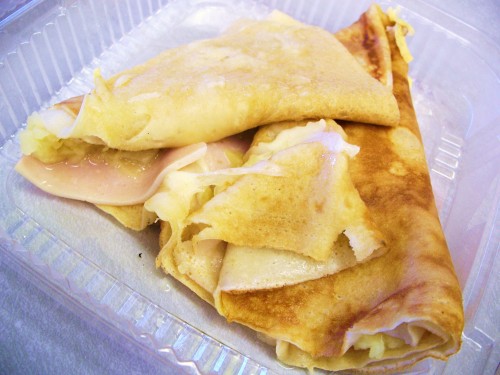
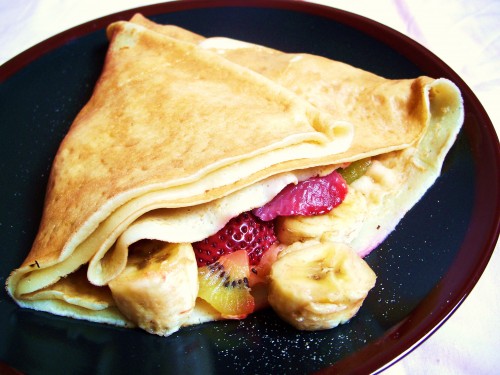

And soon I am one happy hog myself. The cheese-turkey-pineapple crepe is a rich and chewy mess. The first bite is so good I ditch the plastic fork (which doesn’t do much at cutting anyway). Pineapple juice streams out at the tip as I scramble to bite sideway, and when the crepe reduces to a sizable conic chunk I use it to wipe clean the juice. The last mouthful is as rewarding and lingering as it can be, my fingers wet with butter and cheese. But my embarrassing story doesn’t just end here.


I feel full, yet still want more, but I know better than letting the tongue fool the tummy. So I save the luke warm sweet crepe for later. And I forget about it. It sits in my fridge for over a day. The next morning, filled with guilt, I microwave my sweet crepe. Cut-up fruits don’t behave really well with refrigerating and microwaving, the banana turns overripe, the kiwi and the strawberry taste zealously sour. But the crepe still has its fleece-like texture, buttery, thick, and snuggly. The squirt of lemon juice gives a refreshing fragrant. I scrape off the fruit chunks, sink my teeth, and sheepishly smile.

Seven years and counting:
Crepes A-Go-Go near UC Berkeley campus
2334 Telegraph Avenue (between Durant and Bancroft)
Berkeley, CA 94704
(510) 486-2310

Borrowed from the receipt: Bon Appetit, Bon Journee

Exchange rate:
Cheese-turkey-pinapple crepe: $5.25;
Strawberry-banana-kiwi crepe: $5.50

Other tasty creperies in the Bay Area:
Cafe Grillades in San Bruno
Crêpes Café in Menlo Park

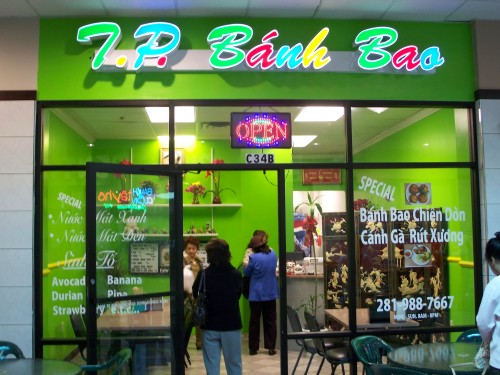
T.P. Banh Bao

March 17, 2010 By: Mai Truong Category: Houston, savory snacks, Texas, Vietnamese


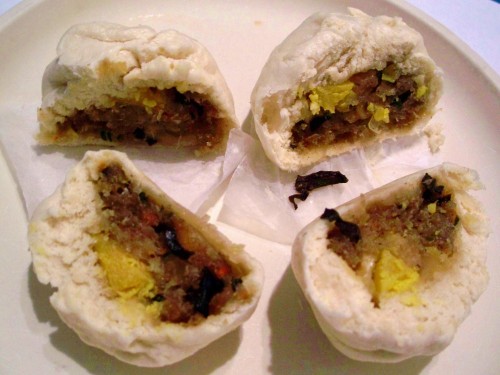
Mini steam buns, as big as a clementine, stuffed with interesting fillings, sold like hotcakes at a mini store inside the Bellaire Hong Kong Mall. Well, they are essentially hot cakes after all.

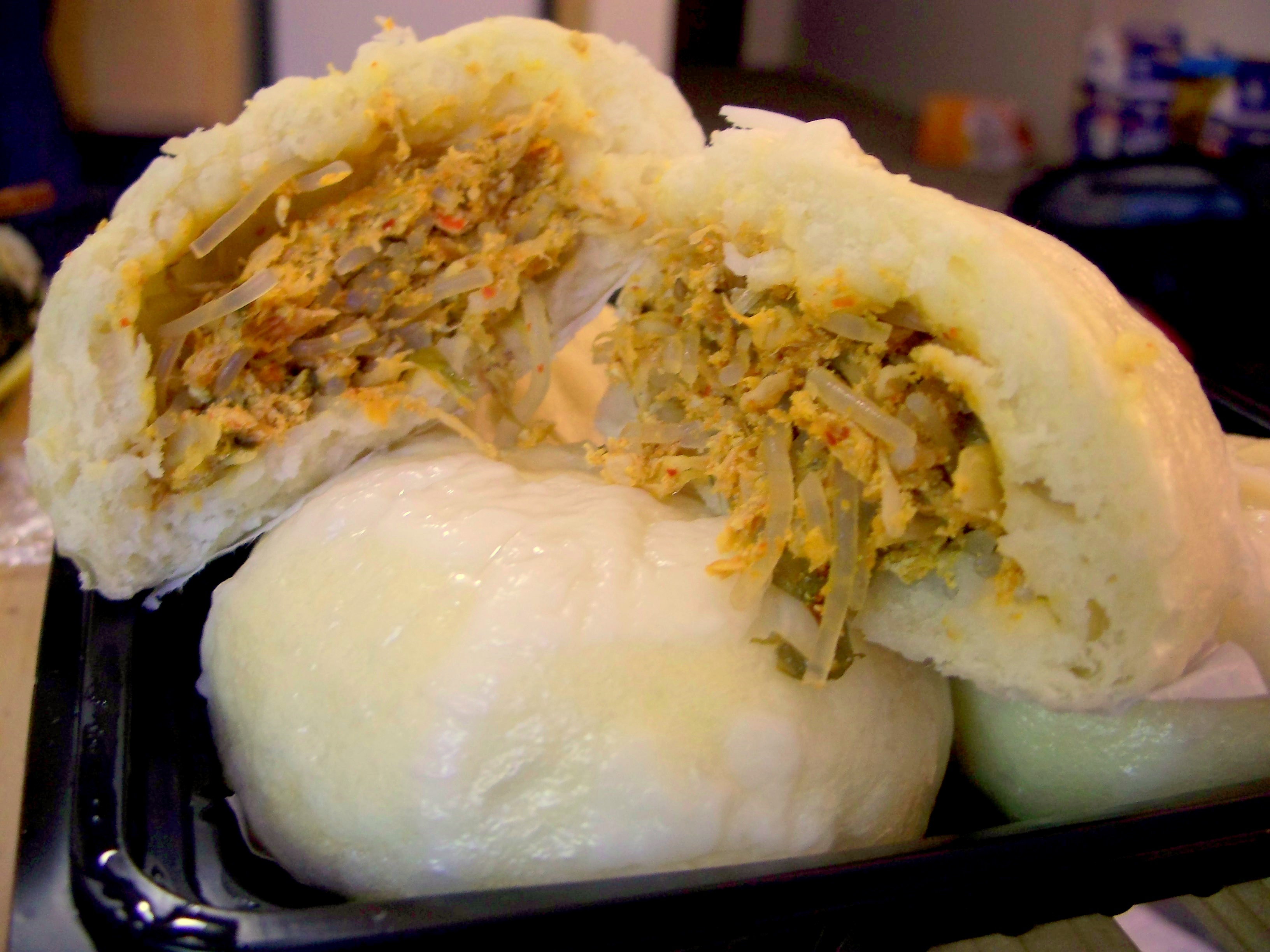
TP Banh Bao have many kinds of banh bao, but most were sold out by midday when we got there. We were lucky enough to get 3 different kinds: seafood (đồ biển), taro and pork (khoai môn thịt), and original, i.e. pork and chinese sausage (thập cẩm). However, we couldn’t tell which was which. They put them in the same box, no marking, the bun skin and the innards looked the same for all three kinds. They also tasted the same. Good, but indistinguishable.


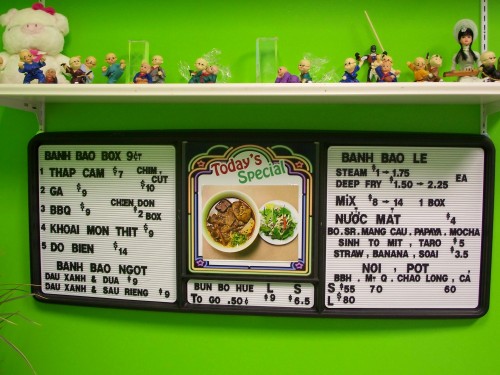
On the door is an exciting advertisement of their specials: deep fried banh bao and deboned chicken wings, but few seem to come here for those. I’d imagine even fewer would come here for bun bo Hue, mi Quang, chao long (offal porridge) and chao ca (fish porridge). It’d be just as funny if McDonald serves spaghetti.


A box of 9 banh bao sets back your bank anywhere between $7 -14. Although a little pricey, these bite-size buns make a reasonable, savory but not so fatty snack, maybe breakfast if you eat three or four.  I’m curious about the sweet kinds, with mung bean paste and either coconut or durian.

Address: T.P. Banh Bao (inside HongKong Mall, near Banh Cuon Tay Ho #18)
11209 Bellaire Blvd
Houston, TX 77072
(281) 988-7667

While you’re in the Hong Kong Mall area, check out the butter-fried soft shell crab at Tay Do restaurant.

Tags: